
DEPARTMENT OF MECHANICAL ENGINEERING
Presentation on
“NON-DESTRUCTIVE TESTING”
BY :- SONAM PALJOR(PES1201702403)
CONTENTS
 Ultrasonic testing
 Magnetic particle testing
 Eddy current testing
 Radiography testing
 Liquid penetrant testing
 Destructive Vs Non-destructive testing
ULTRASONIC TESTING
Types of faults indicated
 Crack
 Porosity
 Inclusions
 Lack of fusion
 Incomplete penetration
Applications
 All types of welded work in metallic
and non-metallic materials.
 Advantages of Ultrasonic testing
 portable
 Safe to use
 Fast method
 High sensitivity
 Indicates depth of flow.
 Results available immediately.
 Disadvantages of Ultrasonic testing
 Require surface contact.
 Surface must be clean and smooth.
 Unsuitable for welding of complex shape.
 Require skill operator
EDDY CURRENT TESTING
 Types of faults indicated
 Crack
 Porosity
 Inclusions
 Applications
 Structural testing
 Coating thickness measurement.
 Sheet resistance measurement.
 Identification of metal.
 Advantages of Eddy current testing
 Portable
 Can be automated
 Sensitivity to surface defects.
 Can detect through several layer.
 Can detect through surface coating.
 Accurate conducting measurement.
 Disadvantages of Ultrasonic testing
 No permanent record.(unless automated)
 Signal interpretation required.
 Will not detect defects parallel to surface.
 Not suitable for large area and complex geometries.
RADIOGRAPHY TESTING
 Types of faults indicated
 Cracks
 Porosity
 Inclusions
 Lack of fusion
 Incomplete penetration
 Applications
 Aerospace industries
 Military defence
 Automotive industries
 Manufacturing industries
 Advantages of radiography testing
 Disadvantages of radiography testing
 Good portability
 High sensitivity
 No part preparation is required.
 Permanent test record is obtained.
 Technique standardized
 Radiation hazard
 Highly directional
 Power source needed.
 Required skill operator.
 The process is generally slow.
 Equipment is an expensive.
LIQUID PENETRANT TESTING
 Types of faults indicated
 Cracks
 Porosity
 Inclusions
 Applications
 All welds in ferrous and non-ferrous material
and non-metallic material.
 Advantages of liquid penetrant testing
 Disadvantages of liquid penetrant testing
 Highly portable
 Simple method
 Relatively inexpensive
 Can be used on variety of materials
 Fairly sensitive to fine, tight discontinuities
 Rust or paint will mark defects.
 Detects surface discontinuities only.
 Test surface must be clean and dry.
 Only surface defect will be detected.
 There is no easy method to produce penetrant record.
MAGNETIC PARTICLE TESTING
 Types of faults indicated
 Cracks
 Porosity
 Inclusions
 Discontinuities surface
 Applications
 Welds, particularly fillet welds
 All ferro magnetic material
 Advantages of magnetic particle testing
 Disadvantages of magnetic particle testing
 Highly portable
 Immediate result
 Generally inexpensive
 Fast and relatively simple.
 Will work through thin coating.
 Difficult to find wide crack.
 Material must be ferromagnetic.
 Demagnetization may be needed.
 Large current sometimes required.
 Orientation and strength of magnetic field is critical.
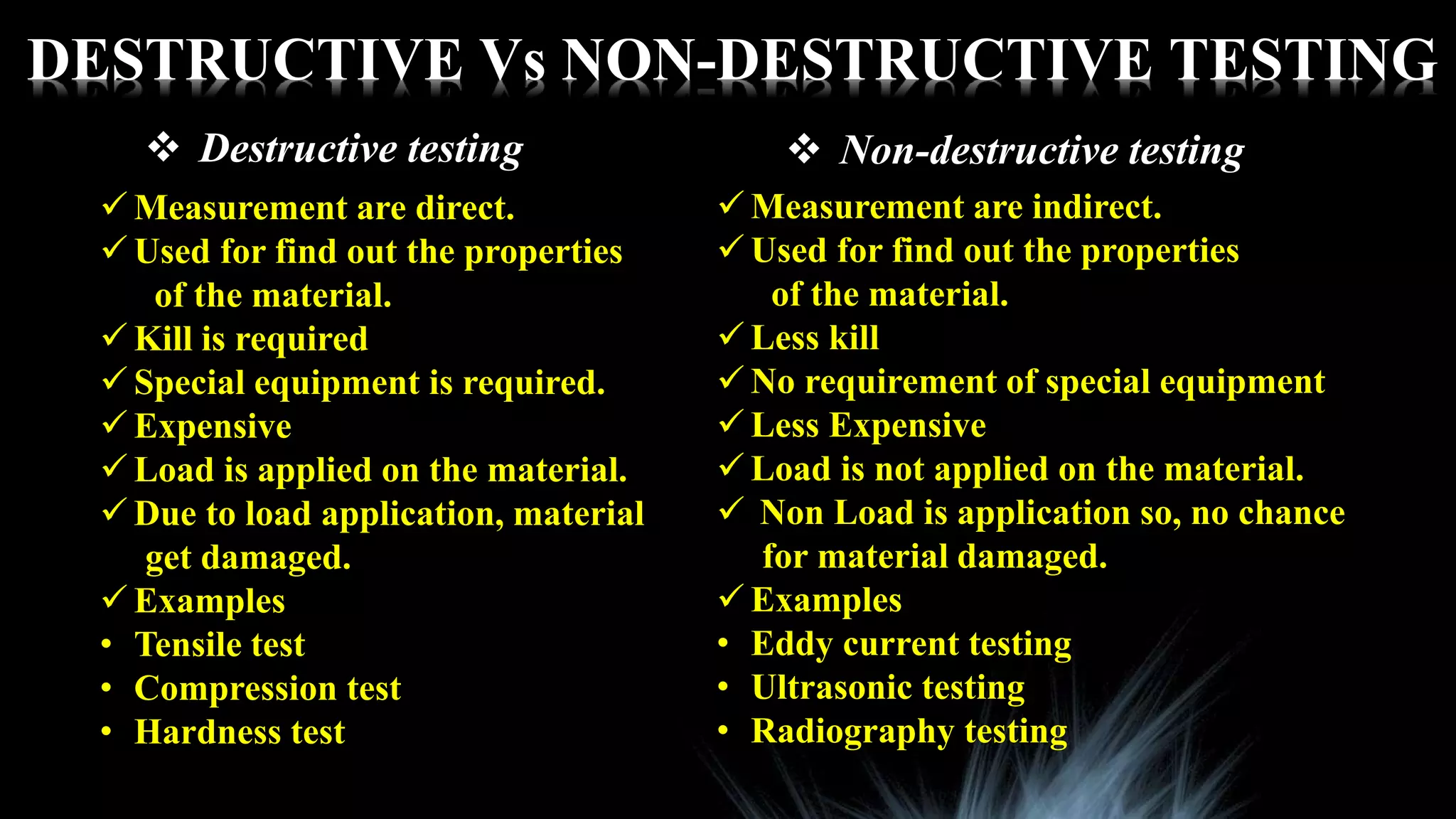
DESTRUCTIVE Vs NON-DESTRUCTIVE TESTING
 Destructive testing  Non-destructive testing
 Measurement are direct.
 Used for find out the properties
of the material.
 Kill is required
 Special equipment is required.
 Expensive
 Load is applied on the material.
 Due to load application, material
get damaged.
 Examples
• Tensile test
• Compression test
• Hardness test
 Measurement are indirect.
 Used for find out the properties
of the material.
 Less kill
 No requirement of special equipment
 Less Expensive
 Load is not applied on the material.
 Non Load is application so, no chance
for material damaged.
 Examples
• Eddy current testing
• Ultrasonic testing
• Radiography testing
THANK YOU . . . !

Non-destructive testing

  • 1.
    DEPARTMENT OF MECHANICALENGINEERING Presentation on “NON-DESTRUCTIVE TESTING” BY :- SONAM PALJOR(PES1201702403)
  • 2.
    CONTENTS  Ultrasonic testing Magnetic particle testing  Eddy current testing  Radiography testing  Liquid penetrant testing  Destructive Vs Non-destructive testing
  • 3.
    ULTRASONIC TESTING Types offaults indicated  Crack  Porosity  Inclusions  Lack of fusion  Incomplete penetration Applications  All types of welded work in metallic and non-metallic materials.
  • 4.
     Advantages ofUltrasonic testing  portable  Safe to use  Fast method  High sensitivity  Indicates depth of flow.  Results available immediately.  Disadvantages of Ultrasonic testing  Require surface contact.  Surface must be clean and smooth.  Unsuitable for welding of complex shape.  Require skill operator
  • 5.
    EDDY CURRENT TESTING Types of faults indicated  Crack  Porosity  Inclusions  Applications  Structural testing  Coating thickness measurement.  Sheet resistance measurement.  Identification of metal.
  • 6.
     Advantages ofEddy current testing  Portable  Can be automated  Sensitivity to surface defects.  Can detect through several layer.  Can detect through surface coating.  Accurate conducting measurement.  Disadvantages of Ultrasonic testing  No permanent record.(unless automated)  Signal interpretation required.  Will not detect defects parallel to surface.  Not suitable for large area and complex geometries.
  • 7.
    RADIOGRAPHY TESTING  Typesof faults indicated  Cracks  Porosity  Inclusions  Lack of fusion  Incomplete penetration  Applications  Aerospace industries  Military defence  Automotive industries  Manufacturing industries
  • 8.
     Advantages ofradiography testing  Disadvantages of radiography testing  Good portability  High sensitivity  No part preparation is required.  Permanent test record is obtained.  Technique standardized  Radiation hazard  Highly directional  Power source needed.  Required skill operator.  The process is generally slow.  Equipment is an expensive.
  • 9.
    LIQUID PENETRANT TESTING Types of faults indicated  Cracks  Porosity  Inclusions  Applications  All welds in ferrous and non-ferrous material and non-metallic material.
  • 10.
     Advantages ofliquid penetrant testing  Disadvantages of liquid penetrant testing  Highly portable  Simple method  Relatively inexpensive  Can be used on variety of materials  Fairly sensitive to fine, tight discontinuities  Rust or paint will mark defects.  Detects surface discontinuities only.  Test surface must be clean and dry.  Only surface defect will be detected.  There is no easy method to produce penetrant record.
  • 11.
    MAGNETIC PARTICLE TESTING Types of faults indicated  Cracks  Porosity  Inclusions  Discontinuities surface  Applications  Welds, particularly fillet welds  All ferro magnetic material
  • 12.
     Advantages ofmagnetic particle testing  Disadvantages of magnetic particle testing  Highly portable  Immediate result  Generally inexpensive  Fast and relatively simple.  Will work through thin coating.  Difficult to find wide crack.  Material must be ferromagnetic.  Demagnetization may be needed.  Large current sometimes required.  Orientation and strength of magnetic field is critical.
  • 13.
    DESTRUCTIVE Vs NON-DESTRUCTIVETESTING  Destructive testing  Non-destructive testing  Measurement are direct.  Used for find out the properties of the material.  Kill is required  Special equipment is required.  Expensive  Load is applied on the material.  Due to load application, material get damaged.  Examples • Tensile test • Compression test • Hardness test  Measurement are indirect.  Used for find out the properties of the material.  Less kill  No requirement of special equipment  Less Expensive  Load is not applied on the material.  Non Load is application so, no chance for material damaged.  Examples • Eddy current testing • Ultrasonic testing • Radiography testing
  • 14.