TRANSGENIC AND
GENOME ANALYSIS
Name: Patel Dhwani J
ID NO: 18BPH044
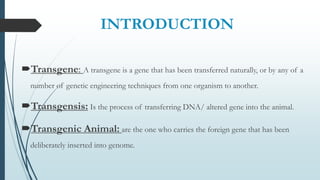
INTRODUCTION
Transgene: A transgene is a gene that has been transferred naturally, or by any of a
number of genetic engineering techniques from one organism to another.
Transgensis: Is the process of transferring DNA/ altered gene into the animal.
Transgenic Animal: are the one who carries the foreign gene that has been
deliberately inserted into genome.
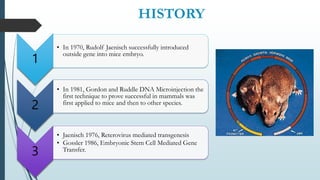
HISTORY
1
• In 1970, Rudolf Jaenisch successfully introduced
outside gene into mice embryo.
2
• In 1981, Gordon and Ruddle DNA Microinjection the
first technique to prove successful in mammals was
first applied to mice and then to other species.
3
• Jaenisch 1976, Reterovirus mediated transgenesis
• Gossler 1986, Embryonic Stem Cell Mediated Gene
Transfer.
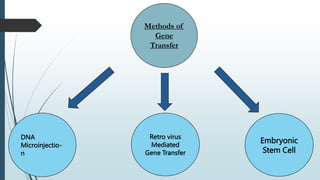
Methods of
Gene
Transfer
DNA
Microinjectio-
n
Retro virus
Mediated
Gene Transfer
Embryonic
Stem Cell
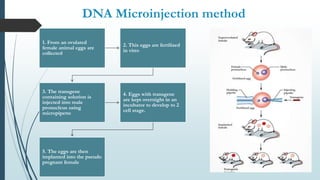
DNA Microinjection method
1. From an ovulated
female animal eggs are
collected
2. This eggs are fertilized
in vitro
3. The transgene
containing solution is
injected into male
pronucleus using
micropipette
4. Eggs with transgene
are kept overnight in an
incubator to develop to 2
cell stage.
5. The eggs are then
implanted into the pseudo
pregnant female
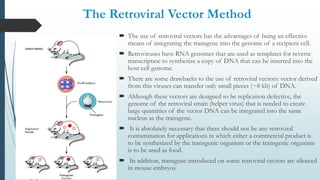
The Retroviral Vector Method
 The use of retroviral vectors has the advantages of being an effective
means of integrating the transgene into the genome of a recipient cell.
 Retroviruses have RNA genomes that are used as templates for reverse
transcriptase to synthesize a copy of DNA that can be inserted into the
host cell genome.
 There are some drawbacks to the use of retroviral vectors: vector derived
from this viruses can transfer only small pieces (~8 kb) of DNA.
 Although these vectors are designed to be replication defective, the
genome of the retroviral strain (helper virus) that is needed to create
large quantities of the vector DNA can be integrated into the same
nucleus as the transgene.
 It is absolutely necessary that there should not be any retroviral
contamination for applications in which either a commercial product is
to be synthesized by the transgenic organism or the transgenic organism
is to be used as food.
 In addition, transgene introduced on some retroviral vectors are silenced
in mouse embryos.
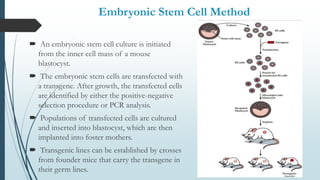
Embryonic Stem Cell Method
 An embryonic stem cell culture is initiated
from the inner cell mass of a mouse
blastocyst.
 The embryonic stem cells are transfected with
a transgene. After growth, the transfected cells
are identified by either the positive-negative
selection procedure or PCR analysis.
 Populations of transfected cells are cultured
and inserted into blastocyst, which are then
implanted into foster mothers.
 Transgenic lines can be established by crosses
from founder mice that carry the transgene in
their germ lines.
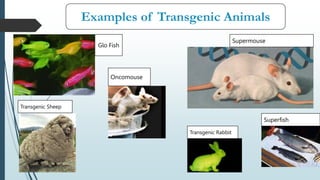
Examples of Transgenic Animals
Glo Fish
Oncomouse
Supermouse
Superfish
Transgenic Sheep
Transgenic Rabbit
Pros and Cons of Transgenesis
ADVANTAGES
 Improve the disease resistance
 Improve the food conversion
rate
 Improved nutritional value
 Improved wool quality and
increased quantity.
 Increased muscle mass and
growth rate.
DISADVANTAGES
 Low survival rate of transgenic
animal
 Breeding problem
 Inserted gene has multiple
functions
 Sometime leads to mutagenesis
and functional disorder.
 Requires high cost laboratory
facilities and highly skilled
personnel.
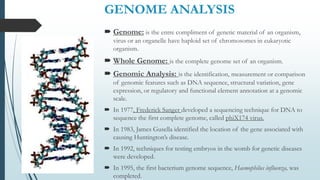
GENOME ANALYSIS
 Genome: is the entre compliment of genetic material of an organism,
virus or an organelle have haploid set of chromosomes in eukaryotic
organism.
 Whole Genome: is the complete genome set of an organism.
 Genomic Analysis: is the identification, measurement or comparison
of genomic features such as DNA sequence, structural variation, gene
expression, or regulatory and functional element annotation at a genomic
scale.
 In 1977, Frederick Sanger developed a sequencing technique for DNA to
sequence the first complete genome, called phiX174 virus.
 In 1983, James Gusella identified the location of the gene associated with
causing Huntington’s disease.
 In 1992, techniques for testing embryos in the womb for genetic diseases
were developed.
 In 1995, the first bacterium genome sequence, Haemophilus influenza, was
completed.
How does whole genome
sequencing works?
 Genomics uses a combination of recombinant DNA, DNA sequencing methods, and
bioinformatics to sequence, assemble, and analyse the structure and function of genomes.
 whole genome sequencing can be done by following four main steps:
 DNA shearing: It begin by using molecular scissors to cut the DNA, which is composed of
millions of bases: A’s, C’s, T’s and G’s, into pieces that are small enough for the sequencing machine
to read.
 DNA bar-coding: add small pieces of DNA tags, or bar codes, to identify which piece of sheared
DNA belongs to which bacteria.
 Whole genome sequencing: The bar-coded DNA from multiple bacteria are combined and put in
the whole genome sequencer. The sequencer identifies the A’s, C’s, T’s, and G’s, or bases, that make
up each bacterial sequence. The sequencer uses the bar code to keep track of which bases belong to
which bacteria.
 Data analysis: computer analysis tools are used to compare bacterial sequences and identify
differences.
Application
 The most commonly-known application of genomics
is to understand and find cures for diseases.
 Predicting the risk of disease involves screening currently-
healthy individuals by genome analysis at the individual
level.
 Gene discovery and diagnosis of rare monogenic
disorders.
 Identification and diagnosis of genetic factors
contributing to common disease.
 Prenatal diagnosis and testing Genetic diseases are often
devastating and may cause significant disability and even
death in childhood.
THANK YOU

18BPH044- TRANSGENIC AND GENOMIC ANALYSIS.pptx

  • 1.
    TRANSGENIC AND GENOME ANALYSIS Name:Patel Dhwani J ID NO: 18BPH044
  • 2.
    INTRODUCTION Transgene: A transgeneis a gene that has been transferred naturally, or by any of a number of genetic engineering techniques from one organism to another. Transgensis: Is the process of transferring DNA/ altered gene into the animal. Transgenic Animal: are the one who carries the foreign gene that has been deliberately inserted into genome.
  • 3.
    HISTORY 1 • In 1970,Rudolf Jaenisch successfully introduced outside gene into mice embryo. 2 • In 1981, Gordon and Ruddle DNA Microinjection the first technique to prove successful in mammals was first applied to mice and then to other species. 3 • Jaenisch 1976, Reterovirus mediated transgenesis • Gossler 1986, Embryonic Stem Cell Mediated Gene Transfer.
  • 4.
  • 5.
    DNA Microinjection method 1.From an ovulated female animal eggs are collected 2. This eggs are fertilized in vitro 3. The transgene containing solution is injected into male pronucleus using micropipette 4. Eggs with transgene are kept overnight in an incubator to develop to 2 cell stage. 5. The eggs are then implanted into the pseudo pregnant female
  • 6.
    The Retroviral VectorMethod  The use of retroviral vectors has the advantages of being an effective means of integrating the transgene into the genome of a recipient cell.  Retroviruses have RNA genomes that are used as templates for reverse transcriptase to synthesize a copy of DNA that can be inserted into the host cell genome.  There are some drawbacks to the use of retroviral vectors: vector derived from this viruses can transfer only small pieces (~8 kb) of DNA.  Although these vectors are designed to be replication defective, the genome of the retroviral strain (helper virus) that is needed to create large quantities of the vector DNA can be integrated into the same nucleus as the transgene.  It is absolutely necessary that there should not be any retroviral contamination for applications in which either a commercial product is to be synthesized by the transgenic organism or the transgenic organism is to be used as food.  In addition, transgene introduced on some retroviral vectors are silenced in mouse embryos.
  • 7.
    Embryonic Stem CellMethod  An embryonic stem cell culture is initiated from the inner cell mass of a mouse blastocyst.  The embryonic stem cells are transfected with a transgene. After growth, the transfected cells are identified by either the positive-negative selection procedure or PCR analysis.  Populations of transfected cells are cultured and inserted into blastocyst, which are then implanted into foster mothers.  Transgenic lines can be established by crosses from founder mice that carry the transgene in their germ lines.
  • 8.
    Examples of TransgenicAnimals Glo Fish Oncomouse Supermouse Superfish Transgenic Sheep Transgenic Rabbit
  • 9.
    Pros and Consof Transgenesis ADVANTAGES  Improve the disease resistance  Improve the food conversion rate  Improved nutritional value  Improved wool quality and increased quantity.  Increased muscle mass and growth rate. DISADVANTAGES  Low survival rate of transgenic animal  Breeding problem  Inserted gene has multiple functions  Sometime leads to mutagenesis and functional disorder.  Requires high cost laboratory facilities and highly skilled personnel.
  • 10.
    GENOME ANALYSIS  Genome:is the entre compliment of genetic material of an organism, virus or an organelle have haploid set of chromosomes in eukaryotic organism.  Whole Genome: is the complete genome set of an organism.  Genomic Analysis: is the identification, measurement or comparison of genomic features such as DNA sequence, structural variation, gene expression, or regulatory and functional element annotation at a genomic scale.  In 1977, Frederick Sanger developed a sequencing technique for DNA to sequence the first complete genome, called phiX174 virus.  In 1983, James Gusella identified the location of the gene associated with causing Huntington’s disease.  In 1992, techniques for testing embryos in the womb for genetic diseases were developed.  In 1995, the first bacterium genome sequence, Haemophilus influenza, was completed.
  • 11.
    How does wholegenome sequencing works?  Genomics uses a combination of recombinant DNA, DNA sequencing methods, and bioinformatics to sequence, assemble, and analyse the structure and function of genomes.  whole genome sequencing can be done by following four main steps:  DNA shearing: It begin by using molecular scissors to cut the DNA, which is composed of millions of bases: A’s, C’s, T’s and G’s, into pieces that are small enough for the sequencing machine to read.  DNA bar-coding: add small pieces of DNA tags, or bar codes, to identify which piece of sheared DNA belongs to which bacteria.  Whole genome sequencing: The bar-coded DNA from multiple bacteria are combined and put in the whole genome sequencer. The sequencer identifies the A’s, C’s, T’s, and G’s, or bases, that make up each bacterial sequence. The sequencer uses the bar code to keep track of which bases belong to which bacteria.  Data analysis: computer analysis tools are used to compare bacterial sequences and identify differences.
  • 12.
    Application  The mostcommonly-known application of genomics is to understand and find cures for diseases.  Predicting the risk of disease involves screening currently- healthy individuals by genome analysis at the individual level.  Gene discovery and diagnosis of rare monogenic disorders.  Identification and diagnosis of genetic factors contributing to common disease.  Prenatal diagnosis and testing Genetic diseases are often devastating and may cause significant disability and even death in childhood.
  • 13.