Dr Vikas M. Raval
Objectives:
o Introduce types of non-verbal communication
o Show the importance of non-verbal communication
in presentation
 Non-verbal communication makes no use of
the words, sentences, grammar and other
structures that we associate with spoken and
written language.
 Non-verbal communication includes facial
expressions, eye contact, tone of voice, body
posture and motions, and positioning within
groups.
 Verbal communication is organized by
language; non-verbal communication is not.
 Types of non-verbal communication:

 Kinesics
 Proxemics
 Chronemics
 Paralinguistics
 Personal appearance:
“People see you before they hear you”
Appearance plays an important role in presentation
It includes clothes, hair, jewellery, cosmetics, so on.
Expect appearance to be a part of message you
communicate.
 Personal appearance: (cont)
You should be clean and well groomed,
conforming to the need of the occasion.
Appearance communicate how we fell about
ourselves and how we want to be viewed.
 Posture
The way in which we position our bodies
Types:
Slumped posture: low spirits
Erect posture: high spirits, energy and confidence
Lean forward: open, honest and interested
Crossed arms: defensive and not ready to listen
Uncrossed arms: willingness to listen
 Posture (cont)
 Early age:
 “sit up straight”, “shoulder back” – instruction heard at
home or school
 Upright posture – people who have confident (police, army)
 Posture is another sign of the status and role within society
(army, police)
 Use posture as one means of indicating to another person our
feelings of friendship or hostility
 “hands on hips” – confrontational and hostile
 Group – imitating the postures of the people they are with
(mirroring, postural congruence)
 Cross legs, fold their arms
 Reinforce group identities
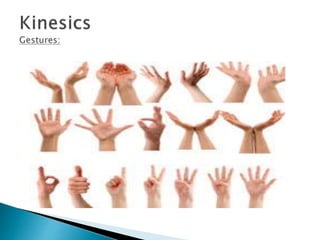
 Gestures:
 Gestures, e.g: handshake
 Changing their meanings over a period of
time
 How to tell someone to be quiet in a library?
 We use gesture when our voice engaged,
e.g: talking on the telephone, we used
gesture to tell another person to come and
sit down
 Many of the gestures are automatic. When
we speaking on the telephone, we often
make hand gestures
 Gestures: (cont)
Types
Enumerative- numbers
Descriptive- size of the objects
Symbolic- abstract concepts
Locative- location of an object
Emphatic- emphasis
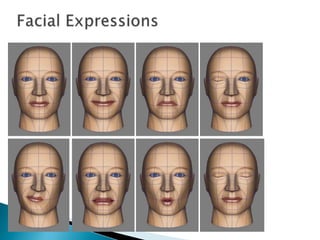
 Facial expressions:
 We face other people when we talk
 Facial expression is bound to be an important
indicator to other people of our attitudes, state of
mind and relationships to them
 Human face has a complex arrangement of muscles
that allows us to produce a whole range of
different expressions, most of which are an index
of our feelings (happy, sad, pain, etc.)
 Smiling – important facial gesture that indicate that
we pleased to see other people
 Eye contact
 Important way in which we communicate our
feelings towards other people
 Initial eye contact to assess a stranger
 Staring – identified as threatening form or
behaviour
 If we staring at someone, their behaviour will
change, often becoming either defensive or at
the other extreme aggressive towards you
 Eye contact:
 Deeply suspicious of people who ‘cannot look us in
the eye’; they are seen as shifty or people with
something to hide
 Gazing – look steadily; men gaze at women,
sometimes in intimidating way
 Eye contact – can be an index of the closeness of a
relationship that people share
 Eye contact:
 A popular belief, “we can detect the truth in
people’s eyes”. Although people may hide
the truth with words, their true feelings will
be revealed in their eyes
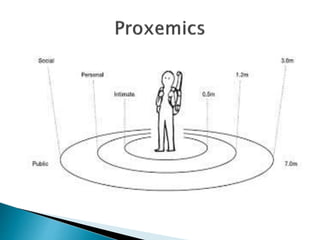
 The study of how we handle the space around
us, especially in relation to other people
 Human beings are territorial!
 We create for ourselves spaces that belong to
us and to which we try carefully to control
access
 Example:
 Our homes
 Our spaces at work or school
 Issue: how space is occupied is about how
territory reflects the power relations within
groups of people. The more powerful a
person the larger and more impressive the
space they will occupy
 Another important type of space; the space we carry with us
 Individual invisible space that we protect from outside intrusion
 Invisible bubble around us
 Determined by the situation and by the relationship we have, or
might like to have, with the person or people who are near to us
 In crowded place such as a bus or train
 Cultural/religious differences in our attitudes to the proximity,
or nearness, of other people
 “Don’t touch” – touching things, other people, or even our own
bodies, is socially undesirable.
 Some cultures physical contact with relative strangers is openly
encouraged
 Study of time is considered as chronemics in
communication.
 Time perception plays a large role in the
nonverbal communication process. Time
perceptions include punctuality, willingness
to wait, and interactions. The use of time can
affect lifestyle, daily agendas, speed of
speech, movements, and how long people are
willing to listen.
 Monochronic time (M-time)
People are punctual. They know the
importance of time. Under this system,
time is scheduled, arranged and managed.
The United States considers itself a
monochronic society.
American's viewpoint of time in the
business world, "the schedule is sacred."
 Polychronic time (P-time)
 People are of this culture consider time as
flexible. They don’t realize the importance of
time.
 Polychronic cultures are much less focused
on the preciseness of accounting for each
and every moment.
 Asian countries come under this category
Quality:
Each one of us has a unique voice quality and
its quality depends upon its resonating
mechanism.
While the quality of one’s voice cannot be
changed, it can be trained for optimum impact.
Abraham Lincoln and Winston Churchill
adopted the quality of their voices to become
speakers par excellence.
 Volume:
Volume is the loudness or the softness of the
voice.
Your voice should always project but need not
always be loud.
If your volume is high you may sound boorish
and insensitive, whereas if it is too low you
may convey an impression of timidity.
 Pace/Rate:
Rate is the number of words which you speak per
minute. The normal rate is from 129 to 150 words per
minute.
Cultivate your pace so as to fit in this reasonable limit.
If a person speaks too slowly and monotonously, he is
likely to be considered dull speaker.
Similarly a fast speaker also causes discomfort because
the listener do not get time to grasp the thoughts.
 Pitch
Pitch refers to the number of vibrations per
second of our voice.
The rise and fall of the voice conveys various
emotions.
Use a variety of pitches to hold your
listeners’ attention
 Articulation
If all the sounds are not uttered properly, the
flow of understanding gets interrupted and
deters the listener from grasping the meaning.
lazy articulation, slurred sounds, or skipping
over words will lower the credibility of the
speaker.
Develop in yourself the ability to speak distinctly.
 Pronunciation
One should be careful enough to pronounce
individual sounds along with word stress
according to the set norms.
Wherever there is confusion, always consult a
good dictionary and try to pronounce it
accordingly.
 Voice Modulation
Intonation refers to the tonal variations,
modulation pertains to the way we regulate,
vary, or adjust the tone, pitch and volume of
the sound or speaking voice.
Modulation of voice brings flexibility and
vitality of your voice, and you can express
emotions, sentiments like impatience, careful
planning, despondency, suspicion etc in the
best possible way.
 Pauses:
A pause is a short silence flanked by words.
Pauses automatically come in between the major
points of your speech.
Vocalized pauses or vocal segreagtes such as uh,
ah, hm, ahem, a, aah should be substituted by
silence pauses.
Vocalized pauses make the speech sound evasive
and untruthful.
Thanks
Meet me on:
https://drvikasraval.blogspot.in/
http://www.vikasraval.in/
https://drvikasraval.wordpress.com

Non verbal communication

  • 1.
  • 2.
    Objectives: o Introduce typesof non-verbal communication o Show the importance of non-verbal communication in presentation
  • 3.
     Non-verbal communicationmakes no use of the words, sentences, grammar and other structures that we associate with spoken and written language.  Non-verbal communication includes facial expressions, eye contact, tone of voice, body posture and motions, and positioning within groups.  Verbal communication is organized by language; non-verbal communication is not.
  • 4.
     Types ofnon-verbal communication:   Kinesics  Proxemics  Chronemics  Paralinguistics
  • 5.
     Personal appearance: “Peoplesee you before they hear you” Appearance plays an important role in presentation It includes clothes, hair, jewellery, cosmetics, so on. Expect appearance to be a part of message you communicate.
  • 6.
     Personal appearance:(cont) You should be clean and well groomed, conforming to the need of the occasion. Appearance communicate how we fell about ourselves and how we want to be viewed.
  • 7.
     Posture The wayin which we position our bodies Types: Slumped posture: low spirits Erect posture: high spirits, energy and confidence Lean forward: open, honest and interested Crossed arms: defensive and not ready to listen Uncrossed arms: willingness to listen
  • 8.
     Posture (cont) Early age:  “sit up straight”, “shoulder back” – instruction heard at home or school  Upright posture – people who have confident (police, army)  Posture is another sign of the status and role within society (army, police)  Use posture as one means of indicating to another person our feelings of friendship or hostility  “hands on hips” – confrontational and hostile  Group – imitating the postures of the people they are with (mirroring, postural congruence)  Cross legs, fold their arms  Reinforce group identities
  • 10.
     Gestures:  Gestures,e.g: handshake  Changing their meanings over a period of time  How to tell someone to be quiet in a library?  We use gesture when our voice engaged, e.g: talking on the telephone, we used gesture to tell another person to come and sit down  Many of the gestures are automatic. When we speaking on the telephone, we often make hand gestures
  • 11.
     Gestures: (cont) Types Enumerative-numbers Descriptive- size of the objects Symbolic- abstract concepts Locative- location of an object Emphatic- emphasis
  • 12.
     Facial expressions: We face other people when we talk  Facial expression is bound to be an important indicator to other people of our attitudes, state of mind and relationships to them  Human face has a complex arrangement of muscles that allows us to produce a whole range of different expressions, most of which are an index of our feelings (happy, sad, pain, etc.)  Smiling – important facial gesture that indicate that we pleased to see other people
  • 14.
     Eye contact Important way in which we communicate our feelings towards other people  Initial eye contact to assess a stranger  Staring – identified as threatening form or behaviour  If we staring at someone, their behaviour will change, often becoming either defensive or at the other extreme aggressive towards you
  • 15.
     Eye contact: Deeply suspicious of people who ‘cannot look us in the eye’; they are seen as shifty or people with something to hide  Gazing – look steadily; men gaze at women, sometimes in intimidating way  Eye contact – can be an index of the closeness of a relationship that people share
  • 16.
     Eye contact: A popular belief, “we can detect the truth in people’s eyes”. Although people may hide the truth with words, their true feelings will be revealed in their eyes
  • 18.
     The studyof how we handle the space around us, especially in relation to other people  Human beings are territorial!  We create for ourselves spaces that belong to us and to which we try carefully to control access  Example:  Our homes  Our spaces at work or school
  • 19.
     Issue: howspace is occupied is about how territory reflects the power relations within groups of people. The more powerful a person the larger and more impressive the space they will occupy
  • 20.
     Another importanttype of space; the space we carry with us  Individual invisible space that we protect from outside intrusion  Invisible bubble around us  Determined by the situation and by the relationship we have, or might like to have, with the person or people who are near to us  In crowded place such as a bus or train  Cultural/religious differences in our attitudes to the proximity, or nearness, of other people  “Don’t touch” – touching things, other people, or even our own bodies, is socially undesirable.  Some cultures physical contact with relative strangers is openly encouraged
  • 21.
     Study oftime is considered as chronemics in communication.  Time perception plays a large role in the nonverbal communication process. Time perceptions include punctuality, willingness to wait, and interactions. The use of time can affect lifestyle, daily agendas, speed of speech, movements, and how long people are willing to listen.
  • 22.
     Monochronic time(M-time) People are punctual. They know the importance of time. Under this system, time is scheduled, arranged and managed. The United States considers itself a monochronic society. American's viewpoint of time in the business world, "the schedule is sacred."
  • 23.
     Polychronic time(P-time)  People are of this culture consider time as flexible. They don’t realize the importance of time.  Polychronic cultures are much less focused on the preciseness of accounting for each and every moment.  Asian countries come under this category
  • 24.
    Quality: Each one ofus has a unique voice quality and its quality depends upon its resonating mechanism. While the quality of one’s voice cannot be changed, it can be trained for optimum impact. Abraham Lincoln and Winston Churchill adopted the quality of their voices to become speakers par excellence.
  • 25.
     Volume: Volume isthe loudness or the softness of the voice. Your voice should always project but need not always be loud. If your volume is high you may sound boorish and insensitive, whereas if it is too low you may convey an impression of timidity.
  • 26.
     Pace/Rate: Rate isthe number of words which you speak per minute. The normal rate is from 129 to 150 words per minute. Cultivate your pace so as to fit in this reasonable limit. If a person speaks too slowly and monotonously, he is likely to be considered dull speaker. Similarly a fast speaker also causes discomfort because the listener do not get time to grasp the thoughts.
  • 27.
     Pitch Pitch refersto the number of vibrations per second of our voice. The rise and fall of the voice conveys various emotions. Use a variety of pitches to hold your listeners’ attention
  • 28.
     Articulation If allthe sounds are not uttered properly, the flow of understanding gets interrupted and deters the listener from grasping the meaning. lazy articulation, slurred sounds, or skipping over words will lower the credibility of the speaker. Develop in yourself the ability to speak distinctly.
  • 29.
     Pronunciation One shouldbe careful enough to pronounce individual sounds along with word stress according to the set norms. Wherever there is confusion, always consult a good dictionary and try to pronounce it accordingly.
  • 30.
     Voice Modulation Intonationrefers to the tonal variations, modulation pertains to the way we regulate, vary, or adjust the tone, pitch and volume of the sound or speaking voice. Modulation of voice brings flexibility and vitality of your voice, and you can express emotions, sentiments like impatience, careful planning, despondency, suspicion etc in the best possible way.
  • 31.
     Pauses: A pauseis a short silence flanked by words. Pauses automatically come in between the major points of your speech. Vocalized pauses or vocal segreagtes such as uh, ah, hm, ahem, a, aah should be substituted by silence pauses. Vocalized pauses make the speech sound evasive and untruthful.
  • 32.