November, 2012

              Design:
             Marbelis
             Parra
             Gainza

             Landry
             Thomas


Tolls and Keys about
Communication
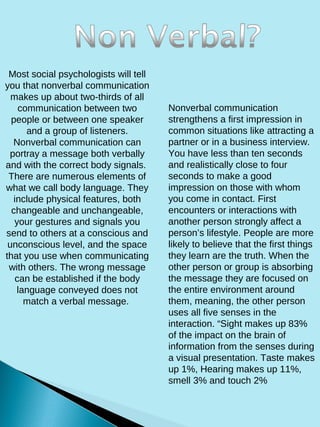
Most social psychologists will tell
you that nonverbal communication
  makes up about two-thirds of all
     communication between two         Nonverbal communication
  people or between one speaker        strengthens a first impression in
       and a group of listeners.       common situations like attracting a
  Nonverbal communication can          partner or in a business interview.
 portray a message both verbally       You have less than ten seconds
and with the correct body signals.     and realistically close to four
 There are numerous elements of        seconds to make a good
what we call body language. They       impression on those with whom
   include physical features, both     you come in contact. First
  changeable and unchangeable,         encounters or interactions with
   your gestures and signals you       another person strongly affect a
send to others at a conscious and      person’s lifestyle. People are more
 unconscious level, and the space      likely to believe that the first things
that you use when communicating        they learn are the truth. When the
 with others. The wrong message        other person or group is absorbing
    can be established if the body     the message they are focused on
    language conveyed does not         the entire environment around
      match a verbal message.          them, meaning, the other person
                                       uses all five senses in the
                                       interaction. “Sight makes up 83%
                                       of the impact on the brain of
                                       information from the senses during
                                       a visual presentation. Taste makes
                                       up 1%, Hearing makes up 11%,
                                       smell 3% and touch 2%
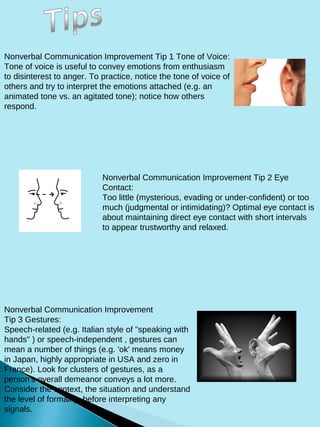
Nonverbal Communication Improvement Tip 1 Tone of Voice:
Tone of voice is useful to convey emotions from enthusiasm
to disinterest to anger. To practice, notice the tone of voice of
others and try to interpret the emotions attached (e.g. an
animated tone vs. an agitated tone); notice how others
respond.


                            Nonverbal Communication Improvement Tip 2 Eye
                            Contact:
                            Too little (mysterious, evading or under-confident) or too
                            much (judgmental or intimidating)? Optimal eye contact is
                            about maintaining direct eye contact with short intervals
                            to appear trustworthy and relaxed.


Nonverbal Communication Improvement
Tip 3 Gestures:
Speech-related (e.g. Italian style of "speaking with
hands" ) or speech-independent , gestures can
mean a number of things (e.g. 'ok' means money
in Japan, highly appropriate in USA and zero in
France). Look for clusters of gestures, as a
person's overall demeanor conveys a lot more.
Consider the context, the situation and understand
the level of formality, before interpreting any
signals.
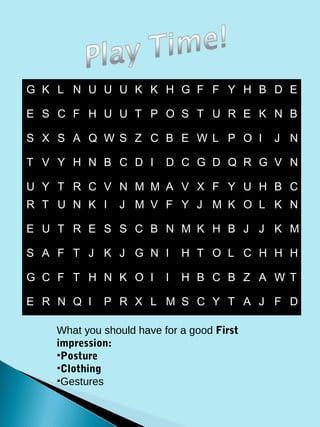
G K L N U U U K K H G F F Y H B D E

E S C F H U U T P O S T U R E K N B

S X S A Q W S Z C B E W L P O I             J N

T V Y H N B C D I         D C G D Q R G V N

U Y T R C V N M M A V X F Y U H B C
R T U N K I     J M V F Y J M K O L K N

E U T R E S S C B N M K H B J J K M

S A F T J K J G N I           H T O L C H H H

G C F T H N K O I         I   H B C B Z A W T

E R N Q I    P R X L M S C Y T A J F D

    What you should have for a good First
    impression:
    •Posture
    •Clothing
    •Gestures
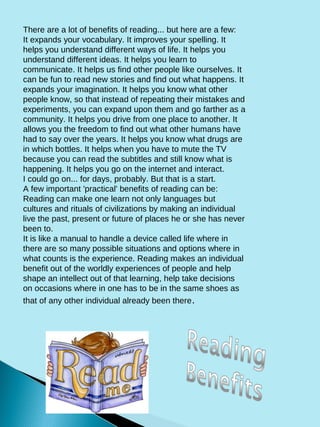
There are a lot of benefits of reading... but here are a few:
It expands your vocabulary. It improves your spelling. It
helps you understand different ways of life. It helps you
understand different ideas. It helps you learn to
communicate. It helps us find other people like ourselves. It
can be fun to read new stories and find out what happens. It
expands your imagination. It helps you know what other
people know, so that instead of repeating their mistakes and
experiments, you can expand upon them and go farther as a
community. It helps you drive from one place to another. It
allows you the freedom to find out what other humans have
had to say over the years. It helps you know what drugs are
in which bottles. It helps when you have to mute the TV
because you can read the subtitles and still know what is
happening. It helps you go on the internet and interact.
I could go on... for days, probably. But that is a start.
A few important 'practical' benefits of reading can be:
Reading can make one learn not only languages but
cultures and rituals of civilizations by making an individual
live the past, present or future of places he or she has never
been to.
It is like a manual to handle a device called life where in
there are so many possible situations and options where in
what counts is the experience. Reading makes an individual
benefit out of the worldly experiences of people and help
shape an intellect out of that learning, help take decisions
on occasions where in one has to be in the same shoes as
that of any other individual already been there .

Non verbal communication

  • 1.
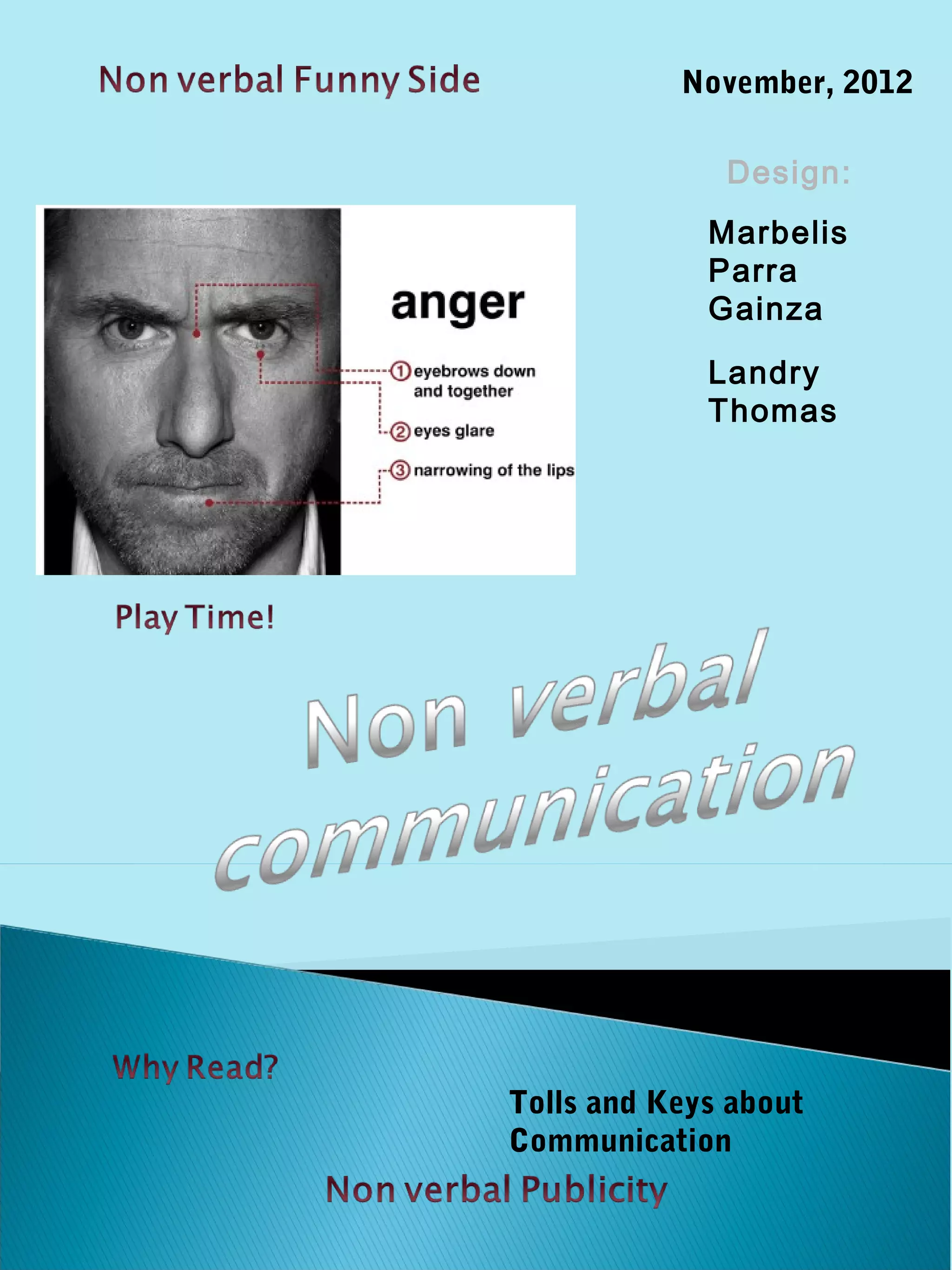
    November, 2012 Design: Marbelis Parra Gainza Landry Thomas Tolls and Keys about Communication
  • 2.
    Most social psychologistswill tell you that nonverbal communication makes up about two-thirds of all communication between two Nonverbal communication people or between one speaker strengthens a first impression in and a group of listeners. common situations like attracting a Nonverbal communication can partner or in a business interview. portray a message both verbally You have less than ten seconds and with the correct body signals. and realistically close to four There are numerous elements of seconds to make a good what we call body language. They impression on those with whom include physical features, both you come in contact. First changeable and unchangeable, encounters or interactions with your gestures and signals you another person strongly affect a send to others at a conscious and person’s lifestyle. People are more unconscious level, and the space likely to believe that the first things that you use when communicating they learn are the truth. When the with others. The wrong message other person or group is absorbing can be established if the body the message they are focused on language conveyed does not the entire environment around match a verbal message. them, meaning, the other person uses all five senses in the interaction. “Sight makes up 83% of the impact on the brain of information from the senses during a visual presentation. Taste makes up 1%, Hearing makes up 11%, smell 3% and touch 2%
  • 3.
    Nonverbal Communication ImprovementTip 1 Tone of Voice: Tone of voice is useful to convey emotions from enthusiasm to disinterest to anger. To practice, notice the tone of voice of others and try to interpret the emotions attached (e.g. an animated tone vs. an agitated tone); notice how others respond. Nonverbal Communication Improvement Tip 2 Eye Contact: Too little (mysterious, evading or under-confident) or too much (judgmental or intimidating)? Optimal eye contact is about maintaining direct eye contact with short intervals to appear trustworthy and relaxed. Nonverbal Communication Improvement Tip 3 Gestures: Speech-related (e.g. Italian style of "speaking with hands" ) or speech-independent , gestures can mean a number of things (e.g. 'ok' means money in Japan, highly appropriate in USA and zero in France). Look for clusters of gestures, as a person's overall demeanor conveys a lot more. Consider the context, the situation and understand the level of formality, before interpreting any signals.
  • 4.
    G K LN U U U K K H G F F Y H B D E E S C F H U U T P O S T U R E K N B S X S A Q W S Z C B E W L P O I J N T V Y H N B C D I D C G D Q R G V N U Y T R C V N M M A V X F Y U H B C R T U N K I J M V F Y J M K O L K N E U T R E S S C B N M K H B J J K M S A F T J K J G N I H T O L C H H H G C F T H N K O I I H B C B Z A W T E R N Q I P R X L M S C Y T A J F D What you should have for a good First impression: •Posture •Clothing •Gestures
  • 7.
    There are alot of benefits of reading... but here are a few: It expands your vocabulary. It improves your spelling. It helps you understand different ways of life. It helps you understand different ideas. It helps you learn to communicate. It helps us find other people like ourselves. It can be fun to read new stories and find out what happens. It expands your imagination. It helps you know what other people know, so that instead of repeating their mistakes and experiments, you can expand upon them and go farther as a community. It helps you drive from one place to another. It allows you the freedom to find out what other humans have had to say over the years. It helps you know what drugs are in which bottles. It helps when you have to mute the TV because you can read the subtitles and still know what is happening. It helps you go on the internet and interact. I could go on... for days, probably. But that is a start. A few important 'practical' benefits of reading can be: Reading can make one learn not only languages but cultures and rituals of civilizations by making an individual live the past, present or future of places he or she has never been to. It is like a manual to handle a device called life where in there are so many possible situations and options where in what counts is the experience. Reading makes an individual benefit out of the worldly experiences of people and help shape an intellect out of that learning, help take decisions on occasions where in one has to be in the same shoes as that of any other individual already been there .