By
Meka Santosh
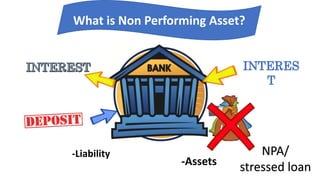
What is Non Performing Asset?
INTERES
T
NPA/
stressed loan
-Liability
-Assets
Non Performing Assets
• Non Performing Asset means a loan or an account of borrower, which
has been classified by a bank or financial institution as sub-standard,
doubtful or loss asset, in accordance with the directions or guidelines
relating to asset classification issued by RBI
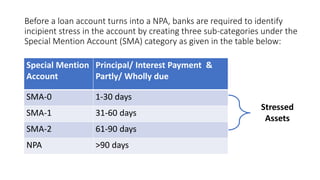
Before a loan account turns into a NPA, banks are required to identify
incipient stress in the account by creating three sub-categories under the
Special Mention Account (SMA) category as given in the table below:
Special Mention
Account
Principal/ Interest Payment &
Partly/ Wholly due
SMA-0 1-30 days
SMA-1 31-60 days
SMA-2 61-90 days
NPA >90 days
Stressed
Assets
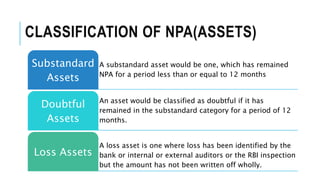
CLASSIFICATION OF NPA(ASSETS)
A substandard asset would be one, which has remained
NPA for a period less than or equal to 12 months
Substandard
Assets
An asset would be classified as doubtful if it has
remained in the substandard category for a period of 12
months.
Doubtful
Assets
A loss asset is one where loss has been identified by the
bank or internal or external auditors or the RBI inspection
but the amount has not been written off wholly.
Loss Assets
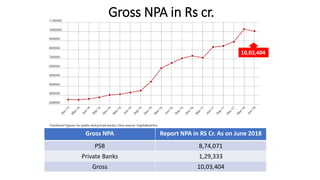
Gross NPA in Rs cr.
10,03,404
Gross NPA Report NPA in RS Cr. As on June 2018
PSB 8,74,071
Private Banks 1,29,333
Gross 10,03,404
Reason Behind the NPA
• Default - One of the main reason behind NPA is default by borrowers.
• Economic conditions - The Economic condition of a region affected by
natural calamities or any other reason may cause NPA.
• No more proper risk management - Speculation is one of the major
reason behind default. Sometimes banks provide loans to borrowers
with bad credit history. There is a high probability of default in these
cases.
• Mis-management - Often ill-minded borrowers bribe bank officials to
get loans with an intention of default.
• Diversion of funds - Many times borrowers divert the borrowed funds
to purposes other than mentioned in loan documents. It is very hard
to recover from this kind of borrowers.
IMPACT OF NPA: -
• Profitability
• Liquidity & Opportunity Cost
• Waste of valuable Management time
• Loss of credibility as high NPA reflect poorly on Management
• Impact on Share Price
• The price of loans, interest rates will shoot up badly.
• Finally, it will lead to lower growth and higher inflation because of the
higher cost of capital
Types Of NPAs
• Gross NPA
It is the total number of NPAs of the bank simply added. Banks would
continuously assess this by evaluating their loan payments and decide
the NPAs.
• Net NPA
Net NPA is simply the total bad assets (actual) minus the provision left
aside.
Ex. You have lent $100 Cr. ,Provision $20 Cr. ,Collected amount $50 Cr.
Ans. 50Cr. Loss but less $20Cr. (Provision) = NET NPA is $30 Cr.
NPA Management Strategies
Indian Banks are pursuing variety of strategies to control NPAs, which
can be studied under two broad categories as under : –
a. Preventive Management
b. Curative Management
A. Preventive Management
• It is rightly said that prevention is better than cure.
• Developing ‘Know Your Client’ profile (KYC)
• Monitoring Early Warning Signals
• Installing Proper Credit Assessment and Risk Management Mechanism
• Reduced Dependence on Interest
• Generating Watch-list/Special Mention Category
B. Curative Management
• Re-phasement of loans
• Pursuing Corporate Debt Restructuring (CDR)
• Encouraging acquisition of sick units by healthy units
• Using Lok Adalats for compromise settlement for smaller loans in
“doubtful” and “loss” category.
• Using Securitization & SARFAESI Act
• Using Asset Reconstruction Company (ARC)
• Approaching Debt Recovery Tribunals (DRTs).
• Recovery Action against Large NPAs
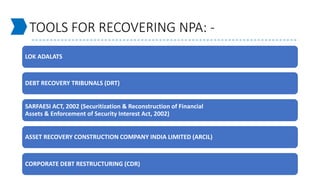
TOOLS FOR RECOVERING NPA: -
LOK ADALATS
DEBT RECOVERY TRIBUNALS (DRT)
SARFAESI ACT, 2002 (Securitization & Reconstruction of Financial
Assets & Enforcement of Security Interest Act, 2002)
ASSET RECOVERY CONSTRUCTION COMPANY INDIA LIMITED (ARCIL)
CORPORATE DEBT RESTRUCTURING (CDR)
SARFESI Act 2002
• The Securitization and Reconstruction of Financial Assets and
Enforcement of Security Interest (SARFAESI) Act has provisions for the
banks to take legal recourse to recover their dues.
• When a borrower makes any default in repayment and his account is
classified as NPA; the secured creditor has to issue notice to the
borrower giving him 60 days to pay his dues.
• If the dues are not paid, the bank can take possession of the assets
and can also give it on lease or sell it; as per provisions of the SAFAESI
Act.
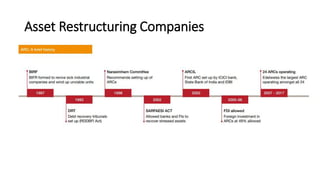
Asset Restructuring Companies
• An Asset Reconstruction Company is a specialized financial institution that buys
the NPAs or bad assets from banks and financial institutions so that the latter can
clean up their balance sheets
• If a bad loan remains NPA for at least two years, the bank can also resale the
same to the ARC such as ARCIL.
• These sales are only on Cash Basis and the purchasing bank/ company would
have to keep the accounts for at least 15 months before it sells to other bank.
• ARCs clean up the balance sheets of banks when they sells these to the ARCs
• They purchase such loans on low amounts and try to recover as much as possible
from the defaulters.
• Their revenue is difference between the purchased amount and recovered
amount.
• This helps banks to concentrate in normal banking activities.
• Banks rather than going after the defaulters by wasting their time and effort, can
sell the bad assets to the ARCs at a mutually agreed value.
NPA Problem
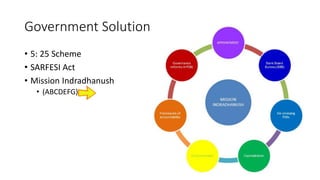
Government Solution
• 5: 25 Scheme
• SARFESI Act
• Mission Indradhanush
• (ABCDEFG)
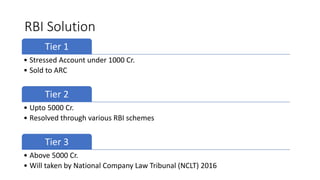
RBI Solution
Tier 1
• Stressed Account under 1000 Cr.
• Sold to ARC
Tier 2
• Upto 5000 Cr.
• Resolved through various RBI schemes
Tier 3
• Above 5000 Cr.
• Will taken by National Company Law Tribunal (NCLT) 2016
Reference
• https://www.rbi.org.in/Scripts/NotificationUser.aspx?Id=8754&Mode=0
• https://rbi.org.in/scripts/BS_ViewMasCirculardetails.aspx?id=7357#
• http://blog.forumias.com/non-performing-assetsnpas-and-its-impact-on-indian-
economy
• http://www.ijmbs.com/13/bhawani.pdf
• https://www.firstpost.com/business/bank-bad-loans-pile-crosses-rs-10-lakh-
crore-up-rs-139-lakh-crore-in-march-quarter-the-nap-mess-explained-in-7-
charts-4496431.html
NPA - Non Performing Assets by Meka Santosh

NPA - Non Performing Assets by Meka Santosh

  • 1.
  • 2.
    What is NonPerforming Asset? INTERES T NPA/ stressed loan -Liability -Assets
  • 3.
    Non Performing Assets •Non Performing Asset means a loan or an account of borrower, which has been classified by a bank or financial institution as sub-standard, doubtful or loss asset, in accordance with the directions or guidelines relating to asset classification issued by RBI
  • 4.
    Before a loanaccount turns into a NPA, banks are required to identify incipient stress in the account by creating three sub-categories under the Special Mention Account (SMA) category as given in the table below: Special Mention Account Principal/ Interest Payment & Partly/ Wholly due SMA-0 1-30 days SMA-1 31-60 days SMA-2 61-90 days NPA >90 days Stressed Assets
  • 5.
    CLASSIFICATION OF NPA(ASSETS) Asubstandard asset would be one, which has remained NPA for a period less than or equal to 12 months Substandard Assets An asset would be classified as doubtful if it has remained in the substandard category for a period of 12 months. Doubtful Assets A loss asset is one where loss has been identified by the bank or internal or external auditors or the RBI inspection but the amount has not been written off wholly. Loss Assets
  • 6.
    Gross NPA inRs cr. 10,03,404 Gross NPA Report NPA in RS Cr. As on June 2018 PSB 8,74,071 Private Banks 1,29,333 Gross 10,03,404
  • 7.
    Reason Behind theNPA • Default - One of the main reason behind NPA is default by borrowers. • Economic conditions - The Economic condition of a region affected by natural calamities or any other reason may cause NPA. • No more proper risk management - Speculation is one of the major reason behind default. Sometimes banks provide loans to borrowers with bad credit history. There is a high probability of default in these cases. • Mis-management - Often ill-minded borrowers bribe bank officials to get loans with an intention of default. • Diversion of funds - Many times borrowers divert the borrowed funds to purposes other than mentioned in loan documents. It is very hard to recover from this kind of borrowers.
  • 8.
    IMPACT OF NPA:- • Profitability • Liquidity & Opportunity Cost • Waste of valuable Management time • Loss of credibility as high NPA reflect poorly on Management • Impact on Share Price • The price of loans, interest rates will shoot up badly. • Finally, it will lead to lower growth and higher inflation because of the higher cost of capital
  • 9.
    Types Of NPAs •Gross NPA It is the total number of NPAs of the bank simply added. Banks would continuously assess this by evaluating their loan payments and decide the NPAs. • Net NPA Net NPA is simply the total bad assets (actual) minus the provision left aside. Ex. You have lent $100 Cr. ,Provision $20 Cr. ,Collected amount $50 Cr. Ans. 50Cr. Loss but less $20Cr. (Provision) = NET NPA is $30 Cr.
  • 10.
    NPA Management Strategies IndianBanks are pursuing variety of strategies to control NPAs, which can be studied under two broad categories as under : – a. Preventive Management b. Curative Management
  • 11.
    A. Preventive Management •It is rightly said that prevention is better than cure. • Developing ‘Know Your Client’ profile (KYC) • Monitoring Early Warning Signals • Installing Proper Credit Assessment and Risk Management Mechanism • Reduced Dependence on Interest • Generating Watch-list/Special Mention Category
  • 12.
    B. Curative Management •Re-phasement of loans • Pursuing Corporate Debt Restructuring (CDR) • Encouraging acquisition of sick units by healthy units • Using Lok Adalats for compromise settlement for smaller loans in “doubtful” and “loss” category. • Using Securitization & SARFAESI Act • Using Asset Reconstruction Company (ARC) • Approaching Debt Recovery Tribunals (DRTs). • Recovery Action against Large NPAs
  • 13.
    TOOLS FOR RECOVERINGNPA: - LOK ADALATS DEBT RECOVERY TRIBUNALS (DRT) SARFAESI ACT, 2002 (Securitization & Reconstruction of Financial Assets & Enforcement of Security Interest Act, 2002) ASSET RECOVERY CONSTRUCTION COMPANY INDIA LIMITED (ARCIL) CORPORATE DEBT RESTRUCTURING (CDR)
  • 14.
    SARFESI Act 2002 •The Securitization and Reconstruction of Financial Assets and Enforcement of Security Interest (SARFAESI) Act has provisions for the banks to take legal recourse to recover their dues. • When a borrower makes any default in repayment and his account is classified as NPA; the secured creditor has to issue notice to the borrower giving him 60 days to pay his dues. • If the dues are not paid, the bank can take possession of the assets and can also give it on lease or sell it; as per provisions of the SAFAESI Act.
  • 15.
  • 16.
    Asset Restructuring Companies •An Asset Reconstruction Company is a specialized financial institution that buys the NPAs or bad assets from banks and financial institutions so that the latter can clean up their balance sheets • If a bad loan remains NPA for at least two years, the bank can also resale the same to the ARC such as ARCIL. • These sales are only on Cash Basis and the purchasing bank/ company would have to keep the accounts for at least 15 months before it sells to other bank. • ARCs clean up the balance sheets of banks when they sells these to the ARCs • They purchase such loans on low amounts and try to recover as much as possible from the defaulters. • Their revenue is difference between the purchased amount and recovered amount. • This helps banks to concentrate in normal banking activities. • Banks rather than going after the defaulters by wasting their time and effort, can sell the bad assets to the ARCs at a mutually agreed value.
  • 17.
  • 18.
    Government Solution • 5:25 Scheme • SARFESI Act • Mission Indradhanush • (ABCDEFG)
  • 19.
    RBI Solution Tier 1 •Stressed Account under 1000 Cr. • Sold to ARC Tier 2 • Upto 5000 Cr. • Resolved through various RBI schemes Tier 3 • Above 5000 Cr. • Will taken by National Company Law Tribunal (NCLT) 2016
  • 20.
    Reference • https://www.rbi.org.in/Scripts/NotificationUser.aspx?Id=8754&Mode=0 • https://rbi.org.in/scripts/BS_ViewMasCirculardetails.aspx?id=7357# •http://blog.forumias.com/non-performing-assetsnpas-and-its-impact-on-indian- economy • http://www.ijmbs.com/13/bhawani.pdf • https://www.firstpost.com/business/bank-bad-loans-pile-crosses-rs-10-lakh- crore-up-rs-139-lakh-crore-in-march-quarter-the-nap-mess-explained-in-7- charts-4496431.html

Editor's Notes

  • #5 https://www.rbi.org.in/Scripts/NotificationUser.aspx?Id=8754&Mode=0
  • #6 https://rbi.org.in/scripts/BS_ViewMasCirculardetails.aspx?id=7357#
  • #9 http://blog.forumias.com/non-performing-assetsnpas-and-its-impact-on-indian-economy/
  • #11 http://www.ijmbs.com/13/bhawani.pdf