NON PERFORMING ASSETS (NPA)
Contents
Introduction
NPA’s in Indian economy
Classification of NPA - Illustration
NPA’s - In international context
Measures to reduce rate of NPA
Resellingof NPA
Conclusion
Introduction
Non-Performing Assets are generally termed as NPA. Commercial Banks
possess various types of assets. All those assets which do not generate
periodical income are called as Non-performing assets.
If the customer do not repay principal amount or interest for a certain
period of time then, such loan becomes Non-performing assets. Thus non-
performing assets are basically Non-performing loans.
In India the time frame given for classifying an asset as a NPA is 180 days
as compared to 45 - 90 days according to international norms.
NPA’s in Indian economy
In India, currently 11 Public Sector Banks (PSB’s) show a whooping amount
12,000 crores of loss due to NPA’s. The rate of NPA’s were very high in the
beginning of 90’s but over a period of the time there was a considerable
decline in the NPA’s of all the banks.
Rate of Gross Non-performing assets were 9.4% in 2002-03 and it declined
to 7.8% in the year 2003-04 and further it went on to decrease up to 4.5% to
3%.
But, in 2008 the value of these non-performing assets was around 53,100
Crores with a 2.11 % rate which has gone up to 3, 41,000 Crores with an
alarming rate of 5.08% ,till 2015.
Classification of NPA - Illustration
Non-Performing Assets have been classified into following Four categories.
Standard assets :-
A standard asset is a performing asset. Standard assets generate
continuous income and repayments as when they fall due. Such assets carry
a normal risk and are not NPA in the real sense so, no special provision are
required for standard assets.
Sub-standard Assets :-
All those assets (loans & advances) from which bank couldn’t generate
any income for a period of 6 months are called as Sub-standard assets.
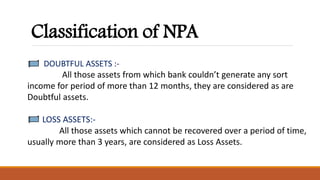
Classification of NPA
DOUBTFUL ASSETS :-
All those assets from which bank couldn’t generate any sort
income for period of more than 12 months, they are considered as are
Doubtful assets.
LOSS ASSETS:-
All those assets which cannot be recovered over a period of time,
usually more than 3 years, are considered as Loss Assets.
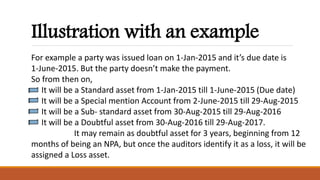
Illustration with an example
For example a party was issued loan on 1-Jan-2015 and it’s due date is
1-June-2015. But the party doesn’t make the payment.
So from then on,
It will be a Standard asset from 1-Jan-2015 till 1-June-2015 (Due date)
It will be a Special mention Account from 2-June-2015 till 29-Aug-2015
It will be a Sub- standard asset from 30-Aug-2015 till 29-Aug-2016
It will be a Doubtful asset from 30-Aug-2016 till 29-Aug-2017.
It may remain as doubtful asset for 3 years, beginning from 12
months of being an NPA, but once the auditors identify it as a loss, it will be
assigned a Loss asset.
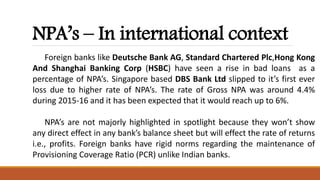
NPA’s – In international context
Foreign banks like Deutsche Bank AG, Standard Chartered Plc,Hong Kong
And Shanghai Banking Corp (HSBC) have seen a rise in bad loans as a
percentage of NPA’s. Singapore based DBS Bank Ltd slipped to it’s first ever
loss due to higher rate of NPA’s. The rate of Gross NPA was around 4.4%
during 2015-16 and it has been expected that it would reach up to 6%.
NPA’s are not majorly highlighted in spotlight because they won’t show
any direct effect in any bank’s balance sheet but will effect the rate of returns
i.e., profits. Foreign banks have rigid norms regarding the maintenance of
Provisioning Coverage Ratio (PCR) unlike Indian banks.
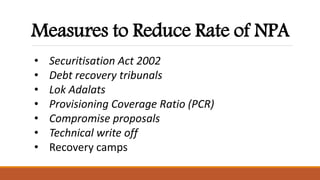
Measures to Reduce Rate of NPA
• Securitisation Act 2002
• Debt recovery tribunals
• Lok Adalats
• Provisioning Coverage Ratio (PCR)
• Compromise proposals
• Technical write off
• Recovery camps
Resale of NPA’s
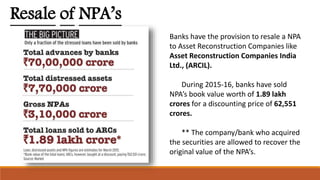
Banks have the provision to resale a NPA
to Asset Reconstruction Companies like
Asset Reconstruction Companies India
Ltd., (ARCIL).
During 2015-16, banks have sold
NPA’s book value worth of 1.89 lakh
crores for a discounting price of 62,551
crores.
** The company/bank who acquired
the securities are allowed to recover the
original value of the NPA’s.
Conclusion
Non Performing Assets are one of the most influencing factors that effect
the profit rate of banking sector. RBI suggested various measures to recover
the loss from NPA’s like Increasing the rate of Provisioning Coverage
Ratio(PCR), conduct more recovery camps, resale of NPA’s to Asset
Reconstruction Companies etc.,
RBI governor Raghuram Rajan has given strict guidelines to all public and
private sector banks to control the growing rate of NPA’s which will ultimately
effect the performance of whole banking sector.
Thank You A presentation by
Salman Khan.P.T
&
Narendra Kumar G

Npa 18

  • 1.
  • 2.
    Contents Introduction NPA’s in Indianeconomy Classification of NPA - Illustration NPA’s - In international context Measures to reduce rate of NPA Resellingof NPA Conclusion
  • 3.
    Introduction Non-Performing Assets aregenerally termed as NPA. Commercial Banks possess various types of assets. All those assets which do not generate periodical income are called as Non-performing assets. If the customer do not repay principal amount or interest for a certain period of time then, such loan becomes Non-performing assets. Thus non- performing assets are basically Non-performing loans. In India the time frame given for classifying an asset as a NPA is 180 days as compared to 45 - 90 days according to international norms.
  • 4.
    NPA’s in Indianeconomy In India, currently 11 Public Sector Banks (PSB’s) show a whooping amount 12,000 crores of loss due to NPA’s. The rate of NPA’s were very high in the beginning of 90’s but over a period of the time there was a considerable decline in the NPA’s of all the banks. Rate of Gross Non-performing assets were 9.4% in 2002-03 and it declined to 7.8% in the year 2003-04 and further it went on to decrease up to 4.5% to 3%. But, in 2008 the value of these non-performing assets was around 53,100 Crores with a 2.11 % rate which has gone up to 3, 41,000 Crores with an alarming rate of 5.08% ,till 2015.
  • 5.
    Classification of NPA- Illustration Non-Performing Assets have been classified into following Four categories. Standard assets :- A standard asset is a performing asset. Standard assets generate continuous income and repayments as when they fall due. Such assets carry a normal risk and are not NPA in the real sense so, no special provision are required for standard assets. Sub-standard Assets :- All those assets (loans & advances) from which bank couldn’t generate any income for a period of 6 months are called as Sub-standard assets.
  • 6.
    Classification of NPA DOUBTFULASSETS :- All those assets from which bank couldn’t generate any sort income for period of more than 12 months, they are considered as are Doubtful assets. LOSS ASSETS:- All those assets which cannot be recovered over a period of time, usually more than 3 years, are considered as Loss Assets.
  • 7.
    Illustration with anexample For example a party was issued loan on 1-Jan-2015 and it’s due date is 1-June-2015. But the party doesn’t make the payment. So from then on, It will be a Standard asset from 1-Jan-2015 till 1-June-2015 (Due date) It will be a Special mention Account from 2-June-2015 till 29-Aug-2015 It will be a Sub- standard asset from 30-Aug-2015 till 29-Aug-2016 It will be a Doubtful asset from 30-Aug-2016 till 29-Aug-2017. It may remain as doubtful asset for 3 years, beginning from 12 months of being an NPA, but once the auditors identify it as a loss, it will be assigned a Loss asset.
  • 8.
    NPA’s – Ininternational context Foreign banks like Deutsche Bank AG, Standard Chartered Plc,Hong Kong And Shanghai Banking Corp (HSBC) have seen a rise in bad loans as a percentage of NPA’s. Singapore based DBS Bank Ltd slipped to it’s first ever loss due to higher rate of NPA’s. The rate of Gross NPA was around 4.4% during 2015-16 and it has been expected that it would reach up to 6%. NPA’s are not majorly highlighted in spotlight because they won’t show any direct effect in any bank’s balance sheet but will effect the rate of returns i.e., profits. Foreign banks have rigid norms regarding the maintenance of Provisioning Coverage Ratio (PCR) unlike Indian banks.
  • 9.
    Measures to ReduceRate of NPA • Securitisation Act 2002 • Debt recovery tribunals • Lok Adalats • Provisioning Coverage Ratio (PCR) • Compromise proposals • Technical write off • Recovery camps
  • 10.
    Resale of NPA’s Bankshave the provision to resale a NPA to Asset Reconstruction Companies like Asset Reconstruction Companies India Ltd., (ARCIL). During 2015-16, banks have sold NPA’s book value worth of 1.89 lakh crores for a discounting price of 62,551 crores. ** The company/bank who acquired the securities are allowed to recover the original value of the NPA’s.
  • 11.
    Conclusion Non Performing Assetsare one of the most influencing factors that effect the profit rate of banking sector. RBI suggested various measures to recover the loss from NPA’s like Increasing the rate of Provisioning Coverage Ratio(PCR), conduct more recovery camps, resale of NPA’s to Asset Reconstruction Companies etc., RBI governor Raghuram Rajan has given strict guidelines to all public and private sector banks to control the growing rate of NPA’s which will ultimately effect the performance of whole banking sector.
  • 12.
    Thank You Apresentation by Salman Khan.P.T & Narendra Kumar G