PwC Case Study
Gamification in HR
Prepared By
Manu Melwin Joy
Assistant Professor
SCMS School of Technology and Management
Kerala, India.
Phone – 9744551114
Mail – manu_melwinjoy@yahoo.com
Kindly restrict the use of slides for personal purpose.
Please seek permission to reproduce the same in public forms and presentations.
Gamification in HR - PwC Case study
• The human resources
department of any company
has the tricky task of trying to
recruit the best candidates,
then keeping them on staff
once they’ve been hired. It’s a
tall order. With most job
searches now conducted over
the Internet, a job candidate
can be lost with a single click.
Gamification in HR - PwC Case study
• Accounting and consulting
firm Pricewaterhouse
Coopers wanted to see if it
could do a better job with
recruiting and retention. At
the firm’s Hungary location,
the human resources
department set goal of more
fully engaging its job
candidates during the search
process, explains Forbes.
Gamification in HR - PwC Case study
• Job candidates were passing
through the PwC website too
quickly, spending 10 minutes
or less. PwC believed a more
engaged candidate pool
would yield better
candidates, and would also
result in workers who would
stay on with the company
longer after they had been
hired.
Gamification in HR - PwC Case study
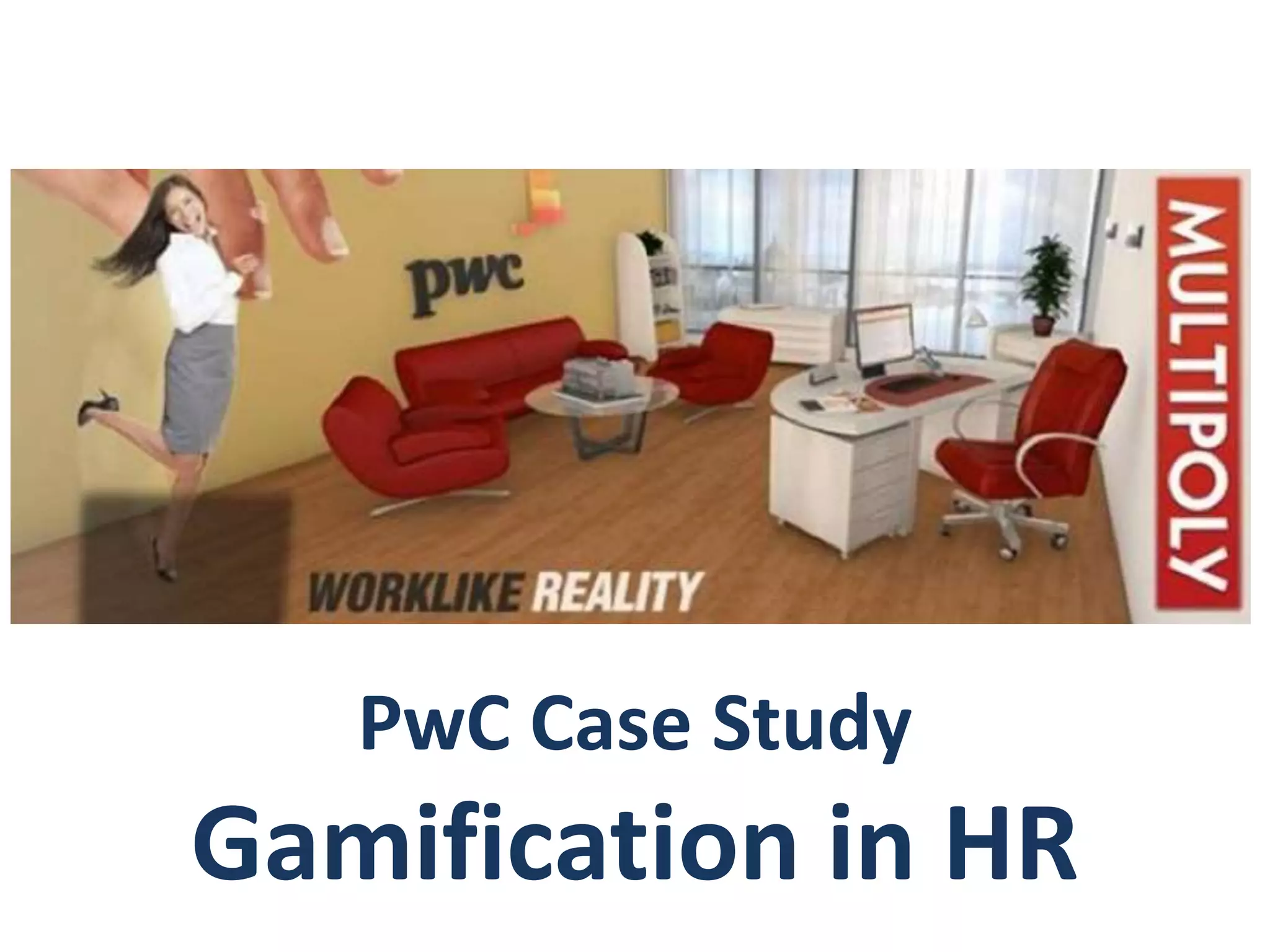
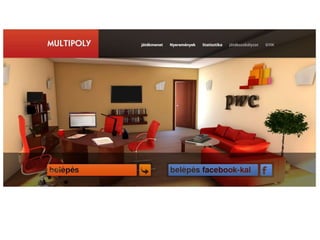
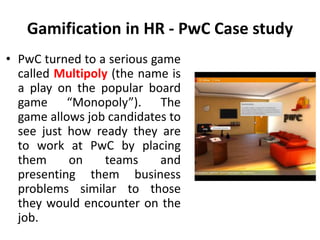
• PwC turned to a serious game
called Multipoly (the name is
a play on the popular board
game “Monopoly”). The
game allows job candidates to
see just how ready they are
to work at PwC by placing
them on teams and
presenting them business
problems similar to those
they would encounter on the
job.
Gamification in HR - PwC Case study
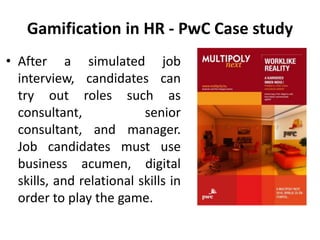
• After a simulated job
interview, candidates can
try out roles such as
consultant, senior
consultant, and manager.
Job candidates must use
business acumen, digital
skills, and relational skills in
order to play the game.
Gamification in HR - PwC Case study
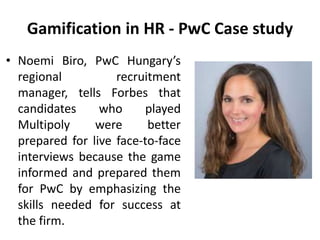
• Noemi Biro, PwC Hungary’s
regional recruitment
manager, tells Forbes that
candidates who played
Multipoly were better
prepared for live face-to-face
interviews because the game
informed and prepared them
for PwC by emphasizing the
skills needed for success at
the firm.
Gamification in HR - PwC Case study
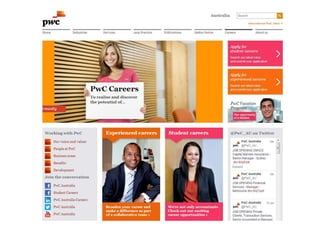
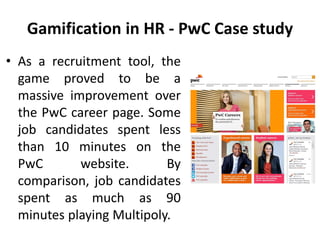
• As a recruitment tool, the
game proved to be a
massive improvement over
the PwC career page. Some
job candidates spent less
than 10 minutes on the
PwC website. By
comparison, job candidates
spent as much as 90
minutes playing Multipoly.
Gamification in HR - PwC Case study
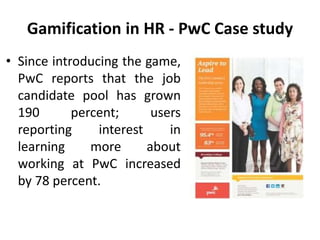
• Since introducing the game,
PwC reports that the job
candidate pool has grown
190 percent; users
reporting interest in
learning more about
working at PwC increased
by 78 percent.
Gamification in HR - PwC Case study
• But just as important,
Forbes says, job candidates
who were hired after
playing Multipoly made the
transition to the company
employee more easily.
That’s because they already
had a taste of PwC’s
company culture from
playing the game.
Gamification in hr   pw c case study - Manu Melwin Joy

Gamification in hr pw c case study - Manu Melwin Joy

  • 1.
  • 2.
    Prepared By Manu MelwinJoy Assistant Professor SCMS School of Technology and Management Kerala, India. Phone – 9744551114 Mail – manu_melwinjoy@yahoo.com Kindly restrict the use of slides for personal purpose. Please seek permission to reproduce the same in public forms and presentations.
  • 3.
    Gamification in HR- PwC Case study • The human resources department of any company has the tricky task of trying to recruit the best candidates, then keeping them on staff once they’ve been hired. It’s a tall order. With most job searches now conducted over the Internet, a job candidate can be lost with a single click.
  • 4.
    Gamification in HR- PwC Case study • Accounting and consulting firm Pricewaterhouse Coopers wanted to see if it could do a better job with recruiting and retention. At the firm’s Hungary location, the human resources department set goal of more fully engaging its job candidates during the search process, explains Forbes.
  • 5.
    Gamification in HR- PwC Case study • Job candidates were passing through the PwC website too quickly, spending 10 minutes or less. PwC believed a more engaged candidate pool would yield better candidates, and would also result in workers who would stay on with the company longer after they had been hired.
  • 7.
    Gamification in HR- PwC Case study • PwC turned to a serious game called Multipoly (the name is a play on the popular board game “Monopoly”). The game allows job candidates to see just how ready they are to work at PwC by placing them on teams and presenting them business problems similar to those they would encounter on the job.
  • 8.
    Gamification in HR- PwC Case study • After a simulated job interview, candidates can try out roles such as consultant, senior consultant, and manager. Job candidates must use business acumen, digital skills, and relational skills in order to play the game.
  • 9.
    Gamification in HR- PwC Case study • Noemi Biro, PwC Hungary’s regional recruitment manager, tells Forbes that candidates who played Multipoly were better prepared for live face-to-face interviews because the game informed and prepared them for PwC by emphasizing the skills needed for success at the firm.
  • 11.
    Gamification in HR- PwC Case study • As a recruitment tool, the game proved to be a massive improvement over the PwC career page. Some job candidates spent less than 10 minutes on the PwC website. By comparison, job candidates spent as much as 90 minutes playing Multipoly.
  • 12.
    Gamification in HR- PwC Case study • Since introducing the game, PwC reports that the job candidate pool has grown 190 percent; users reporting interest in learning more about working at PwC increased by 78 percent.
  • 13.
    Gamification in HR- PwC Case study • But just as important, Forbes says, job candidates who were hired after playing Multipoly made the transition to the company employee more easily. That’s because they already had a taste of PwC’s company culture from playing the game.