NPA Management
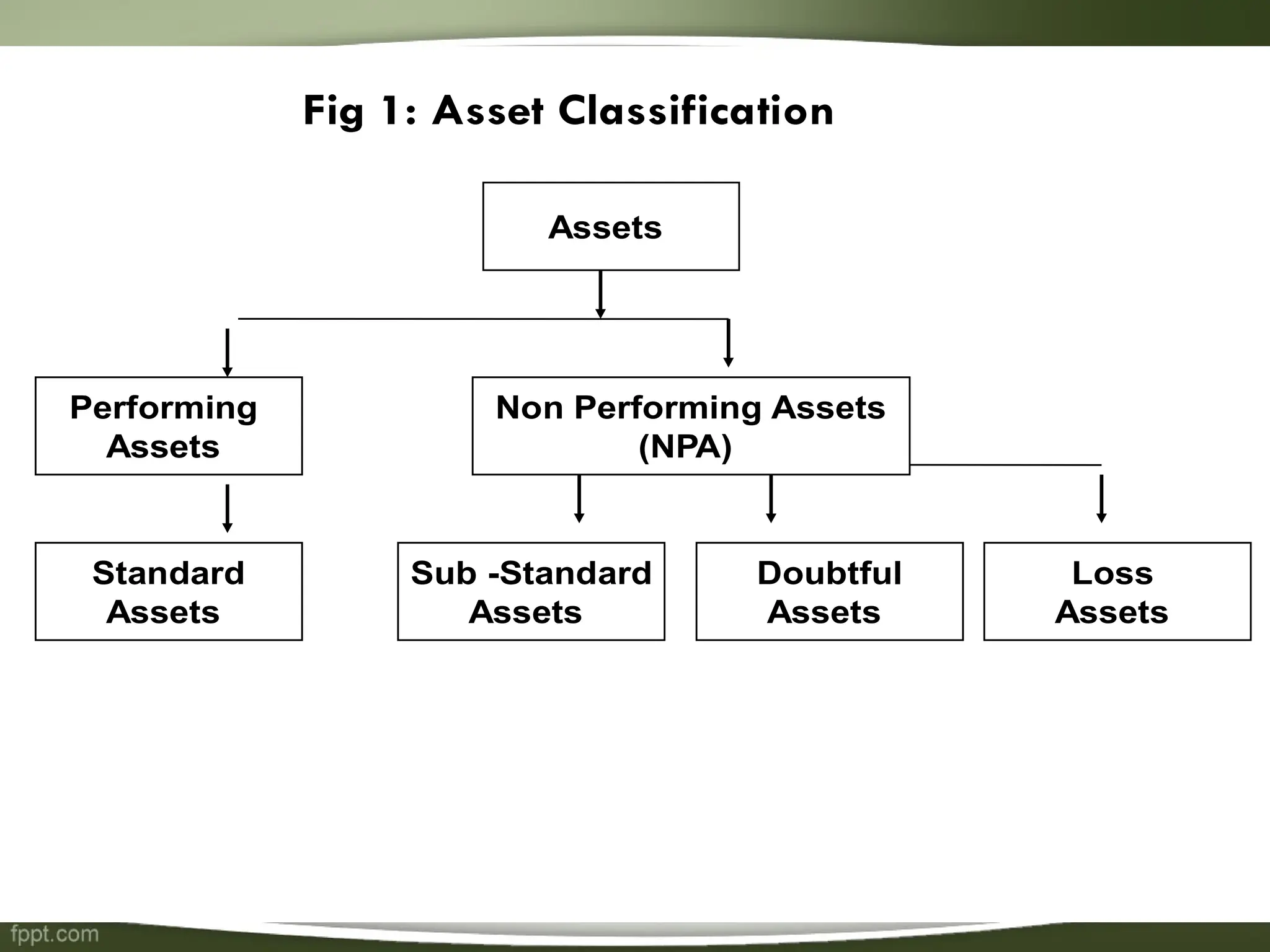
Fig 1: Asset Classification
Assets
Performing
Assets
Standard
Assets
Non Performing Assets
(NPA)
Sub -Standard
Assets
Doubtful
Assets
Loss
Assets
Performing Asset
• An account does not disclose any
problems and carry more than normal
risk attached to the business
• All loan facilities which are regular !
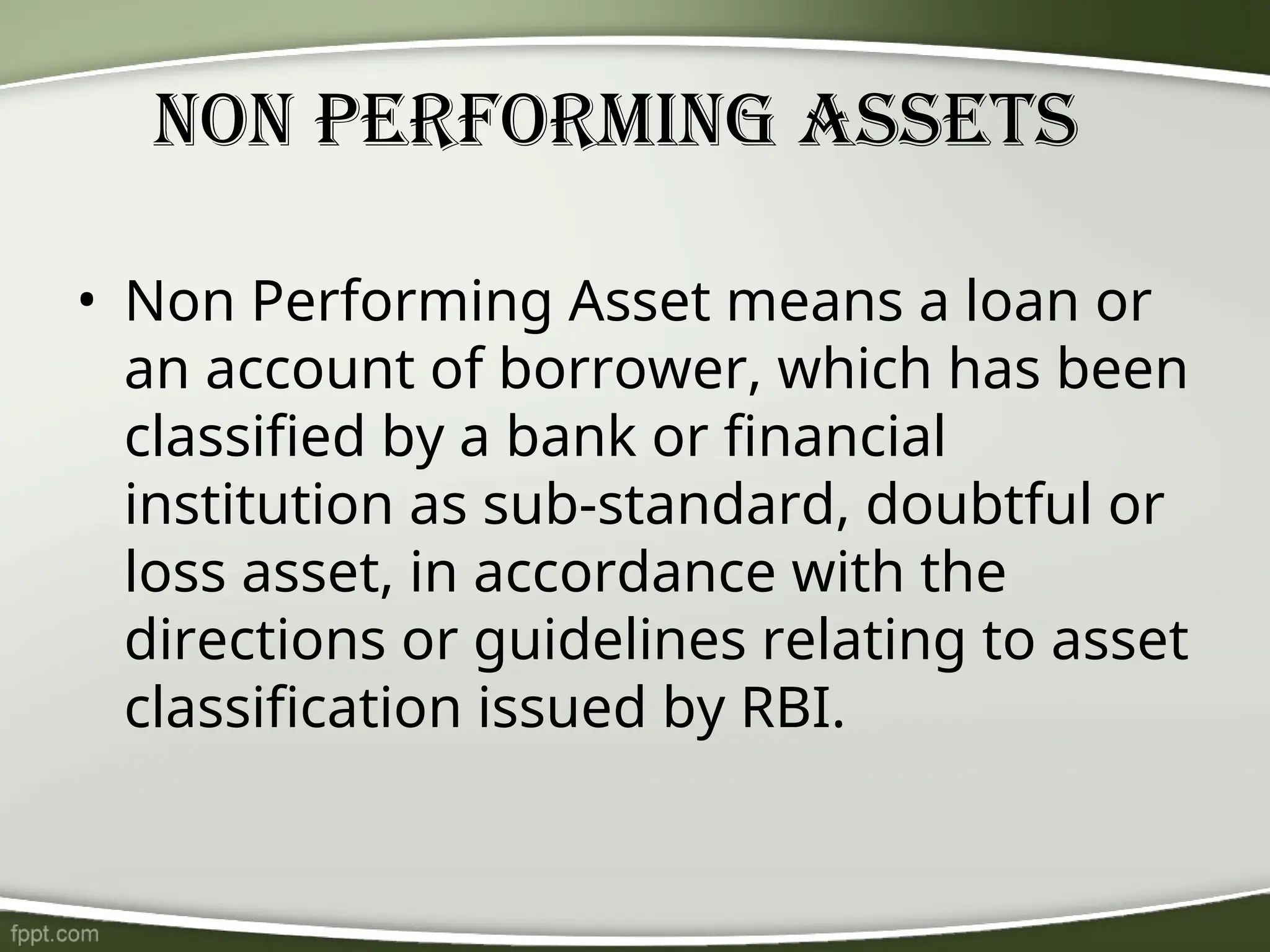
Non Performing Assets
• Non Performing Asset means a loan or
an account of borrower, which has been
classified by a bank or financial
institution as sub-standard, doubtful or
loss asset, in accordance with the
directions or guidelines relating to asset
classification issued by RBI.
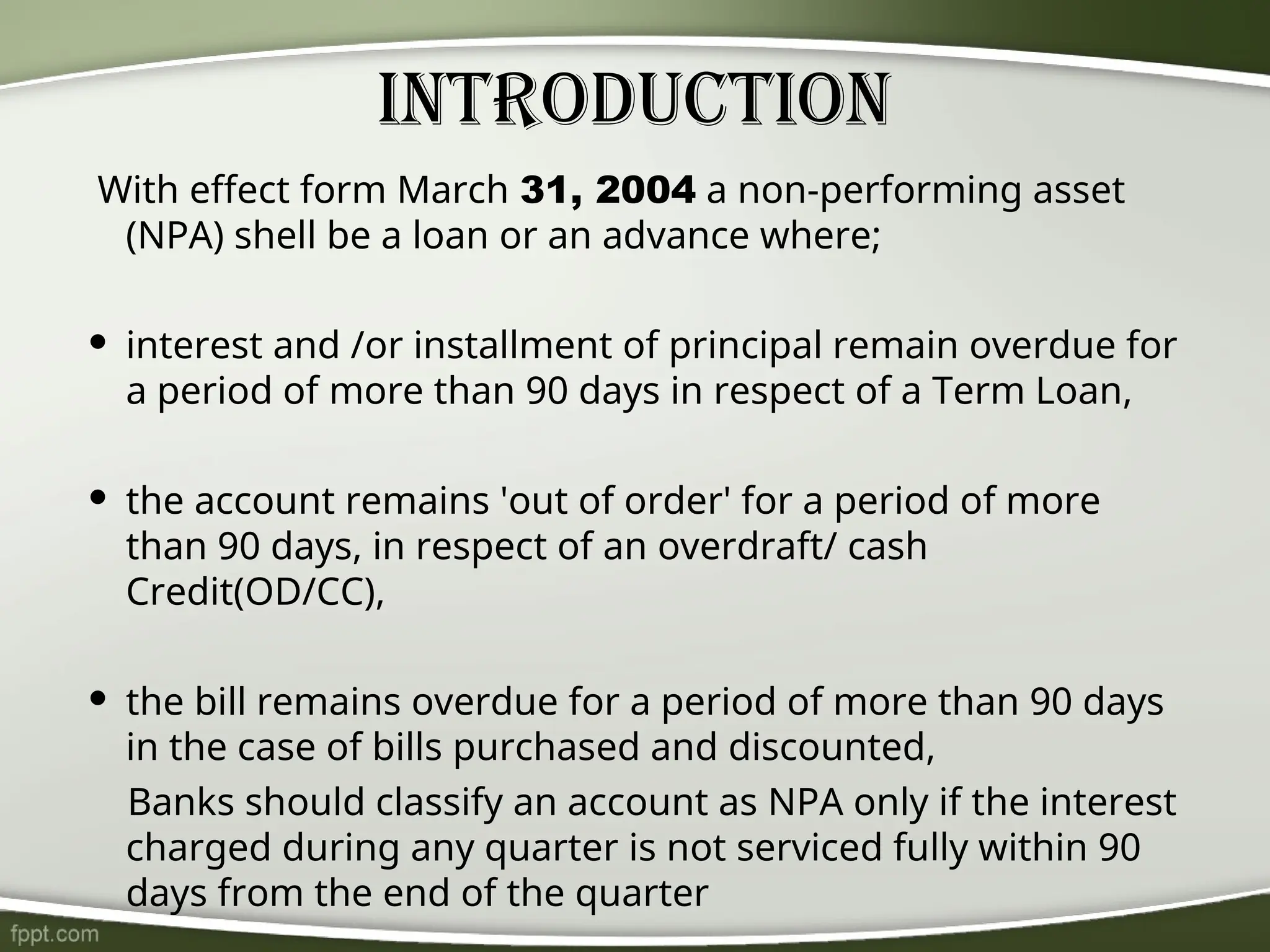
With effect form March 31, 2004 a non-performing asset
(NPA) shell be a loan or an advance where;
 interest and /or installment of principal remain overdue for
a period of more than 90 days in respect of a Term Loan,
 the account remains 'out of order' for a period of more
than 90 days, in respect of an overdraft/ cash
Credit(OD/CC),
 the bill remains overdue for a period of more than 90 days
in the case of bills purchased and discounted,
Banks should classify an account as NPA only if the interest
charged during any quarter is not serviced fully within 90
days from the end of the quarter
Introduction
CATEGORIES OF NPA
 Standard Assets : Arrears of interest and the principal amount
of loan does not exceed 90 days at the end of financial year
 Substandard Assets : Which has remained NPA for a period less
than or equal to 12 months and provision is made for 10% of the
secured portion and 20% of the unsecured portion of the
outstanding.
 Doubtful Assets : Which has remained in the sub-standard
category for a period of 12 months. Provisioning is made at
100% of the unsecured portion of the outstanding and for
secured portion
• D1 i.e. up to 1 year : 20% provision is made by the bank
• D2 i.e. up to 2 year : 30% provision is made by the bank
• D3 i.e. up to 3 year : 100% provision is made by the bank
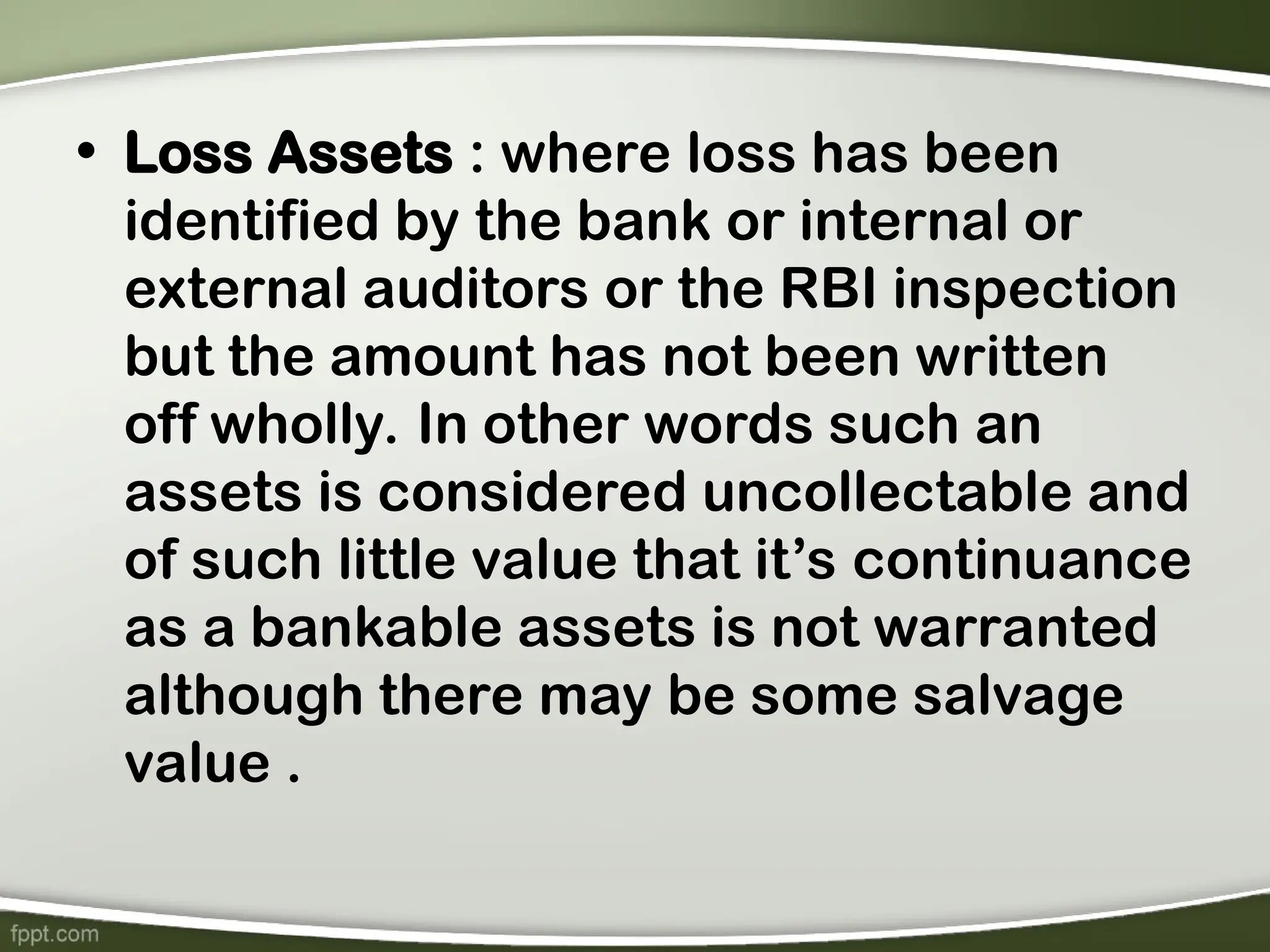
• Loss Assets : where loss has been
identified by the bank or internal or
external auditors or the RBI inspection
but the amount has not been written
off wholly. In other words such an
assets is considered uncollectable and
of such little value that it’s continuance
as a bankable assets is not warranted
although there may be some salvage
value .
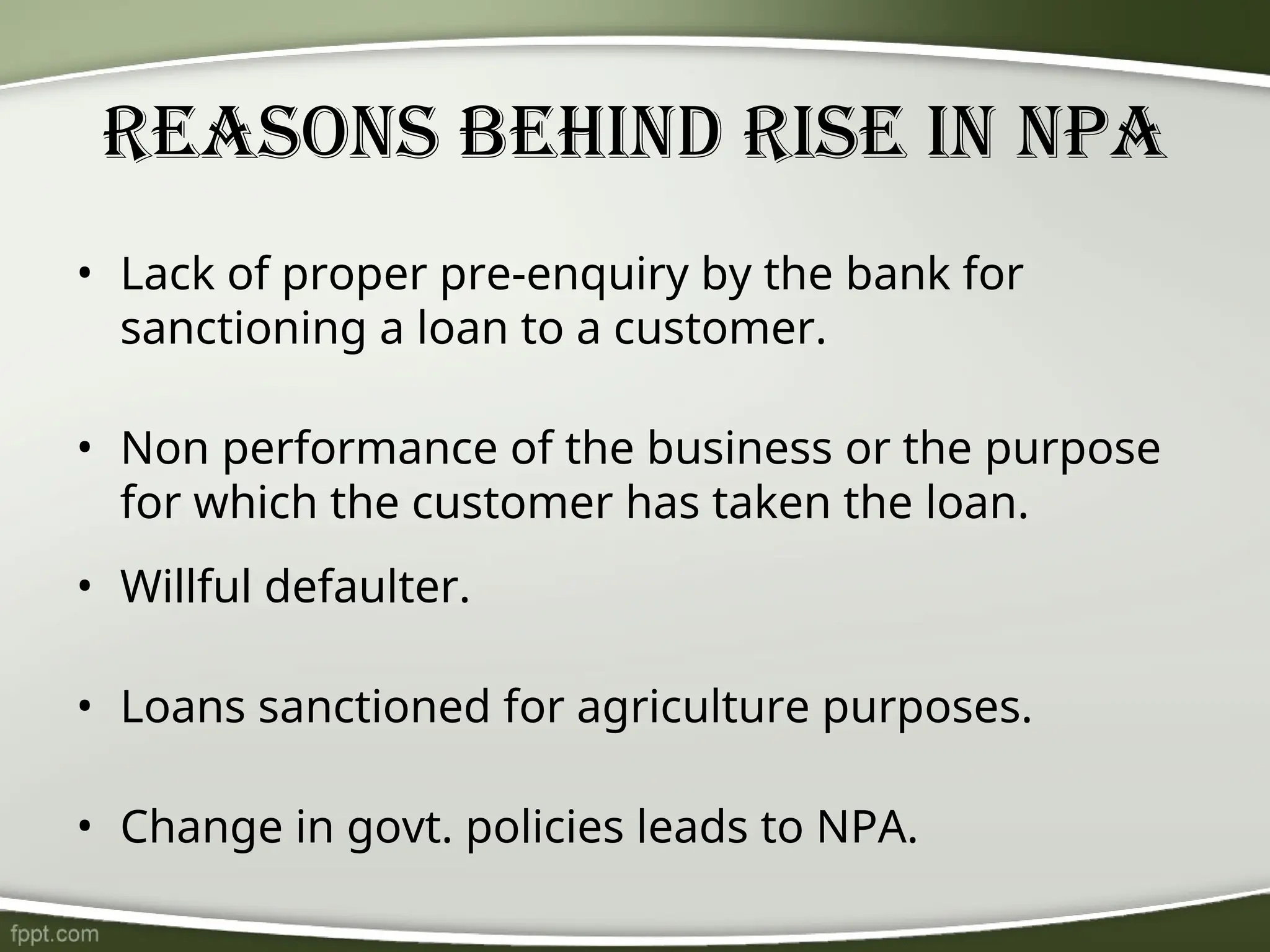
Reasons behind rise in NPA
• Lack of proper pre-enquiry by the bank for
sanctioning a loan to a customer.
• Non performance of the business or the purpose
for which the customer has taken the loan.
• Willful defaulter.
• Loans sanctioned for agriculture purposes.
• Change in govt. policies leads to NPA.
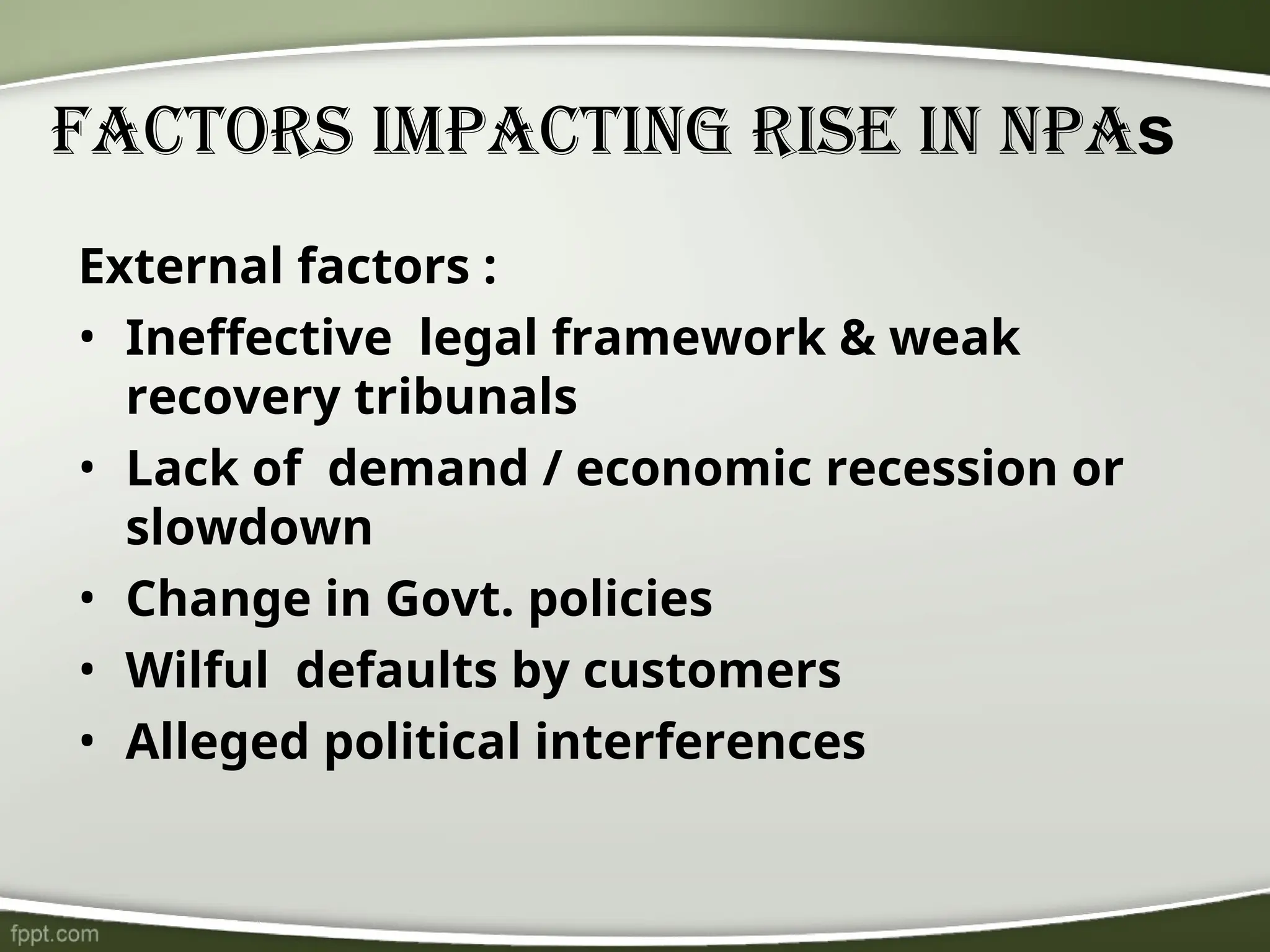
Factors Impacting Rise In NPAs
External factors :
• Ineffective legal framework & weak
recovery tribunals
• Lack of demand / economic recession or
slowdown
• Change in Govt. policies
• Wilful defaults by customers
• Alleged political interferences
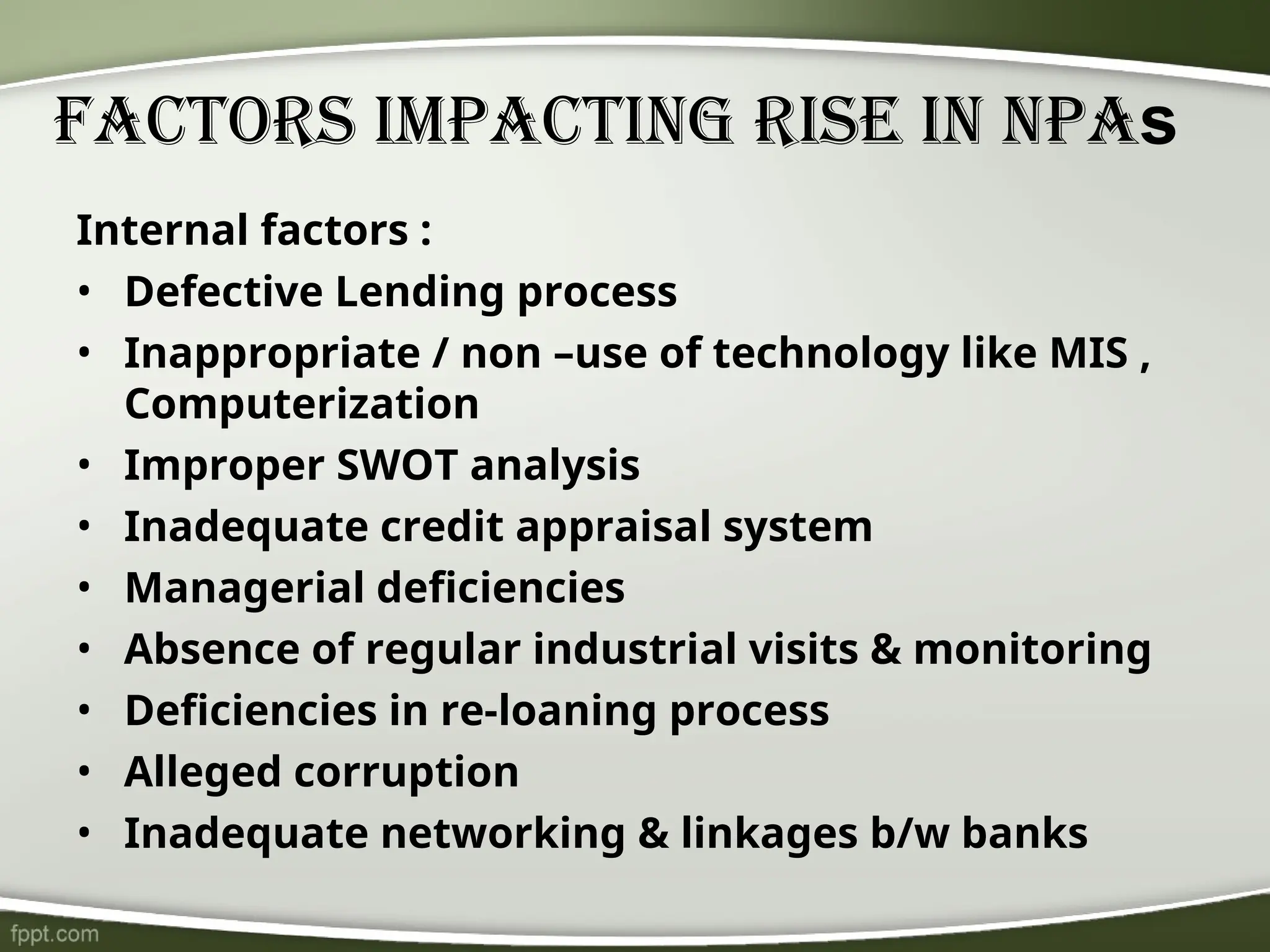
Factors Impacting Rise In NPAs
Internal factors :
• Defective Lending process
• Inappropriate / non –use of technology like MIS ,
Computerization
• Improper SWOT analysis
• Inadequate credit appraisal system
• Managerial deficiencies
• Absence of regular industrial visits & monitoring
• Deficiencies in re-loaning process
• Alleged corruption
• Inadequate networking & linkages b/w banks
BANKER – SIDE
Defective Sanction
No post-sanction
supervision, etc
Delay in releases
Directed lending
Slow decision
making process
BORROWER-SIDE
Lack of Planning
Diversion of Funds
Disputes within
No contribution
No modernization
Improper monitoring
Industrial Relations
Natural Calamities
Why Loan accounts go bad ?
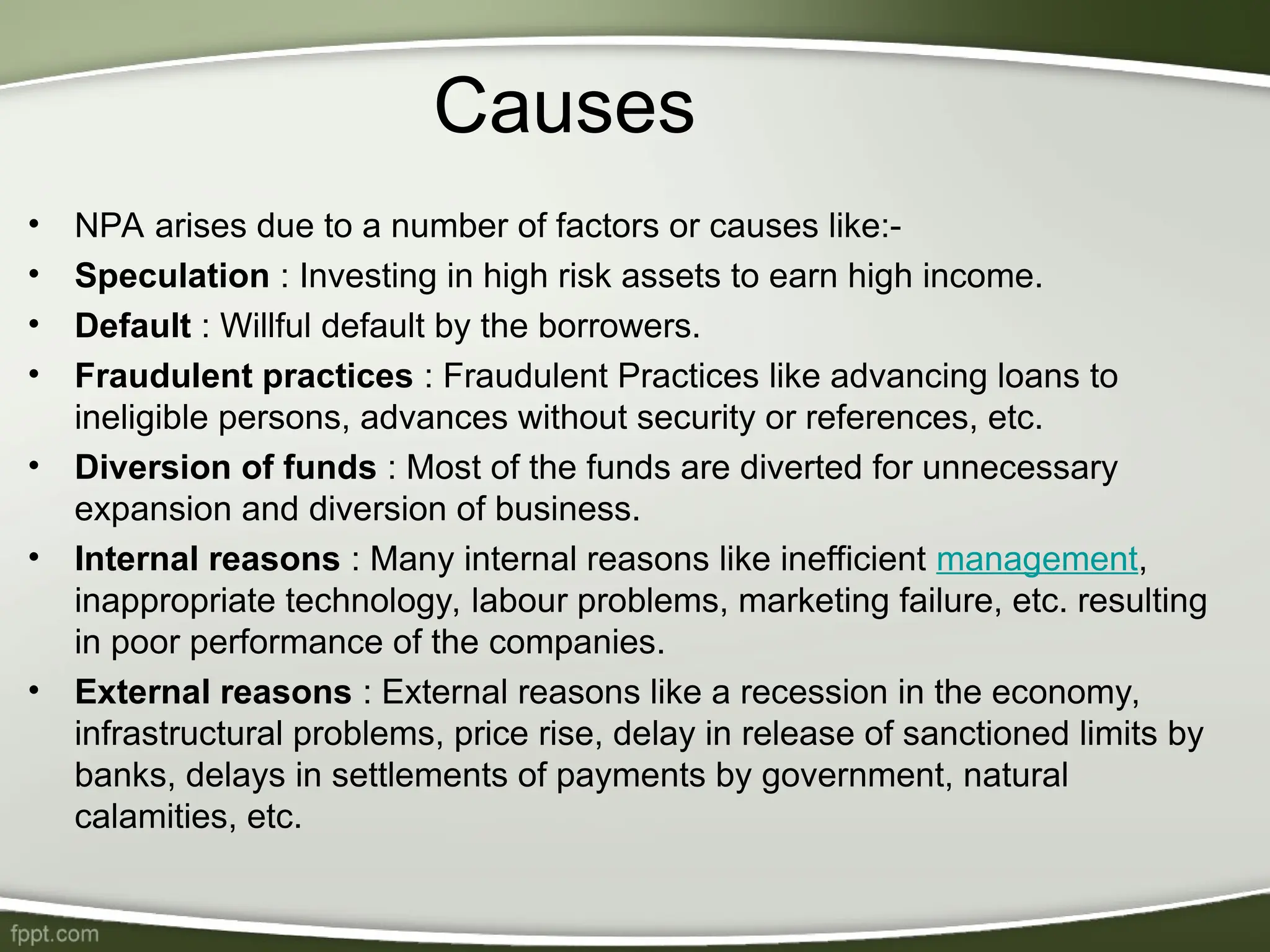
Causes
• NPA arises due to a number of factors or causes like:-
• Speculation : Investing in high risk assets to earn high income.
• Default : Willful default by the borrowers.
• Fraudulent practices : Fraudulent Practices like advancing loans to
ineligible persons, advances without security or references, etc.
• Diversion of funds : Most of the funds are diverted for unnecessary
expansion and diversion of business.
• Internal reasons : Many internal reasons like inefficient management,
inappropriate technology, labour problems, marketing failure, etc. resulting
in poor performance of the companies.
• External reasons : External reasons like a recession in the economy,
infrastructural problems, price rise, delay in release of sanctioned limits by
banks, delays in settlements of payments by government, natural
calamities, etc.
TYPES OF NPA
• Gross NPA :
Gross NPAs are the sum total of all loan
assets that are classified as NPAs as
per RBI guidelines as on Balance Sheet
date. Gross NPA reflects the quality of
the loans made by banks. It consists of
all the non standard assets like as sub-
standard, doubtful, and loss assets.
• Gross NPAs Gross NPAs
Gross Advances
• Net NPA:
Net NPAs are those type of NPAs in which
the bank has deducted the provision
regarding NPAs. Net NPA shows the actual
burden of banks.
Net NPAs Gross = __NPAs – Provisions__
Gross Advances - Provisions
SBI
• State Bank of India
Net NPAs : Rs 12,347.90 crore
Gross NPAs : Rs 25,326.29 crore
• The gross non-performing assets (NPAs) of public sector
banks increased by 20 per cent during June-September 2011.
• Standard & Poor's, which had in September downgraded
standalone ratings of State Bank of India, said high credit
risks in the Indian banking sector reflects that the country has
a weak payment culture and legal system that often result in
low recoveries and delayed settlement of foreclosures.
ICICI Bank
• 2. ICICI Bank
• Net NPAs: Rs 2,407.36 crore
Gross NPAs: Rs 10,034.26 crore
• ICICI Bank has the highest NPAs among private
sector banks. ICICI Bank has slightly improved its
net bad debts to 0.90 per cent from 0.91 per cent in
the earlier quarter.
• Indian banks face challenges like increase in
interest rates on saving deposits, a tighter monetary
policy, restructured loan accounts and increasing
infrastructure loans.
NET NON PERFORMING
ASSETS
YEARS SBI PNB ICICI UTI SCB
1998 7.31 10.21 3.69 5.33 3.30
1999 7.30 10.38 3.22 3.66 2.88
2000 6.07 9.57 1.14 5.63 2.42
2001 7.33 8.96 2.88 6.32 NA
2002 6.65 8.52 1.53 4.71 2.04
2003 5.33 6.69 3.36 2.39 1.53
2004 5.63 5.32 5.48 3.46 3.46
2005 4.5 3.86 5.21 2.39 2.39
2006 3.48 0.98 2.21 1.29 1.29
2007 2.65 0.2 1.65 1.39 1.39
2008 1.87 0.29 0.72 0.98 0.98
2009 1.32 0.28 0.78 0.72 0.87
NPA Management Strategies
• Indian Banks are pursuing variety of
strategies to control NPAs, which can be
studied under two broad categories as
under :
– a. Preventive Management
– b. Curative Management
NPA Management Strategies
a. Preventive Management - It is rightly said
that prevention is better than cure.
• Developing ‘Know Your Client’ profile (KYC
• Monitoring Early Warning Signals
• Installing Proper Credit Assessment and
Risk Management Mechanism
• Reduced Dependence on Interest
• Generating Watch-list/Special Mention
Category
NPA Management Strategies
b. Curative Management
• Re-phasement of loans
• Pursuing Corporate Debt Restructuring (CDR
• Encouraging rehabilitation of potentially viable units
• Encouraging acquisition of sick units by healthy units
• Entering compromise schemes with borrowers /
Entering one time settlement
• Recovery Action against Large NPAs
• Circulation of Information of Defaulters-
Strengthening Database of Defaulters
LOK ADALAT
• To settle disputes involving account in
“doubtful” and “loss” category.
• Outstanding balance of Rs.5 lakhs for
compromise settlement.
• Proved to be quite effective for speedy
justice and recovery of small loans.
• Progress through this channel is expected
to pick up in the coming years
DEBT RECOVERY TRIBUNALS (DRT)
• To recover their bad Debt quickly and efficiently.
• 33 Debt Recovery Tribunal and 5 Debt Recovery Appellate
Tribunal
• It is the special court established by central government for the
purpose of bank or any financial institutions recovery.
• The judges of this court are the retired judges of high court.
• In this court only the recovery cases of Rs.10 lakhs and above
can be filed.
SARFAESI Act
• SECURITIZATION AND RECONSTRUCTION OF
FINANCIAL ASSETS AND ENFORCEMENT OF SECURITY
INTEREST ACT 2002
• The Act provides three alternative methods for recovery of
non-performing assets, namely: -
Securitisation
Asset Reconstruction
Enforcement of Security without the intervention of the
Court.
• NPA loans with outstanding above Rs. 1.00 lac.
• NPA loan accounts where the amount is less than 20% of the
principal and interest are not eligible to be dealt with under
this Act
This Act empowers the Bank:
• To issue demand notice to the defaulting borrower
and guarantor, calling upon them to discharge their
dues in full within 60 days from the date of the notice.
• To give notice to any person who has acquired any of
the secured assets from the borrower to surrender the
same to the Bank.
• To ask any debtor of the borrower to pay any sum due
or becoming due to the borrower.
• Any Security Interest created over Agricultural Land
cannot be proceeded with.
ARCIL
• A company which is set up with the objective of taking over
distressed assets (NPA) from banks or financial institutions and to
reconstruct or re-pack these assets to make those assets saleable.
• To buy out troubled loans from banks and make special efforts at
recovering value from the assets, if necessary by special
legislation, with special powers for recovery.
• Restructuring of weak banks to divest the bad loan portfolio.
• India’s first ARC with an initial equity of Rs.10 crore with ICICI bank,
IDBI and SBI.
• Incorporated as a public limited company on February 11, 2002
OBJECTIVES
• Unlocking capital for the banking system and the economy
• Creating a vibrant market for distressed debt assets
/securities in India offering a trading platform for Lenders
• To evolve and create significant capacity in the system for
quicker resolution of NPAs by deploying the assets optimally
• www.arcil.co.in
CORPORATE DEBT
RESTRUCTURING (CDR)
• For the revival of the corporate as well as for the safety
of the money lent by the banks and FI.
• Based on the experience in other countries like the U.K.,
Thailand,Korea, etc.
• Objective was to ensure timely and transparent
mechanism for restructuring of the corporate debts
• CDR mechanism will be a voluntary system based on
debtor creditor agreement and inter-creditor agreement.
• CDR mechanism will cover only multiple banking
accounts / syndication / consortium accounts .
• An outstanding exposure of Rs.20 crore and above by
banks and institutions.
S
No
SCBs FY
2006-07
2007-08 2008-09 2009-10 2010-11
1 Gross NPAs
(%)
2.5 2.3 2.3 2.4 2.3
2 Net NPAs
(%)
1.0 1.0 1.1 1.1 0.9
3 Fresh NPA
Generation
Rate (%)
1.7 1.8 2.1 2.2 2.0
4 Net
NPAs/Net
Worth (%)
9.2 7.8 8.6 9.1 10.0
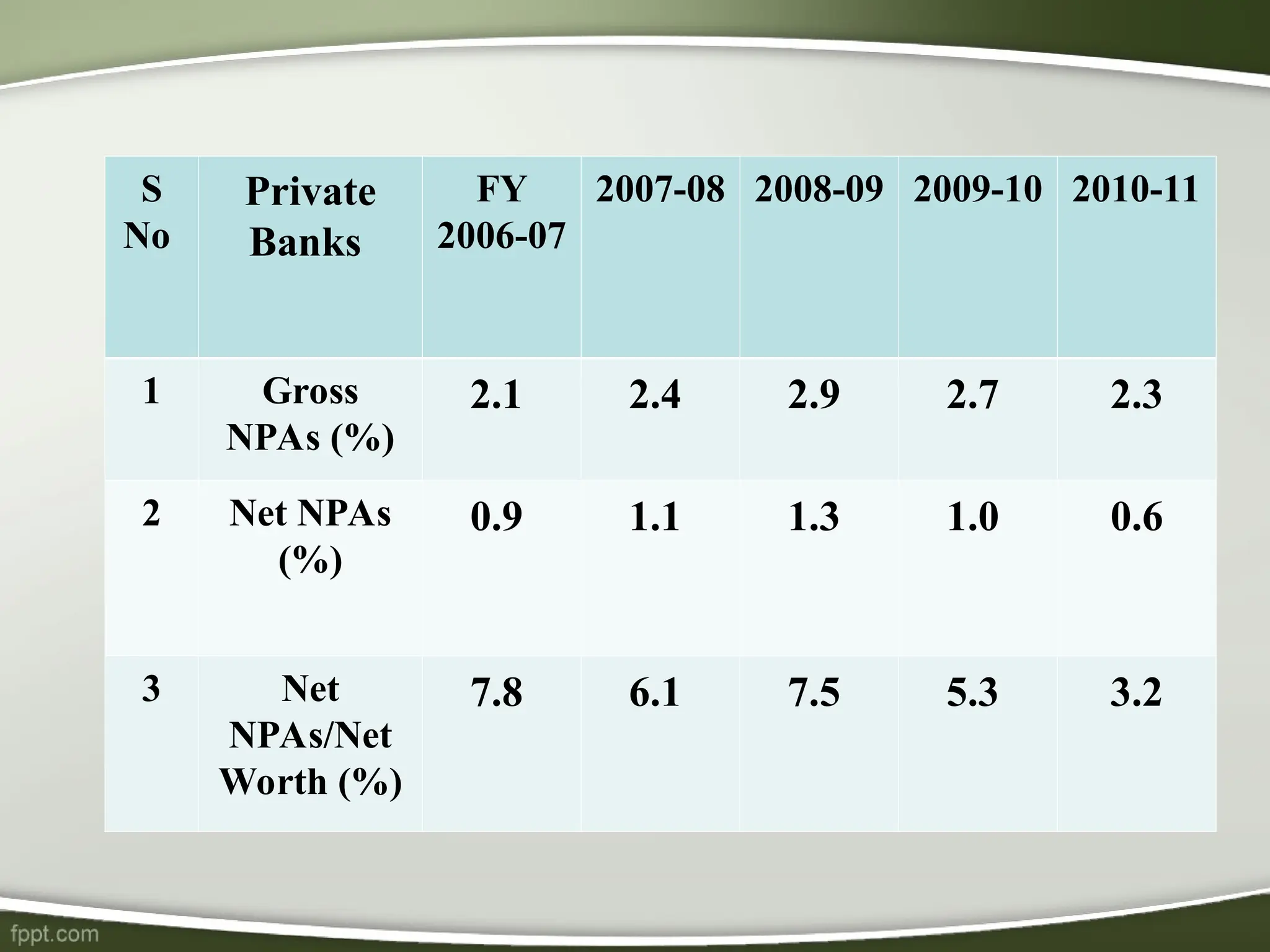
S
No
Private
Banks
FY
2006-07
2007-08 2008-09 2009-10 2010-11
1 Gross
NPAs (%)
2.1 2.4 2.9 2.7 2.3
2 Net NPAs
(%)
0.9 1.1 1.3 1.0 0.6
3 Net
NPAs/Net
Worth (%)
7.8 6.1 7.5 5.3 3.2
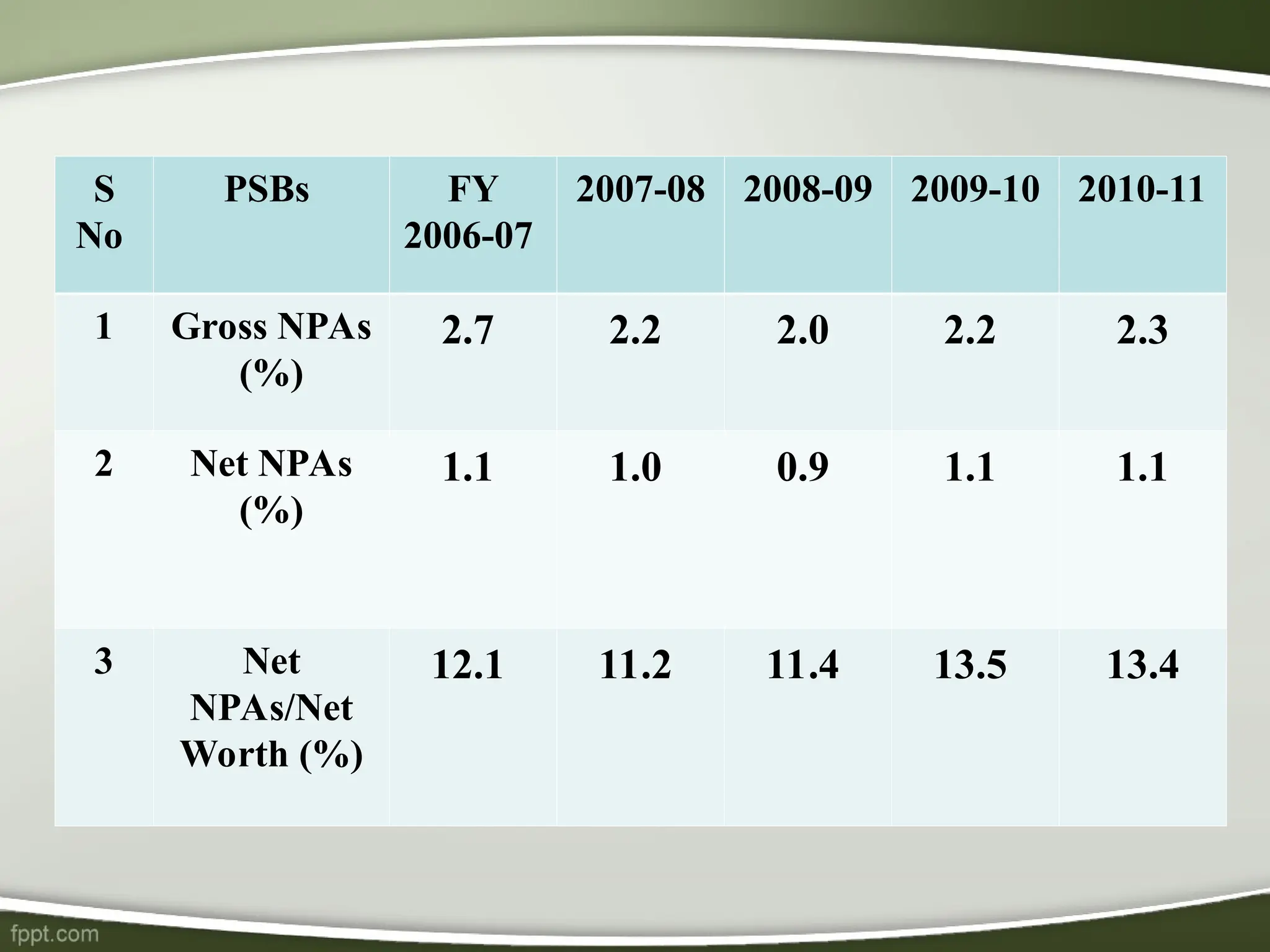
S
No
PSBs FY
2006-07
2007-08 2008-09 2009-10 2010-11
1 Gross NPAs
(%)
2.7 2.2 2.0 2.2 2.3
2 Net NPAs
(%)
1.1 1.0 0.9 1.1 1.1
3 Net
NPAs/Net
Worth (%)
12.1 11.2 11.4 13.5 13.4

A good NPA new non performing assets.ppt

  • 1.
  • 2.
    Fig 1: AssetClassification Assets Performing Assets Standard Assets Non Performing Assets (NPA) Sub -Standard Assets Doubtful Assets Loss Assets
  • 3.
    Performing Asset • Anaccount does not disclose any problems and carry more than normal risk attached to the business • All loan facilities which are regular !
  • 4.
    Non Performing Assets •Non Performing Asset means a loan or an account of borrower, which has been classified by a bank or financial institution as sub-standard, doubtful or loss asset, in accordance with the directions or guidelines relating to asset classification issued by RBI.
  • 5.
    With effect formMarch 31, 2004 a non-performing asset (NPA) shell be a loan or an advance where;  interest and /or installment of principal remain overdue for a period of more than 90 days in respect of a Term Loan,  the account remains 'out of order' for a period of more than 90 days, in respect of an overdraft/ cash Credit(OD/CC),  the bill remains overdue for a period of more than 90 days in the case of bills purchased and discounted, Banks should classify an account as NPA only if the interest charged during any quarter is not serviced fully within 90 days from the end of the quarter Introduction
  • 6.
    CATEGORIES OF NPA Standard Assets : Arrears of interest and the principal amount of loan does not exceed 90 days at the end of financial year  Substandard Assets : Which has remained NPA for a period less than or equal to 12 months and provision is made for 10% of the secured portion and 20% of the unsecured portion of the outstanding.  Doubtful Assets : Which has remained in the sub-standard category for a period of 12 months. Provisioning is made at 100% of the unsecured portion of the outstanding and for secured portion • D1 i.e. up to 1 year : 20% provision is made by the bank • D2 i.e. up to 2 year : 30% provision is made by the bank • D3 i.e. up to 3 year : 100% provision is made by the bank
  • 7.
    • Loss Assets: where loss has been identified by the bank or internal or external auditors or the RBI inspection but the amount has not been written off wholly. In other words such an assets is considered uncollectable and of such little value that it’s continuance as a bankable assets is not warranted although there may be some salvage value .
  • 8.
    Reasons behind risein NPA • Lack of proper pre-enquiry by the bank for sanctioning a loan to a customer. • Non performance of the business or the purpose for which the customer has taken the loan. • Willful defaulter. • Loans sanctioned for agriculture purposes. • Change in govt. policies leads to NPA.
  • 10.
    Factors Impacting RiseIn NPAs External factors : • Ineffective legal framework & weak recovery tribunals • Lack of demand / economic recession or slowdown • Change in Govt. policies • Wilful defaults by customers • Alleged political interferences
  • 11.
    Factors Impacting RiseIn NPAs Internal factors : • Defective Lending process • Inappropriate / non –use of technology like MIS , Computerization • Improper SWOT analysis • Inadequate credit appraisal system • Managerial deficiencies • Absence of regular industrial visits & monitoring • Deficiencies in re-loaning process • Alleged corruption • Inadequate networking & linkages b/w banks
  • 12.
    BANKER – SIDE DefectiveSanction No post-sanction supervision, etc Delay in releases Directed lending Slow decision making process BORROWER-SIDE Lack of Planning Diversion of Funds Disputes within No contribution No modernization Improper monitoring Industrial Relations Natural Calamities Why Loan accounts go bad ?
  • 13.
    Causes • NPA arisesdue to a number of factors or causes like:- • Speculation : Investing in high risk assets to earn high income. • Default : Willful default by the borrowers. • Fraudulent practices : Fraudulent Practices like advancing loans to ineligible persons, advances without security or references, etc. • Diversion of funds : Most of the funds are diverted for unnecessary expansion and diversion of business. • Internal reasons : Many internal reasons like inefficient management, inappropriate technology, labour problems, marketing failure, etc. resulting in poor performance of the companies. • External reasons : External reasons like a recession in the economy, infrastructural problems, price rise, delay in release of sanctioned limits by banks, delays in settlements of payments by government, natural calamities, etc.
  • 14.
    TYPES OF NPA •Gross NPA : Gross NPAs are the sum total of all loan assets that are classified as NPAs as per RBI guidelines as on Balance Sheet date. Gross NPA reflects the quality of the loans made by banks. It consists of all the non standard assets like as sub- standard, doubtful, and loss assets. • Gross NPAs Gross NPAs Gross Advances
  • 15.
    • Net NPA: NetNPAs are those type of NPAs in which the bank has deducted the provision regarding NPAs. Net NPA shows the actual burden of banks. Net NPAs Gross = __NPAs – Provisions__ Gross Advances - Provisions
  • 16.
    SBI • State Bankof India Net NPAs : Rs 12,347.90 crore Gross NPAs : Rs 25,326.29 crore • The gross non-performing assets (NPAs) of public sector banks increased by 20 per cent during June-September 2011. • Standard & Poor's, which had in September downgraded standalone ratings of State Bank of India, said high credit risks in the Indian banking sector reflects that the country has a weak payment culture and legal system that often result in low recoveries and delayed settlement of foreclosures.
  • 17.
    ICICI Bank • 2.ICICI Bank • Net NPAs: Rs 2,407.36 crore Gross NPAs: Rs 10,034.26 crore • ICICI Bank has the highest NPAs among private sector banks. ICICI Bank has slightly improved its net bad debts to 0.90 per cent from 0.91 per cent in the earlier quarter. • Indian banks face challenges like increase in interest rates on saving deposits, a tighter monetary policy, restructured loan accounts and increasing infrastructure loans.
  • 18.
    NET NON PERFORMING ASSETS YEARSSBI PNB ICICI UTI SCB 1998 7.31 10.21 3.69 5.33 3.30 1999 7.30 10.38 3.22 3.66 2.88 2000 6.07 9.57 1.14 5.63 2.42 2001 7.33 8.96 2.88 6.32 NA 2002 6.65 8.52 1.53 4.71 2.04 2003 5.33 6.69 3.36 2.39 1.53 2004 5.63 5.32 5.48 3.46 3.46 2005 4.5 3.86 5.21 2.39 2.39 2006 3.48 0.98 2.21 1.29 1.29 2007 2.65 0.2 1.65 1.39 1.39 2008 1.87 0.29 0.72 0.98 0.98 2009 1.32 0.28 0.78 0.72 0.87
  • 19.
    NPA Management Strategies •Indian Banks are pursuing variety of strategies to control NPAs, which can be studied under two broad categories as under : – a. Preventive Management – b. Curative Management
  • 20.
    NPA Management Strategies a.Preventive Management - It is rightly said that prevention is better than cure. • Developing ‘Know Your Client’ profile (KYC • Monitoring Early Warning Signals • Installing Proper Credit Assessment and Risk Management Mechanism • Reduced Dependence on Interest • Generating Watch-list/Special Mention Category
  • 22.
    NPA Management Strategies b.Curative Management • Re-phasement of loans • Pursuing Corporate Debt Restructuring (CDR • Encouraging rehabilitation of potentially viable units • Encouraging acquisition of sick units by healthy units • Entering compromise schemes with borrowers / Entering one time settlement • Recovery Action against Large NPAs • Circulation of Information of Defaulters- Strengthening Database of Defaulters
  • 24.
    LOK ADALAT • Tosettle disputes involving account in “doubtful” and “loss” category. • Outstanding balance of Rs.5 lakhs for compromise settlement. • Proved to be quite effective for speedy justice and recovery of small loans. • Progress through this channel is expected to pick up in the coming years
  • 25.
    DEBT RECOVERY TRIBUNALS(DRT) • To recover their bad Debt quickly and efficiently. • 33 Debt Recovery Tribunal and 5 Debt Recovery Appellate Tribunal • It is the special court established by central government for the purpose of bank or any financial institutions recovery. • The judges of this court are the retired judges of high court. • In this court only the recovery cases of Rs.10 lakhs and above can be filed.
  • 26.
    SARFAESI Act • SECURITIZATIONAND RECONSTRUCTION OF FINANCIAL ASSETS AND ENFORCEMENT OF SECURITY INTEREST ACT 2002 • The Act provides three alternative methods for recovery of non-performing assets, namely: - Securitisation Asset Reconstruction Enforcement of Security without the intervention of the Court. • NPA loans with outstanding above Rs. 1.00 lac. • NPA loan accounts where the amount is less than 20% of the principal and interest are not eligible to be dealt with under this Act
  • 27.
    This Act empowersthe Bank: • To issue demand notice to the defaulting borrower and guarantor, calling upon them to discharge their dues in full within 60 days from the date of the notice. • To give notice to any person who has acquired any of the secured assets from the borrower to surrender the same to the Bank. • To ask any debtor of the borrower to pay any sum due or becoming due to the borrower. • Any Security Interest created over Agricultural Land cannot be proceeded with.
  • 28.
    ARCIL • A companywhich is set up with the objective of taking over distressed assets (NPA) from banks or financial institutions and to reconstruct or re-pack these assets to make those assets saleable. • To buy out troubled loans from banks and make special efforts at recovering value from the assets, if necessary by special legislation, with special powers for recovery. • Restructuring of weak banks to divest the bad loan portfolio. • India’s first ARC with an initial equity of Rs.10 crore with ICICI bank, IDBI and SBI. • Incorporated as a public limited company on February 11, 2002
  • 29.
    OBJECTIVES • Unlocking capitalfor the banking system and the economy • Creating a vibrant market for distressed debt assets /securities in India offering a trading platform for Lenders • To evolve and create significant capacity in the system for quicker resolution of NPAs by deploying the assets optimally • www.arcil.co.in
  • 30.
    CORPORATE DEBT RESTRUCTURING (CDR) •For the revival of the corporate as well as for the safety of the money lent by the banks and FI. • Based on the experience in other countries like the U.K., Thailand,Korea, etc. • Objective was to ensure timely and transparent mechanism for restructuring of the corporate debts • CDR mechanism will be a voluntary system based on debtor creditor agreement and inter-creditor agreement.
  • 31.
    • CDR mechanismwill cover only multiple banking accounts / syndication / consortium accounts . • An outstanding exposure of Rs.20 crore and above by banks and institutions.
  • 32.
    S No SCBs FY 2006-07 2007-08 2008-092009-10 2010-11 1 Gross NPAs (%) 2.5 2.3 2.3 2.4 2.3 2 Net NPAs (%) 1.0 1.0 1.1 1.1 0.9 3 Fresh NPA Generation Rate (%) 1.7 1.8 2.1 2.2 2.0 4 Net NPAs/Net Worth (%) 9.2 7.8 8.6 9.1 10.0
  • 33.
    S No Private Banks FY 2006-07 2007-08 2008-09 2009-102010-11 1 Gross NPAs (%) 2.1 2.4 2.9 2.7 2.3 2 Net NPAs (%) 0.9 1.1 1.3 1.0 0.6 3 Net NPAs/Net Worth (%) 7.8 6.1 7.5 5.3 3.2
  • 34.
    S No PSBs FY 2006-07 2007-08 2008-092009-10 2010-11 1 Gross NPAs (%) 2.7 2.2 2.0 2.2 2.3 2 Net NPAs (%) 1.1 1.0 0.9 1.1 1.1 3 Net NPAs/Net Worth (%) 12.1 11.2 11.4 13.5 13.4