PUBLIC HEALTH - INTRODUCTION
Colonel (Dr) Zulfiquer Ahmed Amin
M Phil, MPH, PGD (Health Economics), MBBS (DMC)
Armed Forces Medical Institute (AFMI) 1
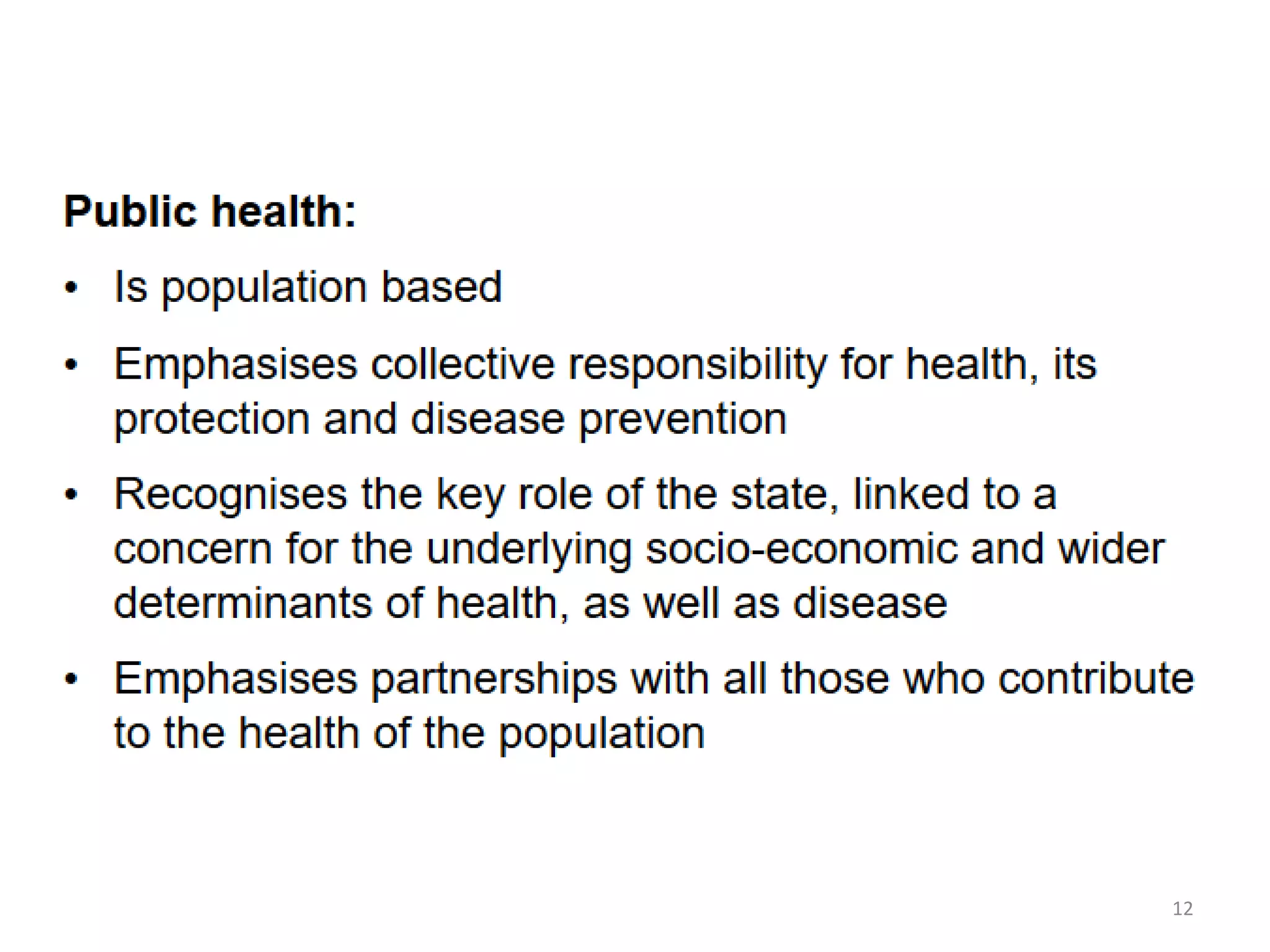
• Concepts of public health
• Major issues and challenges of Public Health
2
CONTENTS OF CLASS
3
4
5
6
7
Public health may be conceptualized as
- Analyzing the health of a population and the threats it faces is the
basis for public health.
- Science of protecting the safety and improving the health of
communities through education, policy making and research for
disease and injury prevention.
8
Comprehensive definition of Public health (Charles-Edward Amory
Winslow, 1920 ):
ā€œThe science and art of preventing disease, prolonging life, and
promoting health and efficiency through organized community
effort for:
- The sanitation of the environment
- The control of communicable infections
- The education of the individual in personal hygiene
- The organization of medical and nursing services for the early
diagnosis and preventive treatment of disease, and
- The development of the social machinery to ensure everyone a
standard of living adequate for maintenance of health
So, organizing these benefits as to enable every citizen to realize his
birth right of health and longevity.
Definition
Public Health Specialist and Clinician
In the medical field, clinicians treat diseases and injuries of one
patient at a time. But in public health, we prevent disease and injury.
Public health researchers, practitioners and educators work with
communities and populations. We identify the causes of disease and
disability, and we implement large scale solutions.
For example, instead of treating a gunshot wound, we work to
identify the causes of gun violence and develop interventions.
Instead of treating premature or low birth-weight babies, we
investigate the factors at work and we develop programs to keep
babies healthy.
10
Instead of prescribing medication for high blood pressure, we
examine the links among obesity, diabetes and heart disease—and
we use our data to influence policy aimed at reducing all
three conditions.
In public health, microbiologists work to find a vaccine for malaria,
while behavioral scientists research ways to discourage populations
from smoking. Environmental health scientists work to discover
which foods prevent cancer, while health policy analysts evaluate
health insurance programs and make recommendations. And
epidemiologists identify trends in health and illness, looking for
links, causes and interventions in areas such as HIV/AIDS,
tuberculosis and infant mortality.
11
12
13
14
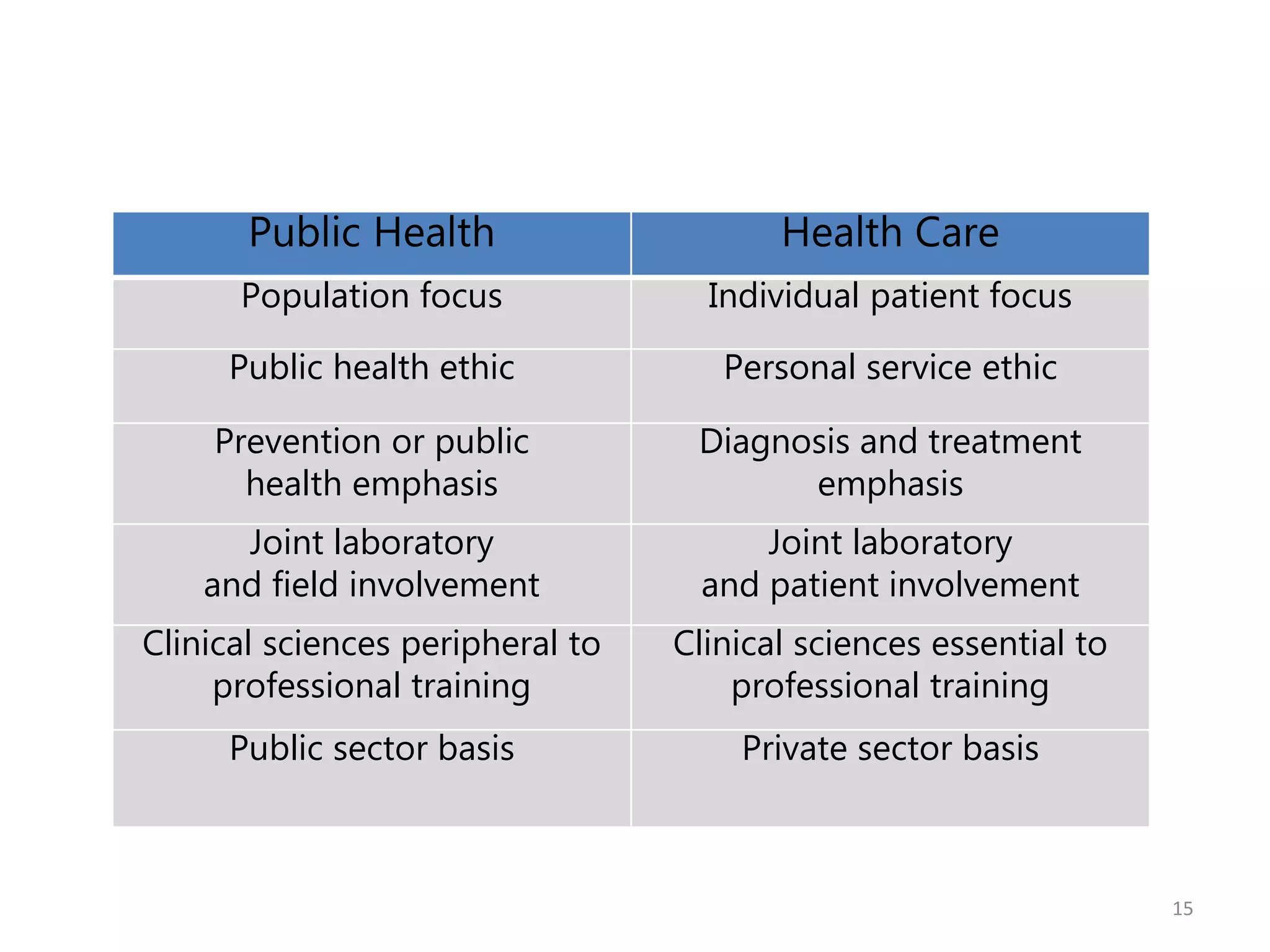
Public Health Health Care
Population focus Individual patient focus
Public health ethic Personal service ethic
Prevention or public
health emphasis
Diagnosis and treatment
emphasis
Joint laboratory
and field involvement
Joint laboratory
and patient involvement
Clinical sciences peripheral to
professional training
Clinical sciences essential to
professional training
Public sector basis Private sector basis
15
Components of PH
Public health is an interdisciplinary field. It includes:
- Epidemiology,
- Biostatistics
- Management of health services
- Environmental health,
- Community health,
- Behavioral health,
- Health economics,
- Public policy,
- Mental health,
- Occupational safety,
- Gender issues in health, and
- Sexual and reproductive health.
16
17
18
19
20
Levels of Prevention
21
22
23
Rehabilitation
24
Rehabilitation is ā€œthe combined and coordinated use of medical,
social, educational, and vocational measures for training and
retraining the individual to the highest possible level of functional
ability.ā€
25
Salutogenesis is a medical approach focusing on factors that support
human health and well-being, rather than on factors that cause
disease (pathogenesis).
Public Health Activities
26
• Prevents epidemics
• Protects the environment, workplaces, housing, food, and water
• Monitors health status of population
• Mobilizes community action
• Responds to disasters
• Assures quality, accessibility, and accountability of medical care
• Researches to develop new insights and innovative solutions
• Leads the development of sound health policy and planning
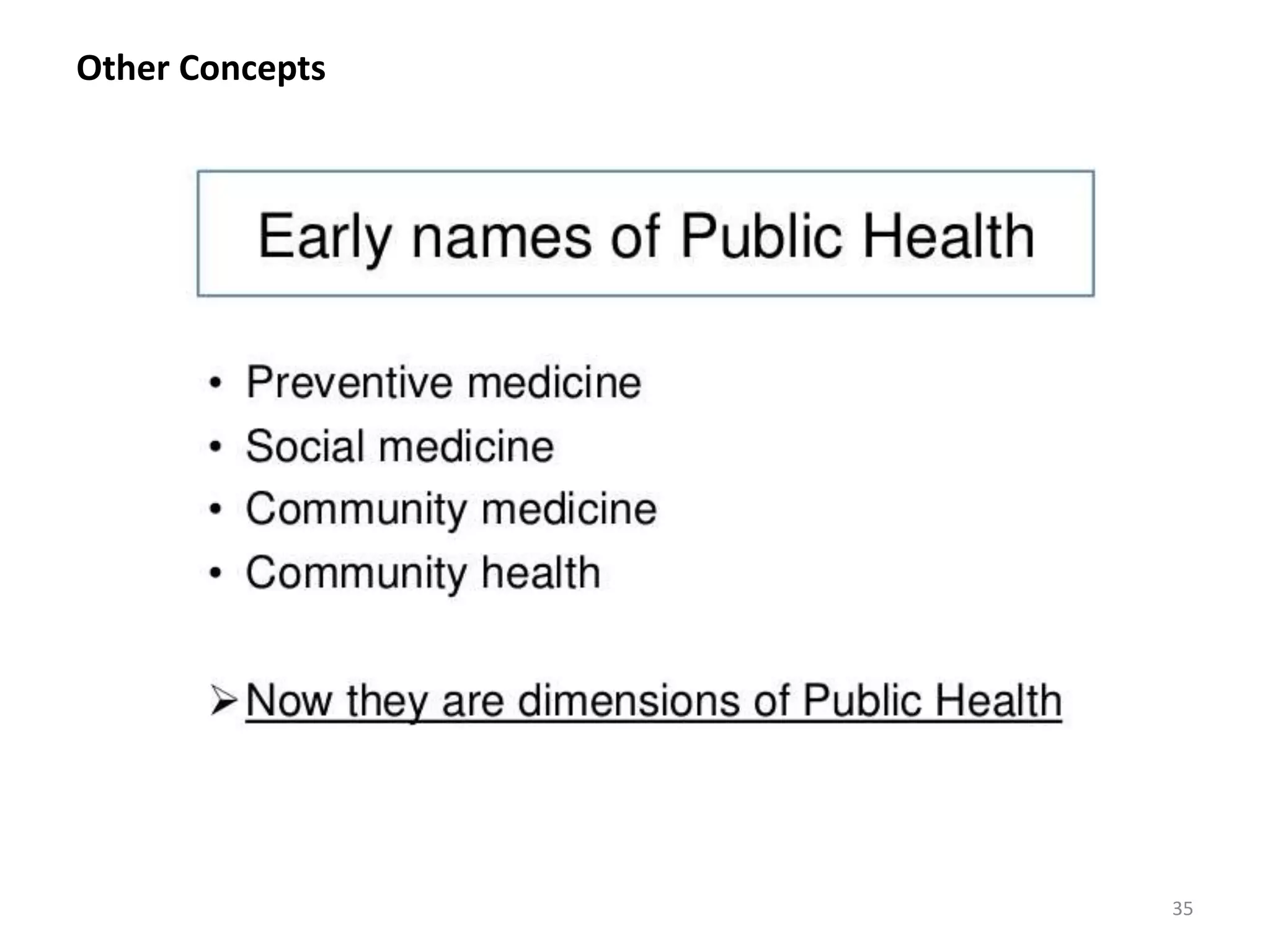
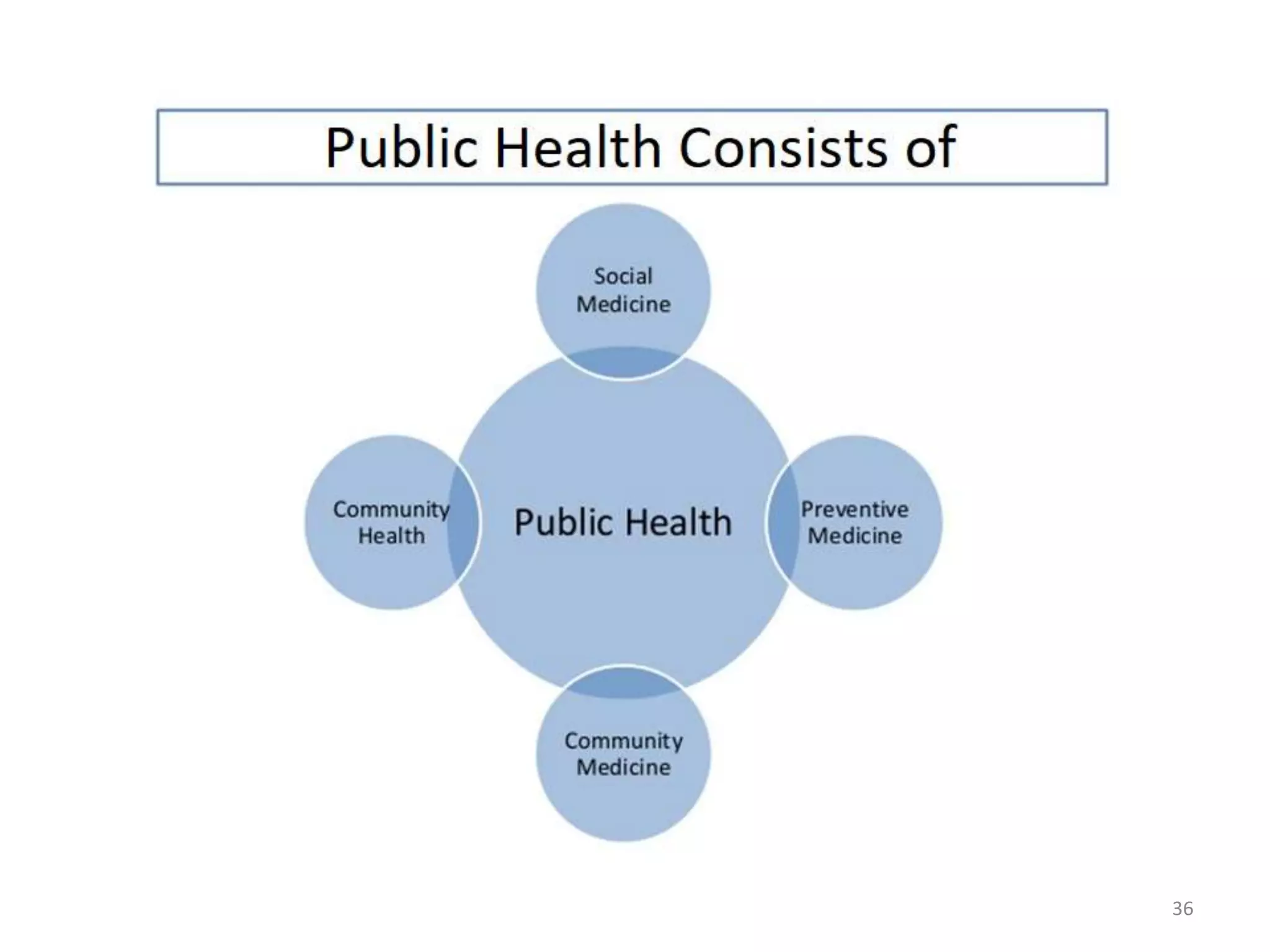
Differentiation among PH, Community Medicine,
Social Medicine & Preventive Medicine
The terms are often used interchangeably, a practice which adds to
the confusion.
Two basic concepts are at issue: public health on the one hand, and
community/social/preventive medicine on the other. The latter three
terms have different historical roots, but reflect a more or less
identical orientation.
27
The key word: community, social and preventive medicine are
considered to be, a subdivision of the overall discipline. The common
denominator of all three of these terms is "medicine." Indeed, they
constitute a very minor subdivision of ā€˜medicine’.
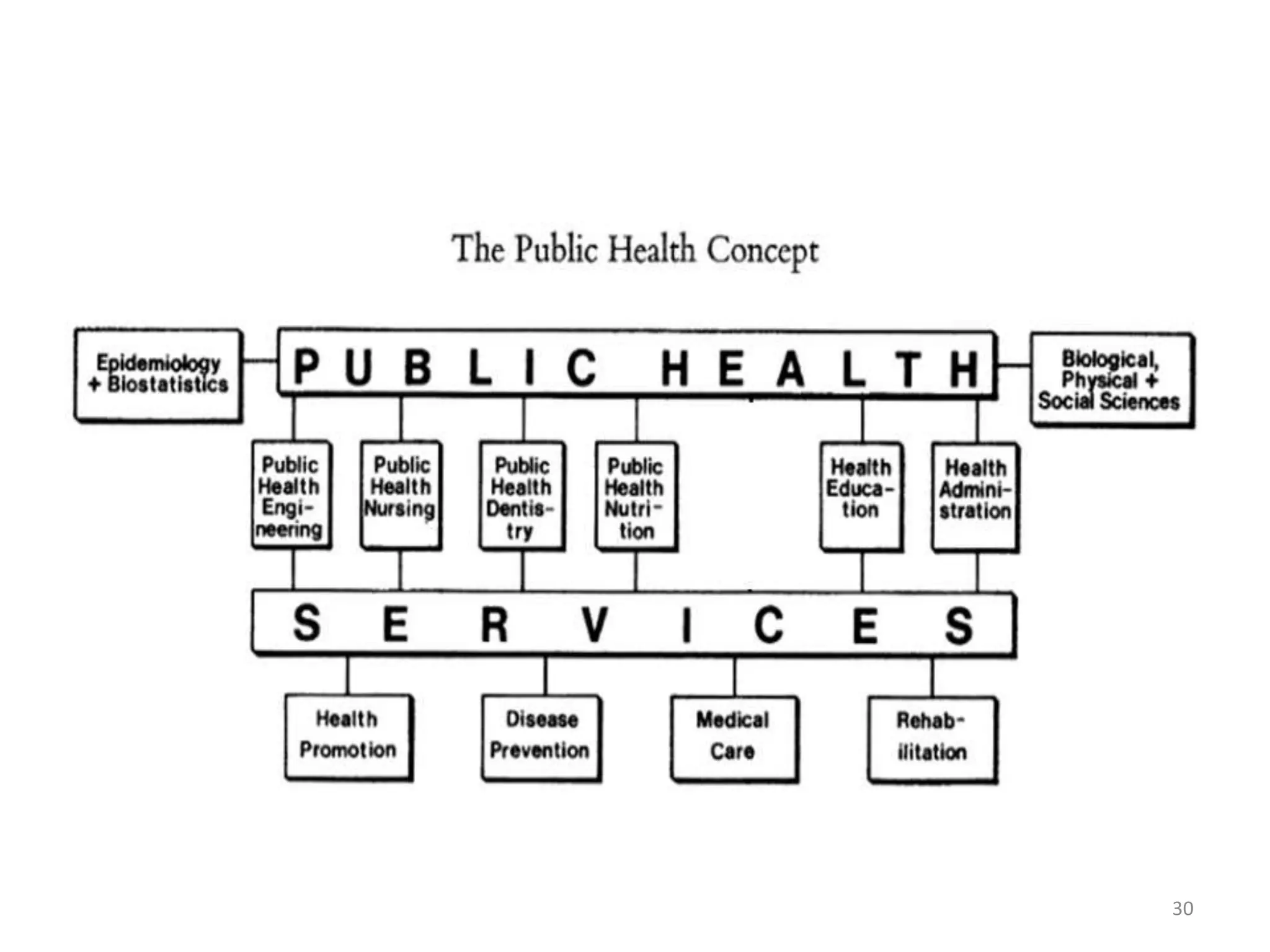
The concept of public health, on the other hand, is that of a major
governmental and social activity, multidisciplinary in nature. Here the
key word is "health," not "medicineā€œ.
28
29
30
ā€œPreventive Medicineā€œ
- The term "preventive medicine" stems in USA.
- Dominated by the medical profession.
- Concerned with the prevention of infectious diseases.
31
32
"Social Medicineā€œ
- Product of France, Germany, Belgium and other European
countries.
- Firmly based in the medical profession,
- Concerned with the role of social factors in the etiology of
disease, and the need for government action.
"Community Medicineā€œ
- "Community medicine" became prevalent in the United States as a
substitute for "social medicine," since the later term sounds too
much like "socialism.ā€œ
- It is the system of delivery of comprehensive health care by
medical professions.
- It encompasses promotive, preventive and curative health services
33
34
Other Concepts
35
36
Rise of Public Health:
The Nineteenth Century: The Great Sanitary Awakening
37
In the era of unplanned industrialization
in nineteenth century, "The great
sanitary awakening"— symbolizes the
identification of filth as both a cause of
disease and a vehicle of transmission,
and the ensuing embrace of cleanliness
as a remedy.
38
- Illness came to be seen as an indicator of poor social and
environmental conditions.
- Cleanliness was embraced as a path both to physical and moral
health.
- Disease control shifted from reacting to intermittent outbreaks to
continuing measures for prevention.
- With sanitation, public health became a societal goal and
- Protecting health became a public activity.
The Development of Public Activities in Health
39
- Edwin Chadwick, a London lawyer (1838), is one of the most
recognized names in the sanitary reform movement.
- Under Chadwick's authority, a commission conducted studies of the
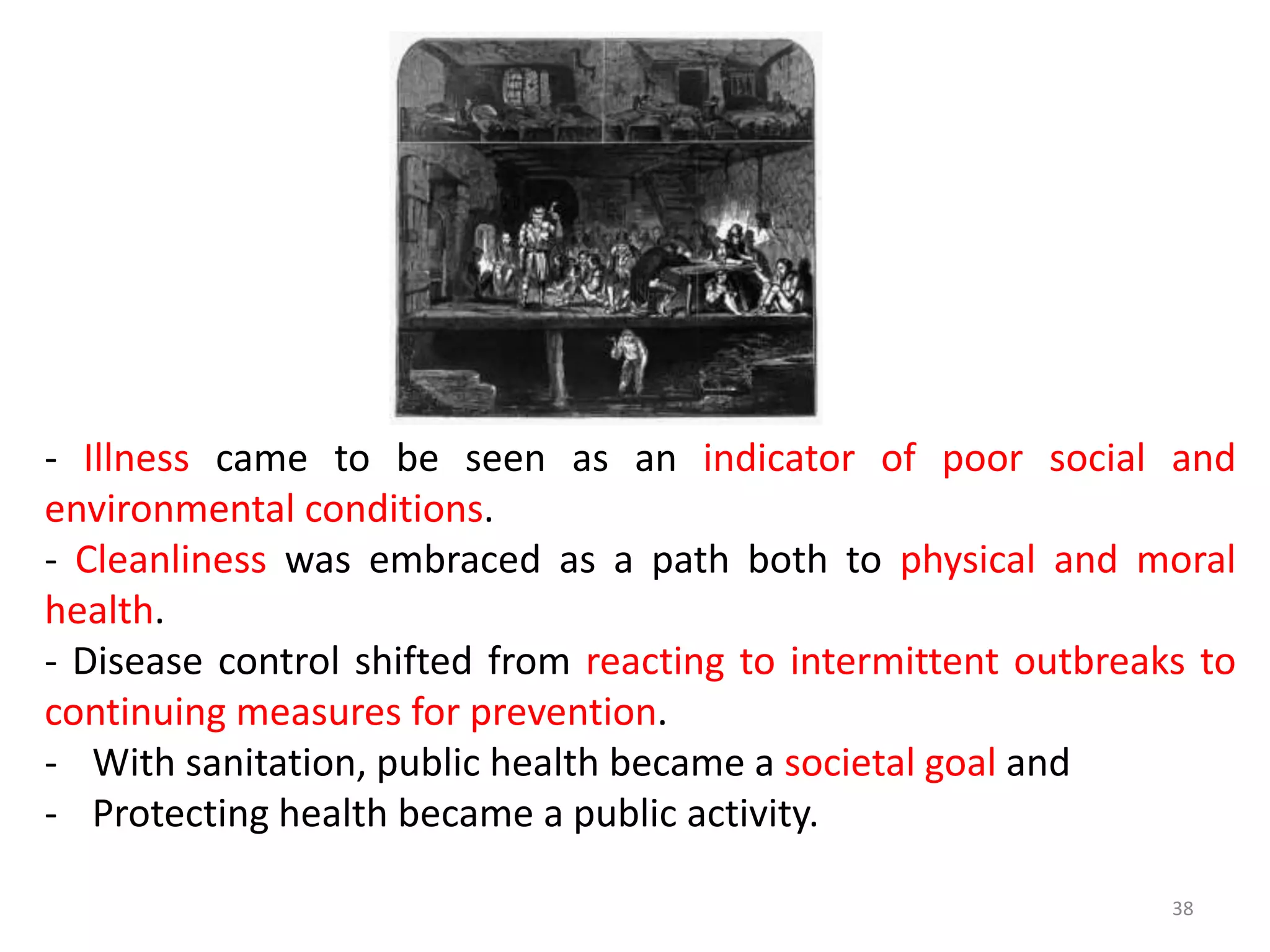
life and health of the London working class in 1838 and that of the
entire country in 1842.
40
- The report of these studies, ā€˜General Report on the Sanitary
Conditions’, was a document of the appalling conditions in which
masses of the working people were compelled to live.
- Chadwick documented that the average age at death for the gentry
was 36 years; for the tradesmen, 22 years; and for the laborers, only
16 years.
41
To remedy the situation, Chadwick proposed what came to be known
as the "sanitary idea."
- His remedy was based on the assumption that diseases are caused
by foul air from the decomposition of waste.
- To remove disease, therefore, it was necessary to build a drainage
network to remove sewage and waste.
- Chadwick's report eventually was adopted in the Public Health Act,
of 1848 in UK, and subsequently American Public Health Act 1872.
42
43
44
Beneficence refers to actions or rules aimed at benefiting others.
The concept of non-maleficence is embodied by the phrase, "first,
do no harm," or the Latin, ā€˜primum non nocere’. ā€œNon-Maleficenceā€
requires an intention to avoid needless harm or injury that can arise
through acts of commission or omission.
The principle of autonomy, views the rights of an individual to self-
determination, and respect for individuals' ability to make informed
decisions.
45
Social justice is a concept of fair and just relations between the
individual and society. Social justice assigns rights and duties in the
institutions of society, which enables people to receive the basic
benefits and cooperation.
Truth-telling, or veracity, can be defined as the avoidance of lying,
deception, misrepresentation, and non-disclosure in interactions
with patients or relevant to patient care.
46
47
48
49
50
51
52
Shifting Focus of Public Health
(Healthy People Report-1979)
53
54
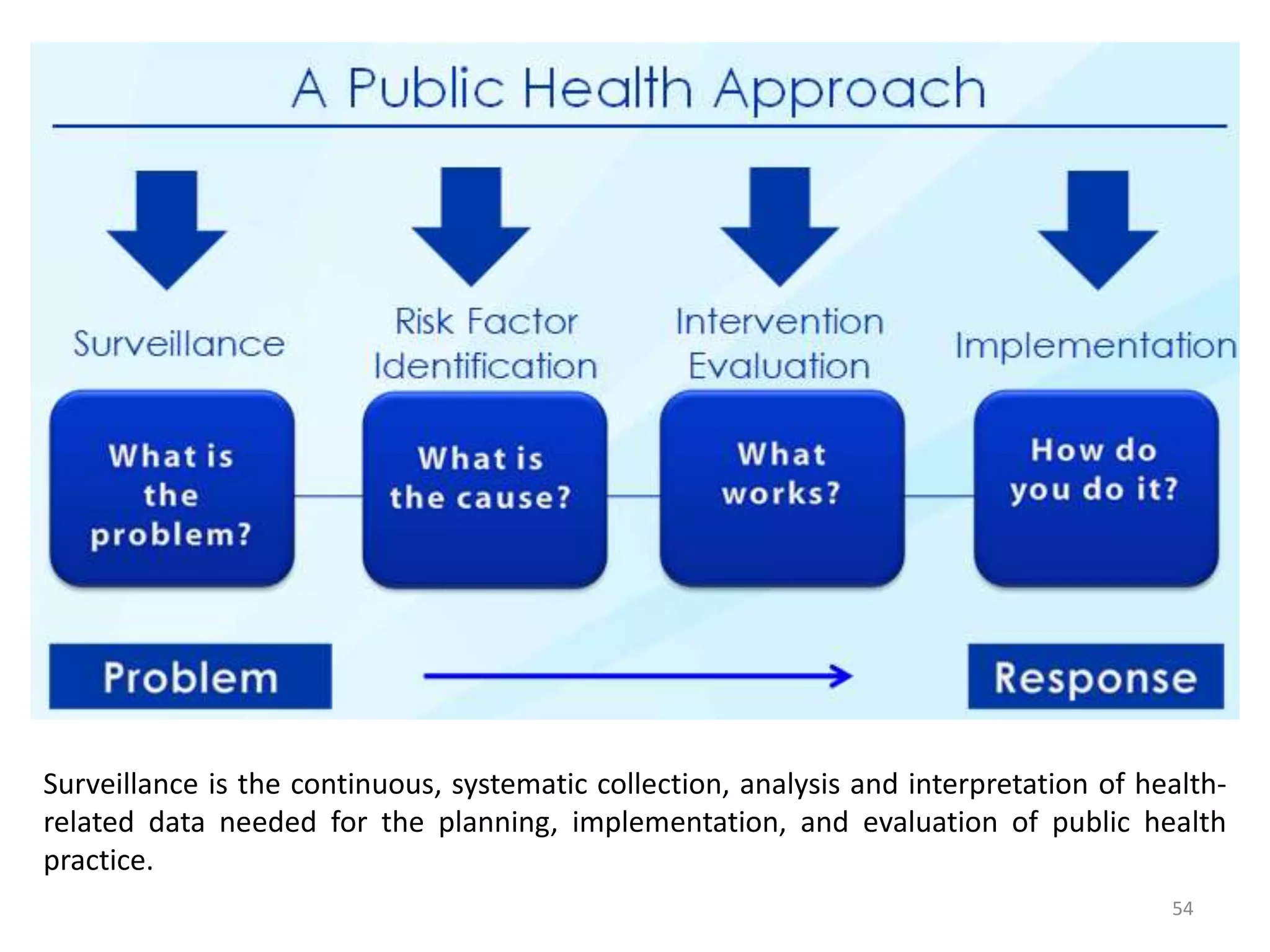
Surveillance is the continuous, systematic collection, analysis and interpretation of health-
related data needed for the planning, implementation, and evaluation of public health
practice.
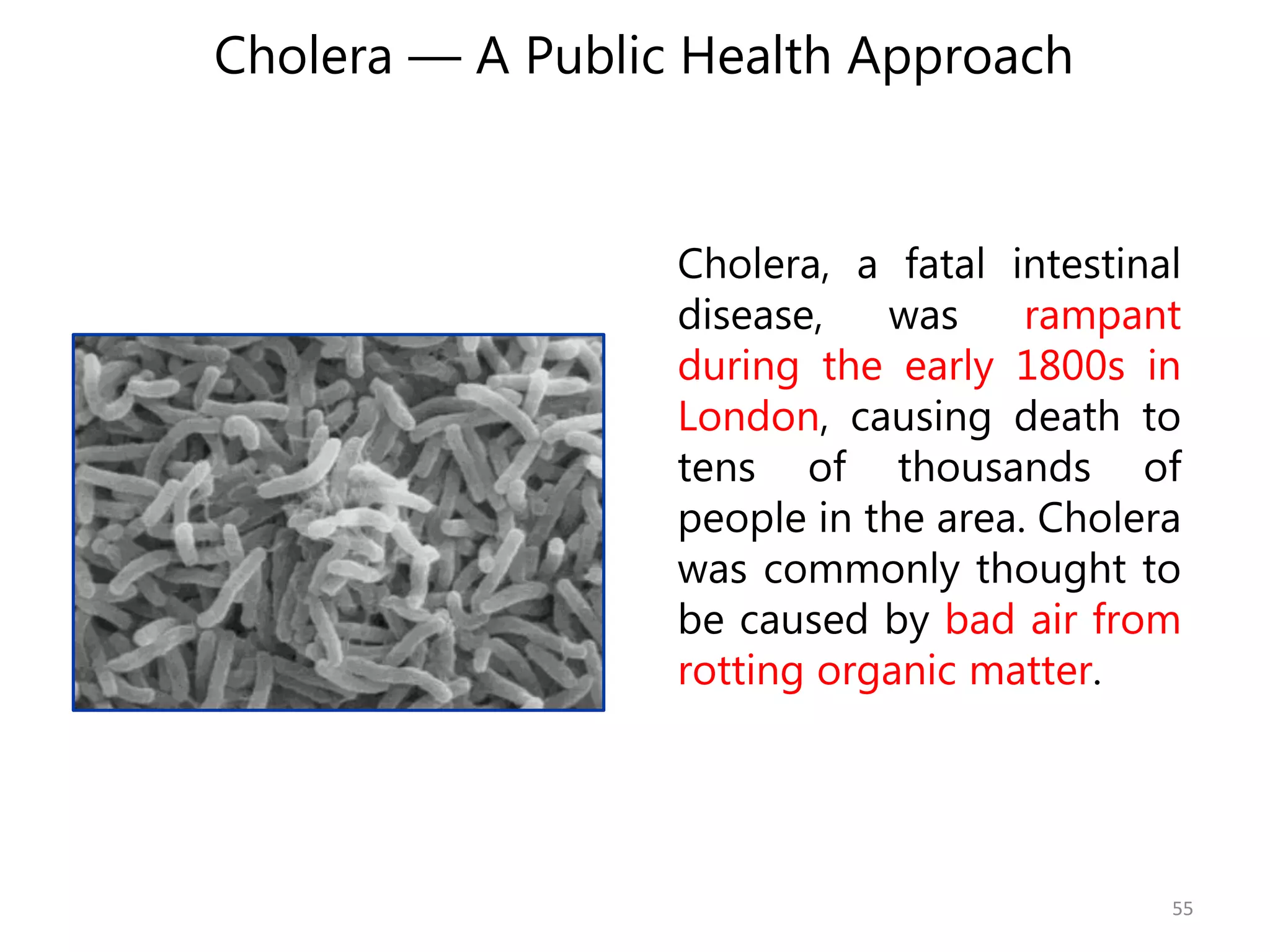
Cholera, a fatal intestinal
disease, was rampant
during the early 1800s in
London, causing death to
tens of thousands of
people in the area. Cholera
was commonly thought to
be caused by bad air from
rotting organic matter.
Cholera — A Public Health Approach
55
John Snow is best known for his
work tracing the source of the
cholera outbreak and is
considered the father of modern
epidemiology.
John Snow, Physician
56
Epidemiology — What is the Problem?
57
58
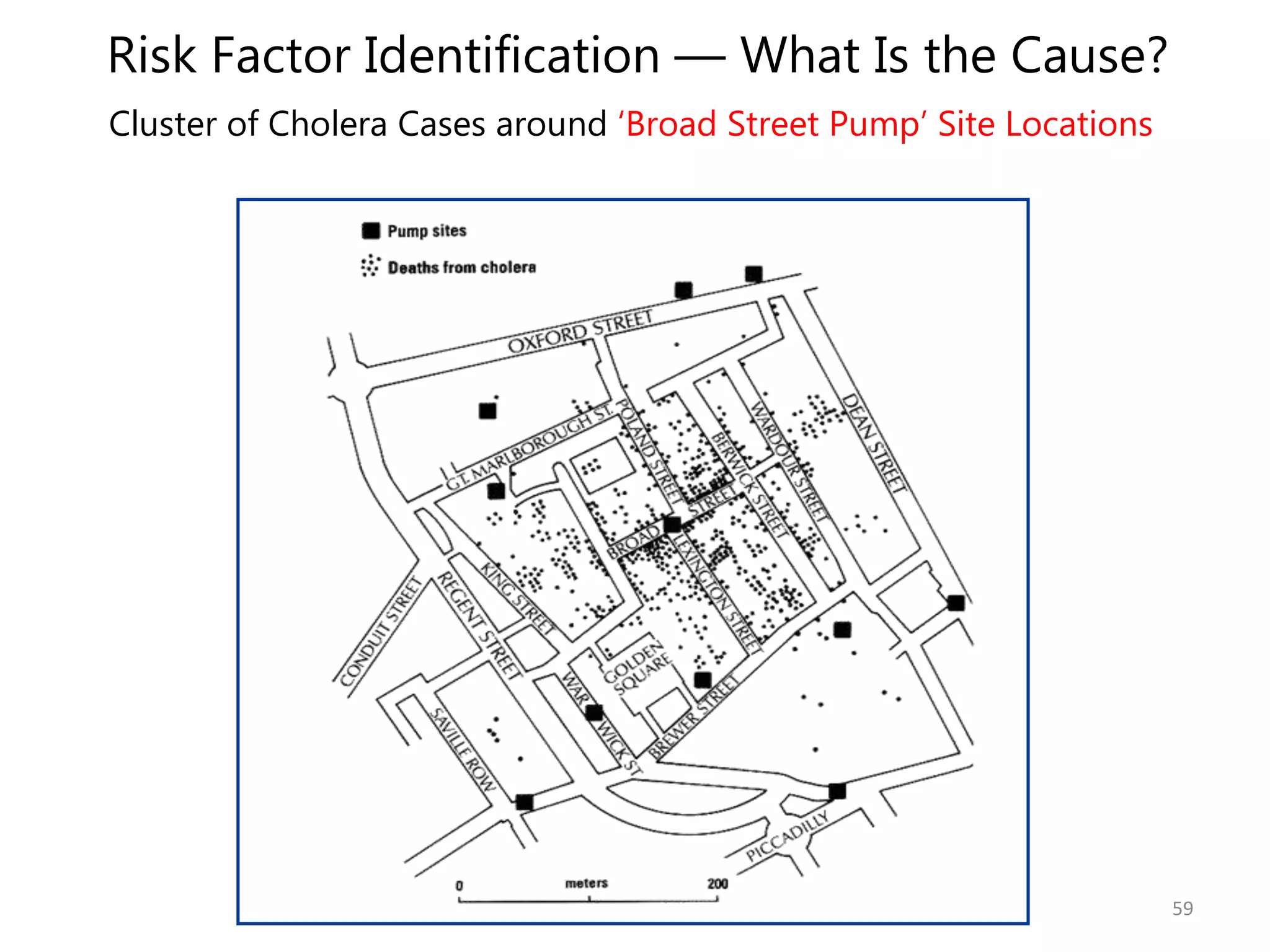
Cluster of Cholera Cases around ā€˜Broad Street Pump’ Site Locations
Risk Factor Identification — What Is the Cause?
59
Intervention Evaluation — What Works?
Through continuous research, Snow understood what
interventions were required to
• stop exposure to the supply of contaminated
water in the area
60
Implementation — How Do You Do It?
John Snow’s research
convinced the British
government that the source of
cholera was water
contaminated with sewage.
Thus Broad Street Pump to
supply water was sealed for
ever.
61
Three Core Functions of Public Health
Assessment
Policy
Development
Policy
Development
Assurance
Systematically collect, analyze, and
make available information on
population at risk to identify health
problems and priorities.
Promote the use of a scientific
knowledge base in policy and
decision making to solve
problems.
Ensure provision of services to
those in need
62
Ten Essential Public Health Services
1. Monitor Health
2. Diagnose and Investigate
3. Inform, Educate, Empower
4. Mobilize Community Partnership
5. Develop Policies
6. Enforce Laws
7. Provide Care
8. Assure a Competent Workforce
9. Evaluate
10. Research
63
Core Functions at Government Levels
Assessment
Policy
Development Assurance
Federal
State
National tobacco
public health
surveillance
Smoking ban
on commercial
flights
Federal grants
for antismoking
research
Monitor state
tobacco use
Increase
tobacco tax
Funding
for campaign
Report on local
tobacco use
County laws
prohibiting
smoking in public
places
Resources to help
smokers quit
Local
64
Stakeholder Roles in Public Health
65
Ensuring the Conditions
for Population Health
Community
Clinical Care
Delivery System
Government
Public Health
Infrastructure
Employers
and Businesses
The MediaAcademia
66
Stakeholder Roles in Public Health
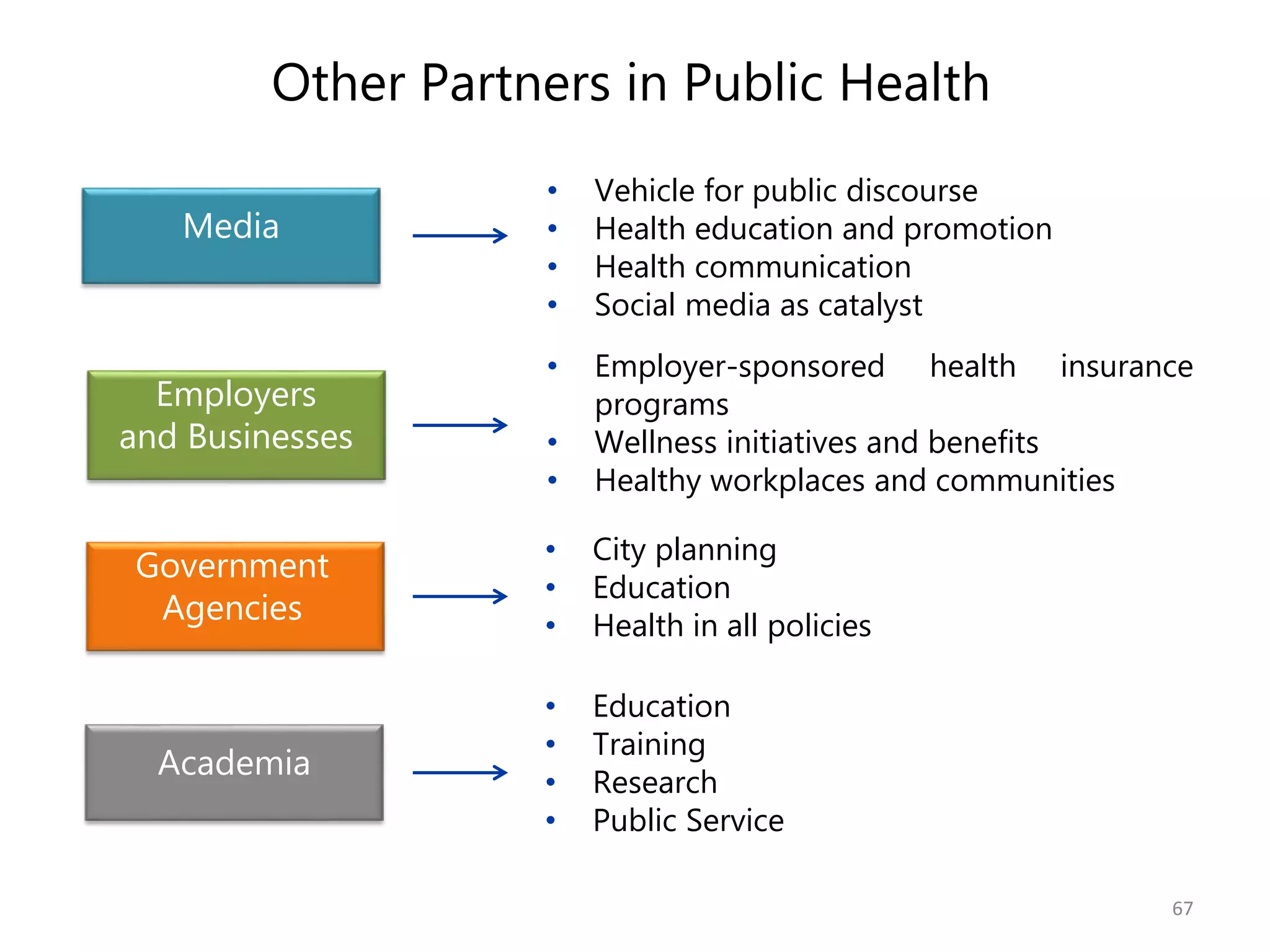
Other Partners in Public Health
Media
Employers
and Businesses
Government
Agencies
• Vehicle for public discourse
• Health education and promotion
• Health communication
• Social media as catalyst
• Employer-sponsored health insurance
programs
• Wellness initiatives and benefits
• Healthy workplaces and communities
• City planning
• Education
• Health in all policies
Academia
• Education
• Training
• Research
• Public Service
67
68
69
70
71
72
73
Other major global health issues now at the forefront include:
- Infant mortality
- Water scarcity
- Environmental risk factors (factory emissions, car exhaust, tobacco
smoke, etc.)
- Tobacco use
- Obesity
- Global warming
- Terrorism
- Substance abuse
74
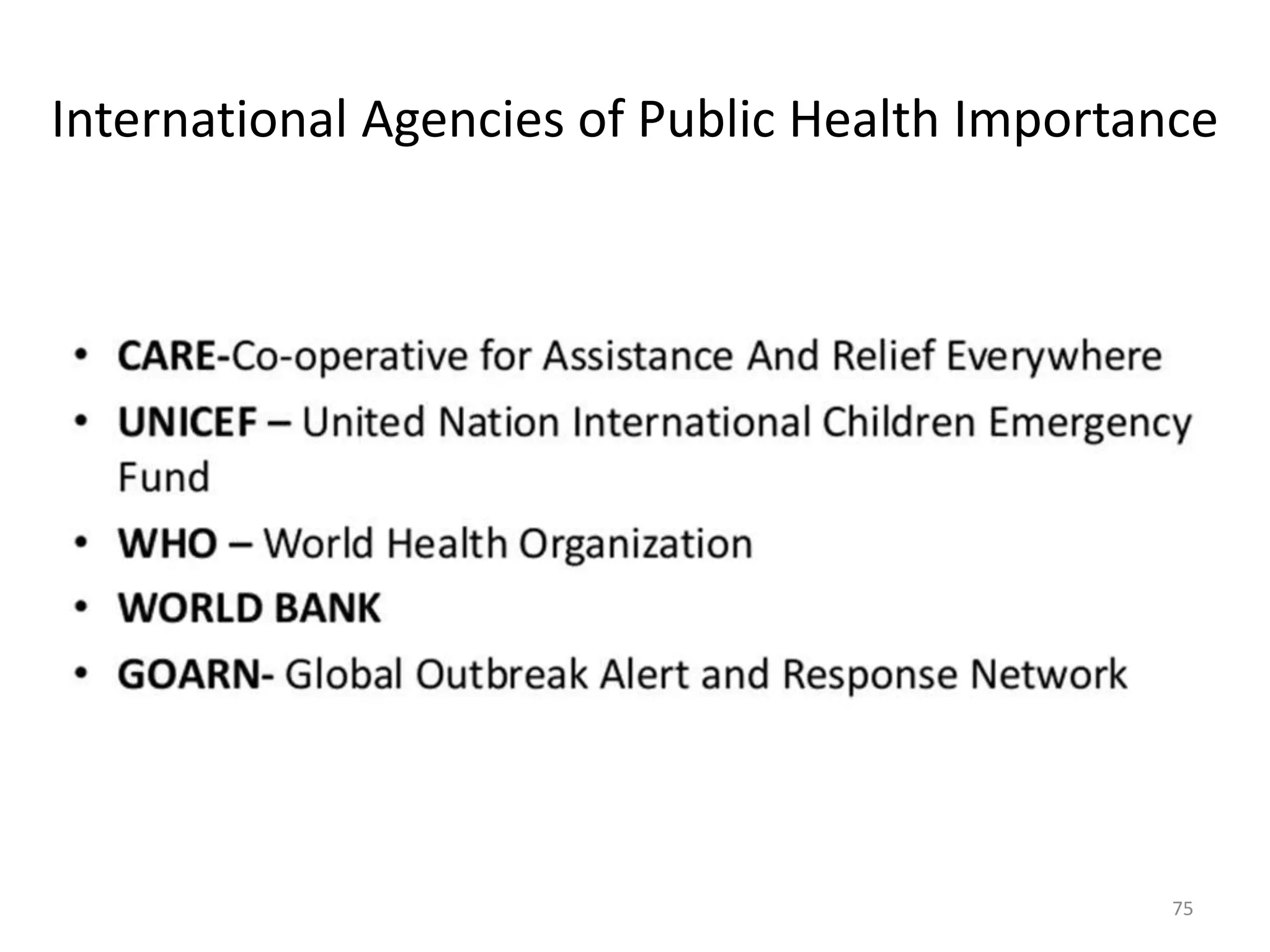
International Agencies of Public Health Importance
75
76
77
78
79
80
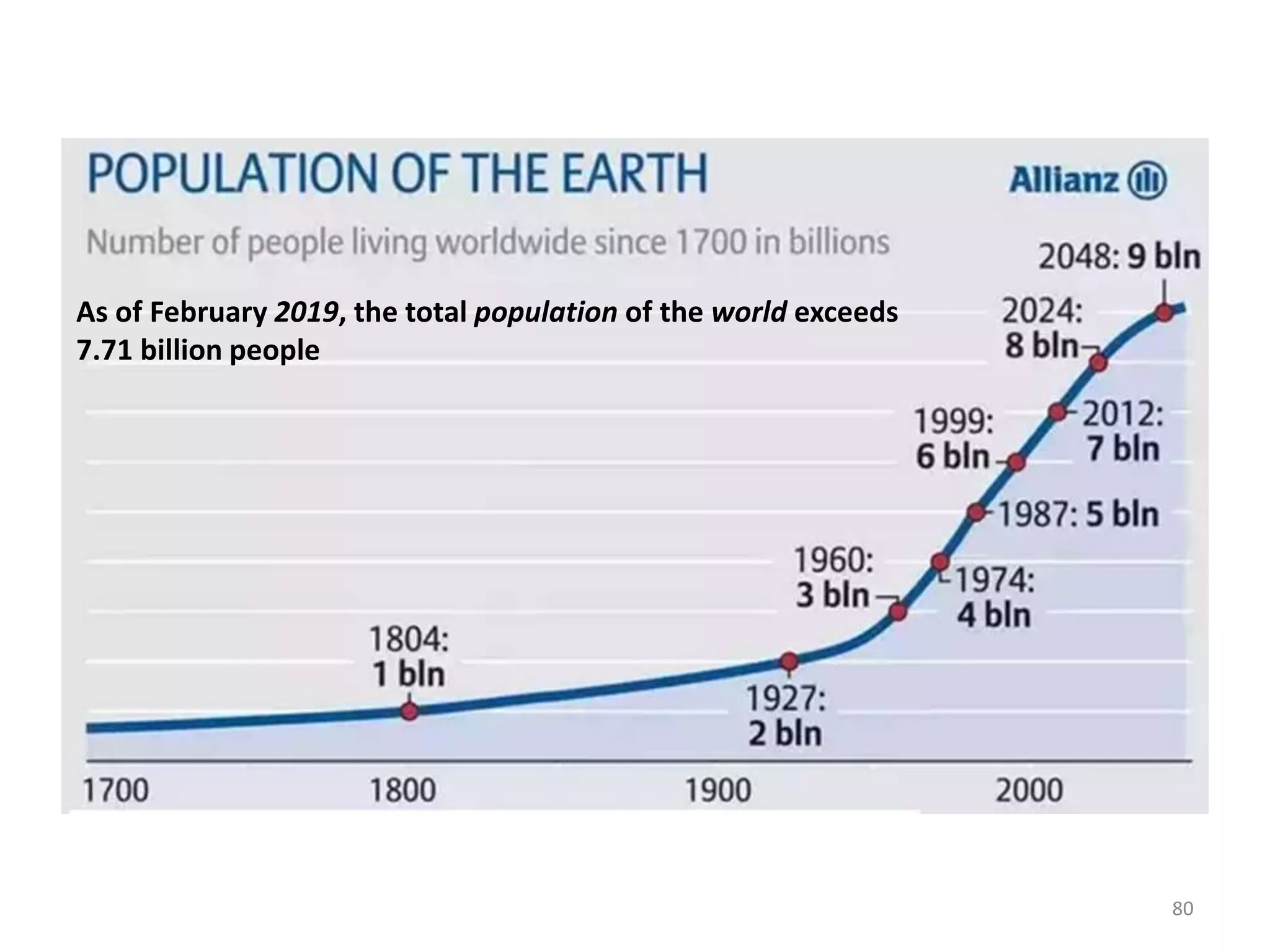
As of February 2019, the total population of the world exceeds
7.71 billion people
81
82
83
Substance Abuse
84
(Gamma-hydroxybutyrate)
85
Ethical issues and challenges of Public Health
1. Political conservatism : Reluctant to any change in health policy.
2. Individualism – Individualistic societies resist the notion of public
health’s concern for the collective.
3. Economic impacts - Public Health regulations affects the industries
(E.g. tobacco), those paying for the public health benefits may not
necessarily be the beneficiaries (E.g. Regulatory actions for worker
safety raising costs to consumers).
4. Preference for immediate result: People may not be willing to pay
costs for benefits that would accrue in the long future (E.g. measures
to limit global warming) and it is easier to calculate current costs
incurred for public health than the benefits that would come later.
86
5. Promoting public welfare versus individual liberty – Extent to
which governments should restrict individual freedom for the
purpose of improving community health.
6. Libertarianism – Restrictions on individual behavior for protecting
their own health (E.g. enforcing seat belts). libertarianism claims
that ā€œthe only purpose for which power can be rightfully exercised
over any member of a civilized community against her / his will is, if
her/his act harms others( E.g. regulate drunk behavior)
7. Public health measures and religion/moral – Some public health
measures are not acceptable on religious and moral grounds,(E.g.
sex education and distribution of contraceptives and/or condoms to
adolescences)
87
8. Values and responsibilities - Health authorities deciding on values
and choices of those they serve (e.g. whether some one should not
take the responsibility on behavior causing ill health such as
smokers, alcoholics, promiscuous people).
9. Surveillance versus cure – Surveillance is costly and time taking;
where as, cure is immediate benefit.
10. Dilemmas in Cost Benefit Analysis – Difficulty of valuing life, and
values to be assigned for the rich versus the poor.
New Concept on Public Health
88
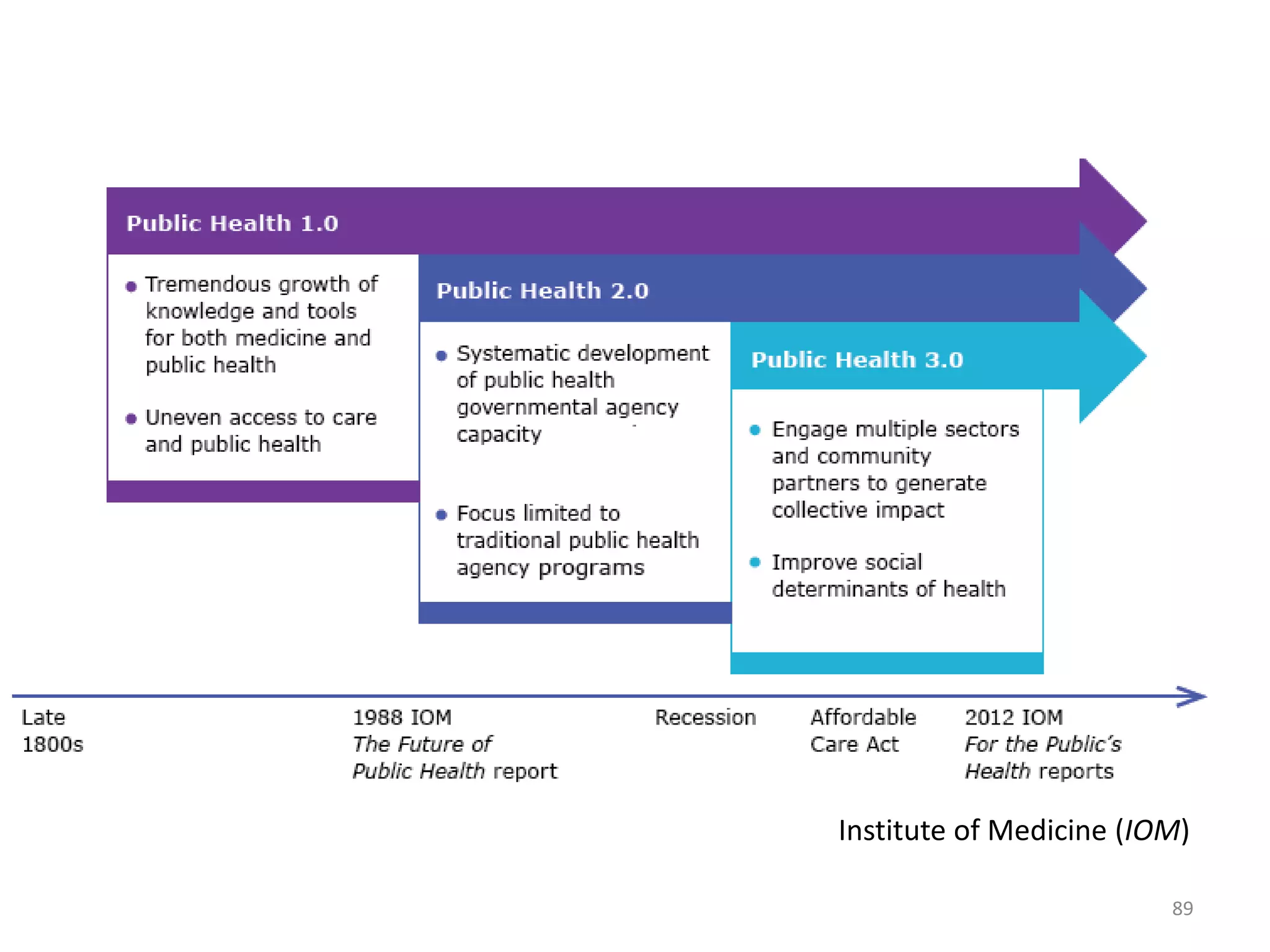
ā€œPublic Health 2.0ā€ refers to a movement that aims to make the field
of public health more accessible and user-driven by employing
participatory technologies.
Public Health 3.0 represents a challenge to business leaders,
community leaders, state lawmakers, and federal policymakers to
incorporate health into all areas of governance.
89
Institute of Medicine (IOM)
90
91
92

Public Health - Introduction

  • 1.
    PUBLIC HEALTH -INTRODUCTION Colonel (Dr) Zulfiquer Ahmed Amin M Phil, MPH, PGD (Health Economics), MBBS (DMC) Armed Forces Medical Institute (AFMI) 1
  • 2.
    • Concepts ofpublic health • Major issues and challenges of Public Health 2 CONTENTS OF CLASS
  • 3.
  • 4.
  • 5.
  • 6.
  • 7.
  • 8.
    Public health maybe conceptualized as - Analyzing the health of a population and the threats it faces is the basis for public health. - Science of protecting the safety and improving the health of communities through education, policy making and research for disease and injury prevention. 8
  • 9.
    Comprehensive definition ofPublic health (Charles-Edward Amory Winslow, 1920 ): ā€œThe science and art of preventing disease, prolonging life, and promoting health and efficiency through organized community effort for: - The sanitation of the environment - The control of communicable infections - The education of the individual in personal hygiene - The organization of medical and nursing services for the early diagnosis and preventive treatment of disease, and - The development of the social machinery to ensure everyone a standard of living adequate for maintenance of health So, organizing these benefits as to enable every citizen to realize his birth right of health and longevity. Definition
  • 10.
    Public Health Specialistand Clinician In the medical field, clinicians treat diseases and injuries of one patient at a time. But in public health, we prevent disease and injury. Public health researchers, practitioners and educators work with communities and populations. We identify the causes of disease and disability, and we implement large scale solutions. For example, instead of treating a gunshot wound, we work to identify the causes of gun violence and develop interventions. Instead of treating premature or low birth-weight babies, we investigate the factors at work and we develop programs to keep babies healthy. 10
  • 11.
    Instead of prescribingmedication for high blood pressure, we examine the links among obesity, diabetes and heart disease—and we use our data to influence policy aimed at reducing all three conditions. In public health, microbiologists work to find a vaccine for malaria, while behavioral scientists research ways to discourage populations from smoking. Environmental health scientists work to discover which foods prevent cancer, while health policy analysts evaluate health insurance programs and make recommendations. And epidemiologists identify trends in health and illness, looking for links, causes and interventions in areas such as HIV/AIDS, tuberculosis and infant mortality. 11
  • 12.
  • 13.
  • 14.
  • 15.
    Public Health HealthCare Population focus Individual patient focus Public health ethic Personal service ethic Prevention or public health emphasis Diagnosis and treatment emphasis Joint laboratory and field involvement Joint laboratory and patient involvement Clinical sciences peripheral to professional training Clinical sciences essential to professional training Public sector basis Private sector basis 15
  • 16.
    Components of PH Publichealth is an interdisciplinary field. It includes: - Epidemiology, - Biostatistics - Management of health services - Environmental health, - Community health, - Behavioral health, - Health economics, - Public policy, - Mental health, - Occupational safety, - Gender issues in health, and - Sexual and reproductive health. 16
  • 17.
  • 18.
  • 19.
  • 20.
  • 21.
  • 22.
  • 23.
  • 24.
    Rehabilitation 24 Rehabilitation is ā€œthecombined and coordinated use of medical, social, educational, and vocational measures for training and retraining the individual to the highest possible level of functional ability.ā€
  • 25.
    25 Salutogenesis is amedical approach focusing on factors that support human health and well-being, rather than on factors that cause disease (pathogenesis).
  • 26.
    Public Health Activities 26 •Prevents epidemics • Protects the environment, workplaces, housing, food, and water • Monitors health status of population • Mobilizes community action • Responds to disasters • Assures quality, accessibility, and accountability of medical care • Researches to develop new insights and innovative solutions • Leads the development of sound health policy and planning
  • 27.
    Differentiation among PH,Community Medicine, Social Medicine & Preventive Medicine The terms are often used interchangeably, a practice which adds to the confusion. Two basic concepts are at issue: public health on the one hand, and community/social/preventive medicine on the other. The latter three terms have different historical roots, but reflect a more or less identical orientation. 27
  • 28.
    The key word:community, social and preventive medicine are considered to be, a subdivision of the overall discipline. The common denominator of all three of these terms is "medicine." Indeed, they constitute a very minor subdivision of ā€˜medicine’. The concept of public health, on the other hand, is that of a major governmental and social activity, multidisciplinary in nature. Here the key word is "health," not "medicineā€œ. 28
  • 29.
  • 30.
  • 31.
    ā€œPreventive Medicineā€œ - Theterm "preventive medicine" stems in USA. - Dominated by the medical profession. - Concerned with the prevention of infectious diseases. 31
  • 32.
    32 "Social Medicineā€œ - Productof France, Germany, Belgium and other European countries. - Firmly based in the medical profession, - Concerned with the role of social factors in the etiology of disease, and the need for government action.
  • 33.
    "Community Medicineā€œ - "Communitymedicine" became prevalent in the United States as a substitute for "social medicine," since the later term sounds too much like "socialism.ā€œ - It is the system of delivery of comprehensive health care by medical professions. - It encompasses promotive, preventive and curative health services 33
  • 34.
  • 35.
  • 36.
  • 37.
    Rise of PublicHealth: The Nineteenth Century: The Great Sanitary Awakening 37 In the era of unplanned industrialization in nineteenth century, "The great sanitary awakening"— symbolizes the identification of filth as both a cause of disease and a vehicle of transmission, and the ensuing embrace of cleanliness as a remedy.
  • 38.
    38 - Illness cameto be seen as an indicator of poor social and environmental conditions. - Cleanliness was embraced as a path both to physical and moral health. - Disease control shifted from reacting to intermittent outbreaks to continuing measures for prevention. - With sanitation, public health became a societal goal and - Protecting health became a public activity.
  • 39.
    The Development ofPublic Activities in Health 39 - Edwin Chadwick, a London lawyer (1838), is one of the most recognized names in the sanitary reform movement. - Under Chadwick's authority, a commission conducted studies of the life and health of the London working class in 1838 and that of the entire country in 1842.
  • 40.
    40 - The reportof these studies, ā€˜General Report on the Sanitary Conditions’, was a document of the appalling conditions in which masses of the working people were compelled to live. - Chadwick documented that the average age at death for the gentry was 36 years; for the tradesmen, 22 years; and for the laborers, only 16 years.
  • 41.
    41 To remedy thesituation, Chadwick proposed what came to be known as the "sanitary idea." - His remedy was based on the assumption that diseases are caused by foul air from the decomposition of waste. - To remove disease, therefore, it was necessary to build a drainage network to remove sewage and waste. - Chadwick's report eventually was adopted in the Public Health Act, of 1848 in UK, and subsequently American Public Health Act 1872.
  • 42.
  • 43.
  • 44.
    44 Beneficence refers toactions or rules aimed at benefiting others. The concept of non-maleficence is embodied by the phrase, "first, do no harm," or the Latin, ā€˜primum non nocere’. ā€œNon-Maleficenceā€ requires an intention to avoid needless harm or injury that can arise through acts of commission or omission. The principle of autonomy, views the rights of an individual to self- determination, and respect for individuals' ability to make informed decisions.
  • 45.
    45 Social justice isa concept of fair and just relations between the individual and society. Social justice assigns rights and duties in the institutions of society, which enables people to receive the basic benefits and cooperation. Truth-telling, or veracity, can be defined as the avoidance of lying, deception, misrepresentation, and non-disclosure in interactions with patients or relevant to patient care.
  • 46.
  • 47.
  • 48.
  • 49.
  • 50.
  • 51.
  • 52.
  • 53.
    Shifting Focus ofPublic Health (Healthy People Report-1979) 53
  • 54.
    54 Surveillance is thecontinuous, systematic collection, analysis and interpretation of health- related data needed for the planning, implementation, and evaluation of public health practice.
  • 55.
    Cholera, a fatalintestinal disease, was rampant during the early 1800s in London, causing death to tens of thousands of people in the area. Cholera was commonly thought to be caused by bad air from rotting organic matter. Cholera — A Public Health Approach 55
  • 56.
    John Snow isbest known for his work tracing the source of the cholera outbreak and is considered the father of modern epidemiology. John Snow, Physician 56
  • 57.
    Epidemiology — Whatis the Problem? 57
  • 58.
  • 59.
    Cluster of CholeraCases around ā€˜Broad Street Pump’ Site Locations Risk Factor Identification — What Is the Cause? 59
  • 60.
    Intervention Evaluation —What Works? Through continuous research, Snow understood what interventions were required to • stop exposure to the supply of contaminated water in the area 60
  • 61.
    Implementation — HowDo You Do It? John Snow’s research convinced the British government that the source of cholera was water contaminated with sewage. Thus Broad Street Pump to supply water was sealed for ever. 61
  • 62.
    Three Core Functionsof Public Health Assessment Policy Development Policy Development Assurance Systematically collect, analyze, and make available information on population at risk to identify health problems and priorities. Promote the use of a scientific knowledge base in policy and decision making to solve problems. Ensure provision of services to those in need 62
  • 63.
    Ten Essential PublicHealth Services 1. Monitor Health 2. Diagnose and Investigate 3. Inform, Educate, Empower 4. Mobilize Community Partnership 5. Develop Policies 6. Enforce Laws 7. Provide Care 8. Assure a Competent Workforce 9. Evaluate 10. Research 63
  • 64.
    Core Functions atGovernment Levels Assessment Policy Development Assurance Federal State National tobacco public health surveillance Smoking ban on commercial flights Federal grants for antismoking research Monitor state tobacco use Increase tobacco tax Funding for campaign Report on local tobacco use County laws prohibiting smoking in public places Resources to help smokers quit Local 64
  • 65.
    Stakeholder Roles inPublic Health 65
  • 66.
    Ensuring the Conditions forPopulation Health Community Clinical Care Delivery System Government Public Health Infrastructure Employers and Businesses The MediaAcademia 66 Stakeholder Roles in Public Health
  • 67.
    Other Partners inPublic Health Media Employers and Businesses Government Agencies • Vehicle for public discourse • Health education and promotion • Health communication • Social media as catalyst • Employer-sponsored health insurance programs • Wellness initiatives and benefits • Healthy workplaces and communities • City planning • Education • Health in all policies Academia • Education • Training • Research • Public Service 67
  • 68.
  • 69.
  • 70.
  • 71.
  • 72.
  • 73.
  • 74.
    Other major globalhealth issues now at the forefront include: - Infant mortality - Water scarcity - Environmental risk factors (factory emissions, car exhaust, tobacco smoke, etc.) - Tobacco use - Obesity - Global warming - Terrorism - Substance abuse 74
  • 75.
    International Agencies ofPublic Health Importance 75
  • 76.
  • 77.
  • 78.
  • 79.
  • 80.
    80 As of February2019, the total population of the world exceeds 7.71 billion people
  • 81.
  • 82.
  • 83.
  • 84.
  • 85.
    85 Ethical issues andchallenges of Public Health 1. Political conservatism : Reluctant to any change in health policy. 2. Individualism – Individualistic societies resist the notion of public health’s concern for the collective. 3. Economic impacts - Public Health regulations affects the industries (E.g. tobacco), those paying for the public health benefits may not necessarily be the beneficiaries (E.g. Regulatory actions for worker safety raising costs to consumers). 4. Preference for immediate result: People may not be willing to pay costs for benefits that would accrue in the long future (E.g. measures to limit global warming) and it is easier to calculate current costs incurred for public health than the benefits that would come later.
  • 86.
    86 5. Promoting publicwelfare versus individual liberty – Extent to which governments should restrict individual freedom for the purpose of improving community health. 6. Libertarianism – Restrictions on individual behavior for protecting their own health (E.g. enforcing seat belts). libertarianism claims that ā€œthe only purpose for which power can be rightfully exercised over any member of a civilized community against her / his will is, if her/his act harms others( E.g. regulate drunk behavior) 7. Public health measures and religion/moral – Some public health measures are not acceptable on religious and moral grounds,(E.g. sex education and distribution of contraceptives and/or condoms to adolescences)
  • 87.
    87 8. Values andresponsibilities - Health authorities deciding on values and choices of those they serve (e.g. whether some one should not take the responsibility on behavior causing ill health such as smokers, alcoholics, promiscuous people). 9. Surveillance versus cure – Surveillance is costly and time taking; where as, cure is immediate benefit. 10. Dilemmas in Cost Benefit Analysis – Difficulty of valuing life, and values to be assigned for the rich versus the poor.
  • 88.
    New Concept onPublic Health 88 ā€œPublic Health 2.0ā€ refers to a movement that aims to make the field of public health more accessible and user-driven by employing participatory technologies. Public Health 3.0 represents a challenge to business leaders, community leaders, state lawmakers, and federal policymakers to incorporate health into all areas of governance.
  • 89.
  • 90.
  • 91.
  • 92.