STUDY OF CRUDE DRUGS
ANTI-TUMOUR, ANTIDIABETICS, DIURETICS
ANUBHAV GUPTA
B. PHARM
VBS Purvanchal University, Jaunpur
M. PHARM*
(Pharmacognosy)
ANUBHAV GUPTA 1
โ€ข Anti-tumour are also known as anti-cancer or anit-neoplastic drugs.
โ€ข These are the agents that is effective in the treatment of malignant or
cancerous disease, or they.
โ€ข This can be achieved either by inhibiting the cell growth by interfering with
DNA.
โ€ข Crude Drugs having this action are:
โ€ข Vinca
โ€ข Podophyllum
ANTI-TUMOUR
ANUBHAV GUPTA 2
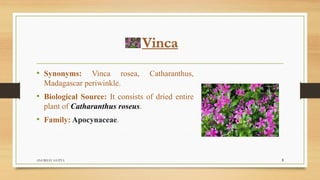
Vinca
โ€ข Synonyms: Vinca rosea, Catharanthus,
Madagascar periwinkle.
โ€ข Biological Source: It consists of dried entire
plant of Catharanthus roseus.
โ€ข Family: Apocynaceae.
ANUBHAV GUPTA 3
Vinca
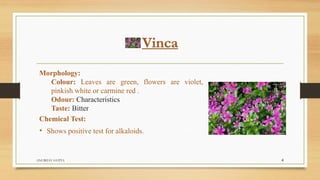
Morphology:
Colour: Leaves are green, flowers are violet,
pinkish white or carmine red .
Odour: Characteristics
Taste: Bitter
Chemical Test:
โ€ข Shows positive test for alkaloids.
ANUBHAV GUPTA 4
Vinca
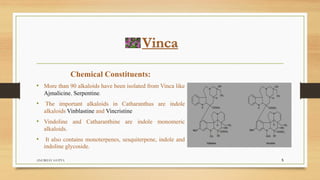
Chemical Constituents:
โ€ข More than 90 alkaloids have been isolated from Vinca like
Ajmalicine, Serpentine.
โ€ข The important alkaloids in Catharanthus are indole
alkaloids Vinblastine and Vincristine
โ€ข Vindoline and Catharanthine are indole monomeric
alkaloids.
โ€ข It also contains monoterpenes, sesquiterpene, indole and
indoline glycoside.
ANUBHAV GUPTA 5
Vinca
Therapeutic Efficacy:
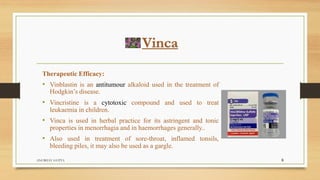
โ€ข Vinblastin is an antitumour alkaloid used in the treatment of
Hodgkinโ€™s disease.
โ€ข Vincristine is a cytotoxic compound and used to treat
leukaemia in children.
โ€ข Vinca is used in herbal practice for its astringent and tonic
properties in menorrhagia and in haemorrhages generally..
โ€ข Also used in treatment of sore-throat, inflamed tonsils,
bleeding piles, it may also be used as a gargle.
ANUBHAV GUPTA 6
Podophyllum
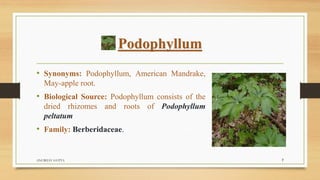
โ€ข Synonyms: Podophyllum, American Mandrake,
May-apple root.
โ€ข Biological Source: Podophyllum consists of the
dried rhizomes and roots of Podophyllum
peltatum
โ€ข Family: Berberidaceae.
ANUBHAV GUPTA 7
Podophyllum
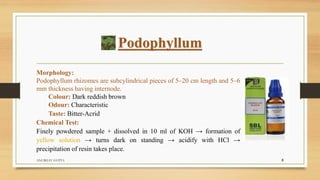
Morphology:
Podophyllum rhizomes are subcylindrical pieces of 5โ€“20 cm length and 5โ€“6
mm thickness having internode.
Colour: Dark reddish brown
Odour: Characteristic
Taste: Bitter-Acrid
Chemical Test:
Finely powdered sample + dissolved in 10 ml of KOH โ†’ formation of
yellow solution โ†’ turns dark on standing โ†’ acidify with HCl โ†’
precipitation of resin takes place.
ANUBHAV GUPTA 8
Podophyllum
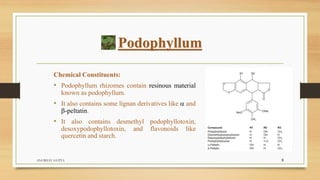
Chemical Constituents:
โ€ข Podophyllum rhizomes contain resinous material
known as podophyllum.
โ€ข It also contains some lignan derivatives like ๏ก and
๏ข-peltatin.
โ€ข It also contains desmethyl podophyllotoxin,
desoxypodophyllotoxin, and flavonoids like
quercetin and starch.
ANUBHAV GUPTA 9
Podophyllum
Therapeutic Efficacy:
โ€ข Podophyllum resin or podophyllin shows cytotoxic
activity.
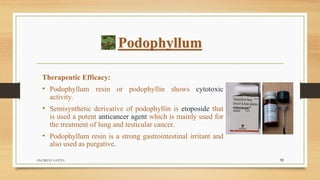
โ€ข Semisynthetic derivative of podophyllin is etoposide that
is used a potent anticancer agent which is mainly used for
the treatment of lung and testicular cancer.
โ€ข Podophyllum resin is a strong gastrointestinal irritant and
also used as purgative.
ANUBHAV GUPTA 10
ANTIDIABETICS
โ€ข The agents or drugs which helps in to control and manage the blood glucose level of a
person suffering from diabetes are called antidiabetics.
โ€ข There are various classes of these agents like sulfonylureas, meglitinides, biguanides,
thiazolidinediones and alpha-glucosidase inhibitors.
โ€ข The most widely used antidiabetics drugs are: Metformin, Glibenclamide, Glipizide,
Sitagliptin etc.
โ€ข Crude Drugs having this action are:
โ€ข Pterocarpus
โ€ข Gymnema
โ€ข Fenugreek
ANUBHAV GUPTA 11
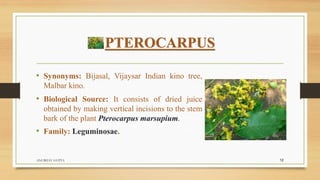
PTEROCARPUS
โ€ข Synonyms: Bijasal, Vijaysar Indian kino tree,
Malbar kino.
โ€ข Biological Source: It consists of dried juice
obtained by making vertical incisions to the stem
bark of the plant Pterocarpus marsupium.
โ€ข Family: Leguminosae.
ANUBHAV GUPTA 12
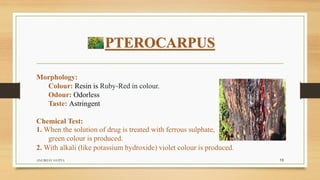
PTEROCARPUS
Morphology:
Colour: Resin is Ruby-Red in colour.
Odour: Odorless
Taste: Astringent
Chemical Test:
1. When the solution of drug is treated with ferrous sulphate,
green colour is produced.
2. With alkali (like potassium hydroxide) violet colour is produced.
ANUBHAV GUPTA 13
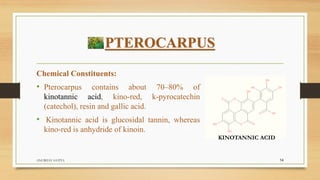
PTEROCARPUS
Chemical Constituents:
โ€ข Pterocarpus contains about 70โ€“80% of
kinotannic acid, kino-red, k-pyrocatechin
(catechol), resin and gallic acid.
โ€ข Kinotannic acid is glucosidal tannin, whereas
kino-red is anhydride of kinoin.
ANUBHAV GUPTA 14
KINOTANNIC ACID
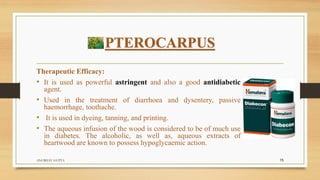
PTEROCARPUS
Therapeutic Efficacy:
โ€ข It is used as powerful astringent and also a good antidiabetic
agent.
โ€ข Used in the treatment of diarrhoea and dysentery, passive
haemorrhage, toothache.
โ€ข It is used in dyeing, tanning, and printing.
โ€ข The aqueous infusion of the wood is considered to be of much use
in diabetes. The alcoholic, as well as, aqueous extracts of
heartwood are known to possess hypoglycaemic action.
ANUBHAV GUPTA 15
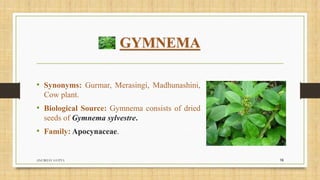
GYMNEMA
โ€ข Synonyms: Gurmar, Merasingi, Madhunashini,
Cow plant.
โ€ข Biological Source: Gymnema consists of dried
seeds of Gymnema sylvestre.
โ€ข Family: Apocynaceae.
ANUBHAV GUPTA 16
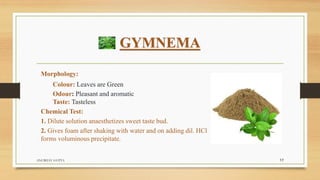
GYMNEMA
Morphology:
Colour: Leaves are Green
Odour: Pleasant and aromatic
Taste: Tasteless
Chemical Test:
1. Dilute solution anaesthetizes sweet taste bud.
2. Gives foam after shaking with water and on adding dil. HCl
forms voluminous precipitate.
ANUBHAV GUPTA 17
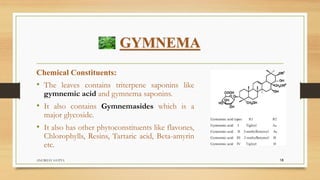
GYMNEMA
Chemical Constituents:
โ€ข The leaves contains triterpene saponins like
gymnemic acid and gymnema saponins.
โ€ข It also contains Gymnemasides which is a
major glycoside.
โ€ข It also has other phytoconstituents like flavones,
Chlorophylls, Resins, Tartaric acid, Beta-amyrin
etc.
ANUBHAV GUPTA 18
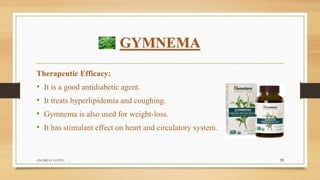
GYMNEMA
Therapeutic Efficacy:
โ€ข It is a good antidiabetic agent.
โ€ข It treats hyperlipidemia and coughing.
โ€ข Gymnema is also used for weight-loss.
โ€ข It has stimulant effect on heart and circulatory system.
ANUBHAV GUPTA 19
DIURETICS
โ€ข Diuretics are also termed as water-pills, which increases the flow of urine(diuresis) by
removal of excess water and salts.
โ€ข Since they helps in removal of salts(Na+) that`s why they are also used to lower the blood
pressure.
โ€ข Diuretics promotes removal of excess water, salts, poisons, accumulated metabolic
products like urea etc.
โ€ข Loop-acting, potassium-sparing and thiazide diuretics are most widely used diuretics.
โ€ข Crude Drugs having this action are:
โ€ข Gokhru
โ€ข Punarnava
ANUBHAV GUPTA 20
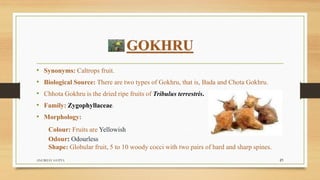
GOKHRU
โ€ข Synonyms: Caltrops fruit.
โ€ข Biological Source: There are two types of Gokhru, that is, Bada and Chota Gokhru.
โ€ข Chhota Gokhru is the dried ripe fruits of Tribulus terrestris.
โ€ข Family: Zygophyllaceae.
โ€ข Morphology:
Colour: Fruits are Yellowish
Odour: Odourless
Shape: Globular fruit, 5 to 10 woody cocci with two pairs of hard and sharp spines.
ANUBHAV GUPTA 21
GOKHRU
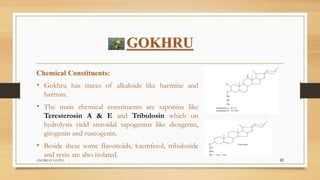
Chemical Constituents:
โ€ข Gokhru has traces of alkaloids like harmine and
harman.
โ€ข The main chemical constituents are saponins like
Teresterosin A & E and Tribulosin which on
hydrolysis yield steroidal sapogenins like diosgenin,
gitogenin and ruscogenin.
โ€ข Beside these some flavonoids, kaemferol, tribuloside
and resin are also isolated.
ANUBHAV GUPTA 22
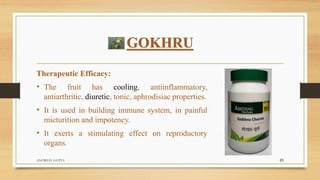
GOKHRU
Therapeutic Efficacy:
โ€ข The fruit has cooling, antiinflammatory,
antiarthritic, diuretic, tonic, aphrodisiac properties.
โ€ข It is used in building immune system, in painful
micturition and impotency.
โ€ข It exerts a stimulating effect on reproductory
organs.
ANUBHAV GUPTA 23
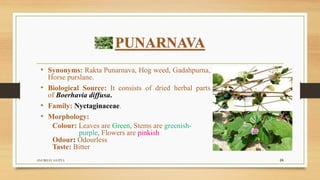
PUNARNAVA
โ€ข Synonyms: Rakta Punarnava, Hog weed, Gadahpurna,
Horse purslane.
โ€ข Biological Source: It consists of dried herbal parts
of Boerhavia diffusa.
โ€ข Family: Nyctaginaceae.
โ€ข Morphology:
Colour: Leaves are Green, Stems are greenish-
purple, Flowers are pinkish
Odour: Odourless
Taste: Bitter
ANUBHAV GUPTA 24
PUNARNAVA
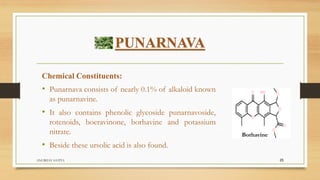
Chemical Constituents:
โ€ข Punarnava consists of nearly 0.1% of alkaloid known
as punarnavine.
โ€ข It also contains phenolic glycoside punarnavoside,
rotenoids, boeravinone, borhavine and potassium
nitrate.
โ€ข Beside these ursolic acid is also found.
ANUBHAV GUPTA 25
Borhavine
PUNARNAVA
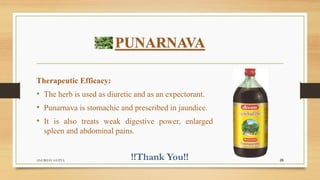
Therapeutic Efficacy:
โ€ข The herb is used as diuretic and as an expectorant.
โ€ข Punarnava is stomachic and prescribed in jaundice.
โ€ข It is also treats weak digestive power, enlarged
spleen and abdominal pains.
ANUBHAV GUPTA 26

Antitumor diabetics diuretics.pdf

  • 1.
    STUDY OF CRUDEDRUGS ANTI-TUMOUR, ANTIDIABETICS, DIURETICS ANUBHAV GUPTA B. PHARM VBS Purvanchal University, Jaunpur M. PHARM* (Pharmacognosy) ANUBHAV GUPTA 1
  • 2.
    โ€ข Anti-tumour arealso known as anti-cancer or anit-neoplastic drugs. โ€ข These are the agents that is effective in the treatment of malignant or cancerous disease, or they. โ€ข This can be achieved either by inhibiting the cell growth by interfering with DNA. โ€ข Crude Drugs having this action are: โ€ข Vinca โ€ข Podophyllum ANTI-TUMOUR ANUBHAV GUPTA 2
  • 3.
    Vinca โ€ข Synonyms: Vincarosea, Catharanthus, Madagascar periwinkle. โ€ข Biological Source: It consists of dried entire plant of Catharanthus roseus. โ€ข Family: Apocynaceae. ANUBHAV GUPTA 3
  • 4.
    Vinca Morphology: Colour: Leaves aregreen, flowers are violet, pinkish white or carmine red . Odour: Characteristics Taste: Bitter Chemical Test: โ€ข Shows positive test for alkaloids. ANUBHAV GUPTA 4
  • 5.
    Vinca Chemical Constituents: โ€ข Morethan 90 alkaloids have been isolated from Vinca like Ajmalicine, Serpentine. โ€ข The important alkaloids in Catharanthus are indole alkaloids Vinblastine and Vincristine โ€ข Vindoline and Catharanthine are indole monomeric alkaloids. โ€ข It also contains monoterpenes, sesquiterpene, indole and indoline glycoside. ANUBHAV GUPTA 5
  • 6.
    Vinca Therapeutic Efficacy: โ€ข Vinblastinis an antitumour alkaloid used in the treatment of Hodgkinโ€™s disease. โ€ข Vincristine is a cytotoxic compound and used to treat leukaemia in children. โ€ข Vinca is used in herbal practice for its astringent and tonic properties in menorrhagia and in haemorrhages generally.. โ€ข Also used in treatment of sore-throat, inflamed tonsils, bleeding piles, it may also be used as a gargle. ANUBHAV GUPTA 6
  • 7.
    Podophyllum โ€ข Synonyms: Podophyllum,American Mandrake, May-apple root. โ€ข Biological Source: Podophyllum consists of the dried rhizomes and roots of Podophyllum peltatum โ€ข Family: Berberidaceae. ANUBHAV GUPTA 7
  • 8.
    Podophyllum Morphology: Podophyllum rhizomes aresubcylindrical pieces of 5โ€“20 cm length and 5โ€“6 mm thickness having internode. Colour: Dark reddish brown Odour: Characteristic Taste: Bitter-Acrid Chemical Test: Finely powdered sample + dissolved in 10 ml of KOH โ†’ formation of yellow solution โ†’ turns dark on standing โ†’ acidify with HCl โ†’ precipitation of resin takes place. ANUBHAV GUPTA 8
  • 9.
    Podophyllum Chemical Constituents: โ€ข Podophyllumrhizomes contain resinous material known as podophyllum. โ€ข It also contains some lignan derivatives like ๏ก and ๏ข-peltatin. โ€ข It also contains desmethyl podophyllotoxin, desoxypodophyllotoxin, and flavonoids like quercetin and starch. ANUBHAV GUPTA 9
  • 10.
    Podophyllum Therapeutic Efficacy: โ€ข Podophyllumresin or podophyllin shows cytotoxic activity. โ€ข Semisynthetic derivative of podophyllin is etoposide that is used a potent anticancer agent which is mainly used for the treatment of lung and testicular cancer. โ€ข Podophyllum resin is a strong gastrointestinal irritant and also used as purgative. ANUBHAV GUPTA 10
  • 11.
    ANTIDIABETICS โ€ข The agentsor drugs which helps in to control and manage the blood glucose level of a person suffering from diabetes are called antidiabetics. โ€ข There are various classes of these agents like sulfonylureas, meglitinides, biguanides, thiazolidinediones and alpha-glucosidase inhibitors. โ€ข The most widely used antidiabetics drugs are: Metformin, Glibenclamide, Glipizide, Sitagliptin etc. โ€ข Crude Drugs having this action are: โ€ข Pterocarpus โ€ข Gymnema โ€ข Fenugreek ANUBHAV GUPTA 11
  • 12.
    PTEROCARPUS โ€ข Synonyms: Bijasal,Vijaysar Indian kino tree, Malbar kino. โ€ข Biological Source: It consists of dried juice obtained by making vertical incisions to the stem bark of the plant Pterocarpus marsupium. โ€ข Family: Leguminosae. ANUBHAV GUPTA 12
  • 13.
    PTEROCARPUS Morphology: Colour: Resin isRuby-Red in colour. Odour: Odorless Taste: Astringent Chemical Test: 1. When the solution of drug is treated with ferrous sulphate, green colour is produced. 2. With alkali (like potassium hydroxide) violet colour is produced. ANUBHAV GUPTA 13
  • 14.
    PTEROCARPUS Chemical Constituents: โ€ข Pterocarpuscontains about 70โ€“80% of kinotannic acid, kino-red, k-pyrocatechin (catechol), resin and gallic acid. โ€ข Kinotannic acid is glucosidal tannin, whereas kino-red is anhydride of kinoin. ANUBHAV GUPTA 14 KINOTANNIC ACID
  • 15.
    PTEROCARPUS Therapeutic Efficacy: โ€ข Itis used as powerful astringent and also a good antidiabetic agent. โ€ข Used in the treatment of diarrhoea and dysentery, passive haemorrhage, toothache. โ€ข It is used in dyeing, tanning, and printing. โ€ข The aqueous infusion of the wood is considered to be of much use in diabetes. The alcoholic, as well as, aqueous extracts of heartwood are known to possess hypoglycaemic action. ANUBHAV GUPTA 15
  • 16.
    GYMNEMA โ€ข Synonyms: Gurmar,Merasingi, Madhunashini, Cow plant. โ€ข Biological Source: Gymnema consists of dried seeds of Gymnema sylvestre. โ€ข Family: Apocynaceae. ANUBHAV GUPTA 16
  • 17.
    GYMNEMA Morphology: Colour: Leaves areGreen Odour: Pleasant and aromatic Taste: Tasteless Chemical Test: 1. Dilute solution anaesthetizes sweet taste bud. 2. Gives foam after shaking with water and on adding dil. HCl forms voluminous precipitate. ANUBHAV GUPTA 17
  • 18.
    GYMNEMA Chemical Constituents: โ€ข Theleaves contains triterpene saponins like gymnemic acid and gymnema saponins. โ€ข It also contains Gymnemasides which is a major glycoside. โ€ข It also has other phytoconstituents like flavones, Chlorophylls, Resins, Tartaric acid, Beta-amyrin etc. ANUBHAV GUPTA 18
  • 19.
    GYMNEMA Therapeutic Efficacy: โ€ข Itis a good antidiabetic agent. โ€ข It treats hyperlipidemia and coughing. โ€ข Gymnema is also used for weight-loss. โ€ข It has stimulant effect on heart and circulatory system. ANUBHAV GUPTA 19
  • 20.
    DIURETICS โ€ข Diuretics arealso termed as water-pills, which increases the flow of urine(diuresis) by removal of excess water and salts. โ€ข Since they helps in removal of salts(Na+) that`s why they are also used to lower the blood pressure. โ€ข Diuretics promotes removal of excess water, salts, poisons, accumulated metabolic products like urea etc. โ€ข Loop-acting, potassium-sparing and thiazide diuretics are most widely used diuretics. โ€ข Crude Drugs having this action are: โ€ข Gokhru โ€ข Punarnava ANUBHAV GUPTA 20
  • 21.
    GOKHRU โ€ข Synonyms: Caltropsfruit. โ€ข Biological Source: There are two types of Gokhru, that is, Bada and Chota Gokhru. โ€ข Chhota Gokhru is the dried ripe fruits of Tribulus terrestris. โ€ข Family: Zygophyllaceae. โ€ข Morphology: Colour: Fruits are Yellowish Odour: Odourless Shape: Globular fruit, 5 to 10 woody cocci with two pairs of hard and sharp spines. ANUBHAV GUPTA 21
  • 22.
    GOKHRU Chemical Constituents: โ€ข Gokhruhas traces of alkaloids like harmine and harman. โ€ข The main chemical constituents are saponins like Teresterosin A & E and Tribulosin which on hydrolysis yield steroidal sapogenins like diosgenin, gitogenin and ruscogenin. โ€ข Beside these some flavonoids, kaemferol, tribuloside and resin are also isolated. ANUBHAV GUPTA 22
  • 23.
    GOKHRU Therapeutic Efficacy: โ€ข Thefruit has cooling, antiinflammatory, antiarthritic, diuretic, tonic, aphrodisiac properties. โ€ข It is used in building immune system, in painful micturition and impotency. โ€ข It exerts a stimulating effect on reproductory organs. ANUBHAV GUPTA 23
  • 24.
    PUNARNAVA โ€ข Synonyms: RaktaPunarnava, Hog weed, Gadahpurna, Horse purslane. โ€ข Biological Source: It consists of dried herbal parts of Boerhavia diffusa. โ€ข Family: Nyctaginaceae. โ€ข Morphology: Colour: Leaves are Green, Stems are greenish- purple, Flowers are pinkish Odour: Odourless Taste: Bitter ANUBHAV GUPTA 24
  • 25.
    PUNARNAVA Chemical Constituents: โ€ข Punarnavaconsists of nearly 0.1% of alkaloid known as punarnavine. โ€ข It also contains phenolic glycoside punarnavoside, rotenoids, boeravinone, borhavine and potassium nitrate. โ€ข Beside these ursolic acid is also found. ANUBHAV GUPTA 25 Borhavine
  • 26.
    PUNARNAVA Therapeutic Efficacy: โ€ข Theherb is used as diuretic and as an expectorant. โ€ข Punarnava is stomachic and prescribed in jaundice. โ€ข It is also treats weak digestive power, enlarged spleen and abdominal pains. ANUBHAV GUPTA 26