


SAP S/4 HANA: Everything you need to
know for a successful implementation
S/4 HANA in a nutshell
SAP S4/HANA, SAP’s next big thing
4
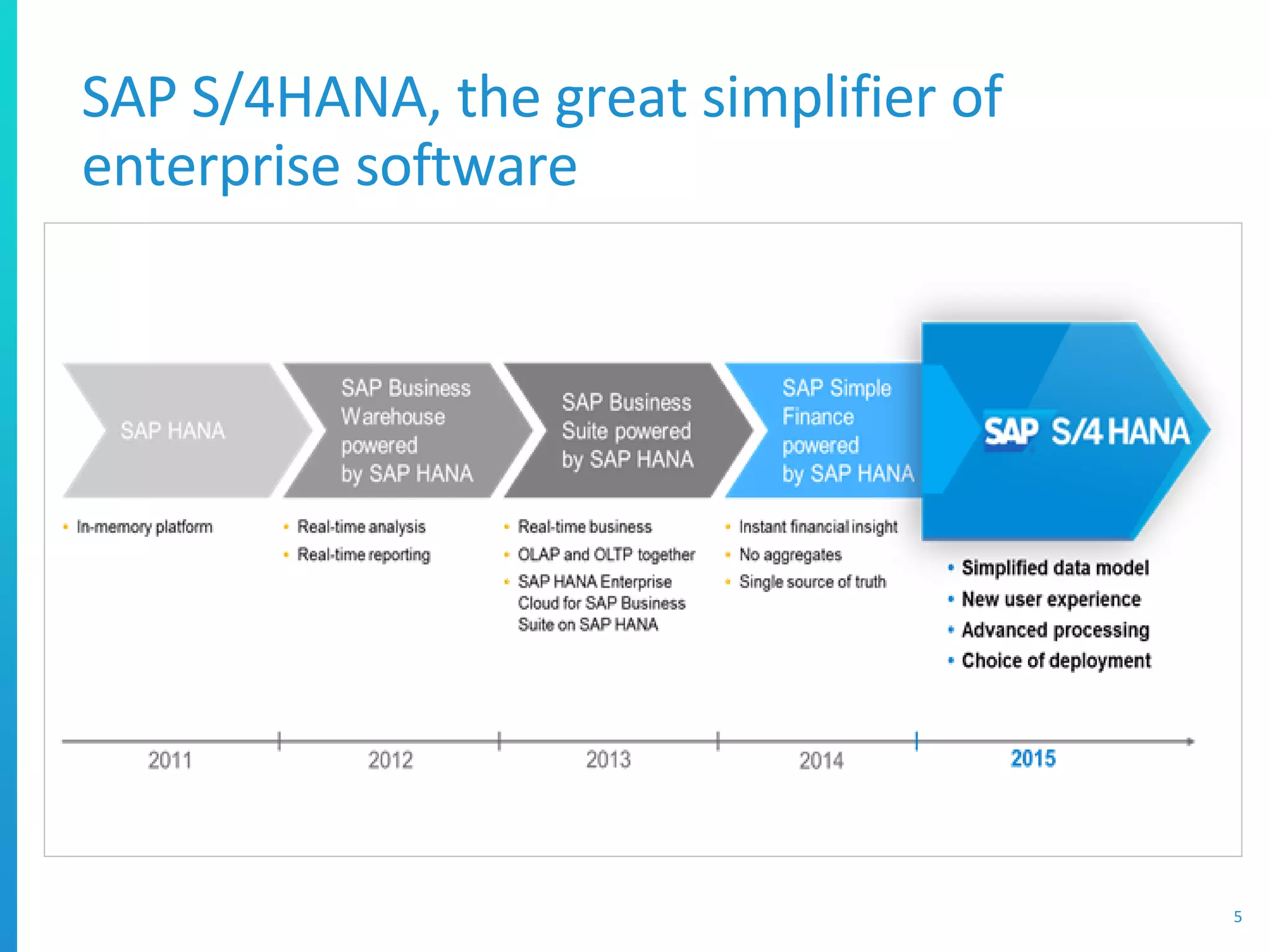
SAP S/4HANA, the great simplifier of
enterprise software
5
SAP S/4HANA, reimagines businesses for the
digital economy
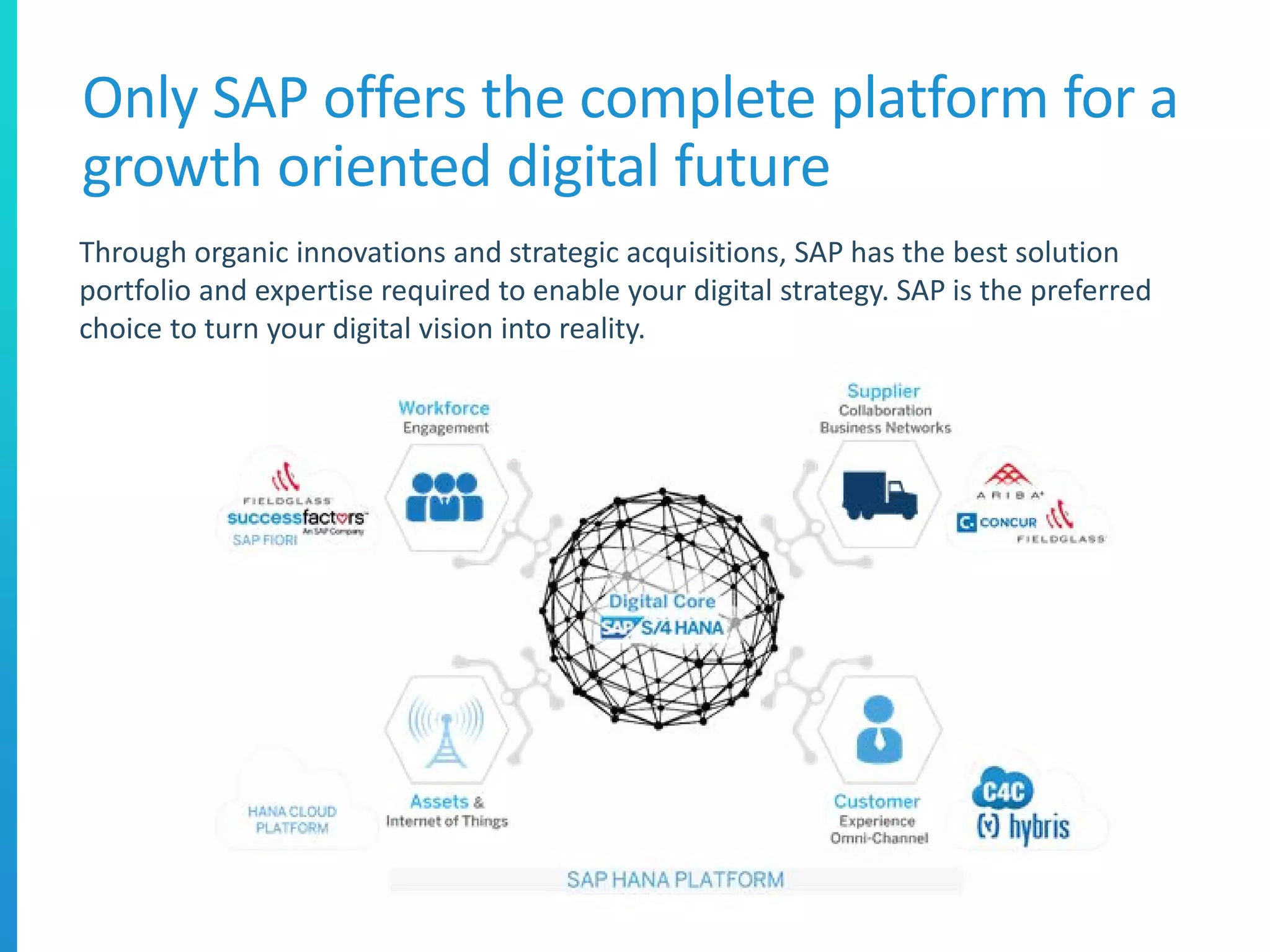
Only SAP offers the complete platform for a
growth oriented digital future
Through organic innovations and strategic acquisitions, SAP has the best solution
portfolio and expertise required to enable your digital strategy. SAP is the preferred
choice to turn your digital vision into reality.
…inter-linkaage of all aspects of the value
chain
Digitize beyond the core, embrace the
digital economy
S/4HANA Migration
What is SAP S/4HANA?
• The next version of SAP Business Suite
• New code base
 Only supported with the SAP HANA DB
• S/4HANA themes
 Renewed interface with Fiori UX
 Simplified structure with SAP HANA
11
Deployment options
12
Public
Cloud
Shared HANA
multi-tenant DB
No customisations
HANA Cloud
Platform
Extensions
Quarterly Release
Schedule
100% Managed by
SAP
Automatic Updates
Subscription
pricing
Managed
Cloud
Managed HANA DB
and network
HANA Cloud
Platform
Extensions
Limited ABAP
Customization
100% Managed by
SAP
Scheduled Updates
Subscription
pricing
On-
Premises
On-Premises or
Hosted
Full ABAP
Customization
available
Yearly Release
Schedule
Managed by
Customer/Partner
Update schedule
defined by
customer
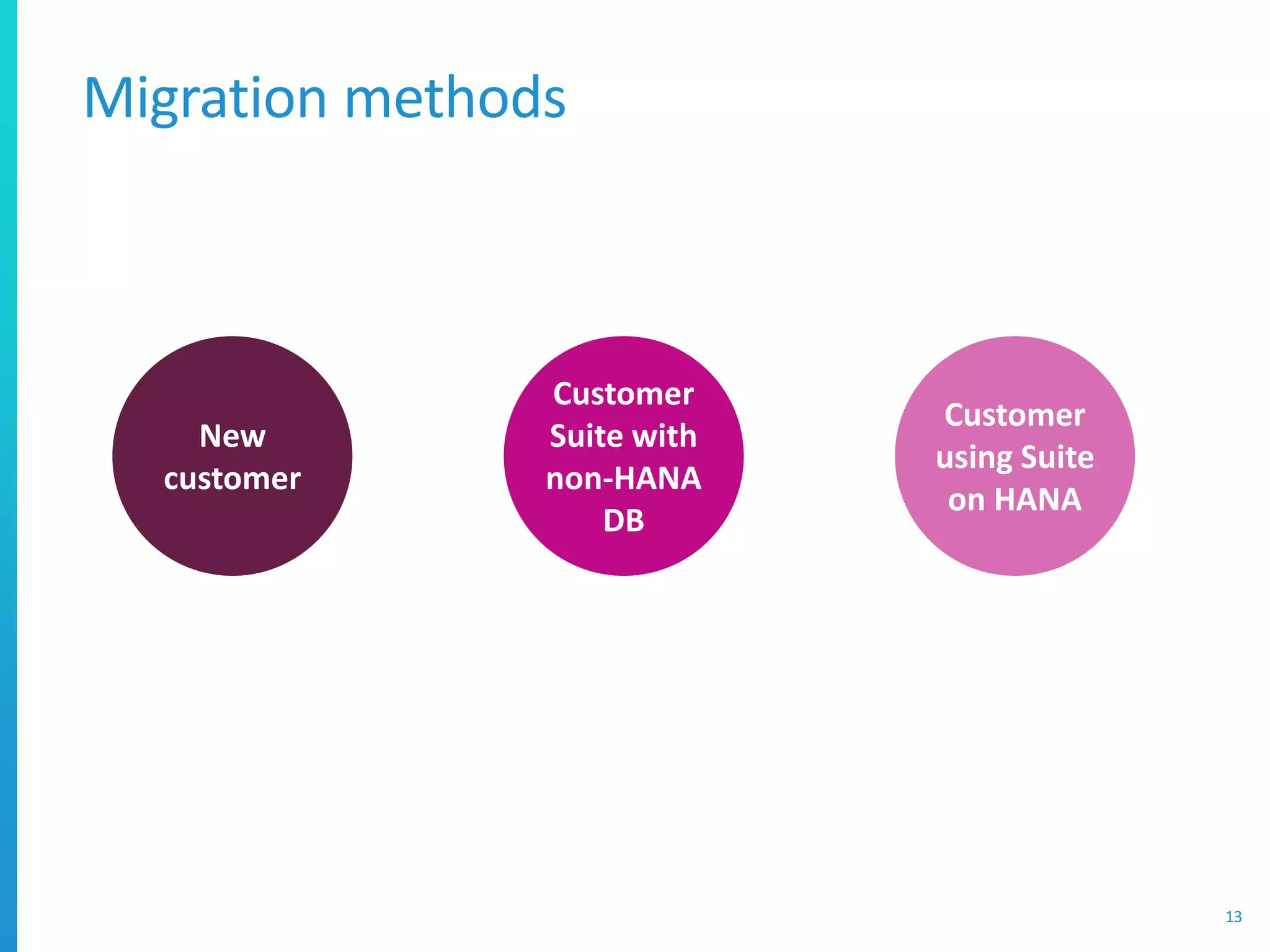
Migration methods
13
New
customer
Customer
Suite with
non-HANA
DB
Customer
using Suite
on HANA
New customer
14
Cloud
Deployment
Using RDS packages customer can be up and
running in days
Deploy new hardware
Customer Suite on non-HANA DB
15
Cloud
Deployment
Transfer data to the Cloud
Upgrade, migrate database to HANA on new
hardware
Customer using Suite on HANA
16
Cloud
Deployment
Transfer data to the Cloud
Upgrade and deploy innovations
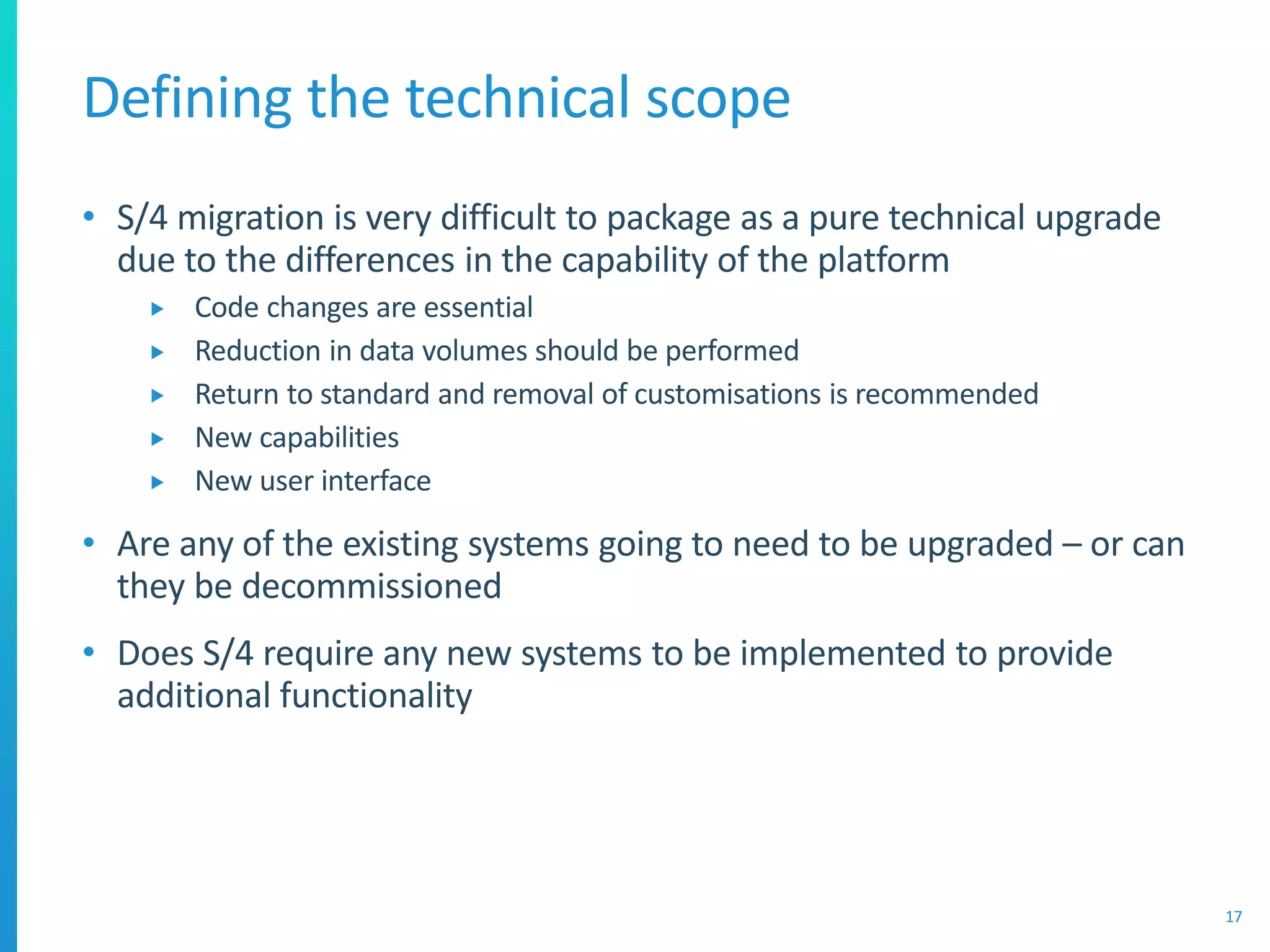
Defining the technical scope
• S/4 migration is very difficult to package as a pure technical upgrade
due to the differences in the capability of the platform
 Code changes are essential
 Reduction in data volumes should be performed
 Return to standard and removal of customisations is recommended
 New capabilities
 New user interface
• Are any of the existing systems going to need to be upgraded – or can
they be decommissioned
• Does S/4 require any new systems to be implemented to provide
additional functionality
17
Pre-migration activities
• Housekeeping
 Basis Tables – change documents, logs etc…
 Transport and upgrade logs
 IDOCs
• Sizing
 Run the Sizing reports for ECC and BW
 Identify large tables – consider archiving or Data tiering
 Create action plan and execute
• Architecture
 Server specifications
 HA/DR
 Non-Functional requirements
18
Migration Stages
19
Initial
Planning
Sandbox
Migration
Second Round
Plannning
Remediation
Development
Migration
Remediation
and
Optimizations
QAS
Migration
Transport
build for UAT
testing
UAT testing Mock Cut over
Final
Production
OaT testing
Production
Cut Over
Production
Sized/Quality Data set
No plan survives engagement
with the enemy
Remediate in
Sandbox ASAP
Consistency is
critical
Optimise
for HANA
Production like kit
Clustering etc…
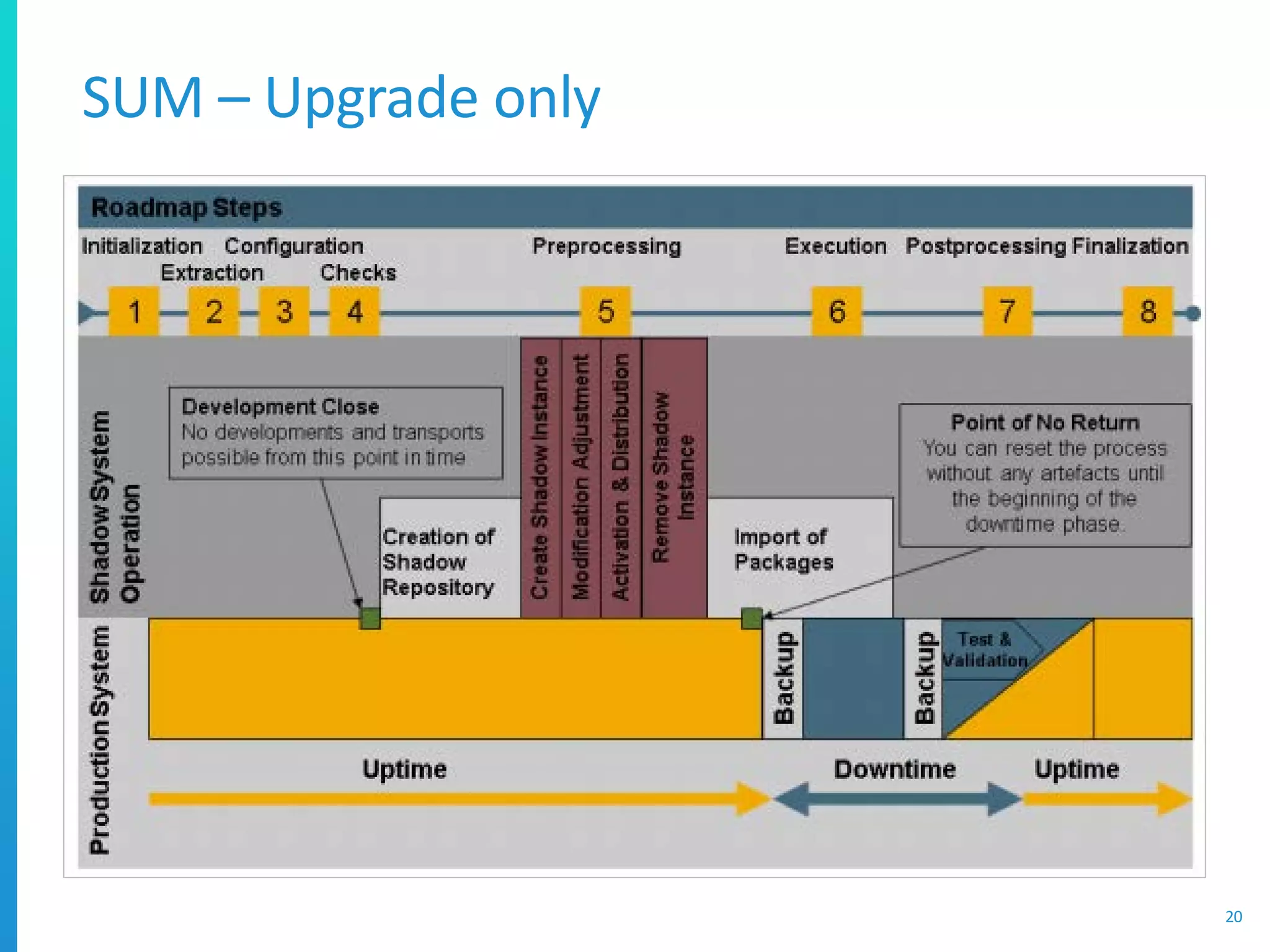
SUM – Upgrade only
20
Upgrade and migration – SUM DMO Step 1
21
Upgrade and migration – SUM DMO Step 2
22
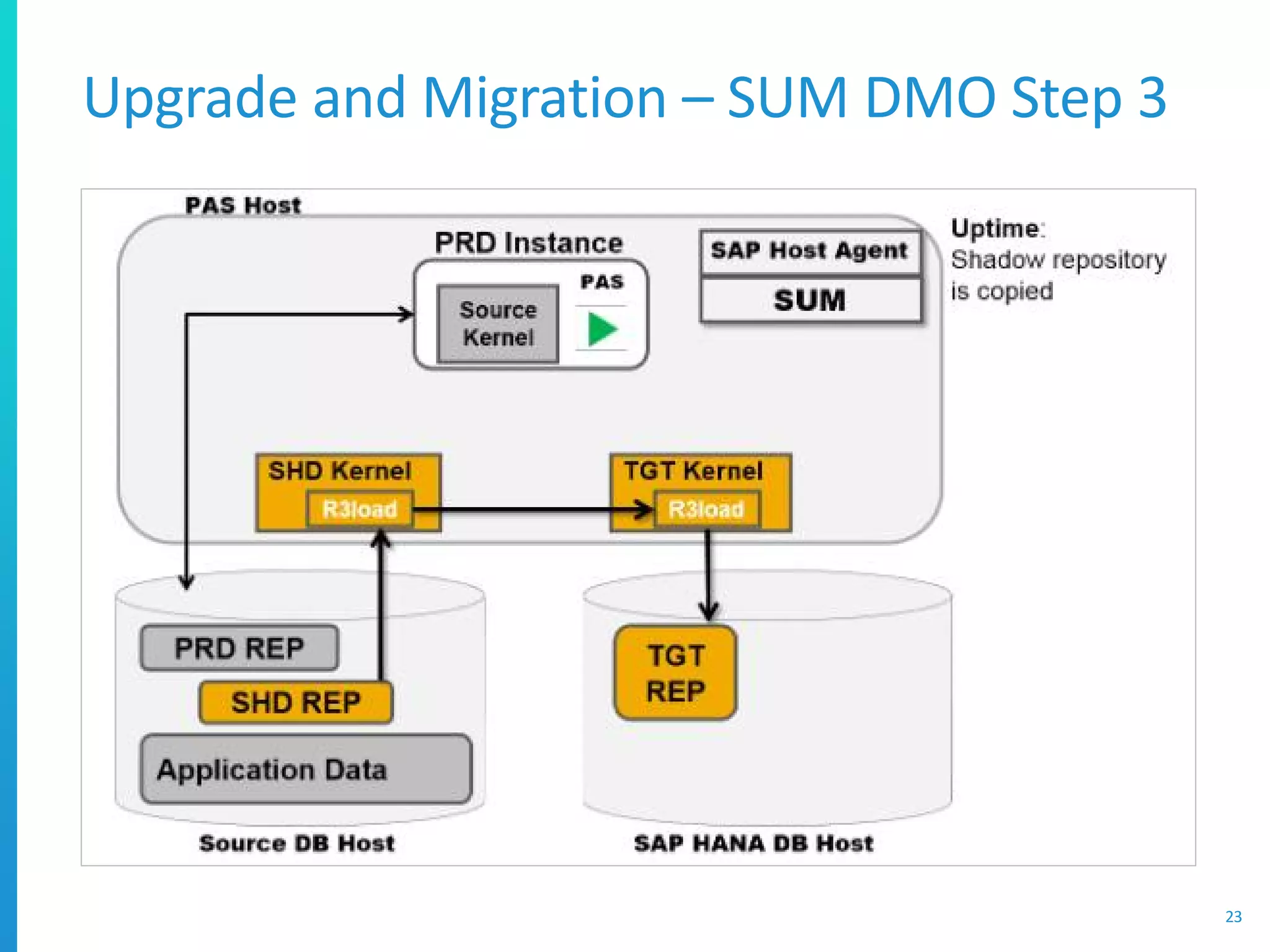
Upgrade and Migration – SUM DMO Step 3
23
Upgrade and migration – SUM DMO Step 4
24
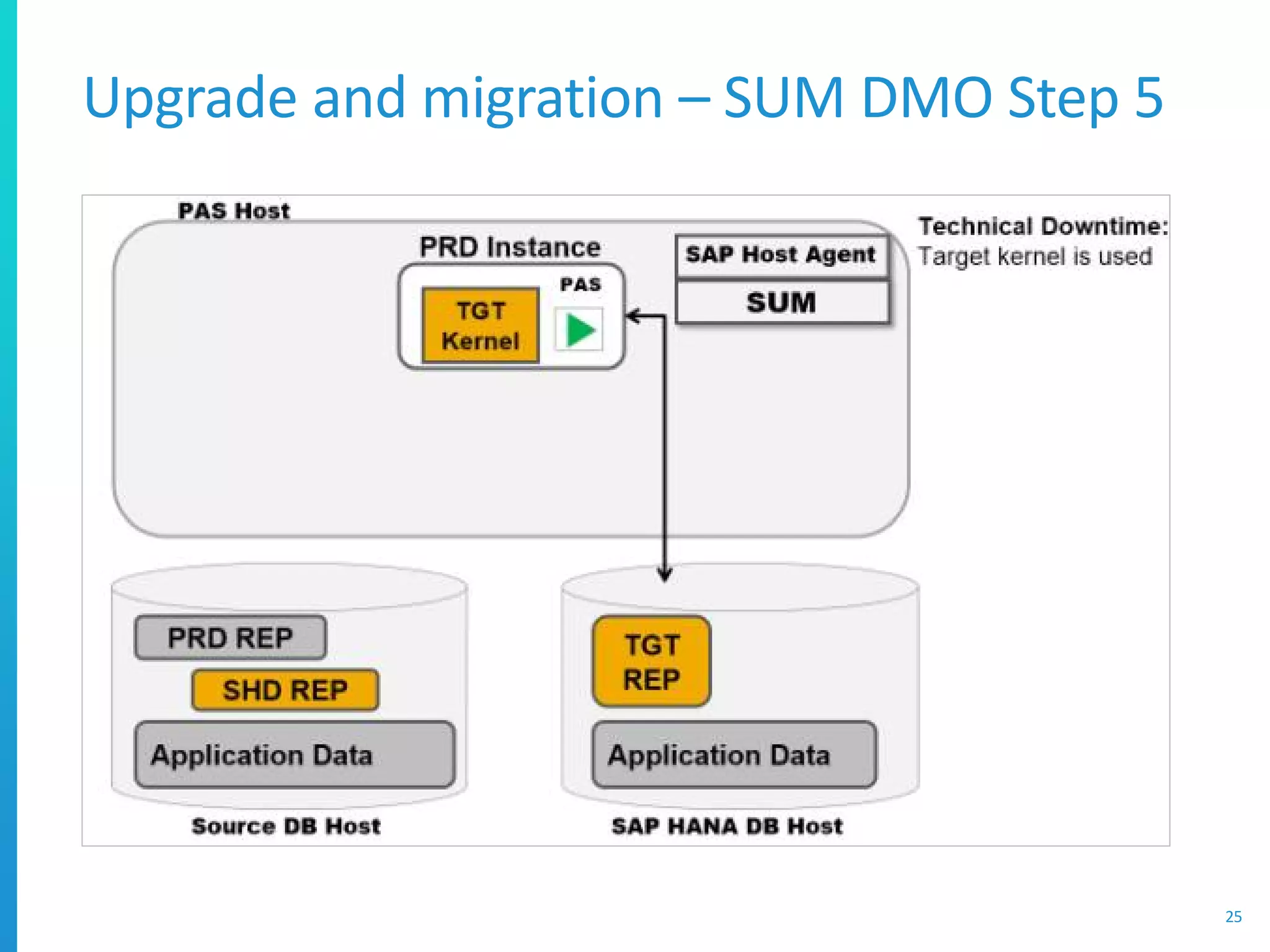
Upgrade and migration – SUM DMO Step 5
25
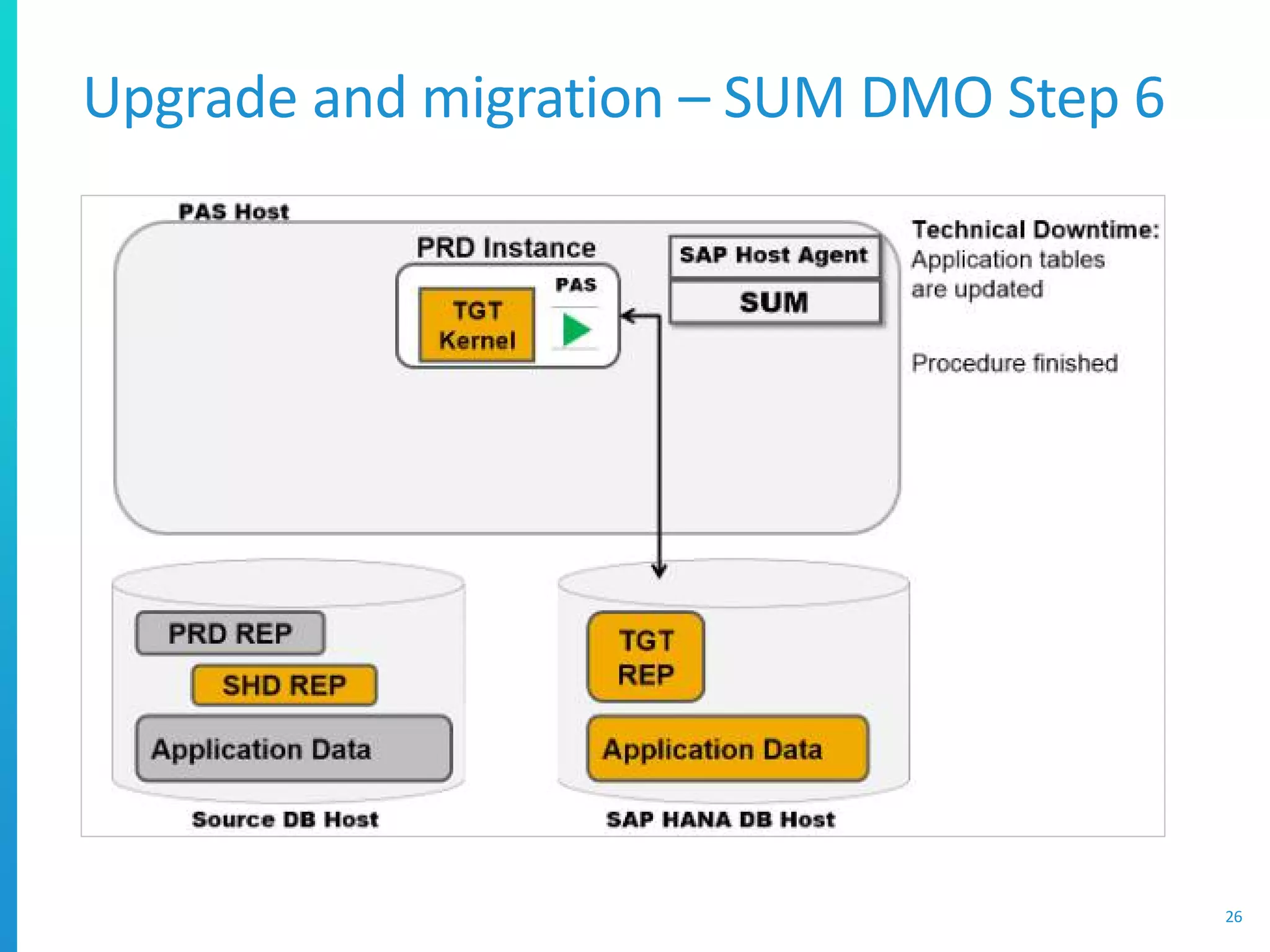
Upgrade and migration – SUM DMO Step 6
26
Migration tools – return to standard
• Return to standard confers many benefits
 Faster upgrades
 Reduction in time spent managing complexity
 Reduced effort in support
• Make sure you are on the latest latest SP!
 http://scn.sap.com/community/abap/custom-code-management
• Custom Code Management Tools (CCMT)
 Custom Code Management Cockpit (CDMC)
 Usage & Procedure Logging (UPL)
 CloneFinder
27
Migration tools - testing
• Test Management is critical
 Technical not just functional – HANA is a radically different platform
 Some customers have a mature strategy
• Revise your test management strategy
 Test automation
 Test coverage
 Test prioritization
• Reduce your time to complete testing
 How long does it take to complete regression test?
28
User Interface changes
Fiori and SAP UI5 are now the primary user interaction/interfaces for S/4
• Reduced requirement for SAP Gui
 Reduction in amount of desktop software
• Browser based interfaces
 Browser compatibility issues and frequent updates
• Mobile accessibility
 Planning needed for external access
• SAP HCP connectivity for extending applications
• Use of design standards for consistent look and feel
• User experience is of increasing importance
• Testing just became about a million times easier!
29
Sum-up: Indicators of success
The biggest indicators of success in an upgrade/migration project are:
• Simplicity
• Repeatability
• Consistency
• Documentation
• Team work
• Planning
30
What is Central Finance and why I
should use it?
Mr.Soumya De
SAP Tech Lead
What is central finance and its relationship
to Simple Finance, S/4 HANA
32
S4/HANA Finance brings together the latest Finance innovations and simplifications in
one market leading solution set based on SAP HANA for our customers. S4/HANA
Finance is Simple Finance (rebranded in Q4/2015)
Central Finance allows for non-disruptive adoption, particularly in heterogeneous
system landscapes
Central Finance (formerly Central Journal)
33
Dedicated S/4 HANA Finance system (SAP HANA, SAP ERP, S/4HANA Finance)
connected to one or more ERP (SAP or non-SAP ERP) systems for single source
transaction recording, reporting, and planning / consolidation
Central Finance (formerly Central Journal)
34
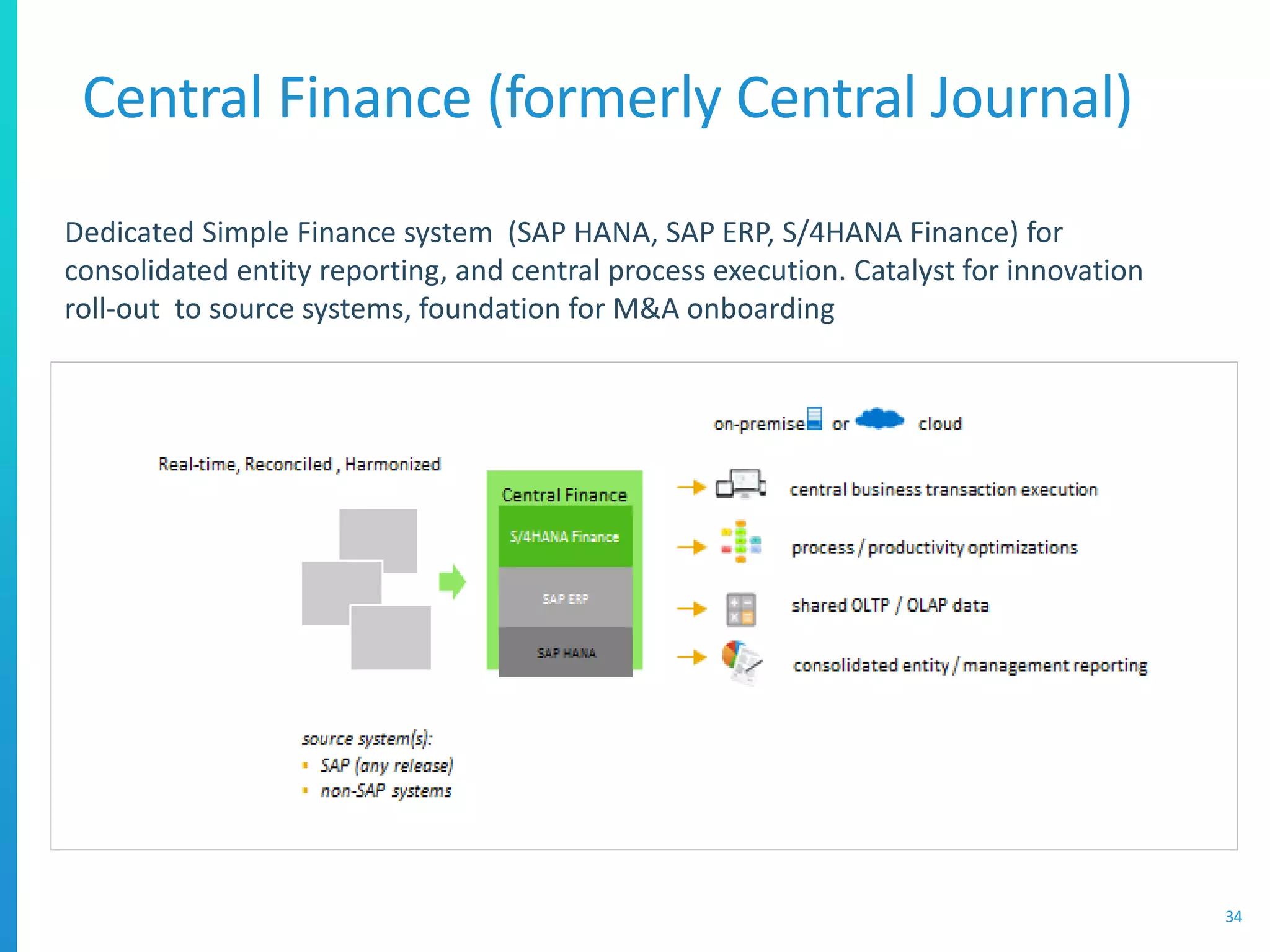
Dedicated Simple Finance system (SAP HANA, SAP ERP, S/4HANA Finance) for
consolidated entity reporting, and central process execution. Catalyst for innovation
roll-out to source systems, foundation for M&A onboarding
Key use cases to help identify the use of
Central Finance
35
Limits of the system to explain what can and
cannot be done in Central Finance
How Central Finance is different from a BW,
BI or Hyperion environment
Limits of the system to explain what can and
cannot be done in Central Finance
Shared Services and Central Finance
The SAP Shared Services Framework today successfully supports Shared Services
operations globally
Central Finance provides the ability* to have “one face to the customer” and “one face
to the organization” by bringing data together enterprise wide and unify diverse
integration technologies required for optimized central process execution
SAP: Central Finance as platform and
playbook for shared services
Planning in SAP BPC for S/4HANA
Key areas of Planning in S/4HANA
42
Real-time
Analytics with
SAP HANA
SAP BPC’s
powerful
modelling
capability
Pre-built
starter
planning
models
SAP Predictive
Analytics
increases plan
accuracy
Simplified
landscape
reduces TCO
Accelerate
ROI
SAP BPC for S/4HANA
43
Add
transparency
to planning
cycle
No data
redundancy of
Actuals
Out of the box
data
retraction
functionality
to ECC
Powerful
scripting to
allow complex
calculations
Version
management
to plan for the
best and worst
case
Sharing of
data and
master data
with ECC =
Real time
planning
Workflow No duplication Push to ECC
Driver-based planning Scenario analysis ECC Integration
Real-time planning and reporting
44
Master Data
structures
Actuals +
Journals
Disaggregation
logic
Faster
planning and
analysis
Reduced TCO
Pre-built Planning Models
• Starter content to replace ECC Planning functionality
• SAP BO Analysis for Office
• Models, Workbooks, Planning Logic, Queries
• Planning functions such as disaggregation's, BPC to ECC copy and
more included
• Customisable
45
Pre-built Planning Models
SAP BPC for S/4HANA Starter content includes:
• Cost Centre Planning
• Internal Order Planning
• Project Planning
• Profit Centre Planning
• Cost of Sales Planning
• P&L Planning
• Market Segment Planning
• Balance Sheet Planning
46
Recap
• Simplification of planning process
• Reduced implementation costs through starter kit
• Predictive capability of SAP HANA easier to utilise
• Increase accuracy whilst reducing effort required
• Improve usability and user experience
47
SAP S/4HANA Finance
SAP S/4HANA Finance
49
Financial
planning and
analysis
Treasury and
financial risk
management
Accounting and
financial close
Collaborative
finance
operations
Enterprise risk and
compliance
management
Data consistency across
solutions
Insight-to-action with seamless access
On-the-fly modelling of
what-if scenarios
Alignment
Agility
Predictability
Benefits
SAP S/4HANA building blocks
• Single source of truth (Universal Journal)
• Re-vamped user experience
• Streamlining of month-end
• Line-item based flexibility
All of the benefits without the loss of functional scope
50
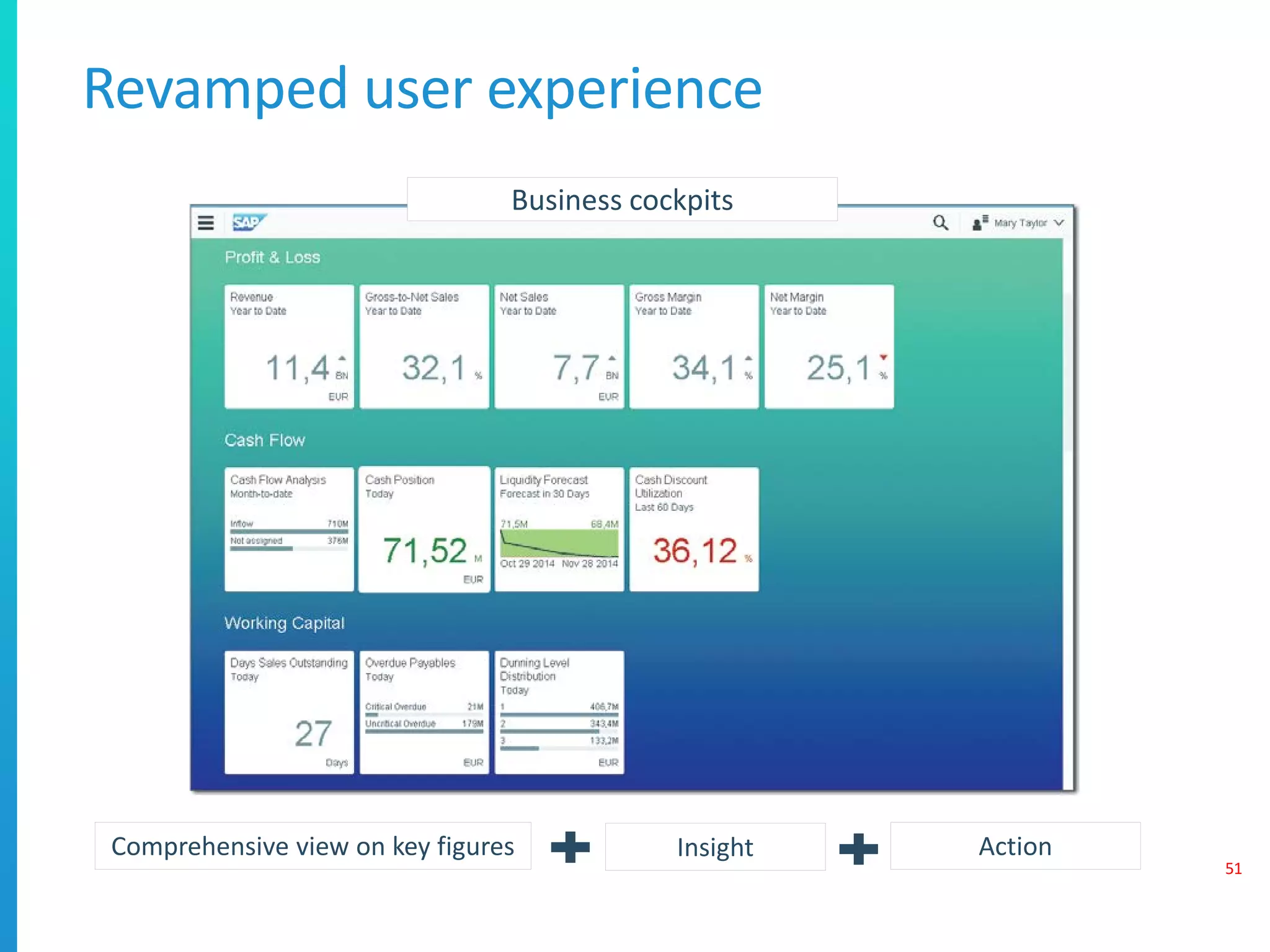
Revamped user experience
51
Comprehensive view on key figures Insight Action
Business cockpits
Tables vs Compatibility views approach
Removal of redundancy
Streamlining month-end
53
Continuous intercompany reconciliation
Reduction in number of batch jobs
Higher data quality
s
Period close
Period close
Soft-close on demand
Within the period
Within the period
Period-end close
Period-end close
Traditional
close
SAP
S/4HANA
Finance
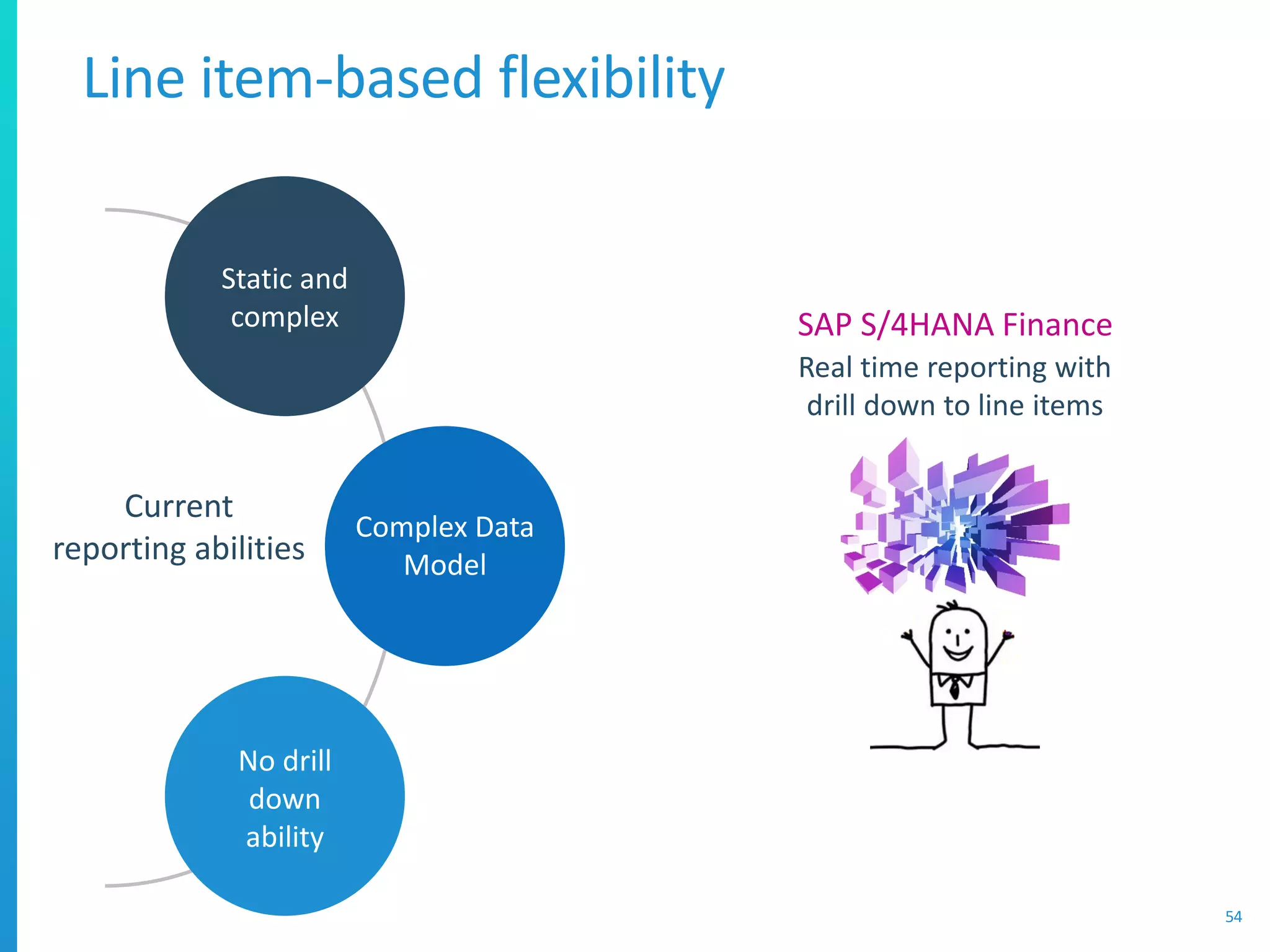
Line item-based flexibility
54
Current
reporting abilities
Static and
complex
No drill
down
ability
Complex Data
Model
Real time reporting with
drill down to line items
SAP S/4HANA Finance
Building a business case for SAP
S/4HANA
Mr.Soumya De
SAP Tech Lead
Approach
Engage key business users
Business
Non-cooperation Reduced ROI Missed synergies
IT
Building the business case for S/4 HANA
57
Hardware
Licences
Support
Software
Data
reconciliation
Month-end
tasks reduction
Ease of use
Reports
preparation
IT cost savings Business process efficiencies
Cost savings for IT
Reduction in hardware costs
 Database size reduction at least 5:1
 Removal of a planning landscape
Reduction in support costs
 Fewer systems to support
 HANA databases more reliable
Migrate away from non-SAP systems
 Few systems to support
 Simplified user experience
Better use of licenses
 Reduction in non-SAP license costs
58
Cost savings for the Business
Reduction in month-end tasks
 Increased speed
 Soft close tasks at anytime
Increased reporting flexibility
 Simplified data model
 Real-time data
 Single source of truth
 ‘What if?’ reporting
Reduction in manual effort
 Intuitive Fiori apps
 Task based
 25-40% key stroke reduction
Elimination of reconciliation effort
 Removal of reconciliation between Finance and Controlling
59
Quantifiable business benefits
60
Source: SAP, 2015
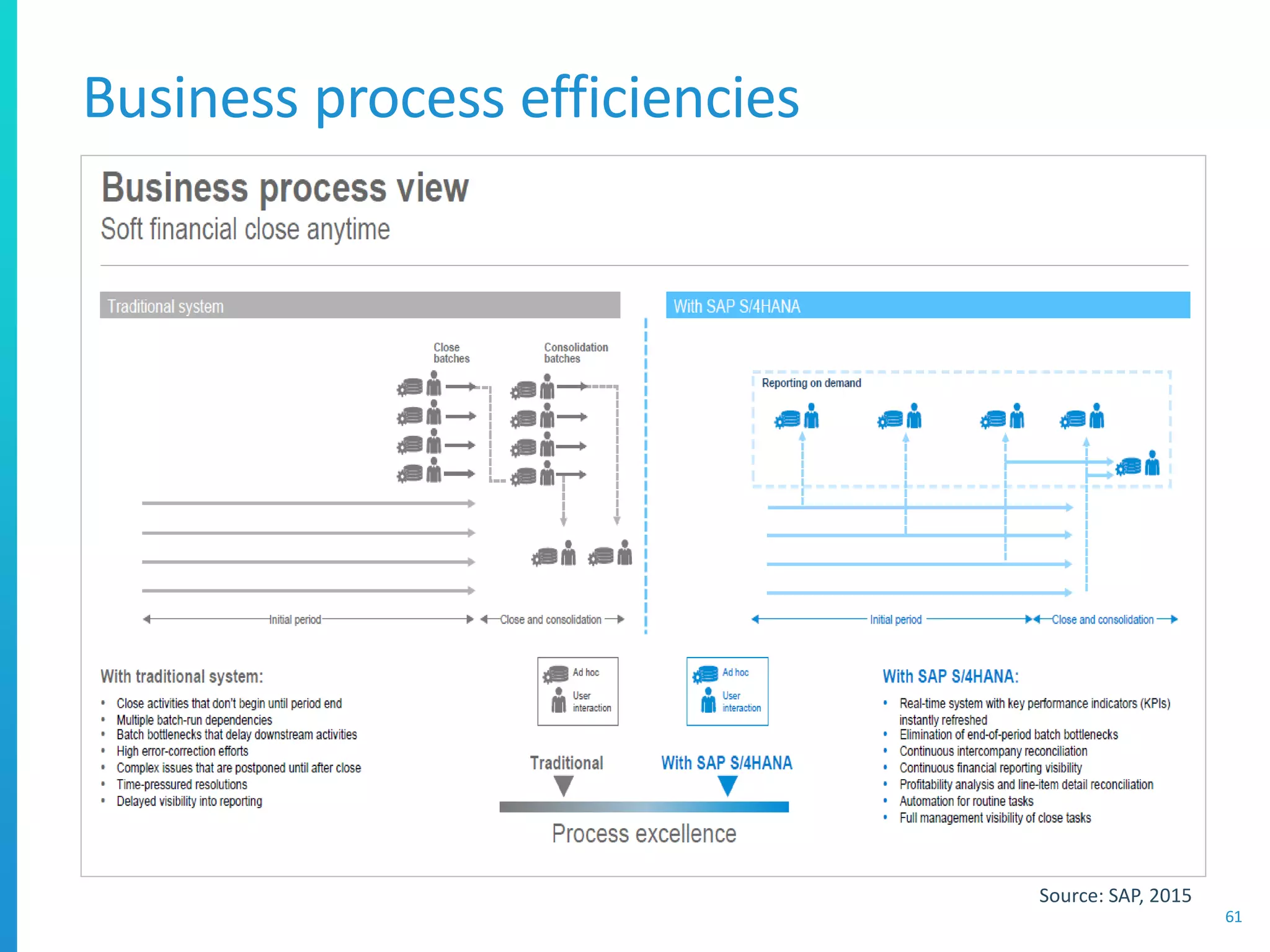
Business process efficiencies
61
Source: SAP, 2015
Latest thinking
The SAP® Business Suite 4 SAP HANA® (SAP S/4HANA) FAQ – Read
By John Appleby
SAP BPC for S/4HANA - what does it mean for your Planning teams? – Read
By Nick Carter
SAP Universal Journal - how can you maximise the benefit – Read
By Mark Chalfen
Moving your applications to the Cloud: 11 tips – Read
By Chris Kernaghan
62
63
Sap S4 HANA Everything You Need To Know

Sap S4 HANA Everything You Need To Know

  • 1.
    SAP S/4 HANA:Everything you need to know for a successful implementation
  • 3.
    S/4 HANA ina nutshell
  • 4.
    SAP S4/HANA, SAP’snext big thing 4
  • 5.
    SAP S/4HANA, thegreat simplifier of enterprise software 5
  • 6.
    SAP S/4HANA, reimaginesbusinesses for the digital economy
  • 7.
    Only SAP offersthe complete platform for a growth oriented digital future Through organic innovations and strategic acquisitions, SAP has the best solution portfolio and expertise required to enable your digital strategy. SAP is the preferred choice to turn your digital vision into reality.
  • 8.
    …inter-linkaage of allaspects of the value chain
  • 9.
    Digitize beyond thecore, embrace the digital economy
  • 10.
  • 11.
    What is SAPS/4HANA? • The next version of SAP Business Suite • New code base  Only supported with the SAP HANA DB • S/4HANA themes  Renewed interface with Fiori UX  Simplified structure with SAP HANA 11
  • 12.
    Deployment options 12 Public Cloud Shared HANA multi-tenantDB No customisations HANA Cloud Platform Extensions Quarterly Release Schedule 100% Managed by SAP Automatic Updates Subscription pricing Managed Cloud Managed HANA DB and network HANA Cloud Platform Extensions Limited ABAP Customization 100% Managed by SAP Scheduled Updates Subscription pricing On- Premises On-Premises or Hosted Full ABAP Customization available Yearly Release Schedule Managed by Customer/Partner Update schedule defined by customer
  • 13.
  • 14.
    New customer 14 Cloud Deployment Using RDSpackages customer can be up and running in days Deploy new hardware
  • 15.
    Customer Suite onnon-HANA DB 15 Cloud Deployment Transfer data to the Cloud Upgrade, migrate database to HANA on new hardware
  • 16.
    Customer using Suiteon HANA 16 Cloud Deployment Transfer data to the Cloud Upgrade and deploy innovations
  • 17.
    Defining the technicalscope • S/4 migration is very difficult to package as a pure technical upgrade due to the differences in the capability of the platform  Code changes are essential  Reduction in data volumes should be performed  Return to standard and removal of customisations is recommended  New capabilities  New user interface • Are any of the existing systems going to need to be upgraded – or can they be decommissioned • Does S/4 require any new systems to be implemented to provide additional functionality 17
  • 18.
    Pre-migration activities • Housekeeping Basis Tables – change documents, logs etc…  Transport and upgrade logs  IDOCs • Sizing  Run the Sizing reports for ECC and BW  Identify large tables – consider archiving or Data tiering  Create action plan and execute • Architecture  Server specifications  HA/DR  Non-Functional requirements 18
  • 19.
    Migration Stages 19 Initial Planning Sandbox Migration Second Round Plannning Remediation Development Migration Remediation and Optimizations QAS Migration Transport buildfor UAT testing UAT testing Mock Cut over Final Production OaT testing Production Cut Over Production Sized/Quality Data set No plan survives engagement with the enemy Remediate in Sandbox ASAP Consistency is critical Optimise for HANA Production like kit Clustering etc…
  • 20.
  • 21.
    Upgrade and migration– SUM DMO Step 1 21
  • 22.
    Upgrade and migration– SUM DMO Step 2 22
  • 23.
    Upgrade and Migration– SUM DMO Step 3 23
  • 24.
    Upgrade and migration– SUM DMO Step 4 24
  • 25.
    Upgrade and migration– SUM DMO Step 5 25
  • 26.
    Upgrade and migration– SUM DMO Step 6 26
  • 27.
    Migration tools –return to standard • Return to standard confers many benefits  Faster upgrades  Reduction in time spent managing complexity  Reduced effort in support • Make sure you are on the latest latest SP!  http://scn.sap.com/community/abap/custom-code-management • Custom Code Management Tools (CCMT)  Custom Code Management Cockpit (CDMC)  Usage & Procedure Logging (UPL)  CloneFinder 27
  • 28.
    Migration tools -testing • Test Management is critical  Technical not just functional – HANA is a radically different platform  Some customers have a mature strategy • Revise your test management strategy  Test automation  Test coverage  Test prioritization • Reduce your time to complete testing  How long does it take to complete regression test? 28
  • 29.
    User Interface changes Fioriand SAP UI5 are now the primary user interaction/interfaces for S/4 • Reduced requirement for SAP Gui  Reduction in amount of desktop software • Browser based interfaces  Browser compatibility issues and frequent updates • Mobile accessibility  Planning needed for external access • SAP HCP connectivity for extending applications • Use of design standards for consistent look and feel • User experience is of increasing importance • Testing just became about a million times easier! 29
  • 30.
    Sum-up: Indicators ofsuccess The biggest indicators of success in an upgrade/migration project are: • Simplicity • Repeatability • Consistency • Documentation • Team work • Planning 30
  • 31.
    What is CentralFinance and why I should use it? Mr.Soumya De SAP Tech Lead
  • 32.
    What is centralfinance and its relationship to Simple Finance, S/4 HANA 32 S4/HANA Finance brings together the latest Finance innovations and simplifications in one market leading solution set based on SAP HANA for our customers. S4/HANA Finance is Simple Finance (rebranded in Q4/2015) Central Finance allows for non-disruptive adoption, particularly in heterogeneous system landscapes
  • 33.
    Central Finance (formerlyCentral Journal) 33 Dedicated S/4 HANA Finance system (SAP HANA, SAP ERP, S/4HANA Finance) connected to one or more ERP (SAP or non-SAP ERP) systems for single source transaction recording, reporting, and planning / consolidation
  • 34.
    Central Finance (formerlyCentral Journal) 34 Dedicated Simple Finance system (SAP HANA, SAP ERP, S/4HANA Finance) for consolidated entity reporting, and central process execution. Catalyst for innovation roll-out to source systems, foundation for M&A onboarding
  • 35.
    Key use casesto help identify the use of Central Finance 35
  • 36.
    Limits of thesystem to explain what can and cannot be done in Central Finance
  • 37.
    How Central Financeis different from a BW, BI or Hyperion environment
  • 38.
    Limits of thesystem to explain what can and cannot be done in Central Finance
  • 39.
    Shared Services andCentral Finance The SAP Shared Services Framework today successfully supports Shared Services operations globally Central Finance provides the ability* to have “one face to the customer” and “one face to the organization” by bringing data together enterprise wide and unify diverse integration technologies required for optimized central process execution
  • 40.
    SAP: Central Financeas platform and playbook for shared services
  • 41.
    Planning in SAPBPC for S/4HANA
  • 42.
    Key areas ofPlanning in S/4HANA 42 Real-time Analytics with SAP HANA SAP BPC’s powerful modelling capability Pre-built starter planning models SAP Predictive Analytics increases plan accuracy Simplified landscape reduces TCO Accelerate ROI
  • 43.
    SAP BPC forS/4HANA 43 Add transparency to planning cycle No data redundancy of Actuals Out of the box data retraction functionality to ECC Powerful scripting to allow complex calculations Version management to plan for the best and worst case Sharing of data and master data with ECC = Real time planning Workflow No duplication Push to ECC Driver-based planning Scenario analysis ECC Integration
  • 44.
    Real-time planning andreporting 44 Master Data structures Actuals + Journals Disaggregation logic Faster planning and analysis Reduced TCO
  • 45.
    Pre-built Planning Models •Starter content to replace ECC Planning functionality • SAP BO Analysis for Office • Models, Workbooks, Planning Logic, Queries • Planning functions such as disaggregation's, BPC to ECC copy and more included • Customisable 45
  • 46.
    Pre-built Planning Models SAPBPC for S/4HANA Starter content includes: • Cost Centre Planning • Internal Order Planning • Project Planning • Profit Centre Planning • Cost of Sales Planning • P&L Planning • Market Segment Planning • Balance Sheet Planning 46
  • 47.
    Recap • Simplification ofplanning process • Reduced implementation costs through starter kit • Predictive capability of SAP HANA easier to utilise • Increase accuracy whilst reducing effort required • Improve usability and user experience 47
  • 48.
  • 49.
    SAP S/4HANA Finance 49 Financial planningand analysis Treasury and financial risk management Accounting and financial close Collaborative finance operations Enterprise risk and compliance management Data consistency across solutions Insight-to-action with seamless access On-the-fly modelling of what-if scenarios Alignment Agility Predictability Benefits
  • 50.
    SAP S/4HANA buildingblocks • Single source of truth (Universal Journal) • Re-vamped user experience • Streamlining of month-end • Line-item based flexibility All of the benefits without the loss of functional scope 50
  • 51.
    Revamped user experience 51 Comprehensiveview on key figures Insight Action Business cockpits
  • 52.
    Tables vs Compatibilityviews approach Removal of redundancy
  • 53.
    Streamlining month-end 53 Continuous intercompanyreconciliation Reduction in number of batch jobs Higher data quality s Period close Period close Soft-close on demand Within the period Within the period Period-end close Period-end close Traditional close SAP S/4HANA Finance
  • 54.
    Line item-based flexibility 54 Current reportingabilities Static and complex No drill down ability Complex Data Model Real time reporting with drill down to line items SAP S/4HANA Finance
  • 55.
    Building a businesscase for SAP S/4HANA Mr.Soumya De SAP Tech Lead
  • 56.
    Approach Engage key businessusers Business Non-cooperation Reduced ROI Missed synergies IT
  • 57.
    Building the businesscase for S/4 HANA 57 Hardware Licences Support Software Data reconciliation Month-end tasks reduction Ease of use Reports preparation IT cost savings Business process efficiencies
  • 58.
    Cost savings forIT Reduction in hardware costs  Database size reduction at least 5:1  Removal of a planning landscape Reduction in support costs  Fewer systems to support  HANA databases more reliable Migrate away from non-SAP systems  Few systems to support  Simplified user experience Better use of licenses  Reduction in non-SAP license costs 58
  • 59.
    Cost savings forthe Business Reduction in month-end tasks  Increased speed  Soft close tasks at anytime Increased reporting flexibility  Simplified data model  Real-time data  Single source of truth  ‘What if?’ reporting Reduction in manual effort  Intuitive Fiori apps  Task based  25-40% key stroke reduction Elimination of reconciliation effort  Removal of reconciliation between Finance and Controlling 59
  • 60.
  • 61.
  • 62.
    Latest thinking The SAP®Business Suite 4 SAP HANA® (SAP S/4HANA) FAQ – Read By John Appleby SAP BPC for S/4HANA - what does it mean for your Planning teams? – Read By Nick Carter SAP Universal Journal - how can you maximise the benefit – Read By Mark Chalfen Moving your applications to the Cloud: 11 tips – Read By Chris Kernaghan 62
  • 63.