Nickel / Cobalt Laterite Processes
A short training for SPA Geologists
February 2005
By Boy Adhitya
Presented by : Frans Attong
Adopted from ALTA 1997, Ni/Co Laterite Project Development Seminar
And
A presentation MS 2004-133rd Annual Meeting & Exhibition,
International Laterite Symposium – 2004 by Ashok Davi
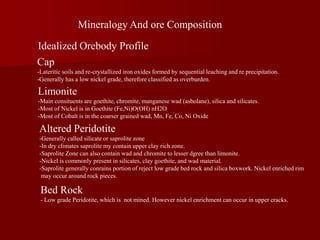
Mineralogy And ore Composition
Idealized Orebody Profile
Cap
-Lateritic soils and re-crystallized iron oxides formed by sequential leaching and re precipitation.
-Generally has a low nickel grade, therefore classified as overburden.
Limonite
-Main consituents are goethite, chromite, manganese wad (asbolane), silica and silicates.
-Most of Nickel is in Goethite (Fe,Ni)O(OH) nH2O
-Most of Cobalt is in the coarser grained wad, Mn, Fe, Co, Ni Oxide
Altered Peridotite
-Generally called silicate or saprolite zone
-In dry climates saprolite my contain upper clay rich zone.
-Saprolite Zone can also contain wad and chromite to lesser dgree than limonite.
-Nickel is commonly present in silicates, clay goethite, and wad material.
-Saprolite generally conrains portion of reject low grade bed rock and silica boxwork. Nickel enriched rim
may occur around rock pieces.
Bed Rock
- Low grade Peridotite, which is not mined. However nickel enrichment can occur in upper cracks.
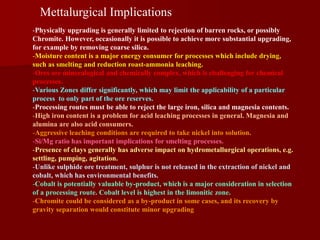
Mettalurgical Implications
-Physically upgrading is generally limited to rejection of barren rocks, or possibly
Chromite. However, occasionally it is possible to achieve more substantial upgrading,
for example by removing coarse silica.
-Moisture content is a major energy consumer for processes which include drying,
such as smelting and reduction roast-ammonia leaching.
-Ores are mineralogical and chemically complex, which is challenging for chemical
processes.
-Various Zones differ significantly, which may limit the applicability of a particular
process to only part of the ore reserves.
-Processing routes must be able to reject the large iron, silica and magnesia contents.
-High iron content is a problem for acid leaching processes in general. Magnesia and
alumina are also acid consumers.
-Aggressive leaching conditions are required to take nickel into solution.
-Si/Mg ratio has important implications for smelting processes.
-Presence of clays generally has adverse impact on hydrometallurgical operations, e.g.
settling, pumping, agitation.
-Unlike sulphide ore treatment, sulphur is not released in the extraction of nickel and
cobalt, which has environmental benefits.
-Cobalt is potentially valuable by-product, which is a major consideration in selection
of a processing route. Cobalt level is highest in the limonitic zone.
-Chromite could be considered as a by-product in some cases, and its recovery by
gravity separation would constitute minor upgrading
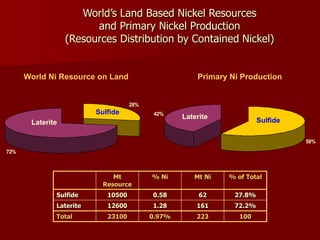
World’s Land Based Nickel Resources
and Primary Nickel Production
(Resources Distribution by Contained Nickel)
58%
42%
28%
72%
Primary Ni Production
Laterite
Sulfide
World Ni Resource on Land
Laterite
Sulfide
Mt
Resource
% Ni Mt Ni % of Total
Sulfide 10500 0.58 62 27.8%
Laterite 12600 1.28 161 72.2%
Total 23100 0.97% 223 100
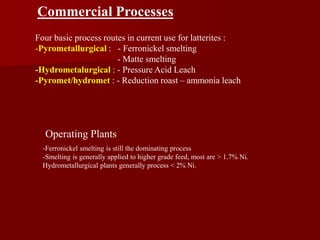
Commercial Processes
Four basic process routes in current use for latterites :
-Pyrometallurgical : - Ferronickel smelting
- Matte smelting
-Hydrometalurgical : - Pressure Acid Leach
-Pyromet/hydromet : - Reduction roast – ammonia leach
Operating Plants
-Ferronickel smelting is still the dominating process
-Smelting is generally applied to higher grade feed, most are > 1.7% Ni.
Hydrometallurgical plants generally process < 2% Ni.
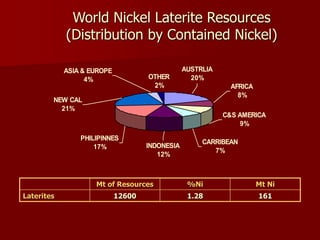
World Nickel Laterite Resources
(Distribution by Contained Nickel)
World Nickel Laterite Resources Combined HYDROMET & PYRO
(Distribution by Contained Nickel)
OTHER
2%
PHILIPINNES
17%
NEW CAL
21%
AUSTRLIA
20%
AFRICA
8%
CARRIBEAN
7%
C&S AMERICA
9%
INDONESIA
12%
ASIA & EUROPE
4%
Mt of Resources %Ni Mt Ni
Laterites 12600 1.28 161
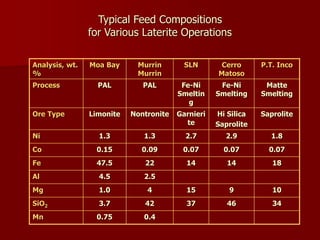
Typical Feed Compositions
for Various Laterite Operations
Analysis, wt.
%
Moa Bay Murrin
Murrin
SLN Cerro
Matoso
P.T. Inco
Process PAL PAL Fe-Ni
Smeltin
g
Fe-Ni
Smelting
Matte
Smelting
Ore Type Limonite Nontronite Garnieri
te
Hi Silica
Saprolite
Saprolite
Ni 1.3 1.3 2.7 2.9 1.8
Co 0.15 0.09 0.07 0.07 0.07
Fe 47.5 22 14 14 18
Al 4.5 2.5
Mg 1.0 4 15 9 10
SiO2 3.7 42 37 46 34
Mn 0.75 0.4
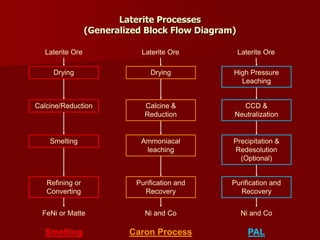
Laterite Processes
(Generalized Block Flow Diagram)
Drying
Calcine/Reduction Calcine &
Reduction
CCD &
Neutralization
Smelting
Refining or
Converting
Ammoniacal
leaching
Purification and
Recovery
Drying High Pressure
Leaching
Precipitation &
Redesolution
(Optional)
Purification and
Recovery
Laterite Ore Laterite Ore
Laterite Ore
FeNi or Matte Ni and Co Ni and Co
Smelting Caron Process PAL
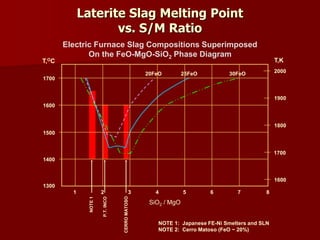
Laterite Slag Melting Point
vs. S/M Ratio
8
1 2 3 4 5 6 7
1400
1300
1500
1600
1700
1600
1700
1800
1900
2000
T,K
T,OC
20FeO 25FeO 30FeO
SiO2 / MgO
NOTE
1
P.T.
INCO
CERRO
MATOSO
NOTE 1: Japanese FE-Ni Smelters and SLN
NOTE 2: Cerro Matoso (FeO ~ 20%)
Electric Furnace Slag Compositions Superimposed
On the FeO-MgO-SiO2 Phase Diagram
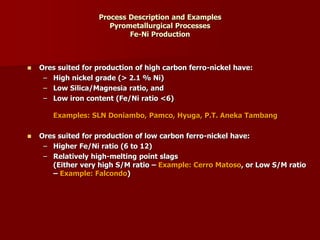
Process Description and Examples
Pyrometallurgical Processes
Fe-Ni Production
 Ores suited for production of high carbon ferro-nickel have:
– High nickel grade (> 2.1 % Ni)
– Low Silica/Magnesia ratio, and
– Low iron content (Fe/Ni ratio <6)
Examples: SLN Doniambo, Pamco, Hyuga, P.T. Aneka Tambang
 Ores suited for production of low carbon ferro-nickel have:
– Higher Fe/Ni ratio (6 to 12)
– Relatively high-melting point slags
(Either very high S/M ratio – Example: Cerro Matoso, or Low S/M ratio
– Example: Falcondo)
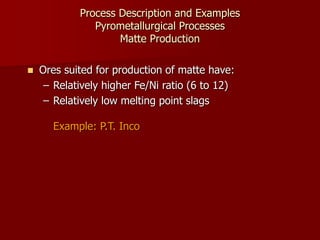
Process Description and Examples
Pyrometallurgical Processes
Matte Production
 Ores suited for production of matte have:
– Relatively higher Fe/Ni ratio (6 to 12)
– Relatively low melting point slags
Example: P.T. Inco
Process Description and Examples
Caron Process
– Caron process could be used for limonitic ores or a
mixture of limonite and saprolite
– The process can tolerate a higher amount of Mg in
the feed than the PAL processes
Examples: Nicaro, Punta Gorda, Yabulu, Nonoc
(Closed)
Process Description and Examples
PAL Processes
 PAL processes use ore that:
– are predominantly limonitic, or nontronitic
in the case of dry laterites
– contain some saprolite
– have Mg generally limited to <4 % (At
higher Mg acid consumption is higher)
– require lower Al content
Examples: Moa Bay, Murrin Murrin
Smelting Process
Smelting process are governed by two basic chemical facts:
-Separation of Nickel from Oxide gangue components such as silica
and magnesia is readily achieved by smelting, due to large
differences in the free energies of formation.
-Only partial separation of nickel from iron is possible by selective
reduction of oxides. Reduction conditions can be set to completely
reduce nickel oxide, but part of the iron oxide is co-reduced.
Two approaches have been adopted :
-Minimise Fe/Ni ratio and accept a ferronickel product
-Add sulphur to form a nickel/iron sulfide matte, then prefentially
convert iron sulphide to oxide by blowing with air, to leave a low
iron nickel suphide matte product (for further refining).
Ferronickel Smelting
Main reactions
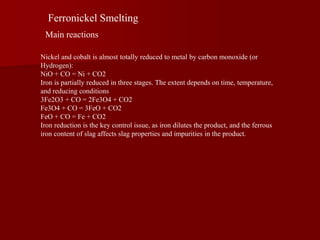
Nickel and cobalt is almost totally reduced to metal by carbon monoxide (or
Hydrogen):
NiO + CO = Ni + CO2
Iron is partially reduced in three stages. The extent depends on time, temperature,
and reducing conditions
3Fe2O3 + CO = 2Fe3O4 + CO2
Fe3O4 + CO = 3FeO + CO2
FeO + CO = Fe + CO2
Iron reduction is the key control issue, as iron dilutes the product, and the ferrous
iron content of slag affects slag properties and impurities in the product.
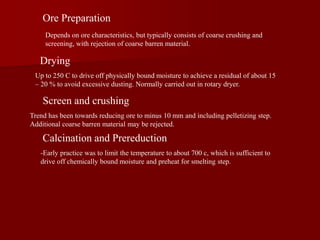
Ore Preparation
Depends on ore characteristics, but typically consists of coarse crushing and
screening, with rejection of coarse barren material.
Drying
Up to 250 C to drive off physically bound moisture to achieve a residual of about 15
– 20 % to avoid excessive dusting. Normally carried out in rotary dryer.
Screen and crushing
Trend has been towards reducing ore to minus 10 mm and including pelletizing step.
Additional coarse barren material may be rejected.
Calcination and Prereduction
-Early practice was to limit the temperature to about 700 c, which is sufficient to
drive off chemically bound moisture and preheat for smelting step.
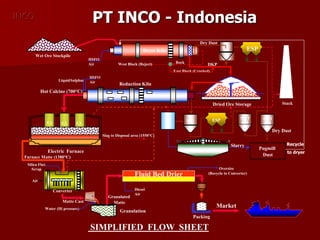
INCO
SIMPLIFIED FLOW SHEET
Packing
E.L E.L E.L
ESP
THICKENER
Scrubber
500 T
BIN
100 T
BIN
ESP
M.C
Slag to Disposal area (1550°C)
Furnace Matte (1380°C)
Electric Furnace
Silica Flux
Scrap
Converter
Matte Cast
Hot Calcine (700°C)
Wet Ore Stockpile
Dryer Kiln
Reduction Kiln
Recycle
Slurry
Dry Dust
Pugmill
Dust
Market
Stack
HSFO
Air
Granulation
HSFO
Air
LiquidSulphur
Dry Dust
DKP
Dried Ore Storage
Rock
West Block (Reject)
East Block (Crushed)
Diesel
Air
Water (Hi pressure)
Granulated
Matte
Oversize
(Recycle to Converter)
M.C
Air
Fluid Bed Drier
to dryer
PT INCO - Indonesia
SCREENING
STATION PRODUCT
Dried Ore
Storage 2
Dried Ore
Storage 1 REDUCTION
KILN
ELECTRIC
FURNACE
DRYER
CONVERTER
PRODUCT
DRYER
Dryer 1
Dryer 2
Dryer 3
Kiln 1
Kiln 2
Kiln 3
Kiln 4
Kiln 5
Furnace 1
Furnace 2
Furnace 3
Furnace 4
PS2
PS3
PS4
Slag to Disposal
Reverts
to Kiln
EB
WB
SHIPPING
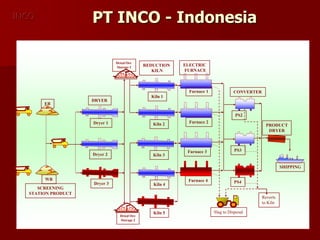
INCO PT INCO - Indonesia
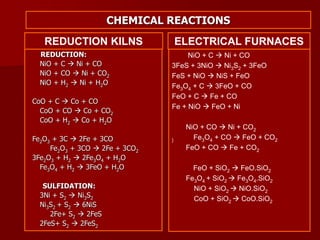
CHEMICAL REACTIONS
REDUCTION:
NiO + C  Ni + CO
NiO + CO  Ni + CO2
NiO + H2  Ni + H2O
CoO + C  Co + CO
CoO + CO  Co + CO2
CoO + H2  Co + H2O
Fe2O3 + 3C  2Fe + 3CO
Fe2O3 + 3CO  2Fe + 3CO2
3Fe2O3 + H2  2Fe3O4 + H2O
Fe3O4 + H2  3FeO + H2O
SULFIDATION:
3Ni + S2  Ni3S2
Ni3S2 + S2  6NiS
2Fe+ S2  2FeS
2FeS+ S2  2FeS2
REDUCTION KILNS
NiO + C  Ni + CO
3FeS + 3NiO  Ni3S2 + 3FeO
FeS + NiO  NiS + FeO
Fe3O4 + C  3FeO + CO
FeO + C  Fe + CO
Fe + NiO  FeO + Ni
NiO + CO  Ni + CO2
} Fe3O4 + CO  FeO + CO2
FeO + CO  Fe + CO2
FeO + SiO2  FeO.SiO2
Fe3O4 + SiO2  Fe3O4.SiO2
NiO + SiO2  NiO.SiO2
CoO + SiO2  CoO.SiO2
ELECTRICAL FURNACES
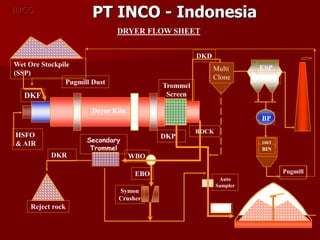
DRYER FLOW SHEET
DKP
Dryer Kiln
Pugmill
Secondary
Trommel
Symon
Crusher
Trommel
Screen
HSFO
& AIR
BP
WBO
EBO
DKF
DKR
Wet Ore Stockpile
(SSP)
Pugmill Dust
ESP
DKD
D 1,2+3
Reject rock
Multi
Clone
100T
BIN
Scale
Auto
Sampler
ROCK
INCO PT INCO - Indonesia
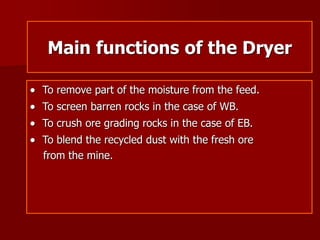
Main functions of the Dryer
 To remove part of the moisture from the feed.
 To screen barren rocks in the case of WB.
 To crush ore grading rocks in the case of EB.
 To blend the recycled dust with the fresh ore
from the mine.
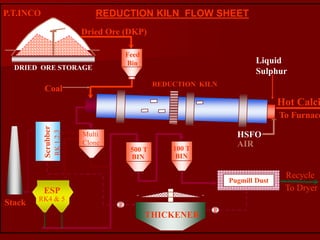
REDUCTION KILN FLOW SHEET
DRIED ORE STORAGE
HSFO
AIR
Liquid
Sulphur
Coal
Dried Ore (DKP)
Feed
Bin
Stack
Pugmill Dust
Hot Calci
To Furnace
Recycle
To Dryer
P.T.INCO
500 T
BIN
Multi
Clone
ESP
RK4 & 5
100 T
BIN
P
P
REDUCTION KILN
THICKENER
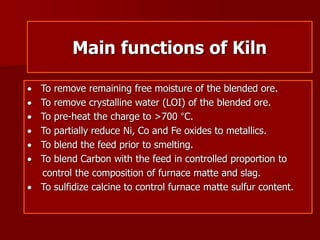
Main functions of Kiln
 To remove remaining free moisture of the blended ore.
 To remove crystalline water (LOI) of the blended ore.
 To pre-heat the charge to >700 °C.
 To partially reduce Ni, Co and Fe oxides to metallics.
 To blend the feed prior to smelting.
 To blend Carbon with the feed in controlled proportion to
control the composition of furnace matte and slag.
 To sulfidize calcine to control furnace matte sulfur content.
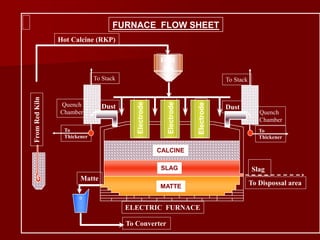
FURNACE FLOW SHEET
Hot Calcine (RKP)
From
Red
Kiln
CALCINE
SLAG
MATTE
Electrode
Electrode
Electrode
Feed
Bin
ELECTRIC FURNACE
Slag
To Dispossal area
Matte
To Converter
Quench
Chamber
Dust
To
Thickener
Dust
Quench
Chamber
To
Thickener
To Stack To Stack
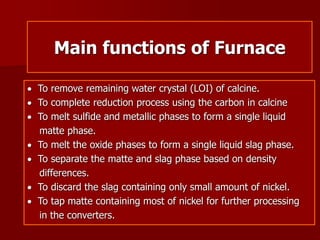
Main functions of Furnace
 To remove remaining water crystal (LOI) of calcine.
 To complete reduction process using the carbon in calcine
 To melt sulfide and metallic phases to form a single liquid
matte phase.
 To melt the oxide phases to form a single liquid slag phase.
 To separate the matte and slag phase based on density
differences.
 To discard the slag containing only small amount of nickel.
 To tap matte containing most of nickel for further processing
in the converters.
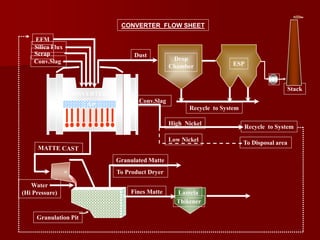
CONVERTER FLOW SHEET
EFM
Silica Flux
Scrap
Conv.Slag
Granulation Pit
Water
(Hi Pressure)
Conv.Slag
To Disposal area
Low Nickel
High Nickel
Dust
Stack
Granulated Matte
Air
F
Drop
Chamber ESP
CONVERTER
Recycle to System
Recycle to System
Fines Matte Lamela
Thikener
To Product Dryer
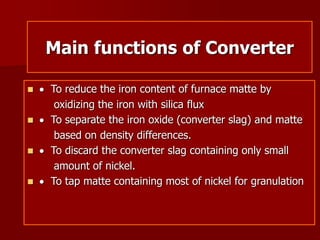
Main functions of Converter
  To reduce the iron content of furnace matte by
oxidizing the iron with silica flux
  To separate the iron oxide (converter slag) and matte
based on density differences.
  To discard the converter slag containing only small
amount of nickel.
  To tap matte containing most of nickel for granulation
Adopted from :
- ALTA 1997, Ni/Co Laterite Project Development Seminar
- A presentation MS 2004-133rd Annual Meeting & Exhibition,
International Laterite Symposium – 2004 by Ashok Davi.
- PTI _Plant flow sheet , a ppt by Agus Superiadi

Nickel_Processes.ppt

  • 1.
    Nickel / CobaltLaterite Processes A short training for SPA Geologists February 2005 By Boy Adhitya Presented by : Frans Attong Adopted from ALTA 1997, Ni/Co Laterite Project Development Seminar And A presentation MS 2004-133rd Annual Meeting & Exhibition, International Laterite Symposium – 2004 by Ashok Davi
  • 2.
    Mineralogy And oreComposition Idealized Orebody Profile Cap -Lateritic soils and re-crystallized iron oxides formed by sequential leaching and re precipitation. -Generally has a low nickel grade, therefore classified as overburden. Limonite -Main consituents are goethite, chromite, manganese wad (asbolane), silica and silicates. -Most of Nickel is in Goethite (Fe,Ni)O(OH) nH2O -Most of Cobalt is in the coarser grained wad, Mn, Fe, Co, Ni Oxide Altered Peridotite -Generally called silicate or saprolite zone -In dry climates saprolite my contain upper clay rich zone. -Saprolite Zone can also contain wad and chromite to lesser dgree than limonite. -Nickel is commonly present in silicates, clay goethite, and wad material. -Saprolite generally conrains portion of reject low grade bed rock and silica boxwork. Nickel enriched rim may occur around rock pieces. Bed Rock - Low grade Peridotite, which is not mined. However nickel enrichment can occur in upper cracks.
  • 5.
    Mettalurgical Implications -Physically upgradingis generally limited to rejection of barren rocks, or possibly Chromite. However, occasionally it is possible to achieve more substantial upgrading, for example by removing coarse silica. -Moisture content is a major energy consumer for processes which include drying, such as smelting and reduction roast-ammonia leaching. -Ores are mineralogical and chemically complex, which is challenging for chemical processes. -Various Zones differ significantly, which may limit the applicability of a particular process to only part of the ore reserves. -Processing routes must be able to reject the large iron, silica and magnesia contents. -High iron content is a problem for acid leaching processes in general. Magnesia and alumina are also acid consumers. -Aggressive leaching conditions are required to take nickel into solution. -Si/Mg ratio has important implications for smelting processes. -Presence of clays generally has adverse impact on hydrometallurgical operations, e.g. settling, pumping, agitation. -Unlike sulphide ore treatment, sulphur is not released in the extraction of nickel and cobalt, which has environmental benefits. -Cobalt is potentially valuable by-product, which is a major consideration in selection of a processing route. Cobalt level is highest in the limonitic zone. -Chromite could be considered as a by-product in some cases, and its recovery by gravity separation would constitute minor upgrading
  • 6.
    World’s Land BasedNickel Resources and Primary Nickel Production (Resources Distribution by Contained Nickel) 58% 42% 28% 72% Primary Ni Production Laterite Sulfide World Ni Resource on Land Laterite Sulfide Mt Resource % Ni Mt Ni % of Total Sulfide 10500 0.58 62 27.8% Laterite 12600 1.28 161 72.2% Total 23100 0.97% 223 100
  • 7.
    Commercial Processes Four basicprocess routes in current use for latterites : -Pyrometallurgical : - Ferronickel smelting - Matte smelting -Hydrometalurgical : - Pressure Acid Leach -Pyromet/hydromet : - Reduction roast – ammonia leach Operating Plants -Ferronickel smelting is still the dominating process -Smelting is generally applied to higher grade feed, most are > 1.7% Ni. Hydrometallurgical plants generally process < 2% Ni.
  • 8.
    World Nickel LateriteResources (Distribution by Contained Nickel) World Nickel Laterite Resources Combined HYDROMET & PYRO (Distribution by Contained Nickel) OTHER 2% PHILIPINNES 17% NEW CAL 21% AUSTRLIA 20% AFRICA 8% CARRIBEAN 7% C&S AMERICA 9% INDONESIA 12% ASIA & EUROPE 4% Mt of Resources %Ni Mt Ni Laterites 12600 1.28 161
  • 9.
    Typical Feed Compositions forVarious Laterite Operations Analysis, wt. % Moa Bay Murrin Murrin SLN Cerro Matoso P.T. Inco Process PAL PAL Fe-Ni Smeltin g Fe-Ni Smelting Matte Smelting Ore Type Limonite Nontronite Garnieri te Hi Silica Saprolite Saprolite Ni 1.3 1.3 2.7 2.9 1.8 Co 0.15 0.09 0.07 0.07 0.07 Fe 47.5 22 14 14 18 Al 4.5 2.5 Mg 1.0 4 15 9 10 SiO2 3.7 42 37 46 34 Mn 0.75 0.4
  • 10.
    Laterite Processes (Generalized BlockFlow Diagram) Drying Calcine/Reduction Calcine & Reduction CCD & Neutralization Smelting Refining or Converting Ammoniacal leaching Purification and Recovery Drying High Pressure Leaching Precipitation & Redesolution (Optional) Purification and Recovery Laterite Ore Laterite Ore Laterite Ore FeNi or Matte Ni and Co Ni and Co Smelting Caron Process PAL
  • 11.
    Laterite Slag MeltingPoint vs. S/M Ratio 8 1 2 3 4 5 6 7 1400 1300 1500 1600 1700 1600 1700 1800 1900 2000 T,K T,OC 20FeO 25FeO 30FeO SiO2 / MgO NOTE 1 P.T. INCO CERRO MATOSO NOTE 1: Japanese FE-Ni Smelters and SLN NOTE 2: Cerro Matoso (FeO ~ 20%) Electric Furnace Slag Compositions Superimposed On the FeO-MgO-SiO2 Phase Diagram
  • 12.
    Process Description andExamples Pyrometallurgical Processes Fe-Ni Production  Ores suited for production of high carbon ferro-nickel have: – High nickel grade (> 2.1 % Ni) – Low Silica/Magnesia ratio, and – Low iron content (Fe/Ni ratio <6) Examples: SLN Doniambo, Pamco, Hyuga, P.T. Aneka Tambang  Ores suited for production of low carbon ferro-nickel have: – Higher Fe/Ni ratio (6 to 12) – Relatively high-melting point slags (Either very high S/M ratio – Example: Cerro Matoso, or Low S/M ratio – Example: Falcondo)
  • 13.
    Process Description andExamples Pyrometallurgical Processes Matte Production  Ores suited for production of matte have: – Relatively higher Fe/Ni ratio (6 to 12) – Relatively low melting point slags Example: P.T. Inco
  • 14.
    Process Description andExamples Caron Process – Caron process could be used for limonitic ores or a mixture of limonite and saprolite – The process can tolerate a higher amount of Mg in the feed than the PAL processes Examples: Nicaro, Punta Gorda, Yabulu, Nonoc (Closed)
  • 15.
    Process Description andExamples PAL Processes  PAL processes use ore that: – are predominantly limonitic, or nontronitic in the case of dry laterites – contain some saprolite – have Mg generally limited to <4 % (At higher Mg acid consumption is higher) – require lower Al content Examples: Moa Bay, Murrin Murrin
  • 16.
    Smelting Process Smelting processare governed by two basic chemical facts: -Separation of Nickel from Oxide gangue components such as silica and magnesia is readily achieved by smelting, due to large differences in the free energies of formation. -Only partial separation of nickel from iron is possible by selective reduction of oxides. Reduction conditions can be set to completely reduce nickel oxide, but part of the iron oxide is co-reduced. Two approaches have been adopted : -Minimise Fe/Ni ratio and accept a ferronickel product -Add sulphur to form a nickel/iron sulfide matte, then prefentially convert iron sulphide to oxide by blowing with air, to leave a low iron nickel suphide matte product (for further refining).
  • 17.
    Ferronickel Smelting Main reactions Nickeland cobalt is almost totally reduced to metal by carbon monoxide (or Hydrogen): NiO + CO = Ni + CO2 Iron is partially reduced in three stages. The extent depends on time, temperature, and reducing conditions 3Fe2O3 + CO = 2Fe3O4 + CO2 Fe3O4 + CO = 3FeO + CO2 FeO + CO = Fe + CO2 Iron reduction is the key control issue, as iron dilutes the product, and the ferrous iron content of slag affects slag properties and impurities in the product.
  • 18.
    Ore Preparation Depends onore characteristics, but typically consists of coarse crushing and screening, with rejection of coarse barren material. Drying Up to 250 C to drive off physically bound moisture to achieve a residual of about 15 – 20 % to avoid excessive dusting. Normally carried out in rotary dryer. Screen and crushing Trend has been towards reducing ore to minus 10 mm and including pelletizing step. Additional coarse barren material may be rejected. Calcination and Prereduction -Early practice was to limit the temperature to about 700 c, which is sufficient to drive off chemically bound moisture and preheat for smelting step.
  • 19.
    INCO SIMPLIFIED FLOW SHEET Packing E.LE.L E.L ESP THICKENER Scrubber 500 T BIN 100 T BIN ESP M.C Slag to Disposal area (1550°C) Furnace Matte (1380°C) Electric Furnace Silica Flux Scrap Converter Matte Cast Hot Calcine (700°C) Wet Ore Stockpile Dryer Kiln Reduction Kiln Recycle Slurry Dry Dust Pugmill Dust Market Stack HSFO Air Granulation HSFO Air LiquidSulphur Dry Dust DKP Dried Ore Storage Rock West Block (Reject) East Block (Crushed) Diesel Air Water (Hi pressure) Granulated Matte Oversize (Recycle to Converter) M.C Air Fluid Bed Drier to dryer PT INCO - Indonesia
  • 20.
    SCREENING STATION PRODUCT Dried Ore Storage2 Dried Ore Storage 1 REDUCTION KILN ELECTRIC FURNACE DRYER CONVERTER PRODUCT DRYER Dryer 1 Dryer 2 Dryer 3 Kiln 1 Kiln 2 Kiln 3 Kiln 4 Kiln 5 Furnace 1 Furnace 2 Furnace 3 Furnace 4 PS2 PS3 PS4 Slag to Disposal Reverts to Kiln EB WB SHIPPING INCO PT INCO - Indonesia
  • 21.
    CHEMICAL REACTIONS REDUCTION: NiO +C  Ni + CO NiO + CO  Ni + CO2 NiO + H2  Ni + H2O CoO + C  Co + CO CoO + CO  Co + CO2 CoO + H2  Co + H2O Fe2O3 + 3C  2Fe + 3CO Fe2O3 + 3CO  2Fe + 3CO2 3Fe2O3 + H2  2Fe3O4 + H2O Fe3O4 + H2  3FeO + H2O SULFIDATION: 3Ni + S2  Ni3S2 Ni3S2 + S2  6NiS 2Fe+ S2  2FeS 2FeS+ S2  2FeS2 REDUCTION KILNS NiO + C  Ni + CO 3FeS + 3NiO  Ni3S2 + 3FeO FeS + NiO  NiS + FeO Fe3O4 + C  3FeO + CO FeO + C  Fe + CO Fe + NiO  FeO + Ni NiO + CO  Ni + CO2 } Fe3O4 + CO  FeO + CO2 FeO + CO  Fe + CO2 FeO + SiO2  FeO.SiO2 Fe3O4 + SiO2  Fe3O4.SiO2 NiO + SiO2  NiO.SiO2 CoO + SiO2  CoO.SiO2 ELECTRICAL FURNACES
  • 22.
    DRYER FLOW SHEET DKP DryerKiln Pugmill Secondary Trommel Symon Crusher Trommel Screen HSFO & AIR BP WBO EBO DKF DKR Wet Ore Stockpile (SSP) Pugmill Dust ESP DKD D 1,2+3 Reject rock Multi Clone 100T BIN Scale Auto Sampler ROCK INCO PT INCO - Indonesia
  • 23.
    Main functions ofthe Dryer  To remove part of the moisture from the feed.  To screen barren rocks in the case of WB.  To crush ore grading rocks in the case of EB.  To blend the recycled dust with the fresh ore from the mine.
  • 24.
    REDUCTION KILN FLOWSHEET DRIED ORE STORAGE HSFO AIR Liquid Sulphur Coal Dried Ore (DKP) Feed Bin Stack Pugmill Dust Hot Calci To Furnace Recycle To Dryer P.T.INCO 500 T BIN Multi Clone ESP RK4 & 5 100 T BIN P P REDUCTION KILN THICKENER
  • 25.
    Main functions ofKiln  To remove remaining free moisture of the blended ore.  To remove crystalline water (LOI) of the blended ore.  To pre-heat the charge to >700 °C.  To partially reduce Ni, Co and Fe oxides to metallics.  To blend the feed prior to smelting.  To blend Carbon with the feed in controlled proportion to control the composition of furnace matte and slag.  To sulfidize calcine to control furnace matte sulfur content.
  • 26.
    FURNACE FLOW SHEET HotCalcine (RKP) From Red Kiln CALCINE SLAG MATTE Electrode Electrode Electrode Feed Bin ELECTRIC FURNACE Slag To Dispossal area Matte To Converter Quench Chamber Dust To Thickener Dust Quench Chamber To Thickener To Stack To Stack
  • 27.
    Main functions ofFurnace  To remove remaining water crystal (LOI) of calcine.  To complete reduction process using the carbon in calcine  To melt sulfide and metallic phases to form a single liquid matte phase.  To melt the oxide phases to form a single liquid slag phase.  To separate the matte and slag phase based on density differences.  To discard the slag containing only small amount of nickel.  To tap matte containing most of nickel for further processing in the converters.
  • 28.
    CONVERTER FLOW SHEET EFM SilicaFlux Scrap Conv.Slag Granulation Pit Water (Hi Pressure) Conv.Slag To Disposal area Low Nickel High Nickel Dust Stack Granulated Matte Air F Drop Chamber ESP CONVERTER Recycle to System Recycle to System Fines Matte Lamela Thikener To Product Dryer
  • 29.
    Main functions ofConverter   To reduce the iron content of furnace matte by oxidizing the iron with silica flux   To separate the iron oxide (converter slag) and matte based on density differences.   To discard the converter slag containing only small amount of nickel.   To tap matte containing most of nickel for granulation
  • 30.
    Adopted from : -ALTA 1997, Ni/Co Laterite Project Development Seminar - A presentation MS 2004-133rd Annual Meeting & Exhibition, International Laterite Symposium – 2004 by Ashok Davi. - PTI _Plant flow sheet , a ppt by Agus Superiadi