Nickel–titanium: a super-elastic alloy
endodontic instruments
Triveni institute of dental sciences, hospital and research centre
Guided by-
Dr. Vinod Agarwal
Submitted by-
Vivek Upadhyay
Final year BDS
Date of submission- 28-01-2013
Department of Conservative & Endodontics.
Introduction-
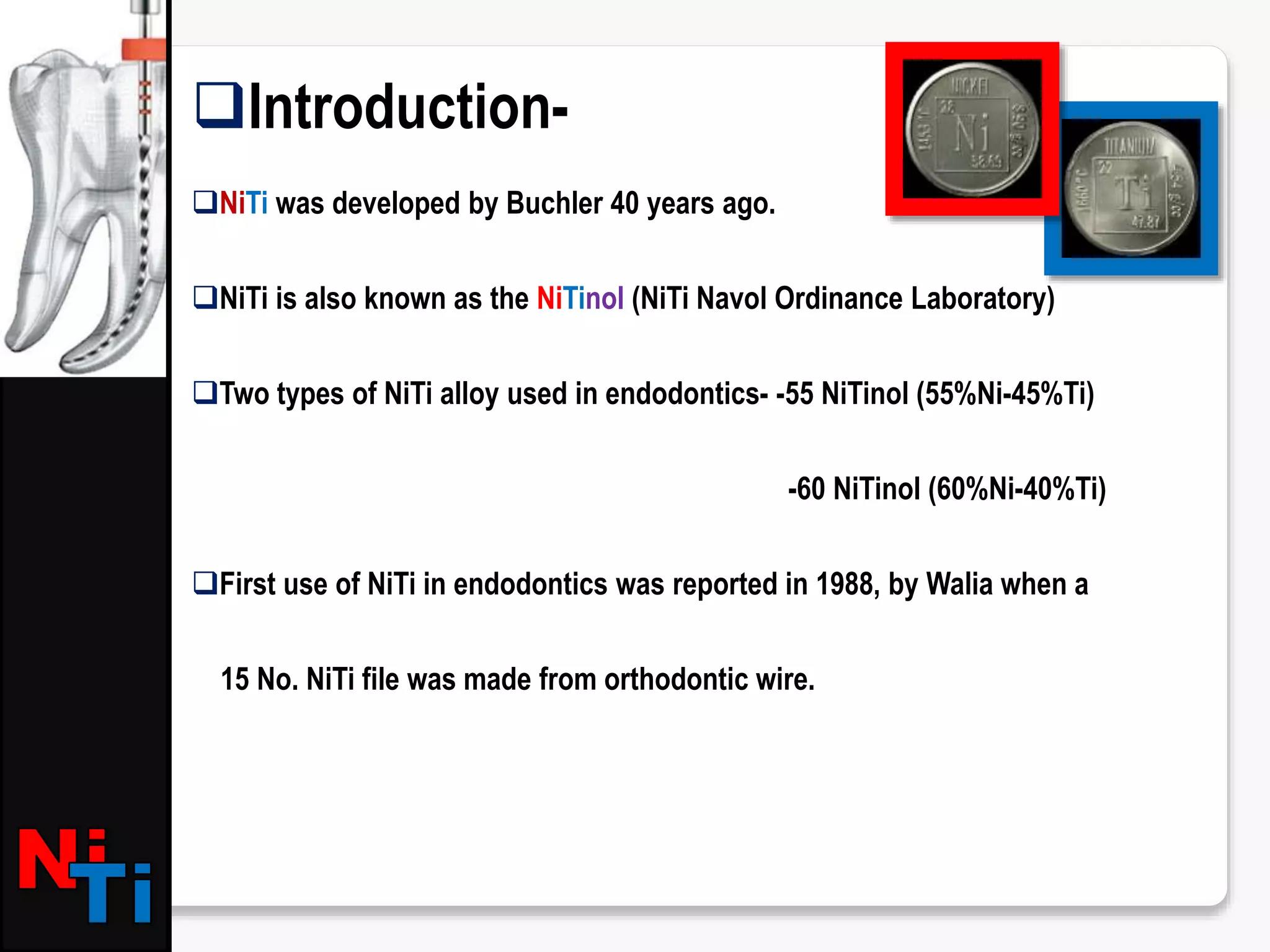
NiTi was developed by Buchler 40 years ago.
NiTi is also known as the NiTinol (NiTi Navol Ordinance Laboratory)
Two types of NiTi alloy used in endodontics- -55 NiTinol (55%Ni-45%Ti)
-60 NiTinol (60%Ni-40%Ti)
First use of NiTi in endodontics was reported in 1988, by Walia when a
15 No. NiTi file was made from orthodontic wire.
Manufacturing-
Nickel–titanium “shape memory metal alloy” can exist in two different
temperature-dependent crystal structures called
-martensite(lower temperature or daughter phase) and
-austenite (higher temperature or parent phase)
Ni–Ti can have three different forms:
-martensite,
-stress-induced martensite (super-elastic) and
-austenite.
 When thematerial is in its martensite form, it is soft and ductile, and it can be easily
deformed. Super-elastic Ni–Ti is highly elastic (rubber-like),
while austenitic Ni–Ti is quite strong and hard.
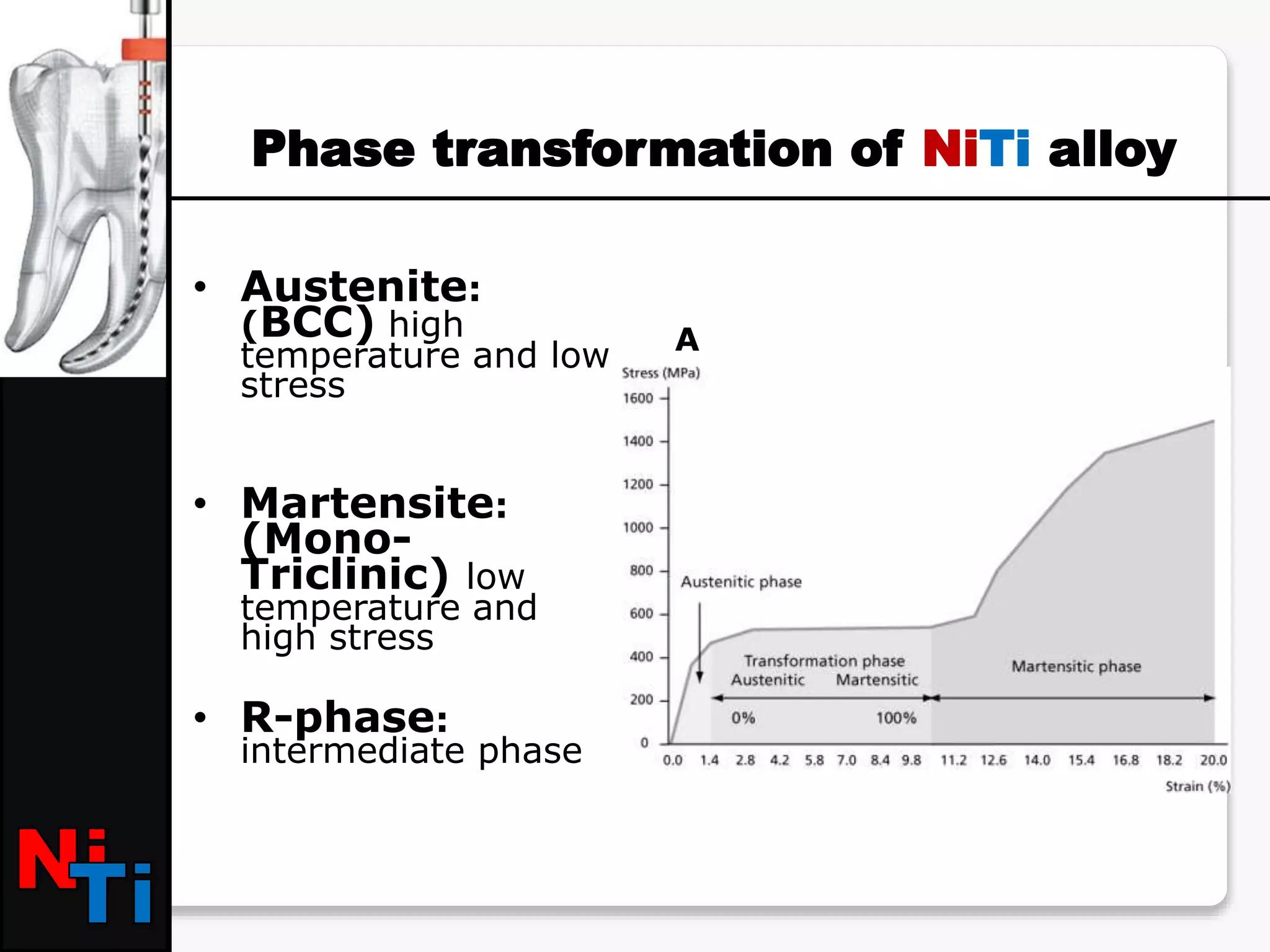
Phase transformation of NiTi alloy
• Austenite:
(BCC) high
temperature and low
stress
• Martensite:
(Mono-
Triclinic) low
temperature and
high stress
• R-phase:
intermediate phase
A
M
R
 Design & Structure-
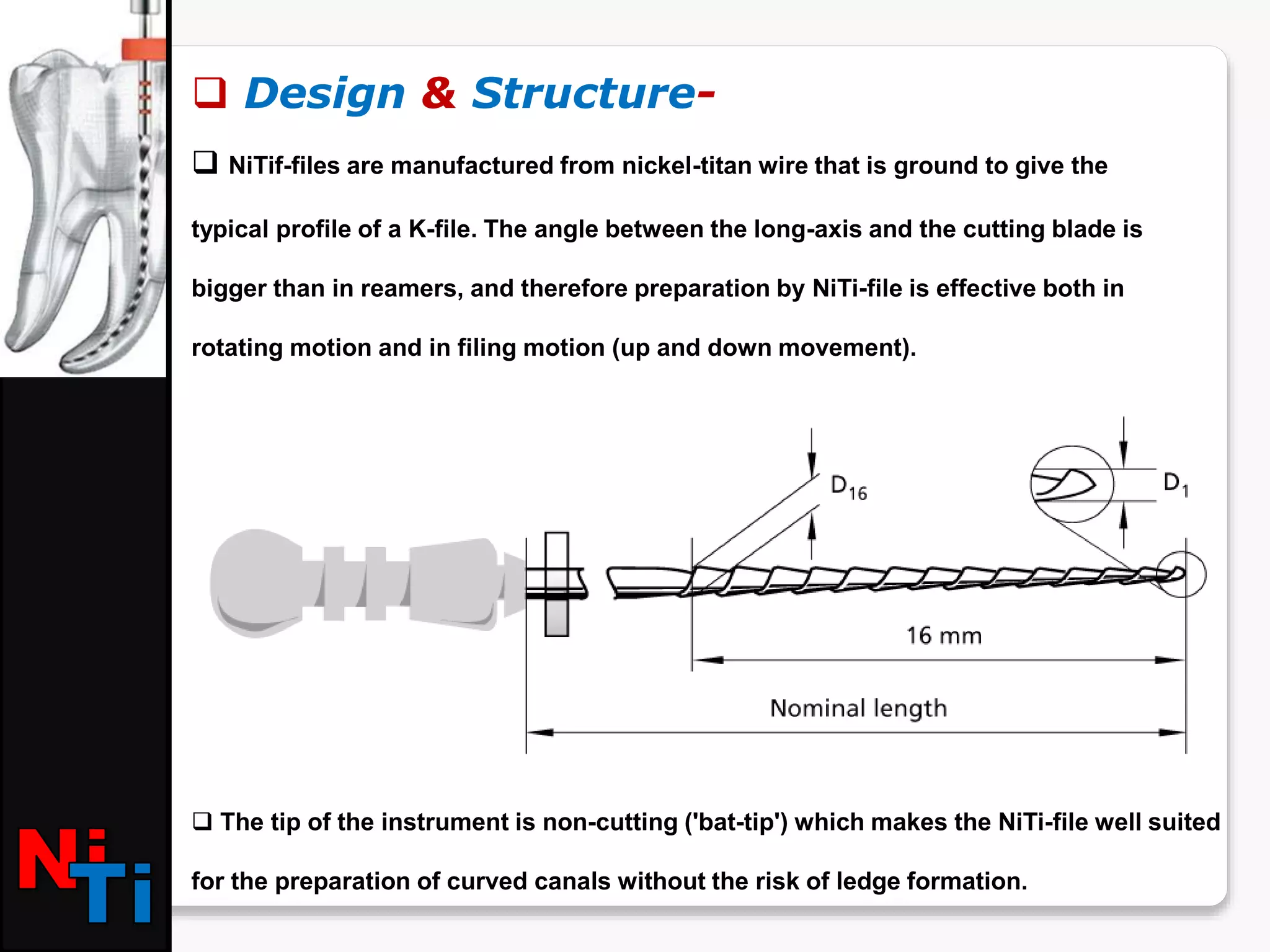
 NiTif-files are manufactured from nickel-titan wire that is ground to give the
typical profile of a K-file. The angle between the long-axis and the cutting blade is
bigger than in reamers, and therefore preparation by NiTi-file is effective both in
rotating motion and in filing motion (up and down movement).
 The tip of the instrument is non-cutting ('bat-tip') which makes the NiTi-file well suited
for the preparation of curved canals without the risk of ledge formation.
Sizes & Codes-
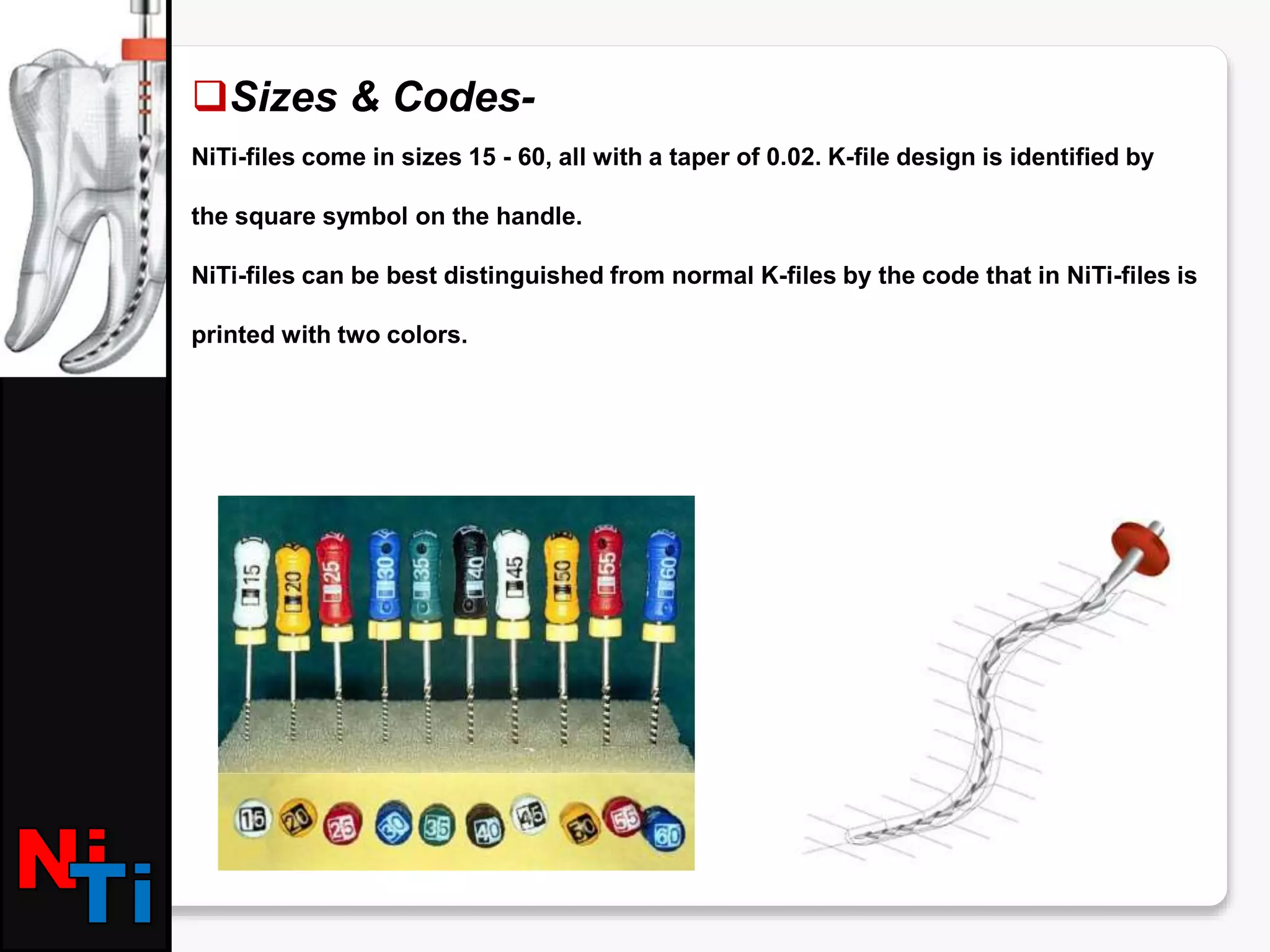
NiTi-files come in sizes 15 - 60, all with a taper of 0.02. K-file design is identified by
the square symbol on the handle.
NiTi-files can be best distinguished from normal K-files by the code that in NiTi-files is
printed with two colors.
Advantage of NiTi alloy-
1. Shape memory
2. Super elasticity
3. Low modulus of elasticity
4. Good resiliency
5. Corrosion resistance
6. Softer than stainless steel.
Disadvantages of NiTi Files-
1. Poor cutting efficiency.
2. NiTi files do not show sings of fatigue before they fracture.
3. Poor resistance to fracture as compare to stainless steal.
4. Break after 720 degree of rotation
Safety tips-
NiTi-files can be rotated only using moderate pressure.
Use of force may result in fracture also with bigger sized instruments.
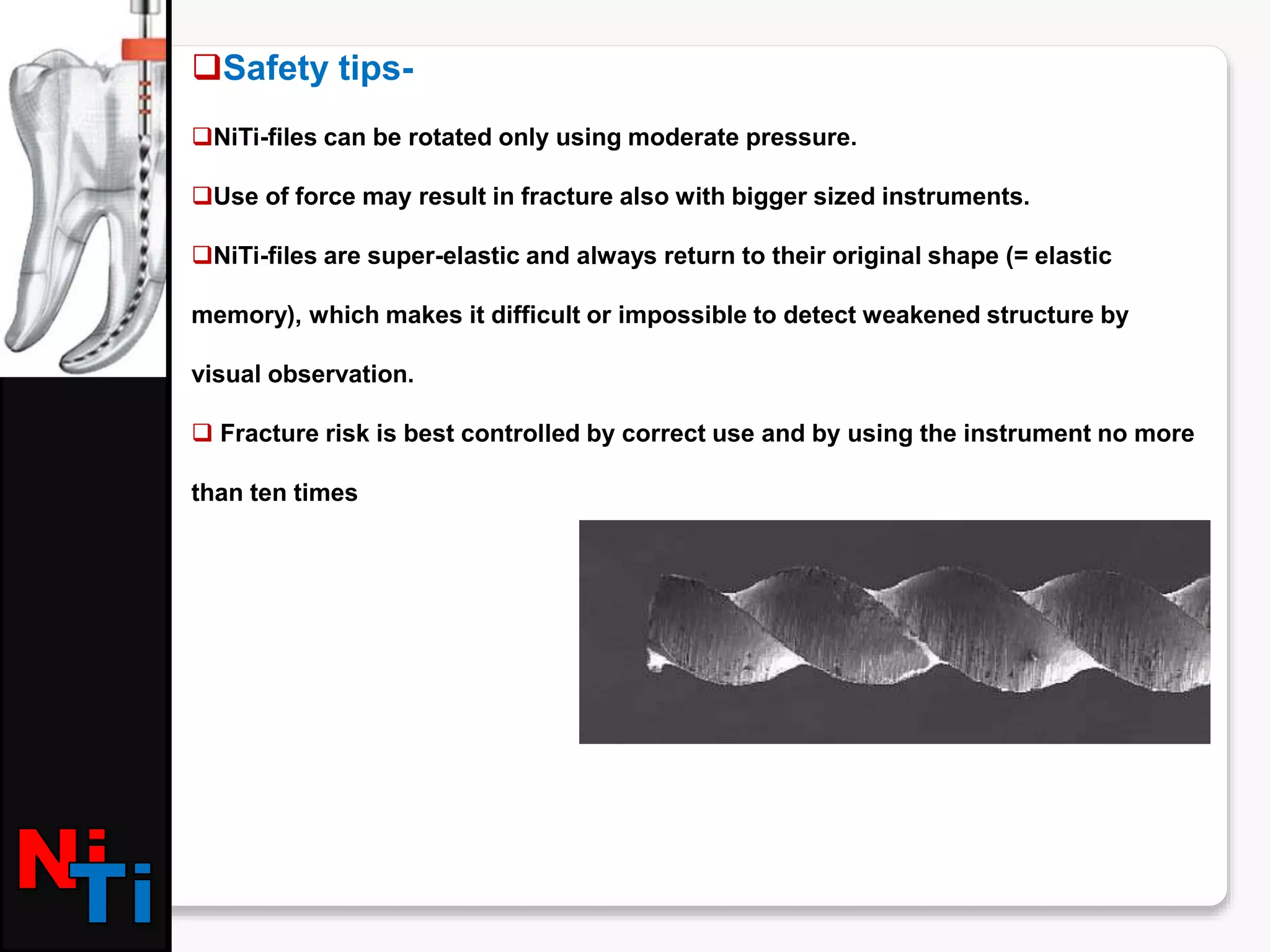
NiTi-files are super-elastic and always return to their original shape (= elastic
memory), which makes it difficult or impossible to detect weakened structure by
visual observation.
 Fracture risk is best controlled by correct use and by using the instrument no more
than ten times
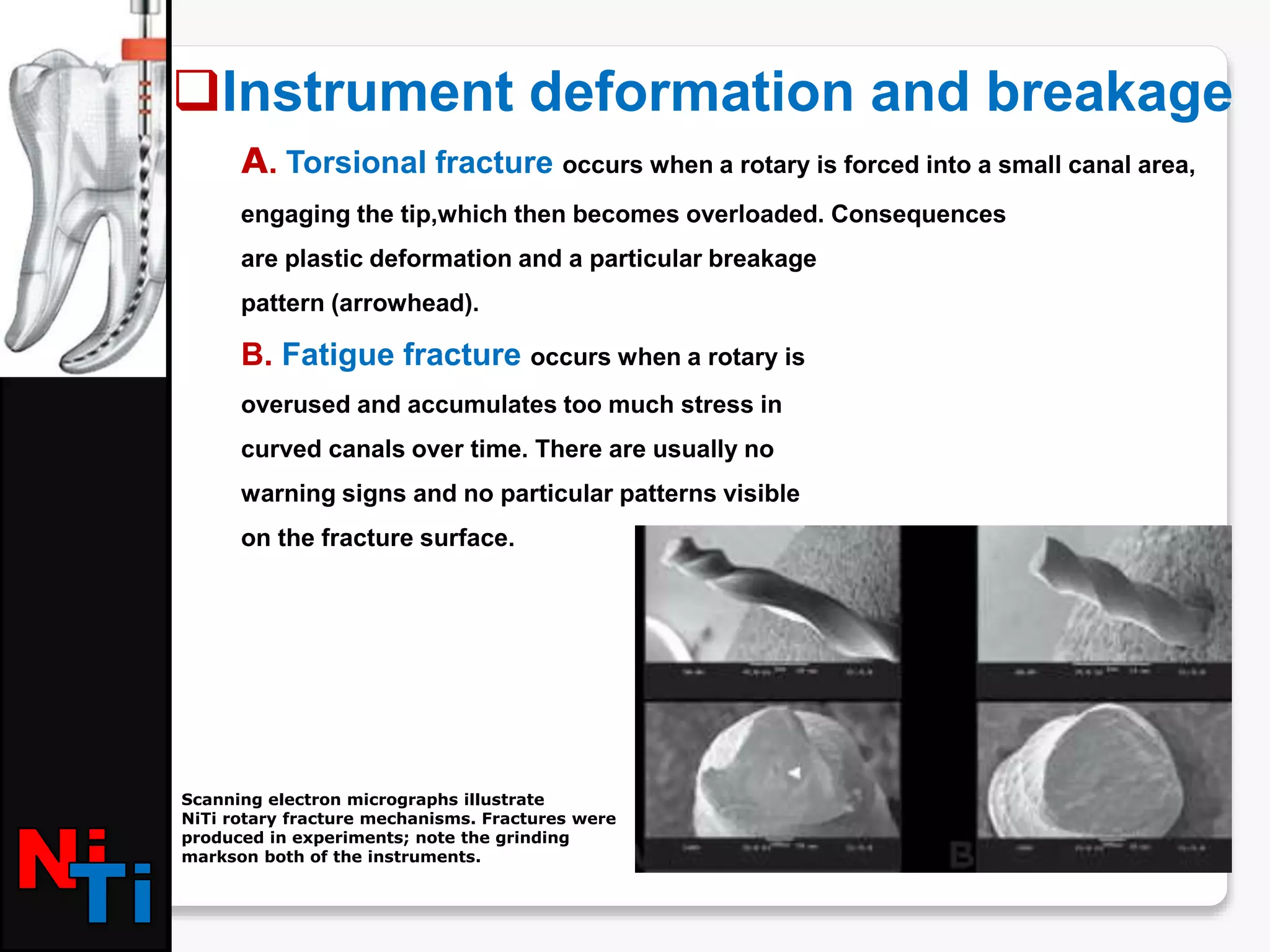
A. Torsional fracture occurs when a rotary is forced into a small canal area,
engaging the tip,which then becomes overloaded. Consequences
are plastic deformation and a particular breakage
pattern (arrowhead).
B. Fatigue fracture occurs when a rotary is
overused and accumulates too much stress in
curved canals over time. There are usually no
warning signs and no particular patterns visible
on the fracture surface.
Instrument deformation and breakage
Scanning electron micrographs illustrate
NiTi rotary fracture mechanisms. Fractures were
produced in experiments; note the grinding
markson both of the instruments.
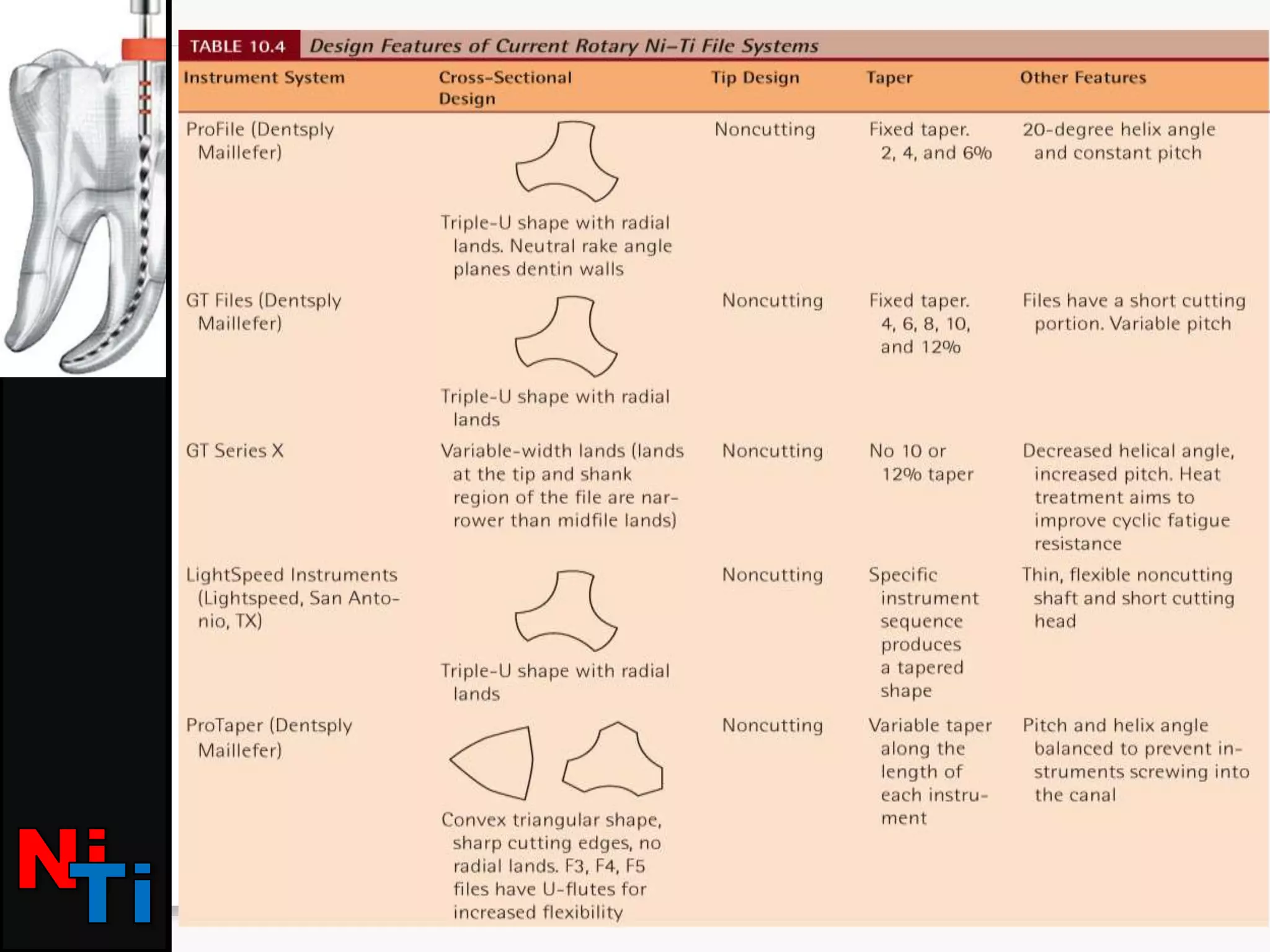
Nickel–titanium rotary systems
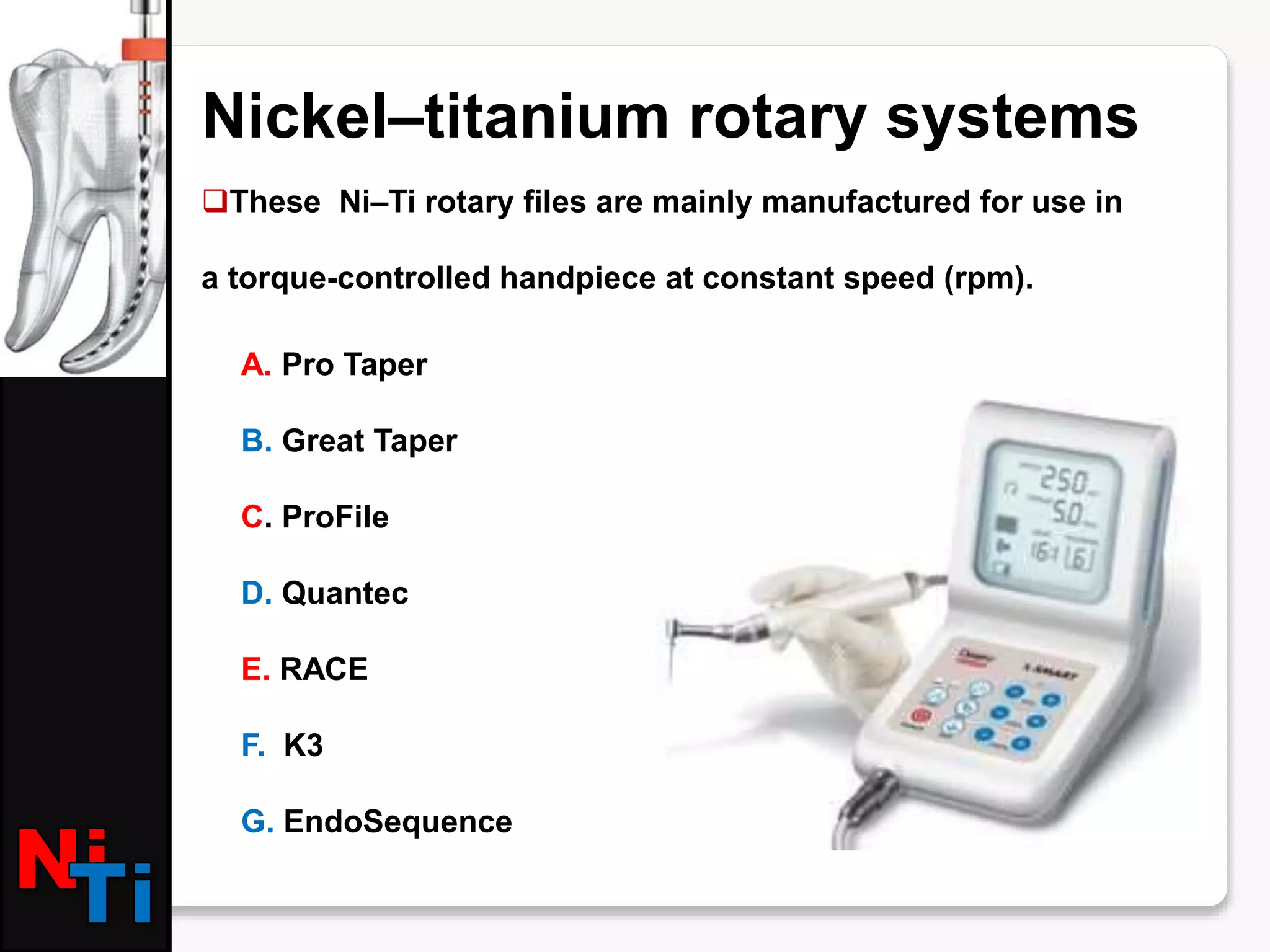
These Ni–Ti rotary files are mainly manufactured for use in
a torque-controlled handpiece at constant speed (rpm).
A. Pro Taper
B. Great Taper
C. ProFile
D. Quantec
E. RACE
F. K3
G. EndoSequence
The “Golden Rules” for NiTi Rotary Preparation
Use only tourque controlled handpiece.
Proper glide path must be stablished before using file.
Examin the file & bend the file at least 80 degree angle, every time before placing into
canal.
Use crown down method.
Do not force apically against resistance.
Remove the possible pulp tissue by broach.
Canal should be well lubricated and irrigated.
Dentine mud should be cleared off by frequent irrigation.
Discard the file if it is bend, streched or has a shiny spot.
Do not use rotary instrument to true working length specially in teeth with “S-shaped
canal”.
A. Pro Taper-
Design and Structure -
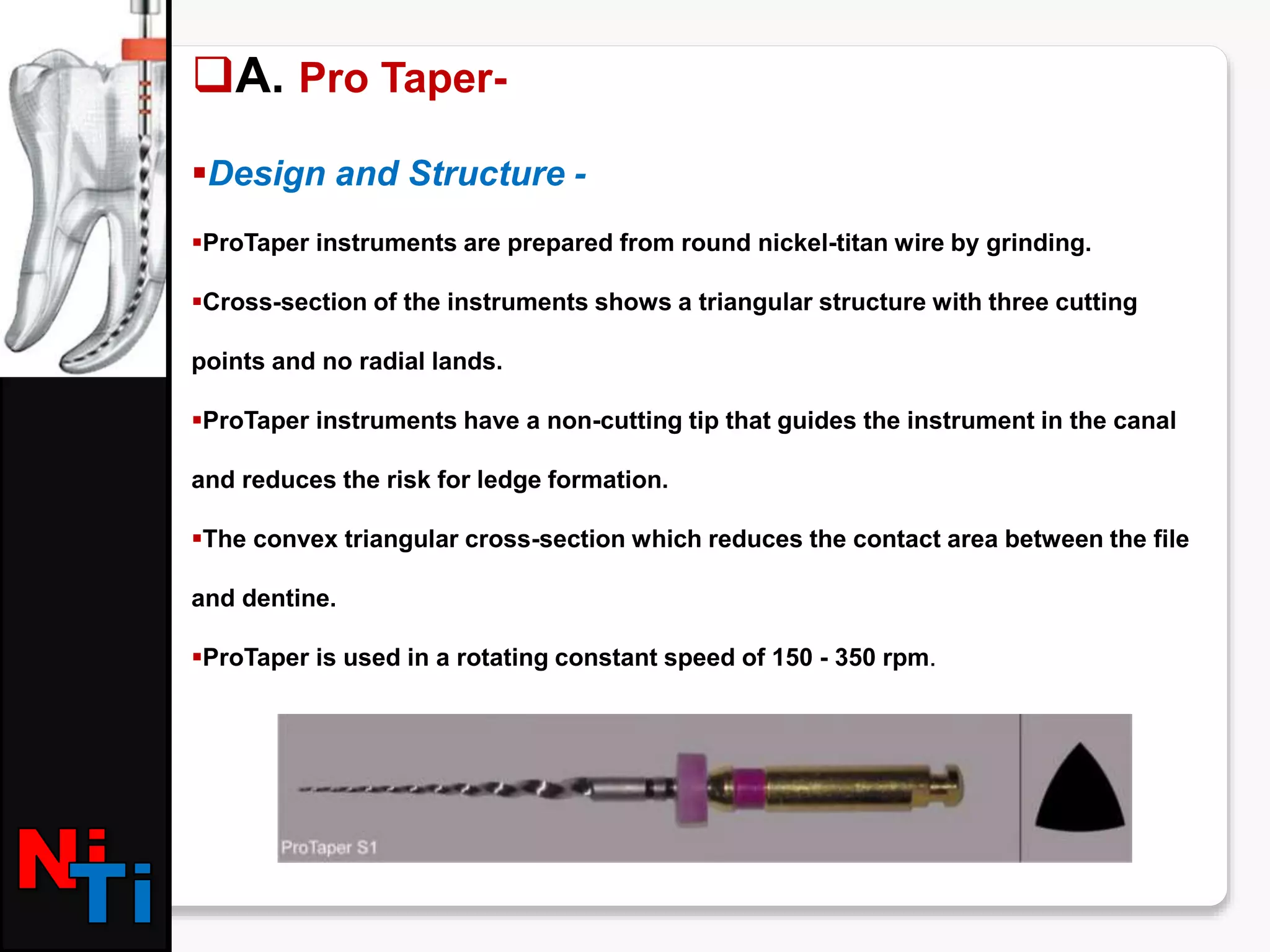
ProTaper instruments are prepared from round nickel-titan wire by grinding.
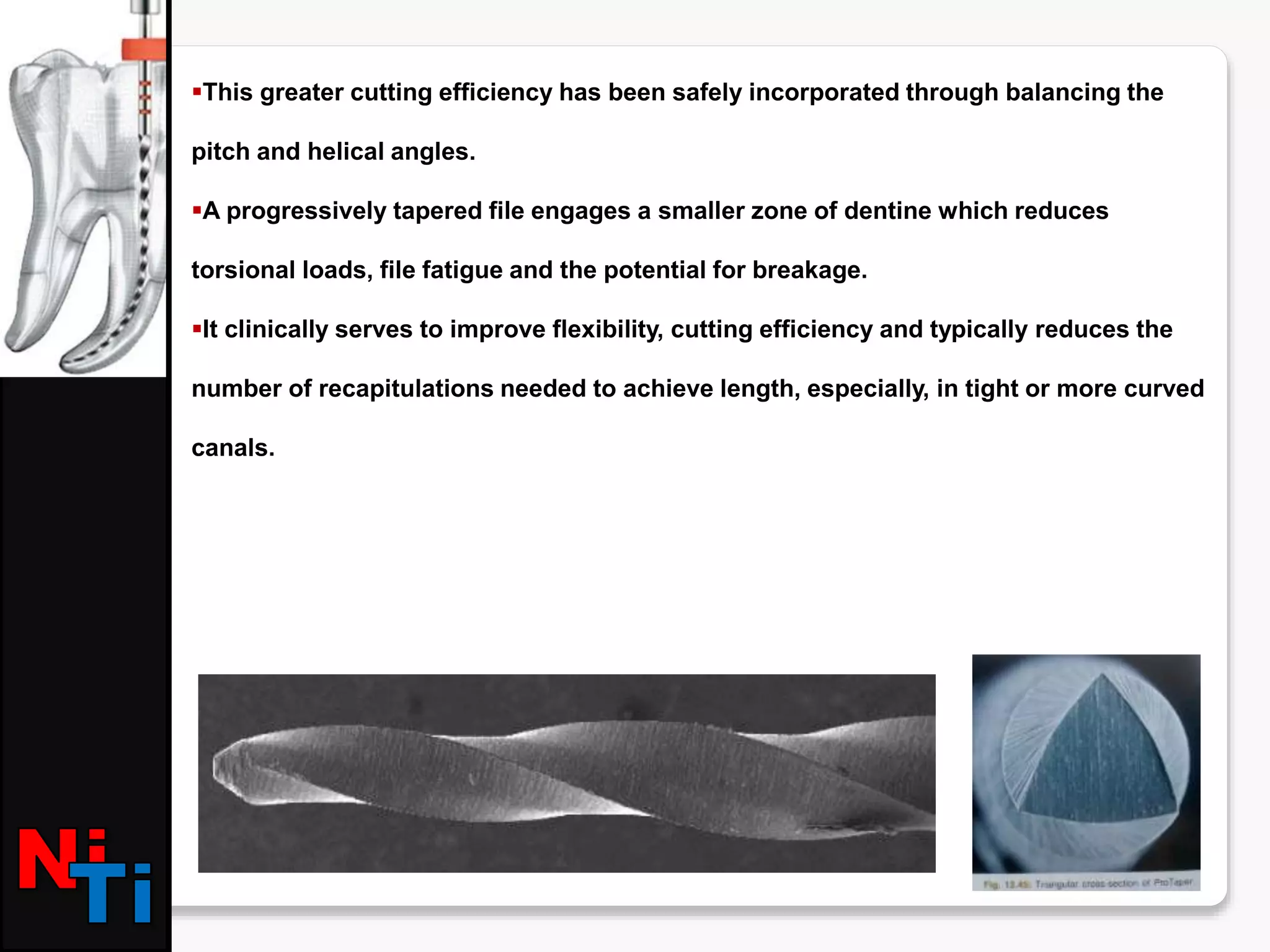
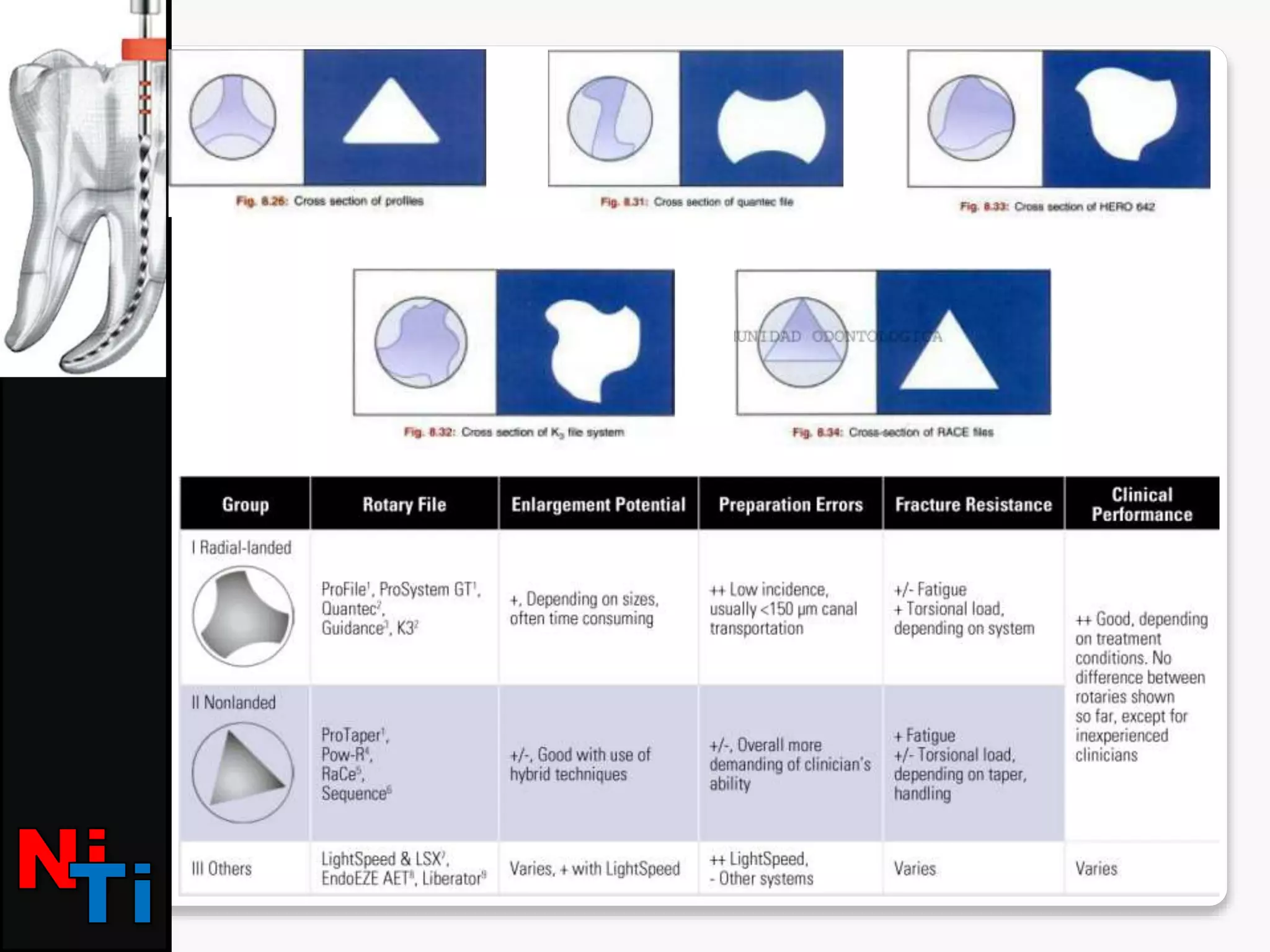
Cross-section of the instruments shows a triangular structure with three cutting
points and no radial lands.
ProTaper instruments have a non-cutting tip that guides the instrument in the canal
and reduces the risk for ledge formation.
The convex triangular cross-section which reduces the contact area between the file
and dentine.
ProTaper is used in a rotating constant speed of 150 - 350 rpm.
This greater cutting efficiency has been safely incorporated through balancing the
pitch and helical angles.
A progressively tapered file engages a smaller zone of dentine which reduces
torsional loads, file fatigue and the potential for breakage.
It clinically serves to improve flexibility, cutting efficiency and typically reduces the
number of recapitulations needed to achieve length, especially, in tight or more curved
canals.
Sizes & Codes :
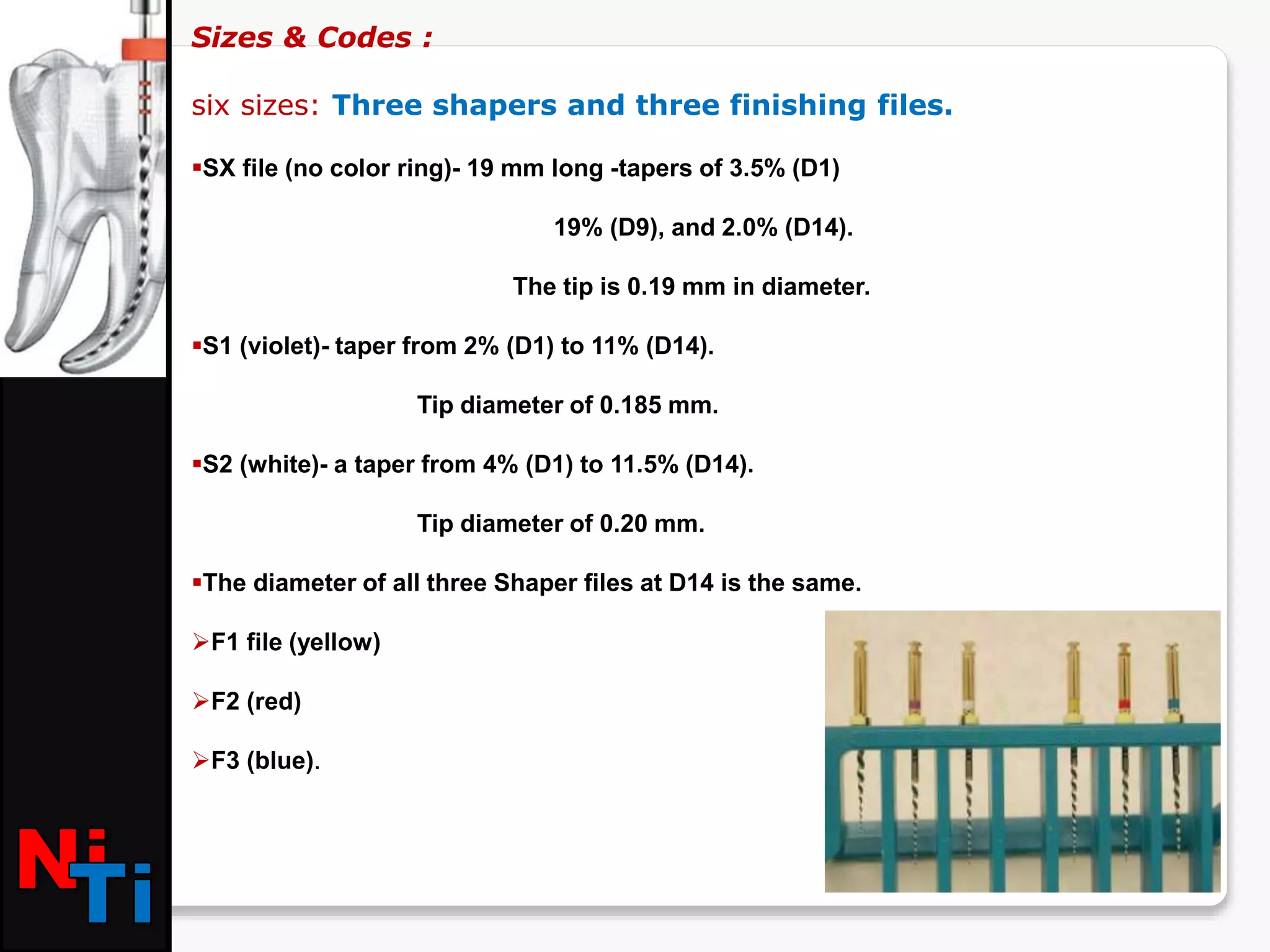
six sizes: Three shapers and three finishing files.
SX file (no color ring)- 19 mm long -tapers of 3.5% (D1)
19% (D9), and 2.0% (D14).
The tip is 0.19 mm in diameter.
S1 (violet)- taper from 2% (D1) to 11% (D14).
Tip diameter of 0.185 mm.
S2 (white)- a taper from 4% (D1) to 11.5% (D14).
Tip diameter of 0.20 mm.
The diameter of all three Shaper files at D14 is the same.
F1 file (yellow)
F2 (red)
F3 (blue).
B. Great Taper-
Design and Structure
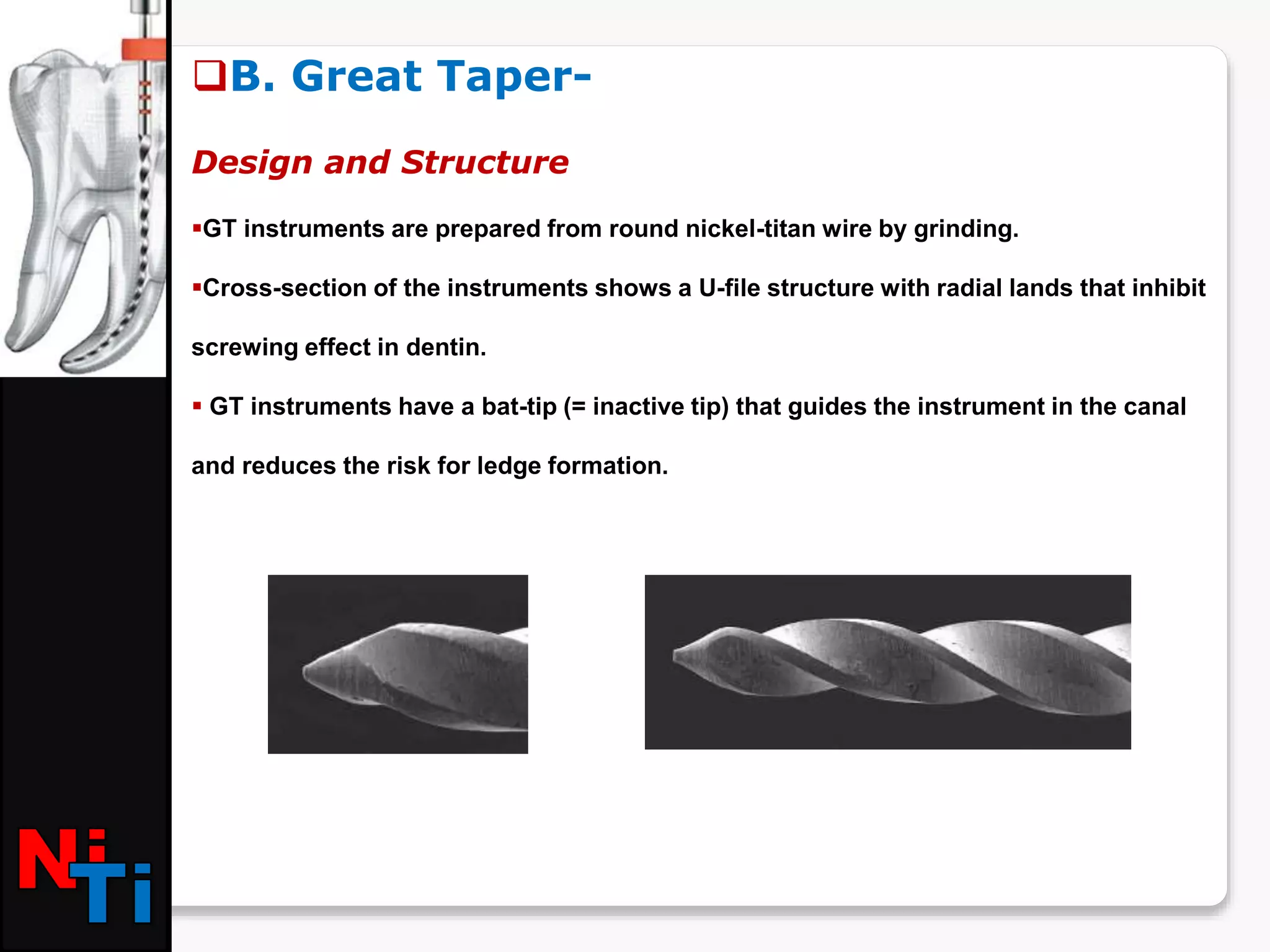
GT instruments are prepared from round nickel-titan wire by grinding.
Cross-section of the instruments shows a U-file structure with radial lands that inhibit
screwing effect in dentin.
 GT instruments have a bat-tip (= inactive tip) that guides the instrument in the canal
and reduces the risk for ledge formation.
Sizes & Codes :-
GT instruments are produced in three sizes (iso tip sizes), 20, 30, and 40, and each
size comes in four tapers: 12, 10, 08, 06 and 04.
In addition, three bigger instruments are included in the GT family; sizes 35, 50 and 70,
all with a taper 12, for preparation of very large canals and for coronal flare in other
canals.
Negative rake angle makes them too scrape the dentine rather than cutting.
Recommended use-
GT instruments are used in a rotating contra-angle with a high torque and a constant
speed of 350 rpm.
Each instrument is used for 5 to 10 seconds in a pecking motion: push forward -
draw back - push forward etc.
C. ProFile -
Design and Structure
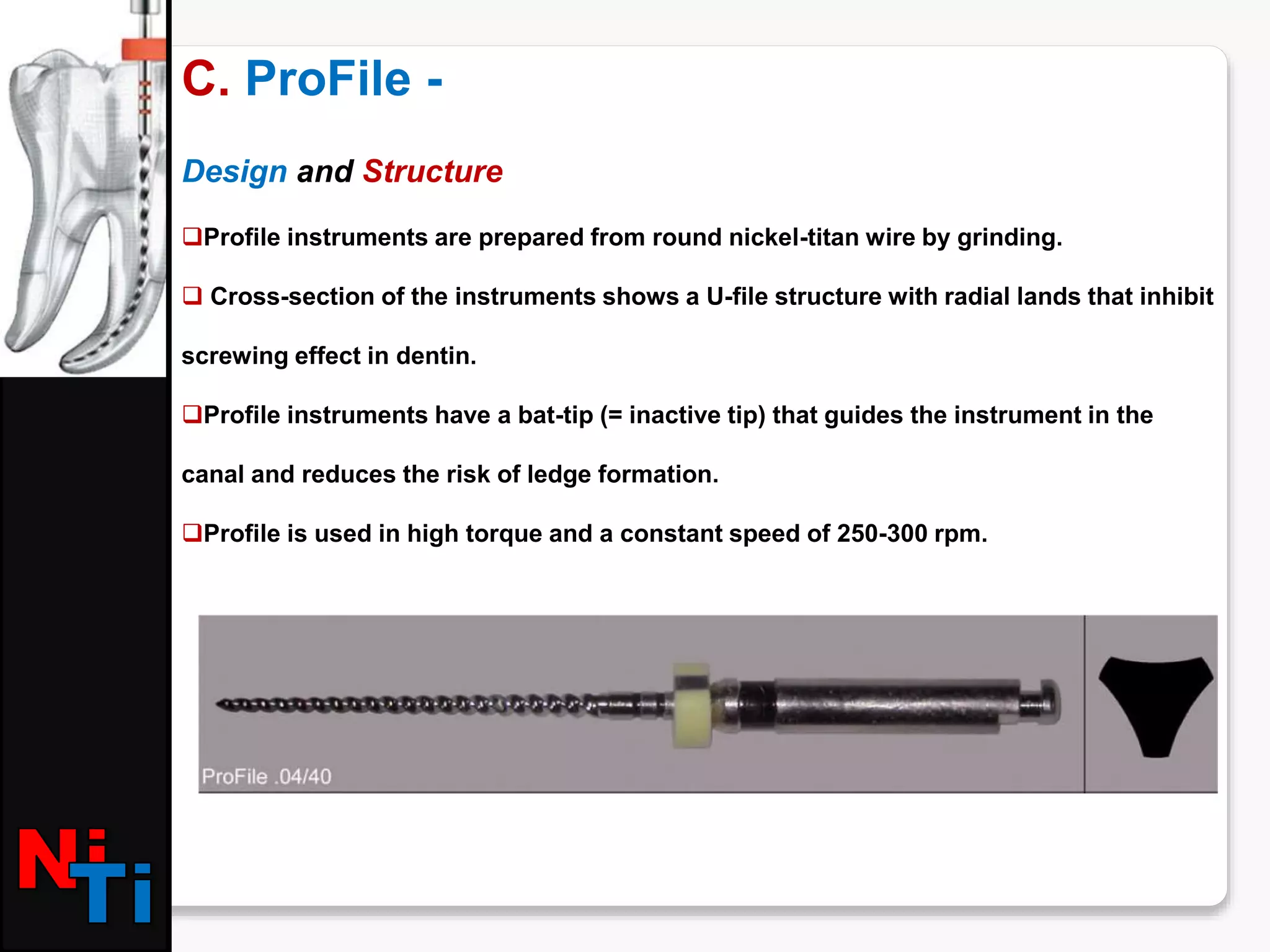
Profile instruments are prepared from round nickel-titan wire by grinding.
 Cross-section of the instruments shows a U-file structure with radial lands that inhibit
screwing effect in dentin.
Profile instruments have a bat-tip (= inactive tip) that guides the instrument in the
canal and reduces the risk of ledge formation.
Profile is used in high torque and a constant speed of 250-300 rpm.
 Sizes & Codes-
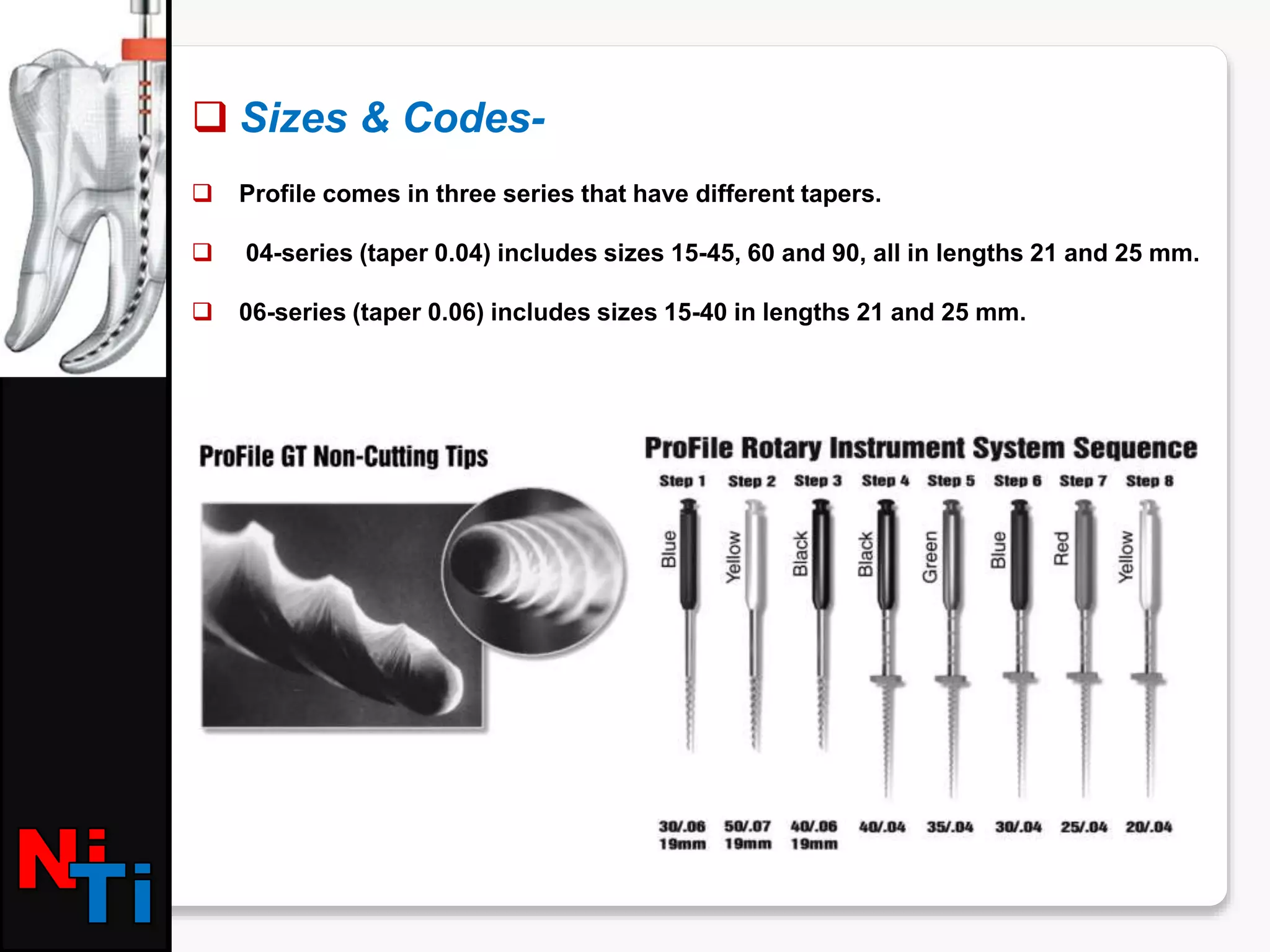
 Profile comes in three series that have different tapers.
 04-series (taper 0.04) includes sizes 15-45, 60 and 90, all in lengths 21 and 25 mm.
 06-series (taper 0.06) includes sizes 15-40 in lengths 21 and 25 mm.
D.Quantec -
Design and Structure
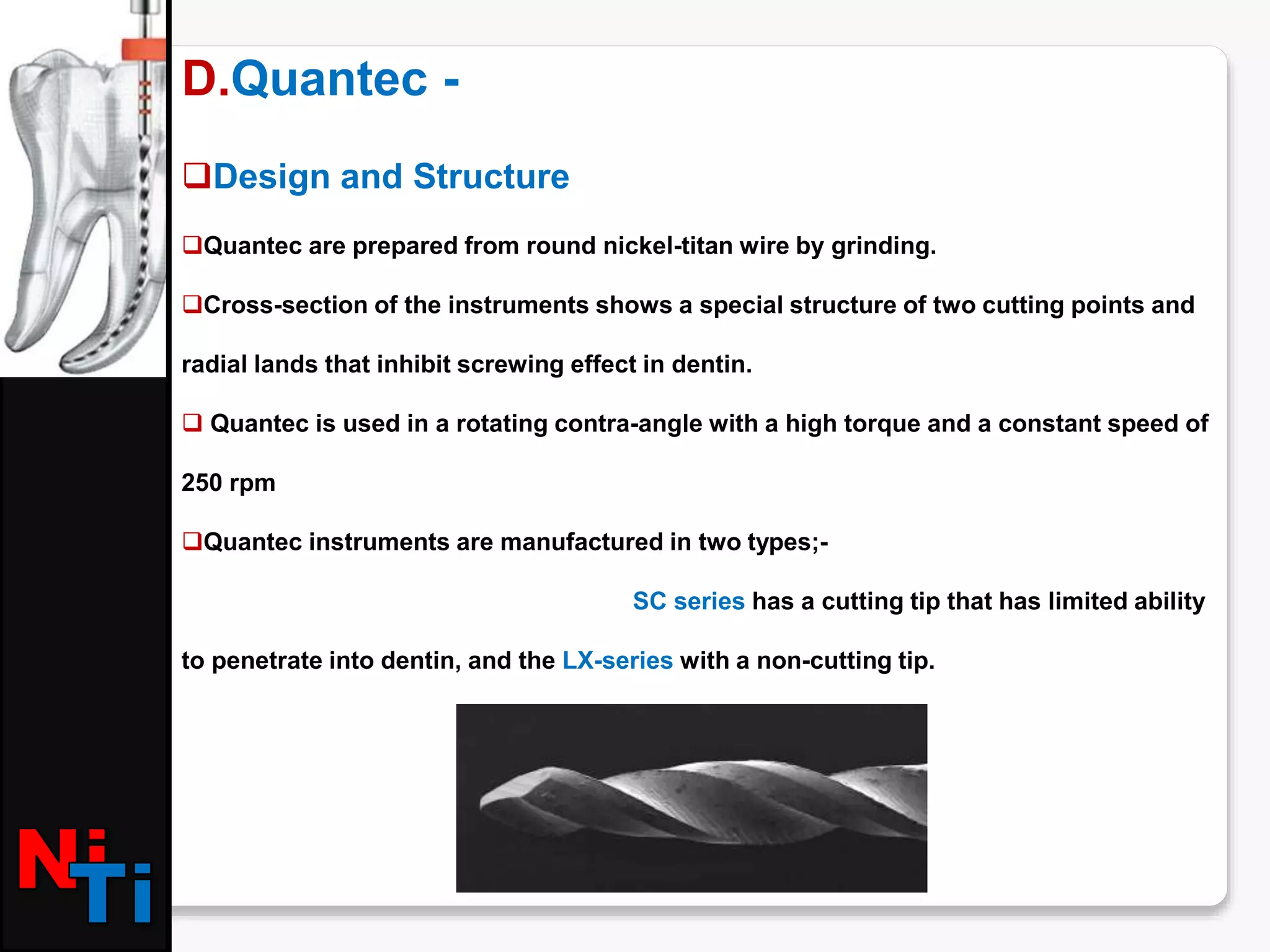
Quantec are prepared from round nickel-titan wire by grinding.
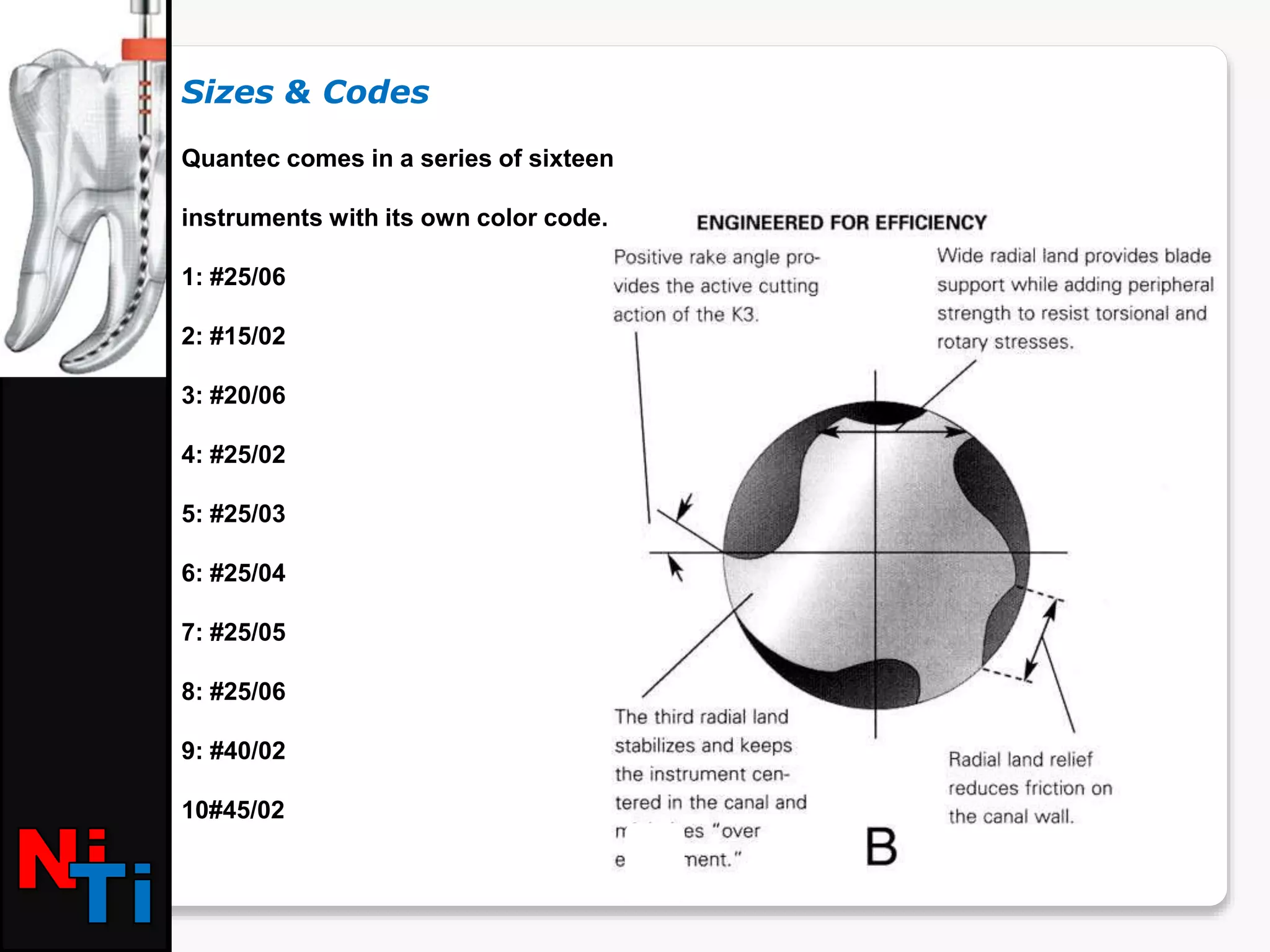
Cross-section of the instruments shows a special structure of two cutting points and
radial lands that inhibit screwing effect in dentin.
 Quantec is used in a rotating contra-angle with a high torque and a constant speed of
250 rpm
Quantec instruments are manufactured in two types;-
SC series has a cutting tip that has limited ability
to penetrate into dentin, and the LX-series with a non-cutting tip.
Sizes & Codes
Quantec comes in a series of sixteen
instruments with its own color code.
1: #25/06
2: #15/02
3: #20/06
4: #25/02
5: #25/03
6: #25/04
7: #25/05
8: #25/06
9: #40/02
10#45/02
E.RaCe-
Design and Structure
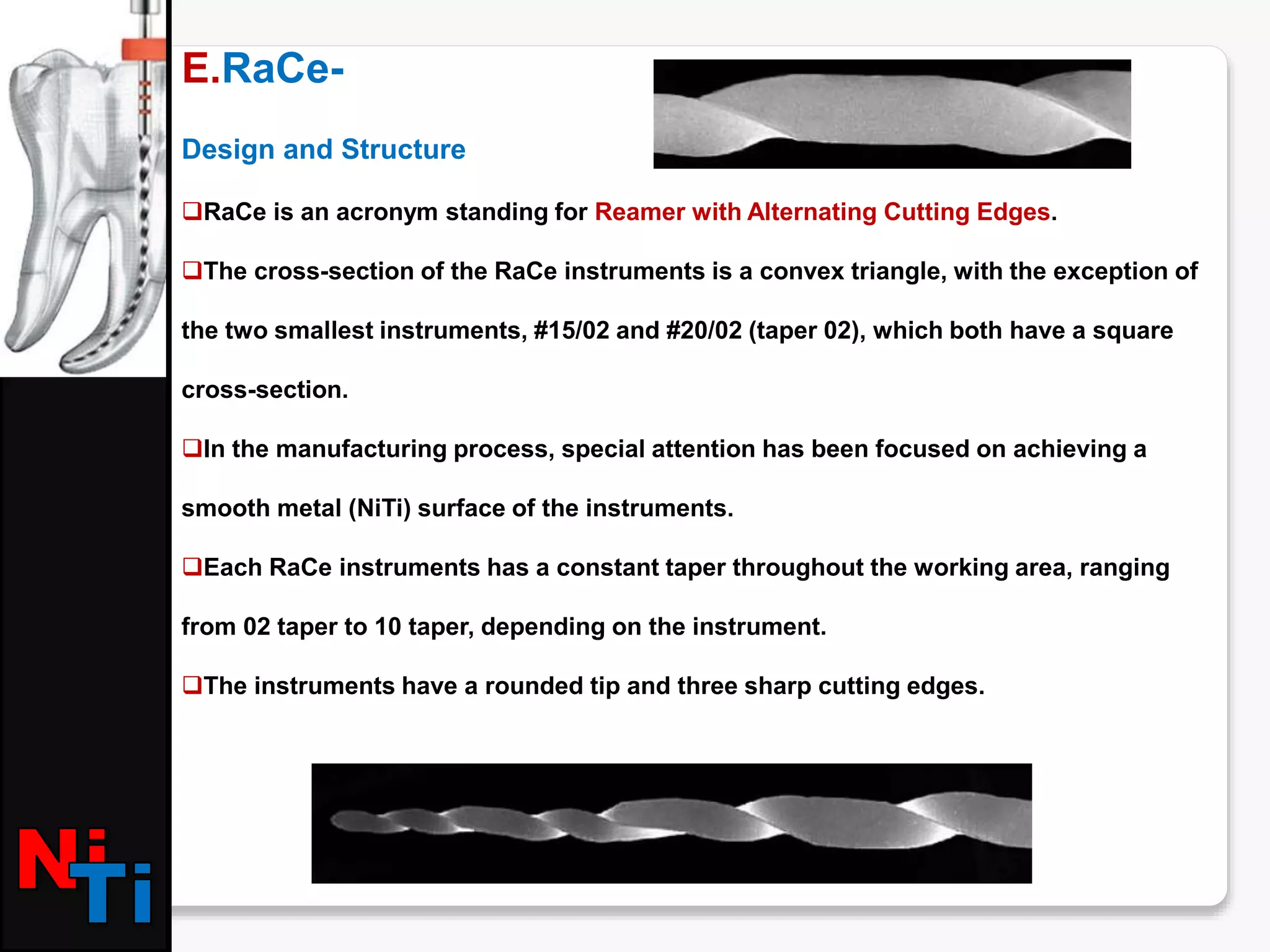
RaCe is an acronym standing for Reamer with Alternating Cutting Edges.
The cross-section of the RaCe instruments is a convex triangle, with the exception of
the two smallest instruments, #15/02 and #20/02 (taper 02), which both have a square
cross-section.
In the manufacturing process, special attention has been focused on achieving a
smooth metal (NiTi) surface of the instruments.
Each RaCe instruments has a constant taper throughout the working area, ranging
from 02 taper to 10 taper, depending on the instrument.
The instruments have a rounded tip and three sharp cutting edges.
Sizes & Codes
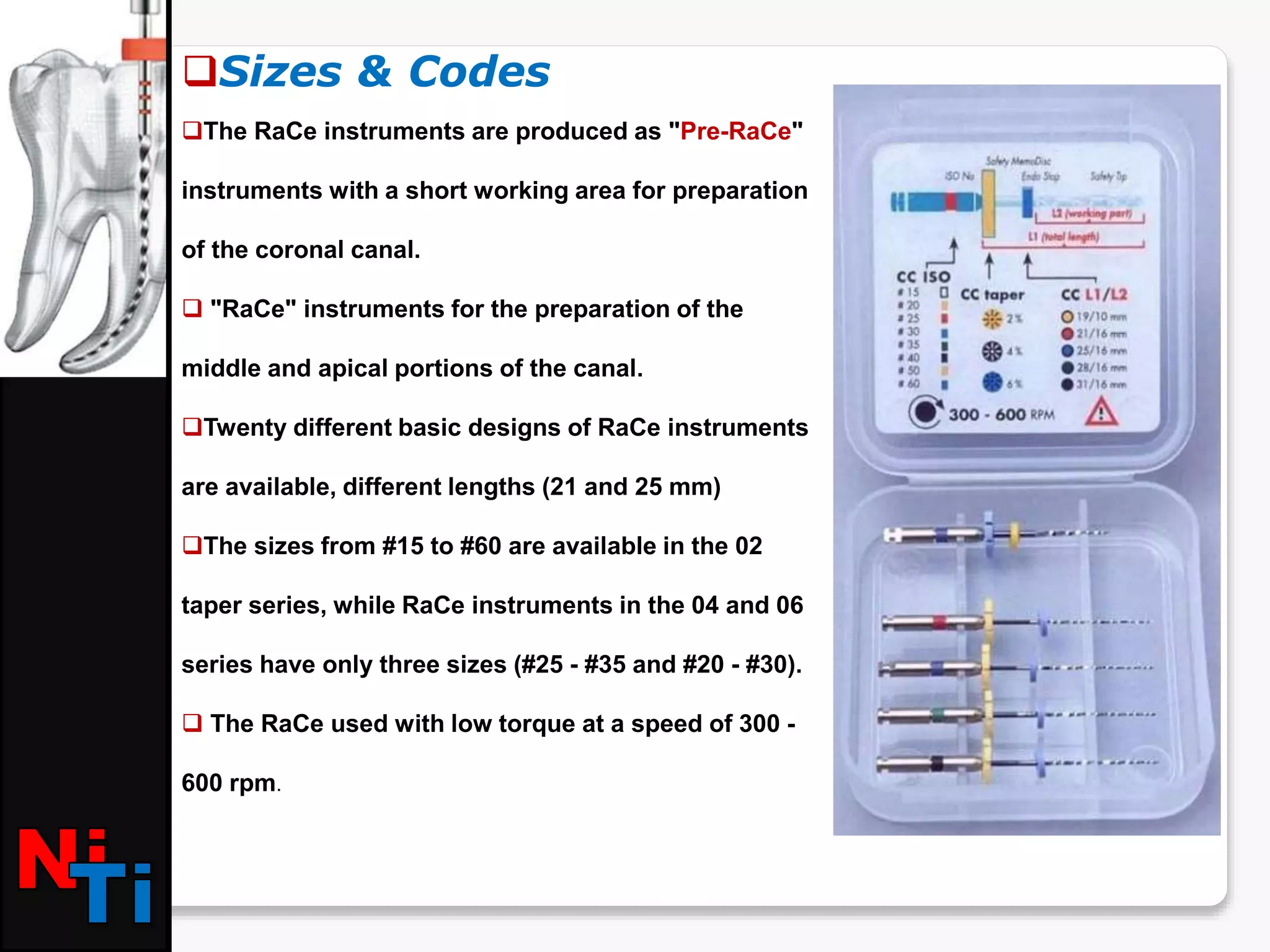
The RaCe instruments are produced as "Pre-RaCe"
instruments with a short working area for preparation
of the coronal canal.
 "RaCe" instruments for the preparation of the
middle and apical portions of the canal.
Twenty different basic designs of RaCe instruments
are available, different lengths (21 and 25 mm)
The sizes from #15 to #60 are available in the 02
taper series, while RaCe instruments in the 04 and 06
series have only three sizes (#25 - #35 and #20 - #30).
 The RaCe used with low torque at a speed of 300 -
600 rpm.
G.K3
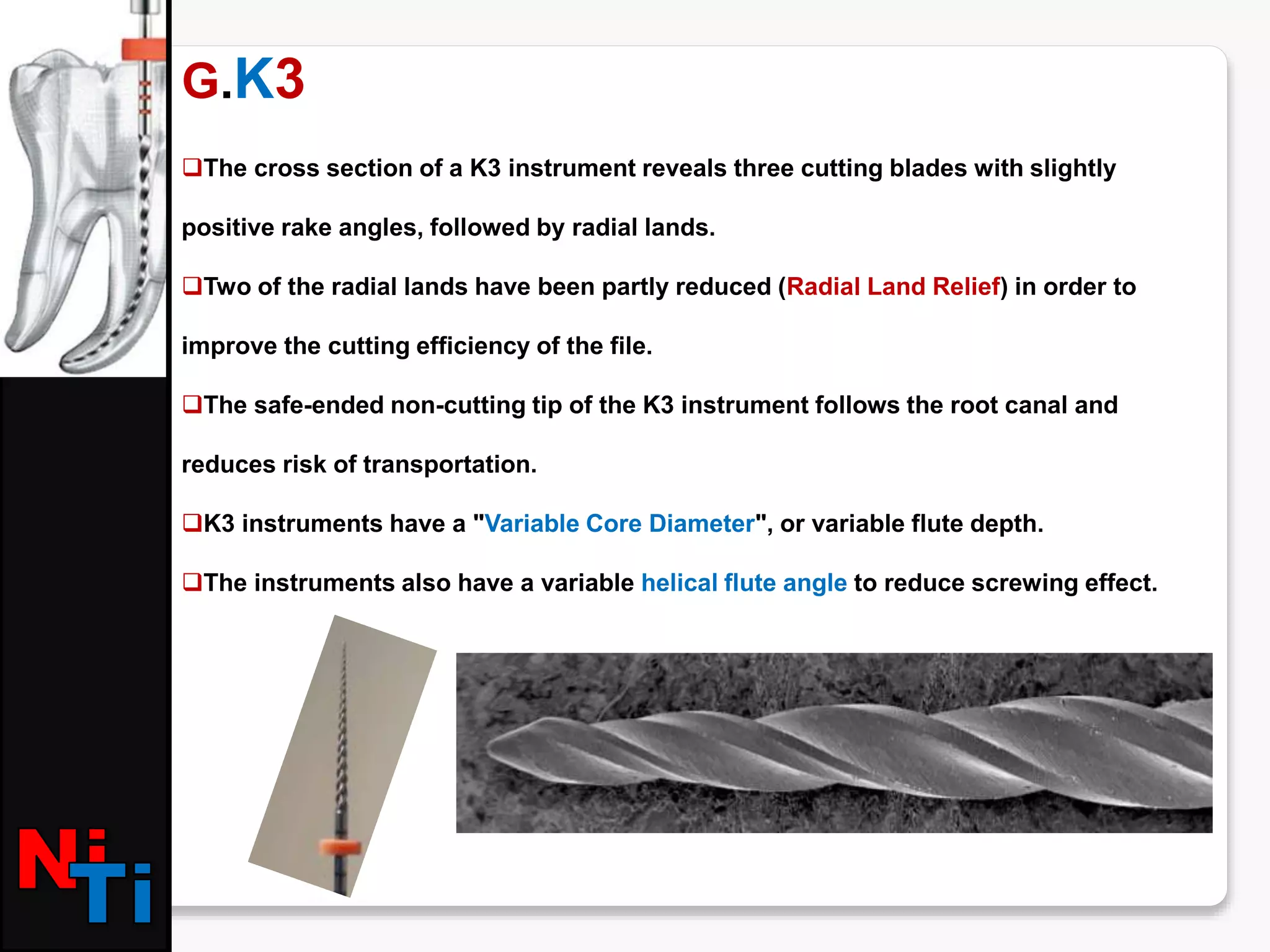
The cross section of a K3 instrument reveals three cutting blades with slightly
positive rake angles, followed by radial lands.
Two of the radial lands have been partly reduced (Radial Land Relief) in order to
improve the cutting efficiency of the file.
The safe-ended non-cutting tip of the K3 instrument follows the root canal and
reduces risk of transportation.
K3 instruments have a "Variable Core Diameter", or variable flute depth.
The instruments also have a variable helical flute angle to reduce screwing effect.
H.EndoSequence-
Design and Structure
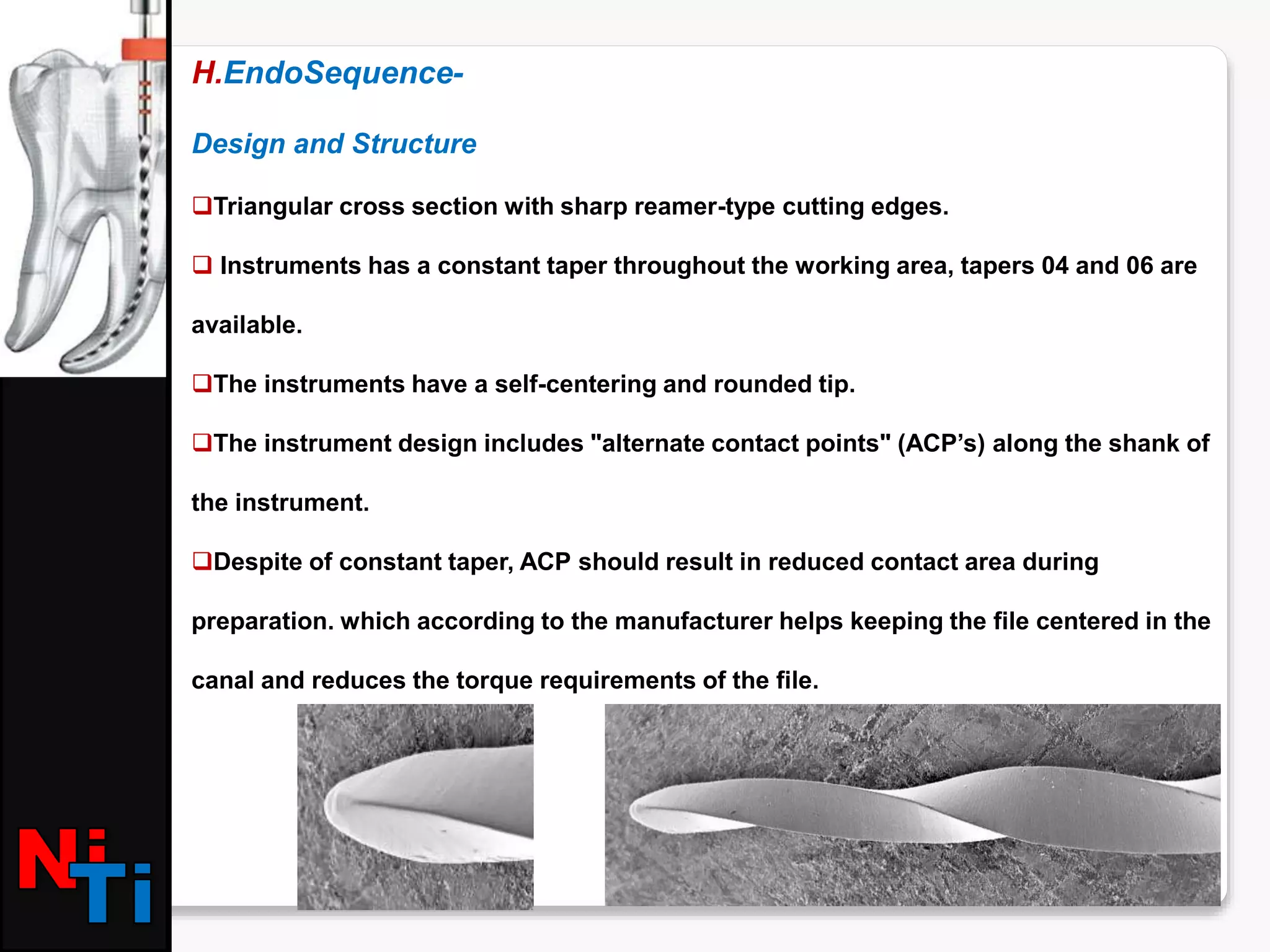
Triangular cross section with sharp reamer-type cutting edges.
 Instruments has a constant taper throughout the working area, tapers 04 and 06 are
available.
The instruments have a self-centering and rounded tip.
The instrument design includes "alternate contact points" (ACP’s) along the shank of
the instrument.
Despite of constant taper, ACP should result in reduced contact area during
preparation. which according to the manufacturer helps keeping the file centered in the
canal and reduces the torque requirements of the file.
Sizes & Codes
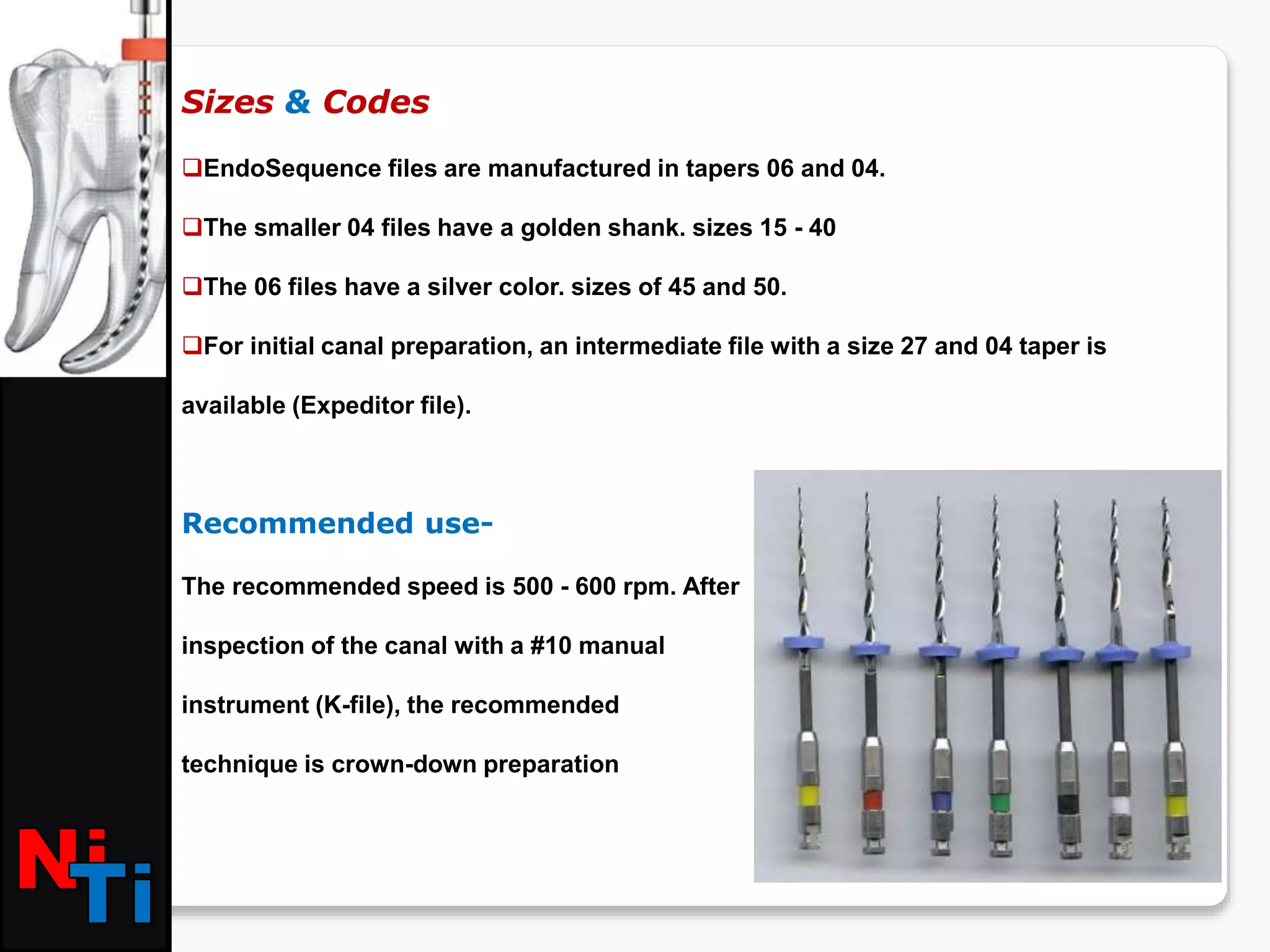
EndoSequence files are manufactured in tapers 06 and 04.
The smaller 04 files have a golden shank. sizes 15 - 40
The 06 files have a silver color. sizes of 45 and 50.
For initial canal preparation, an intermediate file with a size 27 and 04 taper is
available (Expeditor file).
Recommended use-
The recommended speed is 500 - 600 rpm. After
inspection of the canal with a #10 manual
instrument (K-file), the recommended
technique is crown-down preparation
Conclusions-
 Root canal preparation with NiTi rotaries is a very effective
and safe procedure. However, it demands understanding
of root canal anatomy and the usage principles of the selected rotary system.
 Every canal needs to be evaluated on its own merit regarding length, width
and curvature. It is only then that an educated decision about the strategy for
the preparation of that particular canal can be made.
Vivek2566@gmail.com
www.facebook.com/vivek2566

Ni ti endodontic instrument by Dr. vivek upadhyay

  • 1.
    Nickel–titanium: a super-elasticalloy endodontic instruments Triveni institute of dental sciences, hospital and research centre Guided by- Dr. Vinod Agarwal Submitted by- Vivek Upadhyay Final year BDS Date of submission- 28-01-2013 Department of Conservative & Endodontics.
  • 2.
    Introduction- NiTi was developedby Buchler 40 years ago. NiTi is also known as the NiTinol (NiTi Navol Ordinance Laboratory) Two types of NiTi alloy used in endodontics- -55 NiTinol (55%Ni-45%Ti) -60 NiTinol (60%Ni-40%Ti) First use of NiTi in endodontics was reported in 1988, by Walia when a 15 No. NiTi file was made from orthodontic wire.
  • 3.
    Manufacturing- Nickel–titanium “shape memorymetal alloy” can exist in two different temperature-dependent crystal structures called -martensite(lower temperature or daughter phase) and -austenite (higher temperature or parent phase) Ni–Ti can have three different forms: -martensite, -stress-induced martensite (super-elastic) and -austenite.  When thematerial is in its martensite form, it is soft and ductile, and it can be easily deformed. Super-elastic Ni–Ti is highly elastic (rubber-like), while austenitic Ni–Ti is quite strong and hard.
  • 4.
    Phase transformation ofNiTi alloy • Austenite: (BCC) high temperature and low stress • Martensite: (Mono- Triclinic) low temperature and high stress • R-phase: intermediate phase A M R
  • 5.
     Design &Structure-  NiTif-files are manufactured from nickel-titan wire that is ground to give the typical profile of a K-file. The angle between the long-axis and the cutting blade is bigger than in reamers, and therefore preparation by NiTi-file is effective both in rotating motion and in filing motion (up and down movement).  The tip of the instrument is non-cutting ('bat-tip') which makes the NiTi-file well suited for the preparation of curved canals without the risk of ledge formation.
  • 6.
    Sizes & Codes- NiTi-filescome in sizes 15 - 60, all with a taper of 0.02. K-file design is identified by the square symbol on the handle. NiTi-files can be best distinguished from normal K-files by the code that in NiTi-files is printed with two colors.
  • 7.
    Advantage of NiTialloy- 1. Shape memory 2. Super elasticity 3. Low modulus of elasticity 4. Good resiliency 5. Corrosion resistance 6. Softer than stainless steel. Disadvantages of NiTi Files- 1. Poor cutting efficiency. 2. NiTi files do not show sings of fatigue before they fracture. 3. Poor resistance to fracture as compare to stainless steal. 4. Break after 720 degree of rotation
  • 8.
    Safety tips- NiTi-files canbe rotated only using moderate pressure. Use of force may result in fracture also with bigger sized instruments. NiTi-files are super-elastic and always return to their original shape (= elastic memory), which makes it difficult or impossible to detect weakened structure by visual observation.  Fracture risk is best controlled by correct use and by using the instrument no more than ten times
  • 9.
    A. Torsional fractureoccurs when a rotary is forced into a small canal area, engaging the tip,which then becomes overloaded. Consequences are plastic deformation and a particular breakage pattern (arrowhead). B. Fatigue fracture occurs when a rotary is overused and accumulates too much stress in curved canals over time. There are usually no warning signs and no particular patterns visible on the fracture surface. Instrument deformation and breakage Scanning electron micrographs illustrate NiTi rotary fracture mechanisms. Fractures were produced in experiments; note the grinding markson both of the instruments.
  • 10.
    Nickel–titanium rotary systems TheseNi–Ti rotary files are mainly manufactured for use in a torque-controlled handpiece at constant speed (rpm). A. Pro Taper B. Great Taper C. ProFile D. Quantec E. RACE F. K3 G. EndoSequence
  • 11.
    The “Golden Rules”for NiTi Rotary Preparation Use only tourque controlled handpiece. Proper glide path must be stablished before using file. Examin the file & bend the file at least 80 degree angle, every time before placing into canal. Use crown down method. Do not force apically against resistance. Remove the possible pulp tissue by broach. Canal should be well lubricated and irrigated. Dentine mud should be cleared off by frequent irrigation. Discard the file if it is bend, streched or has a shiny spot. Do not use rotary instrument to true working length specially in teeth with “S-shaped canal”.
  • 12.
    A. Pro Taper- Designand Structure - ProTaper instruments are prepared from round nickel-titan wire by grinding. Cross-section of the instruments shows a triangular structure with three cutting points and no radial lands. ProTaper instruments have a non-cutting tip that guides the instrument in the canal and reduces the risk for ledge formation. The convex triangular cross-section which reduces the contact area between the file and dentine. ProTaper is used in a rotating constant speed of 150 - 350 rpm.
  • 13.
    This greater cuttingefficiency has been safely incorporated through balancing the pitch and helical angles. A progressively tapered file engages a smaller zone of dentine which reduces torsional loads, file fatigue and the potential for breakage. It clinically serves to improve flexibility, cutting efficiency and typically reduces the number of recapitulations needed to achieve length, especially, in tight or more curved canals.
  • 14.
    Sizes & Codes: six sizes: Three shapers and three finishing files. SX file (no color ring)- 19 mm long -tapers of 3.5% (D1) 19% (D9), and 2.0% (D14). The tip is 0.19 mm in diameter. S1 (violet)- taper from 2% (D1) to 11% (D14). Tip diameter of 0.185 mm. S2 (white)- a taper from 4% (D1) to 11.5% (D14). Tip diameter of 0.20 mm. The diameter of all three Shaper files at D14 is the same. F1 file (yellow) F2 (red) F3 (blue).
  • 15.
    B. Great Taper- Designand Structure GT instruments are prepared from round nickel-titan wire by grinding. Cross-section of the instruments shows a U-file structure with radial lands that inhibit screwing effect in dentin.  GT instruments have a bat-tip (= inactive tip) that guides the instrument in the canal and reduces the risk for ledge formation.
  • 16.
    Sizes & Codes:- GT instruments are produced in three sizes (iso tip sizes), 20, 30, and 40, and each size comes in four tapers: 12, 10, 08, 06 and 04. In addition, three bigger instruments are included in the GT family; sizes 35, 50 and 70, all with a taper 12, for preparation of very large canals and for coronal flare in other canals. Negative rake angle makes them too scrape the dentine rather than cutting. Recommended use- GT instruments are used in a rotating contra-angle with a high torque and a constant speed of 350 rpm. Each instrument is used for 5 to 10 seconds in a pecking motion: push forward - draw back - push forward etc.
  • 17.
    C. ProFile - Designand Structure Profile instruments are prepared from round nickel-titan wire by grinding.  Cross-section of the instruments shows a U-file structure with radial lands that inhibit screwing effect in dentin. Profile instruments have a bat-tip (= inactive tip) that guides the instrument in the canal and reduces the risk of ledge formation. Profile is used in high torque and a constant speed of 250-300 rpm.
  • 18.
     Sizes &Codes-  Profile comes in three series that have different tapers.  04-series (taper 0.04) includes sizes 15-45, 60 and 90, all in lengths 21 and 25 mm.  06-series (taper 0.06) includes sizes 15-40 in lengths 21 and 25 mm.
  • 19.
    D.Quantec - Design andStructure Quantec are prepared from round nickel-titan wire by grinding. Cross-section of the instruments shows a special structure of two cutting points and radial lands that inhibit screwing effect in dentin.  Quantec is used in a rotating contra-angle with a high torque and a constant speed of 250 rpm Quantec instruments are manufactured in two types;- SC series has a cutting tip that has limited ability to penetrate into dentin, and the LX-series with a non-cutting tip.
  • 20.
    Sizes & Codes Quanteccomes in a series of sixteen instruments with its own color code. 1: #25/06 2: #15/02 3: #20/06 4: #25/02 5: #25/03 6: #25/04 7: #25/05 8: #25/06 9: #40/02 10#45/02
  • 21.
    E.RaCe- Design and Structure RaCeis an acronym standing for Reamer with Alternating Cutting Edges. The cross-section of the RaCe instruments is a convex triangle, with the exception of the two smallest instruments, #15/02 and #20/02 (taper 02), which both have a square cross-section. In the manufacturing process, special attention has been focused on achieving a smooth metal (NiTi) surface of the instruments. Each RaCe instruments has a constant taper throughout the working area, ranging from 02 taper to 10 taper, depending on the instrument. The instruments have a rounded tip and three sharp cutting edges.
  • 22.
    Sizes & Codes TheRaCe instruments are produced as "Pre-RaCe" instruments with a short working area for preparation of the coronal canal.  "RaCe" instruments for the preparation of the middle and apical portions of the canal. Twenty different basic designs of RaCe instruments are available, different lengths (21 and 25 mm) The sizes from #15 to #60 are available in the 02 taper series, while RaCe instruments in the 04 and 06 series have only three sizes (#25 - #35 and #20 - #30).  The RaCe used with low torque at a speed of 300 - 600 rpm.
  • 23.
    G.K3 The cross sectionof a K3 instrument reveals three cutting blades with slightly positive rake angles, followed by radial lands. Two of the radial lands have been partly reduced (Radial Land Relief) in order to improve the cutting efficiency of the file. The safe-ended non-cutting tip of the K3 instrument follows the root canal and reduces risk of transportation. K3 instruments have a "Variable Core Diameter", or variable flute depth. The instruments also have a variable helical flute angle to reduce screwing effect.
  • 24.
    H.EndoSequence- Design and Structure Triangularcross section with sharp reamer-type cutting edges.  Instruments has a constant taper throughout the working area, tapers 04 and 06 are available. The instruments have a self-centering and rounded tip. The instrument design includes "alternate contact points" (ACP’s) along the shank of the instrument. Despite of constant taper, ACP should result in reduced contact area during preparation. which according to the manufacturer helps keeping the file centered in the canal and reduces the torque requirements of the file.
  • 25.
    Sizes & Codes EndoSequencefiles are manufactured in tapers 06 and 04. The smaller 04 files have a golden shank. sizes 15 - 40 The 06 files have a silver color. sizes of 45 and 50. For initial canal preparation, an intermediate file with a size 27 and 04 taper is available (Expeditor file). Recommended use- The recommended speed is 500 - 600 rpm. After inspection of the canal with a #10 manual instrument (K-file), the recommended technique is crown-down preparation
  • 28.
    Conclusions-  Root canalpreparation with NiTi rotaries is a very effective and safe procedure. However, it demands understanding of root canal anatomy and the usage principles of the selected rotary system.  Every canal needs to be evaluated on its own merit regarding length, width and curvature. It is only then that an educated decision about the strategy for the preparation of that particular canal can be made. Vivek2566@gmail.com www.facebook.com/vivek2566