ROTARY INSTRUMENTS
IN ENDODONTICS
Dr. Aditee Agrawal,
DEPARTMENT OF CONSERVATIVE
DENTISTRY & ENDODONTICS.
CONTENTS
∆ INTRODUCTION
∆ HISTORY
∆ NICKEL TITANIUM ENDODONTIC INSTRUMENTS
∆ PROPERTIES OF NiTi Alloy
∆ COMPONENTS OF ROTARY FILE
∆ CLASSIFICATION OF NITI INSTRUMENTS
∆ DIFFERENT ROTARY SYSTEMS
INTRODUCTION
The principles of root canal treatment consists of
thoroughly cleaning, adequate shaping and complete filling
of root canal system.
In order to accomplish these objectives , many different
instruments are available
• Rotary shaping instruments are replacing the conventional
hand file systems to enhance shaping ability of canal,
reduce clinical mishaps like blocks, ledges, transportations
and perforations.
• When clinician masters the “ method of use” protocols of
rotary shaping instruments unpredictable file breakage,
metal fatigue, loss of cutting efficiency, variation in length,
diameter in curvature of the canal can be avoided and
better shaping of the canals with desired taper will be
achieved.
HISTORY
• The manufacture of the first instrument for Endodontic use
dates to 1875. These early instruments, which were made by
hand from thin steel wires, performed more or less the function
of modern broaches.
• 1876-1926 : This period showed improvement in procedures and
introduction of standardized instruments and cavity preparation.
• 1885: Gates – Glidden was introduced and it was one of the
instruments which gained fame as a rotary instrument.
• 1889 : The first contra angle for endodontic purpose with a
whole circle rotation was introduced by Rollins.
• 1915 : Kerr manufacturing company obtained the patent for
instruments which were later known as K type instruments.
• 1928: Endocursor handpiece was designed for use with rotary
files.
• 1958 Ingle and Levine first proposed standardization of
Endodontic instruments.
• Early 1960s, nickel titanium alloy was developed by W. F.
Buehler, a metallurgist investigating non magnetic, salt
resistant, water proof alloys for the space programme at the
“Naval Ordinance Laboratory”, in Silver Springs,
Maryland,USA.
• 1971 Anderson and Hilleman first reported potential application
of Nickel- Titanium alloys in dentistry.
• 1988 Walia, Brantely and Gerstein was first to fabricate
endodontic files from NiTi orthodontic wires.
• 1988 The reports of first use of Nickel - Titanium alloys as
Endodontic instruments.
• Since 1991 to present a resurgence of mechanized and rotary
NiTi systems with different instrument designs are establishing
the market for root canal treatment.
Nickel titanium [NiTi] Endodontic instruments
• When using the stainless steel files, occurrence of procedural
errors cannot be avoided specially in case of curved canals.
Deviation from the original shape, ledge formation, zipping,
stripping and perforations are common problems which are seen
in such cases.
• But the superelasticity of NiTi alloy allows these instruments to
flex more than the stainless steel instruments before exceeding
their elastic limit, thereby allowing canal preparation with
minimal procedural errors.
• NiTi was developed by Buchler 40 year ago. NiTi is
also known NiTinol [NiTi Naval ordinance laboratory
in US].
• In endodontics commonly used NiTi alloys are called
55 NiTi nol[55% wt Ni and 45% Ti] and 60 NiTi nol
[60% wt of Ni, 40% Ti].
• First use of NiTi in endodontics was reported in
1988,by Walia et al when a 15 no. NiTi file was made
from orthodontic wire and it showed superior
flexibility and resistance to tortional fracture. This
suggested the use of NiTi files in curved canals.
Properties of NiTi alloys:
1. Shape memory:
The NiTi file comes back to its original
straight form without showing any sign
of lasting deformation .This is called shape
memory.
2. Super elasticity
The ability of resisting stress without
permanent deformation and going back
to the initial lattice form is called super
elasticity.
3. Low modulus of elasticity
4. Good resiliency
5. Corrosion resistance
6. Softer than stainless steel
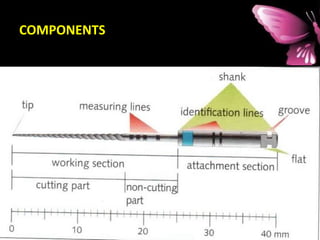
COMPONENTS
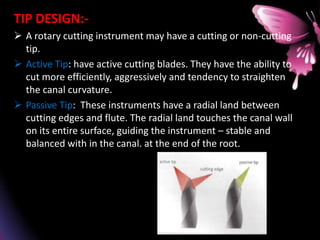
TIP DESIGN:-
 A rotary cutting instrument may have a cutting or non-cutting
tip.
 Active Tip: have active cutting blades. They have the ability to
cut more efficiently, aggressively and tendency to straighten
the canal curvature.
 Passive Tip: These instruments have a radial land between
cutting edges and flute. The radial land touches the canal wall
on its entire surface, guiding the instrument – stable and
balanced with in the canal. at the end of the root.
• Active cutting blade:
- Protaper
-Hero 642
- Race file
- K3
- Flexmaster
• Passive cutting blade:
-Profile
- GT
- Lightspeed
• Semiactive :
- Quantec
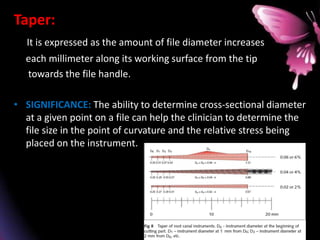
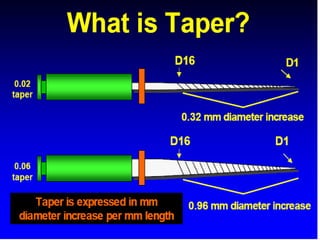
Taper:
It is expressed as the amount of file diameter increases
each millimeter along its working surface from the tip
towards the file handle.
• SIGNIFICANCE: The ability to determine cross-sectional diameter
at a given point on a file can help the clinician to determine the
file size in the point of curvature and the relative stress being
placed on the instrument.
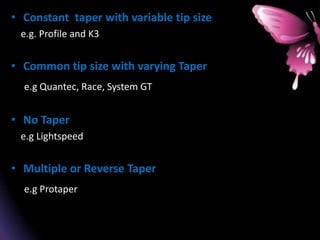
• Constant taper with variable tip size
e.g. Profile and K3
• Common tip size with varying Taper
e.g Quantec, Race, System GT
• No Taper
e.g Lightspeed
• Multiple or Reverse Taper
e.g Protaper
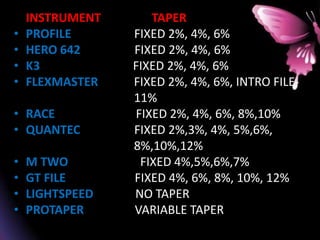
INSTRUMENT TAPER
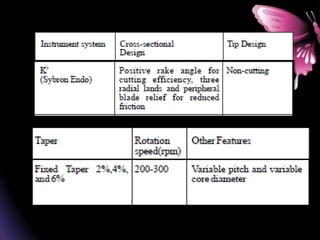
• PROFILE FIXED 2%, 4%, 6%
• HERO 642 FIXED 2%, 4%, 6%
• K3 FIXED 2%, 4%, 6%
• FLEXMASTER FIXED 2%, 4%, 6%, INTRO FILE-
11%
• RACE FIXED 2%, 4%, 6%, 8%,10%
• QUANTEC FIXED 2%,3%, 4%, 5%,6%,
8%,10%,12%
• M TWO FIXED 4%,5%,6%,7%
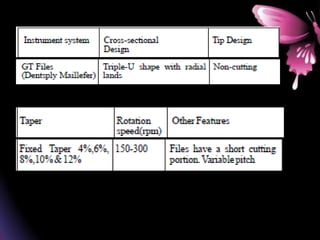
• GT FILE FIXED 4%, 6%, 8%, 10%, 12%
• LIGHTSPEED NO TAPER
• PROTAPER VARIABLE TAPER
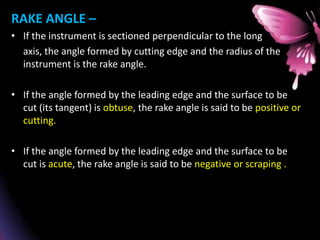
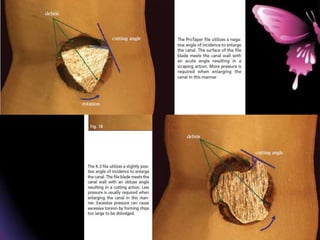
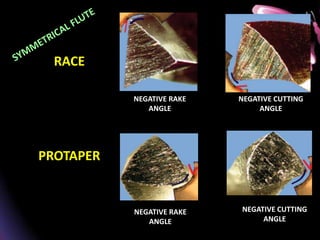
RAKE ANGLE –
• If the instrument is sectioned perpendicular to the long
axis, the angle formed by cutting edge and the radius of the
instrument is the rake angle.
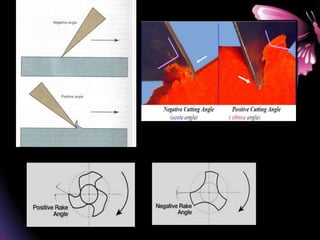
• If the angle formed by the leading edge and the surface to be
cut (its tangent) is obtuse, the rake angle is said to be positive or
cutting.
• If the angle formed by the leading edge and the surface to be
cut is acute, the rake angle is said to be negative or scraping .
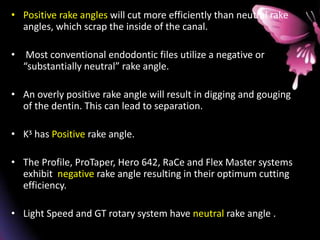
• Positive rake angles will cut more efficiently than neutral rake
angles, which scrap the inside of the canal.
• Most conventional endodontic files utilize a negative or
“substantially neutral” rake angle.
• An overly positive rake angle will result in digging and gouging
of the dentin. This can lead to separation.
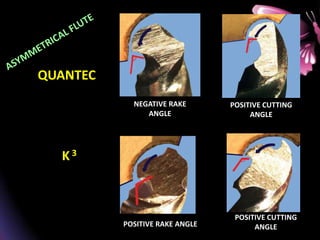
• Kᶾ has Positive rake angle.
• The Profile, ProTaper, Hero 642, RaCe and Flex Master systems
exhibit negative rake angle resulting in their optimum cutting
efficiency.
• Light Speed and GT rotary system have neutral rake angle .
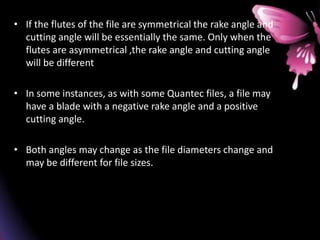
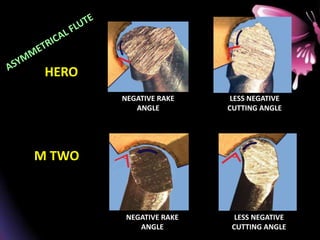
• If the flutes of the file are symmetrical the rake angle and
cutting angle will be essentially the same. Only when the
flutes are asymmetrical ,the rake angle and cutting angle
will be different
• In some instances, as with some Quantec files, a file may
have a blade with a negative rake angle and a positive
cutting angle.
• Both angles may change as the file diameters change and
may be different for file sizes.
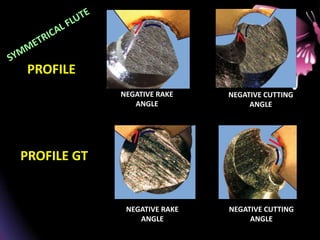
NEGATIVE RAKE
ANGLE
NEGATIVE CUTTING
ANGLE
NEGATIVE RAKE
ANGLE
NEGATIVE CUTTING
ANGLE
PROFILE
PROFILE GT
NEGATIVE RAKE
ANGLE
NEGATIVE CUTTING
ANGLE
NEGATIVE RAKE
ANGLE
NEGATIVE CUTTING
ANGLE
RACE
PROTAPER
NEGATIVE RAKE
ANGLE
LESS NEGATIVE
CUTTING ANGLE
NEGATIVE RAKE
ANGLE
LESS NEGATIVE
CUTTING ANGLE
HERO
M TWO
NEGATIVE RAKE
ANGLE
POSITIVE CUTTING
ANGLE
POSITIVE RAKE ANGLE
POSITIVE CUTTING
ANGLE
QUANTEC
K3
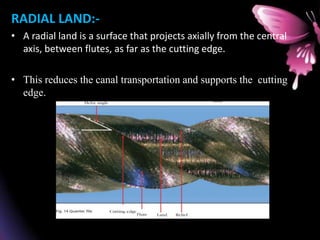
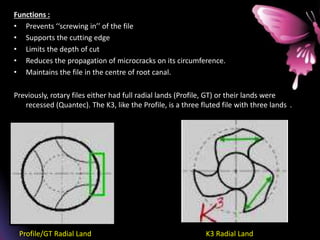
RADIAL LAND:-
• A radial land is a surface that projects axially from the central
axis, between flutes, as far as the cutting edge.
• This reduces the canal transportation and supports the cutting
edge.
Functions :
• Prevents ‘‘screwing in’’ of the file
• Supports the cutting edge
• Limits the depth of cut
• Reduces the propagation of microcracks on its circumference.
• Maintains the file in the centre of root canal.
Previously, rotary files either had full radial lands (Profile, GT) or their lands were
recessed (Quantec). The K3, like the Profile, is a three fluted file with three lands .
Profile/GT Radial Land K3 Radial Land
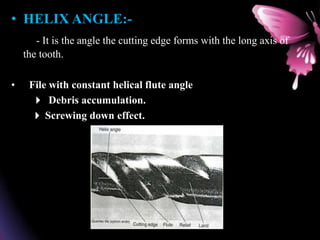
• HELIX ANGLE:-
- It is the angle the cutting edge forms with the long axis of
the tooth.
• File with constant helical flute angle
 Debris accumulation.
 Screwing down effect.
• Variable helical angle preferred
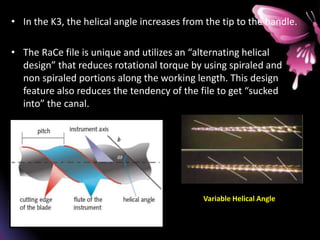
• In the K3, the helical angle increases from the tip to the handle.
• The RaCe file is unique and utilizes an “alternating helical
design” that reduces rotational torque by using spiraled and
non spiraled portions along the working length. This design
feature also reduces the tendency of the file to get “sucked
into” the canal.
Variable Helical Angle
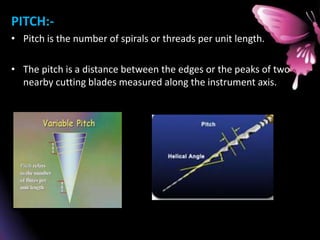
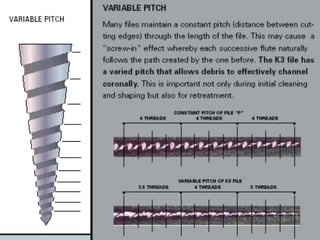
PITCH:-
• Pitch is the number of spirals or threads per unit length.
• The pitch is a distance between the edges or the peaks of two
nearby cutting blades measured along the instrument axis.
• The smaller the pitch, greater the contact area between the
instrument and root canal walls. It increases torsional stress and
the drawing of the instrument in to the root canal. The pitch
may be constant or changing along the long instrument.
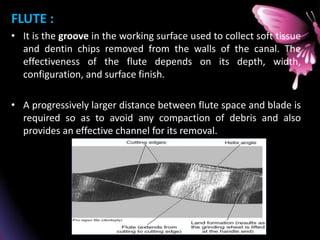
FLUTE :
• It is the groove in the working surface used to collect soft tissue
and dentin chips removed from the walls of the canal. The
effectiveness of the flute depends on its depth, width,
configuration, and surface finish.
• A progressively larger distance between flute space and blade is
required so as to avoid any compaction of debris and also
provides an effective channel for its removal.
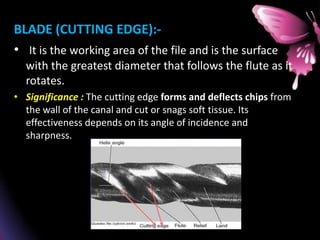
BLADE (CUTTING EDGE):-
• It is the working area of the file and is the surface
with the greatest diameter that follows the flute as it
rotates.
• Significance : The cutting edge forms and deflects chips from
the wall of the canal and cut or snags soft tissue. Its
effectiveness depends on its angle of incidence and
sharpness.
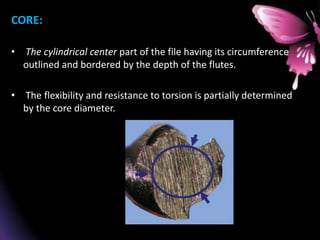
CORE:
• The cylindrical center part of the file having its circumference
outlined and bordered by the depth of the flutes.
• The flexibility and resistance to torsion is partially determined
by the core diameter.
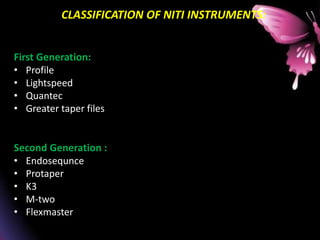
CLASSIFICATION OF NITI INSTRUMENTS:
First Generation:
• Profile
• Lightspeed
• Quantec
• Greater taper files
Second Generation :
• Endosequnce
• Protaper
• K3
• M-two
• Flexmaster
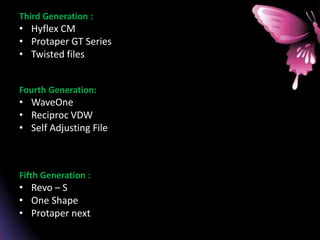
Third Generation :
• Hyflex CM
• Protaper GT Series
• Twisted files
Fourth Generation:
• WaveOne
• Reciproc VDW
• Self Adjusting File
Fifth Generation :
• Revo – S
• One Shape
• Protaper next
ROTARY SYSTEMS
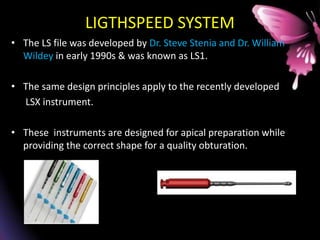
LIGTHSPEED SYSTEM
• The LS file was developed by Dr. Steve Stenia and Dr. William
Wildey in early 1990s & was known as LS1.
• The same design principles apply to the recently developed
LSX instrument.
• These instruments are designed for apical preparation while
providing the correct shape for a quality obturation.
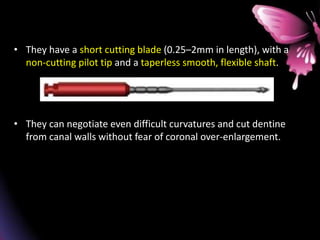
• They have a short cutting blade (0.25–2mm in length), with a
non-cutting pilot tip and a taperless smooth, flexible shaft.
• They can negotiate even difficult curvatures and cut dentine
from canal walls without fear of coronal over-enlargement.
Sizes :
• LightSpeed /LSI set consist of totals 26 instruments with sizes 20
to 140 and in lengths of 21 mm, 25 mm, and 31 mm.
• LightSpeed instruments also have half-sizes between 20 and 70
(22.5, 27.5, 32.5, 57.5, and 65.5)
• The half-sizes instruments are color-coded exactly as the
previous sizes, but also have white or black markings or
engraved rings on the instrument’s handles .
• LSX does not have half size files and set consist of size 20 – 80. It
can be used with 2500 rpm because of high flexibility.
• Because of thin non cutting shaft both types of light
speed instruments are considerably more flexible than
any other instrument on the market.
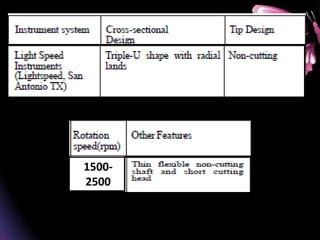
• Speed – 1500 - 2000 rpm (LS1)
– 2500 rpm (LSX)
Characteristic features:
Cutting Head:
A) CROSS SECTIONAL GEOMETRY:
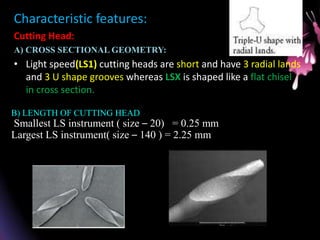
• Light speed(LS1) cutting heads are short and have 3 radial lands
and 3 U shape grooves whereas LSX is shaped like a flat chisel
in cross section.
B) LENGTH OF CUTTING HEAD
Smallest LS instrument ( size – 20) = 0.25 mm
Largest LS instrument( size – 140 ) = 2.25 mm
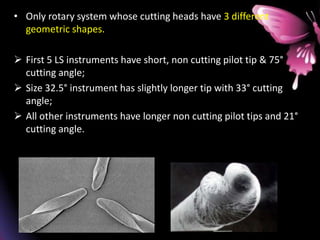
• Only rotary system whose cutting heads have 3 different
geometric shapes.
 First 5 LS instruments have short, non cutting pilot tip & 75°
cutting angle;
 Size 32.5° instrument has slightly longer tip with 33° cutting
angle;
 All other instruments have longer non cutting pilot tips and 21°
cutting angle.
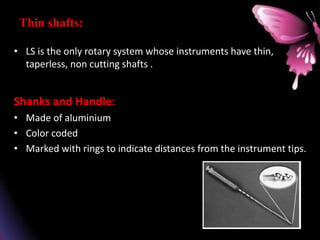
• LS is the
• LS is the only rotary system whose instruments have thin,
taperless, non cutting shafts .
Shanks and Handle:
• Made of aluminium
• Color coded
• Marked with rings to indicate distances from the instrument tips.
Thin shafts:
Technique:
• Light speed instruments require a straight line access to
mid root areas.
• Working length be recorded using small sized K files.
• There are three methods of using light speed instruments:
1. Conventional technique
2. Zurich technique
3. Hybrid technique
Conventional technique:
Step 1 – Determining initial light speed size
• A light speed instrument can reach working length if its cutting
head is smaller than canal’s diameter at the constriction.
• For e.g. Size 25 LS instrument if reaches working length
indicates that canal’s diameter is larger than size 25.
• Gauging continues with sequentially larger sizes until a LS
instrument doesn’t reach working length. If size 25 reaches
working length but size 27.5 doesn’t, then size 27.5 is termed
as First Light Speed Instrument.
Step 2 – Determining master apical size
After determining the FLSI, appropriate size of instrument
required for apical preparation is determined. The instrument
that takes at least 12 pecks to reach working length is master
apical instrument. This is known as ‘12 pecks rule.’
Step 3 – Complete apical instrumentation.
After determining the MAI size, complete the apical
preparation by using next light speed size that is 4 mm shorter
than working length..
Step 4 – Recapitulation
The canal is recapitulated using respective master apical
instrument to working length.
Zurich technique:
Step 1 – Coronal pre – flaring
After canal orifices are located, their coronal openings are
enlarged using Gates glidden drills. Initially 4 – 6 mm coronal
preparation is achieved.
Step 2 – Determining initial apical instrument
Working length is determined using size 15 stainless steel K
files. Then, light speed instruments are used. The first few light
speed instruments may not bind within the canal. The
instrument which first feel resistance in the canal is termed as
‘Initial apical instrument.’
Step 3 – Determining master apical instrument
• All LSI used after initial apical instruments are called ‘binding
instruments.’
• They are used with controlled forward and backward “Pecking
movement”.
• The forward motion reams the canal where as backward motion
tends to clean as it retreats into fresh irrigant.
• These instruments are used sequentially from smaller to larger
one. The last instrument used to prepare apical area is termed
as ‘Master apical instrument.’
Step 4 – Step back and recapitulation
After master apical instrument is finalized the step back
preparation is initiated. The last step back instrument is termed
as ‘ Final instrument.’ Finally canal is recapitulated using
respective master apical instrument to working length.
Hybrid technique (LightSpeed technique
combined with taper technique):
• LightSpeed Endodontics recommends this hybrid technique for
clinicians wishing to combine both tapered rotary and
LightSpeed systems.
• In this way, canals can be cleaned and shaped in a crown-down
fashion according to the technique recommended by the
manufacturer of the tapered instruments used.
• After the crown-down is completed, LightSpeed instruments
complete the apical part of the canal.
1500-
2500
PROFILE SYSTEM
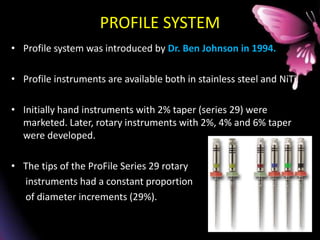
• Profile system was introduced by Dr. Ben Johnson in 1994.
• Profile instruments are available both in stainless steel and NiTi.
• Initially hand instruments with 2% taper (series 29) were
marketed. Later, rotary instruments with 2%, 4% and 6% taper
were developed.
• The tips of the ProFile Series 29 rotary
instruments had a constant proportion
of diameter increments (29%).
Later on profile series with ISO-sized tips and orifice
shaper were also marketed.
I] Series 29
a) Hand instruments -0.02 taper.
b) Rotary instruments -0.04, 0.06 taper.
II] ISO Series
a) 0.04 and 0.06 taper hand and rotary instruments.
Ⅲ] Profile Orifice shaper: 0.05- 0.08 taper.
IV] Profile GT rotary instruments AND hand files
Characteristic features:
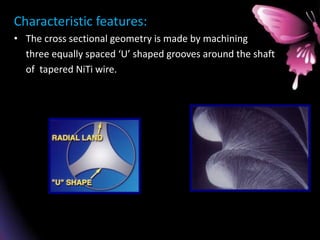
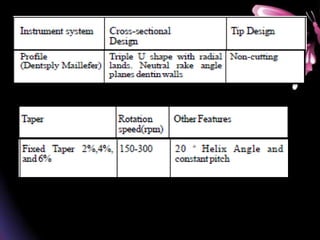
• The cross sectional geometry is made by machining
three equally spaced ‘U’ shaped grooves around the shaft
of tapered NiTi wire.
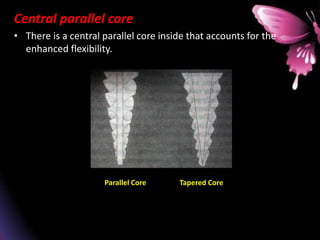
Central parallel core
• There is a central parallel core inside that accounts for the
enhanced flexibility.
Parallel Core Tapered Core
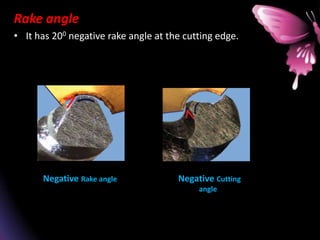
Rake angle
• It has 200 negative rake angle at the cutting edge.
Negative Rake angle -Negative Cutting
angle
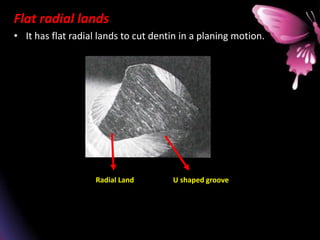
Flat radial lands
• It has flat radial lands to cut dentin in a planing motion.
Radial Land
U Shaped Groove
U Shaped Groove
U Shaped Groove
U Shaped Groove
U shaped groove
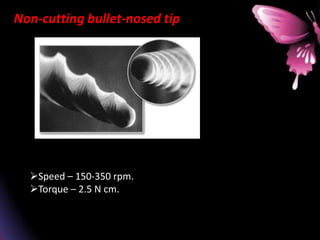
Non-cutting bullet-nosed tip
Speed – 150-350 rpm.
Torque – 2.5 N cm.
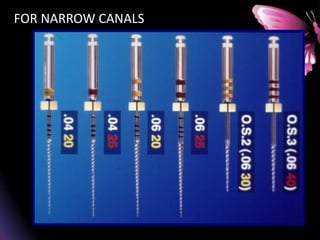
FOR NARROW CANALS
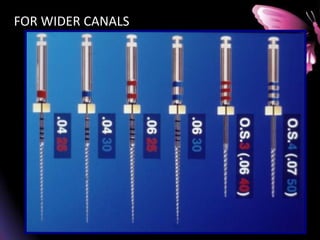
FOR WIDER CANALS
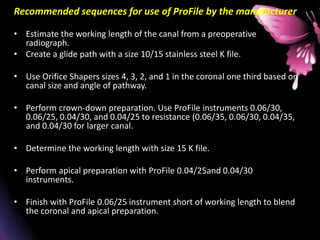
Recommended sequences for use of ProFile by the manufacturer
• Estimate the working length of the canal from a preoperative
radiograph.
• Create a glide path with a size 10/15 stainless steel K file.
• Use Orifice Shapers sizes 4, 3, 2, and 1 in the coronal one third based on
canal size and angle of pathway.
• Perform crown-down preparation. Use ProFile instruments 0.06/30,
0.06/25, 0.04/30, and 0.04/25 to resistance (0.06/35, 0.06/30, 0.04/35,
and 0.04/30 for larger canal.
• Determine the working length with size 15 K file.
• Perform apical preparation with ProFile 0.04/25and 0.04/30
instruments.
• Finish with ProFile 0.06/25 instrument short of working length to blend
the coronal and apical preparation.
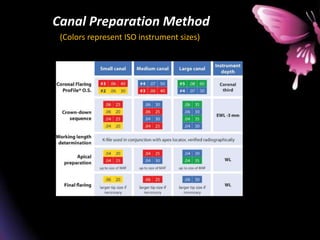
Canal Preparation Method
(Colors represent ISO instrument sizes)
Canal Preparation Method32
(Colors represent ISO instrument sizes)
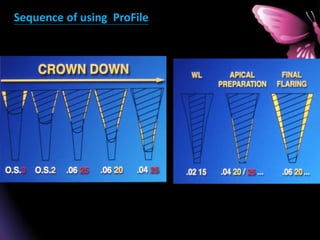
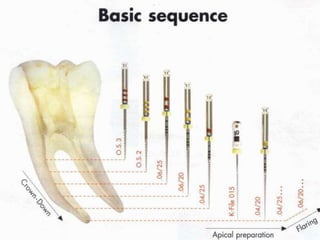
Sequence of using ProFile
• A very recent addition to the ProFile family of instruments
is the Vortex. The major change lies in the non landed cross
section, whereas tip sizes and taper are similar.
• ProFile vortex also have varying helical angle to counteract
the tendency of non landed files to thread into the root
canal.
• Manufactured using M wire technology.
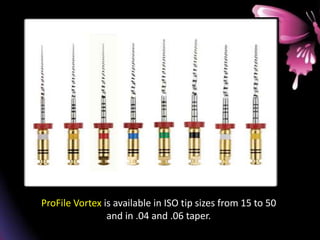
ProFile Vortex is available in ISO tip sizes from 15 to 50
and in .04 and .06 taper.
GREATER TAPER (GT) AND GTX FILES
• The greater taper or GT file was introduced by Dr Steve
Buchanan in 1994.
• The system was first produced as a set of hand operated files &
later as engine driven files.
• The main difference between GTX and GT files is the M wire
technology used for GTX.
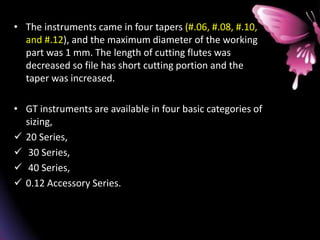
• The instruments came in four tapers (#.06, #.08, #.10,
and #.12), and the maximum diameter of the working
part was 1 mm. The length of cutting flutes was
decreased so file has short cutting portion and the
taper was increased.
• GT instruments are available in four basic categories of
sizing,
 20 Series,
 30 Series,
 40 Series,
 0.12 Accessory Series.
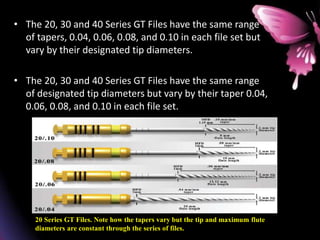
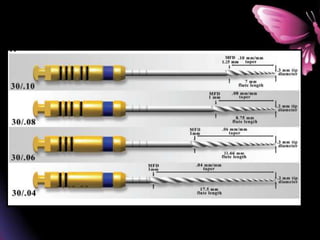
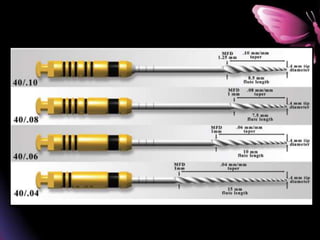
• The 20, 30 and 40 Series GT Files have the same range
of tapers, 0.04, 0.06, 0.08, and 0.10 in each file set but
vary by their designated tip diameters.
• The 20, 30 and 40 Series GT Files have the same range
of designated tip diameters but vary by their taper 0.04,
0.06, 0.08, and 0.10 in each file set.
20 Series GT Files. Note how the tapers vary but the tip and maximum flute
diameters are constant through the series of files.
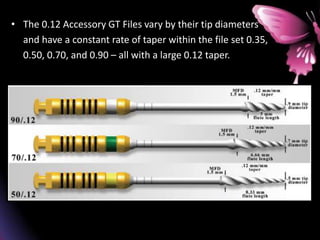
• The 0.12 Accessory GT Files vary by their tip diameters
and have a constant rate of taper within the file set 0.35,
0.50, 0.70, and 0.90 – all with a large 0.12 taper.
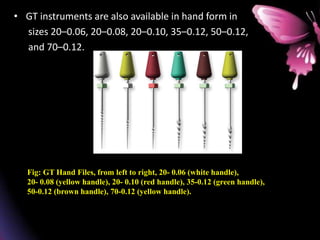
• GT instruments are also available in hand form in
sizes 20–0.06, 20–0.08, 20–0.10, 35–0.12, 50–0.12,
and 70–0.12.
Fig: GT Hand Files, from left to right, 20- 0.06 (white handle),
20- 0.08 (yellow handle), 20- 0.10 (red handle), 35-0.12 (green handle),
50-0.12 (brown handle), 70-0.12 (yellow handle).
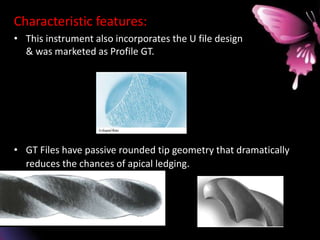
Characteristic features:
• This instrument also incorporates the U file design
& was marketed as Profile GT.
• GT Files have passive rounded tip geometry that dramatically
reduces the chances of apical ledging.
• The cutting flutes of GT instruments are landed, adding
further safety in apical regions of canals.
• GT instruments have variable-pitch flutes, meaning that
the flute angles, relative to the long axis of the file, are
different along their length.
• The recommended rotational speed for GT and GTX files is
300 rpm.
• The GT instruments and product identification is simple.
The number of black bands on the shank-ends, times two,
equals the taper of the file. The color bands on the shanks (or
handle color in the case of GT Obturators) indicate the tip
diameters in the ISO convention .
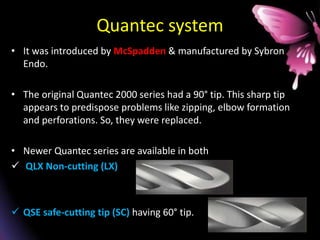
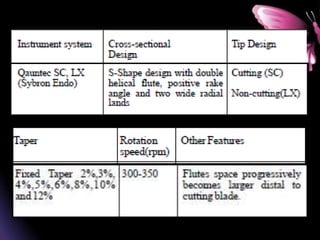
Quantec system
• It was introduced by McSpadden & manufactured by Sybron
Endo.
• The original Quantec 2000 series had a 90° tip. This sharp tip
appears to predispose problems like zipping, elbow formation
and perforations. So, they were replaced.
• Newer Quantec series are available in both
 QLX Non-cutting (LX)
 QSE safe-cutting tip (SC) having 60° tip.
• The quantec system provides graduated taper
technique whereby a series of varying tapers are used
to prepare a single canal.
• It consists of a series of 10 graduated NiTi taper files; taper
ranges from 0.02 to 0.12
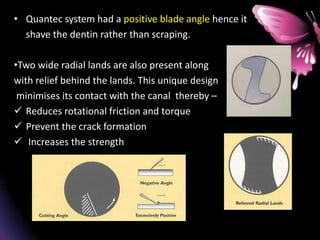
• Quantec system had a positive blade angle hence it
shave the dentin rather than scraping.
•Two wide radial lands are also present along
with relief behind the lands. This unique design
minimises its contact with the canal thereby –
 Reduces rotational friction and torque
 Prevent the crack formation
 Increases the strength
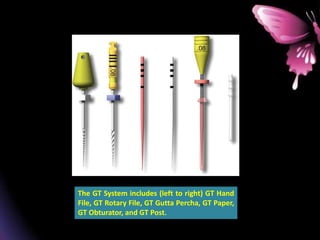
The GT System includes (left to right) GT Hand
File, GT Rotary File, GT Gutta Percha, GT Paper,
GT Obturator, and GT Post.
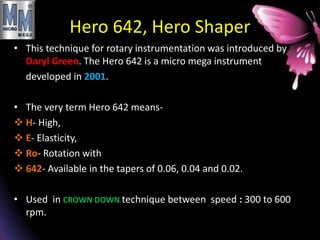
Hero 642, Hero Shaper
• This technique for rotary instrumentation was introduced by
Daryl Green. The Hero 642 is a micro mega instrument
developed in 2001.
• The very term Hero 642 means-
 H- High,
 E- Elasticity,
 Ro- Rotation with
 642- Available in the tapers of 0.06, 0.04 and 0.02.
• Used in CROWN DOWN technique between speed : 300 to 600
rpm.
• First – generation rotary systems had neutral or
slightly negative rake angles.
• Second generation systems were designed with positive rake
angles, which gave them better cutting efficiency.
• HERO instruments( MicroMega, Besancon, France) are an
example of a second generation system.
• The original system known as HERO 642 has now been replaced
by HERO Shaper, with very little differences in the instrument
design.
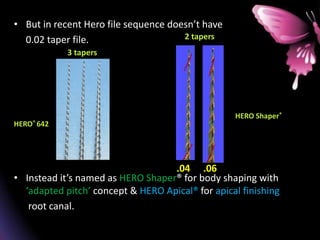
• But in recent Hero file sequence doesn’t have
0.02 taper file.
• Instead it’s named as HERO Shaper® for body shaping with
‘adapted pitch’ concept & HERO Apical® for apical finishing
root canal.
3 tapers
HERO® 642
2 tapers
.04 .06
HERO Shaper®
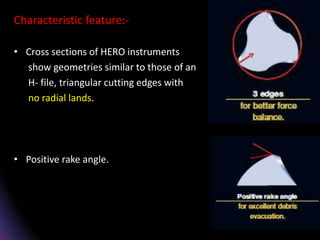
Characteristic feature:-
• Cross sections of HERO instruments
show geometries similar to those of an
H- file, triangular cutting edges with
no radial lands.
• Positive rake angle.
• Bigger inner core (better
resistance to fracture).
• Safe tip.
• Varying helical angle
(It avoids the screwing effect.)
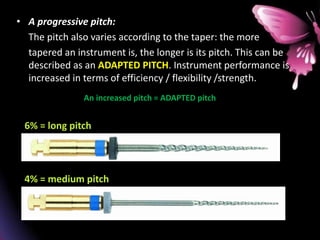
6 %
4 %
2 %
• A progressive pitch:
The pitch also varies according to the taper: the more
tapered an instrument is, the longer is its pitch. This can be
described as an ADAPTED PITCH. Instrument performance is
increased in terms of efficiency / flexibility /strength.
An increased pitch = ADAPTED pitch
6% = long pitch
4% = medium pitch
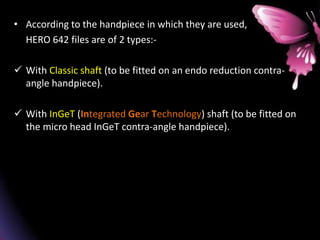
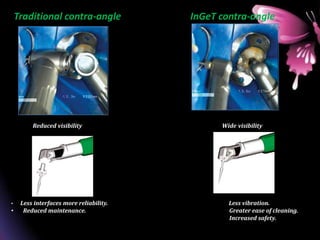
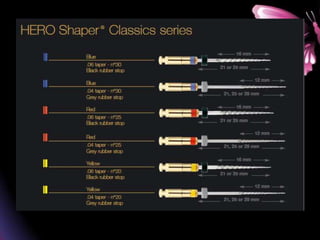
• According to the handpiece in which they are used,
HERO 642 files are of 2 types:-
 With Classic shaft (to be fitted on an endo reduction contra-
angle handpiece).
 With InGeT (Integrated Gear Technology) shaft (to be fitted on
the micro head InGeT contra-angle handpiece).
Traditional contra-angle InGeT contra-angle
Reduced visibility Wide visibility
• Less interfaces more reliability. Less vibration.
• Reduced maintenance. Greater ease of cleaning.
Increased safety.
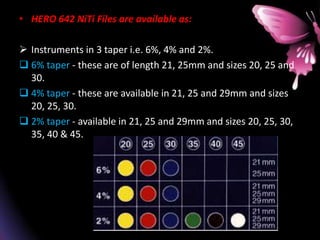
• HERO 642 NiTi Files are available as:
 Instruments in 3 taper i.e. 6%, 4% and 2%.
 6% taper - these are of length 21, 25mm and sizes 20, 25 and
30.
 4% taper - these are available in 21, 25 and 29mm and sizes
20, 25, 30.
 2% taper - available in 21, 25 and 29mm and sizes 20, 25, 30,
35, 40 & 45.
Canal preparation method :-
• The instruments are used based on the type of canal.
The canals are classified as easy, average or difficult
according to the curvature criteria given by S.W. Schneider :
 Easy – Straight and curved < 5 degrees
 Average – Curved > 10 degrees and < 25 degrees.
 Difficult – Curved > 25 degrees.
• CROWN DOWN IN EASY CANALS (Blue Sequence)
Step-1
 Place the 0.06 taper Hero No. 30 in a reducing contra-angle
handpiece.
 Adjust the stopper to one-half to two-third the working length
(used with an in and out motion).
 Insert the instrument while rotating at a constant speed beween
300 to 600 rpm.
 Proceed apically in short in and out movement.
Step-2
 Change to a 0.04 taper Hero No. 30.
 Place the instrument up to the working length.
 Use with in and out motion but with slight circumferential filing.
 The pressure while working should be as if writing with a sharp lead
pencil. Frequent irrigation and recapitulation with hand file, if any
resistance is met are recommended.
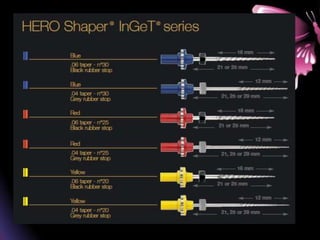
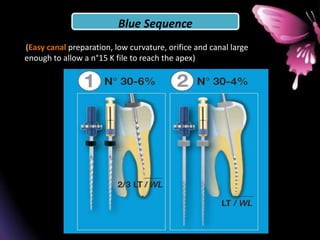
Blue Sequence
(Easy canal preparation, low curvature, orifice and canal large
enough to allow a n°15 K file to reach the apex)
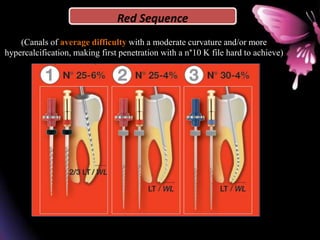
Red Sequence
(Canals of average difficulty with a moderate curvature and/or more
hypercalcification, making first penetration with a n°10 K file hard to achieve)
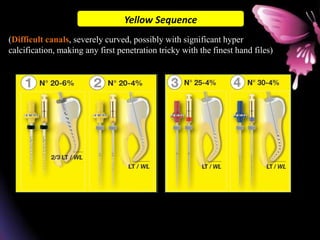
Yellow Sequence
(Difficult canals, severely curved, possibly with significant hyper
calcification, making any first penetration tricky with the finest hand files)
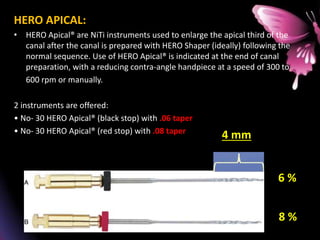
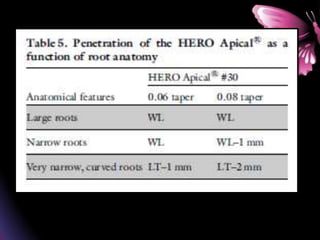
HERO APICAL:
• HERO Apical® are NiTi instruments used to enlarge the apical third of the
canal after the canal is prepared with HERO Shaper (ideally) following the
normal sequence. Use of HERO Apical® is indicated at the end of canal
preparation, with a reducing contra-angle handpiece at a speed of 300 to
600 rpm or manually.
2 instruments are offered:
• No- 30 HERO Apical® (black stop) with .06 taper
• No- 30 HERO Apical® (red stop) with .08 taper
6 %
8 %
4 mm
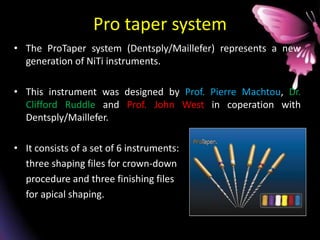
Pro taper system
• The ProTaper system (Dentsply/Maillefer) represents a new
generation of NiTi instruments.
• This instrument was designed by Prof. Pierre Machtou, Dr.
Clifford Ruddle and Prof. John West in coperation with
Dentsply/Maillefer.
• It consists of a set of 6 instruments:
three shaping files for crown-down
procedure and three finishing files
for apical shaping.
• This set is now complemented by two larger finishing
files and a set designed for retreatment procedures.
• These are available as both hand and rotary files.
• Speed –150 - 350 rpm
• Characteristic features:
 Progressive taper
 Modified guiding tip
 Varying tip diameters
 Modified cross-section
 Varying helical angle and pitches
 Shorter handle of the file
• Progressive taper - The unique design factor is the
varying tapers along the instruments' long axes. This
progressively tapered design serves to significantly improve
flexibility, cutting efficiency and safety.
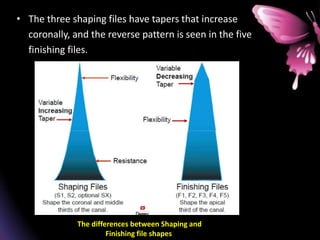
• The three shaping files have tapers that increase
coronally, and the reverse pattern is seen in the five
finishing files.
The differences between Shaping and
Finishing file shapes
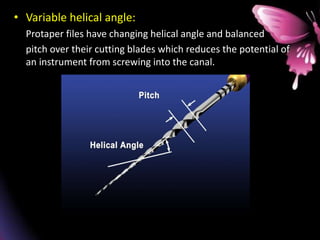
• Variable helical angle:
Protaper files have changing helical angle and balanced
pitch over their cutting blades which reduces the potential of
an instrument from screwing into the canal.
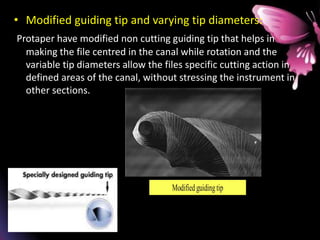
• Modified guiding tip and varying tip diameters:
Protaper have modified non cutting guiding tip that helps in
making the file centred in the canal while rotation and the
variable tip diameters allow the files specific cutting action in
defined areas of the canal, without stressing the instrument in
other sections.
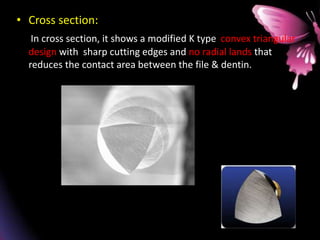
• Cross section:
In cross section, it shows a modified K type convex triangular
design with sharp cutting edges and no radial lands that
reduces the contact area between the file & dentin.
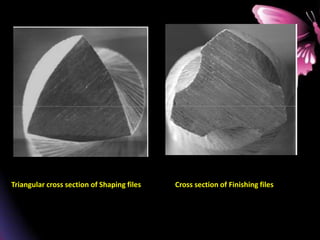
Triangular cross section of Shaping files Cross section of Finishing files
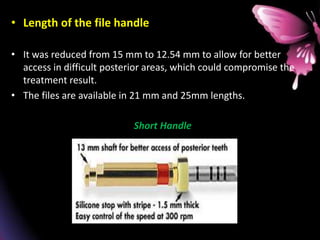
• Length of the file handle
• It was reduced from 15 mm to 12.54 mm to allow for better
access in difficult posterior areas, which could compromise the
treatment result.
• The files are available in 21 mm and 25mm lengths.
Short Handle
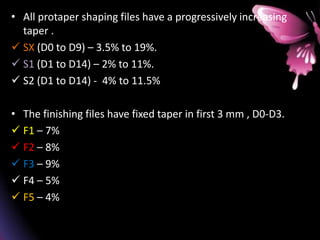
• All protaper shaping files have a progressively increasing
taper .
 SX (D0 to D9) – 3.5% to 19%.
 S1 (D1 to D14) – 2% to 11%.
 S2 (D1 to D14) - 4% to 11.5%
• The finishing files have fixed taper in first 3 mm , D0-D3.
 F1 – 7%
 F2 – 8%
 F3 – 9%
 F4 – 5%
 F5 – 4%
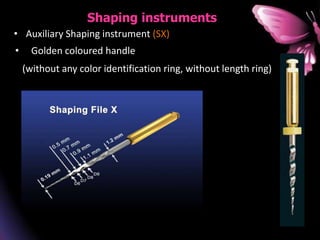
Shaping instruments
• Auxiliary Shaping instrument (SX)
• Golden coloured handle
(without any color identification ring, without length ring)
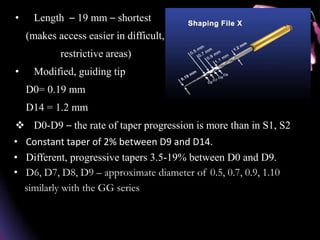
• Length – 19 mm – shortest
(makes access easier in difficult,
restrictive areas)
• Modified, guiding tip
D0= 0.19 mm
D14 = 1.2 mm
 D0-D9 – the rate of taper progression is more than in S1, S2
• Constant taper of 2% between D9 and D14.
• Different, progressive tapers 3.5-19% between D0 and D9.
• D6, D7, D8, D9 – approximate diameter of 0.5, 0.7, 0.9, 1.10
similarly with the GG series
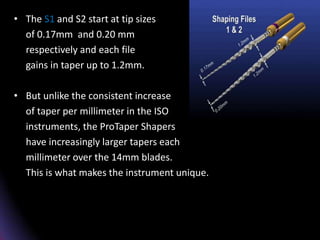
• The S1 and S2 start at tip sizes
of 0.17mm and 0.20 mm
respectively and each file
gains in taper up to 1.2mm.
• But unlike the consistent increase
of taper per millimeter in the ISO
instruments, the ProTaper Shapers
have increasingly larger tapers each
millimeter over the 14mm blades.
This is what makes the instrument unique.
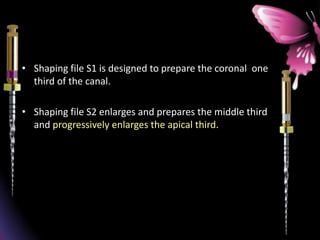
• Shaping file S1 is designed to prepare the coronal one
third of the canal.
• Shaping file S2 enlarges and prepares the middle third
and progressively enlarges the apical third.
Finishing instruments
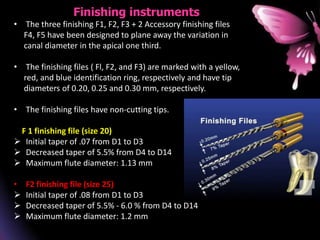
• The three finishing F1, F2, F3 + 2 Accessory finishing files
F4, F5 have been designed to plane away the variation in
canal diameter in the apical one third.
• The finishing files ( Fl, F2, and F3) are marked with a yellow,
red, and blue identification ring, respectively and have tip
diameters of 0.20, 0.25 and 0.30 mm, respectively.
• The finishing files have non-cutting tips.
F 1 finishing file (size 20)
 Initial taper of .07 from D1 to D3
 Decreased taper of 5.5% from D4 to D14
 Maximum flute diameter: 1.13 mm
• F2 finishing file (size 25)
 Initial taper of .08 from D1 to D3
 Decreased taper of 5.5% - 6.0 % from D4 to D14
 Maximum flute diameter: 1.2 mm
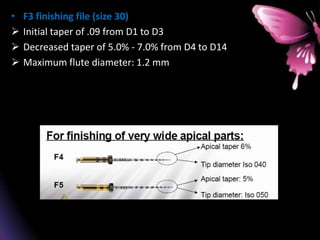
• F3 finishing file (size 30)
 Initial taper of .09 from D1 to D3
 Decreased taper of 5.0% - 7.0% from D4 to D14
 Maximum flute diameter: 1.2 mm
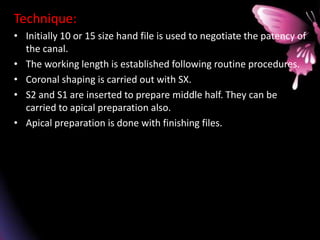
Technique:
• Initially 10 or 15 size hand file is used to negotiate the patency of
the canal.
• The working length is established following routine procedures.
• Coronal shaping is carried out with SX.
• S2 and S1 are inserted to prepare middle half. They can be
carried to apical preparation also.
• Apical preparation is done with finishing files.
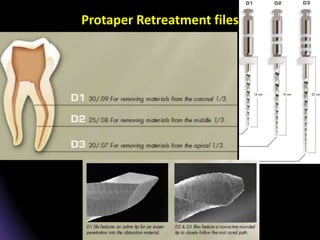
Protaper Retreatment files
K3 system
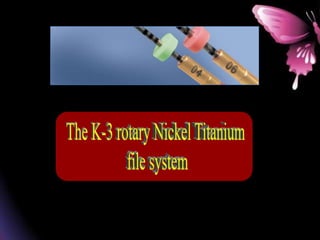
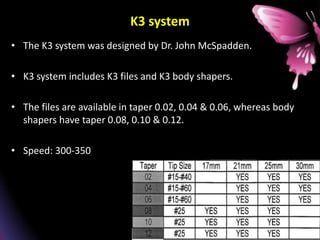
• The K3 system was designed by Dr. John McSpadden.
• K3 system includes K3 files and K3 body shapers.
• The files are available in taper 0.02, 0.04 & 0.06, whereas body
shapers have taper 0.08, 0.10 & 0.12.
• Speed: 300-350
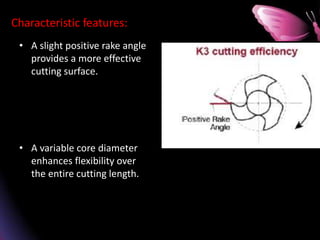
Characteristic features:
• A slight positive rake angle
provides a more effective
cutting surface.
• A variable core diameter
enhances flexibility over
the entire cutting length.
• 2
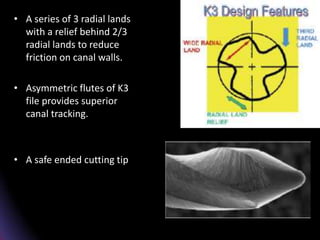
• A series of 3 radial lands
with a relief behind 2/3
radial lands to reduce
friction on canal walls.
• Asymmetric flutes of K3
file provides superior
canal tracking.
• A safe ended cutting tip.
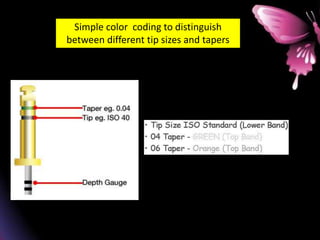
Simple color coding to distinguish
between different tip sizes and tapers
Technique:
• K3 body shapers are used to enlarge coronal one third of the root
canal.
• The initial chosen body shaper is followed by successively smaller
body shaper. Used in succession, k3 files may take the operator
to the junction of middle & apical third.
• The apical area is explored first with hand instrument to
determine the apical canal diameter, curvatures, calcifications,
patency and ease of negotiation.
• After true working length is established, a glide path for
subsequent k3 is established to approximate size of 15 or 20 K
files.
• K3 files are introduced with larger to smaller tip sizes till
working length is reached.
RACE SYSTEM
• The RaCe stands for Reamers with
Alternating Cutting Edges.
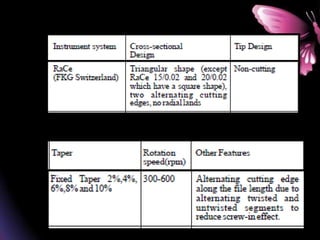
• The RaCe was manufactured by FKG and was
later distributed in the United States by
Brasseler (Savannah, GA).
• In 1999, 10 years after the first NiTi
instruments were introduced, the RaCe
(Reamer with Alternating Cutting Edges)
system became available.
Characteristics:
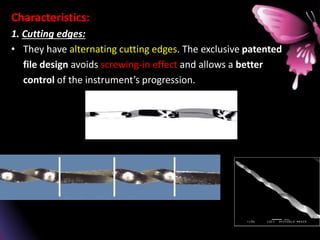
1. Cutting edges:
• They have alternating cutting edges. The exclusive patented
file design avoids screwing-in effect and allows a better
control of the instrument’s progression.
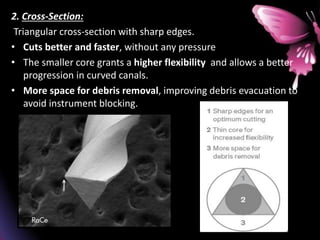
2. Cross-Section:
Triangular cross-section with sharp edges.
• Cuts better and faster, without any pressure
• The smaller core grants a higher flexibility and allows a better
progression in curved canals.
• More space for debris removal, improving debris evacuation to
avoid instrument blocking.
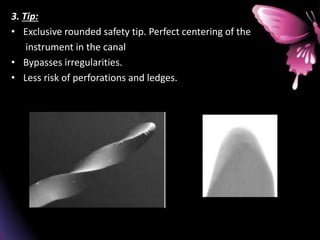
3. Tip:
• Exclusive rounded safety tip. Perfect centering of the
instrument in the canal
• Bypasses irregularities.
• Less risk of perforations and ledges.
4. Electrochemical polishing:
– Enhanced resistance against fatigue and
corrosion.
– The treatment eliminates surface imperfections,
reducing drastically the risk of weak points
(microcracks).
• The resulting shiny surface allows better cleaning and
disinfection.
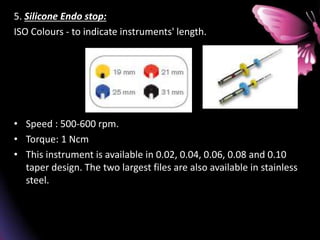
5. Silicone Endo stop:
ISO Colours - to indicate instruments' length.
• Speed : 500-600 rpm.
• Torque: 1 Ncm
• This instrument is available in 0.02, 0.04, 0.06, 0.08 and 0.10
taper design. The two largest files are also available in stainless
steel.
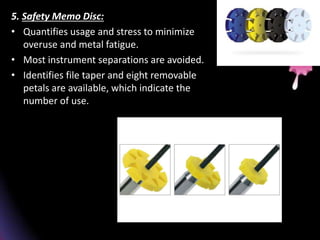
5. Safety Memo Disc:
• Quantifies usage and stress to minimize
overuse and metal fatigue.
• Most instrument separations are avoided.
• Identifies file taper and eight removable
petals are available, which indicate the
number of use.
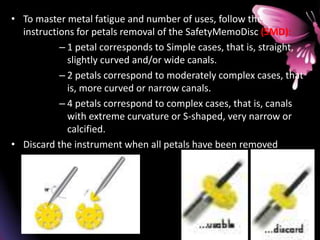
• To master metal fatigue and number of uses, follow the
instructions for petals removal of the SafetyMemoDisc (SMD):
– 1 petal corresponds to Simple cases, that is, straight,
slightly curved and/or wide canals.
– 2 petals correspond to moderately complex cases, that
is, more curved or narrow canals.
– 4 petals correspond to complex cases, that is, canals
with extreme curvature or S-shaped, very narrow or
calcified.
• Discard the instrument when all petals have been removed
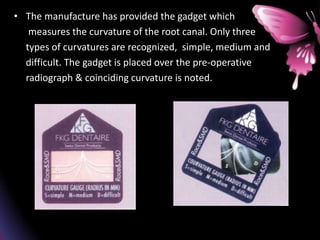
• The manufacture has provided the gadget which
measures the curvature of the root canal. Only three
types of curvatures are recognized, simple, medium and
difficult. The gadget is placed over the pre-operative
radiograph & coinciding curvature is noted.
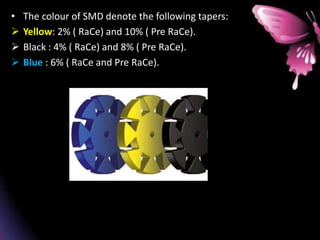
• The colour of SMD denote the following tapers:
 Yellow: 2% ( RaCe) and 10% ( Pre RaCe).
 Black : 4% ( RaCe) and 8% ( Pre RaCe).
 Blue : 6% ( RaCe and Pre RaCe).
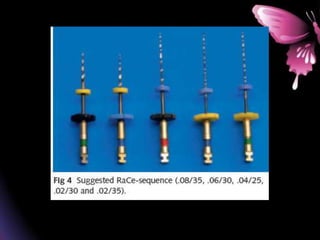
Technique:
Preferred sequence that applies to most root canals is as follows:
• Pre Race: .08 # 35 Crown Down
• Pre Race: .06 # 30 Crown Down
• Electronic measurement of root canal length using an apex
locator followed by verifying radiograph.
• Create a glide path to the working length with a stainless steel
file #15.
• Race : .04 # 25 Crown Down
• Race : .02 #30 Apical preparation
• Race : .02 # 35 Apical preparation
• If necessary, additional Pre- Race (.10 # 40) for enlargement of
the root canal entrance or further Race ( .02 # 40-60) for apical
preparation.
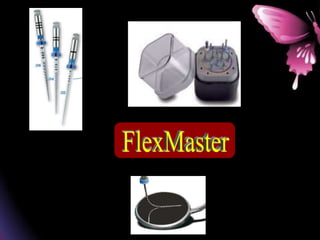
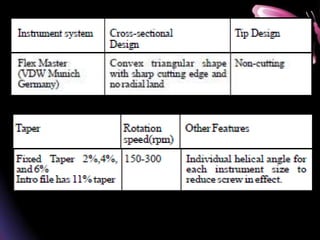
FLEXMASTER
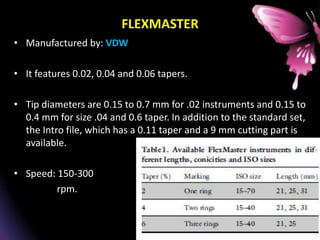
• Manufactured by: VDW
• It features 0.02, 0.04 and 0.06 tapers.
• Tip diameters are 0.15 to 0.7 mm for .02 instruments and 0.15 to
0.4 mm for size .04 and 0.6 taper. In addition to the standard set,
the Intro file, which has a 0.11 taper and a 9 mm cutting part is
available.
• Speed: 150-300
rpm.
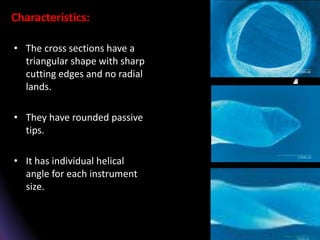
Characteristics:
• The cross sections have a
triangular shape with sharp
cutting edges and no radial
lands.
• They have rounded passive
tips.
• It has individual helical
angle for each instrument
size.
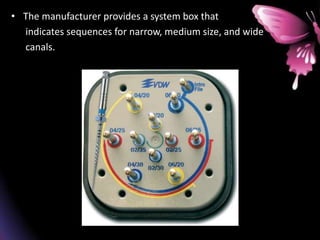
• The manufacturer provides a system box that
indicates sequences for narrow, medium size, and wide
canals.
Technique:
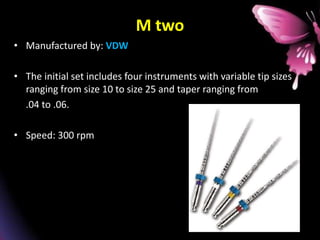
M two
• Manufactured by: VDW
• The initial set includes four instruments with variable tip sizes
ranging from size 10 to size 25 and taper ranging from
.04 to .06.
• Speed: 300 rpm.
• Speed: 300 rpm.
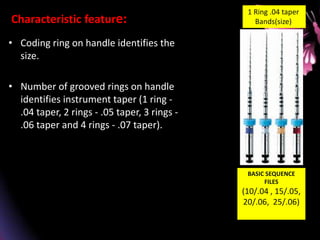
Characteristic feature:
• Coding ring on handle identifies the
size.
• Number of grooved rings on handle
identifies instrument taper (1 ring -
.04 taper, 2 rings - .05 taper, 3 rings -
.06 taper and 4 rings - .07 taper).
1 Ring .04 taper
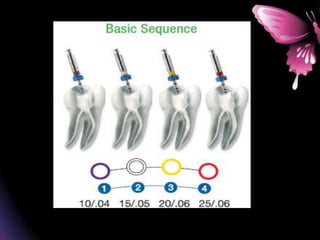
Bands(size)
BASIC SEQUENCE
FILES
(10/.04 , 15/.05,
20/.06, 25/.06)
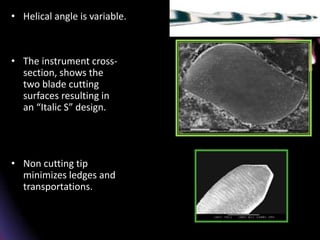
• Helical angle is variable.
• The instrument cross-
section, shows the
two blade cutting
surfaces resulting in
an “Italic S” design.
• Non cutting tip
minimizes ledges and
transportations.
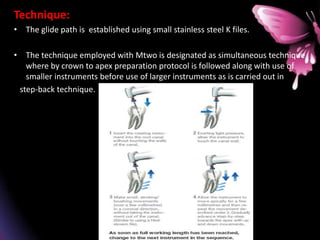
Technique:
• The glide path is established using small stainless steel K files.
• The technique employed with Mtwo is designated as simultaneous technique
where by crown to apex preparation protocol is followed along with use of
smaller instruments before use of larger instruments as is carried out in
step-back technique.
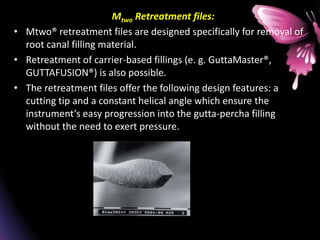
Mtwo Retreatment files:
• Mtwo® retreatment files are designed specifically for removal of
root canal filling material.
• Retreatment of carrier-based fillings (e. g. GuttaMaster®,
GUTTAFUSION®) is also possible.
• The retreatment files offer the following design features: a
cutting tip and a constant helical angle which ensure the
instrument‘s easy progression into the gutta-percha filling
without the need to exert pressure.
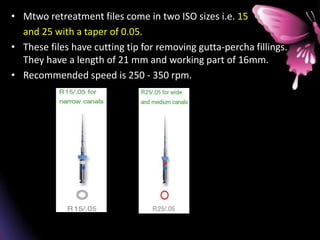
• Retreatment file with cutting tip
• Mtwo retreatment files come in two ISO sizes i.e. 15
and 25 with a taper of 0.05.
• These files have cutting tip for removing gutta-percha fillings.
They have a length of 21 mm and working part of 16mm.
• Recommended speed is 250 - 350 rpm.
Twisted file
• In 2008, SybronEndo presented the first fluted NiTi file.
• Manufactured by plastic deformation, a process similar to the
twisting process that is used to produce stainless steel K-files.
• According to the manufacturer, a thermal process allows
twisting during a phase transformation into the so called R-
phase of nickel-titanium.
• The unique production process is believed to result in superior
physical properties.
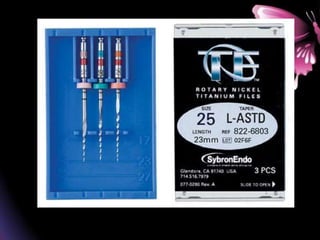
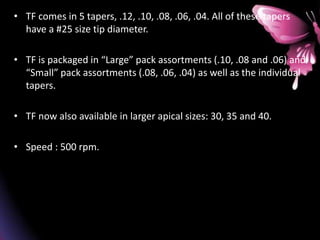
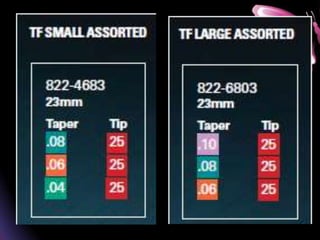
• TF comes in 5 tapers, .12, .10, .08, .06, .04. All of these tapers
have a #25 size tip diameter.
• TF is packaged in “Large” pack assortments (.10, .08 and .06) and
“Small” pack assortments (.08, .06, .04) as well as the individual
tapers.
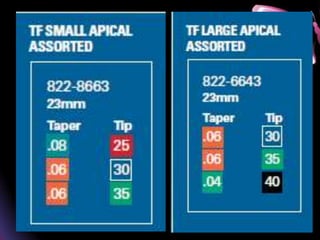
• TF now also available in larger apical sizes: 30, 35 and 40.
• Speed : 500 rpm.
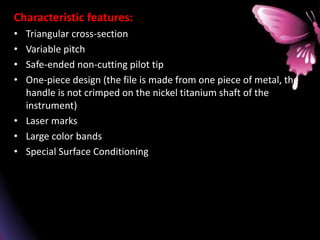
Characteristic features:
• Triangular cross-section
• Variable pitch
• Safe-ended non-cutting pilot tip
• One-piece design (the file is made from one piece of metal, the
handle is not crimped on the nickel titanium shaft of the
instrument)
• Laser marks
• Large color bands
• Special Surface Conditioning
Technique:
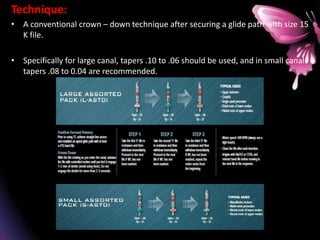
• A conventional crown – down technique after securing a glide path with size 15
K file.
• Specifically for large canal, tapers .10 to .06 should be used, and in small canal
tapers .08 to 0.04 are recommended.
Newer rotary systems
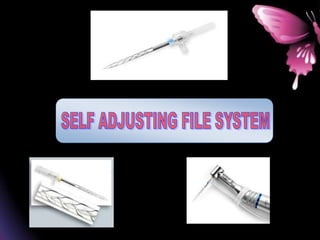
Self Adjusting File
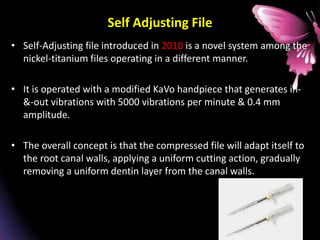
• Self-Adjusting file introduced in 2010 is a novel system among the
nickel-titanium files operating in a different manner.
• It is operated with a modified KaVo handpiece that generates in-
&-out vibrations with 5000 vibrations per minute & 0.4 mm
amplitude.
• The overall concept is that the compressed file will adapt itself to
the root canal walls, applying a uniform cutting action, gradually
removing a uniform dentin layer from the canal walls.
• The unique feature of this file is that it adapts to the shape
of the canal not only longitudinally, as every NiTi file does, but
also to the cross-section of the canal.
• Consequently the basic shape of the root canal is preserved.
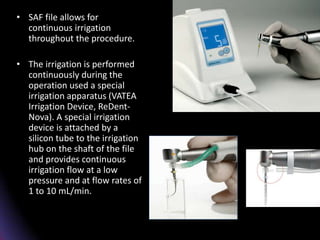
• SAF file allows for
continuous irrigation
throughout the procedure.
• The irrigation is performed
continuously during the
operation used a special
irrigation apparatus (VATEA
Irrigation Device, ReDent-
Nova). A special irrigation
device is attached by a
silicon tube to the irrigation
hub on the shaft of the file
and provides continuous
irrigation flow at a low
pressure and at flow rates of
1 to 10 mL/min.
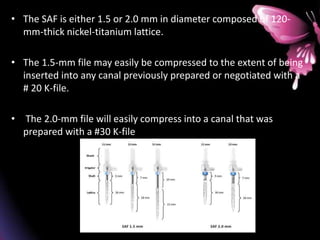
• The SAF is either 1.5 or 2.0 mm in diameter composed of 120-
mm-thick nickel-titanium lattice.
• The 1.5-mm file may easily be compressed to the extent of being
inserted into any canal previously prepared or negotiated with a
# 20 K-file.
• The 2.0-mm file will easily compress into a canal that was
prepared with a #30 K-file
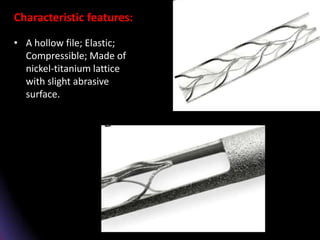
Characteristic features:
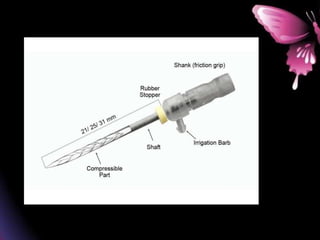
• A hollow file; Elastic;
Compressible; Made of
nickel-titanium lattice
with slight abrasive
surface.
• The SAF is used as a single
instrument to achieve
complete 3D root canal
shaping, cleaning and
Irrigation.
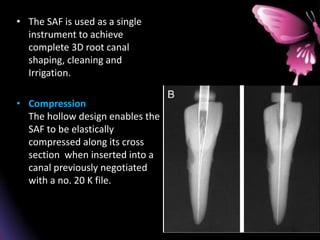
• Compression
The hollow design enables the
SAF to be elastically
compressed along its cross
section when inserted into a
canal previously negotiated
with a no. 20 K file.
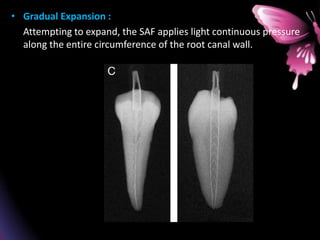
• Gradual Expansion :
Attempting to expand, the SAF applies light continuous pressure
along the entire circumference of the root canal wall.
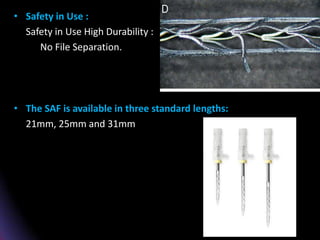
• Safety in Use :
Safety in Use High Durability :
No File Separation.
• The SAF is available in three standard lengths:
21mm, 25mm and 31mm
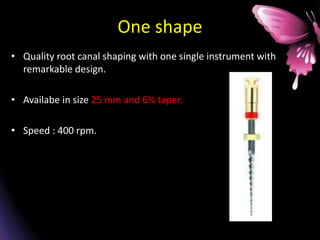
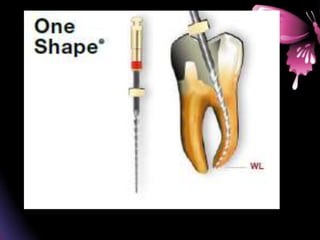
One shape
• Quality root canal shaping with one single instrument with
remarkable design.
• Availabe in size 25 mm and 6% taper.
• Speed : 400 rpm.
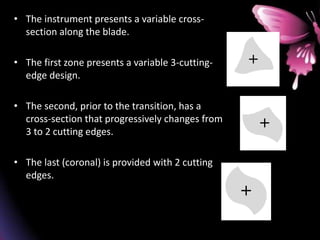
• The instrument presents a variable cross-
section along the blade.
• The first zone presents a variable 3-cutting-
edge design.
• The second, prior to the transition, has a
cross-section that progressively changes from
3 to 2 cutting edges.
• The last (coronal) is provided with 2 cutting
edges.
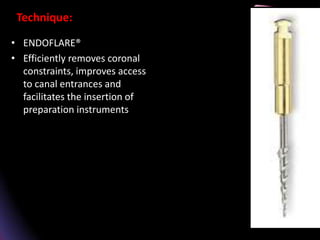
Technique:
• ENDOFLARE®
• Efficiently removes coronal
constraints, improves access
to canal entrances and
facilitates the insertion of
preparation instruments.
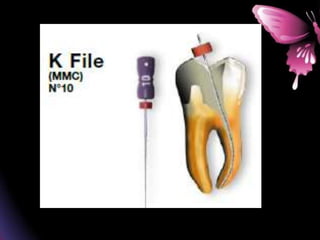
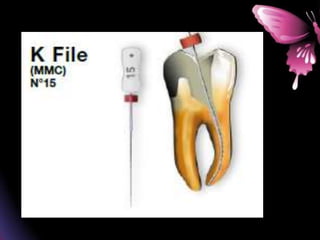
• If the glide path development with a K-File until 15 is not
possible, use the G-Files™ (G1+G2) to establish the glide
path and to achieve the estimated working length. Then
determine the working length with a K-File n°15.
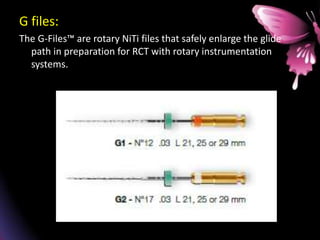
G files:
The G-Files™ are rotary NiTi files that safely enlarge the glide
path in preparation for RCT with rotary instrumentation
systems.
Structure of nickel–titanium:
• The crystal structure of NiTi alloy at high temperature
ranges (100°C) is a stable, body-centred cubic lattice
which is referred to as the austenite phase or parent
phase.
• When it is cooled through a critical transformation temperature
range (TTR), the alloy shows dramatic changes in its modulus of
elasticity (stiffness), yield strength and electric resistivity.
• By reducing or cooling the temperature through this range, there
is a change in the crystal structure which is known as the
martensitic transformation
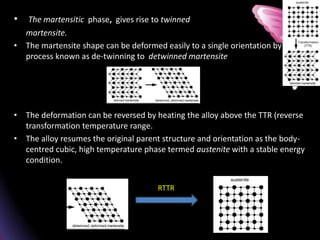
• The martensitic phase, gives rise to twinned
martensite.
• The martensite shape can be deformed easily to a single orientation by a
process known as de-twinning to detwinned martensite
• The deformation can be reversed by heating the alloy above the TTR (reverse
transformation temperature range.
• The alloy resumes the original parent structure and orientation as the body-
centred cubic, high temperature phase termed austenite with a stable energy
condition.
RTTR
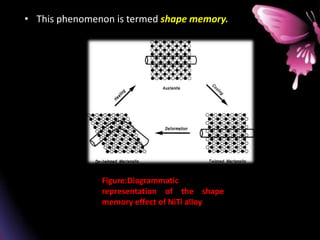
• This phenomenon is termed shape memory.
Figure:Diagrammatic
representation of the shape
memory effect of NiTi alloy.
Hyflex CM
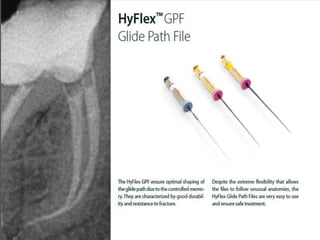
• Hyflex is a new NiTi rotary file for root canal preparation that
has been commercialized since 2011 .
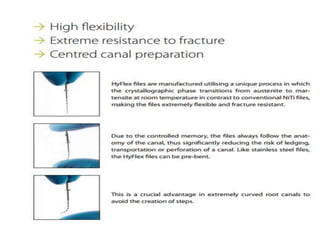
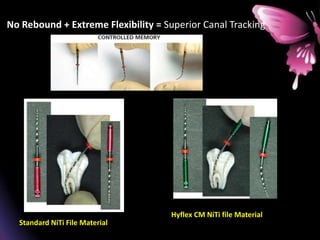
• HyFlex® Controlled Memory NiTi files have been
manufactured by Coltene Endo, utilizing a unique process that
controls the material’s memory, making the files extremely
flexible but without the shape memory of other NiTi files.
No Rebound + Extreme Flexibility = Superior Canal Tracking58
No Rebound + Extreme Flexibility = Superior Canal Tracking
Standard NiTi File Material
Hyflex CM NiTi file Material
• HyFlex NiTi have a built-in shape memory.
• They prevent stress during preparation by changing their
spiral shape.
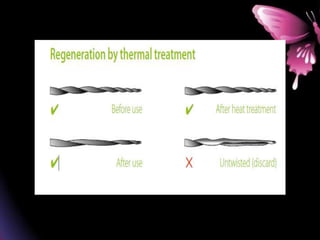
• They regain their shape after heat treatment. A normal
autoclaving process is enough to return the files to their
original shape and to regenerate the crystal structures and
resistance to fatigue.
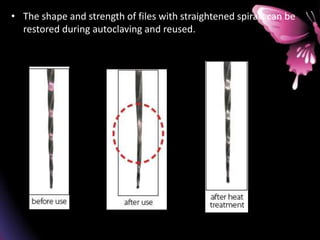
• The shape and strength of files with straightened spirals can be
restored during autoclaving and reused.
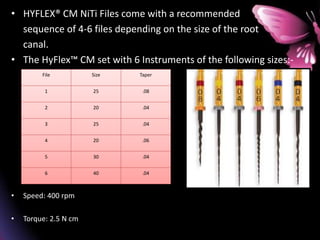
• HYFLEX® CM NiTi Files come with a recommended
sequence of 4-6 files depending on the size of the root
canal.
• The HyFlex™ CM set with 6 Instruments of the following sizes:-
• Speed: 400 rpm
• Torque: 2.5 N cm
File Size Taper
1 25 .08
2 20 .04
3 25 .04
4 20 .06
5 30 .04
6 40 .04
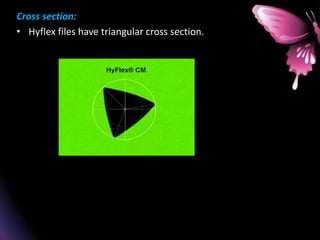
Cross section:
• Hyflex files have triangular cross section.
Canal preparation method:-
• HYFLEX® CM Files may also be used with Crown-down
and Step-back techniques.
Coronal patency:
• After gaining straight-line coronal access, assess working length
(WL) with an electronic apex locator and create an apical glide
path to a K file 02/20 hand file size.
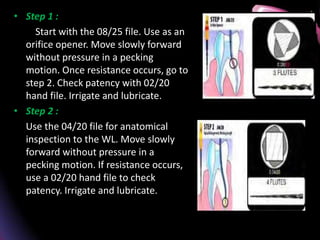
• Step 1 :
Start with the 08/25 file. Use as an
orifice opener. Move slowly forward
without pressure in a pecking
motion. Once resistance occurs, go to
step 2. Check patency with 02/20
hand file. Irrigate and lubricate.
• Step 2 :
Use the 04/20 file for anatomical
inspection to the WL. Move slowly
forward without pressure in a
pecking motion. If resistance occurs,
use a 02/20 hand file to check
patency. Irrigate and lubricate.
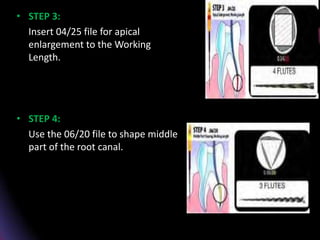
• STEP 3:
Insert 04/25 file for apical
enlargement to the Working
Length.
• STEP 4:
Use the 06/20 file to shape middle
part of the root canal.
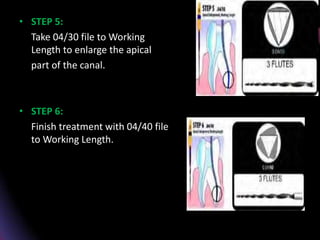
• STEP 5:
Take 04/30 file to Working
Length to enlarge the apical
part of the canal.
• STEP 6:
Finish treatment with 04/40 file
to Working Length.
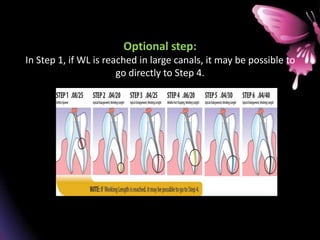
Optional step:
In Step 1, if WL is reached in large canals, it may be possible to
go directly to Step 4.
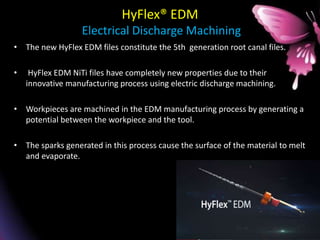
HyFlex® EDM
Electrical Discharge Machining
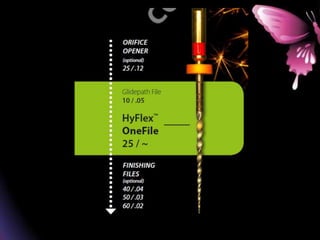
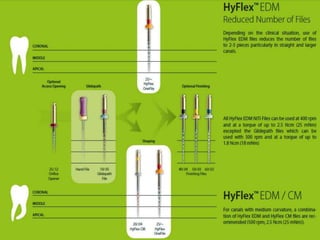
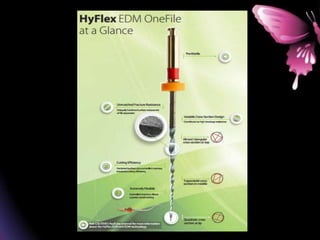
• The new HyFlex EDM files constitute the 5th generation root canal files.
• HyFlex EDM NiTi files have completely new properties due to their
innovative manufacturing process using electric discharge machining.
• Workpieces are machined in the EDM manufacturing process by generating a
potential between the workpiece and the tool.
• The sparks generated in this process cause the surface of the material to melt
and evaporate.
• This creates the unique surface of the new Niti files
and makes the HyFlex EDM files stronger and more
fracture resistant.
• This entirely unique combination of flexibility and fracture
resistance makes it possible to reduce the number of files
required for cleaning and shaping during root canal treatments.
• Just like HyFlex CM files, HyFlex EDM files have the already
familiar controlled memory effect (CM). This results in very
similar properties in terms of material flexibility and
regeneration..
• Up to 700% higher fracture resistance
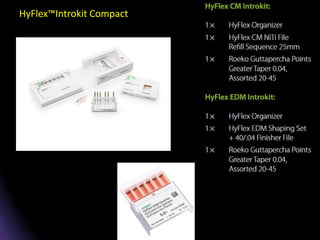
HyFlex™Introkit Compact
Wave-one
• The new WaveOne NiTi single-file system has been recently
introduced by Dentsply Maillefer in 2011..
• The system is designed to be used with a dedicated
reciprocating motion motor is a SINGLE-use, SINGLE-file system
to shape the root canal completely from start to finish.
• The specially designed NiTi files work in a similar but reverse
“balanced force” action using a pre-programmed motor to move
the files in a back and forth “reciprocal motion”.
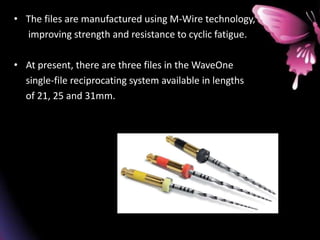
• The files are manufactured using M-Wire technology,
improving strength and resistance to cyclic fatigue.
• At present, there are three files in the WaveOne
single-file reciprocating system available in lengths
of 21, 25 and 31mm.
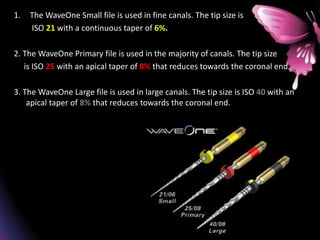
1. The WaveOne Small file is used in fine canals. The tip size is
ISO 21 with a continuous taper of 6%.
2. The WaveOne Primary file is used in the majority of canals. The tip size
is ISO 25 with an apical taper of 8% that reduces towards the coronal end.
3. The WaveOne Large file is used in large canals. The tip size is ISO 40 with an
apical taper of 8% that reduces towards the coronal end.
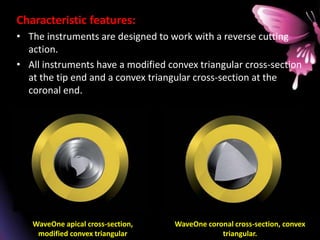
Characteristic features:
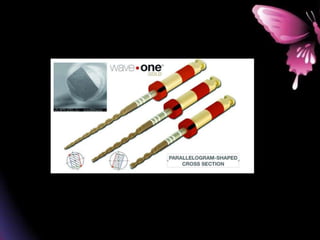
• The instruments are designed to work with a reverse cutting
action.
• All instruments have a modified convex triangular cross-section
at the tip end and a convex triangular cross-section at the
coronal end.
WaveOne apical cross-section,
modified convex triangular
WaveOne coronal cross-section, convex
triangular.
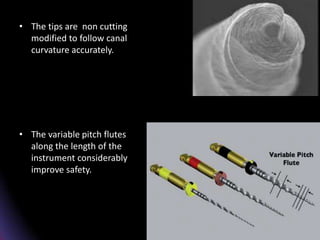
• The tips are modified
to follow canal
curvature accurately.
The variable pitch
flutes along the length
of the instrument
considerably improve
safety.
• The tips are non cutting
modified to follow canal
curvature accurately.
• The variable pitch flutes
along the length of the
instrument considerably
improve safety.
• All brands of NiTi files can be used with the WaveOne
motor, as it has additional functions for continuous rotation.
However, as WaveOne files have their own unique reverse
design, they can ONLY be used with the WaveOne motor with its
reverse reciprocating function.
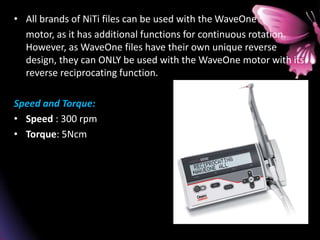
Speed and Torque:
• Speed : 300 rpm
• Torque: 5Ncm
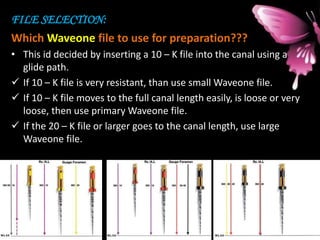
FILE SELECTION:
Which Waveone file to use for preparation???
• This id decided by inserting a 10 – K file into the canal using a
glide path.
 If 10 – K file is very resistant, than use small Waveone file.
 If 10 – K file moves to the full canal length easily, is loose or very
loose, then use primary Waveone file.
 If the 20 – K file or larger goes to the canal length, use large
Waveone file.
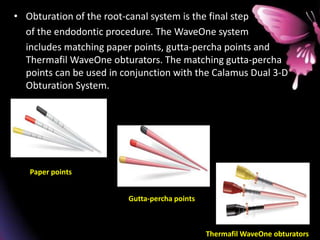
• Obturation of the root-canal system is the final step
of the endodontic procedure. The WaveOne system
includes matching paper points, gutta-percha points and
Thermafil WaveOne obturators. The matching gutta-percha
points can be used in conjunction with the Calamus Dual 3-D
Obturation System.
Paper points
Gutta-percha points
Thermafil WaveOne obturators
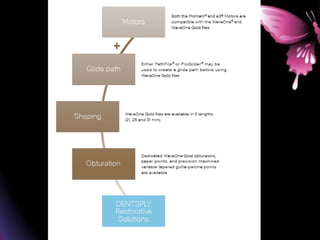
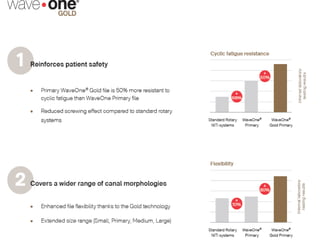
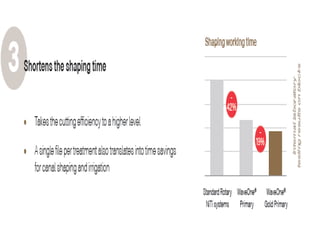
WAVEONE GOLD
• With WaveOne® Gold, DENTSPLY Tulsa Dental Specialties
promotes a comprehensive treatment solution and optimizes
predict able, successful outcomes.
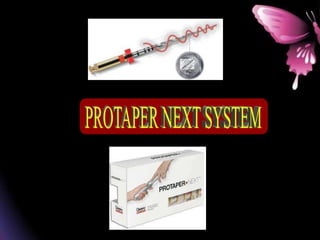
PROTAPER NEXT
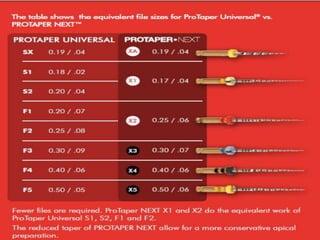
• PROTAPER NEXT™ is the successor to the PROTAPER UNIVERSAL
system, which has been the gold standard in endodontics for
many years.
• The convergence of a variable tapered design on a given file
(ProTaper Universal), innovative M-Wire technology, and a unique
offset mass of rotation.
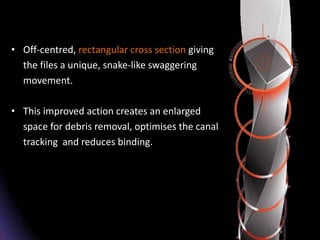
• Off-centred, rectangular cross section giving
the files a unique, snake-like swaggering
movement.
• This improved action creates an enlarged
space for debris removal, optimises the canal
tracking and reduces binding.
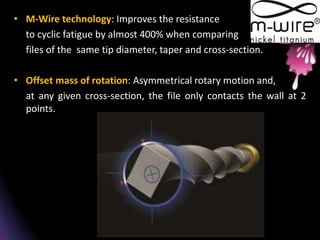
• M-Wire technology: Improves the resistance
to cyclic fatigue by almost 400% when comparing
files of the same tip diameter, taper and cross-section.
• Offset mass of rotation: Asymmetrical rotary motion and,
at any given cross-section, the file only contacts the wall at 2
points.
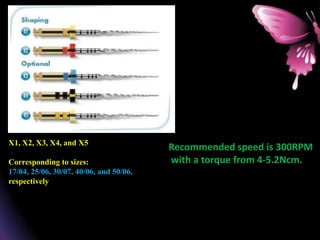
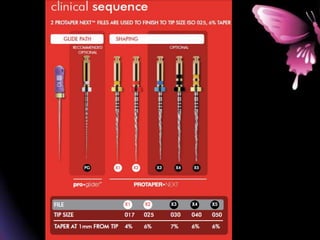
X1, X2, X3, X4, and X5
Corresponding to sizes:
17/04, 25/06, 30/07, 40/06, and 50/06,
respectively.
Recommended speed is 300RPM
with a torque from 4-5.2Ncm.
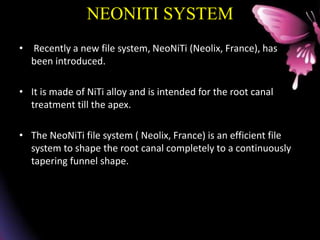
NEONITI SYSTEM
• Recently a new file system, NeoNiTi (Neolix, France), has
been introduced.
• It is made of NiTi alloy and is intended for the root canal
treatment till the apex.
• The NeoNiTi file system ( Neolix, France) is an efficient file
system to shape the root canal completely to a continuously
tapering funnel shape.
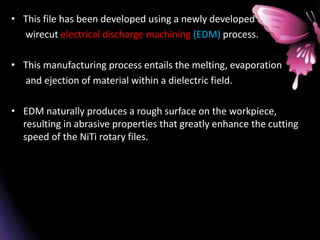
• This file has been developed using a newly developed
wirecut electrical discharge machining (EDM) process.
• This manufacturing process entails the melting, evaporation
and ejection of material within a dielectric field.
• EDM naturally produces a rough surface on the workpiece,
resulting in abrasive properties that greatly enhance the cutting
speed of the NiTi rotary files.
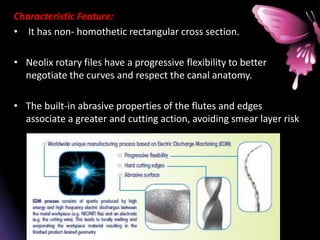
Characteristic Feature:
• It has non- homothetic rectangular cross section.
• Neolix rotary files have a progressive flexibility to better
negotiate the curves and respect the canal anatomy.
• The built-in abrasive properties of the flutes and edges
associate a greater and cutting action, avoiding smear layer risk
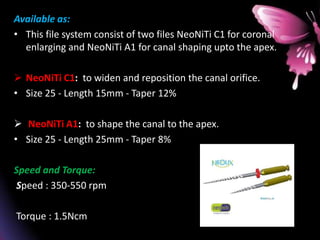
Available as:
• This file system consist of two files NeoNiTi C1 for coronal
enlarging and NeoNiTi A1 for canal shaping upto the apex.
 NeoNiTi C1: to widen and reposition the canal orifice.
• Size 25 - Length 15mm - Taper 12%
 NeoNiTi A1: to shape the canal to the apex.
• Size 25 - Length 25mm - Taper 8%
Speed and Torque:
Speed : 350-550 rpm
Torque : 1.5Ncm
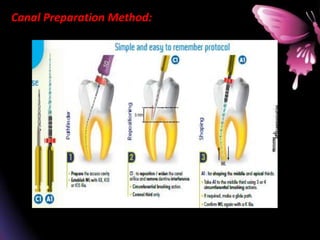
Canal Preparation Method:
REFERENCES
• Cohen’s – Pathways of the pulp 10th edition.
• Ingle’s endodontics – 6th edition.
• Grossman’s endodontic practice 13th edition.
• Castelucci endodontics volume 1.
• Design features of rotary instruments in endodontics The Journal of
Ahmedabad Dental College and Hospital; 2(1), March 2011 - August 2011.
• Design features of rotary root canal instruments. ENDO (Lond Engl)
2012;6(1 ):29-39.
• Modern Endodontic NiTi Systems: Morphological and Technical
Characteristics Part I: “New Generation” NiTi Systems. Endodotic therapy
vol. 5 no. 1.
• Nickel–titanium: options and challenges. Dent Clin
N Am 48 (2004) 55–67.
• Endodontic rotary nickel-titanium instrument systems. Clinical Update.
Vol. 25, No. 8.
• Fred Barbakow. The lightspeed system. The Dental Clinic of North America
48(2004) 113-135.
• Adam Lloyd. Root canal instrumentation with Profile instruments.
Endodontic Topics 2005, 10, 151-154.
• Syngcuk Kim. The Profile system. Dental Clinic of North America 48(2004)
69-85.
• Preparation of the Root Canal System 2. Rotary Instrumentation.
• Quantec™ System Brochure.
• L. STEPHEN BUCHANAN. ProSystem GT: design, technique, and
advantages. Endodontic Topics 2005, 10, 168–175.
• Profile GTX instrumentation technique Tulsa.
• http://micromega.com/anglais/produits/heroshaper/images/heroshaperli
vret.pdf.
• http://micro-mega.com/en/hero-shaper/
• www.endodonziamauroventuri.it/...Ti/Hero%20Apical%20-
%20Brochure.pdf
• http://www.fkg_race_family_brochure_en.pdf.
• David sonntag. Flexmaster: a universal system. Endodontic topics 2005, 10,
183–186.
• Clifford j. Ruddle. The Protaper technique. Endodontic topics 2005, 10,
187–190
• ARACENA, D.; BETANCOURT, P.; BORIE, E.; GUZMçN, M. & FUENTES, R.
WaveOne: a simple and safe way to perform an endodontic treatment. Int.
J. Odontostomat., 8(2):207-210, 2014.
• Dr Julian Webber et al. The WaveOne single-file reciprocating system. Roots
2011.
• Anurag Singhal et al. Waveone single file system. Review article. Journal of
Dental Sciences and Oral Rehabilitation, July- Sept 2012.
• http://pdf.medicalexpo.com/pdf/neolix-sas/flyer-en-neoniti/102856-
149564.html.
12. ROTARY INSTRUMENTS IN ENDODONTICS.pptx

12. ROTARY INSTRUMENTS IN ENDODONTICS.pptx

  • 1.
    ROTARY INSTRUMENTS IN ENDODONTICS Dr.Aditee Agrawal, DEPARTMENT OF CONSERVATIVE DENTISTRY & ENDODONTICS.
  • 2.
    CONTENTS ∆ INTRODUCTION ∆ HISTORY ∆NICKEL TITANIUM ENDODONTIC INSTRUMENTS ∆ PROPERTIES OF NiTi Alloy ∆ COMPONENTS OF ROTARY FILE ∆ CLASSIFICATION OF NITI INSTRUMENTS ∆ DIFFERENT ROTARY SYSTEMS
  • 3.
    INTRODUCTION The principles ofroot canal treatment consists of thoroughly cleaning, adequate shaping and complete filling of root canal system. In order to accomplish these objectives , many different instruments are available
  • 4.
    • Rotary shapinginstruments are replacing the conventional hand file systems to enhance shaping ability of canal, reduce clinical mishaps like blocks, ledges, transportations and perforations. • When clinician masters the “ method of use” protocols of rotary shaping instruments unpredictable file breakage, metal fatigue, loss of cutting efficiency, variation in length, diameter in curvature of the canal can be avoided and better shaping of the canals with desired taper will be achieved.
  • 5.
    HISTORY • The manufactureof the first instrument for Endodontic use dates to 1875. These early instruments, which were made by hand from thin steel wires, performed more or less the function of modern broaches. • 1876-1926 : This period showed improvement in procedures and introduction of standardized instruments and cavity preparation. • 1885: Gates – Glidden was introduced and it was one of the instruments which gained fame as a rotary instrument.
  • 6.
    • 1889 :The first contra angle for endodontic purpose with a whole circle rotation was introduced by Rollins. • 1915 : Kerr manufacturing company obtained the patent for instruments which were later known as K type instruments. • 1928: Endocursor handpiece was designed for use with rotary files. • 1958 Ingle and Levine first proposed standardization of Endodontic instruments. • Early 1960s, nickel titanium alloy was developed by W. F. Buehler, a metallurgist investigating non magnetic, salt resistant, water proof alloys for the space programme at the “Naval Ordinance Laboratory”, in Silver Springs, Maryland,USA.
  • 7.
    • 1971 Andersonand Hilleman first reported potential application of Nickel- Titanium alloys in dentistry. • 1988 Walia, Brantely and Gerstein was first to fabricate endodontic files from NiTi orthodontic wires. • 1988 The reports of first use of Nickel - Titanium alloys as Endodontic instruments. • Since 1991 to present a resurgence of mechanized and rotary NiTi systems with different instrument designs are establishing the market for root canal treatment.
  • 8.
    Nickel titanium [NiTi]Endodontic instruments • When using the stainless steel files, occurrence of procedural errors cannot be avoided specially in case of curved canals. Deviation from the original shape, ledge formation, zipping, stripping and perforations are common problems which are seen in such cases. • But the superelasticity of NiTi alloy allows these instruments to flex more than the stainless steel instruments before exceeding their elastic limit, thereby allowing canal preparation with minimal procedural errors.
  • 9.
    • NiTi wasdeveloped by Buchler 40 year ago. NiTi is also known NiTinol [NiTi Naval ordinance laboratory in US]. • In endodontics commonly used NiTi alloys are called 55 NiTi nol[55% wt Ni and 45% Ti] and 60 NiTi nol [60% wt of Ni, 40% Ti].
  • 10.
    • First useof NiTi in endodontics was reported in 1988,by Walia et al when a 15 no. NiTi file was made from orthodontic wire and it showed superior flexibility and resistance to tortional fracture. This suggested the use of NiTi files in curved canals.
  • 11.
    Properties of NiTialloys: 1. Shape memory: The NiTi file comes back to its original straight form without showing any sign of lasting deformation .This is called shape memory. 2. Super elasticity The ability of resisting stress without permanent deformation and going back to the initial lattice form is called super elasticity. 3. Low modulus of elasticity 4. Good resiliency 5. Corrosion resistance 6. Softer than stainless steel
  • 12.
  • 13.
    TIP DESIGN:-  Arotary cutting instrument may have a cutting or non-cutting tip.  Active Tip: have active cutting blades. They have the ability to cut more efficiently, aggressively and tendency to straighten the canal curvature.  Passive Tip: These instruments have a radial land between cutting edges and flute. The radial land touches the canal wall on its entire surface, guiding the instrument – stable and balanced with in the canal. at the end of the root.
  • 14.
    • Active cuttingblade: - Protaper -Hero 642 - Race file - K3 - Flexmaster • Passive cutting blade: -Profile - GT - Lightspeed • Semiactive : - Quantec
  • 15.
    Taper: It is expressedas the amount of file diameter increases each millimeter along its working surface from the tip towards the file handle. • SIGNIFICANCE: The ability to determine cross-sectional diameter at a given point on a file can help the clinician to determine the file size in the point of curvature and the relative stress being placed on the instrument.
  • 17.
    • Constant taperwith variable tip size e.g. Profile and K3 • Common tip size with varying Taper e.g Quantec, Race, System GT • No Taper e.g Lightspeed • Multiple or Reverse Taper e.g Protaper
  • 18.
    INSTRUMENT TAPER • PROFILEFIXED 2%, 4%, 6% • HERO 642 FIXED 2%, 4%, 6% • K3 FIXED 2%, 4%, 6% • FLEXMASTER FIXED 2%, 4%, 6%, INTRO FILE- 11% • RACE FIXED 2%, 4%, 6%, 8%,10% • QUANTEC FIXED 2%,3%, 4%, 5%,6%, 8%,10%,12% • M TWO FIXED 4%,5%,6%,7% • GT FILE FIXED 4%, 6%, 8%, 10%, 12% • LIGHTSPEED NO TAPER • PROTAPER VARIABLE TAPER
  • 19.
    RAKE ANGLE – •If the instrument is sectioned perpendicular to the long axis, the angle formed by cutting edge and the radius of the instrument is the rake angle. • If the angle formed by the leading edge and the surface to be cut (its tangent) is obtuse, the rake angle is said to be positive or cutting. • If the angle formed by the leading edge and the surface to be cut is acute, the rake angle is said to be negative or scraping .
  • 21.
    • Positive rakeangles will cut more efficiently than neutral rake angles, which scrap the inside of the canal. • Most conventional endodontic files utilize a negative or “substantially neutral” rake angle. • An overly positive rake angle will result in digging and gouging of the dentin. This can lead to separation. • Kᶾ has Positive rake angle. • The Profile, ProTaper, Hero 642, RaCe and Flex Master systems exhibit negative rake angle resulting in their optimum cutting efficiency. • Light Speed and GT rotary system have neutral rake angle .
  • 23.
    • If theflutes of the file are symmetrical the rake angle and cutting angle will be essentially the same. Only when the flutes are asymmetrical ,the rake angle and cutting angle will be different • In some instances, as with some Quantec files, a file may have a blade with a negative rake angle and a positive cutting angle. • Both angles may change as the file diameters change and may be different for file sizes.
  • 24.
    NEGATIVE RAKE ANGLE NEGATIVE CUTTING ANGLE NEGATIVERAKE ANGLE NEGATIVE CUTTING ANGLE PROFILE PROFILE GT
  • 25.
    NEGATIVE RAKE ANGLE NEGATIVE CUTTING ANGLE NEGATIVERAKE ANGLE NEGATIVE CUTTING ANGLE RACE PROTAPER
  • 26.
    NEGATIVE RAKE ANGLE LESS NEGATIVE CUTTINGANGLE NEGATIVE RAKE ANGLE LESS NEGATIVE CUTTING ANGLE HERO M TWO
  • 27.
    NEGATIVE RAKE ANGLE POSITIVE CUTTING ANGLE POSITIVERAKE ANGLE POSITIVE CUTTING ANGLE QUANTEC K3
  • 28.
    RADIAL LAND:- • Aradial land is a surface that projects axially from the central axis, between flutes, as far as the cutting edge. • This reduces the canal transportation and supports the cutting edge.
  • 29.
    Functions : • Prevents‘‘screwing in’’ of the file • Supports the cutting edge • Limits the depth of cut • Reduces the propagation of microcracks on its circumference. • Maintains the file in the centre of root canal. Previously, rotary files either had full radial lands (Profile, GT) or their lands were recessed (Quantec). The K3, like the Profile, is a three fluted file with three lands . Profile/GT Radial Land K3 Radial Land
  • 30.
    • HELIX ANGLE:- -It is the angle the cutting edge forms with the long axis of the tooth. • File with constant helical flute angle  Debris accumulation.  Screwing down effect. • Variable helical angle preferred
  • 31.
    • In theK3, the helical angle increases from the tip to the handle. • The RaCe file is unique and utilizes an “alternating helical design” that reduces rotational torque by using spiraled and non spiraled portions along the working length. This design feature also reduces the tendency of the file to get “sucked into” the canal. Variable Helical Angle
  • 32.
    PITCH:- • Pitch isthe number of spirals or threads per unit length. • The pitch is a distance between the edges or the peaks of two nearby cutting blades measured along the instrument axis.
  • 33.
    • The smallerthe pitch, greater the contact area between the instrument and root canal walls. It increases torsional stress and the drawing of the instrument in to the root canal. The pitch may be constant or changing along the long instrument.
  • 34.
    FLUTE : • Itis the groove in the working surface used to collect soft tissue and dentin chips removed from the walls of the canal. The effectiveness of the flute depends on its depth, width, configuration, and surface finish. • A progressively larger distance between flute space and blade is required so as to avoid any compaction of debris and also provides an effective channel for its removal.
  • 35.
    BLADE (CUTTING EDGE):- •It is the working area of the file and is the surface with the greatest diameter that follows the flute as it rotates. • Significance : The cutting edge forms and deflects chips from the wall of the canal and cut or snags soft tissue. Its effectiveness depends on its angle of incidence and sharpness.
  • 36.
    CORE: • The cylindricalcenter part of the file having its circumference outlined and bordered by the depth of the flutes. • The flexibility and resistance to torsion is partially determined by the core diameter.
  • 37.
    CLASSIFICATION OF NITIINSTRUMENTS: First Generation: • Profile • Lightspeed • Quantec • Greater taper files Second Generation : • Endosequnce • Protaper • K3 • M-two • Flexmaster
  • 38.
    Third Generation : •Hyflex CM • Protaper GT Series • Twisted files Fourth Generation: • WaveOne • Reciproc VDW • Self Adjusting File Fifth Generation : • Revo – S • One Shape • Protaper next
  • 39.
  • 41.
    LIGTHSPEED SYSTEM • TheLS file was developed by Dr. Steve Stenia and Dr. William Wildey in early 1990s & was known as LS1. • The same design principles apply to the recently developed LSX instrument. • These instruments are designed for apical preparation while providing the correct shape for a quality obturation.
  • 42.
    • They havea short cutting blade (0.25–2mm in length), with a non-cutting pilot tip and a taperless smooth, flexible shaft. • They can negotiate even difficult curvatures and cut dentine from canal walls without fear of coronal over-enlargement.
  • 43.
    Sizes : • LightSpeed/LSI set consist of totals 26 instruments with sizes 20 to 140 and in lengths of 21 mm, 25 mm, and 31 mm. • LightSpeed instruments also have half-sizes between 20 and 70 (22.5, 27.5, 32.5, 57.5, and 65.5) • The half-sizes instruments are color-coded exactly as the previous sizes, but also have white or black markings or engraved rings on the instrument’s handles . • LSX does not have half size files and set consist of size 20 – 80. It can be used with 2500 rpm because of high flexibility.
  • 45.
    • Because ofthin non cutting shaft both types of light speed instruments are considerably more flexible than any other instrument on the market. • Speed – 1500 - 2000 rpm (LS1) – 2500 rpm (LSX)
  • 46.
    Characteristic features: Cutting Head: A)CROSS SECTIONAL GEOMETRY: • Light speed(LS1) cutting heads are short and have 3 radial lands and 3 U shape grooves whereas LSX is shaped like a flat chisel in cross section. B) LENGTH OF CUTTING HEAD Smallest LS instrument ( size – 20) = 0.25 mm Largest LS instrument( size – 140 ) = 2.25 mm
  • 47.
    • Only rotarysystem whose cutting heads have 3 different geometric shapes.  First 5 LS instruments have short, non cutting pilot tip & 75° cutting angle;  Size 32.5° instrument has slightly longer tip with 33° cutting angle;  All other instruments have longer non cutting pilot tips and 21° cutting angle.
  • 48.
    • LS isthe • LS is the only rotary system whose instruments have thin, taperless, non cutting shafts . Shanks and Handle: • Made of aluminium • Color coded • Marked with rings to indicate distances from the instrument tips. Thin shafts:
  • 49.
    Technique: • Light speedinstruments require a straight line access to mid root areas. • Working length be recorded using small sized K files. • There are three methods of using light speed instruments: 1. Conventional technique 2. Zurich technique 3. Hybrid technique
  • 50.
    Conventional technique: Step 1– Determining initial light speed size • A light speed instrument can reach working length if its cutting head is smaller than canal’s diameter at the constriction. • For e.g. Size 25 LS instrument if reaches working length indicates that canal’s diameter is larger than size 25. • Gauging continues with sequentially larger sizes until a LS instrument doesn’t reach working length. If size 25 reaches working length but size 27.5 doesn’t, then size 27.5 is termed as First Light Speed Instrument.
  • 51.
    Step 2 –Determining master apical size After determining the FLSI, appropriate size of instrument required for apical preparation is determined. The instrument that takes at least 12 pecks to reach working length is master apical instrument. This is known as ‘12 pecks rule.’ Step 3 – Complete apical instrumentation. After determining the MAI size, complete the apical preparation by using next light speed size that is 4 mm shorter than working length.. Step 4 – Recapitulation The canal is recapitulated using respective master apical instrument to working length.
  • 52.
    Zurich technique: Step 1– Coronal pre – flaring After canal orifices are located, their coronal openings are enlarged using Gates glidden drills. Initially 4 – 6 mm coronal preparation is achieved. Step 2 – Determining initial apical instrument Working length is determined using size 15 stainless steel K files. Then, light speed instruments are used. The first few light speed instruments may not bind within the canal. The instrument which first feel resistance in the canal is termed as ‘Initial apical instrument.’
  • 53.
    Step 3 –Determining master apical instrument • All LSI used after initial apical instruments are called ‘binding instruments.’ • They are used with controlled forward and backward “Pecking movement”. • The forward motion reams the canal where as backward motion tends to clean as it retreats into fresh irrigant. • These instruments are used sequentially from smaller to larger one. The last instrument used to prepare apical area is termed as ‘Master apical instrument.’
  • 54.
    Step 4 –Step back and recapitulation After master apical instrument is finalized the step back preparation is initiated. The last step back instrument is termed as ‘ Final instrument.’ Finally canal is recapitulated using respective master apical instrument to working length.
  • 55.
    Hybrid technique (LightSpeedtechnique combined with taper technique): • LightSpeed Endodontics recommends this hybrid technique for clinicians wishing to combine both tapered rotary and LightSpeed systems. • In this way, canals can be cleaned and shaped in a crown-down fashion according to the technique recommended by the manufacturer of the tapered instruments used. • After the crown-down is completed, LightSpeed instruments complete the apical part of the canal.
  • 56.
  • 58.
    PROFILE SYSTEM • Profilesystem was introduced by Dr. Ben Johnson in 1994. • Profile instruments are available both in stainless steel and NiTi. • Initially hand instruments with 2% taper (series 29) were marketed. Later, rotary instruments with 2%, 4% and 6% taper were developed. • The tips of the ProFile Series 29 rotary instruments had a constant proportion of diameter increments (29%).
  • 59.
    Later on profileseries with ISO-sized tips and orifice shaper were also marketed. I] Series 29 a) Hand instruments -0.02 taper. b) Rotary instruments -0.04, 0.06 taper. II] ISO Series a) 0.04 and 0.06 taper hand and rotary instruments. Ⅲ] Profile Orifice shaper: 0.05- 0.08 taper. IV] Profile GT rotary instruments AND hand files
  • 60.
    Characteristic features: • Thecross sectional geometry is made by machining three equally spaced ‘U’ shaped grooves around the shaft of tapered NiTi wire.
  • 61.
    Central parallel core •There is a central parallel core inside that accounts for the enhanced flexibility. Parallel Core Tapered Core
  • 62.
    Rake angle • Ithas 200 negative rake angle at the cutting edge. Negative Rake angle -Negative Cutting angle
  • 63.
    Flat radial lands •It has flat radial lands to cut dentin in a planing motion. Radial Land U Shaped Groove U Shaped Groove U Shaped Groove U Shaped Groove U shaped groove
  • 64.
    Non-cutting bullet-nosed tip Speed– 150-350 rpm. Torque – 2.5 N cm.
  • 65.
  • 66.
  • 67.
    Recommended sequences foruse of ProFile by the manufacturer • Estimate the working length of the canal from a preoperative radiograph. • Create a glide path with a size 10/15 stainless steel K file. • Use Orifice Shapers sizes 4, 3, 2, and 1 in the coronal one third based on canal size and angle of pathway. • Perform crown-down preparation. Use ProFile instruments 0.06/30, 0.06/25, 0.04/30, and 0.04/25 to resistance (0.06/35, 0.06/30, 0.04/35, and 0.04/30 for larger canal. • Determine the working length with size 15 K file. • Perform apical preparation with ProFile 0.04/25and 0.04/30 instruments. • Finish with ProFile 0.06/25 instrument short of working length to blend the coronal and apical preparation.
  • 68.
    Canal Preparation Method (Colorsrepresent ISO instrument sizes) Canal Preparation Method32 (Colors represent ISO instrument sizes)
  • 69.
  • 71.
    • A veryrecent addition to the ProFile family of instruments is the Vortex. The major change lies in the non landed cross section, whereas tip sizes and taper are similar. • ProFile vortex also have varying helical angle to counteract the tendency of non landed files to thread into the root canal. • Manufactured using M wire technology.
  • 72.
    ProFile Vortex isavailable in ISO tip sizes from 15 to 50 and in .04 and .06 taper.
  • 75.
    GREATER TAPER (GT)AND GTX FILES • The greater taper or GT file was introduced by Dr Steve Buchanan in 1994. • The system was first produced as a set of hand operated files & later as engine driven files. • The main difference between GTX and GT files is the M wire technology used for GTX.
  • 76.
    • The instrumentscame in four tapers (#.06, #.08, #.10, and #.12), and the maximum diameter of the working part was 1 mm. The length of cutting flutes was decreased so file has short cutting portion and the taper was increased. • GT instruments are available in four basic categories of sizing,  20 Series,  30 Series,  40 Series,  0.12 Accessory Series.
  • 77.
    • The 20,30 and 40 Series GT Files have the same range of tapers, 0.04, 0.06, 0.08, and 0.10 in each file set but vary by their designated tip diameters. • The 20, 30 and 40 Series GT Files have the same range of designated tip diameters but vary by their taper 0.04, 0.06, 0.08, and 0.10 in each file set. 20 Series GT Files. Note how the tapers vary but the tip and maximum flute diameters are constant through the series of files.
  • 80.
    • The 0.12Accessory GT Files vary by their tip diameters and have a constant rate of taper within the file set 0.35, 0.50, 0.70, and 0.90 – all with a large 0.12 taper.
  • 81.
    • GT instrumentsare also available in hand form in sizes 20–0.06, 20–0.08, 20–0.10, 35–0.12, 50–0.12, and 70–0.12. Fig: GT Hand Files, from left to right, 20- 0.06 (white handle), 20- 0.08 (yellow handle), 20- 0.10 (red handle), 35-0.12 (green handle), 50-0.12 (brown handle), 70-0.12 (yellow handle).
  • 82.
    Characteristic features: • Thisinstrument also incorporates the U file design & was marketed as Profile GT. • GT Files have passive rounded tip geometry that dramatically reduces the chances of apical ledging.
  • 83.
    • The cuttingflutes of GT instruments are landed, adding further safety in apical regions of canals. • GT instruments have variable-pitch flutes, meaning that the flute angles, relative to the long axis of the file, are different along their length. • The recommended rotational speed for GT and GTX files is 300 rpm.
  • 84.
    • The GTinstruments and product identification is simple. The number of black bands on the shank-ends, times two, equals the taper of the file. The color bands on the shanks (or handle color in the case of GT Obturators) indicate the tip diameters in the ISO convention .
  • 87.
    Quantec system • Itwas introduced by McSpadden & manufactured by Sybron Endo. • The original Quantec 2000 series had a 90° tip. This sharp tip appears to predispose problems like zipping, elbow formation and perforations. So, they were replaced. • Newer Quantec series are available in both  QLX Non-cutting (LX)  QSE safe-cutting tip (SC) having 60° tip.
  • 88.
    • The quantecsystem provides graduated taper technique whereby a series of varying tapers are used to prepare a single canal. • It consists of a series of 10 graduated NiTi taper files; taper ranges from 0.02 to 0.12
  • 89.
    • Quantec systemhad a positive blade angle hence it shave the dentin rather than scraping. •Two wide radial lands are also present along with relief behind the lands. This unique design minimises its contact with the canal thereby –  Reduces rotational friction and torque  Prevent the crack formation  Increases the strength
  • 90.
    The GT Systemincludes (left to right) GT Hand File, GT Rotary File, GT Gutta Percha, GT Paper, GT Obturator, and GT Post.
  • 93.
    Hero 642, HeroShaper • This technique for rotary instrumentation was introduced by Daryl Green. The Hero 642 is a micro mega instrument developed in 2001. • The very term Hero 642 means-  H- High,  E- Elasticity,  Ro- Rotation with  642- Available in the tapers of 0.06, 0.04 and 0.02. • Used in CROWN DOWN technique between speed : 300 to 600 rpm.
  • 94.
    • First –generation rotary systems had neutral or slightly negative rake angles. • Second generation systems were designed with positive rake angles, which gave them better cutting efficiency. • HERO instruments( MicroMega, Besancon, France) are an example of a second generation system. • The original system known as HERO 642 has now been replaced by HERO Shaper, with very little differences in the instrument design.
  • 95.
    • But inrecent Hero file sequence doesn’t have 0.02 taper file. • Instead it’s named as HERO Shaper® for body shaping with ‘adapted pitch’ concept & HERO Apical® for apical finishing root canal. 3 tapers HERO® 642 2 tapers .04 .06 HERO Shaper®
  • 96.
    Characteristic feature:- • Crosssections of HERO instruments show geometries similar to those of an H- file, triangular cutting edges with no radial lands. • Positive rake angle.
  • 97.
    • Bigger innercore (better resistance to fracture). • Safe tip.
  • 98.
    • Varying helicalangle (It avoids the screwing effect.) 6 % 4 % 2 %
  • 99.
    • A progressivepitch: The pitch also varies according to the taper: the more tapered an instrument is, the longer is its pitch. This can be described as an ADAPTED PITCH. Instrument performance is increased in terms of efficiency / flexibility /strength. An increased pitch = ADAPTED pitch 6% = long pitch 4% = medium pitch
  • 100.
    • According tothe handpiece in which they are used, HERO 642 files are of 2 types:-  With Classic shaft (to be fitted on an endo reduction contra- angle handpiece).  With InGeT (Integrated Gear Technology) shaft (to be fitted on the micro head InGeT contra-angle handpiece).
  • 101.
    Traditional contra-angle InGeTcontra-angle Reduced visibility Wide visibility • Less interfaces more reliability. Less vibration. • Reduced maintenance. Greater ease of cleaning. Increased safety.
  • 102.
    • HERO 642NiTi Files are available as:  Instruments in 3 taper i.e. 6%, 4% and 2%.  6% taper - these are of length 21, 25mm and sizes 20, 25 and 30.  4% taper - these are available in 21, 25 and 29mm and sizes 20, 25, 30.  2% taper - available in 21, 25 and 29mm and sizes 20, 25, 30, 35, 40 & 45.
  • 105.
    Canal preparation method:- • The instruments are used based on the type of canal. The canals are classified as easy, average or difficult according to the curvature criteria given by S.W. Schneider :  Easy – Straight and curved < 5 degrees  Average – Curved > 10 degrees and < 25 degrees.  Difficult – Curved > 25 degrees.
  • 106.
    • CROWN DOWNIN EASY CANALS (Blue Sequence) Step-1  Place the 0.06 taper Hero No. 30 in a reducing contra-angle handpiece.  Adjust the stopper to one-half to two-third the working length (used with an in and out motion).  Insert the instrument while rotating at a constant speed beween 300 to 600 rpm.  Proceed apically in short in and out movement. Step-2  Change to a 0.04 taper Hero No. 30.  Place the instrument up to the working length.  Use with in and out motion but with slight circumferential filing.  The pressure while working should be as if writing with a sharp lead pencil. Frequent irrigation and recapitulation with hand file, if any resistance is met are recommended.
  • 107.
    Blue Sequence (Easy canalpreparation, low curvature, orifice and canal large enough to allow a n°15 K file to reach the apex)
  • 108.
    Red Sequence (Canals ofaverage difficulty with a moderate curvature and/or more hypercalcification, making first penetration with a n°10 K file hard to achieve)
  • 109.
    Yellow Sequence (Difficult canals,severely curved, possibly with significant hyper calcification, making any first penetration tricky with the finest hand files)
  • 110.
    HERO APICAL: • HEROApical® are NiTi instruments used to enlarge the apical third of the canal after the canal is prepared with HERO Shaper (ideally) following the normal sequence. Use of HERO Apical® is indicated at the end of canal preparation, with a reducing contra-angle handpiece at a speed of 300 to 600 rpm or manually. 2 instruments are offered: • No- 30 HERO Apical® (black stop) with .06 taper • No- 30 HERO Apical® (red stop) with .08 taper 6 % 8 % 4 mm
  • 113.
    Pro taper system •The ProTaper system (Dentsply/Maillefer) represents a new generation of NiTi instruments. • This instrument was designed by Prof. Pierre Machtou, Dr. Clifford Ruddle and Prof. John West in coperation with Dentsply/Maillefer. • It consists of a set of 6 instruments: three shaping files for crown-down procedure and three finishing files for apical shaping.
  • 114.
    • This setis now complemented by two larger finishing files and a set designed for retreatment procedures. • These are available as both hand and rotary files. • Speed –150 - 350 rpm • Characteristic features:  Progressive taper  Modified guiding tip  Varying tip diameters  Modified cross-section  Varying helical angle and pitches  Shorter handle of the file
  • 115.
    • Progressive taper- The unique design factor is the varying tapers along the instruments' long axes. This progressively tapered design serves to significantly improve flexibility, cutting efficiency and safety.
  • 116.
    • The threeshaping files have tapers that increase coronally, and the reverse pattern is seen in the five finishing files. The differences between Shaping and Finishing file shapes
  • 117.
    • Variable helicalangle: Protaper files have changing helical angle and balanced pitch over their cutting blades which reduces the potential of an instrument from screwing into the canal.
  • 118.
    • Modified guidingtip and varying tip diameters: Protaper have modified non cutting guiding tip that helps in making the file centred in the canal while rotation and the variable tip diameters allow the files specific cutting action in defined areas of the canal, without stressing the instrument in other sections.
  • 119.
    • Cross section: Incross section, it shows a modified K type convex triangular design with sharp cutting edges and no radial lands that reduces the contact area between the file & dentin.
  • 120.
    Triangular cross sectionof Shaping files Cross section of Finishing files
  • 121.
    • Length ofthe file handle • It was reduced from 15 mm to 12.54 mm to allow for better access in difficult posterior areas, which could compromise the treatment result. • The files are available in 21 mm and 25mm lengths. Short Handle
  • 122.
    • All protapershaping files have a progressively increasing taper .  SX (D0 to D9) – 3.5% to 19%.  S1 (D1 to D14) – 2% to 11%.  S2 (D1 to D14) - 4% to 11.5% • The finishing files have fixed taper in first 3 mm , D0-D3.  F1 – 7%  F2 – 8%  F3 – 9%  F4 – 5%  F5 – 4%
  • 123.
    Shaping instruments • AuxiliaryShaping instrument (SX) • Golden coloured handle (without any color identification ring, without length ring)
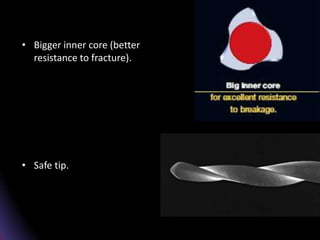
  • 124.
    • Length –19 mm – shortest (makes access easier in difficult, restrictive areas) • Modified, guiding tip D0= 0.19 mm D14 = 1.2 mm  D0-D9 – the rate of taper progression is more than in S1, S2 • Constant taper of 2% between D9 and D14. • Different, progressive tapers 3.5-19% between D0 and D9. • D6, D7, D8, D9 – approximate diameter of 0.5, 0.7, 0.9, 1.10 similarly with the GG series
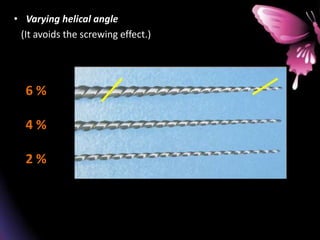
  • 125.
    • The S1and S2 start at tip sizes of 0.17mm and 0.20 mm respectively and each file gains in taper up to 1.2mm. • But unlike the consistent increase of taper per millimeter in the ISO instruments, the ProTaper Shapers have increasingly larger tapers each millimeter over the 14mm blades. This is what makes the instrument unique.
  • 126.
    • Shaping fileS1 is designed to prepare the coronal one third of the canal. • Shaping file S2 enlarges and prepares the middle third and progressively enlarges the apical third.
  • 127.
    Finishing instruments • Thethree finishing F1, F2, F3 + 2 Accessory finishing files F4, F5 have been designed to plane away the variation in canal diameter in the apical one third. • The finishing files ( Fl, F2, and F3) are marked with a yellow, red, and blue identification ring, respectively and have tip diameters of 0.20, 0.25 and 0.30 mm, respectively. • The finishing files have non-cutting tips. F 1 finishing file (size 20)  Initial taper of .07 from D1 to D3  Decreased taper of 5.5% from D4 to D14  Maximum flute diameter: 1.13 mm • F2 finishing file (size 25)  Initial taper of .08 from D1 to D3  Decreased taper of 5.5% - 6.0 % from D4 to D14  Maximum flute diameter: 1.2 mm
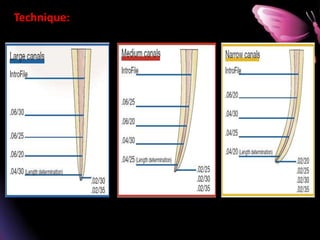
  • 128.
    • F3 finishingfile (size 30)  Initial taper of .09 from D1 to D3  Decreased taper of 5.0% - 7.0% from D4 to D14  Maximum flute diameter: 1.2 mm
  • 129.
    Technique: • Initially 10or 15 size hand file is used to negotiate the patency of the canal. • The working length is established following routine procedures. • Coronal shaping is carried out with SX. • S2 and S1 are inserted to prepare middle half. They can be carried to apical preparation also. • Apical preparation is done with finishing files.
  • 130.
  • 132.
    K3 system • TheK3 system was designed by Dr. John McSpadden. • K3 system includes K3 files and K3 body shapers. • The files are available in taper 0.02, 0.04 & 0.06, whereas body shapers have taper 0.08, 0.10 & 0.12. • Speed: 300-350
  • 133.
    Characteristic features: • Aslight positive rake angle provides a more effective cutting surface. • A variable core diameter enhances flexibility over the entire cutting length.
  • 134.
    • 2 • Aseries of 3 radial lands with a relief behind 2/3 radial lands to reduce friction on canal walls. • Asymmetric flutes of K3 file provides superior canal tracking. • A safe ended cutting tip.
  • 136.
    Simple color codingto distinguish between different tip sizes and tapers
  • 137.
    Technique: • K3 bodyshapers are used to enlarge coronal one third of the root canal. • The initial chosen body shaper is followed by successively smaller body shaper. Used in succession, k3 files may take the operator to the junction of middle & apical third. • The apical area is explored first with hand instrument to determine the apical canal diameter, curvatures, calcifications, patency and ease of negotiation.
  • 138.
    • After trueworking length is established, a glide path for subsequent k3 is established to approximate size of 15 or 20 K files. • K3 files are introduced with larger to smaller tip sizes till working length is reached.
  • 141.
    RACE SYSTEM • TheRaCe stands for Reamers with Alternating Cutting Edges. • The RaCe was manufactured by FKG and was later distributed in the United States by Brasseler (Savannah, GA). • In 1999, 10 years after the first NiTi instruments were introduced, the RaCe (Reamer with Alternating Cutting Edges) system became available.
  • 142.
    Characteristics: 1. Cutting edges: •They have alternating cutting edges. The exclusive patented file design avoids screwing-in effect and allows a better control of the instrument’s progression.
  • 143.
    2. Cross-Section: Triangular cross-sectionwith sharp edges. • Cuts better and faster, without any pressure • The smaller core grants a higher flexibility and allows a better progression in curved canals. • More space for debris removal, improving debris evacuation to avoid instrument blocking.
  • 144.
    3. Tip: • Exclusiverounded safety tip. Perfect centering of the instrument in the canal • Bypasses irregularities. • Less risk of perforations and ledges.
  • 145.
    4. Electrochemical polishing: –Enhanced resistance against fatigue and corrosion. – The treatment eliminates surface imperfections, reducing drastically the risk of weak points (microcracks). • The resulting shiny surface allows better cleaning and disinfection.
  • 146.
    5. Silicone Endostop: ISO Colours - to indicate instruments' length. • Speed : 500-600 rpm. • Torque: 1 Ncm • This instrument is available in 0.02, 0.04, 0.06, 0.08 and 0.10 taper design. The two largest files are also available in stainless steel.
  • 147.
    5. Safety MemoDisc: • Quantifies usage and stress to minimize overuse and metal fatigue. • Most instrument separations are avoided. • Identifies file taper and eight removable petals are available, which indicate the number of use.
  • 148.
    • To mastermetal fatigue and number of uses, follow the instructions for petals removal of the SafetyMemoDisc (SMD): – 1 petal corresponds to Simple cases, that is, straight, slightly curved and/or wide canals. – 2 petals correspond to moderately complex cases, that is, more curved or narrow canals. – 4 petals correspond to complex cases, that is, canals with extreme curvature or S-shaped, very narrow or calcified. • Discard the instrument when all petals have been removed
  • 149.
    • The manufacturehas provided the gadget which measures the curvature of the root canal. Only three types of curvatures are recognized, simple, medium and difficult. The gadget is placed over the pre-operative radiograph & coinciding curvature is noted.
  • 150.
    • The colourof SMD denote the following tapers:  Yellow: 2% ( RaCe) and 10% ( Pre RaCe).  Black : 4% ( RaCe) and 8% ( Pre RaCe).  Blue : 6% ( RaCe and Pre RaCe).
  • 151.
    Technique: Preferred sequence thatapplies to most root canals is as follows: • Pre Race: .08 # 35 Crown Down • Pre Race: .06 # 30 Crown Down • Electronic measurement of root canal length using an apex locator followed by verifying radiograph. • Create a glide path to the working length with a stainless steel file #15. • Race : .04 # 25 Crown Down • Race : .02 #30 Apical preparation • Race : .02 # 35 Apical preparation • If necessary, additional Pre- Race (.10 # 40) for enlargement of the root canal entrance or further Race ( .02 # 40-60) for apical preparation.
  • 155.
    FLEXMASTER • Manufactured by:VDW • It features 0.02, 0.04 and 0.06 tapers. • Tip diameters are 0.15 to 0.7 mm for .02 instruments and 0.15 to 0.4 mm for size .04 and 0.6 taper. In addition to the standard set, the Intro file, which has a 0.11 taper and a 9 mm cutting part is available. • Speed: 150-300 rpm.
  • 156.
    Characteristics: • The crosssections have a triangular shape with sharp cutting edges and no radial lands. • They have rounded passive tips. • It has individual helical angle for each instrument size.
  • 157.
    • The manufacturerprovides a system box that indicates sequences for narrow, medium size, and wide canals.
  • 158.
  • 161.
    M two • Manufacturedby: VDW • The initial set includes four instruments with variable tip sizes ranging from size 10 to size 25 and taper ranging from .04 to .06. • Speed: 300 rpm. • Speed: 300 rpm.
  • 162.
    Characteristic feature: • Codingring on handle identifies the size. • Number of grooved rings on handle identifies instrument taper (1 ring - .04 taper, 2 rings - .05 taper, 3 rings - .06 taper and 4 rings - .07 taper). 1 Ring .04 taper Bands(size) BASIC SEQUENCE FILES (10/.04 , 15/.05, 20/.06, 25/.06)
  • 163.
    • Helical angleis variable. • The instrument cross- section, shows the two blade cutting surfaces resulting in an “Italic S” design. • Non cutting tip minimizes ledges and transportations.
  • 164.
    Technique: • The glidepath is established using small stainless steel K files. • The technique employed with Mtwo is designated as simultaneous technique where by crown to apex preparation protocol is followed along with use of smaller instruments before use of larger instruments as is carried out in step-back technique.
  • 166.
    Mtwo Retreatment files: •Mtwo® retreatment files are designed specifically for removal of root canal filling material. • Retreatment of carrier-based fillings (e. g. GuttaMaster®, GUTTAFUSION®) is also possible. • The retreatment files offer the following design features: a cutting tip and a constant helical angle which ensure the instrument‘s easy progression into the gutta-percha filling without the need to exert pressure. • Retreatment file with cutting tip
  • 167.
    • Mtwo retreatmentfiles come in two ISO sizes i.e. 15 and 25 with a taper of 0.05. • These files have cutting tip for removing gutta-percha fillings. They have a length of 21 mm and working part of 16mm. • Recommended speed is 250 - 350 rpm.
  • 169.
    Twisted file • In2008, SybronEndo presented the first fluted NiTi file. • Manufactured by plastic deformation, a process similar to the twisting process that is used to produce stainless steel K-files. • According to the manufacturer, a thermal process allows twisting during a phase transformation into the so called R- phase of nickel-titanium. • The unique production process is believed to result in superior physical properties.
  • 171.
    • TF comesin 5 tapers, .12, .10, .08, .06, .04. All of these tapers have a #25 size tip diameter. • TF is packaged in “Large” pack assortments (.10, .08 and .06) and “Small” pack assortments (.08, .06, .04) as well as the individual tapers. • TF now also available in larger apical sizes: 30, 35 and 40. • Speed : 500 rpm.
  • 174.
    Characteristic features: • Triangularcross-section • Variable pitch • Safe-ended non-cutting pilot tip • One-piece design (the file is made from one piece of metal, the handle is not crimped on the nickel titanium shaft of the instrument) • Laser marks • Large color bands • Special Surface Conditioning
  • 175.
    Technique: • A conventionalcrown – down technique after securing a glide path with size 15 K file. • Specifically for large canal, tapers .10 to .06 should be used, and in small canal tapers .08 to 0.04 are recommended.
  • 176.
  • 178.
    Self Adjusting File •Self-Adjusting file introduced in 2010 is a novel system among the nickel-titanium files operating in a different manner. • It is operated with a modified KaVo handpiece that generates in- &-out vibrations with 5000 vibrations per minute & 0.4 mm amplitude. • The overall concept is that the compressed file will adapt itself to the root canal walls, applying a uniform cutting action, gradually removing a uniform dentin layer from the canal walls.
  • 179.
    • The uniquefeature of this file is that it adapts to the shape of the canal not only longitudinally, as every NiTi file does, but also to the cross-section of the canal. • Consequently the basic shape of the root canal is preserved.
  • 180.
    • SAF fileallows for continuous irrigation throughout the procedure. • The irrigation is performed continuously during the operation used a special irrigation apparatus (VATEA Irrigation Device, ReDent- Nova). A special irrigation device is attached by a silicon tube to the irrigation hub on the shaft of the file and provides continuous irrigation flow at a low pressure and at flow rates of 1 to 10 mL/min.
  • 182.
    • The SAFis either 1.5 or 2.0 mm in diameter composed of 120- mm-thick nickel-titanium lattice. • The 1.5-mm file may easily be compressed to the extent of being inserted into any canal previously prepared or negotiated with a # 20 K-file. • The 2.0-mm file will easily compress into a canal that was prepared with a #30 K-file
  • 183.
    Characteristic features: • Ahollow file; Elastic; Compressible; Made of nickel-titanium lattice with slight abrasive surface.
  • 184.
    • The SAFis used as a single instrument to achieve complete 3D root canal shaping, cleaning and Irrigation. • Compression The hollow design enables the SAF to be elastically compressed along its cross section when inserted into a canal previously negotiated with a no. 20 K file.
  • 185.
    • Gradual Expansion: Attempting to expand, the SAF applies light continuous pressure along the entire circumference of the root canal wall.
  • 186.
    • Safety inUse : Safety in Use High Durability : No File Separation. • The SAF is available in three standard lengths: 21mm, 25mm and 31mm
  • 188.
    One shape • Qualityroot canal shaping with one single instrument with remarkable design. • Availabe in size 25 mm and 6% taper. • Speed : 400 rpm.
  • 189.
    • The instrumentpresents a variable cross- section along the blade. • The first zone presents a variable 3-cutting- edge design. • The second, prior to the transition, has a cross-section that progressively changes from 3 to 2 cutting edges. • The last (coronal) is provided with 2 cutting edges.
  • 190.
    Technique: • ENDOFLARE® • Efficientlyremoves coronal constraints, improves access to canal entrances and facilitates the insertion of preparation instruments.
  • 193.
    • If theglide path development with a K-File until 15 is not possible, use the G-Files™ (G1+G2) to establish the glide path and to achieve the estimated working length. Then determine the working length with a K-File n°15.
  • 194.
    G files: The G-Files™are rotary NiTi files that safely enlarge the glide path in preparation for RCT with rotary instrumentation systems.
  • 197.
    Structure of nickel–titanium: •The crystal structure of NiTi alloy at high temperature ranges (100°C) is a stable, body-centred cubic lattice which is referred to as the austenite phase or parent phase. • When it is cooled through a critical transformation temperature range (TTR), the alloy shows dramatic changes in its modulus of elasticity (stiffness), yield strength and electric resistivity. • By reducing or cooling the temperature through this range, there is a change in the crystal structure which is known as the martensitic transformation
  • 198.
    • The martensiticphase, gives rise to twinned martensite. • The martensite shape can be deformed easily to a single orientation by a process known as de-twinning to detwinned martensite • The deformation can be reversed by heating the alloy above the TTR (reverse transformation temperature range. • The alloy resumes the original parent structure and orientation as the body- centred cubic, high temperature phase termed austenite with a stable energy condition. RTTR
  • 199.
    • This phenomenonis termed shape memory. Figure:Diagrammatic representation of the shape memory effect of NiTi alloy.
  • 200.
    Hyflex CM • Hyflexis a new NiTi rotary file for root canal preparation that has been commercialized since 2011 . • HyFlex® Controlled Memory NiTi files have been manufactured by Coltene Endo, utilizing a unique process that controls the material’s memory, making the files extremely flexible but without the shape memory of other NiTi files.
  • 202.
    No Rebound +Extreme Flexibility = Superior Canal Tracking58 No Rebound + Extreme Flexibility = Superior Canal Tracking Standard NiTi File Material Hyflex CM NiTi file Material
  • 203.
    • HyFlex NiTihave a built-in shape memory. • They prevent stress during preparation by changing their spiral shape. • They regain their shape after heat treatment. A normal autoclaving process is enough to return the files to their original shape and to regenerate the crystal structures and resistance to fatigue.
  • 204.
    • The shapeand strength of files with straightened spirals can be restored during autoclaving and reused.
  • 206.
    • HYFLEX® CMNiTi Files come with a recommended sequence of 4-6 files depending on the size of the root canal. • The HyFlex™ CM set with 6 Instruments of the following sizes:- • Speed: 400 rpm • Torque: 2.5 N cm File Size Taper 1 25 .08 2 20 .04 3 25 .04 4 20 .06 5 30 .04 6 40 .04
  • 207.
    Cross section: • Hyflexfiles have triangular cross section.
  • 208.
    Canal preparation method:- •HYFLEX® CM Files may also be used with Crown-down and Step-back techniques. Coronal patency: • After gaining straight-line coronal access, assess working length (WL) with an electronic apex locator and create an apical glide path to a K file 02/20 hand file size.
  • 209.
    • Step 1: Start with the 08/25 file. Use as an orifice opener. Move slowly forward without pressure in a pecking motion. Once resistance occurs, go to step 2. Check patency with 02/20 hand file. Irrigate and lubricate. • Step 2 : Use the 04/20 file for anatomical inspection to the WL. Move slowly forward without pressure in a pecking motion. If resistance occurs, use a 02/20 hand file to check patency. Irrigate and lubricate.
  • 210.
    • STEP 3: Insert04/25 file for apical enlargement to the Working Length. • STEP 4: Use the 06/20 file to shape middle part of the root canal.
  • 211.
    • STEP 5: Take04/30 file to Working Length to enlarge the apical part of the canal. • STEP 6: Finish treatment with 04/40 file to Working Length.
  • 212.
    Optional step: In Step1, if WL is reached in large canals, it may be possible to go directly to Step 4.
  • 213.
    HyFlex® EDM Electrical DischargeMachining • The new HyFlex EDM files constitute the 5th generation root canal files. • HyFlex EDM NiTi files have completely new properties due to their innovative manufacturing process using electric discharge machining. • Workpieces are machined in the EDM manufacturing process by generating a potential between the workpiece and the tool. • The sparks generated in this process cause the surface of the material to melt and evaporate.
  • 214.
    • This createsthe unique surface of the new Niti files and makes the HyFlex EDM files stronger and more fracture resistant. • This entirely unique combination of flexibility and fracture resistance makes it possible to reduce the number of files required for cleaning and shaping during root canal treatments. • Just like HyFlex CM files, HyFlex EDM files have the already familiar controlled memory effect (CM). This results in very similar properties in terms of material flexibility and regeneration.. • Up to 700% higher fracture resistance
  • 219.
  • 221.
    Wave-one • The newWaveOne NiTi single-file system has been recently introduced by Dentsply Maillefer in 2011.. • The system is designed to be used with a dedicated reciprocating motion motor is a SINGLE-use, SINGLE-file system to shape the root canal completely from start to finish. • The specially designed NiTi files work in a similar but reverse “balanced force” action using a pre-programmed motor to move the files in a back and forth “reciprocal motion”.
  • 222.
    • The filesare manufactured using M-Wire technology, improving strength and resistance to cyclic fatigue. • At present, there are three files in the WaveOne single-file reciprocating system available in lengths of 21, 25 and 31mm.
  • 223.
    1. The WaveOneSmall file is used in fine canals. The tip size is ISO 21 with a continuous taper of 6%. 2. The WaveOne Primary file is used in the majority of canals. The tip size is ISO 25 with an apical taper of 8% that reduces towards the coronal end. 3. The WaveOne Large file is used in large canals. The tip size is ISO 40 with an apical taper of 8% that reduces towards the coronal end.
  • 224.
    Characteristic features: • Theinstruments are designed to work with a reverse cutting action. • All instruments have a modified convex triangular cross-section at the tip end and a convex triangular cross-section at the coronal end. WaveOne apical cross-section, modified convex triangular WaveOne coronal cross-section, convex triangular.
  • 225.
    • The tipsare modified to follow canal curvature accurately. The variable pitch flutes along the length of the instrument considerably improve safety. • The tips are non cutting modified to follow canal curvature accurately. • The variable pitch flutes along the length of the instrument considerably improve safety.
  • 226.
    • All brandsof NiTi files can be used with the WaveOne motor, as it has additional functions for continuous rotation. However, as WaveOne files have their own unique reverse design, they can ONLY be used with the WaveOne motor with its reverse reciprocating function. Speed and Torque: • Speed : 300 rpm • Torque: 5Ncm
  • 227.
    FILE SELECTION: Which Waveonefile to use for preparation??? • This id decided by inserting a 10 – K file into the canal using a glide path.  If 10 – K file is very resistant, than use small Waveone file.  If 10 – K file moves to the full canal length easily, is loose or very loose, then use primary Waveone file.  If the 20 – K file or larger goes to the canal length, use large Waveone file.
  • 228.
    • Obturation ofthe root-canal system is the final step of the endodontic procedure. The WaveOne system includes matching paper points, gutta-percha points and Thermafil WaveOne obturators. The matching gutta-percha points can be used in conjunction with the Calamus Dual 3-D Obturation System. Paper points Gutta-percha points Thermafil WaveOne obturators
  • 229.
    WAVEONE GOLD • WithWaveOne® Gold, DENTSPLY Tulsa Dental Specialties promotes a comprehensive treatment solution and optimizes predict able, successful outcomes.
  • 236.
    PROTAPER NEXT • PROTAPERNEXT™ is the successor to the PROTAPER UNIVERSAL system, which has been the gold standard in endodontics for many years. • The convergence of a variable tapered design on a given file (ProTaper Universal), innovative M-Wire technology, and a unique offset mass of rotation.
  • 237.
    • Off-centred, rectangularcross section giving the files a unique, snake-like swaggering movement. • This improved action creates an enlarged space for debris removal, optimises the canal tracking and reduces binding.
  • 238.
    • M-Wire technology:Improves the resistance to cyclic fatigue by almost 400% when comparing files of the same tip diameter, taper and cross-section. • Offset mass of rotation: Asymmetrical rotary motion and, at any given cross-section, the file only contacts the wall at 2 points.
  • 239.
    X1, X2, X3,X4, and X5 Corresponding to sizes: 17/04, 25/06, 30/07, 40/06, and 50/06, respectively. Recommended speed is 300RPM with a torque from 4-5.2Ncm.
  • 243.
    NEONITI SYSTEM • Recentlya new file system, NeoNiTi (Neolix, France), has been introduced. • It is made of NiTi alloy and is intended for the root canal treatment till the apex. • The NeoNiTi file system ( Neolix, France) is an efficient file system to shape the root canal completely to a continuously tapering funnel shape.
  • 244.
    • This filehas been developed using a newly developed wirecut electrical discharge machining (EDM) process. • This manufacturing process entails the melting, evaporation and ejection of material within a dielectric field. • EDM naturally produces a rough surface on the workpiece, resulting in abrasive properties that greatly enhance the cutting speed of the NiTi rotary files.
  • 245.
    Characteristic Feature: • Ithas non- homothetic rectangular cross section. • Neolix rotary files have a progressive flexibility to better negotiate the curves and respect the canal anatomy. • The built-in abrasive properties of the flutes and edges associate a greater and cutting action, avoiding smear layer risk
  • 246.
    Available as: • Thisfile system consist of two files NeoNiTi C1 for coronal enlarging and NeoNiTi A1 for canal shaping upto the apex.  NeoNiTi C1: to widen and reposition the canal orifice. • Size 25 - Length 15mm - Taper 12%  NeoNiTi A1: to shape the canal to the apex. • Size 25 - Length 25mm - Taper 8% Speed and Torque: Speed : 350-550 rpm Torque : 1.5Ncm
  • 247.
  • 248.
    REFERENCES • Cohen’s –Pathways of the pulp 10th edition. • Ingle’s endodontics – 6th edition. • Grossman’s endodontic practice 13th edition. • Castelucci endodontics volume 1. • Design features of rotary instruments in endodontics The Journal of Ahmedabad Dental College and Hospital; 2(1), March 2011 - August 2011. • Design features of rotary root canal instruments. ENDO (Lond Engl) 2012;6(1 ):29-39. • Modern Endodontic NiTi Systems: Morphological and Technical Characteristics Part I: “New Generation” NiTi Systems. Endodotic therapy vol. 5 no. 1.
  • 249.
    • Nickel–titanium: optionsand challenges. Dent Clin N Am 48 (2004) 55–67. • Endodontic rotary nickel-titanium instrument systems. Clinical Update. Vol. 25, No. 8. • Fred Barbakow. The lightspeed system. The Dental Clinic of North America 48(2004) 113-135. • Adam Lloyd. Root canal instrumentation with Profile instruments. Endodontic Topics 2005, 10, 151-154. • Syngcuk Kim. The Profile system. Dental Clinic of North America 48(2004) 69-85. • Preparation of the Root Canal System 2. Rotary Instrumentation. • Quantec™ System Brochure. • L. STEPHEN BUCHANAN. ProSystem GT: design, technique, and advantages. Endodontic Topics 2005, 10, 168–175.
  • 250.
    • Profile GTXinstrumentation technique Tulsa. • http://micromega.com/anglais/produits/heroshaper/images/heroshaperli vret.pdf. • http://micro-mega.com/en/hero-shaper/ • www.endodonziamauroventuri.it/...Ti/Hero%20Apical%20- %20Brochure.pdf • http://www.fkg_race_family_brochure_en.pdf. • David sonntag. Flexmaster: a universal system. Endodontic topics 2005, 10, 183–186. • Clifford j. Ruddle. The Protaper technique. Endodontic topics 2005, 10, 187–190
  • 251.
    • ARACENA, D.;BETANCOURT, P.; BORIE, E.; GUZMçN, M. & FUENTES, R. WaveOne: a simple and safe way to perform an endodontic treatment. Int. J. Odontostomat., 8(2):207-210, 2014. • Dr Julian Webber et al. The WaveOne single-file reciprocating system. Roots 2011. • Anurag Singhal et al. Waveone single file system. Review article. Journal of Dental Sciences and Oral Rehabilitation, July- Sept 2012. • http://pdf.medicalexpo.com/pdf/neolix-sas/flyer-en-neoniti/102856- 149564.html.

Editor's Notes

  • #116 Comparing the ProTaper NT system with other systems, one can note that other file systems focus on one taper within a file and tend to combine a series of files to achieve the necessary effect. In contrast, ProTaper has varying tapers within one file ranging from 3.5% to 19%, which makes it possible to shape specific sections of a root canal with one file.
  • #117 The shaping files are characterized by increasing tapers over the whole length of their cutting blades, allowing for a controlled cutting performance in special sections of the instrumented root canal. The finishing files are dominated by different diameters; #20, #25, #30 and a fixed taper over 3 mm to finish apical preparation.