Prepared by :
DR. Anwar N. Altowaity
Endodontic instruments .II
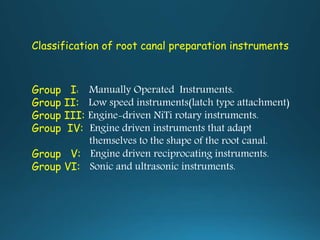
Group I: Manually Operated Instruments.
Group II: Low speed instruments(latch type attachment)
Group III: Engine-driven NiTi rotary instruments.
Group IV: Engine driven instruments that adapt
themselves to the shape of the root canal.
Group V: Engine driven reciprocating instruments.
Group VI: Sonic and ultrasonic instruments.
Classification of root canal preparation instruments
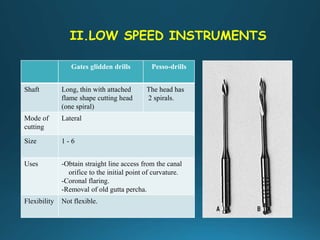
II.LOW SPEED INSTRUMENTS
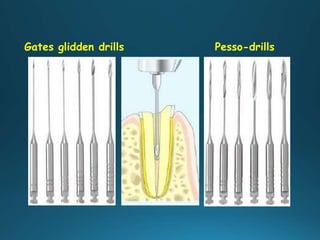
Pesso-drillsGates glidden drills
The head has
2 spirals.
Long, thin with attached
flame shape cutting head
(one spiral)
Shaft
LateralMode of
cutting
1 - 6Size
-Obtain straight line access from the canal
orifice to the initial point of curvature.
-Coronal flaring.
-Removal of old gutta percha.
Uses
Not flexible.Flexibility
Gates glidden drills Pesso-drills
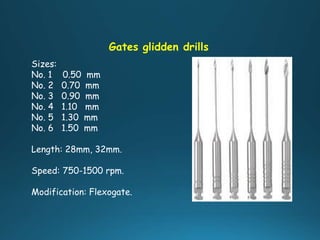
Gates glidden drills
Sizes:
No. 1 0.50 mm
No. 2 0.70 mm
No. 3 0.90 mm
No. 4 1.10 mm
No. 5 1.30 mm
No. 6 1.50 mm
Length: 28mm, 32mm.
Speed: 750-1500 rpm.
Modification: Flexogate.
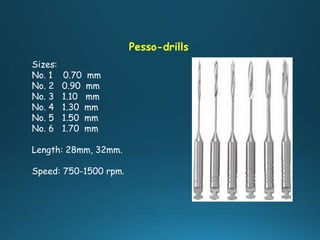
Pesso-drills
Sizes:
No. 1 0.70 mm
No. 2 0.90 mm
No. 3 1.10 mm
No. 4 1.30 mm
No. 5 1.50 mm
No. 6 1.70 mm
Length: 28mm, 32mm.
Speed: 750-1500 rpm.
The preparation of curved root canals requires :
-Flexible instrument.
-Increased cutting efficiency.
-Increased debris loading.
-Decreased procedural mishaps
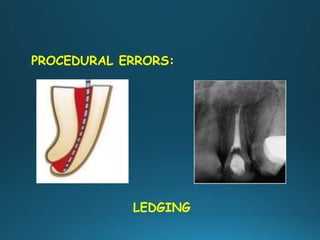
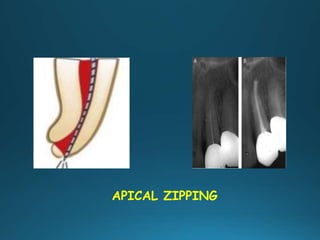
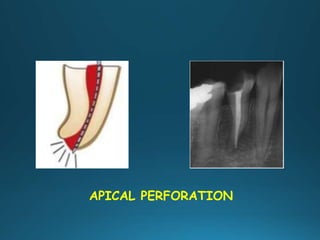
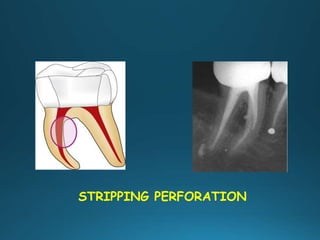
( ledge, apical zipping , perforation ,instrument breakage)
LEDGING
PROCEDURAL ERRORS:
APICAL ZIPPING
APICAL PERFORATION
STRIPPING PERFORATION
Nickel-Titanium Instruments of Root Canal
Preparation:
History of rotary NiTi Endodontics:
1960:WF Buchler first developed NiTi alloy.
1988:Walia et al introduced NiTi in endodontics.
1992:Maillefer introduced Flexogates.
1992:Herbert Schilder introduced Profile 29series.
1996:Buchanan introduced Greater Taper (12%).
2002:McSpadden introduced K3 file system.
2002:Maillefer introduced Protaper universal.
Recent generations : Revo S , Protaper Next,
Wave One , SAF…
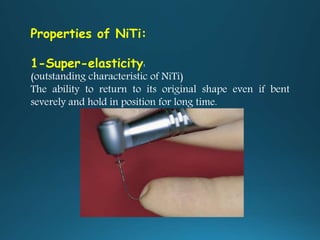
Properties of NiTi:
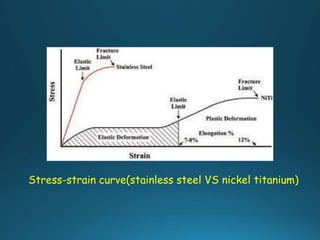
1-Super-elasticity:
(outstanding characteristic of NiTi)
The ability to return to its original shape even if bent
severely and hold in position for long time.
Stress-strain curve(stainless steel VS nickel titanium)
2-LOW CUTTING EFFICIENCY:
SO,
 used in low speed torque control hand piece to perform
complete canal preparation in a reasonable time.
 The surface NiTi file is treated with TITANIUM
NITRIDE to create hard surface & increase cutting
efficiency.
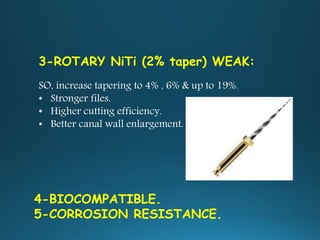
3-ROTARY NiTi (2% taper) WEAK:
SO, increase tapering to 4% , 6% & up to 19%.
• Stronger files.
• Higher cutting efficiency.
• Better canal wall enlargement.
4-BIOCOMPATIBLE.
5-CORROSION RESISTANCE.
Different designs of NiTi instruments of root
canal preparation:
Variation in design includes change in :
1.Taper : The amount of file diameter increase each mm
along its working part from tip to handle.
Importance:
 The ability to determine cross-sectional diameter at a
given point on a file can help the clinician to determine
the file size in the point of curvature and the relative
stress being placed on the instrument.
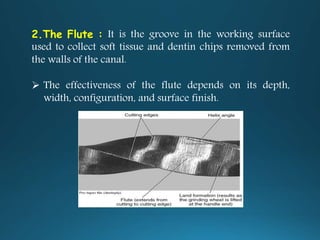
2.The Flute : It is the groove in the working surface
used to collect soft tissue and dentin chips removed from
the walls of the canal.
 The effectiveness of the flute depends on its depth,
width, configuration, and surface finish.
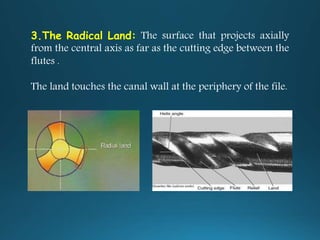
3.The Radical Land: The surface that projects axially
from the central axis as far as the cutting edge between the
flutes .
The land touches the canal wall at the periphery of the file.
Importance of Radical land:
 Reduces the tendency of the file to screw into the canal.
 Maintains the file in the centre of root canal.
 Gives support to the cutting edge & Limits the depth of
cut.
 To decrease frictional resistance from a land , some of
the surface area of the land is reduced to form the relief.
 Wide lands can be very useful in small diameter files as
it increases rigidity and enables the file to negotiate
curvatures when canal enlargement is minimal.
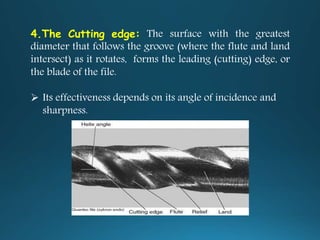
4.The Cutting edge: The surface with the greatest
diameter that follows the groove (where the flute and land
intersect) as it rotates, forms the leading (cutting) edge, or
the blade of the file.
 Its effectiveness depends on its angle of incidence and
sharpness.
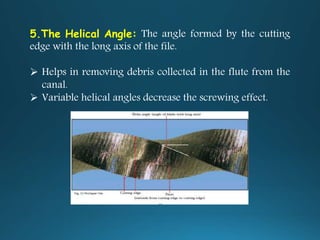
5.The Helical Angle: The angle formed by the cutting
edge with the long axis of the file.
 Helps in removing debris collected in the flute from the
canal.
 Variable helical angles decrease the screwing effect.
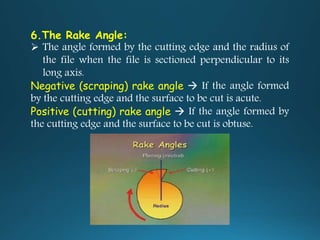
6.The Rake Angle:
 The angle formed by the cutting edge and the radius of
the file when the file is sectioned perpendicular to its
long axis.
Negative (scraping) rake angle  If the angle formed
by the cutting edge and the surface to be cut is acute.
Positive (cutting) rake angle  If the angle formed by
the cutting edge and the surface to be cut is obtuse.
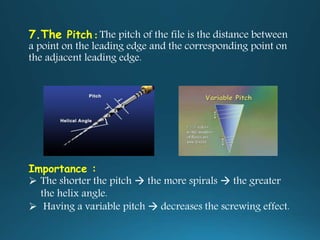
7.The Pitch : The pitch of the file is the distance between
a point on the leading edge and the corresponding point on
the adjacent leading edge.
Importance :
 The shorter the pitch  the more spirals  the greater
the helix angle.
 Having a variable pitch  decreases the screwing effect.
8.Instrument tip (round or non cutting)
Serves as a guide within canal anatomy.
Precisely follows the canal anatomy & minimizes the
risk of transportation , ledging , & zipping of the canal.
Keeps the file centred in the canal  preserve the
natural canal path.
Reduces pushing the debris apically  decreases
patient’s postoperative pain.
Engine-driven NiTi rotary instruments
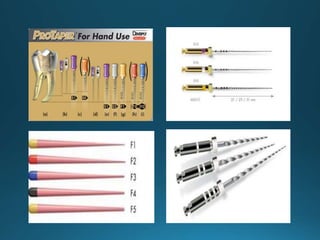
Protaper Universal system
(Gear reduction & Torque control)
Smart motor that is programmed with speed (250-300)
and torque control with an auto reverse feature.
Recently ,a built in apex locator.
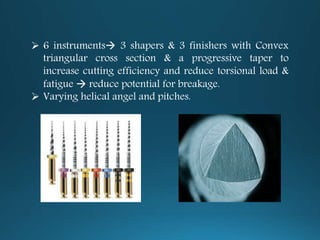
 6 instruments 3 shapers & 3 finishers with Convex
triangular cross section & a progressive taper to
increase cutting efficiency and reduce torsional load &
fatigue  reduce potential for breakage.
 Varying helical angel and pitches.
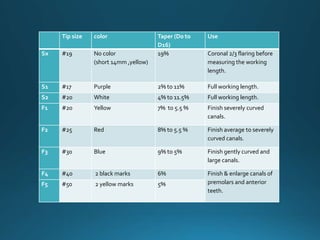
Tip size color Taper (D0 to
D16)
Use
Sx #19 No color
(short 14mm ,yellow)
19% Coronal 2/3 flaring before
measuring the working
length.
S1 #17 Purple 2% to 11% Full working length.
S2 #20 White 4% to 11.5% Full working length.
F1 #20 Yellow 7% to 5.5 % Finish severely curved
canals.
F2 #25 Red 8% to 5.5 % Finish average to severely
curved canals.
F3 #30 Blue 9% to 5% Finish gently curved and
large canals.
F4 #40 2 black marks 6% Finish & enlarge canals of
premolars and anterior
teeth.
F5 #50 2 yellow marks 5%
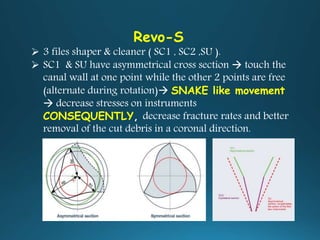
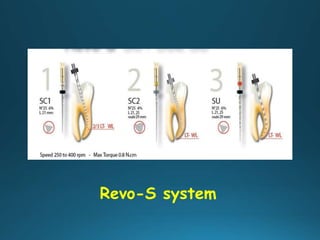
Revo-S
 3 files shaper & cleaner ( SC1 , SC2 ,SU ).
 SC1 & SU have asymmetrical cross section  touch the
canal wall at one point while the other 2 points are free
(alternate during rotation) SNAKE like movement
 decrease stresses on instruments
CONSEQUENTLY, decrease fracture rates and better
removal of the cut debris in a coronal direction.
Revo-S system
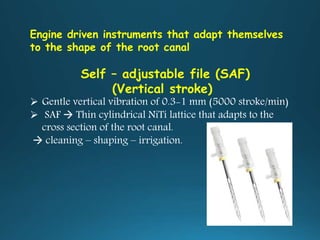
Engine driven instruments that adapt themselves
to the shape of the root canal
Self – adjustable file (SAF)
(Vertical stroke)
 Gentle vertical vibration of 0.3-1 mm (5000 stroke/min)
 SAF  Thin cylindrical NiTi lattice that adapts to the
cross section of the root canal.
 cleaning – shaping – irrigation.
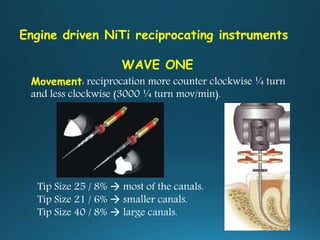
Engine driven NiTi reciprocating instruments
WAVE ONE
Movement: reciprocation more counter clockwise ¼ turn
and less clockwise (3000 ¼ turn mov/min).
Tip Size 25 / 8%  most of the canals.
Tip Size 21 / 6%  smaller canals.
Tip Size 40 / 8%  large canals.
All rotary NiTi files have non cutting pilot tips to avoid
canal ledges, perforations , apical zipping.
NEVER
NEVER exceed the recommended speed & torque.
NEVER push or force the instrument.
NEVER skip sizes.
NEVER work dry.
NEVER exceed the instrument limits.
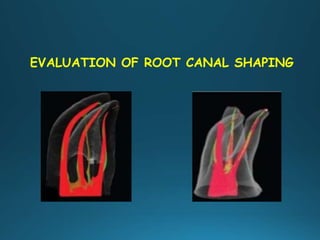
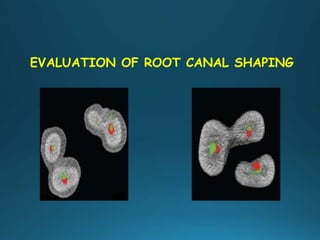
EVALUATION OF ROOT CANAL SHAPING
Advantages of rotary NiTi files:
• Physically effortless.
• Debris are removed easily.
• Canal is enlarges quickly.
• More uniform and smoother canals.
• Less time.
• Faster healing rate.
Disadvantages of rotary NiTi files:
• Lack of tactile sensation.
• Manufacturing defects.
• Expensive.
• Separation of rotary NiTi files.
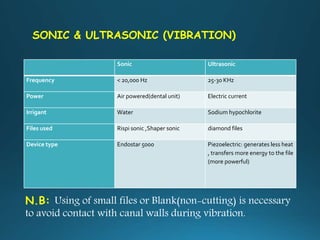
Sonic Ultrasonic
Frequency < 20,000 Hz 25-30 KHz
Power Air powered(dental unit) Electric current
Irrigant Water Sodium hypochlorite
Files used Rispi sonic ,Shaper sonic diamond files
Device type Endostar 5000 Piezoelectric: generates less heat
, transfers more energy to the file
(more powerful)
SONIC & ULTRASONIC (VIBRATION)
N.B: Using of small files or Blank(non-cutting) is necessary
to avoid contact with canal walls during vibration.
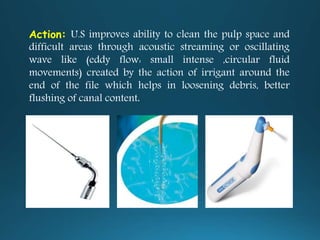
Action: U.S improves ability to clean the pulp space and
difficult areas through acoustic streaming or oscillating
wave like (eddy flow: small intense ,circular fluid
movements) created by the action of irrigant around the
end of the file which helps in loosening debris, better
flushing of canal content.
Advances in the use of U.S :
1. Access refinement, finding calcified canals, removal of
attached pulp stone.
2. Deeping the buccolingual groove overlying the mesio
buccal root, exposes the presence of MB2 canal.
3. Removal of intracanal obstructions
(separated instruments, root canal posts)
4. Increased action of irrigating solutions.
5. U.S condensation of gutta percha & MTA application.
6. Surgical retrograde cavity preparation and filling.
Disadvantages of Ultrasonic:
 Lack of flexibility(shouldn’t be used in curved canals).
 Possibility of instrument fracture.
 Dentin mud formation.
 Very poor shaping.
6. Obturating instruments
Paper points.
Lentulo spiral filler.
Spreaders.
Pluggers .
Gutta percha cones.
Sealer .
RECENT materials & instruments:
Resilion cones.
System B.
Obtura II….etc
Paper points
 To dry and absorb any moisture in the canal.
(i.e. blood, pus and saliva)
 To carry medicaments into the canal.
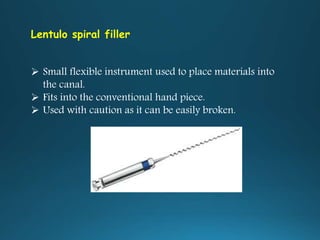
Lentulo spiral filler
 Small flexible instrument used to place materials into
the canal.
 Fits into the conventional hand piece.
 Used with caution as it can be easily broken.
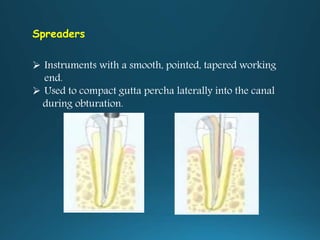
Spreaders
 Instruments with a smooth, pointed, tapered working
end.
 Used to compact gutta percha laterally into the canal
during obturation.
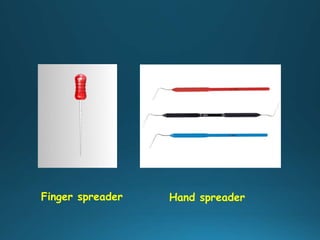
Finger spreader Hand spreader
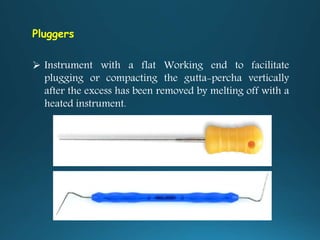
Pluggers
 Instrument with a flat Working end to facilitate
plugging or compacting the gutta-percha vertically
after the excess has been removed by melting off with a
heated instrument.
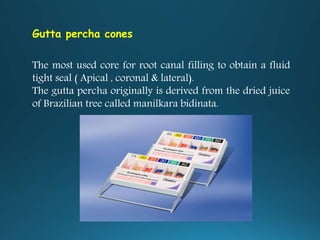
Gutta percha cones
The most used core for root canal filling to obtain a fluid
tight seal ( Apical , coronal & lateral).
The gutta percha originally is derived from the dried juice
of Brazilian tree called manilkara bidinata.
7. Miscellaneous instruments
Rubber dam set for tooth isolation.
Endodontic ruler.
Apex locator.
Root canal irrigation materials & instruments.
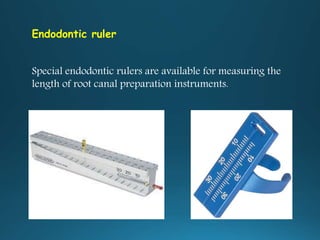
Endodontic ruler
Special endodontic rulers are available for measuring the
length of root canal preparation instruments.
Endodontic instruments 2

Endodontic instruments 2

  • 1.
    Prepared by : DR.Anwar N. Altowaity Endodontic instruments .II
  • 2.
    Group I: ManuallyOperated Instruments. Group II: Low speed instruments(latch type attachment) Group III: Engine-driven NiTi rotary instruments. Group IV: Engine driven instruments that adapt themselves to the shape of the root canal. Group V: Engine driven reciprocating instruments. Group VI: Sonic and ultrasonic instruments. Classification of root canal preparation instruments
  • 3.
    II.LOW SPEED INSTRUMENTS Pesso-drillsGatesglidden drills The head has 2 spirals. Long, thin with attached flame shape cutting head (one spiral) Shaft LateralMode of cutting 1 - 6Size -Obtain straight line access from the canal orifice to the initial point of curvature. -Coronal flaring. -Removal of old gutta percha. Uses Not flexible.Flexibility
  • 4.
  • 5.
    Gates glidden drills Sizes: No.1 0.50 mm No. 2 0.70 mm No. 3 0.90 mm No. 4 1.10 mm No. 5 1.30 mm No. 6 1.50 mm Length: 28mm, 32mm. Speed: 750-1500 rpm. Modification: Flexogate.
  • 6.
    Pesso-drills Sizes: No. 1 0.70mm No. 2 0.90 mm No. 3 1.10 mm No. 4 1.30 mm No. 5 1.50 mm No. 6 1.70 mm Length: 28mm, 32mm. Speed: 750-1500 rpm.
  • 7.
    The preparation ofcurved root canals requires : -Flexible instrument. -Increased cutting efficiency. -Increased debris loading. -Decreased procedural mishaps ( ledge, apical zipping , perforation ,instrument breakage)
  • 8.
  • 9.
  • 10.
  • 11.
  • 12.
    Nickel-Titanium Instruments ofRoot Canal Preparation: History of rotary NiTi Endodontics: 1960:WF Buchler first developed NiTi alloy. 1988:Walia et al introduced NiTi in endodontics. 1992:Maillefer introduced Flexogates. 1992:Herbert Schilder introduced Profile 29series. 1996:Buchanan introduced Greater Taper (12%). 2002:McSpadden introduced K3 file system. 2002:Maillefer introduced Protaper universal. Recent generations : Revo S , Protaper Next, Wave One , SAF…

  • 13.
    Properties of NiTi: 1-Super-elasticity: (outstandingcharacteristic of NiTi) The ability to return to its original shape even if bent severely and hold in position for long time.
  • 14.
  • 15.
    2-LOW CUTTING EFFICIENCY: SO, used in low speed torque control hand piece to perform complete canal preparation in a reasonable time.  The surface NiTi file is treated with TITANIUM NITRIDE to create hard surface & increase cutting efficiency.
  • 16.
    3-ROTARY NiTi (2%taper) WEAK: SO, increase tapering to 4% , 6% & up to 19%. • Stronger files. • Higher cutting efficiency. • Better canal wall enlargement. 4-BIOCOMPATIBLE. 5-CORROSION RESISTANCE.
  • 17.
    Different designs ofNiTi instruments of root canal preparation: Variation in design includes change in : 1.Taper : The amount of file diameter increase each mm along its working part from tip to handle. Importance:  The ability to determine cross-sectional diameter at a given point on a file can help the clinician to determine the file size in the point of curvature and the relative stress being placed on the instrument.
  • 18.
    2.The Flute :It is the groove in the working surface used to collect soft tissue and dentin chips removed from the walls of the canal.  The effectiveness of the flute depends on its depth, width, configuration, and surface finish.
  • 19.
    3.The Radical Land:The surface that projects axially from the central axis as far as the cutting edge between the flutes . The land touches the canal wall at the periphery of the file.
  • 20.
    Importance of Radicalland:  Reduces the tendency of the file to screw into the canal.  Maintains the file in the centre of root canal.  Gives support to the cutting edge & Limits the depth of cut.  To decrease frictional resistance from a land , some of the surface area of the land is reduced to form the relief.  Wide lands can be very useful in small diameter files as it increases rigidity and enables the file to negotiate curvatures when canal enlargement is minimal.
  • 21.
    4.The Cutting edge:The surface with the greatest diameter that follows the groove (where the flute and land intersect) as it rotates, forms the leading (cutting) edge, or the blade of the file.  Its effectiveness depends on its angle of incidence and sharpness.
  • 22.
    5.The Helical Angle:The angle formed by the cutting edge with the long axis of the file.  Helps in removing debris collected in the flute from the canal.  Variable helical angles decrease the screwing effect.
  • 23.
    6.The Rake Angle: The angle formed by the cutting edge and the radius of the file when the file is sectioned perpendicular to its long axis. Negative (scraping) rake angle  If the angle formed by the cutting edge and the surface to be cut is acute. Positive (cutting) rake angle  If the angle formed by the cutting edge and the surface to be cut is obtuse.
  • 24.
    7.The Pitch :The pitch of the file is the distance between a point on the leading edge and the corresponding point on the adjacent leading edge. Importance :  The shorter the pitch  the more spirals  the greater the helix angle.  Having a variable pitch  decreases the screwing effect.
  • 25.
    8.Instrument tip (roundor non cutting) Serves as a guide within canal anatomy. Precisely follows the canal anatomy & minimizes the risk of transportation , ledging , & zipping of the canal. Keeps the file centred in the canal  preserve the natural canal path. Reduces pushing the debris apically  decreases patient’s postoperative pain.
  • 26.
    Engine-driven NiTi rotaryinstruments Protaper Universal system (Gear reduction & Torque control) Smart motor that is programmed with speed (250-300) and torque control with an auto reverse feature. Recently ,a built in apex locator.
  • 27.
     6 instruments3 shapers & 3 finishers with Convex triangular cross section & a progressive taper to increase cutting efficiency and reduce torsional load & fatigue  reduce potential for breakage.  Varying helical angel and pitches.
  • 28.
    Tip size colorTaper (D0 to D16) Use Sx #19 No color (short 14mm ,yellow) 19% Coronal 2/3 flaring before measuring the working length. S1 #17 Purple 2% to 11% Full working length. S2 #20 White 4% to 11.5% Full working length. F1 #20 Yellow 7% to 5.5 % Finish severely curved canals. F2 #25 Red 8% to 5.5 % Finish average to severely curved canals. F3 #30 Blue 9% to 5% Finish gently curved and large canals. F4 #40 2 black marks 6% Finish & enlarge canals of premolars and anterior teeth. F5 #50 2 yellow marks 5%
  • 30.
    Revo-S  3 filesshaper & cleaner ( SC1 , SC2 ,SU ).  SC1 & SU have asymmetrical cross section  touch the canal wall at one point while the other 2 points are free (alternate during rotation) SNAKE like movement  decrease stresses on instruments CONSEQUENTLY, decrease fracture rates and better removal of the cut debris in a coronal direction.
  • 31.
  • 32.
    Engine driven instrumentsthat adapt themselves to the shape of the root canal Self – adjustable file (SAF) (Vertical stroke)  Gentle vertical vibration of 0.3-1 mm (5000 stroke/min)  SAF  Thin cylindrical NiTi lattice that adapts to the cross section of the root canal.  cleaning – shaping – irrigation.
  • 33.
    Engine driven NiTireciprocating instruments WAVE ONE Movement: reciprocation more counter clockwise ¼ turn and less clockwise (3000 ¼ turn mov/min). Tip Size 25 / 8%  most of the canals. Tip Size 21 / 6%  smaller canals. Tip Size 40 / 8%  large canals.
  • 34.
    All rotary NiTifiles have non cutting pilot tips to avoid canal ledges, perforations , apical zipping. NEVER NEVER exceed the recommended speed & torque. NEVER push or force the instrument. NEVER skip sizes. NEVER work dry. NEVER exceed the instrument limits.
  • 35.
    EVALUATION OF ROOTCANAL SHAPING
  • 36.
    EVALUATION OF ROOTCANAL SHAPING
  • 37.
    Advantages of rotaryNiTi files: • Physically effortless. • Debris are removed easily. • Canal is enlarges quickly. • More uniform and smoother canals. • Less time. • Faster healing rate.
  • 38.
    Disadvantages of rotaryNiTi files: • Lack of tactile sensation. • Manufacturing defects. • Expensive. • Separation of rotary NiTi files.
  • 39.
    Sonic Ultrasonic Frequency <20,000 Hz 25-30 KHz Power Air powered(dental unit) Electric current Irrigant Water Sodium hypochlorite Files used Rispi sonic ,Shaper sonic diamond files Device type Endostar 5000 Piezoelectric: generates less heat , transfers more energy to the file (more powerful) SONIC & ULTRASONIC (VIBRATION) N.B: Using of small files or Blank(non-cutting) is necessary to avoid contact with canal walls during vibration.
  • 40.
    Action: U.S improvesability to clean the pulp space and difficult areas through acoustic streaming or oscillating wave like (eddy flow: small intense ,circular fluid movements) created by the action of irrigant around the end of the file which helps in loosening debris, better flushing of canal content.
  • 41.
    Advances in theuse of U.S : 1. Access refinement, finding calcified canals, removal of attached pulp stone. 2. Deeping the buccolingual groove overlying the mesio buccal root, exposes the presence of MB2 canal. 3. Removal of intracanal obstructions (separated instruments, root canal posts) 4. Increased action of irrigating solutions. 5. U.S condensation of gutta percha & MTA application. 6. Surgical retrograde cavity preparation and filling.
  • 42.
    Disadvantages of Ultrasonic: Lack of flexibility(shouldn’t be used in curved canals).  Possibility of instrument fracture.  Dentin mud formation.  Very poor shaping.
  • 43.
    6. Obturating instruments Paperpoints. Lentulo spiral filler. Spreaders. Pluggers . Gutta percha cones. Sealer . RECENT materials & instruments: Resilion cones. System B. Obtura II….etc
  • 44.
    Paper points  Todry and absorb any moisture in the canal. (i.e. blood, pus and saliva)  To carry medicaments into the canal.
  • 45.
    Lentulo spiral filler Small flexible instrument used to place materials into the canal.  Fits into the conventional hand piece.  Used with caution as it can be easily broken.
  • 46.
    Spreaders  Instruments witha smooth, pointed, tapered working end.  Used to compact gutta percha laterally into the canal during obturation.
  • 47.
  • 48.
    Pluggers  Instrument witha flat Working end to facilitate plugging or compacting the gutta-percha vertically after the excess has been removed by melting off with a heated instrument.
  • 49.
    Gutta percha cones Themost used core for root canal filling to obtain a fluid tight seal ( Apical , coronal & lateral). The gutta percha originally is derived from the dried juice of Brazilian tree called manilkara bidinata.
  • 50.
    7. Miscellaneous instruments Rubberdam set for tooth isolation. Endodontic ruler. Apex locator. Root canal irrigation materials & instruments.
  • 51.
    Endodontic ruler Special endodonticrulers are available for measuring the length of root canal preparation instruments.