Careers and Employability Centre
NHS STP
Scientist Training Programme
Application Briefing
Today’s session
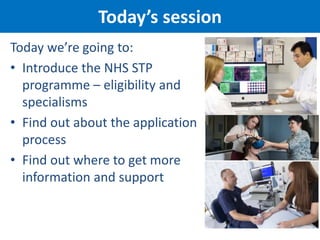
Today we’re going to:
• Introduce the NHS STP
programme – eligibility and
specialisms
• Find out about the application
process
• Find out where to get more
information and support
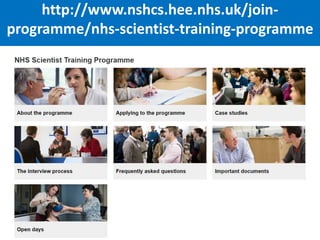
http://www.nshcs.hee.nhs.uk/join-
programme/nhs-scientist-training-programme
What is the STP?
The STP is a 3-year graduate-entry work-based training
programme, leading to senior scientist roles.
What the STP offers
• STP is a combined work (2/3) and training (1/3)
programme:
– Training leads to a specifically commissioned and
accredited master's degree from a University.
– Work programme leads to certification of achievement of
work-based training in 1 of several pathways.
• Employment in an NHS trust for the duration of your
training.
• STP trainees are paid a salary while training (circa £25K)
Eligibility – direct entry
• You must have an honours degree (1st or
2:1) in a pure or applied science area
relevant to the specialism you are
interested in.
• If you achieved a 2:2 in your degree, you
would be considered if you also have an
MSc or PhD in the specialism you wish to
apply for.
• Evidence of research experience in the
form of a higher degree or equivalent
evidence of a scientific/academic basis is
desirable.
Specific eligibility and accepted qualifications for each
specialism is on the Health Careers website.
STP Timeline
• Application window in Jan/Feb 2017 (dates to be
announced – keep checking website)
• Online Test
• Interview
• Sept 2017 start
• You can apply for more than one specialism
(max 2)
• You can apply for multiple employers/locations
for your preferred subject.
STP Timeline
Specialism themes
• Audiology
• Cardiac Science
• Clinical Biochemistry
• Clinical Bioinformatics (Genomics)
• Clinical Bioinformatics (Health
Informatics)
• Clinical Bioinformatics (Physical Sciences)
• Clinical Engineering including:
Rehabilitation Engineering, Clinical
Measurement and Development and
Device Risk Management and
Governance
• Clinical Immunology
• Clinical Microbiology
• Clinical Pharmaceutical Science
• Critical Care Science (not available in
2016)
• Cytopathology (not available in 2016)
• Gastrointestinal Physiology
• Genomics (formerly Genetics)
• Genomic Counselling (formerly
Genetic Counselling)
• Haematology and Transfusion Science
• Histocompatibility and
Immunogenetics
• Histopathology
• Medical Physics including: Imaging
with Ionising Radiation, Imaging Non
Ionising Radiation, Radiation Safety
Physics and Radiotherapy Physics
• Neurophysiology
• Ophthalmic and Vision Science (not
available in 2016)
• Reconstructive Science (not available
in 2016)
• Reproductive Science
• Respiratory and Sleep Sciences
• Urodynamic Science
• Vascular Science
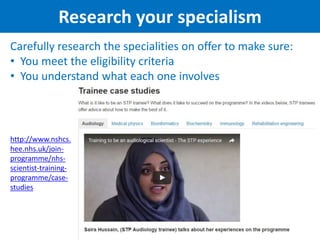
Research your specialism
Carefully research the specialities on offer to make sure:
• You meet the eligibility criteria
• You understand what each one involves
http://www.nshcs.
hee.nhs.uk/join-
programme/nhs-
scientist-training-
programme/case-
studies
STP TimelineFurther information
• Use the website National School for Healthcare
Science’s website:
http://www.nshcs.org.uk/stp-recruitment
• Candidates can follow the School on Twitter
@NSHCS
• Also look at the NHS Careers Website:
http://www.nhscareers.nhs.uk/explore-by-
career/healthcare-science/education-and-training/nhs-
scientist-training-programme-(stp)/
STP Timeline Open days
Application information
www.nshcs.org.uk @NSHCS @NHS_HealthEdEng
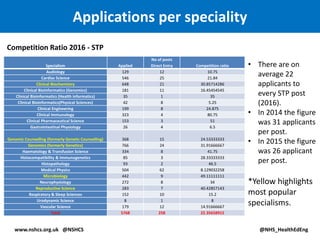
Competition Ratio 2016 - STP
Specialism Applied
No of posts
Direct Entry Competition ratio
Audiology 129 12 10.75
Cardiac Science 546 25 21.84
Clinical Biochemistry 648 21 30.85714286
Clinical Bioinformatics (Genomics) 181 11 16.45454545
Clinical Bioinformatics (Health informatics) 35 1 35
Clinical Bioinformatics(Physical Sciences) 42 8 5.25
Clinical Engineering 199 8 24.875
Clinical Immunology 323 4 80.75
Clinical Pharmaceutical Science 153 3 51
Gastrointestinal Physiology 26 4 6.5
Genomic Counselling (formerly Genetic Counselling) 368 15 24.53333333
Genomics (formerly Genetics) 766 24 31.91666667
Haematology & Transfusion Science 334 8 41.75
Histocompatibility & Immunogenetics 85 3 28.33333333
Histopathology 93 2 46.5
Medical Physics 504 62 8.129032258
Microbiology 442 9 49.11111111
Neurophysiology 272 8 34
Reproductive Science 283 7 40.42857143
Respiratory & Sleep Sciences 152 10 15.2
Urodynamic Science 8 1 8
Vascular Science 179 12 14.91666667
Total 5768 258 22.35658915
• There are on
average 22
applicants to
every STP post
(2016).
• In 2014 the figure
was 31 applicants
per post.
• In 2015 the figure
was 26 applicant
per post.
*Yellow highlights
most popular
specialisms.
Applications per speciality
• University of Manchester careers blog
http://manunicareersblog.com/2016/01/27/applyin
g-for-the-nhs-scientist-training-programme-2016/
(Note – application deadlines for last year, but application tips relevant)
• http://www.nshcs.hee.nhs.uk/join-programme/nhs-
scientist-training-programme/applying-to-the-
programme
Useful sites for application info
STP TimelineOnline application form
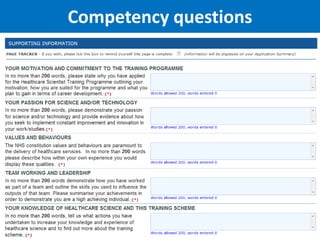
Competency QuestionsCompetency questions
Essay / Competency Questions
1. YOUR KNOWLEDGE, MOTIVATION AND
COMMITMENT TO THE TRAINING PROGRAMME
In less than 250 words, please state why you have
applied for the Healthcare Scientist Training
Programme. Give details of your motivation,
suitability and future career development or
aspirations. Describe what actions you have
undertaken to increase your knowledge, experience
and understanding of healthcare science and the
training programme for your chosen specialism(s).
Essay / competency questions
2. YOUR COMMITMENT TO HEALTHCARE
SCIENCE AND TECHNOLOGY
In less than 250 words, please describe your
commitment, interest and enjoyment of
scientific practice and technology. Please
provide examples of how you seek to develop,
improve and adopt innovative processes in your
work or studies.
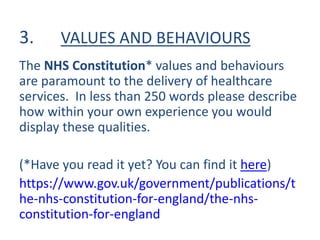
3. VALUES AND BEHAVIOURS
The NHS Constitution* values and behaviours
are paramount to the delivery of healthcare
services. In less than 250 words please describe
how within your own experience you would
display these qualities.
(*Have you read it yet? You can find it here)
https://www.gov.uk/government/publications/t
he-nhs-constitution-for-england/the-nhs-
constitution-for-england
4. TEAM WORKING AND LEADERSHIP
In less than 250 words describe occasions where
you have worked as part of a team and outline
the skills you used to benefit the outputs of that
team. Also*, please describe a situation or
situations when you have taken the opportunity
to lead others and identify how you managed
any challenges that arose.
How to evidence your experience
 Make connections between what you have done and
what the role expects / requires
 Focus on your role in the examples & evidence you give
 End on your achievements
 Make sure you answer the question
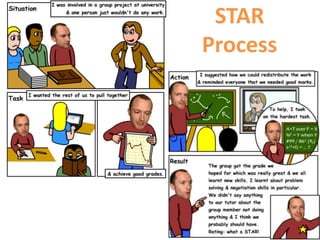
 Use STAR…….
STAR
Process
Online Tests
• Once you’ve submitted your application you will be
sent detail on how to access and complete the online
aptitude tests.
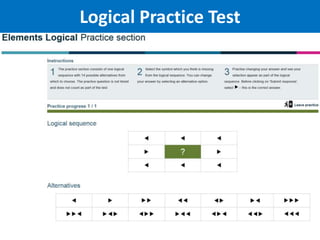
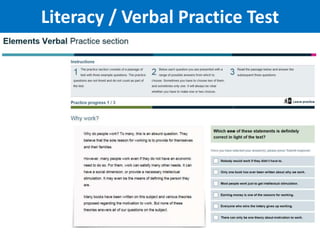
• Numerical and Logical reasoning aptitude tests using
an automated online system.
• Once an online test is started it must be completed
you only have one opportunity.
• If an applicant fails the tests they cannot proceed with
their application.
• All tests must be completed within the application
window identified in order for the results to count.
Online tests
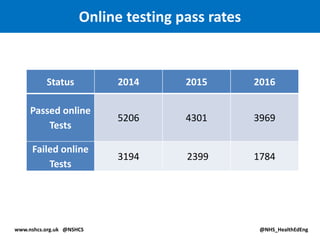
@NHS_HealthEdEngwww.nshcs.org.uk @NSHCS
Status 2014 2015 2016
Passed online
Tests
5206 4301 3969
Failed online
Tests
3194 2399 1784
Online testing pass rates
Practice, Practice, Practice
For Practice tests go to:
• Careers Employability Centre Wider Practice links:
http://www.sussex.ac.uk/careers/jobs/applyingforjobs/selecti
ontests
• The actual link the NHS provide for Practice
www.trytalentq.com
Any applicant who requires extra time to complete the
online tests will need to send evidence to
hcsapplicants@wm.hee.nhs.uk at least 3 working days
before the application window for the aptitude tests is
due to close.
Numerical Practice Test
Logical Practice Test
Literacy / Verbal Practice Test
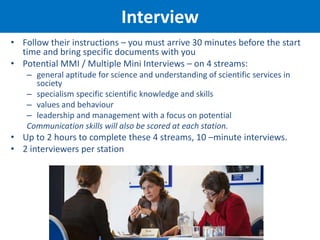
Interview
• Follow their instructions – you must arrive 30 minutes before the start
time and bring specific documents with you
• Potential MMI / Multiple Mini Interviews – on 4 streams:
– general aptitude for science and understanding of scientific services in
society
– specialism specific scientific knowledge and skills
– values and behaviour
– leadership and management with a focus on potential
Communication skills will also be scored at each station.
• Up to 2 hours to complete these 4 streams, 10 –minute interviews.
• 2 interviewers per station
• Another info session:
• Thurs Dec 8 or intersessional week
• NHS scientist
• submit questions to careers@sussex.ac.uk
• Check the NHS STP website
• Check our website www.sussex.ac.uk/careers
• Book a one-to-one with a Careers Adviser
Need more help?

NHS STP Scientist Training Programme - Application Briefing

  • 1.
    Careers and EmployabilityCentre NHS STP Scientist Training Programme Application Briefing
  • 2.
    Today’s session Today we’regoing to: • Introduce the NHS STP programme – eligibility and specialisms • Find out about the application process • Find out where to get more information and support
  • 3.
  • 4.
    What is theSTP? The STP is a 3-year graduate-entry work-based training programme, leading to senior scientist roles. What the STP offers • STP is a combined work (2/3) and training (1/3) programme: – Training leads to a specifically commissioned and accredited master's degree from a University. – Work programme leads to certification of achievement of work-based training in 1 of several pathways. • Employment in an NHS trust for the duration of your training. • STP trainees are paid a salary while training (circa £25K)
  • 5.
    Eligibility – directentry • You must have an honours degree (1st or 2:1) in a pure or applied science area relevant to the specialism you are interested in. • If you achieved a 2:2 in your degree, you would be considered if you also have an MSc or PhD in the specialism you wish to apply for. • Evidence of research experience in the form of a higher degree or equivalent evidence of a scientific/academic basis is desirable. Specific eligibility and accepted qualifications for each specialism is on the Health Careers website.
  • 6.
    STP Timeline • Applicationwindow in Jan/Feb 2017 (dates to be announced – keep checking website) • Online Test • Interview • Sept 2017 start • You can apply for more than one specialism (max 2) • You can apply for multiple employers/locations for your preferred subject. STP Timeline
  • 7.
    Specialism themes • Audiology •Cardiac Science • Clinical Biochemistry • Clinical Bioinformatics (Genomics) • Clinical Bioinformatics (Health Informatics) • Clinical Bioinformatics (Physical Sciences) • Clinical Engineering including: Rehabilitation Engineering, Clinical Measurement and Development and Device Risk Management and Governance • Clinical Immunology • Clinical Microbiology • Clinical Pharmaceutical Science • Critical Care Science (not available in 2016) • Cytopathology (not available in 2016) • Gastrointestinal Physiology • Genomics (formerly Genetics) • Genomic Counselling (formerly Genetic Counselling) • Haematology and Transfusion Science • Histocompatibility and Immunogenetics • Histopathology • Medical Physics including: Imaging with Ionising Radiation, Imaging Non Ionising Radiation, Radiation Safety Physics and Radiotherapy Physics • Neurophysiology • Ophthalmic and Vision Science (not available in 2016) • Reconstructive Science (not available in 2016) • Reproductive Science • Respiratory and Sleep Sciences • Urodynamic Science • Vascular Science
  • 8.
    Research your specialism Carefullyresearch the specialities on offer to make sure: • You meet the eligibility criteria • You understand what each one involves http://www.nshcs. hee.nhs.uk/join- programme/nhs- scientist-training- programme/case- studies
  • 9.
    STP TimelineFurther information •Use the website National School for Healthcare Science’s website: http://www.nshcs.org.uk/stp-recruitment • Candidates can follow the School on Twitter @NSHCS • Also look at the NHS Careers Website: http://www.nhscareers.nhs.uk/explore-by- career/healthcare-science/education-and-training/nhs- scientist-training-programme-(stp)/
  • 10.
  • 11.
  • 12.
    www.nshcs.org.uk @NSHCS @NHS_HealthEdEng CompetitionRatio 2016 - STP Specialism Applied No of posts Direct Entry Competition ratio Audiology 129 12 10.75 Cardiac Science 546 25 21.84 Clinical Biochemistry 648 21 30.85714286 Clinical Bioinformatics (Genomics) 181 11 16.45454545 Clinical Bioinformatics (Health informatics) 35 1 35 Clinical Bioinformatics(Physical Sciences) 42 8 5.25 Clinical Engineering 199 8 24.875 Clinical Immunology 323 4 80.75 Clinical Pharmaceutical Science 153 3 51 Gastrointestinal Physiology 26 4 6.5 Genomic Counselling (formerly Genetic Counselling) 368 15 24.53333333 Genomics (formerly Genetics) 766 24 31.91666667 Haematology & Transfusion Science 334 8 41.75 Histocompatibility & Immunogenetics 85 3 28.33333333 Histopathology 93 2 46.5 Medical Physics 504 62 8.129032258 Microbiology 442 9 49.11111111 Neurophysiology 272 8 34 Reproductive Science 283 7 40.42857143 Respiratory & Sleep Sciences 152 10 15.2 Urodynamic Science 8 1 8 Vascular Science 179 12 14.91666667 Total 5768 258 22.35658915 • There are on average 22 applicants to every STP post (2016). • In 2014 the figure was 31 applicants per post. • In 2015 the figure was 26 applicant per post. *Yellow highlights most popular specialisms. Applications per speciality
  • 13.
    • University ofManchester careers blog http://manunicareersblog.com/2016/01/27/applyin g-for-the-nhs-scientist-training-programme-2016/ (Note – application deadlines for last year, but application tips relevant) • http://www.nshcs.hee.nhs.uk/join-programme/nhs- scientist-training-programme/applying-to-the- programme Useful sites for application info
  • 14.
  • 15.
  • 16.
    Essay / CompetencyQuestions 1. YOUR KNOWLEDGE, MOTIVATION AND COMMITMENT TO THE TRAINING PROGRAMME In less than 250 words, please state why you have applied for the Healthcare Scientist Training Programme. Give details of your motivation, suitability and future career development or aspirations. Describe what actions you have undertaken to increase your knowledge, experience and understanding of healthcare science and the training programme for your chosen specialism(s). Essay / competency questions
  • 17.
    2. YOUR COMMITMENTTO HEALTHCARE SCIENCE AND TECHNOLOGY In less than 250 words, please describe your commitment, interest and enjoyment of scientific practice and technology. Please provide examples of how you seek to develop, improve and adopt innovative processes in your work or studies.
  • 18.
    3. VALUES ANDBEHAVIOURS The NHS Constitution* values and behaviours are paramount to the delivery of healthcare services. In less than 250 words please describe how within your own experience you would display these qualities. (*Have you read it yet? You can find it here) https://www.gov.uk/government/publications/t he-nhs-constitution-for-england/the-nhs- constitution-for-england
  • 19.
    4. TEAM WORKINGAND LEADERSHIP In less than 250 words describe occasions where you have worked as part of a team and outline the skills you used to benefit the outputs of that team. Also*, please describe a situation or situations when you have taken the opportunity to lead others and identify how you managed any challenges that arose.
  • 20.
    How to evidenceyour experience  Make connections between what you have done and what the role expects / requires  Focus on your role in the examples & evidence you give  End on your achievements  Make sure you answer the question  Use STAR…….
  • 21.
  • 22.
    Online Tests • Onceyou’ve submitted your application you will be sent detail on how to access and complete the online aptitude tests. • Numerical and Logical reasoning aptitude tests using an automated online system. • Once an online test is started it must be completed you only have one opportunity. • If an applicant fails the tests they cannot proceed with their application. • All tests must be completed within the application window identified in order for the results to count. Online tests
  • 23.
    @NHS_HealthEdEngwww.nshcs.org.uk @NSHCS Status 20142015 2016 Passed online Tests 5206 4301 3969 Failed online Tests 3194 2399 1784 Online testing pass rates
  • 24.
    Practice, Practice, Practice ForPractice tests go to: • Careers Employability Centre Wider Practice links: http://www.sussex.ac.uk/careers/jobs/applyingforjobs/selecti ontests • The actual link the NHS provide for Practice www.trytalentq.com Any applicant who requires extra time to complete the online tests will need to send evidence to hcsapplicants@wm.hee.nhs.uk at least 3 working days before the application window for the aptitude tests is due to close.
  • 25.
  • 26.
  • 27.
    Literacy / VerbalPractice Test
  • 28.
    Interview • Follow theirinstructions – you must arrive 30 minutes before the start time and bring specific documents with you • Potential MMI / Multiple Mini Interviews – on 4 streams: – general aptitude for science and understanding of scientific services in society – specialism specific scientific knowledge and skills – values and behaviour – leadership and management with a focus on potential Communication skills will also be scored at each station. • Up to 2 hours to complete these 4 streams, 10 –minute interviews. • 2 interviewers per station
  • 29.
    • Another infosession: • Thurs Dec 8 or intersessional week • NHS scientist • submit questions to careers@sussex.ac.uk • Check the NHS STP website • Check our website www.sussex.ac.uk/careers • Book a one-to-one with a Careers Adviser Need more help?