NGN Architecture
Overview
IT-607
INSTRUCTOR: WAQAS AHMAD
1
Outline
Introduction
Use Cases for Next-Generation Networks
NGN Architecture Overview
oTransport Stratum Functions
oService Stratum Functions
oManagement Functions
oEnd-User Functions
Summary
2
Introduction
In July 2003, ITU-T organized a NGN workshop.
In considering the results of this workshop, ITU-T Study Group 13
launched an NGN Joint Rapporteur Group (NGN-JRG).
The NGN-JRG identified key issues and developed fundamental
standards for building the frameworks of an NGN.
Recommendations Y.2001 and Y.2011 are the results, and are now
the basis for NGN studies in ITU-T.
3
ITU-T: International Telecommunication Union-Telecommunication Standardization Sector
Introduction
In parallel with the ITU-T initiatives, several standards organizations
initiated their plans for NGN standards.
Possible incompatibilities among future NGN standards.
After consulting ETSI and other organizations, ITU-T launched its
Focus Group on NGN (FGNGN) in June 2004.
This Focus Group was required to coordinate all aspects of NGN
studies.
4
ITU-T: International Telecommunication Union-Telecommunication Standardization Sector
Key Aspects
Access to common services across multiple types of access
networks.
Coordination of multiple types of communications from a common
control point in the network.
5
The Definition of an NGN
Next-Generation Network (NGN):
“A packet-based network able to provide telecommunication services
and able to make use of multiple broadband QoS-enabled transport
technologies and in which service-related functions are independent
from underlying transport-related technologies.”
6
The Definition of an NGN
It enables unfettered access for users to networks and competing
service providers and/or services of their choice.
It supports generalized mobility that will allow consistent and
ubiquitous provision of services to users.
7
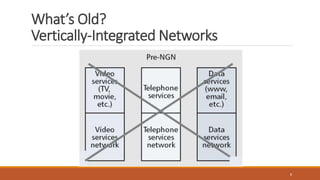
What’s Old?
Vertically-Integrated Networks
8
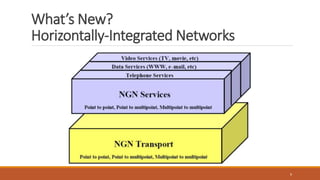
What’s New?
Horizontally-Integrated Networks
9
NGN Architecture Overview
 The NGN functions are divided into service and transport strata.
 End-user functions are connected to the NGN by the user-to-
network interface(UNI).
 Other networks are interconnected through the network-to-
network interface (NNI).
The application-to-network interface (ANI) forms a boundary with
respect to third party application providers.
10
Transport Stratum Functions
Transport stratum provide IP connectivity for all
components within the NGN.
It is responsible for providing end-to-end QoS.
It is divided into access networks and the core network.
11
Transport Stratum Functions
Access Functions
Manage end-user access to the network.
They are access-technology-dependent.
Manage end-user access to the network.
They are access-technology-dependent.
Access Transport Functions
They are responsible for transporting information across the access network.
Also provide QoS control mechanisms.
12
Transport Stratum Functions
Edge Functions
They are used for traffic processing when access traffic is merged into
the core network.
Core Transport Functions
They are responsible for transporting information throughout the core
network.
Also provide QoS control mechanisms.
13
Transport Stratum Functions
Resource and Admission Control Functions (RACF)
Provide admission control and gate control functionalities.
Admission control involves checking authentication and authorization.
Network Attachment Control Functions
Provide initialization of end-user functions for accessing NGN services.
Assist end-user equipment in registering and starting use of the NGN.
14
Transport Stratum Functions
Transport User Profile Functions
Represents the compilation of user and other control data.
May be specified and implemented as a set of cooperating databases.
Gateway Functions
Provide capabilities to interwork with other networks.
Media Handling Functions
They are media resource processes for providing services.
15
Service Stratum Functions
 These functions provide session-based and non-session based
services.
 Session-based services:
IP Telephony, videoconferencing, and video chatting.
 Non-session based services:
Video streaming and broadcasting.
16
Service Stratum Functions
 Service and Control Functions
Include session control functions, a registration function, and
authentication and authorization functions at the service level.
Service User Profile Functions
Represents the compilation of user and other control data.
May be specified and implemented as a set of cooperating databases.
Application Functions
NGN support open APls enabling third-party service providers to
create enhanced services.
17
Summary
 One of the important key features of the NGN is the separation
between different functionalities.
 Horizontally, the NGN is broken down into three sections:
Customer equipment, network equipment, and interconnection with
other networks.
Vertically, the NGN is separated into two areas:
 The service stratum and the transport stratum.
The NGN is no longer a next generation objective, but is becoming a
present generation reality.
18
THANK YOU
19

Lecture-2 NGN Architecture.pptx

  • 1.
  • 2.
    Outline Introduction Use Cases forNext-Generation Networks NGN Architecture Overview oTransport Stratum Functions oService Stratum Functions oManagement Functions oEnd-User Functions Summary 2
  • 3.
    Introduction In July 2003,ITU-T organized a NGN workshop. In considering the results of this workshop, ITU-T Study Group 13 launched an NGN Joint Rapporteur Group (NGN-JRG). The NGN-JRG identified key issues and developed fundamental standards for building the frameworks of an NGN. Recommendations Y.2001 and Y.2011 are the results, and are now the basis for NGN studies in ITU-T. 3 ITU-T: International Telecommunication Union-Telecommunication Standardization Sector
  • 4.
    Introduction In parallel withthe ITU-T initiatives, several standards organizations initiated their plans for NGN standards. Possible incompatibilities among future NGN standards. After consulting ETSI and other organizations, ITU-T launched its Focus Group on NGN (FGNGN) in June 2004. This Focus Group was required to coordinate all aspects of NGN studies. 4 ITU-T: International Telecommunication Union-Telecommunication Standardization Sector
  • 5.
    Key Aspects Access tocommon services across multiple types of access networks. Coordination of multiple types of communications from a common control point in the network. 5
  • 6.
    The Definition ofan NGN Next-Generation Network (NGN): “A packet-based network able to provide telecommunication services and able to make use of multiple broadband QoS-enabled transport technologies and in which service-related functions are independent from underlying transport-related technologies.” 6
  • 7.
    The Definition ofan NGN It enables unfettered access for users to networks and competing service providers and/or services of their choice. It supports generalized mobility that will allow consistent and ubiquitous provision of services to users. 7
  • 8.
  • 9.
  • 10.
    NGN Architecture Overview The NGN functions are divided into service and transport strata.  End-user functions are connected to the NGN by the user-to- network interface(UNI).  Other networks are interconnected through the network-to- network interface (NNI). The application-to-network interface (ANI) forms a boundary with respect to third party application providers. 10
  • 11.
    Transport Stratum Functions Transportstratum provide IP connectivity for all components within the NGN. It is responsible for providing end-to-end QoS. It is divided into access networks and the core network. 11
  • 12.
    Transport Stratum Functions AccessFunctions Manage end-user access to the network. They are access-technology-dependent. Manage end-user access to the network. They are access-technology-dependent. Access Transport Functions They are responsible for transporting information across the access network. Also provide QoS control mechanisms. 12
  • 13.
    Transport Stratum Functions EdgeFunctions They are used for traffic processing when access traffic is merged into the core network. Core Transport Functions They are responsible for transporting information throughout the core network. Also provide QoS control mechanisms. 13
  • 14.
    Transport Stratum Functions Resourceand Admission Control Functions (RACF) Provide admission control and gate control functionalities. Admission control involves checking authentication and authorization. Network Attachment Control Functions Provide initialization of end-user functions for accessing NGN services. Assist end-user equipment in registering and starting use of the NGN. 14
  • 15.
    Transport Stratum Functions TransportUser Profile Functions Represents the compilation of user and other control data. May be specified and implemented as a set of cooperating databases. Gateway Functions Provide capabilities to interwork with other networks. Media Handling Functions They are media resource processes for providing services. 15
  • 16.
    Service Stratum Functions These functions provide session-based and non-session based services.  Session-based services: IP Telephony, videoconferencing, and video chatting.  Non-session based services: Video streaming and broadcasting. 16
  • 17.
    Service Stratum Functions Service and Control Functions Include session control functions, a registration function, and authentication and authorization functions at the service level. Service User Profile Functions Represents the compilation of user and other control data. May be specified and implemented as a set of cooperating databases. Application Functions NGN support open APls enabling third-party service providers to create enhanced services. 17
  • 18.
    Summary  One ofthe important key features of the NGN is the separation between different functionalities.  Horizontally, the NGN is broken down into three sections: Customer equipment, network equipment, and interconnection with other networks. Vertically, the NGN is separated into two areas:  The service stratum and the transport stratum. The NGN is no longer a next generation objective, but is becoming a present generation reality. 18
  • 19.