SEMINAR ON
NEXT GENERATION NETWORKS
(NGN)
NEXT IS WHAT ??
PRESENTED BY:-
MADHUSMITA SAHOO
REGD NO.:-0807101026
NGN OVERVIEW
I
NGN FEATURES
II
NGN ARCHITECTURE
III
NGN CHARACTERISTICS
IV
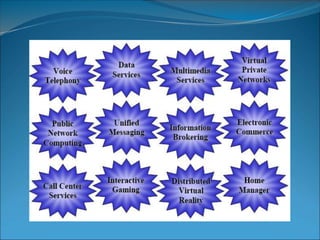
NGN APPLICATIONS
V
SUMMARY
VI
NGN OVERVIEW
I
NGN (DEFINITION):-
 Next Generation Network (NGN):A packet-based
network able to provide telecommunication services
and able to make use of multiple broadband ,QoS-
enabled transport technologies and in which service-
related functions are independent from underlying
transport-related technologies.
 It enables unfettered access for users to networks and
to competing service providers and/or services of their
choice. It supports generalized mobility which will
allow consistent and ubiquitous provision of services
to users .
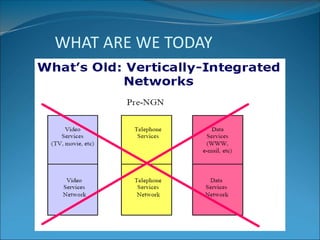
WHAT ARE WE TODAY
Problems of Existing network
FEATURES
 Slow to develop new features and capabilities.
 Expensive upgrades and operating expenses.
 Proprietary vendor troubles .
 Large power and cooling requirements.
 Limited migration strategy to New tech.
 Product/model obsolescence.
What Operators want ?
 More and more customers to increase their revenue
 Fast deployment of new services for more revenue.
 Reduced cost of the network or infrastructure.
What customers want ?
 New services at less cost.
 Value for his money.
 Bundled services from one operator
 Personalization of the services
 Freedom/Mobility.
 Simplicity
BILLS
AND MOST IMPORTANTLY
A CUSTOMER WANTS
A SINGLE INTEGRATED
PLATFORM
 In other words “CONVERGENCE” is the need
of the hour.
 This requirement of “Convergence” And
fast deployment of new services gives birth to
NGN
OR
NEXT GENERATION NETWORKS
FEATURES OF NGN
II
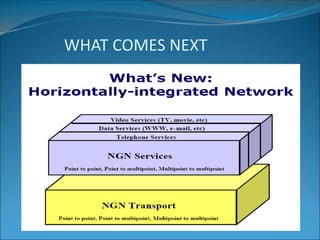
WHAT COMES NEXT
NGN is characterized by the following fundamental
aspects:-
• Packet-based transfer
• Separation of control functions among bearer capabilities,
call/session, and application/ service
• Independence of service-related functions from underlying
transport technologies
• Broadband capabilities with end-to-end QoS and transparency
• Unrestricted access by users to different service providers
• Generalized mobility
• Converged services between fixed/mobile
 Interworking with legacy networks via open interfaces
 Support for a wide range of services, applications and
mechanisms based on service building blocks (including real
time/ streaming/ non-real time services and multi-media)
 Unified service characteristics for the same service as perceived
by the user
 Decoupling of service provision from network, and provision of
open interfaces;
 Compliant with all regulatory requirements (e.g. emergency,
privacy etc.)
 A variety of identification schemes which can be resolved to IP
addresses for the purposes of routing in IP networks
ARCHITECTURE OF NGN
III
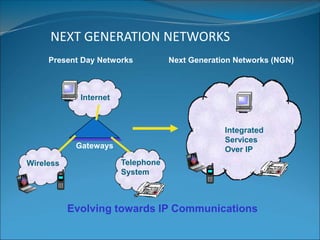
Gateways
Internet
Wireless Telephone
System
Integrated
Services
Over IP
Evolving towards IP Communications
Next Generation Networks (NGN)
Present Day Networks
NEXT GENERATION NETWORKS
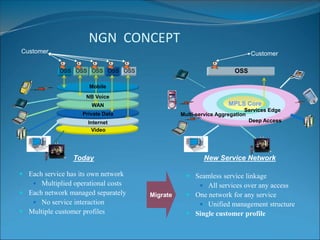
 Each service has its own network
 Multiplied operational costs
 Each network managed separately
 No service interaction
 Multiple customer profiles
 Seamless service linkage
 All services over any access
 One network for any service
 Unified management structure
 Single customer profile
Today New Service Network
Private Data
Internet Deep Access
Services Edge
Multi-service Aggregation
MPLS Core
OSS OSS OSS OSS OSS OSS
Mobile
NB Voice
WAN
Customer Customer
Migrate
NGN CONCEPT
Video
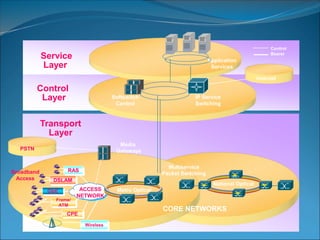
Service
Layer
Control
Bearer
Control
Layer Softswitch
Control
IP Service
Switching
Application
Services
Transport
Layer
PSTN
Internet
Multiservice
Packet Switching
X
X X X
X
CORE NETWORKS
X
National Optical
Broadband
Access
GbE
DSLAM
ACCESS
NETWORK
RAS
Frame/
ATM
Wireless
CPE
Media
Gateways
Metro Optical
X
X
X
X
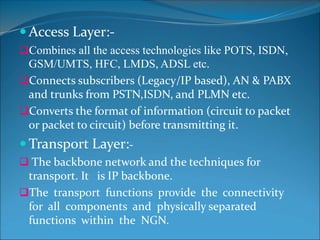
 Access Layer:-
Combines all the access technologies like POTS, ISDN,
GSM/UMTS, HFC, LMDS, ADSL etc.
Connects subscribers (Legacy/IP based), AN & PABX
and trunks from PSTN,ISDN, and PLMN etc.
Converts the format of information (circuit to packet
or packet to circuit) before transmitting it.
 Transport Layer:-
 The backbone network and the techniques for
transport. It is IP backbone.
The transport functions provide the connectivity
for all components and physically separated
functions within the NGN.
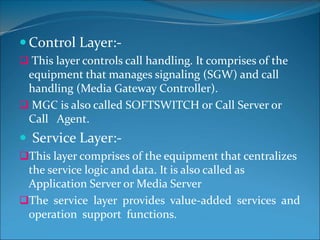
 Control Layer:-
 This layer controls call handling. It comprises of the
equipment that manages signaling (SGW) and call
handling (Media Gateway Controller).
 MGC is also called SOFTSWITCH or Call Server or
Call Agent.
 Service Layer:-
This layer comprises of the equipment that centralizes
the service logic and data. It is also called as
Application Server or Media Server
The service layer provides value-added services and
operation support functions.
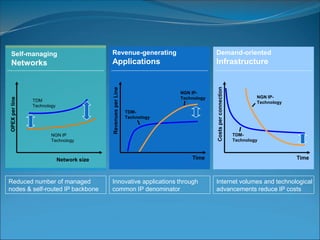
OPEX
per
line

Network size
Reduced number of managed
nodes & self-routed IP backbone
TDM
Technology
NGN IP
Technology
Self-managing
Networks
TDM-
Technology
NGN IP-
Technology
Time
Revenues
per
Line

Revenue-generating
Applications
Innovative applications through
common IP denominator
Internet volumes and technological
advancements reduce IP costs
Demand-oriented
Infrastructure
Time
TDM-
Technology
NGN IP-
Technology
Costs
per
connection
CHARACTERISTICS OF NGN
IV
 Next Generation Networks will for the most part be
high speed packet based networks capable of
delivering a multitude of Broadband services.
 Characteristics features Include :-
 PROTOCOL INDEPENDENCE:-
In order to facilitate multiple forms
of communications NGN would be capable of
operating a multitude of different communications
protocols.
RELIABILITY:-
Increased dependencies on
advanced applications have made NGN achieve
necessary levels of resilience and reliability to support
more diverse topologies and redundant elements than
is normal in today's network.
 CONTROLLABILITY:-
NGN has the flexibility to be
able to design, adapt and optimize the networks to
accommodate simultaneously different types of media
with varying network requirements. The main concern
here is the quality of service.
 PROGRAMMABILITY:-
The more programmable and
reconfigurable the NGN are the more the ability to
cope with new services and user requirements.It allows
for the traffic engineering and dynamic allocation of
network resources.
 SCALABILTY:-
Scalability is an attribute that helps
protect the NGNs from being obsolete. It allows for the
addition of capacity without the need to replace
equipments.
APPLICATIONS OF NGN
V
TELEPRESENCE:-
Telepresence is the ability to
communicate and interact in real time with another
person at a different locations using
telecommunications. Advanced Telepresence Systems
operating on NGNs will enhance users experience of
realism in communications.
3D IMAGING:-
Adding three-dimensional
aspects to the imaging systems of Telepresence
will further enhance the experience of
Telepresence.Other applications of it also include in
medical and educational fields.
VIRTUAL REALITY:-
It involves applications of
complete Tele-immersion. However it is possible that
applications will develop that blend reality and virtual
reality forming hybrid realities to enhance our
experience.
DATA AUGMENTATION:-
Augmentation of data into
Telepresence services in many ways prove helpful in
face-to-face communications that would have files
attached to them that could provide additional
information.
TELE-LEARNING:-
NGN Tele-education will use
advanced graphical visualizations tools to help users
understand difficult or abstract topics and also provide
users with an opportunity to learn in a safe and non-
critical environments.
TELE-MEDICINE:-
Tele-medicine will allow the
transfer of records or actual medical conditions
between patients and medical personnel in
geographically diverse locations. It would also help a
great deal in Tele-surgery.
INTERACTION AND ENTERTAINMENT:-
High capacity applications
would will emerge in the areas of gaming, movies and
social interactivity. It would also support networks to
support multi-player real time use.
Streaming video and audio
entertainment will also be important applications of
NGN. Peer to peer networking of video, audio and even
3D virtual realities would also be possible through
Next Generation Networks.
Advantages of NGN
 One infrastructure is required.
 One backbone for voice and data services instead of
two parallel ones.
 No maintenance of proprietary switching systems.
 Fewer call controlling entities in the network so less
capital and operating cost.
 Easier configuration of equipment.
 Fast advanced and new services deployment is
possible.
Disadvantages of NGN
 Part of the NGN equipment is still under research and
development.
 IP based equipment is deployed mainly in enterprise networks
major concerns about QoS.
 CPEs require significant investments, if mass deployed.
 NGN solutions are not mature enough - major concerns
about QoS, reliability in case of traffic volumes, similar
to those served by the PSTN.
 Not proven economic benefits.
 Lack of standards - interoperability between different vendors’
equipment under question mark.
 Difficult integration between NGN equipment and the
existing PSTN infrastructure.
SUMMARY:-
The NGN concept takes into consideration new realities in the
telecommunication industry characterized by factors such as:
the need to converge and optimize the operating networks and
the extraordinary expansion of digital traffic (i.e., increasing
demand for new multimedia services, increasing demand for
mobility, etc.).
NGN will give users and devices the ability to communicate and to
access services irrespective of change of location or technical
environment. The degree of service availability may depend on
several factors, including access network capabilities, service
level agreements between the user's home network and visited
networks, etc. using a variety of terminal equipment, with or
without service continuity while in transit or while changing
access means. This includes recognition of the need to converge
the previously distinct worlds of fixed and mobile
telecommunications into a coherent whole.
 Wikipedia.com
Dogpile.com
Cuil.com
Itu.int
Bsnl,Bbsr

52892794-Ngn-Presentation.ppt......................

  • 1.
    SEMINAR ON NEXT GENERATIONNETWORKS (NGN) NEXT IS WHAT ?? PRESENTED BY:- MADHUSMITA SAHOO REGD NO.:-0807101026
  • 2.
    NGN OVERVIEW I NGN FEATURES II NGNARCHITECTURE III NGN CHARACTERISTICS IV NGN APPLICATIONS V SUMMARY VI
  • 3.
  • 4.
    NGN (DEFINITION):-  NextGeneration Network (NGN):A packet-based network able to provide telecommunication services and able to make use of multiple broadband ,QoS- enabled transport technologies and in which service- related functions are independent from underlying transport-related technologies.  It enables unfettered access for users to networks and to competing service providers and/or services of their choice. It supports generalized mobility which will allow consistent and ubiquitous provision of services to users .
  • 5.
  • 6.
    Problems of Existingnetwork FEATURES  Slow to develop new features and capabilities.  Expensive upgrades and operating expenses.  Proprietary vendor troubles .  Large power and cooling requirements.  Limited migration strategy to New tech.  Product/model obsolescence.
  • 7.
    What Operators want?  More and more customers to increase their revenue  Fast deployment of new services for more revenue.  Reduced cost of the network or infrastructure. What customers want ?  New services at less cost.  Value for his money.  Bundled services from one operator  Personalization of the services  Freedom/Mobility.  Simplicity
  • 8.
    BILLS AND MOST IMPORTANTLY ACUSTOMER WANTS A SINGLE INTEGRATED PLATFORM
  • 9.
     In otherwords “CONVERGENCE” is the need of the hour.
  • 10.
     This requirementof “Convergence” And fast deployment of new services gives birth to NGN OR NEXT GENERATION NETWORKS
  • 11.
  • 12.
  • 13.
    NGN is characterizedby the following fundamental aspects:- • Packet-based transfer • Separation of control functions among bearer capabilities, call/session, and application/ service • Independence of service-related functions from underlying transport technologies • Broadband capabilities with end-to-end QoS and transparency • Unrestricted access by users to different service providers • Generalized mobility • Converged services between fixed/mobile  Interworking with legacy networks via open interfaces
  • 14.
     Support fora wide range of services, applications and mechanisms based on service building blocks (including real time/ streaming/ non-real time services and multi-media)  Unified service characteristics for the same service as perceived by the user  Decoupling of service provision from network, and provision of open interfaces;  Compliant with all regulatory requirements (e.g. emergency, privacy etc.)  A variety of identification schemes which can be resolved to IP addresses for the purposes of routing in IP networks
  • 15.
  • 16.
    Gateways Internet Wireless Telephone System Integrated Services Over IP Evolvingtowards IP Communications Next Generation Networks (NGN) Present Day Networks NEXT GENERATION NETWORKS
  • 17.
     Each servicehas its own network  Multiplied operational costs  Each network managed separately  No service interaction  Multiple customer profiles  Seamless service linkage  All services over any access  One network for any service  Unified management structure  Single customer profile Today New Service Network Private Data Internet Deep Access Services Edge Multi-service Aggregation MPLS Core OSS OSS OSS OSS OSS OSS Mobile NB Voice WAN Customer Customer Migrate NGN CONCEPT Video
  • 18.
    Service Layer Control Bearer Control Layer Softswitch Control IP Service Switching Application Services Transport Layer PSTN Internet Multiservice PacketSwitching X X X X X CORE NETWORKS X National Optical Broadband Access GbE DSLAM ACCESS NETWORK RAS Frame/ ATM Wireless CPE Media Gateways Metro Optical X X X X
  • 19.
     Access Layer:- Combinesall the access technologies like POTS, ISDN, GSM/UMTS, HFC, LMDS, ADSL etc. Connects subscribers (Legacy/IP based), AN & PABX and trunks from PSTN,ISDN, and PLMN etc. Converts the format of information (circuit to packet or packet to circuit) before transmitting it.  Transport Layer:-  The backbone network and the techniques for transport. It is IP backbone. The transport functions provide the connectivity for all components and physically separated functions within the NGN.
  • 20.
     Control Layer:- This layer controls call handling. It comprises of the equipment that manages signaling (SGW) and call handling (Media Gateway Controller).  MGC is also called SOFTSWITCH or Call Server or Call Agent.  Service Layer:- This layer comprises of the equipment that centralizes the service logic and data. It is also called as Application Server or Media Server The service layer provides value-added services and operation support functions.
  • 21.
    OPEX per line Network size Reduced numberof managed nodes & self-routed IP backbone TDM Technology NGN IP Technology Self-managing Networks TDM- Technology NGN IP- Technology Time Revenues per Line Revenue-generating Applications Innovative applications through common IP denominator Internet volumes and technological advancements reduce IP costs Demand-oriented Infrastructure Time TDM- Technology NGN IP- Technology Costs per connection
  • 22.
  • 23.
     Next GenerationNetworks will for the most part be high speed packet based networks capable of delivering a multitude of Broadband services.  Characteristics features Include :-  PROTOCOL INDEPENDENCE:- In order to facilitate multiple forms of communications NGN would be capable of operating a multitude of different communications protocols. RELIABILITY:- Increased dependencies on advanced applications have made NGN achieve necessary levels of resilience and reliability to support more diverse topologies and redundant elements than is normal in today's network.
  • 24.
     CONTROLLABILITY:- NGN hasthe flexibility to be able to design, adapt and optimize the networks to accommodate simultaneously different types of media with varying network requirements. The main concern here is the quality of service.  PROGRAMMABILITY:- The more programmable and reconfigurable the NGN are the more the ability to cope with new services and user requirements.It allows for the traffic engineering and dynamic allocation of network resources.
  • 25.
     SCALABILTY:- Scalability isan attribute that helps protect the NGNs from being obsolete. It allows for the addition of capacity without the need to replace equipments.
  • 26.
  • 27.
    TELEPRESENCE:- Telepresence is theability to communicate and interact in real time with another person at a different locations using telecommunications. Advanced Telepresence Systems operating on NGNs will enhance users experience of realism in communications. 3D IMAGING:- Adding three-dimensional aspects to the imaging systems of Telepresence will further enhance the experience of Telepresence.Other applications of it also include in medical and educational fields.
  • 28.
    VIRTUAL REALITY:- It involvesapplications of complete Tele-immersion. However it is possible that applications will develop that blend reality and virtual reality forming hybrid realities to enhance our experience. DATA AUGMENTATION:- Augmentation of data into Telepresence services in many ways prove helpful in face-to-face communications that would have files attached to them that could provide additional information.
  • 29.
    TELE-LEARNING:- NGN Tele-education willuse advanced graphical visualizations tools to help users understand difficult or abstract topics and also provide users with an opportunity to learn in a safe and non- critical environments. TELE-MEDICINE:- Tele-medicine will allow the transfer of records or actual medical conditions between patients and medical personnel in geographically diverse locations. It would also help a great deal in Tele-surgery.
  • 30.
    INTERACTION AND ENTERTAINMENT:- Highcapacity applications would will emerge in the areas of gaming, movies and social interactivity. It would also support networks to support multi-player real time use. Streaming video and audio entertainment will also be important applications of NGN. Peer to peer networking of video, audio and even 3D virtual realities would also be possible through Next Generation Networks.
  • 32.
    Advantages of NGN One infrastructure is required.  One backbone for voice and data services instead of two parallel ones.  No maintenance of proprietary switching systems.  Fewer call controlling entities in the network so less capital and operating cost.  Easier configuration of equipment.  Fast advanced and new services deployment is possible.
  • 33.
    Disadvantages of NGN Part of the NGN equipment is still under research and development.  IP based equipment is deployed mainly in enterprise networks major concerns about QoS.  CPEs require significant investments, if mass deployed.  NGN solutions are not mature enough - major concerns about QoS, reliability in case of traffic volumes, similar to those served by the PSTN.  Not proven economic benefits.  Lack of standards - interoperability between different vendors’ equipment under question mark.  Difficult integration between NGN equipment and the existing PSTN infrastructure.
  • 34.
    SUMMARY:- The NGN concepttakes into consideration new realities in the telecommunication industry characterized by factors such as: the need to converge and optimize the operating networks and the extraordinary expansion of digital traffic (i.e., increasing demand for new multimedia services, increasing demand for mobility, etc.). NGN will give users and devices the ability to communicate and to access services irrespective of change of location or technical environment. The degree of service availability may depend on several factors, including access network capabilities, service level agreements between the user's home network and visited networks, etc. using a variety of terminal equipment, with or without service continuity while in transit or while changing access means. This includes recognition of the need to converge the previously distinct worlds of fixed and mobile telecommunications into a coherent whole.
  • 36.