Dipanshu Kumar
B.Tech (CSE)
H R Institiute of Technology
What is NFC?
 NFC or Near Field Communication is a short range high
frequency wireless communication technology.
 A radio communication is established by touching the two
phones or keeping them in a proximity of a few
centimetres.
 NFC is mainly aimed for mobile or handheld devices.
 NFC is an extension of Radio frequency identification or
RFID technology.
 RFID is mainly used for tracking and identification by
sending radio waves.
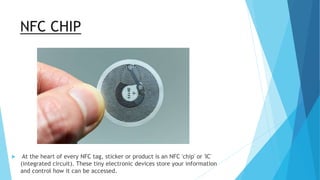
NFC CHIP
 At the heart of every NFC tag, sticker or product is an NFC 'chip' or 'IC'
(integrated circuit). These tiny electronic devices store your information
and control how it can be accessed.
EVOLUTION OF NFC TECHNOLOGY
 In 2004, NFC Forum was formed by Nokia, Philips, Sony,to set
standards for NFC . Every NFC enabled device will have “N-Mark”
trademark ,developed by NFC Forum. N MARK TRADEMARK
EVOLUTION OF NFC TECHNOLOGY
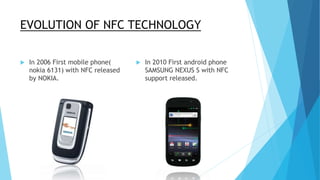
 In 2006 First mobile phone(
nokia 6131) with NFC released
by NOKIA.
 In 2010 First android phone
SAMSUNG NEXUS S with NFC
support released.
OPERATION OF NFC
 NFC is based on inductive-coupling.
 NFC works using magnetic induction between two loop antennas
located within each others near field’.
 operating frequency 13.56 MHz.data rate 106 kbit/s to 424 kbit/s.
 NFC use an initiator and a target; the initiator actively generates an
RF field that can power a passive target.
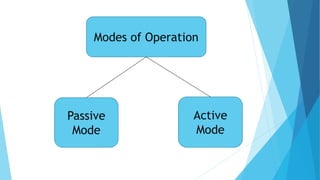
Modes of Operation
Passive
Mode
Active
Mode
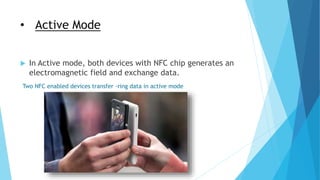
• Active Mode
 In Active mode, both devices with NFC chip generates an
electromagnetic field and exchange data.
Two NFC enabled devices transfer -ring data in active mode
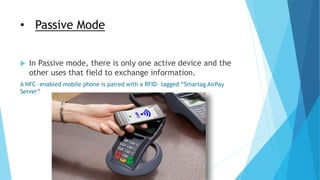
• Passive Mode
 In Passive mode, there is only one active device and the
other uses that field to exchange information.
A NFC- enabled mobile phone is paired with a RFID- tagged “Smartag AirPay
Server”
Application of NFC
 NFC applications can be split into the following three basic
categories:
 Touch and Go
 Touch and Confirm
 Touch and Connect
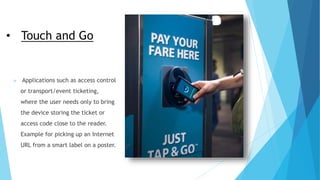
• Touch and Go
 Applications such as access control
or transport/event ticketing,
where the user needs only to bring
the device storing the ticket or
access code close to the reader.
Example for picking up an Internet
URL from a smart label on a poster.
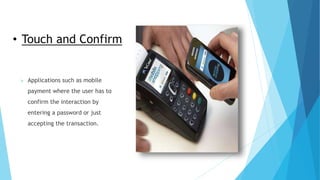
• Touch and Confirm
 Applications such as mobile
payment where the user has to
confirm the interaction by
entering a password or just
accepting the transaction.
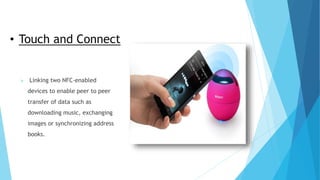
• Touch and Connect
 Linking two NFC-enabled
devices to enable peer to peer
transfer of data such as
downloading music, exchanging
images or synchronizing address
books.
Advantages of NFC
 High convenience to the user, because the data exchange is
done by bringing two mobiles together.
 Reduces cost of electronic issuance.
 Secure communication.
 No special software.
 No manual configuration and settings.
 No search and pair procedure.
Disadvantages of NFC
 The system has the limitation that it can be operated only
with devices under a short range i.e around 10 cm.
 The data transfer rate is very less at about 106kbps, 212
kbps and 424kbps.
Conclusion
 Mobile handsets are the primary target for NFC and soon
NFC will be implemented in most handheld devices. Even
though NFC have the shortest range among radio
frequency technologies, combining them with existing
technologies like Bluetooth or Infrared can increase its
range of applications.
THE END

Nfc presentation

  • 1.
    Dipanshu Kumar B.Tech (CSE) HR Institiute of Technology
  • 2.
    What is NFC? NFC or Near Field Communication is a short range high frequency wireless communication technology.  A radio communication is established by touching the two phones or keeping them in a proximity of a few centimetres.  NFC is mainly aimed for mobile or handheld devices.  NFC is an extension of Radio frequency identification or RFID technology.  RFID is mainly used for tracking and identification by sending radio waves.
  • 3.
    NFC CHIP  Atthe heart of every NFC tag, sticker or product is an NFC 'chip' or 'IC' (integrated circuit). These tiny electronic devices store your information and control how it can be accessed.
  • 4.
    EVOLUTION OF NFCTECHNOLOGY  In 2004, NFC Forum was formed by Nokia, Philips, Sony,to set standards for NFC . Every NFC enabled device will have “N-Mark” trademark ,developed by NFC Forum. N MARK TRADEMARK
  • 5.
    EVOLUTION OF NFCTECHNOLOGY  In 2006 First mobile phone( nokia 6131) with NFC released by NOKIA.  In 2010 First android phone SAMSUNG NEXUS S with NFC support released.
  • 6.
    OPERATION OF NFC NFC is based on inductive-coupling.  NFC works using magnetic induction between two loop antennas located within each others near field’.  operating frequency 13.56 MHz.data rate 106 kbit/s to 424 kbit/s.  NFC use an initiator and a target; the initiator actively generates an RF field that can power a passive target.
  • 7.
  • 8.
    • Active Mode In Active mode, both devices with NFC chip generates an electromagnetic field and exchange data. Two NFC enabled devices transfer -ring data in active mode
  • 9.
    • Passive Mode In Passive mode, there is only one active device and the other uses that field to exchange information. A NFC- enabled mobile phone is paired with a RFID- tagged “Smartag AirPay Server”
  • 10.
    Application of NFC NFC applications can be split into the following three basic categories:  Touch and Go  Touch and Confirm  Touch and Connect
  • 11.
    • Touch andGo  Applications such as access control or transport/event ticketing, where the user needs only to bring the device storing the ticket or access code close to the reader. Example for picking up an Internet URL from a smart label on a poster.
  • 12.
    • Touch andConfirm  Applications such as mobile payment where the user has to confirm the interaction by entering a password or just accepting the transaction.
  • 13.
    • Touch andConnect  Linking two NFC-enabled devices to enable peer to peer transfer of data such as downloading music, exchanging images or synchronizing address books.
  • 14.
    Advantages of NFC High convenience to the user, because the data exchange is done by bringing two mobiles together.  Reduces cost of electronic issuance.  Secure communication.  No special software.  No manual configuration and settings.  No search and pair procedure.
  • 15.
    Disadvantages of NFC The system has the limitation that it can be operated only with devices under a short range i.e around 10 cm.  The data transfer rate is very less at about 106kbps, 212 kbps and 424kbps.
  • 16.
    Conclusion  Mobile handsetsare the primary target for NFC and soon NFC will be implemented in most handheld devices. Even though NFC have the shortest range among radio frequency technologies, combining them with existing technologies like Bluetooth or Infrared can increase its range of applications.
  • 17.