Olga Vinnere Pettersson, PhD
National Genomics Infrastructure hosted by ScilifeLab,
Uppsala Node (UGC)
Version 5.2.1.b
Today we will talk about:
• National Genomics Infrastructure – Sweden
• History and current state of genomic research
• Sequencing technologies:
– Types
– Principles
– Their “+” and “-”
– Couple of pieces of advise
www.robustpm.com
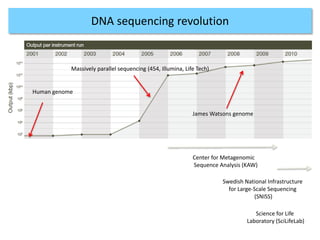
Massively parallel sequencing (454, Illumina, Life Tech)
Human genome
James Watsons genome
DNA sequencing revolution
Center for Metagenomic
Sequence Analysis (KAW)
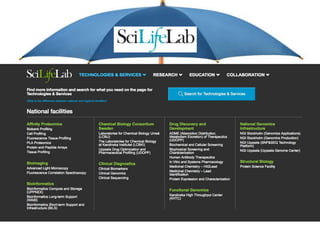
Science for Life
Laboratory (SciLifeLab)
Swedish National Infrastructure
for Large-Scale Sequencing
(SNISS)
What is sequencing?
• “In genetics and biochemistry, sequencing
means to determine the primary structure (or
primary sequence) of an unbranched
biopolymer.”
(http://en.wikipedia.org/wiki/Sequencing)
DEFINITION
Once upon a time…
• Fredrik Sanger and Alan Coulson
Chain Termination Sequencing (1977)
Nobel prize 1980
Principle:
SYNTHESIS of DNA is randomly TERMINATED at different points
Separation of fragments that are 1 nucleotide different in size
Sanger’s sequencing
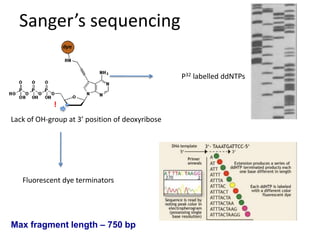
Lack of OH-group at 3’ position of deoxyribose
!
Fluorescent dye terminators
P32 labelled ddNTPs
Max fragment length – 750 bp
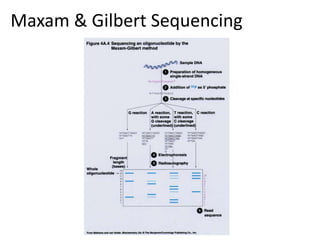
Maxam & Gilbert Sequencing
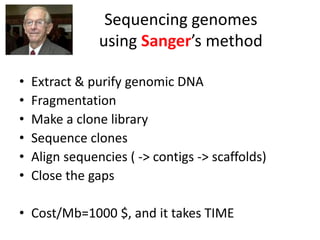
Sequencing genomes
using Sanger’s method
• Extract & purify genomic DNA
• Fragmentation
• Make a clone library
• Sequence clones
• Align sequencies ( -> contigs -> scaffolds)
• Close the gaps
• Cost/Mb=1000 $, and it takes TIME
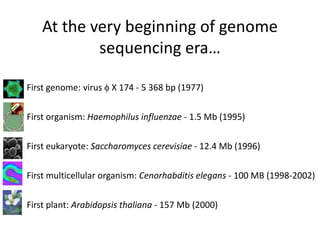
At the very beginning of genome
sequencing era…
• First genome: virus  X 174 - 5 368 bp (1977)
• First organism: Haemophilus influenzae - 1.5 Mb (1995)
• First eukaryote: Saccharomyces cerevisiae - 12.4 Mb (1996)
• First multicellular organism: Cenorhabditis elegans - 100 MB (1998-2002)
• First plant: Arabidopsis thaliana - 157 Mb (2000)
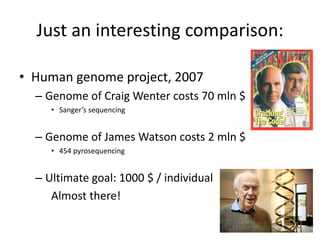
Just an interesting comparison:
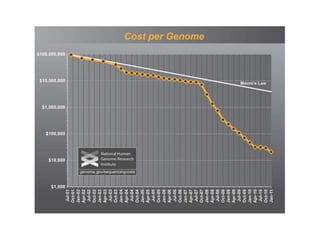
• Human genome project, 2007
– Genome of Craig Wenter costs 70 mln $
• Sanger’s sequencing
– Genome of James Watson costs 2 mln $
• 454 pyrosequencing
– Ultimate goal: 1000 $ / individual
Almost there!
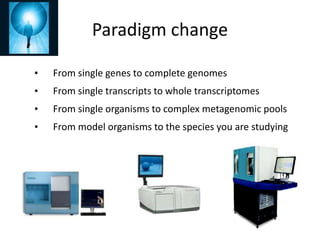
Paradigm change
• From single genes to complete genomes
• From single transcripts to whole transcriptomes
• From single organisms to complex metagenomic pools
• From model organisms to the species you are studying
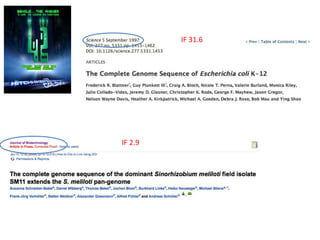
IF 2.9
IF 31.6
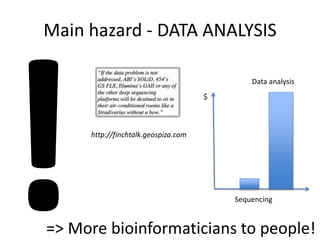
Main hazard - DATA ANALYSIS
http://finchtalk.geospiza.com
=> More bioinformaticians to people!
$
Sequencing
Data analysis
Major NGS technologies
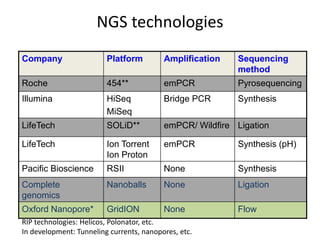
NGS technologies
RIP technologies: Helicos, Polonator, etc.
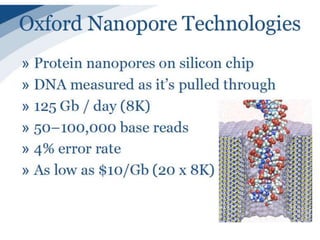
In development: Tunneling currents, nanopores, etc.
Company Platform Amplification Sequencing
method
Roche 454** emPCR Pyrosequencing
Illumina HiSeq
MiSeq
Bridge PCR Synthesis
LifeTech SOLiD** emPCR/ Wildfire Ligation
LifeTech Ion Torrent
Ion Proton
emPCR Synthesis (pH)
Pacific Bioscience RSII None Synthesis
Complete
genomics
Nanoballs None Ligation
Oxford Nanopore* GridION None Flow
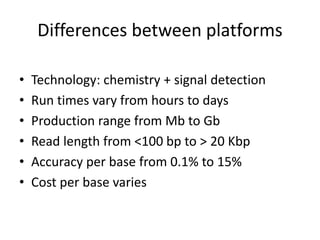
Differences between platforms
• Technology: chemistry + signal detection
• Run times vary from hours to days
• Production range from Mb to Gb
• Read length from <100 bp to > 20 Kbp
• Accuracy per base from 0.1% to 15%
• Cost per base varies
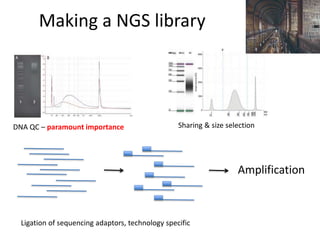
Making a NGS library
DNA QC – paramount importance Sharing & size selection
Ligation of sequencing adaptors, technology specific
Amplification
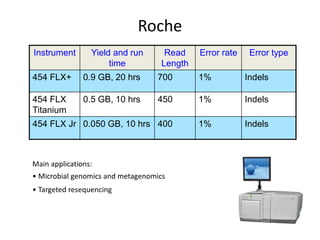
Roche
Instrument Yield and run
time
Read
Length
Error rate Error type
454 FLX+ 0.9 GB, 20 hrs 700 1% Indels
454 FLX
Titanium
0.5 GB, 10 hrs 450 1% Indels
454 FLX Jr 0.050 GB, 10 hrs 400 1% Indels
Main applications:
• Microbial genomics and metagenomics
• Targeted resequencing
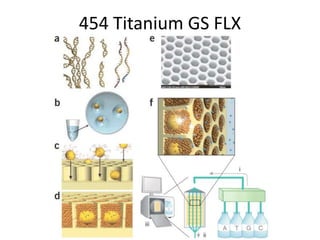
454 Titanium GS FLX
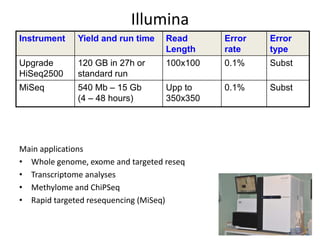
Illumina
Main applications
• Whole genome, exome and targeted reseq
• Transcriptome analyses
• Methylome and ChiPSeq
• Rapid targeted resequencing (MiSeq)
Instrument Yield and run time Read
Length
Error
rate
Error
type
Upgrade
HiSeq2500
120 GB in 27h or
standard run
100x100 0.1% Subst
MiSeq 540 Mb – 15 Gb
(4 – 48 hours)
Upp to
350x350
0.1% Subst
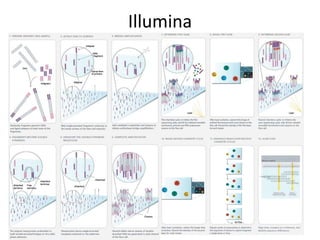
Illumina
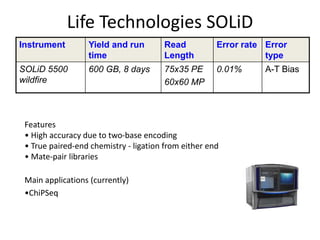
Life Technologies SOLiD
Instrument Yield and run
time
Read
Length
Error rate Error
type
SOLiD 5500
wildfire
600 GB, 8 days 75x35 PE
60x60 MP
0.01% A-T Bias
Features
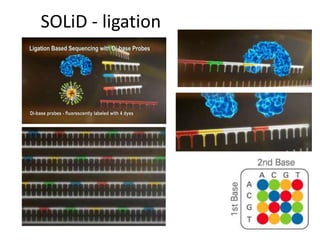
• High accuracy due to two-base encoding
• True paired-end chemistry - ligation from either end
• Mate-pair libraries
Main applications (currently)
•ChiPSeq
SOLiD - ligation
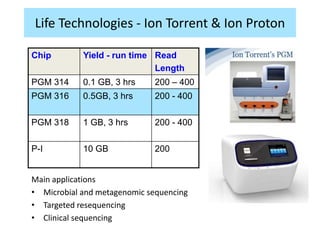
Life Technologies - Ion Torrent & Ion Proton
Main applications
• Microbial and metagenomic sequencing
• Targeted resequencing
• Clinical sequencing
Chip Yield - run time Read
Length
PGM 314 0.1 GB, 3 hrs 200 – 400
PGM 316 0.5GB, 3 hrs 200 - 400
PGM 318 1 GB, 3 hrs 200 - 400
P-I 10 GB 200
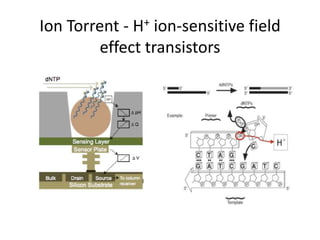
Ion Torrent - H+ ion-sensitive field
effect transistors
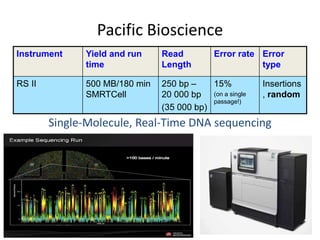
Instrument Yield and run
time
Read
Length
Error rate Error
type
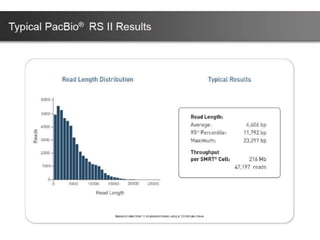
RS II 500 MB/180 min
SMRTCell
250 bp –
20 000 bp
(35 000 bp)
15%
(on a single
passage!)
Insertions
, random
Pacific Bioscience
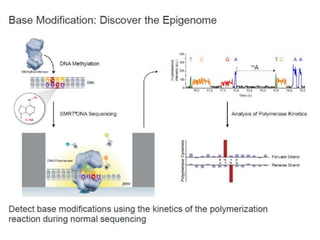
Single-Molecule, Real-Time DNA sequencing
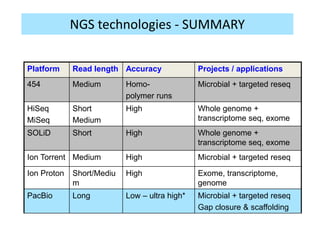
NGS technologies - SUMMARY
Platform Read length Accuracy Projects / applications
454 Medium Homo-
polymer runs
Microbial + targeted reseq
HiSeq
MiSeq
Short
Medium
High Whole genome +
transcriptome seq, exome
SOLiD Short High Whole genome +
transcriptome seq, exome
Ion Torrent Medium High Microbial + targeted reseq
Ion Proton Short/Mediu
m
High Exome, transcriptome,
genome
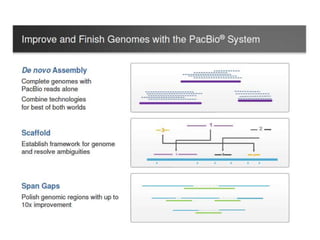
PacBio Long Low – ultra high* Microbial + targeted reseq
Gap closure & scaffolding
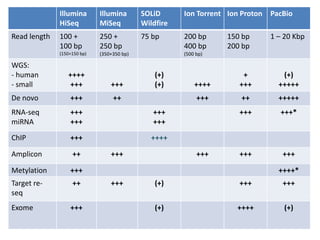
Illumina
HiSeq
Illumina
MiSeq
SOLiD
Wildfire
Ion Torrent Ion Proton PacBio
Read length 100 +
100 bp
(150+150 bp)
250 +
250 bp
(350+350 bp)
75 bp 200 bp
400 bp
(500 bp)
150 bp
200 bp
1 – 20 Kbp
WGS:
- human
- small
++++
+++ +++
(+)
(+) ++++
+
+++
(+)
+++++
De novo +++ ++ +++ ++ +++++
RNA-seq
miRNA
+++
+++
+++
+++
+++ +++*
ChIP +++ ++++
Amplicon ++ +++ +++ +++ +++
Metylation +++ ++++*
Target re-
seq
++ +++ (+) +++ +++
Exome +++ (+) ++++ (+)
Check list:
- Have others done similar work?
- Is your methodology sound? Sample size? Repetitions?
- Is there people to analyze the data?
- Is there computer capacity to analyze the data?
- Will you be able to publish NGS data by yourself?
- PLEASE consult the sequencing facility PRIOR to onset
of your project!
Common pitfalls and a piece of advise:
• If you give us low quality DNA/RNA - expect low quality data
• If you give us too little DNA/RNA – expect biased data
• Do not try to do everything by yourself
• Make sure there is a dedicated bioinformatician available
• Never underestimate time and money needed for data
analysis
• Google often!
• Use online forums, e.g. SeqAnswers.com
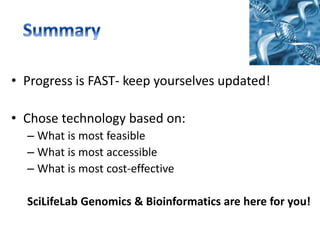
• Progress is FAST- keep yourselves updated!
• Chose technology based on:
– What is most feasible
– What is most accessible
– What is most cost-effective
SciLifeLab Genomics & Bioinformatics are here for you!
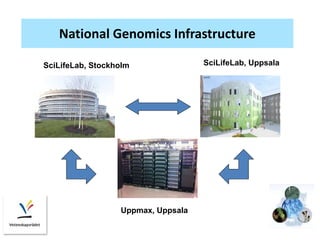
National Genomics Infrastructure
Mid 2010
SciLifeLab, Stockholm SciLifeLab, Uppsala
Uppmax, Uppsala
Projects at CMS
3. Access to genomics platform
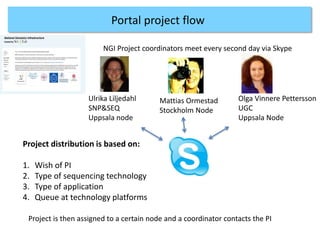
Portal project flow
NGI Project coordinators meet every second day via Skype
Project is then assigned to a certain node and a coordinator contacts the PI
Project distribution is based on:
1. Wish of PI
2. Type of sequencing technology
3. Type of application
4. Queue at technology platforms
Ulrika Liljedahl
SNP&SEQ
Uppsala node
Mattias Ormestad
Stockholm Node
Olga Vinnere Pettersson
UGC
Uppsala Node
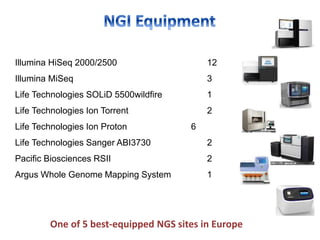
Illumina HiSeq 2000/2500 12
Illumina MiSeq 3
Life Technologies SOLiD 5500wildfire 1
Life Technologies Ion Torrent 2
Life Technologies Ion Proton 6
Life Technologies Sanger ABI3730 2
Pacific Biosciences RSII 2
Argus Whole Genome Mapping System 1
One of 5 best-equipped NGS sites in Europe
Projects at CMS
3. Access to genomics platform
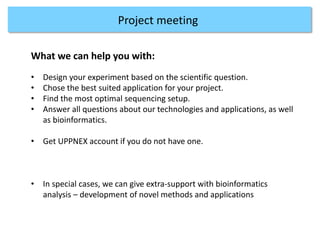
Project meeting
What we can help you with:
• Design your experiment based on the scientific question.
• Chose the best suited application for your project.
• Find the most optimal sequencing setup.
• Answer all questions about our technologies and applications, as well
as bioinformatics.
• Get UPPNEX account if you do not have one.
• In special cases, we can give extra-support with bioinformatics
analysis – development of novel methods and applications
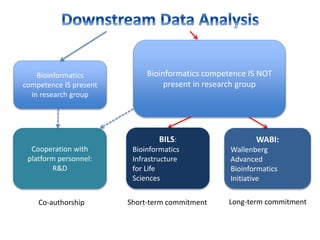
Bioinformatics
competence IS present
in research group
Bioinformatics competence IS NOT
present in research group
BILS:
Bioinformatics
Infrastructure
for Life
Sciences
WABI:
Wallenberg
Advanced
Bioinformatics
Initiative
Short-term commitment Long-term commitment
Cooperation with
platform personnel:
R&D
Co-authorship

Next Generation Sequencing - An Overview

  • 1.
    Olga Vinnere Pettersson,PhD National Genomics Infrastructure hosted by ScilifeLab, Uppsala Node (UGC) Version 5.2.1.b
  • 2.
    Today we willtalk about: • National Genomics Infrastructure – Sweden • History and current state of genomic research • Sequencing technologies: – Types – Principles – Their “+” and “-” – Couple of pieces of advise www.robustpm.com
  • 3.
    Massively parallel sequencing(454, Illumina, Life Tech) Human genome James Watsons genome DNA sequencing revolution Center for Metagenomic Sequence Analysis (KAW) Science for Life Laboratory (SciLifeLab) Swedish National Infrastructure for Large-Scale Sequencing (SNISS)
  • 5.
  • 6.
    • “In geneticsand biochemistry, sequencing means to determine the primary structure (or primary sequence) of an unbranched biopolymer.” (http://en.wikipedia.org/wiki/Sequencing) DEFINITION
  • 7.
    Once upon atime… • Fredrik Sanger and Alan Coulson Chain Termination Sequencing (1977) Nobel prize 1980 Principle: SYNTHESIS of DNA is randomly TERMINATED at different points Separation of fragments that are 1 nucleotide different in size
  • 8.
    Sanger’s sequencing Lack ofOH-group at 3’ position of deoxyribose ! Fluorescent dye terminators P32 labelled ddNTPs Max fragment length – 750 bp
  • 9.
    Maxam & GilbertSequencing
  • 10.
    Sequencing genomes using Sanger’smethod • Extract & purify genomic DNA • Fragmentation • Make a clone library • Sequence clones • Align sequencies ( -> contigs -> scaffolds) • Close the gaps • Cost/Mb=1000 $, and it takes TIME
  • 11.
    At the verybeginning of genome sequencing era… • First genome: virus  X 174 - 5 368 bp (1977) • First organism: Haemophilus influenzae - 1.5 Mb (1995) • First eukaryote: Saccharomyces cerevisiae - 12.4 Mb (1996) • First multicellular organism: Cenorhabditis elegans - 100 MB (1998-2002) • First plant: Arabidopsis thaliana - 157 Mb (2000)
  • 12.
    Just an interestingcomparison: • Human genome project, 2007 – Genome of Craig Wenter costs 70 mln $ • Sanger’s sequencing – Genome of James Watson costs 2 mln $ • 454 pyrosequencing – Ultimate goal: 1000 $ / individual Almost there!
  • 13.
    Paradigm change • Fromsingle genes to complete genomes • From single transcripts to whole transcriptomes • From single organisms to complex metagenomic pools • From model organisms to the species you are studying
  • 14.
  • 15.
    Main hazard -DATA ANALYSIS http://finchtalk.geospiza.com => More bioinformaticians to people! $ Sequencing Data analysis
  • 16.
  • 17.
    NGS technologies RIP technologies:Helicos, Polonator, etc. In development: Tunneling currents, nanopores, etc. Company Platform Amplification Sequencing method Roche 454** emPCR Pyrosequencing Illumina HiSeq MiSeq Bridge PCR Synthesis LifeTech SOLiD** emPCR/ Wildfire Ligation LifeTech Ion Torrent Ion Proton emPCR Synthesis (pH) Pacific Bioscience RSII None Synthesis Complete genomics Nanoballs None Ligation Oxford Nanopore* GridION None Flow
  • 18.
    Differences between platforms •Technology: chemistry + signal detection • Run times vary from hours to days • Production range from Mb to Gb • Read length from <100 bp to > 20 Kbp • Accuracy per base from 0.1% to 15% • Cost per base varies
  • 19.
    Making a NGSlibrary DNA QC – paramount importance Sharing & size selection Ligation of sequencing adaptors, technology specific Amplification
  • 20.
    Roche Instrument Yield andrun time Read Length Error rate Error type 454 FLX+ 0.9 GB, 20 hrs 700 1% Indels 454 FLX Titanium 0.5 GB, 10 hrs 450 1% Indels 454 FLX Jr 0.050 GB, 10 hrs 400 1% Indels Main applications: • Microbial genomics and metagenomics • Targeted resequencing
  • 21.
  • 22.
    Illumina Main applications • Wholegenome, exome and targeted reseq • Transcriptome analyses • Methylome and ChiPSeq • Rapid targeted resequencing (MiSeq) Instrument Yield and run time Read Length Error rate Error type Upgrade HiSeq2500 120 GB in 27h or standard run 100x100 0.1% Subst MiSeq 540 Mb – 15 Gb (4 – 48 hours) Upp to 350x350 0.1% Subst
  • 23.
  • 24.
    Life Technologies SOLiD InstrumentYield and run time Read Length Error rate Error type SOLiD 5500 wildfire 600 GB, 8 days 75x35 PE 60x60 MP 0.01% A-T Bias Features • High accuracy due to two-base encoding • True paired-end chemistry - ligation from either end • Mate-pair libraries Main applications (currently) •ChiPSeq
  • 25.
  • 26.
    Life Technologies -Ion Torrent & Ion Proton Main applications • Microbial and metagenomic sequencing • Targeted resequencing • Clinical sequencing Chip Yield - run time Read Length PGM 314 0.1 GB, 3 hrs 200 – 400 PGM 316 0.5GB, 3 hrs 200 - 400 PGM 318 1 GB, 3 hrs 200 - 400 P-I 10 GB 200
  • 27.
    Ion Torrent -H+ ion-sensitive field effect transistors
  • 28.
    Instrument Yield andrun time Read Length Error rate Error type RS II 500 MB/180 min SMRTCell 250 bp – 20 000 bp (35 000 bp) 15% (on a single passage!) Insertions , random Pacific Bioscience Single-Molecule, Real-Time DNA sequencing
  • 34.
    NGS technologies -SUMMARY Platform Read length Accuracy Projects / applications 454 Medium Homo- polymer runs Microbial + targeted reseq HiSeq MiSeq Short Medium High Whole genome + transcriptome seq, exome SOLiD Short High Whole genome + transcriptome seq, exome Ion Torrent Medium High Microbial + targeted reseq Ion Proton Short/Mediu m High Exome, transcriptome, genome PacBio Long Low – ultra high* Microbial + targeted reseq Gap closure & scaffolding
  • 36.
    Illumina HiSeq Illumina MiSeq SOLiD Wildfire Ion Torrent IonProton PacBio Read length 100 + 100 bp (150+150 bp) 250 + 250 bp (350+350 bp) 75 bp 200 bp 400 bp (500 bp) 150 bp 200 bp 1 – 20 Kbp WGS: - human - small ++++ +++ +++ (+) (+) ++++ + +++ (+) +++++ De novo +++ ++ +++ ++ +++++ RNA-seq miRNA +++ +++ +++ +++ +++ +++* ChIP +++ ++++ Amplicon ++ +++ +++ +++ +++ Metylation +++ ++++* Target re- seq ++ +++ (+) +++ +++ Exome +++ (+) ++++ (+)
  • 37.
    Check list: - Haveothers done similar work? - Is your methodology sound? Sample size? Repetitions? - Is there people to analyze the data? - Is there computer capacity to analyze the data? - Will you be able to publish NGS data by yourself? - PLEASE consult the sequencing facility PRIOR to onset of your project!
  • 38.
    Common pitfalls anda piece of advise: • If you give us low quality DNA/RNA - expect low quality data • If you give us too little DNA/RNA – expect biased data • Do not try to do everything by yourself • Make sure there is a dedicated bioinformatician available • Never underestimate time and money needed for data analysis • Google often! • Use online forums, e.g. SeqAnswers.com
  • 39.
    • Progress isFAST- keep yourselves updated! • Chose technology based on: – What is most feasible – What is most accessible – What is most cost-effective SciLifeLab Genomics & Bioinformatics are here for you!
  • 42.
    National Genomics Infrastructure Mid2010 SciLifeLab, Stockholm SciLifeLab, Uppsala Uppmax, Uppsala
  • 43.
    Projects at CMS 3.Access to genomics platform Portal project flow NGI Project coordinators meet every second day via Skype Project is then assigned to a certain node and a coordinator contacts the PI Project distribution is based on: 1. Wish of PI 2. Type of sequencing technology 3. Type of application 4. Queue at technology platforms Ulrika Liljedahl SNP&SEQ Uppsala node Mattias Ormestad Stockholm Node Olga Vinnere Pettersson UGC Uppsala Node
  • 44.
    Illumina HiSeq 2000/250012 Illumina MiSeq 3 Life Technologies SOLiD 5500wildfire 1 Life Technologies Ion Torrent 2 Life Technologies Ion Proton 6 Life Technologies Sanger ABI3730 2 Pacific Biosciences RSII 2 Argus Whole Genome Mapping System 1 One of 5 best-equipped NGS sites in Europe
  • 45.
    Projects at CMS 3.Access to genomics platform Project meeting What we can help you with: • Design your experiment based on the scientific question. • Chose the best suited application for your project. • Find the most optimal sequencing setup. • Answer all questions about our technologies and applications, as well as bioinformatics. • Get UPPNEX account if you do not have one. • In special cases, we can give extra-support with bioinformatics analysis – development of novel methods and applications
  • 46.
    Bioinformatics competence IS present inresearch group Bioinformatics competence IS NOT present in research group BILS: Bioinformatics Infrastructure for Life Sciences WABI: Wallenberg Advanced Bioinformatics Initiative Short-term commitment Long-term commitment Cooperation with platform personnel: R&D Co-authorship