Next Generation Sequencing (NGS)
in the Clinic – Considerations for
Molecular Pathologists
Jane Gibson, Ph.D., FACMG
Professor of Pathology
Director of Molecular Diagnostics
University of Central Florida College of Medicine
Chair, AMP Whole Genome Analysis Working Group
Opportunities and Challenges associated with Clinical
Diagnostic Genome Sequencing: A Report of the
Association for Molecular Pathology
**Iris Schrijver , Nazneen Aziz, Daniel H. Farkas, Manohar Furtado, Andrea Ferreira-
Gonzalez, Timothy C. Greiner, Wayne W. Grody, Tina Hambuch, Lisa Kalman, Jeffrey
A. Kant, Roger D. Klein, Debra G.B. Leonard, Ira M. Lubin, Rong Mao, Narasimhan
Nagan, Victoria M. Pratt, Mark E. Sobel, Karl V. Voelkerding, Jane S. Gibson
**The Whole Genome Analysis Working Group is a working group of the AMP Clinical Practice
Committee
Goals
• Key opportunities and challenges associated
with clinically diagnostic genome sequencing
• Application examples
• Aspects of clinical utility, ethics and consent
• Analytic and post-analytic considerations
• Professional implications
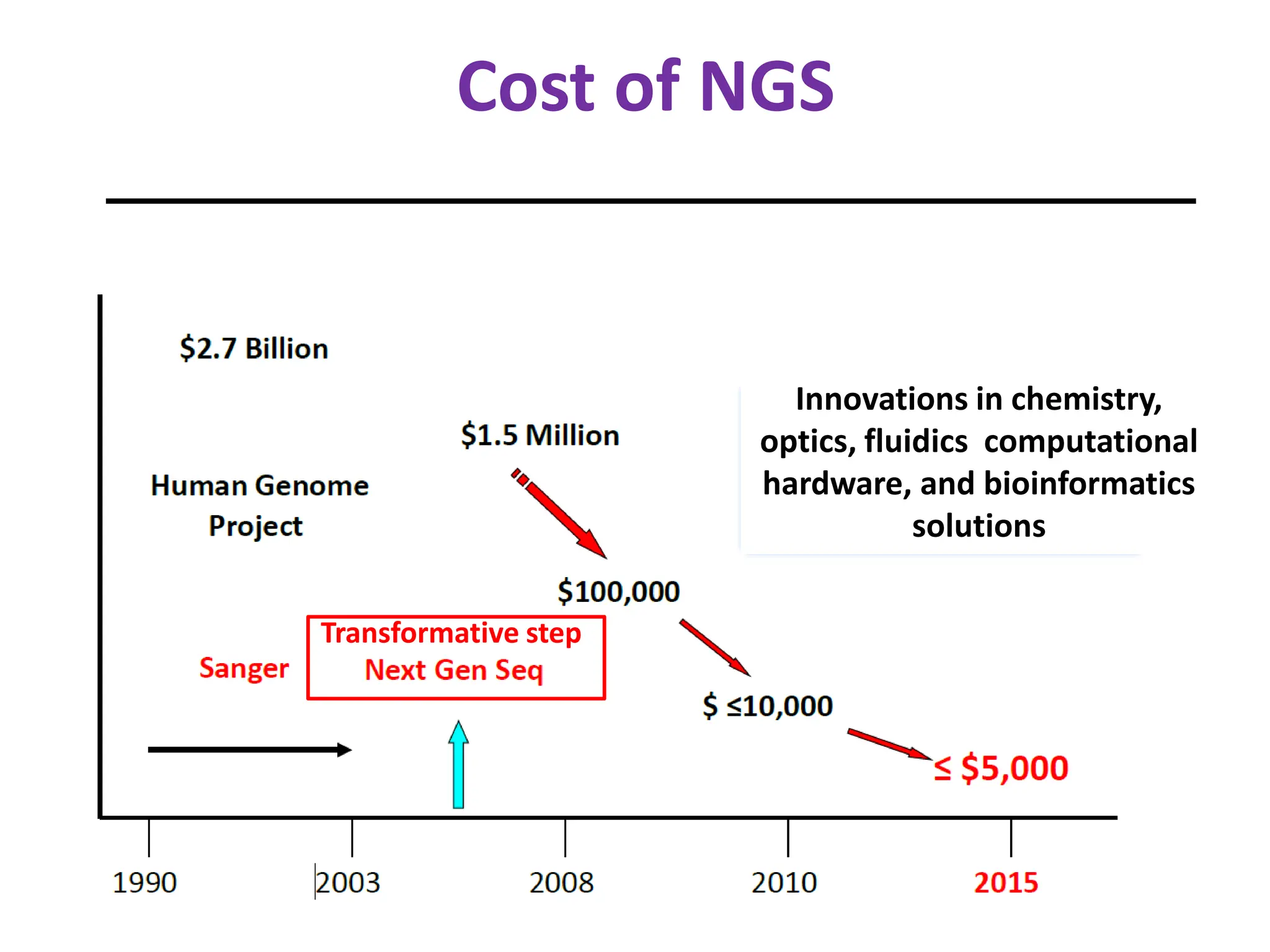
Cost of NGS
Transformative step
Innovations in chemistry,
optics, fluidics computational
hardware, and bioinformatics
solutions
NGS Platforms
• Differ in design and chemistries
• Fundamentally related-sequencing
of thousands to millions of clonally
amplified molecules in a massively
parallel manner
• Orders of magnitude more
information-will continue to evolve
• Attractive for clinical applications –
individual sequencing assays costly
and laborious- serial “gene by
gene” analysis
Pacific Biosciences
Helicos Biosciences
NABsys
VisiGen Biotechnologies
Complete Genomics
Oxford Nanophore Technologies
NGS Application Examples-
Inherited Conditions
Discovery tool: Single gene disorders
i.e. AD – Kabuki syndrome (MLL)
Causative mutations for multigenic
diseases –superior to “one by one”
approach of traditional sequencing
Diagnostic advancements for
diseases with overlapping
symptoms, multiple possible
syndromes/genes
Inherited Conditions-
Challenges and Opportunities
Challenges
Example:
Monogenic disorders
Novel missense mutations
Structural aberrations
Germ line mosaicism
Imprinting effects
Epigenetic factors
Opportunities
Example:
Multifactorial disease
Risk loci more often in
non-coding
or inter-gene regions
Pathogenicity of variants
often unclear- less testing
vs. monogenic disease
Reference human genome
cataloguing of variants =
more test offerings
NGS Application Examples-
Neoplastic Conditions
Cancer susceptibility genes
Risk assessment
Risk management
Tumor sub-typing
Micro-RNAs
Prognosis
Alterations in gene expression
Molecular profiling
Patient stratification
Predictions of therapeutic
response
personalized treatment
Therapeutic monitoring
Somatic/driver mutations
Methylation
Epigenetic changes
NGS Application Examples-
Neoplastic Conditions
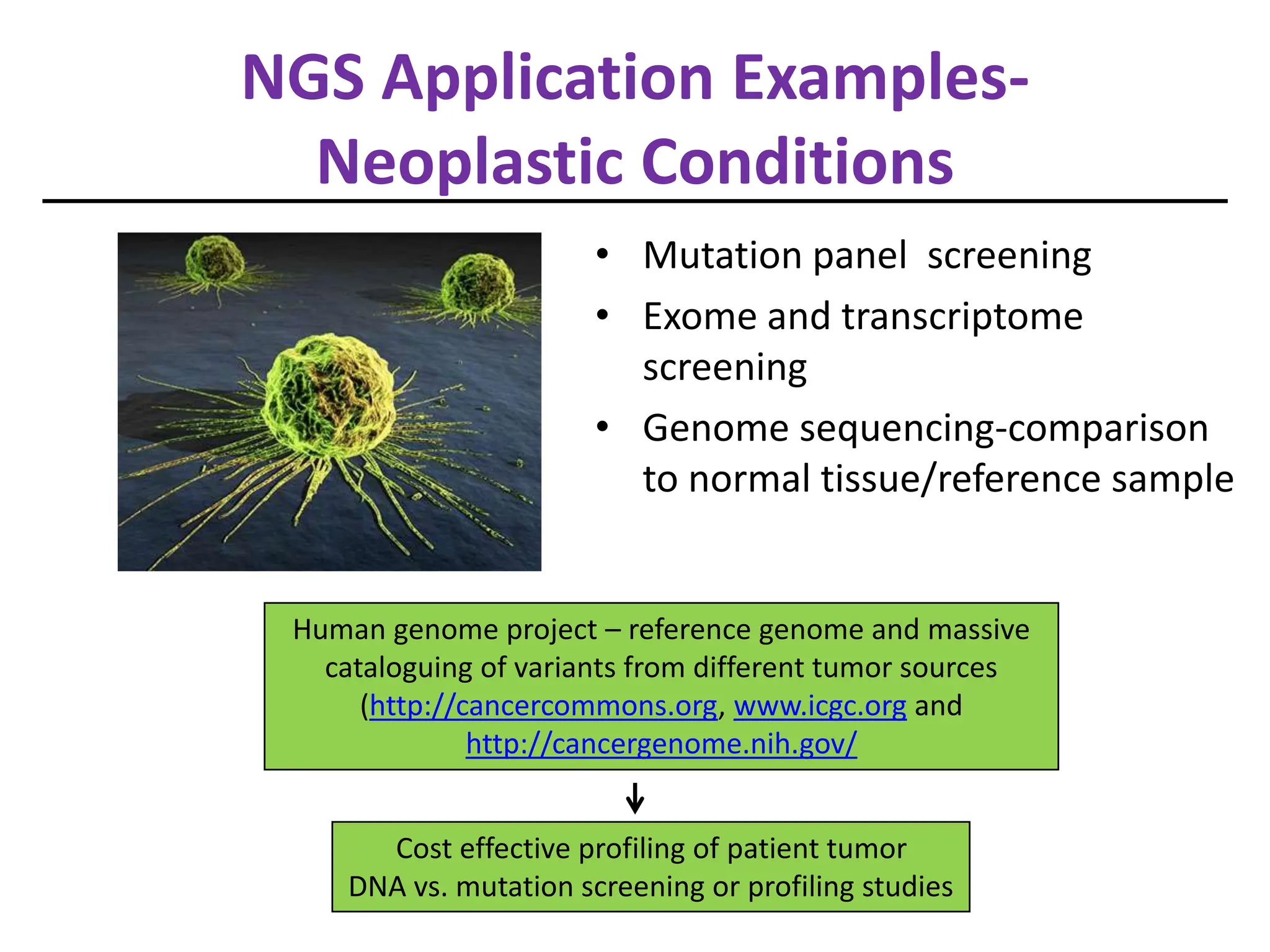
• Mutation panel screening
• Exome and transcriptome
screening
• Genome sequencing-comparison
to normal tissue/reference sample
Human genome project – reference genome and massive
cataloguing of variants from different tumor sources
(http://cancercommons.org, www.icgc.org and
http://cancergenome.nih.gov/
Cost effective profiling of patient tumor
DNA vs. mutation screening or profiling studies
NGS Analysis And Neoplastic
Conditions
• Quantitative nature of NGS- improvement vs.
chip technology
• Gene expression tests- Mammaprint (70 genes),
Oncotype DX (21 genes) and Rotterdam
signature (76 genes) – replaced by NGS analysis
of signature transcripts?
• Germ line DNA characterization and somatic
changes, transcriptome and methylation
profiles - using a single, rapid and cost effective
platform
NGS Application Examples-
Other Considerations
Different NGS platforms have different capabilities
RNA and DNA
sequence changes
DNA copy number
variations
DNA
rearrangements
RNA expression
profiles
Methylation
A single method usually provides
only part of this variety of
information - cost , specimen type,
and application considerations
important
NGS Application Examples-
Other Considerations
NGS- significant false
positive rate
Mutation confirmation
Usually by Sanger sequencing-will
platform evolution eliminate?
Variable % tumor cells
and variable % tumor
cells with (presumably)
secondary mutation
May overlap with NGS
false positive rate
Low level mutations- not easily
confirmed by Sanger sequencing
(higher detection threshold ≈ 15-20%)
without more sensitive mutation
screening - DGGE, dHPLC, pyrosequencing or
mutation enrichment- i.e. COLD PCR
Numerous heterogeneous aberrations-
i.e. oncologic applications
need algorithm development
Clinical Utility
• Balance of net health benefits vs. harm
• NGS –transformative for personalized
treatment of disease
• Clinical indication - includes test rationale,
patient population and clinical scenarios
• Principles of comparative effectiveness-
requires individualized evidence-based
approach for each patient
Clinical Utility-Challenges
NGS data density =
frequently encountered
variants of unknown
significance
Which variants are
clinically actionable?
Development of evidence-based
scientific standards to evaluate
utility in in different patient
populations for accurate
risk estimation
Risk of over interpretation
unnecessary medical action
unwarranted psychological stress
Careful selection of patients for
genome sequencing and
genetic counseling-crucial
Informed Consent and Ethical
Considerations
• Create patient awareness of
benefits and harms
• No specific guidance exists-
institutional policies vary
• Potential for anxiety and
uncertainty exist especially for
variants of unknown significance
• Discovery of incidental findings
unrelated to the disease in
question
Analytical Considerations-Regulation,
Assay Validation, and Reference Materials
• FDA-lab developed tests (LDT)-validation
• FDA-approved/cleared tests-verification
• No FDA-cleared NGS tests at present-validation (LDT)
must document that targeted analyte(s) can be
detected in a robust and consistent manner
CLIA regulations (CFR§493.1253) – accuracy,
precision, analytical sensitivity, analytical specificity,
reportable range, reference intervals, and other
characteristics necessary for assay performance
Considerable uncertainty regarding regulatory
pathway for NGS tests
Analytical Considerations-Regulation,
Assay Validation, and Reference Materials
• Challenges: sequences are not truly complete – gaps in
reads, GC rich regions, bioinformatics limitations with
indel variant calling
• “gold standard” comparison- Sanger sequencing,
however the technical capabilities are dwarfed by NGS
• Regardless - all NGS steps must be evaluated, and
quality control metrics must be in place- is sequencing
portions of a reference genome(s) sufficient?
• Development of reference materials (RMs) for
meaningful validation is key
Development of NGS Guidelines
• Division of Laboratory Science and Standards
(CDC)
• Genetic Testing Reference Material
Coordination Program (Get-RM) (CDC)
http://www.cdc.gov/dls/genetics/rmmaterials/default.aspx
• Clinical Laboratory Standards Institute (CLSI)
• American College of Medical Genetics (ACMG)
• College of American Pathologists (CAP)
• Association For Molecular Pathology (AMP)
Bioinformatics
NGS diagnostics - shifted towards
data analysis rather than the
technical component
NGS infrastructures must consist of
appropriate expertise and
computational hardware
Unprecedented amounts of medical
data and various processing
algorithms necessitate adequate
tools for
Data management
(alignment and assembly)
QC of image processing,
base calling, filtering,
alignment, SNP
finding/application steps
archiving
Bioinformatics-Other Considerations
• Evaluation of the variant positions
“called” involves queries of all known
relevant databases
• Lack of databases curated to accept
clinical standards likely the most
significant challenge in managing and
reporting genome sequencing data
• EHR considerations – test ordering,
archiving of NGS reports, patient
consent, data (reinterpretation?)
NGS-Post-Analytical Considerations
• Expert interpretation and guidance-
correlation of age, gender, clinical
presentation, family hx
• Team approach ideal -pathologists, geneticists,
other providers
• Proficiency testing and alternative assessment
are challenging
• Proficiency testing schemes based on NGS
methods vs. specific genes are likely
Professional Considerations-
Reimbursement and Gene Patents
• Challenging reimbursement issues
• AMA CPT editorial panel- proposed tier system
of category 1 codes to replace stacking codes
(83890-83914)
• Genome sequencing may potentially involve
numerous patented gene sequences
• Development of an affordable system of
common access to genes?
Genomics Education
• Goal: provide trainees with solid grasp of
current concepts within broad range of
opportunities
• AMP, CAP, ACMG and others working in
this area
• Training Residents in Genomics (TRIG)-
curriculum designed to be adopted by any
Pathology residency
• Training needed outside the fields of
Pathology and Genetics is needed
No longer an abstract concept for the future, the exciting reality
of powerful genome testing has decisively arrived…….
No longer an abstract concept for the future, the
exciting reality of powerful genome testing has
decisively arrived…….

Next Generation Sequencing (NGS) in the Clinic

  • 1.
    Next Generation Sequencing(NGS) in the Clinic – Considerations for Molecular Pathologists Jane Gibson, Ph.D., FACMG Professor of Pathology Director of Molecular Diagnostics University of Central Florida College of Medicine Chair, AMP Whole Genome Analysis Working Group
  • 2.
    Opportunities and Challengesassociated with Clinical Diagnostic Genome Sequencing: A Report of the Association for Molecular Pathology **Iris Schrijver , Nazneen Aziz, Daniel H. Farkas, Manohar Furtado, Andrea Ferreira- Gonzalez, Timothy C. Greiner, Wayne W. Grody, Tina Hambuch, Lisa Kalman, Jeffrey A. Kant, Roger D. Klein, Debra G.B. Leonard, Ira M. Lubin, Rong Mao, Narasimhan Nagan, Victoria M. Pratt, Mark E. Sobel, Karl V. Voelkerding, Jane S. Gibson **The Whole Genome Analysis Working Group is a working group of the AMP Clinical Practice Committee
  • 3.
    Goals • Key opportunitiesand challenges associated with clinically diagnostic genome sequencing • Application examples • Aspects of clinical utility, ethics and consent • Analytic and post-analytic considerations • Professional implications
  • 4.
    Cost of NGS Transformativestep Innovations in chemistry, optics, fluidics computational hardware, and bioinformatics solutions
  • 5.
    NGS Platforms • Differin design and chemistries • Fundamentally related-sequencing of thousands to millions of clonally amplified molecules in a massively parallel manner • Orders of magnitude more information-will continue to evolve • Attractive for clinical applications – individual sequencing assays costly and laborious- serial “gene by gene” analysis Pacific Biosciences Helicos Biosciences NABsys VisiGen Biotechnologies Complete Genomics Oxford Nanophore Technologies
  • 6.
    NGS Application Examples- InheritedConditions Discovery tool: Single gene disorders i.e. AD – Kabuki syndrome (MLL) Causative mutations for multigenic diseases –superior to “one by one” approach of traditional sequencing Diagnostic advancements for diseases with overlapping symptoms, multiple possible syndromes/genes
  • 7.
    Inherited Conditions- Challenges andOpportunities Challenges Example: Monogenic disorders Novel missense mutations Structural aberrations Germ line mosaicism Imprinting effects Epigenetic factors Opportunities Example: Multifactorial disease Risk loci more often in non-coding or inter-gene regions Pathogenicity of variants often unclear- less testing vs. monogenic disease Reference human genome cataloguing of variants = more test offerings
  • 8.
    NGS Application Examples- NeoplasticConditions Cancer susceptibility genes Risk assessment Risk management Tumor sub-typing Micro-RNAs Prognosis Alterations in gene expression Molecular profiling Patient stratification Predictions of therapeutic response personalized treatment Therapeutic monitoring Somatic/driver mutations Methylation Epigenetic changes
  • 9.
    NGS Application Examples- NeoplasticConditions • Mutation panel screening • Exome and transcriptome screening • Genome sequencing-comparison to normal tissue/reference sample Human genome project – reference genome and massive cataloguing of variants from different tumor sources (http://cancercommons.org, www.icgc.org and http://cancergenome.nih.gov/ Cost effective profiling of patient tumor DNA vs. mutation screening or profiling studies
  • 10.
    NGS Analysis AndNeoplastic Conditions • Quantitative nature of NGS- improvement vs. chip technology • Gene expression tests- Mammaprint (70 genes), Oncotype DX (21 genes) and Rotterdam signature (76 genes) – replaced by NGS analysis of signature transcripts? • Germ line DNA characterization and somatic changes, transcriptome and methylation profiles - using a single, rapid and cost effective platform
  • 11.
    NGS Application Examples- OtherConsiderations Different NGS platforms have different capabilities RNA and DNA sequence changes DNA copy number variations DNA rearrangements RNA expression profiles Methylation A single method usually provides only part of this variety of information - cost , specimen type, and application considerations important
  • 12.
    NGS Application Examples- OtherConsiderations NGS- significant false positive rate Mutation confirmation Usually by Sanger sequencing-will platform evolution eliminate? Variable % tumor cells and variable % tumor cells with (presumably) secondary mutation May overlap with NGS false positive rate Low level mutations- not easily confirmed by Sanger sequencing (higher detection threshold ≈ 15-20%) without more sensitive mutation screening - DGGE, dHPLC, pyrosequencing or mutation enrichment- i.e. COLD PCR Numerous heterogeneous aberrations- i.e. oncologic applications need algorithm development
  • 13.
    Clinical Utility • Balanceof net health benefits vs. harm • NGS –transformative for personalized treatment of disease • Clinical indication - includes test rationale, patient population and clinical scenarios • Principles of comparative effectiveness- requires individualized evidence-based approach for each patient
  • 14.
    Clinical Utility-Challenges NGS datadensity = frequently encountered variants of unknown significance Which variants are clinically actionable? Development of evidence-based scientific standards to evaluate utility in in different patient populations for accurate risk estimation Risk of over interpretation unnecessary medical action unwarranted psychological stress Careful selection of patients for genome sequencing and genetic counseling-crucial
  • 15.
    Informed Consent andEthical Considerations • Create patient awareness of benefits and harms • No specific guidance exists- institutional policies vary • Potential for anxiety and uncertainty exist especially for variants of unknown significance • Discovery of incidental findings unrelated to the disease in question
  • 16.
    Analytical Considerations-Regulation, Assay Validation,and Reference Materials • FDA-lab developed tests (LDT)-validation • FDA-approved/cleared tests-verification • No FDA-cleared NGS tests at present-validation (LDT) must document that targeted analyte(s) can be detected in a robust and consistent manner CLIA regulations (CFR§493.1253) – accuracy, precision, analytical sensitivity, analytical specificity, reportable range, reference intervals, and other characteristics necessary for assay performance Considerable uncertainty regarding regulatory pathway for NGS tests
  • 17.
    Analytical Considerations-Regulation, Assay Validation,and Reference Materials • Challenges: sequences are not truly complete – gaps in reads, GC rich regions, bioinformatics limitations with indel variant calling • “gold standard” comparison- Sanger sequencing, however the technical capabilities are dwarfed by NGS • Regardless - all NGS steps must be evaluated, and quality control metrics must be in place- is sequencing portions of a reference genome(s) sufficient? • Development of reference materials (RMs) for meaningful validation is key
  • 18.
    Development of NGSGuidelines • Division of Laboratory Science and Standards (CDC) • Genetic Testing Reference Material Coordination Program (Get-RM) (CDC) http://www.cdc.gov/dls/genetics/rmmaterials/default.aspx • Clinical Laboratory Standards Institute (CLSI) • American College of Medical Genetics (ACMG) • College of American Pathologists (CAP) • Association For Molecular Pathology (AMP)
  • 19.
    Bioinformatics NGS diagnostics -shifted towards data analysis rather than the technical component NGS infrastructures must consist of appropriate expertise and computational hardware Unprecedented amounts of medical data and various processing algorithms necessitate adequate tools for Data management (alignment and assembly) QC of image processing, base calling, filtering, alignment, SNP finding/application steps archiving
  • 20.
    Bioinformatics-Other Considerations • Evaluationof the variant positions “called” involves queries of all known relevant databases • Lack of databases curated to accept clinical standards likely the most significant challenge in managing and reporting genome sequencing data • EHR considerations – test ordering, archiving of NGS reports, patient consent, data (reinterpretation?)
  • 21.
    NGS-Post-Analytical Considerations • Expertinterpretation and guidance- correlation of age, gender, clinical presentation, family hx • Team approach ideal -pathologists, geneticists, other providers • Proficiency testing and alternative assessment are challenging • Proficiency testing schemes based on NGS methods vs. specific genes are likely
  • 22.
    Professional Considerations- Reimbursement andGene Patents • Challenging reimbursement issues • AMA CPT editorial panel- proposed tier system of category 1 codes to replace stacking codes (83890-83914) • Genome sequencing may potentially involve numerous patented gene sequences • Development of an affordable system of common access to genes?
  • 23.
    Genomics Education • Goal:provide trainees with solid grasp of current concepts within broad range of opportunities • AMP, CAP, ACMG and others working in this area • Training Residents in Genomics (TRIG)- curriculum designed to be adopted by any Pathology residency • Training needed outside the fields of Pathology and Genetics is needed
  • 24.
    No longer anabstract concept for the future, the exciting reality of powerful genome testing has decisively arrived……. No longer an abstract concept for the future, the exciting reality of powerful genome testing has decisively arrived…….