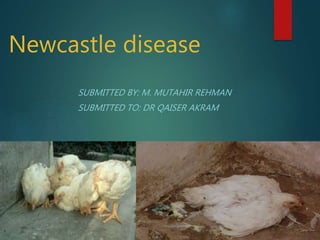

Newcastle disease
SUBMITTED BY: M. MUTAHIR REHMAN
SUBMITTED TO: DR QAISER AKRAM
Outline
 Definition
 Virus overview
 Hosts
 Route of transmission
 Pathogenesis
 Epidemiology
 Clinical findings
 Post mortem lesions
 Diagnosis
 Treatment
 Vaccination
 Control & prevention
Definition
Virulent Newcastle disease (VND), formerly exotic Newcastle
disease is a contagious viral avian disease affecting many
domestic and wild bird species caused by APMV-1 and is
characterized by respiratory, intestinal and nervous signs with
high mortality
First described in 1926 when severe outbreaks were reported in
Newcastle, England & in Java
Other major outbreaks occurred in the Middle East during the
late 1960s and in the 1970s when pigeons were the species
primarily affected
Virus overview
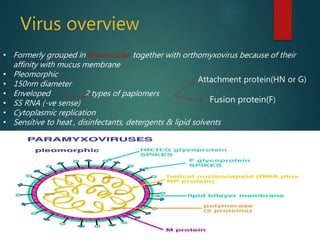
• Formerly grouped in Myxoviridae together with orthomyxovirus because of their
affinity with mucus membrane
• Pleomorphic
• 150nm diameter
• Enveloped 2 types of paplomers
• SS RNA (-ve sense)
• Cytoplasmic replication
• Sensitive to heat , disinfectants, detergents & lipid solvents
Fusion protein(F)
Attachment protein(HN or G)
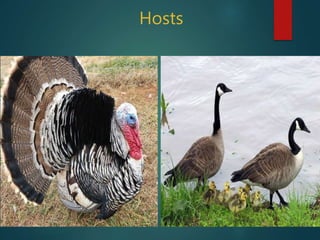
Hosts
Hosts
Route of transmission
• NDV is spread primarily through direct contact between healthy
birds and the bodily discharges of infected birds
• The disease is transmitted through infected birds' droppings
and secretions from the nose, mouth, and eyes
• High concentrations of the NDV are found in birds' bodily
discharges; therefore, the disease can be spread easily by
mechanical means
• Virus-bearing material can be picked up on shoes and clothing
and carried from an infected flock to a healthy one
• NDV can survive for several weeks in a warm and humid
environment on birds' feathers, manure, and other materials
• It can survive indefinitely in frozen material
• However, the virus is destroyed rapidly by dehydration and by the
ultraviolet rays in sunlight
 Smuggled pet birds, especially Amazon parrots from Latin
America, pose a great risk of introducing NDV into the US
 Amazon parrots are carriers of the disease, but do not show
symptoms, and are capable of shedding NDV for more than 400
days
Contin….
Epidemiology
• Infection with NDV is probably endemic in wild birds
especially waterfowl
• Strains of NDV differ in their virulence
• It appears that virulent strains may arise from progenitor
viruses of low virulence following passage in chickens
• Humans may become infected; manifested by unilateral or
bilateral reddening, excessive, lachrymation, edema of the
eyelids, conjunctivitis and sub-conjunctival hemorrhage
Pathotypes
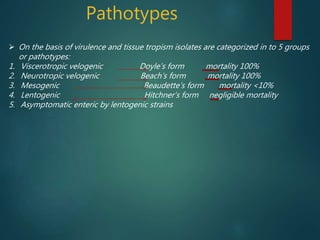
 On the basis of virulence and tissue tropism isolates are categorized in to 5 groups
or pathotypes:
1. Viscerotropic velogenic Doyle’s form mortality 100%
2. Neurotropic velogenic Beach’s form mortality 100%
3. Mesogenic Beaudette’s form mortality <10%
4. Lentogenic Hitchner’s form negligible mortality
5. Asymptomatic enteric by lentogenic strains
Pathogenesis
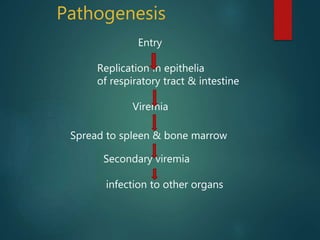
Entry
Replication in epithelia
of respiratory tract & intestine
Viremia
Spread to spleen & bone marrow
Secondary viremia
infection to other organs
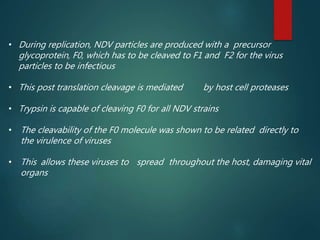
• During replication, NDV particles are produced with a precursor
glycoprotein, F0, which has to be cleaved to F1 and F2 for the virus
particles to be infectious
• This post translation cleavage is mediated by host cell proteases
• Trypsin is capable of cleaving F0 for all NDV strains
• The cleavability of the F0 molecule was shown to be related directly to
the virulence of viruses
• This allows these viruses to spread throughout the host, damaging vital
organs
Clinical findings
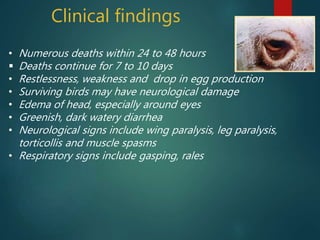
• Numerous deaths within 24 to 48 hours
 Deaths continue for 7 to 10 days
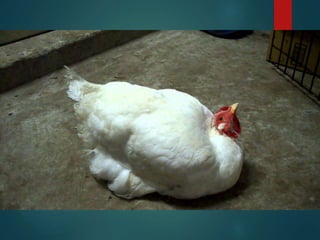
• Restlessness, weakness and drop in egg production
• Surviving birds may have neurological damage
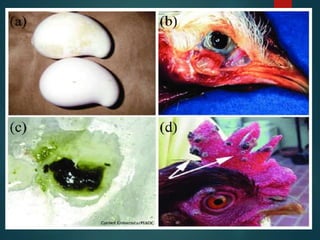
• Edema of head, especially around eyes
• Greenish, dark watery diarrhea
• Neurological signs include wing paralysis, leg paralysis,
torticollis and muscle spasms
• Respiratory signs include gasping, rales
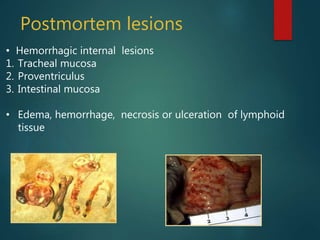
Postmortem lesions
• Hemorrhagic internal lesions
1. Tracheal mucosa
2. Proventriculus
3. Intestinal mucosa
• Edema, hemorrhage, necrosis or ulceration of lymphoid
tissue
Diagnosis
• On the basis of clinical signs & symptoms
• Tracheal & oral swabs
• Feces, intestinal contents and portion of trachea
• Haemagglutination – inhibition test
• Intracerebral pathogenicity test
Control
• Disinfection of premises
• Delay re-introduction of new birds for 30 days
• Control insects and mice
• Limit human traffic
• Combination of vaccination and slaughter policies
Vaccination
• Vaccination routine worldwide
• Reduces clinical signs
• Does not prevent virus replication or shedding
• Not an alternative to good management, biosecurity or good hygiene in rearing
practices
• Lentogenic & mesogenic strains propagated in eggs or tissue culture are used in
live vaccines
• Vaccines are administered as a spray, drinking water or by intranasal or
intraconjuctival instillation

Newcastle disease

  • 1.
    Newcastle disease SUBMITTED BY:M. MUTAHIR REHMAN SUBMITTED TO: DR QAISER AKRAM
  • 2.
    Outline  Definition  Virusoverview  Hosts  Route of transmission  Pathogenesis  Epidemiology  Clinical findings  Post mortem lesions  Diagnosis  Treatment  Vaccination  Control & prevention
  • 3.
    Definition Virulent Newcastle disease(VND), formerly exotic Newcastle disease is a contagious viral avian disease affecting many domestic and wild bird species caused by APMV-1 and is characterized by respiratory, intestinal and nervous signs with high mortality First described in 1926 when severe outbreaks were reported in Newcastle, England & in Java Other major outbreaks occurred in the Middle East during the late 1960s and in the 1970s when pigeons were the species primarily affected
  • 4.
    Virus overview • Formerlygrouped in Myxoviridae together with orthomyxovirus because of their affinity with mucus membrane • Pleomorphic • 150nm diameter • Enveloped 2 types of paplomers • SS RNA (-ve sense) • Cytoplasmic replication • Sensitive to heat , disinfectants, detergents & lipid solvents Fusion protein(F) Attachment protein(HN or G)
  • 5.
  • 6.
  • 7.
    Route of transmission •NDV is spread primarily through direct contact between healthy birds and the bodily discharges of infected birds • The disease is transmitted through infected birds' droppings and secretions from the nose, mouth, and eyes • High concentrations of the NDV are found in birds' bodily discharges; therefore, the disease can be spread easily by mechanical means • Virus-bearing material can be picked up on shoes and clothing and carried from an infected flock to a healthy one
  • 8.
    • NDV cansurvive for several weeks in a warm and humid environment on birds' feathers, manure, and other materials • It can survive indefinitely in frozen material • However, the virus is destroyed rapidly by dehydration and by the ultraviolet rays in sunlight  Smuggled pet birds, especially Amazon parrots from Latin America, pose a great risk of introducing NDV into the US  Amazon parrots are carriers of the disease, but do not show symptoms, and are capable of shedding NDV for more than 400 days Contin….
  • 9.
    Epidemiology • Infection withNDV is probably endemic in wild birds especially waterfowl • Strains of NDV differ in their virulence • It appears that virulent strains may arise from progenitor viruses of low virulence following passage in chickens • Humans may become infected; manifested by unilateral or bilateral reddening, excessive, lachrymation, edema of the eyelids, conjunctivitis and sub-conjunctival hemorrhage
  • 10.
    Pathotypes  On thebasis of virulence and tissue tropism isolates are categorized in to 5 groups or pathotypes: 1. Viscerotropic velogenic Doyle’s form mortality 100% 2. Neurotropic velogenic Beach’s form mortality 100% 3. Mesogenic Beaudette’s form mortality <10% 4. Lentogenic Hitchner’s form negligible mortality 5. Asymptomatic enteric by lentogenic strains
  • 11.
    Pathogenesis Entry Replication in epithelia ofrespiratory tract & intestine Viremia Spread to spleen & bone marrow Secondary viremia infection to other organs
  • 12.
    • During replication,NDV particles are produced with a precursor glycoprotein, F0, which has to be cleaved to F1 and F2 for the virus particles to be infectious • This post translation cleavage is mediated by host cell proteases • Trypsin is capable of cleaving F0 for all NDV strains • The cleavability of the F0 molecule was shown to be related directly to the virulence of viruses • This allows these viruses to spread throughout the host, damaging vital organs
  • 13.
    Clinical findings • Numerousdeaths within 24 to 48 hours  Deaths continue for 7 to 10 days • Restlessness, weakness and drop in egg production • Surviving birds may have neurological damage • Edema of head, especially around eyes • Greenish, dark watery diarrhea • Neurological signs include wing paralysis, leg paralysis, torticollis and muscle spasms • Respiratory signs include gasping, rales
  • 16.
    Postmortem lesions • Hemorrhagicinternal lesions 1. Tracheal mucosa 2. Proventriculus 3. Intestinal mucosa • Edema, hemorrhage, necrosis or ulceration of lymphoid tissue
  • 18.
    Diagnosis • On thebasis of clinical signs & symptoms • Tracheal & oral swabs • Feces, intestinal contents and portion of trachea • Haemagglutination – inhibition test • Intracerebral pathogenicity test
  • 19.
    Control • Disinfection ofpremises • Delay re-introduction of new birds for 30 days • Control insects and mice • Limit human traffic • Combination of vaccination and slaughter policies
  • 20.
    Vaccination • Vaccination routineworldwide • Reduces clinical signs • Does not prevent virus replication or shedding • Not an alternative to good management, biosecurity or good hygiene in rearing practices • Lentogenic & mesogenic strains propagated in eggs or tissue culture are used in live vaccines • Vaccines are administered as a spray, drinking water or by intranasal or intraconjuctival instillation