Care to the new born child within 1-2
hours of birth of a child

Dr Rakesh Kumar
Asst. professor
Dept of pediatrics
N.M.C.H, Patna
Definition
Newborn Period
- birth up to the 27th completed day
of 28 days)

(total

Essential Newborn Care Course
- Covers essential interventions in the 1st
hours after birth until the first week of life
- Emphasizes the need for a package /bundle
of interventions
Definitions contd…


Preterm Baby: A baby who is born before 37 weeks(259 days).



Low Birth Weight(LBW): A baby weighing <2.5 kg.



Very low birth weight (VLBW): wt. < 1.5 kg



Extremely low birth weight (ELBW): w < 1.0 kg



Neonate: A baby who is ≤ 4 weeks or 28 days.



Early Neonatal Period(< 7 days).



Late Neonatal Period(7-28 days).



Infant: A child who is less than 1 year or 365 days.
Millennium Development Goal
(MDG) 4
The

fourth Millennium Development
Goal (MDG 4) aims to reduce the 1990
mortality rate among under-five children
by two thirds.
Millennium Development Goals adopted
by the United Nations in 2000 aim to
decrease child deaths worldwide by 2015.
Key facts about neonatal
mortality
Every

year nearly 41% of all under-five
child deaths are among newborn infants,
i.e. the neonatal period.
75%of all newborn deaths occur in the
first week of life.
In developing countries nearly half of all
mothers and newborns do not receive
skilled care during and immediately after
birth.
Key facts contd….
Up

to two thirds of newborn deaths can
be prevented if known, effective health
measures are provided at birth and
during the first week of life.
Of the 8.2 million under-five child deaths
per year, about 3.3 million occur during
the neonatal period.
The majority - almost 3 million of these die within one week and almost 2 million
on their first day of life.
Key facts contd….
An

additional 3.3 million are stillborn.
A child’s risk of death in the first four
weeks of life is nearly 15 times greater
than any other time before his or her
first birthday.
Almost 3 million of all the babies who die
each year can be saved with low-tech,
low-cost care
Neonatal mortality :Birth

process was the antecedent cause of
2/3 of deaths due to infections
◦ Lack of hygiene at childbirth and during newborn
period
◦ Home deliveries without skilled birth attendants

Birth

asphyxia in developing countries

◦ 3% of newborns suffer mild to moderate birth
asphyxia
◦ Prompt resuscitation is often not initiated or
procedure is inadequate or incorrect
Neonatal mortality :
Hypothermia

and newborn deaths

◦ Significant contribution to deaths in low birth
weight infants and preterm newborns
◦ Social, cultural and health practices delaying
care to the newborn
Ophthalmia

neonatorum is a common
cause of blindness
Neonatal mortality:
Low

birth weight

◦ An extremely important factor in newborn
mortality
Place

of childbirth

◦ At least 2 out 3 childbirths in developing
countries occur at home
◦ Only half are attended by skilled birth attendants
◦ Strategies for improving newborn health should
target
 Birth attendant, families and communities
 Healthcare providers within the formal health system
Essential Newborn Care
Interventions
Clean

childbirth and cord care

◦ Prevent newborn infection
Thermal

protection

◦ Prevent and manage newborn
hypo/hyperthermia
Early

and exclusive breastfeeding

◦ Started within 1 hour after childbirth
Initiation

of breathing and resuscitation

◦ Early asphyxia identification and management
Contd…
Eye

care

◦ Prevent and manage ophthalmia neonatorum
Immunization

◦ At birth: bacille Calmette-Guerin (BCG)
vaccine, oral poliovirus vaccine (OPV) and
hepatitis B virus (HBV) vaccine (WHO)
Identification

and management of sick

newborn
Care of preterm and or low birth weight
newborn
Cleanliness to Prevent
Infection

Principles

of cleanliness essential in both
home and health facilities childbirths
Principles of cleanliness at childbirth
◦
◦
◦
◦
◦
◦

Clean hands
Clean perineum
Nothing unclean introduced vaginally
Clean delivery surface
Cleanliness in cord clamping and cutting
Cleanliness for cord care

Infection

prevention/control measures at
healthcare facilities
Thermal Protection of neonate
Newborn

physiology

◦ Normal temperature: 36.5–37.5°C
◦ Hypothermia: < 36.5°C
◦ Stabilization period: 1st 6–12 hours after birth







Large surface area
Poor thermal insulation
Small body mass to produce and conserve heat
Inability to change posture or adjust clothing to respond
to thermal stress

Increase hypothermia

◦ Newborn left wet while waiting for delivery of
placenta
◦ Early bathing of newborn (within 24 hours)
Hypothermia prevention in
newborn

Deliver in a warm room
Dry newborn thoroughly

and wrap in dry, warm

cloth
Keep out of draft and place on a warm surface
Give to mother as soon as possible

◦ Skin-to-skin contact first few hours after childbirth
◦ Promotes bonding
◦ Enables early breastfeeding

Check

warmth by feeling newborn’s feet every 15
minutes
Bathe when temperature is stable (after 24
hours)
Early & exclusive breast
feeding
Early

contact between mother and newborn

◦ Enables breastfeeding
◦ Rooming-in policies in health facilities prevents
nosocomial infection
Best

practices

◦ No prelacteal feeds or other supplement
◦ Giving first breastfeed within one hour of birth
◦ Correct positioning to enable good attachment
of the newborn
◦ Breastfeeding on demand
◦ Psycho-social support to breastfeeding mother
Neonatal resuscitation if needed
 Spontaneous

newborns

breathing (> 30 breaths/min.) in most

◦ Gentle stimulation, if at all

 Effectiveness

unknown

of routine oro-nasal suctioning is

◦ Biologically plausible advantages – clear airway
◦ Potentially real disadvantages – cardiac arrhythmia
◦ Bulb suctioning preferred

 Newborn

◦
◦
◦
◦

resuscitation may be needed

Fetal distress
Thick meconium staining
Vaginal breech deliveries
Preterm
Eye Care To Prevent or
Manage Ophthalmia
OphthalmiaNeonatorum
neonatorum
◦ Conjunctivitis with discharge during first 2 weeks
of life
◦ Appears usually 2–5 days after birth
◦ Corneal damage if untreated
◦ Systemic progression if not managed
Etiology

◦ N. gonorrhea
 More severe and rapid development of complications
 30–50% mother-newborn transmission rate

◦ C. trachomatis
Eye Care To Prevent or
Manage Ophthalmia
Neonatorum
Prophylaxis
◦ Clean eyes immediately
◦ 1% Silver nitrate solution
 Not effective for chlamydia

◦ 2.5% Povidone-iodine solution
◦ 1% Tetracycline ointment
Immunization
BCG,

OPV, HBV
BCG vaccinations to all neonate.
Single dose of OPV at birth .
HBV vaccination as soon as possible.
Clinical assessment
After

delivery of the baby and in the
absence of any immediate problems,
essential newborn care begins with a
thorough general clinical assessment.
This

should be done on all infants soon
after birth to detect signs of illness and
congenital abnormalities.
Clinical assessment

First steps and appearance
Start by congratulating the mother on the

arrival of her new baby and ask if she has any
concerns. The mother is usually the first
person to notice any problems.
Ask about feeding and the passage of urine
and stools. The infant should pass meconium
(the first black, tarry stools) within 24 hours
of birth.
General observation: inspect colour,
breathing, alertness and spontaneous
activity.
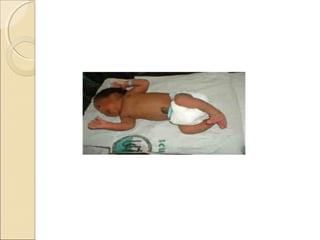
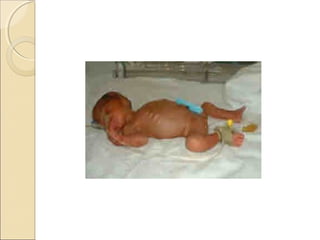
Well infants have a flexed, posture. Partially
flexed posture is found in hypotonia or
prematurity
Clinical assessment
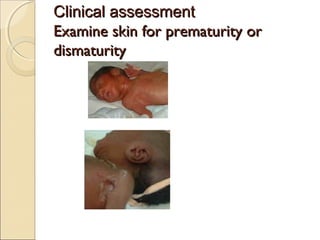
Examine skin for prematurity or
dismaturity
Clinical assessment
Skin: some common normal findings
 Vernix

caseosa: a cream/white cheesy material on the skin
at birth which cleans off easily with oil.
 Lanugo; fine downy hairs seen on the back and shoulders
especially in preterm infants.
 Milia: pinpoint whitish papules on nose and cheeks due to
blocked sebaceous glands.
 Mongolian blue spots: grey/bluish pigment patches seen in
the lumbar area, buttocks and extremities in dark skinned
babies.They usually disappear by one year.
 Capillary heamangiomas (“stork bite” naevi): red flat patches
which blanch with gentle pressure. Commonly occur on
upper eyelids, forehead and nape of the neck.
 Erythema toxicum: small white/yellow papules or pustules on
a red base seen on face, trunk and limbs. Develop 1 – 3 days
after birth and usually disappear by one week
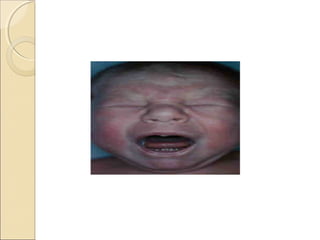
Clinical assessment- color
 Note

palor or plethora

 Cyanosis:

the baby should be uniformly pink

◦ Blueness of the hands and feet (peripheral cyanosis)
may be due to cold extremeties.
◦ Blueness of the mucous membranes and tongue is
central cyanosis and is usually due to lung or heart
problems
 Bruising

(ecchymosis) is common after birth trauma.
Unlike cyanosis, bruising does not blanch on gentle
pressure.
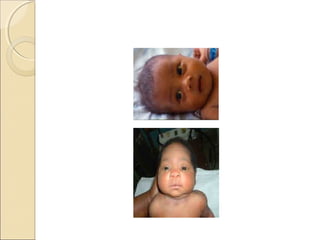
Clinical assessment - jaundice
Jaundice is common in the first week of life
and may be missed in dark skinned babies
Blanch

the tip of the nose or hold baby
up and gently tip forward and backward
to get the eyes to open.

Teach

mother to do the same at home in
the first week and report to hospital if
significant jaundice is observed.
Clinical assessment

Head

After these general observations, examine the
infant starting with the head and moving
down the body.
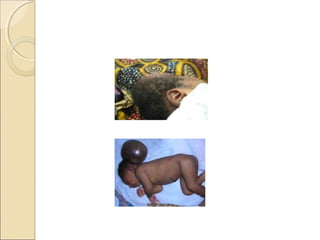
Observe the size and shape of the head
(micro- or macrocephaly; cephalhaematoma)
Check the anterior and posterior
fontanelles and that the skull sutures feel
normal
Form and position of ears (low set ears
occur in chromosomal abnormalities, e.g.
Down syndrome)
Clinical assessment

Eyes and face
Examine

eyes for ocular anomalies and
check for red reflex using the
ophthalmoscope (to exclude cataract)

Examine

the face for dysmorphic features
and normal movements

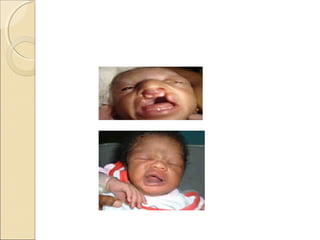
Examine

lips and palate for clefts
Clinical assessment

Cardiovascular and respiratory
Feel

femoral and radial pulses for volume, rate and rhythm.

In

aortic coarctation, femoral pulse is reduced, absent or not
synchronous with radial pulse.

If

child is sick, measure blood pressure.

Locate

the apex beat and listen to the heart sounds for murmurs.

Count

the respiratory rate

◦ normal 30 – 40 breaths/min in term infants
◦ faster in preterms.
◦ > 60 / minute abnormal
Observe

for respiratory distress: nasal flaring, intercostal and
subcostal recession.
Clinical assessment

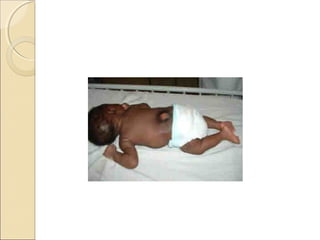
Abdomen
 Inspect

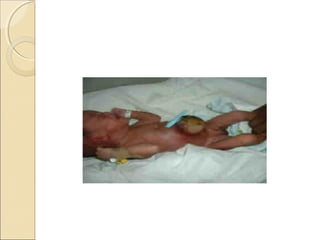
the umbilical cord for presence of 2
arteries and a vein. Abnormal components may
be a pointer to the presence of intra-abdominal
anomalies e.g. renal.

 Look

for umbilical abnormalities, e.g. hernia,
omphalocoele, exompholos

 Gently

palpate the abdomen

◦ the liver may be palpable upto 2cm below
the costal margin
Clinical assessment

Spine and genitalia
Examine:
The spine for dimples, tuft of hair (spina
bifida occulta) or cystic swellings (spina
bifida cystica)
Remove the diaper to examine the genitalia.
In boys, confirm that both testicles have
descended into the scrotum.
Designate the infant’s sex
Inspect the perineum and check anus for
position and patency (can be done by gently
checking rectal temperature)
Clinical assessment

Dysmorphic features
Examine

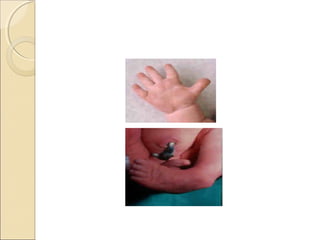
hands. Note single palmar crease
in chromosome abnormalities.

Inspect

the feet. Note effects of foetal
posture should be noted.

Check

hips for dislocation

Limitation

of limb movements occurs in
fractures and nerve injury
Clinical assessment

Routine measurements
Measure:
Weight

◦ normal 2.5 – 3.99kg
Length

◦ normal 48 – 52cm
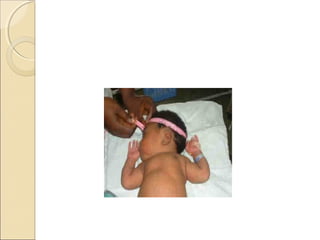
Occipitofrontal

circumference (OFC)

◦ normal 33 – 37cm
Thank you

essential newborn care, careduring 1st-2hr of life

  • 1.
    Care to thenew born child within 1-2 hours of birth of a child Dr Rakesh Kumar Asst. professor Dept of pediatrics N.M.C.H, Patna
  • 2.
    Definition Newborn Period - birthup to the 27th completed day of 28 days) (total Essential Newborn Care Course - Covers essential interventions in the 1st hours after birth until the first week of life - Emphasizes the need for a package /bundle of interventions
  • 3.
    Definitions contd…  Preterm Baby:A baby who is born before 37 weeks(259 days).  Low Birth Weight(LBW): A baby weighing <2.5 kg.  Very low birth weight (VLBW): wt. < 1.5 kg  Extremely low birth weight (ELBW): w < 1.0 kg  Neonate: A baby who is ≤ 4 weeks or 28 days.  Early Neonatal Period(< 7 days).  Late Neonatal Period(7-28 days).  Infant: A child who is less than 1 year or 365 days.
  • 4.
    Millennium Development Goal (MDG)4 The fourth Millennium Development Goal (MDG 4) aims to reduce the 1990 mortality rate among under-five children by two thirds. Millennium Development Goals adopted by the United Nations in 2000 aim to decrease child deaths worldwide by 2015.
  • 5.
    Key facts aboutneonatal mortality Every year nearly 41% of all under-five child deaths are among newborn infants, i.e. the neonatal period. 75%of all newborn deaths occur in the first week of life. In developing countries nearly half of all mothers and newborns do not receive skilled care during and immediately after birth.
  • 6.
    Key facts contd…. Up totwo thirds of newborn deaths can be prevented if known, effective health measures are provided at birth and during the first week of life. Of the 8.2 million under-five child deaths per year, about 3.3 million occur during the neonatal period. The majority - almost 3 million of these die within one week and almost 2 million on their first day of life.
  • 7.
    Key facts contd…. An additional3.3 million are stillborn. A child’s risk of death in the first four weeks of life is nearly 15 times greater than any other time before his or her first birthday. Almost 3 million of all the babies who die each year can be saved with low-tech, low-cost care
  • 8.
    Neonatal mortality :Birth processwas the antecedent cause of 2/3 of deaths due to infections ◦ Lack of hygiene at childbirth and during newborn period ◦ Home deliveries without skilled birth attendants Birth asphyxia in developing countries ◦ 3% of newborns suffer mild to moderate birth asphyxia ◦ Prompt resuscitation is often not initiated or procedure is inadequate or incorrect
  • 9.
    Neonatal mortality : Hypothermia andnewborn deaths ◦ Significant contribution to deaths in low birth weight infants and preterm newborns ◦ Social, cultural and health practices delaying care to the newborn Ophthalmia neonatorum is a common cause of blindness
  • 10.
    Neonatal mortality: Low birth weight ◦An extremely important factor in newborn mortality Place of childbirth ◦ At least 2 out 3 childbirths in developing countries occur at home ◦ Only half are attended by skilled birth attendants ◦ Strategies for improving newborn health should target  Birth attendant, families and communities  Healthcare providers within the formal health system
  • 11.
    Essential Newborn Care Interventions Clean childbirthand cord care ◦ Prevent newborn infection Thermal protection ◦ Prevent and manage newborn hypo/hyperthermia Early and exclusive breastfeeding ◦ Started within 1 hour after childbirth Initiation of breathing and resuscitation ◦ Early asphyxia identification and management
  • 12.
    Contd… Eye care ◦ Prevent andmanage ophthalmia neonatorum Immunization ◦ At birth: bacille Calmette-Guerin (BCG) vaccine, oral poliovirus vaccine (OPV) and hepatitis B virus (HBV) vaccine (WHO) Identification and management of sick newborn Care of preterm and or low birth weight newborn
  • 13.
    Cleanliness to Prevent Infection Principles ofcleanliness essential in both home and health facilities childbirths Principles of cleanliness at childbirth ◦ ◦ ◦ ◦ ◦ ◦ Clean hands Clean perineum Nothing unclean introduced vaginally Clean delivery surface Cleanliness in cord clamping and cutting Cleanliness for cord care Infection prevention/control measures at healthcare facilities
  • 14.
    Thermal Protection ofneonate Newborn physiology ◦ Normal temperature: 36.5–37.5°C ◦ Hypothermia: < 36.5°C ◦ Stabilization period: 1st 6–12 hours after birth      Large surface area Poor thermal insulation Small body mass to produce and conserve heat Inability to change posture or adjust clothing to respond to thermal stress Increase hypothermia ◦ Newborn left wet while waiting for delivery of placenta ◦ Early bathing of newborn (within 24 hours)
  • 15.
    Hypothermia prevention in newborn Deliverin a warm room Dry newborn thoroughly and wrap in dry, warm cloth Keep out of draft and place on a warm surface Give to mother as soon as possible ◦ Skin-to-skin contact first few hours after childbirth ◦ Promotes bonding ◦ Enables early breastfeeding Check warmth by feeling newborn’s feet every 15 minutes Bathe when temperature is stable (after 24 hours)
  • 16.
    Early & exclusivebreast feeding Early contact between mother and newborn ◦ Enables breastfeeding ◦ Rooming-in policies in health facilities prevents nosocomial infection Best practices ◦ No prelacteal feeds or other supplement ◦ Giving first breastfeed within one hour of birth ◦ Correct positioning to enable good attachment of the newborn ◦ Breastfeeding on demand ◦ Psycho-social support to breastfeeding mother
  • 17.
    Neonatal resuscitation ifneeded  Spontaneous newborns breathing (> 30 breaths/min.) in most ◦ Gentle stimulation, if at all  Effectiveness unknown of routine oro-nasal suctioning is ◦ Biologically plausible advantages – clear airway ◦ Potentially real disadvantages – cardiac arrhythmia ◦ Bulb suctioning preferred  Newborn ◦ ◦ ◦ ◦ resuscitation may be needed Fetal distress Thick meconium staining Vaginal breech deliveries Preterm
  • 18.
    Eye Care ToPrevent or Manage Ophthalmia OphthalmiaNeonatorum neonatorum ◦ Conjunctivitis with discharge during first 2 weeks of life ◦ Appears usually 2–5 days after birth ◦ Corneal damage if untreated ◦ Systemic progression if not managed Etiology ◦ N. gonorrhea  More severe and rapid development of complications  30–50% mother-newborn transmission rate ◦ C. trachomatis
  • 19.
    Eye Care ToPrevent or Manage Ophthalmia Neonatorum Prophylaxis ◦ Clean eyes immediately ◦ 1% Silver nitrate solution  Not effective for chlamydia ◦ 2.5% Povidone-iodine solution ◦ 1% Tetracycline ointment
  • 20.
    Immunization BCG, OPV, HBV BCG vaccinationsto all neonate. Single dose of OPV at birth . HBV vaccination as soon as possible.
  • 21.
    Clinical assessment After delivery ofthe baby and in the absence of any immediate problems, essential newborn care begins with a thorough general clinical assessment. This should be done on all infants soon after birth to detect signs of illness and congenital abnormalities.
  • 22.
    Clinical assessment First stepsand appearance Start by congratulating the mother on the arrival of her new baby and ask if she has any concerns. The mother is usually the first person to notice any problems. Ask about feeding and the passage of urine and stools. The infant should pass meconium (the first black, tarry stools) within 24 hours of birth. General observation: inspect colour, breathing, alertness and spontaneous activity. Well infants have a flexed, posture. Partially flexed posture is found in hypotonia or prematurity
  • 25.
    Clinical assessment Examine skinfor prematurity or dismaturity
  • 26.
    Clinical assessment Skin: somecommon normal findings  Vernix caseosa: a cream/white cheesy material on the skin at birth which cleans off easily with oil.  Lanugo; fine downy hairs seen on the back and shoulders especially in preterm infants.  Milia: pinpoint whitish papules on nose and cheeks due to blocked sebaceous glands.  Mongolian blue spots: grey/bluish pigment patches seen in the lumbar area, buttocks and extremities in dark skinned babies.They usually disappear by one year.  Capillary heamangiomas (“stork bite” naevi): red flat patches which blanch with gentle pressure. Commonly occur on upper eyelids, forehead and nape of the neck.  Erythema toxicum: small white/yellow papules or pustules on a red base seen on face, trunk and limbs. Develop 1 – 3 days after birth and usually disappear by one week
  • 27.
    Clinical assessment- color Note palor or plethora  Cyanosis: the baby should be uniformly pink ◦ Blueness of the hands and feet (peripheral cyanosis) may be due to cold extremeties. ◦ Blueness of the mucous membranes and tongue is central cyanosis and is usually due to lung or heart problems  Bruising (ecchymosis) is common after birth trauma. Unlike cyanosis, bruising does not blanch on gentle pressure.
  • 29.
    Clinical assessment -jaundice Jaundice is common in the first week of life and may be missed in dark skinned babies Blanch the tip of the nose or hold baby up and gently tip forward and backward to get the eyes to open. Teach mother to do the same at home in the first week and report to hospital if significant jaundice is observed.
  • 31.
    Clinical assessment Head After thesegeneral observations, examine the infant starting with the head and moving down the body. Observe the size and shape of the head (micro- or macrocephaly; cephalhaematoma) Check the anterior and posterior fontanelles and that the skull sutures feel normal Form and position of ears (low set ears occur in chromosomal abnormalities, e.g. Down syndrome)
  • 33.
    Clinical assessment Eyes andface Examine eyes for ocular anomalies and check for red reflex using the ophthalmoscope (to exclude cataract) Examine the face for dysmorphic features and normal movements Examine lips and palate for clefts
  • 35.
    Clinical assessment Cardiovascular andrespiratory Feel femoral and radial pulses for volume, rate and rhythm. In aortic coarctation, femoral pulse is reduced, absent or not synchronous with radial pulse. If child is sick, measure blood pressure. Locate the apex beat and listen to the heart sounds for murmurs. Count the respiratory rate ◦ normal 30 – 40 breaths/min in term infants ◦ faster in preterms. ◦ > 60 / minute abnormal Observe for respiratory distress: nasal flaring, intercostal and subcostal recession.
  • 36.
    Clinical assessment Abdomen  Inspect theumbilical cord for presence of 2 arteries and a vein. Abnormal components may be a pointer to the presence of intra-abdominal anomalies e.g. renal.  Look for umbilical abnormalities, e.g. hernia, omphalocoele, exompholos  Gently palpate the abdomen ◦ the liver may be palpable upto 2cm below the costal margin
  • 38.
    Clinical assessment Spine andgenitalia Examine: The spine for dimples, tuft of hair (spina bifida occulta) or cystic swellings (spina bifida cystica) Remove the diaper to examine the genitalia. In boys, confirm that both testicles have descended into the scrotum. Designate the infant’s sex Inspect the perineum and check anus for position and patency (can be done by gently checking rectal temperature)
  • 40.
    Clinical assessment Dysmorphic features Examine hands.Note single palmar crease in chromosome abnormalities. Inspect the feet. Note effects of foetal posture should be noted. Check hips for dislocation Limitation of limb movements occurs in fractures and nerve injury
  • 42.
    Clinical assessment Routine measurements Measure: Weight ◦normal 2.5 – 3.99kg Length ◦ normal 48 – 52cm Occipitofrontal circumference (OFC) ◦ normal 33 – 37cm
  • 44.