ESSENTIAL
NEWBORN CARE
SHEBA SUSAN BENNY
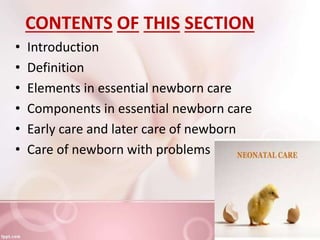
CONTENTS OF THIS SECTION
• Introduction
• Definition
• Elements in essential newborn care
• Components in essential newborn care
• Early care and later care of newborn
• Care of newborn with problems
INTRODUCTION
In India,
2/3 under 5 deaths (66%) happens in 1st
year of life
2/3 infant deaths happens in 1st month /
neonatal period
¾ neonatal deaths happens in 1st day of life
• Birth asphyxia
• Infection
• Hypothermia
• Feeding problems
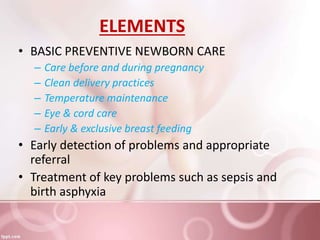
ELEMENTS
• BASIC PREVENTIVE NEWBORN CARE
– Care before and during pregnancy
– Clean delivery practices
– Temperature maintenance
– Eye & cord care
– Early & exclusive breast feeding
• Early detection of problems and appropriate
referral
• Treatment of key problems such as sepsis and
birth asphyxia
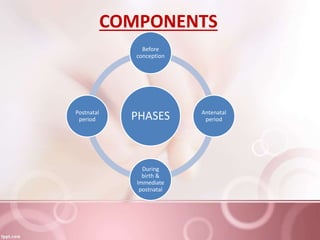
COMPONENTS
PHASES
Before
conception
Antenatal
period
During
birth &
Immediate
postnatal
Postnatal
period
1. Before conception
• Adequate care of a girl child, including
nutrition, education & health care
• Immunization, including TT
• Folate supplementation
• Birth spacing
• Prevention of STD’s
• Avoidance of drug & substance abuse
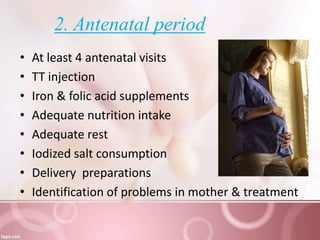
2. Antenatal period
• At least 4 antenatal visits
• TT injection
• Iron & folic acid supplements
• Adequate nutrition intake
• Adequate rest
• Iodized salt consumption
• Delivery preparations
• Identification of problems in mother & treatment
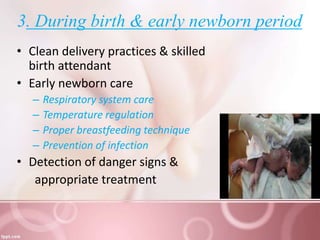
3. During birth & early newborn period
• Clean delivery practices & skilled
birth attendant
• Early newborn care
– Respiratory system care
– Temperature regulation
– Proper breastfeeding technique
– Prevention of infection
• Detection of danger signs &
appropriate treatment
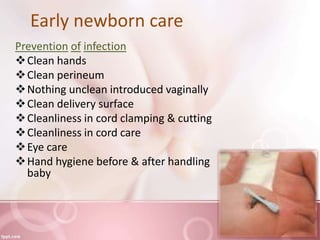
Early newborn care
Prevention of infection
Clean hands
Clean perineum
Nothing unclean introduced vaginally
Clean delivery surface
Cleanliness in cord clamping & cutting
Cleanliness in cord care
Eye care
Hand hygiene before & after handling
baby
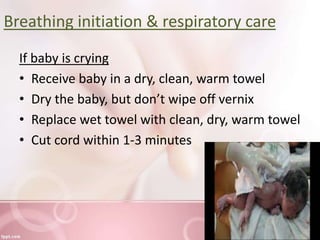
Breathing initiation & respiratory care
If baby is crying
• Receive baby in a dry, clean, warm towel
• Dry the baby, but don’t wipe off vernix
• Replace wet towel with clean, dry, warm towel
• Cut cord within 1-3 minutes
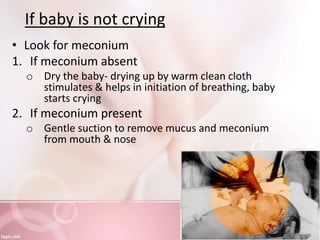
If baby is not crying
• Look for meconium
1. If meconium absent
o Dry the baby- drying up by warm clean cloth
stimulates & helps in initiation of breathing, baby
starts crying
2. If meconium present
o Gentle suction to remove mucus and meconium
from mouth & nose
If baby still not crying
• Cut the cord
• Place on a flat, firm warm surface
• Position baby with neck slightly extended
• Suction mouth & then nose
• Stimulate and reposition
……………… If baby still not crying
Contd…..
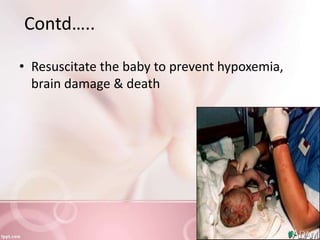
• Resuscitate the baby to prevent hypoxemia,
brain damage & death
Temperature regulation
• Deliver in a warm room
• Dry baby thoroughly & wrap in a warm, clean
cloth.
• Wrap head & body completely
• Give to mother as soon as possible
• Check warmth by feeling newborn’s feet every 15
minutes
• Bathe only after 24hrs
• Maintain temp of 36.5-37.5 degree C
Feeding technique & exclusive
breastfeeding
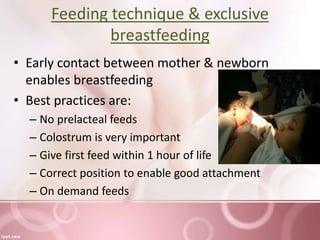
• Early contact between mother & newborn
enables breastfeeding
• Best practices are:
– No prelacteal feeds
– Colostrum is very important
– Give first feed within 1 hour of life
– Correct position to enable good attachment
– On demand feeds
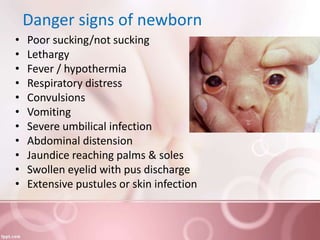
Danger signs of newborn
• Poor sucking/not sucking
• Lethargy
• Fever / hypothermia
• Respiratory distress
• Convulsions
• Vomiting
• Severe umbilical infection
• Abdominal distension
• Jaundice reaching palms & soles
• Swollen eyelid with pus discharge
• Extensive pustules or skin infection
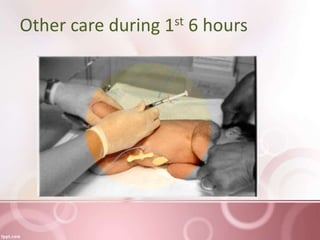
Other care during 1st 6 hours
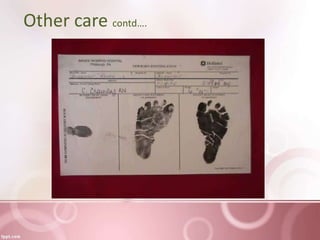
Other care contd….
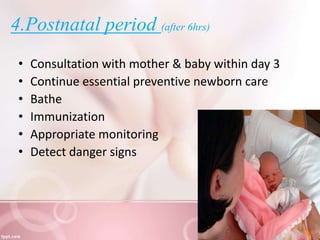
4.Postnatal period (after 6hrs)
• Consultation with mother & baby within day 3
• Continue essential preventive newborn care
• Bathe
• Immunization
• Appropriate monitoring
• Detect danger signs
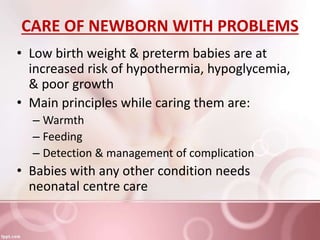
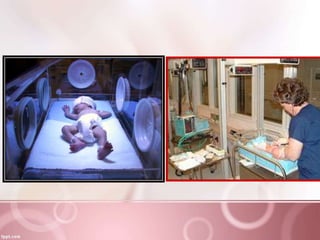
CARE OF NEWBORN WITH PROBLEMS
• Low birth weight & preterm babies are at
increased risk of hypothermia, hypoglycemia,
& poor growth
• Main principles while caring them are:
– Warmth
– Feeding
– Detection & management of complication
• Babies with any other condition needs
neonatal centre care
SUMMARY
Essential newborn care is a comprehensive
strategy, designed to improve the health of
newborns through interventions before
conception, during pregnancy, at & soon after
birth & in postnatal period
REFERENCE
• WHO ‘PRACTICAL GUIDE FOR CARE IN
NORMAL BIRTH’, GENEVA
• USAID, ‘BEST PRACTICES IN MATERNAL &
NEWBORN CARE-A LEARNING RESOURCE
PACKAGE’, 2008, BALTIMORE
• INDIRA NARAYANAN & MANDY ROSS ‘THE
COMPONENTS OF ESSENTIAL NEWBORN
CARE’, USAID

Essential newborn care

  • 1.
  • 2.
    CONTENTS OF THISSECTION • Introduction • Definition • Elements in essential newborn care • Components in essential newborn care • Early care and later care of newborn • Care of newborn with problems
  • 3.
    INTRODUCTION In India, 2/3 under5 deaths (66%) happens in 1st year of life 2/3 infant deaths happens in 1st month / neonatal period ¾ neonatal deaths happens in 1st day of life • Birth asphyxia • Infection • Hypothermia • Feeding problems
  • 4.
    ELEMENTS • BASIC PREVENTIVENEWBORN CARE – Care before and during pregnancy – Clean delivery practices – Temperature maintenance – Eye & cord care – Early & exclusive breast feeding • Early detection of problems and appropriate referral • Treatment of key problems such as sepsis and birth asphyxia
  • 5.
  • 6.
    1. Before conception •Adequate care of a girl child, including nutrition, education & health care • Immunization, including TT • Folate supplementation • Birth spacing • Prevention of STD’s • Avoidance of drug & substance abuse
  • 7.
    2. Antenatal period •At least 4 antenatal visits • TT injection • Iron & folic acid supplements • Adequate nutrition intake • Adequate rest • Iodized salt consumption • Delivery preparations • Identification of problems in mother & treatment
  • 8.
    3. During birth& early newborn period • Clean delivery practices & skilled birth attendant • Early newborn care – Respiratory system care – Temperature regulation – Proper breastfeeding technique – Prevention of infection • Detection of danger signs & appropriate treatment
  • 9.
    Early newborn care Preventionof infection Clean hands Clean perineum Nothing unclean introduced vaginally Clean delivery surface Cleanliness in cord clamping & cutting Cleanliness in cord care Eye care Hand hygiene before & after handling baby
  • 10.
    Breathing initiation &respiratory care If baby is crying • Receive baby in a dry, clean, warm towel • Dry the baby, but don’t wipe off vernix • Replace wet towel with clean, dry, warm towel • Cut cord within 1-3 minutes
  • 11.
    If baby isnot crying • Look for meconium 1. If meconium absent o Dry the baby- drying up by warm clean cloth stimulates & helps in initiation of breathing, baby starts crying 2. If meconium present o Gentle suction to remove mucus and meconium from mouth & nose
  • 12.
    If baby stillnot crying • Cut the cord • Place on a flat, firm warm surface • Position baby with neck slightly extended • Suction mouth & then nose • Stimulate and reposition ……………… If baby still not crying
  • 13.
    Contd….. • Resuscitate thebaby to prevent hypoxemia, brain damage & death
  • 14.
    Temperature regulation • Deliverin a warm room • Dry baby thoroughly & wrap in a warm, clean cloth. • Wrap head & body completely • Give to mother as soon as possible • Check warmth by feeling newborn’s feet every 15 minutes • Bathe only after 24hrs • Maintain temp of 36.5-37.5 degree C
  • 15.
    Feeding technique &exclusive breastfeeding • Early contact between mother & newborn enables breastfeeding • Best practices are: – No prelacteal feeds – Colostrum is very important – Give first feed within 1 hour of life – Correct position to enable good attachment – On demand feeds
  • 16.
    Danger signs ofnewborn • Poor sucking/not sucking • Lethargy • Fever / hypothermia • Respiratory distress • Convulsions • Vomiting • Severe umbilical infection • Abdominal distension • Jaundice reaching palms & soles • Swollen eyelid with pus discharge • Extensive pustules or skin infection
  • 17.
    Other care during1st 6 hours
  • 18.
  • 19.
    4.Postnatal period (after6hrs) • Consultation with mother & baby within day 3 • Continue essential preventive newborn care • Bathe • Immunization • Appropriate monitoring • Detect danger signs
  • 20.
    CARE OF NEWBORNWITH PROBLEMS • Low birth weight & preterm babies are at increased risk of hypothermia, hypoglycemia, & poor growth • Main principles while caring them are: – Warmth – Feeding – Detection & management of complication • Babies with any other condition needs neonatal centre care
  • 22.
    SUMMARY Essential newborn careis a comprehensive strategy, designed to improve the health of newborns through interventions before conception, during pregnancy, at & soon after birth & in postnatal period
  • 25.
    REFERENCE • WHO ‘PRACTICALGUIDE FOR CARE IN NORMAL BIRTH’, GENEVA • USAID, ‘BEST PRACTICES IN MATERNAL & NEWBORN CARE-A LEARNING RESOURCE PACKAGE’, 2008, BALTIMORE • INDIRA NARAYANAN & MANDY ROSS ‘THE COMPONENTS OF ESSENTIAL NEWBORN CARE’, USAID