Dr. Sudhira Kumar Parida.
   Introduction
   Care at birth
   When a newborn baby should be examined ?
   Danger signs
   Examining the newborn at birth
   High risk neonates
   Prevention of hypothermia
   Prevention of infection
   Immunisation
   Normal phenomena after birth
   Resuscitation of newborn not breathing soon after birth
   Care of LBW babies
   Care of sick newborn babies
   Special situation
   Training
   Health Programmes
   Key messages
   References.
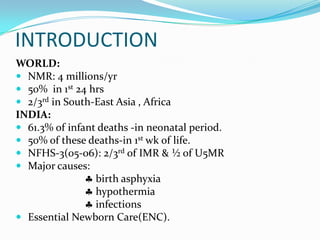
INTRODUCTION
WORLD:
 NMR: 4 millions/yr
 50% in 1st 24 hrs
 2/3rd in South-East Asia , Africa
INDIA:
 61.3% of infant deaths -in neonatal period.
 50% of these deaths-in 1st wk of life.
 NFHS-3(05-06): 2/3rd of IMR & ½ of U5MR
 Major causes:
                 birth asphyxia
                 hypothermia
                 infections
 Essential Newborn Care(ENC).
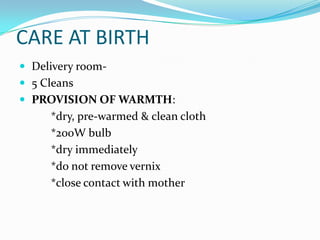
CARE AT BIRTH
 Delivery room-
 5 Cleans
 PROVISION OF WARMTH:
     *dry, pre-warmed & clean cloth
     *200W bulb
     *dry immediately
     *do not remove vernix
     *close contact with mother
 CORD CARE:
     *4 ‘C’s
     *left dry
     *no antiseptics/dressings
 EYE CARE:
     *clean cotton swabs
     *medial to lateral side
     *no prophylactic eye applications
 RECORDING BIRTH WEIGHT:
     *N: 2.5-3 kg
 INITIATING BREASTFEEDING:
    *within 1 hr of birth(within 4hr-C.S.)
    *advantage for        mother
                          baby
    *no pre-lacteal feeds.
WHEN A NEWBORN BABY SHOULD
BE EXAMINED ?
 AFTER BIRTH:
    + at around 1 hr
    +before discharge from hospital
    +if there is a maternal concern about the
     baby’s condition
    +if a danger sign is observed during
     monitoring
 AFTER LEAVING THE HOSPITAL:
    +during the 1st wk of life at a routine visit
    + follow-up
    + sick newborn visit
DANGER SIGNS
 Not suckling (after 6 hours of age)
 Fast breathing (> 60 breaths/min)
 Grunting
 Eyes swollen and draining pus
 Yellow skin on face and < 24 hours old
 > 10 skin pustules
EXAMINING THE NEWBORN AT
BIRTH
 IDENTIFICATION OF MALFORMATIONS:
      hydrocephalus
      meningomyelocele
      large omphalocele
      absent anal openings
 BREATHING PATTERN:
      N: 30-40/min
      irregular
      periodic
      at least 1 min
     quiet,not feeding
Respiration is not normal if-
       RR >60/min
       intercostal/subcostal retractions
       assoociated apnoea(+ cyanosis/HR <100 bpm)
 HR:
       N: 100-160 bpm
 ASSESSING PERFUSION:
       capillary refill time: N- 3s
 COLOUR:
       N: pink
       pale
       yellow
       blue
APGAR SCORING
TEST                0 Points             1 Points           2 Points


Appearance(skin     Blue-grey,pale all   Pink body & blue   Normal over entire
color)              over                 extremities        body,completely
                                                            pink
Pulse(HR)           Absent               <100 bpm           >100 bpm


Grimace(Reflex      No response          Facial grimace     Sneeze,cough,pull
irritability)                                               s away
Activity(m.tone)    Absent               Arms & legs        Active movement
                                         extended           with flexed arms &
                                                            legs
Respiration(Breathi Absent               Slow,irregular     Good,crying
ng)

              N: 7-10, 4-6: mod. Depressed, 0-3: severely depressed.
        ‘ONLY INDICATES IMMEDIATE HEALTH CONDITION OF BABY’
 Posture
1.Term newborn baby:
      loosely clenched fists
      flexed arms, hips, and knees
2.Small babies ( 2.5 kg at birth or born before 37 weeks
    gestation)
      limbs may be extended
3.Babies born in the breech position may have fully
  flexed hips and knees, feet and mouth, and legs may
  even reach near the mouth.
HIGH RISK NEONATES
    birth wt. < 1800 g and/or <35 wk GA
    SFD(<3rd centile) & LFD(>97th centile)
    Peri-natal asphyxia-APGAR score 3 at 5 min and/ or HIE
    Mechanical ventilation for >24 hrs
    Metabolic problems-symptomatic hypoglycemia & hypo-
    calcemia
    Seizures
    Infections- meningitis and/or culture + sepsis
    Shock requiring inotropic / vasopressor agents
    Infants born to HIV + mothers
    Sr. B >20 mg% or requirement of exchange transfusion
    Major malformations
PREVENTION OF HYPOTHERMIA
    < 36 C
    1st signs: less active, doesnot BF well, has a weak cry, has
               resp. distress
 STEPS OF WARM CHAIN:
1. Warm delivery room
2. Warm resuscitation
3. Immediate drying
4. Skin to skin contact
5. BF
6. Bathing postponed
7. Appropriate clothing
8. Mother & baby together
9. Professional alertness
10. Warm transportation
 TEMPERATURE RECORDING:
     axilla/ per rectally
     at least 3 min
     N: 36.5- 37.5 C
 MANAGING HYPOTHERMIA:
     immediate Tt
     200W bulb/45cm or KMC or radiant warmer
     refer if:
PREVENTION OF INFECTION
 Minimize Neonatal tetanus
 5 ‘C’s
 Cord: dry , clean
 Exclusive BF
 Persons with infective disease must not handle
  the baby till infection is under control.
IMMUNISATION
 OPV-O
 BCG
 Hepatitis B(birth dose)
NORMAL PHENOMENA AFTER BIRTH
 MECONIUM PASSAGE:
      dark, greenish-black, sticky
      N: within 24 hrs
 URINE PASSAGE:
      N: soon after birth/ by next 24 – 48 hrs
      after 2nd day, 6 – 7 times/day
 TRANSITIONAL STOOLS:
      greenish yellow
        ed frequency
      loose (& sometimes watery)
      N: highly variable; after first 2wk,upto 15-20 times/day or
      once in 5-6days
 VOMITTING:
      mucous gastritis
      swallow air during feeding
      pathological if:
 MONGOLIAN SPOT:
      bluish-black patches of pigmentation
      sacral & buttock; also trunk & extremities
      disappear by 6 months of age
 ERYTHEMA TOXICUM:
      an erythematous rash
      on 2nd/3rd day
      begins from face & spreads to trunk &extremities
      over next 24 hrs
      disappears spontaneously in 2-3 days
 VAGINAL DISCHARGE/BLEEDING:
      thin white mucoid secretions
      Tt: clean it with clean water &
      keep the place dry
      upto 25%: menstrual like withdrawl bleeding
      after 3-5 days of life &for 2-4 days
 MASTITIS:
      breast engorgement on 3rd /4th day
      may last for 2-4 days
      avoid local massage, fomentation or manual
      expression of discharging milk
 PHYSIOLOGICAL JAUNDICE:
         clinical jaundice after 24 hrs of birth
         > 15 mg%
           ng by 7-10 days of life
If not, Pathological:
         immediate referral & Tt
         >20 mg% - risk of brain damage
 CAPUT SUCCAEDANEUM:
      a boggy s/c swelling over scalp
      soon after birth
      benign
  CEPHALHEMATOMA:
     sub-periosteal hemorrhage
     does not cross sutural lines
     can be asso. With anaemia/jaundice
RESUSCITATION OF NEWBORN NOT
BREATHING SOON AFTER BIRTH
 Equipment needed:
       self-inflating bag & mask
       02
       mucus sucker
       syringe/needle(no.24)
       adrenaline(1:1,000)
 SUCTION:
       most cry soon after birth
       but if not started to breathe by the time it is
       dried start IMMEDIATE RESUSCITATION:
200W bulb/radint warmer
           extend the neck
           mucus sucker- 1st mouth , then nose
           do not use gauge/cloth
If still does not cry:
           flick the soles with fingers 2 or 3 times
            do not slap the baby/hang upside down
If does not start breathing or is gasping:
            start ASSISTED VENTILATION with a bag &
   mask
 USE OF DRUGS:
 Adrenaline-
       when HR <60/min in spite of CC &
               assisted ventilation
       0.1 mg/kg (1:10,000)
       intracardiac /IV
HOW LONG SHOULD RESUSCITATIVE EFFORTS BE
 CONTINUED ?
      discontinued if a baby did not establish
       spontaneous breathing efforts after 30 min after
       birth
      In fresh still born babies(1 min APGAR-O) IF NO
       SIGNS OF LIFE at 10 min
CARE OF LBW BABIES
   India (2000-07): 28%
   Preterm
   SFD
   PREVENTION OF HYPOTHERMIA:
            rooming-in
            KMC
            adequate cloth & dry
            room free from cold air
            100-200W bulb/18 inch from baby
            temp. recorded at least 3-4 hrly
 EXCLUSIVE BF:
        no pre-lacteal feeds
        early BF
        2hrly/more frequently
        if suck poorly-manual expression/spoon
        after 7 days of life, gain in BW:15-20 gms/day
 PREVENTION OF INFECTION:
         ed risk
        people with diarrhoea , skin infections &
        skin infections must stay away
        if the mother has diarrhoea/respiratory inf.-
                                             only breast milk
        must be wrapped in clean , dry linen & clothing
        & not placed on dusty/dirty surfaces
        immunisation-same schedule
 DISCHARGING A LBW BABY:
     when it is-  feeding well
                  gaining wt.
                  no sickness
 REFERRING A LBW BABY:
      >1800g –home mt.
      1500-1800g : PHC
       <1500g : referred to a health facility where
             specialist care is available
CARE OF SICK NEWBORN(IMNCI)
 MILD ILLNESS:
      umbilical discharge
                                          HOME management
      conjunctivitis
      pyoderma
 SEVERE ILLNESS:
                                             Inpatient care at
       diarrhoea                                PRIMARY
       fast breathing/chest compression      HEALTH CARE
                                                FACILITY
       feeding poorly
         ed activity
       fever
 PROVIDE WARMTH:
        200W bulb/radiant warmer
 O2:
        Indications- central cyanosis
                  RR > 60/min
                   severe chest-indrawing
     nasal canula ( no.8) inserted 2cm into nostril
     O2 must be humidified & water-warm
     in absence of O2 monitors, O2 level determined
     by the level at which cyanosis disappears.
 ANTIBIOTICS:
     Inj Amp(50mg/kg BD)+ Inj Gentamicin(2.5mg/kg BD)
      at least 5 days
     If no response after 48 hrs: Refer
 FLUIDS & FEEDING:
      1st 2 days – 10D
      day 3 onwards – 1/6 saline in 10D
  DAILY FLUID REQUIREMRNTS DURING 1ST WK OF LIFE (50 ML/KG/DAY) :

 BIRTH DAY 1          DAY 2      DAY 3   DAY 4      DAY 5       DAY 6   DAY 7
 WT.                                                                    &
                                                                        ONWA
                                                                        RDS
 < 1500g 80           95         110     120        130         140     150
 >1500g    60         75         90      105        120         135     150

 ORAL FEEDING:
     started as soon as baby can suck
     if difficulty in sucking- expressed milk using a NG tube
     20ml/kg/feed, 6times /day
 VERY SEVERE ILLNESS:
      Iinability to feed
      persistent hypothermia
      abdominal distention        REFER to health
                                  facility which has
      cyanosis                 specialist care available
      apnoea
      convulsions
      bleeding
      severe jaundice
      grunting/ stridor

   1st dose antibiotic
   a referral slip
   a vehicle
   mother with newborn
   KMC & adequate clothing
SPECIAL SITUATIONS
 IF MOTHER HAS AIDS / TB :
 immediate skin-to-skin contact
 BF
TRAINING
 NAVJAAT SISHU SURAKSHYA KARYAKRAM:
 1 day
 basic newborn care & resuscitation
 2009(MOHFW, IAP,deptt. of padiatrics , AIIMS)
HEALTH PROGRAMMES
   RCH-II
   IMNCI
   JSY
   VHND
   MAMATA SCHEME
   UIP
KEY MESSAGES
 Hand should be washed each time before handling the
    baby
    Exclusive BF
    No pre-lacteal feeds
    Baby should be kept warm
     check if body & feet are warm
    If DANGER SIGNS are present, health care providers
    should be immediately conacted:
              not able to take feeds
               ed drowsiness
              difficulty breathing/ 60/min
yellow staining of palm & soles
         convulsions
 Mother is advised to bring the child at 6 wks for
  immunisation
 Mother is instructed to keep the immunisation card
  carefully & encouraged to weigh the child at a near by
  health centre
 No pacifier .
REFERENCES
 RCH module for MO(PHC).
 GHAI essential paediatrics,7th edition
 PARK’S textbook of preventive & social medicine. 21st
  edition
 www.who.int
‘‘THANK U’’

Newborn care..skp

  • 1.
  • 2.
    Introduction  Care at birth  When a newborn baby should be examined ?  Danger signs  Examining the newborn at birth  High risk neonates  Prevention of hypothermia  Prevention of infection  Immunisation  Normal phenomena after birth  Resuscitation of newborn not breathing soon after birth  Care of LBW babies  Care of sick newborn babies  Special situation  Training  Health Programmes  Key messages  References.
  • 3.
    INTRODUCTION WORLD:  NMR: 4millions/yr  50% in 1st 24 hrs  2/3rd in South-East Asia , Africa INDIA:  61.3% of infant deaths -in neonatal period.  50% of these deaths-in 1st wk of life.  NFHS-3(05-06): 2/3rd of IMR & ½ of U5MR  Major causes: birth asphyxia hypothermia infections  Essential Newborn Care(ENC).
  • 4.
    CARE AT BIRTH Delivery room-  5 Cleans  PROVISION OF WARMTH: *dry, pre-warmed & clean cloth *200W bulb *dry immediately *do not remove vernix *close contact with mother
  • 5.
     CORD CARE: *4 ‘C’s *left dry *no antiseptics/dressings  EYE CARE: *clean cotton swabs *medial to lateral side *no prophylactic eye applications  RECORDING BIRTH WEIGHT: *N: 2.5-3 kg
  • 6.
     INITIATING BREASTFEEDING: *within 1 hr of birth(within 4hr-C.S.) *advantage for mother baby *no pre-lacteal feeds.
  • 7.
    WHEN A NEWBORNBABY SHOULD BE EXAMINED ?  AFTER BIRTH: + at around 1 hr +before discharge from hospital +if there is a maternal concern about the baby’s condition +if a danger sign is observed during monitoring  AFTER LEAVING THE HOSPITAL: +during the 1st wk of life at a routine visit + follow-up + sick newborn visit
  • 8.
    DANGER SIGNS  Notsuckling (after 6 hours of age)  Fast breathing (> 60 breaths/min)  Grunting  Eyes swollen and draining pus  Yellow skin on face and < 24 hours old  > 10 skin pustules
  • 9.
    EXAMINING THE NEWBORNAT BIRTH  IDENTIFICATION OF MALFORMATIONS: hydrocephalus meningomyelocele large omphalocele absent anal openings  BREATHING PATTERN: N: 30-40/min irregular periodic at least 1 min quiet,not feeding
  • 10.
    Respiration is notnormal if- RR >60/min intercostal/subcostal retractions assoociated apnoea(+ cyanosis/HR <100 bpm)  HR: N: 100-160 bpm  ASSESSING PERFUSION: capillary refill time: N- 3s  COLOUR: N: pink pale yellow blue
  • 11.
  • 12.
    TEST 0 Points 1 Points 2 Points Appearance(skin Blue-grey,pale all Pink body & blue Normal over entire color) over extremities body,completely pink Pulse(HR) Absent <100 bpm >100 bpm Grimace(Reflex No response Facial grimace Sneeze,cough,pull irritability) s away Activity(m.tone) Absent Arms & legs Active movement extended with flexed arms & legs Respiration(Breathi Absent Slow,irregular Good,crying ng) N: 7-10, 4-6: mod. Depressed, 0-3: severely depressed. ‘ONLY INDICATES IMMEDIATE HEALTH CONDITION OF BABY’
  • 13.
     Posture 1.Term newbornbaby: loosely clenched fists flexed arms, hips, and knees 2.Small babies ( 2.5 kg at birth or born before 37 weeks gestation) limbs may be extended 3.Babies born in the breech position may have fully flexed hips and knees, feet and mouth, and legs may even reach near the mouth.
  • 14.
    HIGH RISK NEONATES  birth wt. < 1800 g and/or <35 wk GA  SFD(<3rd centile) & LFD(>97th centile)  Peri-natal asphyxia-APGAR score 3 at 5 min and/ or HIE  Mechanical ventilation for >24 hrs  Metabolic problems-symptomatic hypoglycemia & hypo- calcemia  Seizures  Infections- meningitis and/or culture + sepsis  Shock requiring inotropic / vasopressor agents  Infants born to HIV + mothers  Sr. B >20 mg% or requirement of exchange transfusion  Major malformations
  • 15.
    PREVENTION OF HYPOTHERMIA < 36 C 1st signs: less active, doesnot BF well, has a weak cry, has resp. distress  STEPS OF WARM CHAIN: 1. Warm delivery room 2. Warm resuscitation 3. Immediate drying 4. Skin to skin contact 5. BF 6. Bathing postponed 7. Appropriate clothing 8. Mother & baby together 9. Professional alertness 10. Warm transportation
  • 16.
     TEMPERATURE RECORDING: axilla/ per rectally at least 3 min N: 36.5- 37.5 C  MANAGING HYPOTHERMIA: immediate Tt 200W bulb/45cm or KMC or radiant warmer refer if:
  • 17.
    PREVENTION OF INFECTION Minimize Neonatal tetanus  5 ‘C’s  Cord: dry , clean  Exclusive BF  Persons with infective disease must not handle the baby till infection is under control.
  • 18.
    IMMUNISATION  OPV-O  BCG Hepatitis B(birth dose)
  • 19.
    NORMAL PHENOMENA AFTERBIRTH  MECONIUM PASSAGE: dark, greenish-black, sticky N: within 24 hrs  URINE PASSAGE: N: soon after birth/ by next 24 – 48 hrs after 2nd day, 6 – 7 times/day  TRANSITIONAL STOOLS: greenish yellow ed frequency loose (& sometimes watery) N: highly variable; after first 2wk,upto 15-20 times/day or once in 5-6days
  • 20.
     VOMITTING: mucous gastritis swallow air during feeding pathological if:  MONGOLIAN SPOT: bluish-black patches of pigmentation sacral & buttock; also trunk & extremities disappear by 6 months of age  ERYTHEMA TOXICUM: an erythematous rash on 2nd/3rd day begins from face & spreads to trunk &extremities over next 24 hrs disappears spontaneously in 2-3 days
  • 21.
     VAGINAL DISCHARGE/BLEEDING: thin white mucoid secretions Tt: clean it with clean water & keep the place dry upto 25%: menstrual like withdrawl bleeding after 3-5 days of life &for 2-4 days  MASTITIS: breast engorgement on 3rd /4th day may last for 2-4 days avoid local massage, fomentation or manual expression of discharging milk
  • 22.
     PHYSIOLOGICAL JAUNDICE: clinical jaundice after 24 hrs of birth > 15 mg% ng by 7-10 days of life If not, Pathological: immediate referral & Tt >20 mg% - risk of brain damage
  • 23.
     CAPUT SUCCAEDANEUM: a boggy s/c swelling over scalp soon after birth benign CEPHALHEMATOMA: sub-periosteal hemorrhage does not cross sutural lines can be asso. With anaemia/jaundice
  • 24.
    RESUSCITATION OF NEWBORNNOT BREATHING SOON AFTER BIRTH  Equipment needed: self-inflating bag & mask 02 mucus sucker syringe/needle(no.24) adrenaline(1:1,000)  SUCTION: most cry soon after birth but if not started to breathe by the time it is dried start IMMEDIATE RESUSCITATION:
  • 25.
    200W bulb/radint warmer extend the neck mucus sucker- 1st mouth , then nose do not use gauge/cloth If still does not cry: flick the soles with fingers 2 or 3 times do not slap the baby/hang upside down If does not start breathing or is gasping: start ASSISTED VENTILATION with a bag & mask
  • 30.
     USE OFDRUGS: Adrenaline- when HR <60/min in spite of CC & assisted ventilation 0.1 mg/kg (1:10,000) intracardiac /IV HOW LONG SHOULD RESUSCITATIVE EFFORTS BE CONTINUED ?  discontinued if a baby did not establish spontaneous breathing efforts after 30 min after birth  In fresh still born babies(1 min APGAR-O) IF NO SIGNS OF LIFE at 10 min
  • 31.
    CARE OF LBWBABIES  India (2000-07): 28%  Preterm  SFD  PREVENTION OF HYPOTHERMIA: rooming-in KMC adequate cloth & dry room free from cold air 100-200W bulb/18 inch from baby temp. recorded at least 3-4 hrly
  • 32.
     EXCLUSIVE BF: no pre-lacteal feeds early BF 2hrly/more frequently if suck poorly-manual expression/spoon after 7 days of life, gain in BW:15-20 gms/day  PREVENTION OF INFECTION: ed risk people with diarrhoea , skin infections & skin infections must stay away if the mother has diarrhoea/respiratory inf.- only breast milk must be wrapped in clean , dry linen & clothing & not placed on dusty/dirty surfaces immunisation-same schedule
  • 33.
     DISCHARGING ALBW BABY: when it is- feeding well gaining wt. no sickness  REFERRING A LBW BABY: >1800g –home mt. 1500-1800g : PHC <1500g : referred to a health facility where specialist care is available
  • 34.
    CARE OF SICKNEWBORN(IMNCI)  MILD ILLNESS: umbilical discharge HOME management conjunctivitis pyoderma  SEVERE ILLNESS: Inpatient care at diarrhoea PRIMARY fast breathing/chest compression HEALTH CARE FACILITY feeding poorly ed activity fever
  • 35.
     PROVIDE WARMTH: 200W bulb/radiant warmer  O2: Indications- central cyanosis RR > 60/min severe chest-indrawing nasal canula ( no.8) inserted 2cm into nostril O2 must be humidified & water-warm in absence of O2 monitors, O2 level determined by the level at which cyanosis disappears.  ANTIBIOTICS: Inj Amp(50mg/kg BD)+ Inj Gentamicin(2.5mg/kg BD) at least 5 days If no response after 48 hrs: Refer
  • 36.
     FLUIDS &FEEDING: 1st 2 days – 10D day 3 onwards – 1/6 saline in 10D DAILY FLUID REQUIREMRNTS DURING 1ST WK OF LIFE (50 ML/KG/DAY) : BIRTH DAY 1 DAY 2 DAY 3 DAY 4 DAY 5 DAY 6 DAY 7 WT. & ONWA RDS < 1500g 80 95 110 120 130 140 150 >1500g 60 75 90 105 120 135 150  ORAL FEEDING: started as soon as baby can suck if difficulty in sucking- expressed milk using a NG tube 20ml/kg/feed, 6times /day
  • 37.
     VERY SEVEREILLNESS: Iinability to feed persistent hypothermia abdominal distention REFER to health facility which has cyanosis specialist care available apnoea convulsions bleeding severe jaundice grunting/ stridor  1st dose antibiotic  a referral slip  a vehicle  mother with newborn  KMC & adequate clothing
  • 38.
    SPECIAL SITUATIONS  IFMOTHER HAS AIDS / TB :  immediate skin-to-skin contact  BF
  • 39.
    TRAINING  NAVJAAT SISHUSURAKSHYA KARYAKRAM:  1 day  basic newborn care & resuscitation  2009(MOHFW, IAP,deptt. of padiatrics , AIIMS)
  • 40.
    HEALTH PROGRAMMES  RCH-II  IMNCI  JSY  VHND  MAMATA SCHEME  UIP
  • 41.
    KEY MESSAGES  Handshould be washed each time before handling the baby  Exclusive BF  No pre-lacteal feeds  Baby should be kept warm check if body & feet are warm  If DANGER SIGNS are present, health care providers should be immediately conacted: not able to take feeds ed drowsiness difficulty breathing/ 60/min
  • 42.
    yellow staining ofpalm & soles convulsions  Mother is advised to bring the child at 6 wks for immunisation  Mother is instructed to keep the immunisation card carefully & encouraged to weigh the child at a near by health centre  No pacifier .
  • 43.
    REFERENCES  RCH modulefor MO(PHC).  GHAI essential paediatrics,7th edition  PARK’S textbook of preventive & social medicine. 21st edition  www.who.int
  • 44.