New Trends in Ocular
 Surface Treatment


               J. Alberto Martinez, M.D.
              27201-AS COPE Approved
                       December 9, 2012
OUTLINE
• Dry eye medication use and expenditures
• Six new weapons to attack dry eyes
• How to prescribe artificial tears
• Efficacy and safety of diquafosol ophthalmic solution in
  patients with dry eye syndrome: a Japanese phase 2
  clinical trial.
• Dry eyes and migraines: is there really a correlation?
• IntraductalMeibomian Gland Probes
• A randomized double-masked study of 0.05%
  cyclosporine ophthalmic emulsion in the treatment of
  meibomian gland dysfunction.
OUTLINE, CONT.


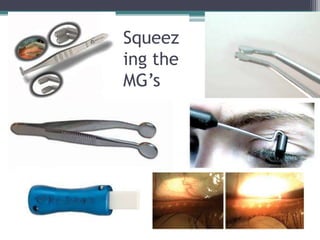
Squeezing the meibomian glands.
• Is topical ganciclovir effective for the treatment of
  adenovirus conjunctivitis?
• NeurotrophicKeratopathy: New Treatment
  Strategies
• Case presentation: Partial stem cell deficiency
Dry eye medication use and expenditures:datafrom
the Medical Expenditure Panel survey 2001 to 2006

 • From the 2001 to 2006
 • Medical Expenditure Panel Survey
 • Data gathered from 147 unique participants aged
   18 years old or older using the prescription
   medicine, Restasis and Blephamide.
 • The results:
   â–« Dry eye medication use and expenditures increased
     between the years 2001 and 2006, with the mean
     expenditure per patient per year being:
     ď‚– $55 in 2001 to 2002 (n = 29)
     ď‚– $137 in 2003 to 2004 (n = 32)
     ď‚– $299 in 2005 to 2006 (n = 86).
• This finding was strongly driven by the
  introduction of topical cyclosporine emulsion
  0.05% (Restasis; Allergan, Irvine, CA).
• In analysis pooled over all survey years,
  demographic factors associated with dry eye
  medication expenditures:
 â–« Gender:
   ď‚– Female: $244 vs. male: $122, P < 0.0001
 â–« Ethnicity
   ď‚– Non-Hispanic: $228 vs. Hispanic: $106, P < 0.0001
 â–« Education
   ď‚– Greater than high school: $250 vs. less than high school:
     $100, P < 0.0001
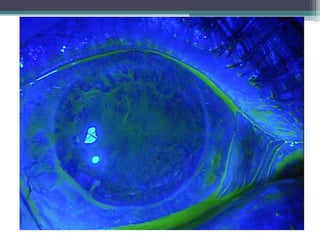
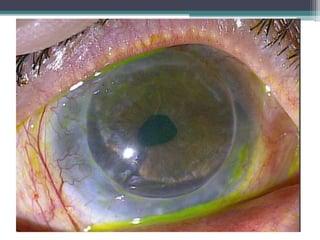
Six new weapons to attack dry eyes
 Tools used 5 years ago:
   â–«   Handing out samples of a lubricating eye drops
   â–«   Recommending increased hygiene around the eye
   â–«   Prescribing Restasis
   â–«   Inserting punctalplugs

 • In 2012, eye care practitioners have multiple new
   tools available to help patients at various stages of
   the condition whose symptoms range from mild to
   severe, making the management of dry eyes a much
   more rewarding proposition, both clinically and
   financially
New toys in dry eyes, anterior segment
•   Anterior segment OCT
•   Osmolarity measurements
•   Lipiview/Lipiflow
•   Inflammadry
•   Zienna eyewear
•   Intraductalmeibomian gland probes
Anterior segment OCT

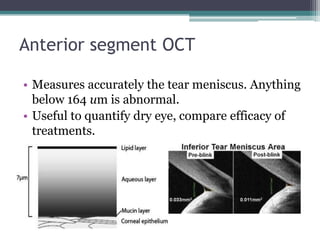
• Measures accurately the tear meniscus. Anything
  below 164 um is abnormal.
• Useful to quantify dry eye, compare efficacy of
  treatments.
Anterior segment OCT
• ADVANTAGES:
• Rapid, non invasive, accurate

• DISADVANTAGES:
• Expensive, not that useful in day to day clinical
  use (too many variables)
TearLabOsmolarity System

• Quickly and reliably during the patient’s visit
• “lab test on a microchip”
  ▫ requires a small sample (50 nL) of the patient’s tear
    film, which is gathered by a special tip and then
    inserted into the unit for measurement
• Accepted as a gold standard
• The test is cleared by the Food and Drug
  Administration (FDA) and CLIA (Clinical
  Laboratory Improvement Amendments)
• Enables doctors to perform the laboratory test in
  their offices
Usefulness of Osmolarity

• Most (only?) objective, measurable test to
  classify severity and to determine effectiveness
  of treatment
• Normal: 300.8 +/_ 7.8
• Mild or moderate : 315.5 +/_ 10.4
• Severe: 336.7 +/_ 22.2
• Potential for doing better than asking patient:
  Do your dry eye problem feels better or worse
  with the treatment I am giving you?
• INTEREYE
  DIFFERENCE                  Usefulness of
• Associated with disease
  severity.                    Osmolarity
• Normal intereye
  difference: 6.9 +/_ 5.9
• Mild/moderate: 11.7
  +/_ 10.9
• Severe: 26.5 +/_ 22.7
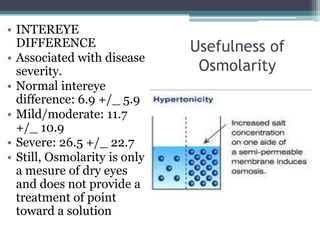
• Still, Osmolarity is only
  a mesure of dry eyes
  and does not provide a
  treatment of point
  toward a solution
LipiView


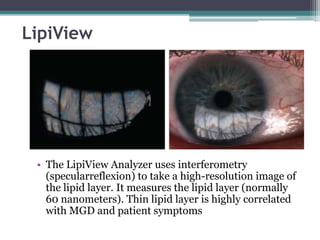
 • The LipiView Analyzer uses interferometry
   (specularreflexion) to take a high-resolution image of
   the lipid layer. It measures the lipid layer (normally
   60 nanometers). Thin lipid layer is highly correlated
   with MGD and patient symptoms
LipiFlow

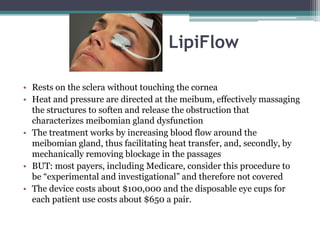
• Rests on the sclera without touching the cornea
• Heat and pressure are directed at the meibum, effectively massaging
  the structures to soften and release the obstruction that
  characterizes meibomian gland dysfunction
• The treatment works by increasing blood flow around the
  meibomian gland, thus facilitating heat transfer, and, secondly, by
  mechanically removing blockage in the passages
• BUT: most payers, including Medicare, consider this procedure to
  be “experimental and investigational” and therefore not covered
• The device costs about $100,000 and the disposable eye cups for
  each patient use costs about $650 a pair.
Lipiflow


• Great possibilities. The “ultimate” warm compress
• Very expensive (both to eye doctors and patients) ,
  not covered by insurance
• Unclear who are the best candidates (where is the
  “sweet spot”) of this treatment?
• Only device in the area: Alan Glazier, OD, Rockville,
  Md. aglazier@youreyesite.com
• Job opening…. 301-670-1212
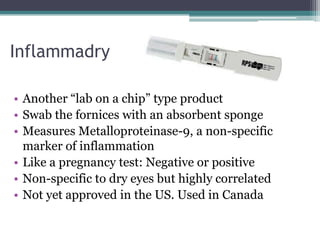
Inflammadry

• Another “lab on a chip” type product
• Swab the fornices with an absorbent sponge
• Measures Metalloproteinase-9, a non-specific
  marker of inflammation
• Like a pregnancy test: Negative or positive
• Non-specific to dry eyes but highly correlated
• Not yet approved in the US. Used in Canada
Dry eyes and nutrition

• We are in a unique position to address nutrition with our
  patients.
• Many (most?) patients are unaware of the connection between diet and
  ocular health
• We know that chronic inflammation plays a central role in dry eye
  disase and MGD
• BEFORE you discuss fish oil, Talk about Vitamin C and E.
• Both of these vitamins have antioxidant properties. Reduce
  inflammation
• Reccommed increased intake of vegetables and fruits (COLOR!) or a
  supplement of 1000 mg of Vit C and 400IU of Vit E
Nutrition: Essential Fatty Acids
• Essential because body can not synthesize them, they have to be
  obtained from diet
• Conpsumption of omega 3 fatty acids has DECREASED dramatically in
  the last 100 years. Why: they are very susceptible to light and heat.
  Easily becomes rancid: Not good for supermarket shelves
• While omega 6 has INCREASED. Why? More resistant to decay, better
  shelf life.
• This “flipped” ratio has been found to be pro-inflammatory.
• Sources of Omega 3 and 6: Cold water fish (sardines, salmon,trout etc),
  nuts and seeds, vegetables, nuts and seeds.
• We must avoid saturated, oxygenated fats and increase essential fatty
  acids
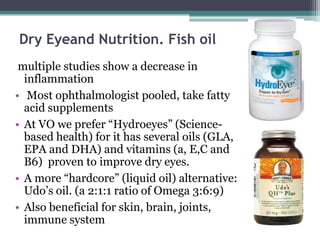
Dry Eyeand Nutrition. Fish oil
 multiple studies show a decrease in
  inflammation
• Most ophthalmologist pooled, take fatty
  acid supplements
• At VO we prefer “Hydroeyes” (Science-
  based health) for it has several oils (GLA,
  EPA and DHA) and vitamins (a, E,C and
  B6) proven to improve dry eyes.
• A more “hardcore” (liquid oil) alternative:
  Udo’s oil. (a 2:1:1 ratio of Omega 3:6:9)
• Also beneficial for skin, brain, joints,
  immune system
ZienaEyewear

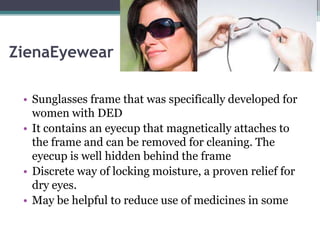
 • Sunglasses frame that was specifically developed for
   women with DED
 • It contains an eyecup that magnetically attaches to
   the frame and can be removed for cleaning. The
   eyecup is well hidden behind the frame
 • Discrete way of locking moisture, a proven relief for
   dry eyes.
 • May be helpful to reduce use of medicines in some
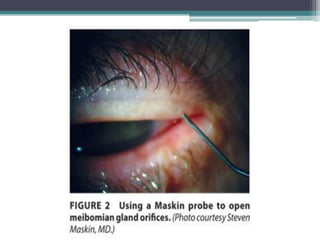
IntraductalMeibomian Gland Probes
• We all have seen obstructed meibomian Glands
• Obstruction is caused by increased viscosity
• Many orifices also exhibit keratinization.
• Inspisated glands lead to swelling, inflammation
  and pain
• Decreased meibum production leads to
  evaporative dry eyes
• Warm compresses often are not sufficient to
  unplug the glands
• Need at least 5 working glands per lid
IntraductalMeibomian Gland Probing
• Indications:
• Swollen tender lids, symptomatic MGD
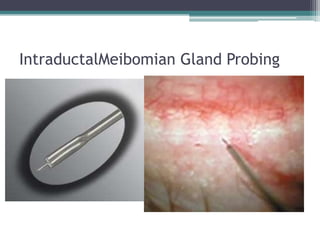
• Procedure:
• Slit lamp, topical anesthesia (lidocaine jelly)
• Disposable probes 1mm-6mm probes. Can
  deliver steroids through probe
• Must continue MGD Rx: Doxy, Omega 3 etc
IntraductalMeibomian Gland Probing
OTC Drops: Telling the Tears Apart


 â–« Is the optimum artificial tear for this patient preserved or not
   preserved?
 â–« Does the patient have more of an aqueous deficiency, mixed disease
   or an evaporative form of dry eye?
 â–« How severe is it?
How to prescribe artificial tears


• Self selection of medications is not a good idea
• Patients will get Walt-Mart or Safeway brand,
  the most inferior tears in the market.

• Worse yet they may choose Visine
How to prescribe artificial tears
• USE TWO CRITERIA:

• 1. Underlying cause of dry eye? ( Aqueous
  deficiency, mixed disease or evaporative form of
  dry eye?)

• 2. How often the patient is instilling drops?
  (severity of the disease). Ore than four
  instillations per day: Go to preservative free
How to prescribe artificial
tears/Preservatives?
BENZALKONIUM CHLORIDE (BAK)
• It is essentially: Ammonia!.
• Deleterious effects to ocular surface are
  innumerable: Destruction of epithelial cell walls,
  destruction of intercellular tight junctions and
  hemidesmosomes, destruction of corneal nerves,
  destruction of bowman’s and even stroma.
• Also: axonopathy and degeneration of corneal
  nerves (irreversible
  neurotrophickeratopathy)
How to prescibe artificial tears
• Best preservative: NONE!
• Single-dose unit. Can twist-off, recap and use for
  the entire day.
• A few good choices (all more expensive than
  multiple dose preparations)
• Refresh (Allergan)
• TheraTears
• Soothe (Bausch + Lomb)
• Systane (Alcon)
How to prescribe artificial tears
• VANISHING PRESERVATIVE
• Preservativeturns into water or non-toxic
  chemical when exposed to air or tear film
• Genteal (Novartis) has sodium perchlorate
• Allergan products: Purite (sodium chlorite)
  Refresh optive
How to prescribe artificial tears
• LIPIDS
• An attempt to mimic biphasic nature of tears by
  providing both aqueous and lipid components
• Guar in Systane
• Refresh Optive Advance and soothe provide a
  lipid substitute
How to prescribe artificial tears
• VISCOSITY
• For people with more severe dry eyes
• “Watery” drops (i.e refresh plus) only last 3-4
  minutes in the eye
• “sticky” viscous ones such as Celluvisc or
  Systane ultra stay around the eye longer, but:
• Blurry vision, unsightly residue in lashes
• Good for patients with poor blink or
  lagophthalmos or bell’s palsy. Best used at
  bedtime
Osmolarity
• lower osmolarity tears may have a better effect on
  the ocular surface.
• There are some tears that have ingredients that are
  called osmoprotectants. They are taken up by cells,
  and they blunt the response of the epithelial cells on
  the surface of the eye to high osmolarity in the tears.
  The Optive tears have osmoprotectants; some of
  those are found in sports drinks also because people
  can lose a lot of fluid and their blood may be a
  higher osmolarity. There is pretty good scientific
  evidence that they do help to protect cells.
How to prescribe artificial tears
• OSMOLARITY
• Increase osmolarity is a final common pathway
  fro dry eyes
• Decreased osmolarity improves symptoms and
  surface (TBUT, staining etc)
• Some tears (Optive)haveosmoprotectants that go
  inside the cells and protect against increased
  osmolarity
How to prescribe artificial tears

• Novasorb cationic emulsion.
  Electrostatic attraction between
  negatively charged droplets and
  positively charged ocular surface
• Hypotonic to reduce osmolarity
• Lipid to lubricate and protect
• Available only through OD or MD
• Not a great deal of personal
  experience yet
How to prescribe artificial tears
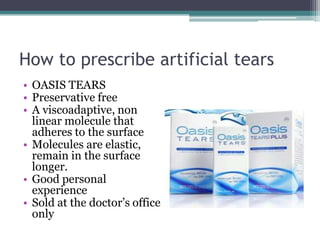
• OASIS TEARS
• Preservative free
• A viscoadaptive, non
  linear molecule that
  adheres to the surface
• Molecules are elastic,
  remain in the surface
  longer.
• Good personal
  experience
• Sold at the doctor’s office
  only
How to prescribe artificial tears
• RESTASIS (Cyclosporine 0.05%)
• Unknown mechanism. Inmunomodulator
• Decrease inflammation, increase tear production
• Compliance is difficult secondary to side effects (
  burning, stinging, FB sensation)
• Expensive
• Undeniably, works well for some people
• Must suppress inflammation prior to starting
  restasis
How to prescribe artificial tears
• RESTASIS.
• My regimen: Lotemax bid X 2 weeks, then start
  restasis bid, taper off Lotemax over two weeks
• In severe dry eye patient with residual
  symptoms but some improvement, may increase
  Restasis up to qid (Positive dose-response
  relationship)
How to prescribe artificial tears
• RESTASIS
• Has been shown to improve MGD
• Increases TBUT (in patients without aqueous
  tear deficiency)
• Decreased lid inflammation
• Increased meibomian gland expressibility
• Unclear mechanism
Diquafosol in dry eyes
• Several studies have shown that Diquafosol is
  effective in dry eye treatment
• Stimulates secretion of the three components of
  tears: Mucin lipids and fluids
• Restores epithelial barrier function
• Approved in Japan in 2010
• In The US is in phase III clinical trials
• Brand name will be Prolacria
• Unclear when will be available
Dry eyes and migraines: is there
really a correlation?
Dry eyes and migraines?
• Yes!. There is a correlation
• Observational comparative study
• 66 patients, half with migraines
• The migraine sufferers have significantly worse
  dry eye scores (TBUT, Schirmer, staining)
• Both migraines and dry eyes have inflammatory
  basis.
Meibomian Gland Secretion secrets

A single MG is capable of secreting oil on demand
 over the course of a working day ( approximately 9
 hours)
Nasal MGs were the most likely to secrete upon
 demand over the course of day compared with the
 temporal and to a lesser degree the central MGs
Secretorycharacteristics of individual MGs examined
 as a function of their location in the lower eyelid
 does not change diurnally.
Squeez
ing the
MG’s
New Tool for Adenoviral Conjunctivitis
• In past studies, corneal and external disease
  specialists' clinical diagnosis of adenoviral
  conjunctivitis had laboratory confirmation in
  only 20-25% of cases
• The RPS Adeno Detector Plus is a point-of-care
  immunoassay that has 93% sensitivity and 96%
  specificity.
• The monoclonal antibodies used in the assay
  detect all 53 adenoviral serotypes.
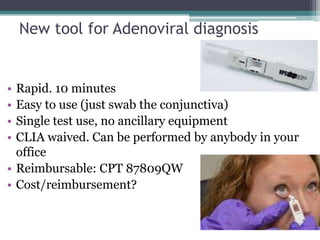
New tool for Adenoviral diagnosis


• Rapid. 10 minutes
• Easy to use (just swab the conjunctiva)
• Single test use, no ancillary equipment
• CLIA waived. Can be performed by anybody in your
  office
• Reimbursable: CPT 87809QW
• Cost/reimbursement?
Is topicalGanciclovir (Zirgan) effective for
the treatment of adenovirus
conjunctivitis?
A multicenter clinical trial is underway

Several studies have shown that Ganciclovir is
 effective against adenovirus

Zirgan reduced the duration of the disease and the
  incidence of subepithelial infiltrates

Inclusion criteria: Follicular conjunctivitis who test
  positive on the RPS ( Rapid Pathogen Screening
  Adeno Detector Plus Immunoassay)
Ganciclovir Treatment Goals
• Limiting the development of corneal infiltrates
  (which can result in irregular astigmatism, glare,
  photophobia and hyperopic shifts), the duration of
  adenoviral shedding, and spread to the second eye
• Prevent the spread of disease by early and accurate
  diagnosis and treatment
• To reduce the cost of lost days at work and school
• To afford specific antiviral treatment and avoid the
  over-prescription of unnecessary, ineffective
  antibiotics.
• To reduce the costs of treatment and diminish the
  development of antibiotic associated allergies and
  toxicities.
Adenovirus treatment
• SILVER BULLET: Betadine 5%

Pre-anethesize with tetracaine, NSAID. 4-5 drops
 of betadine (if no Iodine allergies). Wait 60
 seconds. Rub betadine with cotton tip swab
 around lashes. Rinse with saline. Topical
 steroids
A study is being conducted of a solution of 4%
 betadine/0.1% dexamethasone
NeurotrophicKeratopathy:
New Treatment Strategies

• With loss of sensory function of the nasociliary branch of
  the trigeminal nerve, neurotrophickeratopathy will
  develop and result in degenerative corneal and
  conjunctival changes of varying severity.
• Minor manifestations include:
  â–« conjunctivaland corneal punctate epithelial irregularity
    (fluorescein or rose bengal staining) with or without
    decreased tear production or decreased tear film stability
    (accelerated breakup time).
• However, such abnormalities can also progress to
  involve persistent corneal epithelial defects, stromal
  inflammatory reaction and most ominously, enzymatic
  stromalysis with ulceration potentially leading to
  perforation
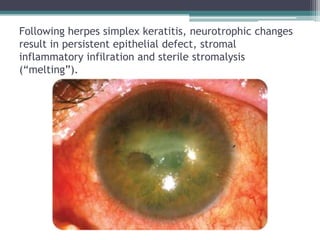
Following herpes simplex keratitis, neurotrophic changes
result in persistent epithelial defect, stromal
inflammatory infilration and sterile stromalysis
(“melting”).
Conventional Management
• Traditional medical and surgical approaches include:
  â–« preservative-free lubricants
  â–« autologousserum drops
  â–« topical steroid and non-toxic antibiotic prophylaxis, MGD
    management
  â–« therapeutic soft contact lenses
  â–« punctal occlusion
  â–« moist chamber glasses
  â–« lid taping, lid malpositionrepair
  â–« lateral tarsorrhaphy or Botoxinducedptosis
  â–« cycanocarylatetissue adhesive
  â–« conjunctival flap
  â–« keratoplasty,
  â–« Boston keratoprosthesis and herpes zoster vaccination.
• Conventional penetrating keratoplasty procedures have
  variable success due to the poor healing capabilities of
  neurotrophic tissues
• The risks of persistent epithelial defect and sterile ulcerative
  stromalysis being of greatest concern.
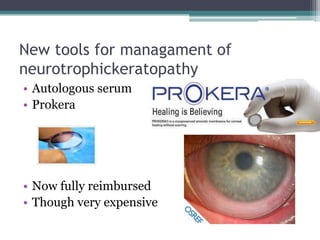
New tools for managament of
neurotrophickeratopathy
• Autologous serum
• Prokera


• Now fully reimbursed
• Though very expensive
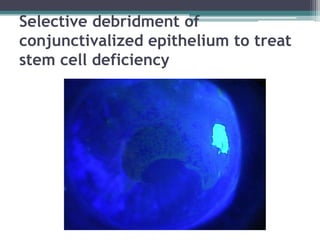
Selective debridment of
conjunctivalized epithelium to treat
stem cell deficiency
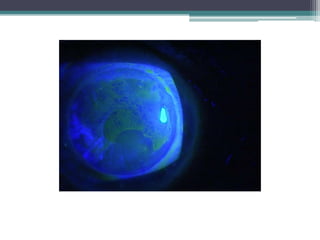
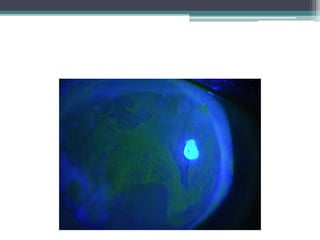
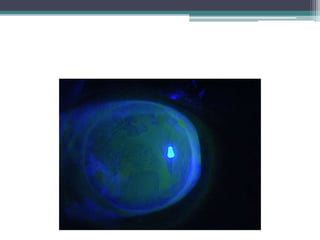
Stem cell deficiency
• 65 Y.O man with a history of alkaline burn.
• Presented initially 5 years ago with a melted,
  perforated cornea.
• Underwent PK, achieved 20/30 was stable until
  1 month ago. Presented with visual acuity of
  20/200, partial stem cell failure
• Underwent selective epithelial debridment with
  prokera, achieved 20/70 and improving.
• Avoided a stem cell transplant
Thank You

New Trends in Ocular Surface Treartment

  • 1.
    New Trends inOcular Surface Treatment J. Alberto Martinez, M.D. 27201-AS COPE Approved December 9, 2012
  • 2.
    OUTLINE • Dry eyemedication use and expenditures • Six new weapons to attack dry eyes • How to prescribe artificial tears • Efficacy and safety of diquafosol ophthalmic solution in patients with dry eye syndrome: a Japanese phase 2 clinical trial. • Dry eyes and migraines: is there really a correlation? • IntraductalMeibomian Gland Probes • A randomized double-masked study of 0.05% cyclosporine ophthalmic emulsion in the treatment of meibomian gland dysfunction.
  • 3.
    OUTLINE, CONT. Squeezing themeibomian glands. • Is topical ganciclovir effective for the treatment of adenovirus conjunctivitis? • NeurotrophicKeratopathy: New Treatment Strategies • Case presentation: Partial stem cell deficiency
  • 4.
    Dry eye medicationuse and expenditures:datafrom the Medical Expenditure Panel survey 2001 to 2006 • From the 2001 to 2006 • Medical Expenditure Panel Survey • Data gathered from 147 unique participants aged 18 years old or older using the prescription medicine, Restasis and Blephamide. • The results: ▫ Dry eye medication use and expenditures increased between the years 2001 and 2006, with the mean expenditure per patient per year being:  $55 in 2001 to 2002 (n = 29)  $137 in 2003 to 2004 (n = 32)  $299 in 2005 to 2006 (n = 86).
  • 5.
    • This findingwas strongly driven by the introduction of topical cyclosporine emulsion 0.05% (Restasis; Allergan, Irvine, CA). • In analysis pooled over all survey years, demographic factors associated with dry eye medication expenditures: ▫ Gender:  Female: $244 vs. male: $122, P < 0.0001 ▫ Ethnicity  Non-Hispanic: $228 vs. Hispanic: $106, P < 0.0001 ▫ Education  Greater than high school: $250 vs. less than high school: $100, P < 0.0001
  • 6.
    Six new weaponsto attack dry eyes Tools used 5 years ago: ▫ Handing out samples of a lubricating eye drops ▫ Recommending increased hygiene around the eye ▫ Prescribing Restasis ▫ Inserting punctalplugs • In 2012, eye care practitioners have multiple new tools available to help patients at various stages of the condition whose symptoms range from mild to severe, making the management of dry eyes a much more rewarding proposition, both clinically and financially
  • 7.
    New toys indry eyes, anterior segment • Anterior segment OCT • Osmolarity measurements • Lipiview/Lipiflow • Inflammadry • Zienna eyewear • Intraductalmeibomian gland probes
  • 8.
    Anterior segment OCT •Measures accurately the tear meniscus. Anything below 164 um is abnormal. • Useful to quantify dry eye, compare efficacy of treatments.
  • 9.
    Anterior segment OCT •ADVANTAGES: • Rapid, non invasive, accurate • DISADVANTAGES: • Expensive, not that useful in day to day clinical use (too many variables)
  • 10.
    TearLabOsmolarity System • Quicklyand reliably during the patient’s visit • “lab test on a microchip” ▫ requires a small sample (50 nL) of the patient’s tear film, which is gathered by a special tip and then inserted into the unit for measurement • Accepted as a gold standard • The test is cleared by the Food and Drug Administration (FDA) and CLIA (Clinical Laboratory Improvement Amendments) • Enables doctors to perform the laboratory test in their offices
  • 11.
    Usefulness of Osmolarity •Most (only?) objective, measurable test to classify severity and to determine effectiveness of treatment • Normal: 300.8 +/_ 7.8 • Mild or moderate : 315.5 +/_ 10.4 • Severe: 336.7 +/_ 22.2 • Potential for doing better than asking patient: Do your dry eye problem feels better or worse with the treatment I am giving you?
  • 12.
    • INTEREYE DIFFERENCE Usefulness of • Associated with disease severity. Osmolarity • Normal intereye difference: 6.9 +/_ 5.9 • Mild/moderate: 11.7 +/_ 10.9 • Severe: 26.5 +/_ 22.7 • Still, Osmolarity is only a mesure of dry eyes and does not provide a treatment of point toward a solution
  • 13.
    LipiView • TheLipiView Analyzer uses interferometry (specularreflexion) to take a high-resolution image of the lipid layer. It measures the lipid layer (normally 60 nanometers). Thin lipid layer is highly correlated with MGD and patient symptoms
  • 14.
    LipiFlow • Rests onthe sclera without touching the cornea • Heat and pressure are directed at the meibum, effectively massaging the structures to soften and release the obstruction that characterizes meibomian gland dysfunction • The treatment works by increasing blood flow around the meibomian gland, thus facilitating heat transfer, and, secondly, by mechanically removing blockage in the passages • BUT: most payers, including Medicare, consider this procedure to be “experimental and investigational” and therefore not covered • The device costs about $100,000 and the disposable eye cups for each patient use costs about $650 a pair.
  • 16.
    Lipiflow • Great possibilities.The “ultimate” warm compress • Very expensive (both to eye doctors and patients) , not covered by insurance • Unclear who are the best candidates (where is the “sweet spot”) of this treatment? • Only device in the area: Alan Glazier, OD, Rockville, Md. aglazier@youreyesite.com • Job opening…. 301-670-1212
  • 17.
    Inflammadry • Another “labon a chip” type product • Swab the fornices with an absorbent sponge • Measures Metalloproteinase-9, a non-specific marker of inflammation • Like a pregnancy test: Negative or positive • Non-specific to dry eyes but highly correlated • Not yet approved in the US. Used in Canada
  • 18.
    Dry eyes andnutrition • We are in a unique position to address nutrition with our patients. • Many (most?) patients are unaware of the connection between diet and ocular health • We know that chronic inflammation plays a central role in dry eye disase and MGD • BEFORE you discuss fish oil, Talk about Vitamin C and E. • Both of these vitamins have antioxidant properties. Reduce inflammation • Reccommed increased intake of vegetables and fruits (COLOR!) or a supplement of 1000 mg of Vit C and 400IU of Vit E
  • 19.
    Nutrition: Essential FattyAcids • Essential because body can not synthesize them, they have to be obtained from diet • Conpsumption of omega 3 fatty acids has DECREASED dramatically in the last 100 years. Why: they are very susceptible to light and heat. Easily becomes rancid: Not good for supermarket shelves • While omega 6 has INCREASED. Why? More resistant to decay, better shelf life. • This “flipped” ratio has been found to be pro-inflammatory. • Sources of Omega 3 and 6: Cold water fish (sardines, salmon,trout etc), nuts and seeds, vegetables, nuts and seeds. • We must avoid saturated, oxygenated fats and increase essential fatty acids
  • 20.
    Dry Eyeand Nutrition.Fish oil multiple studies show a decrease in inflammation • Most ophthalmologist pooled, take fatty acid supplements • At VO we prefer “Hydroeyes” (Science- based health) for it has several oils (GLA, EPA and DHA) and vitamins (a, E,C and B6) proven to improve dry eyes. • A more “hardcore” (liquid oil) alternative: Udo’s oil. (a 2:1:1 ratio of Omega 3:6:9) • Also beneficial for skin, brain, joints, immune system
  • 21.
    ZienaEyewear • Sunglassesframe that was specifically developed for women with DED • It contains an eyecup that magnetically attaches to the frame and can be removed for cleaning. The eyecup is well hidden behind the frame • Discrete way of locking moisture, a proven relief for dry eyes. • May be helpful to reduce use of medicines in some
  • 22.
    IntraductalMeibomian Gland Probes •We all have seen obstructed meibomian Glands • Obstruction is caused by increased viscosity • Many orifices also exhibit keratinization. • Inspisated glands lead to swelling, inflammation and pain • Decreased meibum production leads to evaporative dry eyes • Warm compresses often are not sufficient to unplug the glands • Need at least 5 working glands per lid
  • 23.
    IntraductalMeibomian Gland Probing •Indications: • Swollen tender lids, symptomatic MGD • Procedure: • Slit lamp, topical anesthesia (lidocaine jelly) • Disposable probes 1mm-6mm probes. Can deliver steroids through probe • Must continue MGD Rx: Doxy, Omega 3 etc
  • 24.
  • 26.
    OTC Drops: Tellingthe Tears Apart â–« Is the optimum artificial tear for this patient preserved or not preserved? â–« Does the patient have more of an aqueous deficiency, mixed disease or an evaporative form of dry eye? â–« How severe is it?
  • 27.
    How to prescribeartificial tears • Self selection of medications is not a good idea • Patients will get Walt-Mart or Safeway brand, the most inferior tears in the market. • Worse yet they may choose Visine
  • 28.
    How to prescribeartificial tears • USE TWO CRITERIA: • 1. Underlying cause of dry eye? ( Aqueous deficiency, mixed disease or evaporative form of dry eye?) • 2. How often the patient is instilling drops? (severity of the disease). Ore than four instillations per day: Go to preservative free
  • 29.
    How to prescribeartificial tears/Preservatives? BENZALKONIUM CHLORIDE (BAK) • It is essentially: Ammonia!. • Deleterious effects to ocular surface are innumerable: Destruction of epithelial cell walls, destruction of intercellular tight junctions and hemidesmosomes, destruction of corneal nerves, destruction of bowman’s and even stroma. • Also: axonopathy and degeneration of corneal nerves (irreversible neurotrophickeratopathy)
  • 30.
    How to prescibeartificial tears • Best preservative: NONE! • Single-dose unit. Can twist-off, recap and use for the entire day. • A few good choices (all more expensive than multiple dose preparations) • Refresh (Allergan) • TheraTears • Soothe (Bausch + Lomb) • Systane (Alcon)
  • 31.
    How to prescribeartificial tears • VANISHING PRESERVATIVE • Preservativeturns into water or non-toxic chemical when exposed to air or tear film • Genteal (Novartis) has sodium perchlorate • Allergan products: Purite (sodium chlorite) Refresh optive
  • 32.
    How to prescribeartificial tears • LIPIDS • An attempt to mimic biphasic nature of tears by providing both aqueous and lipid components • Guar in Systane • Refresh Optive Advance and soothe provide a lipid substitute
  • 33.
    How to prescribeartificial tears • VISCOSITY • For people with more severe dry eyes • “Watery” drops (i.e refresh plus) only last 3-4 minutes in the eye • “sticky” viscous ones such as Celluvisc or Systane ultra stay around the eye longer, but: • Blurry vision, unsightly residue in lashes • Good for patients with poor blink or lagophthalmos or bell’s palsy. Best used at bedtime
  • 34.
    Osmolarity • lower osmolaritytears may have a better effect on the ocular surface. • There are some tears that have ingredients that are called osmoprotectants. They are taken up by cells, and they blunt the response of the epithelial cells on the surface of the eye to high osmolarity in the tears. The Optive tears have osmoprotectants; some of those are found in sports drinks also because people can lose a lot of fluid and their blood may be a higher osmolarity. There is pretty good scientific evidence that they do help to protect cells.
  • 35.
    How to prescribeartificial tears • OSMOLARITY • Increase osmolarity is a final common pathway fro dry eyes • Decreased osmolarity improves symptoms and surface (TBUT, staining etc) • Some tears (Optive)haveosmoprotectants that go inside the cells and protect against increased osmolarity
  • 36.
    How to prescribeartificial tears • Novasorb cationic emulsion. Electrostatic attraction between negatively charged droplets and positively charged ocular surface • Hypotonic to reduce osmolarity • Lipid to lubricate and protect • Available only through OD or MD • Not a great deal of personal experience yet
  • 37.
    How to prescribeartificial tears • OASIS TEARS • Preservative free • A viscoadaptive, non linear molecule that adheres to the surface • Molecules are elastic, remain in the surface longer. • Good personal experience • Sold at the doctor’s office only
  • 38.
    How to prescribeartificial tears • RESTASIS (Cyclosporine 0.05%) • Unknown mechanism. Inmunomodulator • Decrease inflammation, increase tear production • Compliance is difficult secondary to side effects ( burning, stinging, FB sensation) • Expensive • Undeniably, works well for some people • Must suppress inflammation prior to starting restasis
  • 39.
    How to prescribeartificial tears • RESTASIS. • My regimen: Lotemax bid X 2 weeks, then start restasis bid, taper off Lotemax over two weeks • In severe dry eye patient with residual symptoms but some improvement, may increase Restasis up to qid (Positive dose-response relationship)
  • 40.
    How to prescribeartificial tears • RESTASIS • Has been shown to improve MGD • Increases TBUT (in patients without aqueous tear deficiency) • Decreased lid inflammation • Increased meibomian gland expressibility • Unclear mechanism
  • 41.
    Diquafosol in dryeyes • Several studies have shown that Diquafosol is effective in dry eye treatment • Stimulates secretion of the three components of tears: Mucin lipids and fluids • Restores epithelial barrier function • Approved in Japan in 2010 • In The US is in phase III clinical trials • Brand name will be Prolacria • Unclear when will be available
  • 42.
    Dry eyes andmigraines: is there really a correlation?
  • 43.
    Dry eyes andmigraines? • Yes!. There is a correlation • Observational comparative study • 66 patients, half with migraines • The migraine sufferers have significantly worse dry eye scores (TBUT, Schirmer, staining) • Both migraines and dry eyes have inflammatory basis.
  • 44.
    Meibomian Gland Secretionsecrets A single MG is capable of secreting oil on demand over the course of a working day ( approximately 9 hours) Nasal MGs were the most likely to secrete upon demand over the course of day compared with the temporal and to a lesser degree the central MGs Secretorycharacteristics of individual MGs examined as a function of their location in the lower eyelid does not change diurnally.
  • 45.
  • 46.
    New Tool forAdenoviral Conjunctivitis • In past studies, corneal and external disease specialists' clinical diagnosis of adenoviral conjunctivitis had laboratory confirmation in only 20-25% of cases • The RPS Adeno Detector Plus is a point-of-care immunoassay that has 93% sensitivity and 96% specificity. • The monoclonal antibodies used in the assay detect all 53 adenoviral serotypes.
  • 47.
    New tool forAdenoviral diagnosis • Rapid. 10 minutes • Easy to use (just swab the conjunctiva) • Single test use, no ancillary equipment • CLIA waived. Can be performed by anybody in your office • Reimbursable: CPT 87809QW • Cost/reimbursement?
  • 48.
    Is topicalGanciclovir (Zirgan)effective for the treatment of adenovirus conjunctivitis? A multicenter clinical trial is underway Several studies have shown that Ganciclovir is effective against adenovirus Zirgan reduced the duration of the disease and the incidence of subepithelial infiltrates Inclusion criteria: Follicular conjunctivitis who test positive on the RPS ( Rapid Pathogen Screening Adeno Detector Plus Immunoassay)
  • 49.
    Ganciclovir Treatment Goals •Limiting the development of corneal infiltrates (which can result in irregular astigmatism, glare, photophobia and hyperopic shifts), the duration of adenoviral shedding, and spread to the second eye • Prevent the spread of disease by early and accurate diagnosis and treatment • To reduce the cost of lost days at work and school • To afford specific antiviral treatment and avoid the over-prescription of unnecessary, ineffective antibiotics. • To reduce the costs of treatment and diminish the development of antibiotic associated allergies and toxicities.
  • 50.
    Adenovirus treatment • SILVERBULLET: Betadine 5% Pre-anethesize with tetracaine, NSAID. 4-5 drops of betadine (if no Iodine allergies). Wait 60 seconds. Rub betadine with cotton tip swab around lashes. Rinse with saline. Topical steroids A study is being conducted of a solution of 4% betadine/0.1% dexamethasone
  • 51.
    NeurotrophicKeratopathy: New Treatment Strategies •With loss of sensory function of the nasociliary branch of the trigeminal nerve, neurotrophickeratopathy will develop and result in degenerative corneal and conjunctival changes of varying severity. • Minor manifestations include: ▫ conjunctivaland corneal punctate epithelial irregularity (fluorescein or rose bengal staining) with or without decreased tear production or decreased tear film stability (accelerated breakup time). • However, such abnormalities can also progress to involve persistent corneal epithelial defects, stromal inflammatory reaction and most ominously, enzymatic stromalysis with ulceration potentially leading to perforation
  • 52.
    Following herpes simplexkeratitis, neurotrophic changes result in persistent epithelial defect, stromal inflammatory infilration and sterile stromalysis (“melting”).
  • 53.
    Conventional Management • Traditionalmedical and surgical approaches include: ▫ preservative-free lubricants ▫ autologousserum drops ▫ topical steroid and non-toxic antibiotic prophylaxis, MGD management ▫ therapeutic soft contact lenses ▫ punctal occlusion ▫ moist chamber glasses ▫ lid taping, lid malpositionrepair ▫ lateral tarsorrhaphy or Botoxinducedptosis ▫ cycanocarylatetissue adhesive ▫ conjunctival flap ▫ keratoplasty, ▫ Boston keratoprosthesis and herpes zoster vaccination. • Conventional penetrating keratoplasty procedures have variable success due to the poor healing capabilities of neurotrophic tissues • The risks of persistent epithelial defect and sterile ulcerative stromalysis being of greatest concern.
  • 54.
    New tools formanagament of neurotrophickeratopathy • Autologous serum • Prokera • Now fully reimbursed • Though very expensive
  • 55.
    Selective debridment of conjunctivalizedepithelium to treat stem cell deficiency
  • 56.
    Stem cell deficiency •65 Y.O man with a history of alkaline burn. • Presented initially 5 years ago with a melted, perforated cornea. • Underwent PK, achieved 20/30 was stable until 1 month ago. Presented with visual acuity of 20/200, partial stem cell failure • Underwent selective epithelial debridment with prokera, achieved 20/70 and improving. • Avoided a stem cell transplant
  • 62.

Editor's Notes

  • #49 Jay S. Pepose, MD, PHD
  • #52 By Kenneth R. Kenyon, MD and Deborah Pavan-Langston, MD, FACS