New Teacher Fears and Needs:
Improving New Teacher Mentoring
CamTESOL Conference, February 22 – 23, 2014
Jeremy Lee and Angel Steadman
Welcome!
 Today’s discussion:
 What is mentoring?
 Research questions
 Research results
 Recommendations
 Discussion and Q&A
Types of Mentoring
 Pre-service: mentoring that takes place during
the training or education phase
 Induction: mentoring that takes place during the
first 1 – 2 years of teaching

 In-service (also called peer): mentoring that
takes place between experienced teachers,
often focusing on a specific area in need of
improvement
Why do we mentor?
(Huling-Austin 1990)

 To improve teaching performance
 To increase the retention of promising beginning
teachers during the induction years
 To promote the personal and professional wellbeing of beginning teachers by improving
teachers’ attitudes toward themselves and the
profession
 To satisfy mandated requirements related to
induction and certification
 To transmit the culture of the system to beginning
teachers
Common Elements of
Mentoring
 Class observations/visitations
 Orientation to school policies and procedures
 Formative assessments/evaluations and advising
Our Questions
 What are the biggest fears and needs of new
teachers, and how well does our school’s new
teacher mentoring program address these?
 How can new teacher mentoring be improved
based on best practices at other institutions?
Research
 Interviews with instructors at the Intensive English
and Academic Bridge Programs at the Center for
English as a Second Language, University of
Arizona
 New teachers (<2 years) with no or little previous
teaching experience
 New teachers with experience teaching elsewhere
 Teachers who have completed the mentoring
program

 Literature review and application
Survey Findings
 New teachers struggle most with:
 Managing the workload (corroborated by McCann &
Johannesen 2008)
 Establishing a teacher persona (including classroom
management style) and respect from students and
colleagues (corroborated by McCann & Johannessen
2009b)
 Assessment and grading (not found frequently in
literature – reasons?)
 Practical aspects of lesson planning – ideas for
activities, etc. (seen widely in the literature)

 Teachers report needing less help with orientation
to procedures and technologies from their mentors
 The mentoring relationship alone is not enough
What Works (for us)
 In-depth weekly meetings with mentors
 Observations of experienced teachers working in
similar areas
 Feedback on teaching from mentors and
administrators
 Ongoing workshops and training sessions with
administrators and veteran teachers
What Doesn’t Work (for us)
 Too much attention to training in technology and
procedures – teachers prefer to learn as they go
 Not enough interaction or collaboration between
new and veteran faculty members
 No centralized guide for processes, resources, and
expectations
 No established learner communities for new
teachers to work or meet together – places for
“brainstorming” and “troubleshooting”

 More guidance on student expectations
 Some mentors more helpful than others
Suggestions for
Improvement
 #1: Better recruitment and training of mentors
 #2: Facilitation of learning/mentoring
communities
 #3: More opportunities for interaction between
new and veteran teachers – coteaching
possibilities, faculty mixers, etc.
 #4: Mentoring isn’t enough!
#1: Better recruitment and
training of mentors
 Make better use of mentor training guides:
Portner 2005, 2008; Sweeny 2008; Eckerman Pitton
2006; Zachary 2012
 Enhancing and supporting mentor reflection and
motivation (Zachary 2012)
 Focus on educative mentoring by “go[ing]
beyond emotional or psychological support and
resource procurement and base their practice
on the premise that learning to teach requires
creating learning opportunities that involve the
mentee intellectually in her or his [ZPD]” (Schwille
2008)
#2: Facilitation of
learning/mentoring
communities
 Areas of reflection and support for one another (McCann
& Johannesssen 2009; Meyer 2002; Portner 2008;
Eckerman Pitton 2006; McCann & Johannessen 2009)
 “Learning from experience requires that a teacher be able to
look back on his or her own teaching and consequences. The
ordinary school setting does not lend itself to such reflection. It
is characterized by speed, solitude, and amnesia” (Shulman
1988, qtd. in Meyer 2002)

 Mitigates sense of isolation new teachers feel (Andrews &
Quinn 2005; Boreen & Niday 2000)
 Provides a non-threatening and non-evaluative space for
new teachers to discuss problems and concerns (Meyer
2002)
#3: More opportunities for
interaction between new
and veteran teachers
 Coteaching possibilities
 Faculty mixers
 Changing the culture and climate of the school
at large
 Bringing administrators in as mentors as well
(Fibkins 2002)
 Difficult to accomplish due to time and job
constraints, but works to “level the playing field” and
validate the concerns of new teachers
#4: Mentoring isn’t enough!
 Mentoring should be one component of a larger
induction program (Olebe 2005; Smith & Ingersoll
2004)
 Encourage ongoing professional development after
mentoring and induction process is complete
(Keengwe & Kyei-Blankson 2013; Cullingford 2006):
 Organize colloquia and workshops
 Encourage use of webinars and webcasts
 Provide teachers with access to useful resources such
as websites, magazines, and a library of materials
 Develop social networks for new teachers to engage
with one another
 Offer peer coaching and mentoring opportunities for
teachers after they are no longer considered “new”
Back to you…
 What sorts of new teacher mentoring and/or
induction happen in your institution?
 What works best? What doesn’t seem to be
working?

 What sorts of fears do you see in your new
teachers? Are these different from what we’ve
discussed today?
Questions?
Thank you!
Angel Steadman
Teacher Training Coordinator
Email: amiller2@email.arizona.edu

Jeremy Lee
Student Activities Coordinator
Email: jeremyjlee@email.arizona.edu
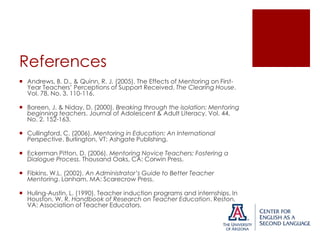
References
 Andrews, B. D., & Quinn, R. J. (2005). The Effects of Mentoring on FirstYear Teachers’ Perceptions of Support Received. The Clearing House.
Vol. 78, No. 3. 110-116.
 Boreen, J. & Niday, D. (2000). Breaking through the isolation: Mentoring
beginning teachers. Journal of Adolescent & Adult Literacy. Vol. 44,
No. 2. 152-163.
 Cullingford, C. (2006). Mentoring in Education: An International
Perspective. Burlington, VT: Ashgate Publishing.
 Eckerman Pitton, D. (2006). Mentoring Novice Teachers: Fostering a
Dialogue Process. Thousand Oaks, CA: Corwin Press.
 Fibkins, W.L. (2002). An Administrator’s Guide to Better Teacher
Mentoring. Lanham, MA: Scarecrow Press.
 Huling-Austin, L. (1990). Teacher induction programs and internships. In
Houston, W. R. Handbook of Research on Teacher Education. Reston,
VA: Association of Teacher Educators.
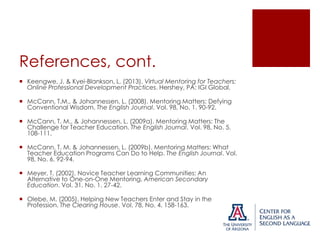
References, cont.
 Keengwe, J. & Kyei-Blankson, L. (2013). Virtual Mentoring for Teachers:
Online Professional Development Practices. Hershey, PA: IGI Global.
 McCann, T.M., & Johannessen, L. (2008). Mentoring Matters: Defying
Conventional Wisdom. The English Journal. Vol. 98, No. 1. 90-92.
 McCann, T. M., & Johannessen, L. (2009a). Mentoring Matters: The
Challenge for Teacher Education. The English Journal. Vol. 98, No. 5.
108-111.
 McCann, T. M. & Johannessen, L. (2009b). Mentoring Matters: What
Teacher Education Programs Can Do to Help. The English Journal. Vol.
98, No. 6. 92-94.
 Meyer, T. (2002). Novice Teacher Learning Communities: An
Alternative to One-on-One Mentoring. American Secondary
Education. Vol. 31, No. 1. 27-42.

 Olebe, M. (2005). Helping New Teachers Enter and Stay in the
Profession. The Clearing House. Vol. 78, No. 4. 158-163.
References, cont.
 Portner, H. (2005). Teacher Mentoring and Induction: The State of the
Art and Beyond. Thousand Oaks, CA: Corwin Press.
 Portner, H. (2008). Mentoring New Teachers, 3rd Ed. Thousand Oaks,
CA: Corwin Press.
 Schwille, S. A. (2008). The Professional Practice of Mentoring. American
Journal of Education. Vol. 115, No. 1. 139-167.
 Smith, T. M., & Ingersoll, R. M. (2004). What Are the Effects of Induction
and Mentoring on Beginning Teacher Turnover? American Educational
Research Journal. Vol. 41, No. 3. 681-714.
 Sweeny, B. W. (2008). Leading the Teacher Induction and Mentoring
Program, 2nd Ed. Thousand Oaks, CA: Corwin Press.
 Zachary, L.J. (2012). The Mentor’s Guide: Facilitating Effective Learning
Relationships, 2nd Ed. San Francisco, CA: Wiley & Sons.

New Teacher Mentoring

  • 1.
    New Teacher Fearsand Needs: Improving New Teacher Mentoring CamTESOL Conference, February 22 – 23, 2014 Jeremy Lee and Angel Steadman
  • 2.
    Welcome!  Today’s discussion: What is mentoring?  Research questions  Research results  Recommendations  Discussion and Q&A
  • 3.
    Types of Mentoring Pre-service: mentoring that takes place during the training or education phase  Induction: mentoring that takes place during the first 1 – 2 years of teaching  In-service (also called peer): mentoring that takes place between experienced teachers, often focusing on a specific area in need of improvement
  • 4.
    Why do wementor? (Huling-Austin 1990)  To improve teaching performance  To increase the retention of promising beginning teachers during the induction years  To promote the personal and professional wellbeing of beginning teachers by improving teachers’ attitudes toward themselves and the profession  To satisfy mandated requirements related to induction and certification  To transmit the culture of the system to beginning teachers
  • 5.
    Common Elements of Mentoring Class observations/visitations  Orientation to school policies and procedures  Formative assessments/evaluations and advising
  • 6.
    Our Questions  Whatare the biggest fears and needs of new teachers, and how well does our school’s new teacher mentoring program address these?  How can new teacher mentoring be improved based on best practices at other institutions?
  • 7.
    Research  Interviews withinstructors at the Intensive English and Academic Bridge Programs at the Center for English as a Second Language, University of Arizona  New teachers (<2 years) with no or little previous teaching experience  New teachers with experience teaching elsewhere  Teachers who have completed the mentoring program  Literature review and application
  • 8.
    Survey Findings  Newteachers struggle most with:  Managing the workload (corroborated by McCann & Johannesen 2008)  Establishing a teacher persona (including classroom management style) and respect from students and colleagues (corroborated by McCann & Johannessen 2009b)  Assessment and grading (not found frequently in literature – reasons?)  Practical aspects of lesson planning – ideas for activities, etc. (seen widely in the literature)  Teachers report needing less help with orientation to procedures and technologies from their mentors  The mentoring relationship alone is not enough
  • 9.
    What Works (forus)  In-depth weekly meetings with mentors  Observations of experienced teachers working in similar areas  Feedback on teaching from mentors and administrators  Ongoing workshops and training sessions with administrators and veteran teachers
  • 10.
    What Doesn’t Work(for us)  Too much attention to training in technology and procedures – teachers prefer to learn as they go  Not enough interaction or collaboration between new and veteran faculty members  No centralized guide for processes, resources, and expectations  No established learner communities for new teachers to work or meet together – places for “brainstorming” and “troubleshooting”  More guidance on student expectations  Some mentors more helpful than others
  • 11.
    Suggestions for Improvement  #1:Better recruitment and training of mentors  #2: Facilitation of learning/mentoring communities  #3: More opportunities for interaction between new and veteran teachers – coteaching possibilities, faculty mixers, etc.  #4: Mentoring isn’t enough!
  • 12.
    #1: Better recruitmentand training of mentors  Make better use of mentor training guides: Portner 2005, 2008; Sweeny 2008; Eckerman Pitton 2006; Zachary 2012  Enhancing and supporting mentor reflection and motivation (Zachary 2012)  Focus on educative mentoring by “go[ing] beyond emotional or psychological support and resource procurement and base their practice on the premise that learning to teach requires creating learning opportunities that involve the mentee intellectually in her or his [ZPD]” (Schwille 2008)
  • 13.
    #2: Facilitation of learning/mentoring communities Areas of reflection and support for one another (McCann & Johannesssen 2009; Meyer 2002; Portner 2008; Eckerman Pitton 2006; McCann & Johannessen 2009)  “Learning from experience requires that a teacher be able to look back on his or her own teaching and consequences. The ordinary school setting does not lend itself to such reflection. It is characterized by speed, solitude, and amnesia” (Shulman 1988, qtd. in Meyer 2002)  Mitigates sense of isolation new teachers feel (Andrews & Quinn 2005; Boreen & Niday 2000)  Provides a non-threatening and non-evaluative space for new teachers to discuss problems and concerns (Meyer 2002)
  • 14.
    #3: More opportunitiesfor interaction between new and veteran teachers  Coteaching possibilities  Faculty mixers  Changing the culture and climate of the school at large  Bringing administrators in as mentors as well (Fibkins 2002)  Difficult to accomplish due to time and job constraints, but works to “level the playing field” and validate the concerns of new teachers
  • 15.
    #4: Mentoring isn’tenough!  Mentoring should be one component of a larger induction program (Olebe 2005; Smith & Ingersoll 2004)  Encourage ongoing professional development after mentoring and induction process is complete (Keengwe & Kyei-Blankson 2013; Cullingford 2006):  Organize colloquia and workshops  Encourage use of webinars and webcasts  Provide teachers with access to useful resources such as websites, magazines, and a library of materials  Develop social networks for new teachers to engage with one another  Offer peer coaching and mentoring opportunities for teachers after they are no longer considered “new”
  • 16.
    Back to you… What sorts of new teacher mentoring and/or induction happen in your institution?  What works best? What doesn’t seem to be working?  What sorts of fears do you see in your new teachers? Are these different from what we’ve discussed today?
  • 17.
  • 18.
    Thank you! Angel Steadman TeacherTraining Coordinator Email: amiller2@email.arizona.edu Jeremy Lee Student Activities Coordinator Email: jeremyjlee@email.arizona.edu
  • 19.
    References  Andrews, B.D., & Quinn, R. J. (2005). The Effects of Mentoring on FirstYear Teachers’ Perceptions of Support Received. The Clearing House. Vol. 78, No. 3. 110-116.  Boreen, J. & Niday, D. (2000). Breaking through the isolation: Mentoring beginning teachers. Journal of Adolescent & Adult Literacy. Vol. 44, No. 2. 152-163.  Cullingford, C. (2006). Mentoring in Education: An International Perspective. Burlington, VT: Ashgate Publishing.  Eckerman Pitton, D. (2006). Mentoring Novice Teachers: Fostering a Dialogue Process. Thousand Oaks, CA: Corwin Press.  Fibkins, W.L. (2002). An Administrator’s Guide to Better Teacher Mentoring. Lanham, MA: Scarecrow Press.  Huling-Austin, L. (1990). Teacher induction programs and internships. In Houston, W. R. Handbook of Research on Teacher Education. Reston, VA: Association of Teacher Educators.
  • 20.
    References, cont.  Keengwe,J. & Kyei-Blankson, L. (2013). Virtual Mentoring for Teachers: Online Professional Development Practices. Hershey, PA: IGI Global.  McCann, T.M., & Johannessen, L. (2008). Mentoring Matters: Defying Conventional Wisdom. The English Journal. Vol. 98, No. 1. 90-92.  McCann, T. M., & Johannessen, L. (2009a). Mentoring Matters: The Challenge for Teacher Education. The English Journal. Vol. 98, No. 5. 108-111.  McCann, T. M. & Johannessen, L. (2009b). Mentoring Matters: What Teacher Education Programs Can Do to Help. The English Journal. Vol. 98, No. 6. 92-94.  Meyer, T. (2002). Novice Teacher Learning Communities: An Alternative to One-on-One Mentoring. American Secondary Education. Vol. 31, No. 1. 27-42.  Olebe, M. (2005). Helping New Teachers Enter and Stay in the Profession. The Clearing House. Vol. 78, No. 4. 158-163.
  • 21.
    References, cont.  Portner,H. (2005). Teacher Mentoring and Induction: The State of the Art and Beyond. Thousand Oaks, CA: Corwin Press.  Portner, H. (2008). Mentoring New Teachers, 3rd Ed. Thousand Oaks, CA: Corwin Press.  Schwille, S. A. (2008). The Professional Practice of Mentoring. American Journal of Education. Vol. 115, No. 1. 139-167.  Smith, T. M., & Ingersoll, R. M. (2004). What Are the Effects of Induction and Mentoring on Beginning Teacher Turnover? American Educational Research Journal. Vol. 41, No. 3. 681-714.  Sweeny, B. W. (2008). Leading the Teacher Induction and Mentoring Program, 2nd Ed. Thousand Oaks, CA: Corwin Press.  Zachary, L.J. (2012). The Mentor’s Guide: Facilitating Effective Learning Relationships, 2nd Ed. San Francisco, CA: Wiley & Sons.