Knowledge Building (the pedagogy)
Knowledge Building Communities (the practice)
    and Knowledge Forum (the ICT tool)
DSM-IV-TR Criteria:
According to the revised fourth edition of the
Diagnostic and Statistical Manual of Mental Disorders
(DSM-IV-TR), to be diagnosed with schizo-pedagogo-
phrenia, three diagnostic criteria must be met:

Characteristic symptoms: Two or more of the
following, each present for much of the time during a
one-month period (or less, if symptoms remitted with
treatment).
   Delusions (ie: I can do a research project as
    well as doing my normal teaching load and
    the duties my school requires of me. I'm
    capable and have something to offer. I enjoy
    exploring new pedagogical paradigms and
    am ready to make a 'shift' to a 21st century
    style of teaching)
   Disorganized speech, which is a manifestation of
    formal thought disorder (ie: what day is it? which
    job should I do first - what did I need to do again?
    What is this sandwich doing in my classroom
    printmaking press? What meeting was I
    supposed to be at? Should I apologise again to
    so and so, what did I do wrong again? Poop on a
    stick for dinner kids - what, no?)
   Grossly disorganized behavior (e.g. dressing
    inappropriately whats wrong with undies for
    a hat?, crying frequently isn't that normal for
    practitioner researchers?) or catatonic
    behavior I was sure the TV had been on for
    the past 2 hours...
Negative symptoms:
Blunted affect (lack or decline in emotional
response), alogia (lack or decline in speech), or
avolition (lack or decline in motivation ie: What
I was going to say about how I feel was...was...
oh... um...whatever... cant be bothered
anymore...)
   If the delusions are judged to be bizarre (um,
    yes?), or hallucinations consist of hearing one
    voice participating in a running commentary of
    the patient's actions or of hearing two or more
    voices conversing with each other (isn't that
    normal? no, its not, yes it is! I don't think it is,
    what do you think? did you see Australia is on TV,
    nah, turn it off and concentrate...), only that
    symptom is required above. The speech
    disorganization criterion is only met if it is severe
    enough to substantially impair communication.
For occupational dysfunction:
For a significant portion of the time since the
onset of the disturbance, one or more major
areas of functioning such as work,
interpersonal relations (what friends), or self-
care (my hair has always had dreads), are
markedly below the level achieved prior to the
onset.
Significant duration:
Continuous signs of the disturbance persist for
at least six months (January to mid/late June
2012, thats six months isn't it?). This six-month
period must include at least one month of
symptoms (or less, if symptoms remitted with
treatment).
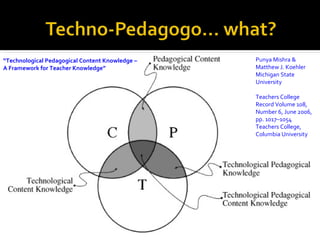
“Technological Pedagogical Content Knowledge –   Punya Mishra &
A Framework for Teacher Knowledge”               Matthew J. Koehler
                                                 Michigan State
                                                 University

                                                 Teachers College
                                                 Record Volume 108,
                                                 Number 6, June 2006,
                                                 pp. 1017–1054
                                                 Teachers College,
                                                 Columbia University
This research project is jointly run by
 Otago University with Kwok Wing Lai
    and Ann Trewern; and the Virtual
Learning Network (VLN) with Ken Pullar
   from OtagoNet, and funded by the
Teaching & Learning Research Initiative
              (TLRI) fund.
New Zealand classroom learners are
  progressively trained to focus on and
   value learning outcomes marked by
assessment events, and directed towards
 learning as a competitive means to win
   employment and contribute to the
       economy beyond schooling.
How can they be turned into a community
  of learners focused on collaborating to
   improve ideas and build knowledge
 together, where the teacher is no longer
 the repository of specialist knowledge?
This will have its challenges, not least of
    which is the question of the purpose of
  school based learning within our society in
                the 21st century.
“Catching The Knowledge Wave? – The Knowledge Society and the Future of Education ”
                     Jane Gilbert (NZCER), 2005, NZCER Press

                 “Supporting Future-Oriented Learning & Teaching –
                 A New Zealand Perspective” June 2012 (Report) MOE
  Rachel Bolstad & Jane Gilbert, with Sue McDowall, Aly Bull, Sally Boyd, & Rosemary
                                        Hipkins
Marlene Scardamalia and Carl Bereiter
 developed and named their educational pedagogy
   ‘Knowledge Building’ integrating pedagogy,
socio-cognition, and technology to form a coherent
         21st century learning paradigm.
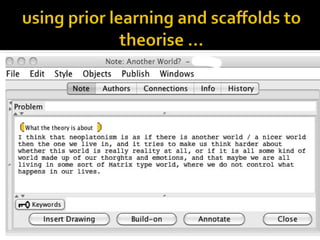
Knowledge Building theory is practically applied in
Knowledge Forum, a digital learning environment.
Marlene Scardamalia posits that
  knowledge building creates idea-
   centred education, rather than
traditional activity-centred education
         (Scardamalia, 2002)
While idea-centredness, teaching for
understanding and constructivist structures
are familiar to teachers, Knowledge Building
  integrates and moves well beyond these
 strategies to form a pedagogical paradigm
 that draws together elements identified by
    researchers as distinct to 21st century
 learning and teaching (Scardamalia, 2002)
Knowledge Building integrate and activate
the ‘front end’ of the NZ Curriculum in an
authentic, ‘real life’ way…

Vision
Principles
Values
Key competencies
“Knowledge Building entails creating a
  culture in the classroom that is not a
  miniature of the surrounding culture,
   but rather is a model of what that
surrounding culture might become — a
    culture in which the creation and
 improvement of ideas pervades social
        life.” (Scardamalia, 2002)
Mechanisms developed to foster Knowledge
Building in Knowledge Forum include:
digital space or public forum where a community
shares ideas
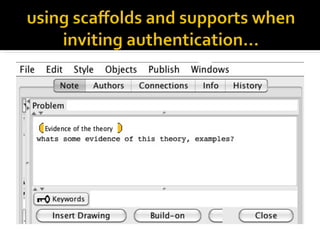
scaffolds & supports that facilitate the inquiry
process
build-on’s enable idea elaboration
quote from ideas presented by others to
encourage reflection and synthesis…
   views enable community members to organise &
    refine notes from other members

   rise-above notes facilitate integration and
    synthesis of ideas & further reflection

   publication of notes which make important and
    creative contributions to the community
                                           (Bielaczyc, 2006)
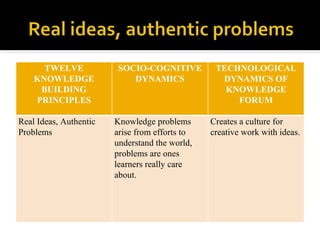
TWELVE             SOCIO-COGNITIVE         TECHNOLOGICAL
    KNOWLEDGE               DYNAMICS              DYNAMICS OF
     BUILDING                                      KNOWLEDGE
    PRINCIPLES                                       FORUM

Real Ideas, Authentic   Knowledge problems      Creates a culture for
Problems                arise from efforts to   creative work with ideas.
                        understand the world,
                        problems are ones
                        learners really care
                        about.
TWELVE         SOCIO-COGNITIVE              TECHNOLOGICAL
   KNOWLEDGE           DYNAMICS                   DYNAMICS OF
    BUILDING                                       KNOWLEDGE
   PRINCIPLES                                        FORUM

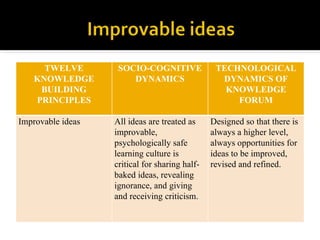
Improvable ideas   All ideas are treated as     Designed so that there is
                   improvable,                  always a higher level,
                   psychologically safe         always opportunities for
                   learning culture is          ideas to be improved,
                   critical for sharing half-   revised and refined.
                   baked ideas, revealing
                   ignorance, and giving
                   and receiving criticism.
TWELVE      SOCIO-COGNITIVE              TECHNOLOGICAL
    KNOWLEDGE        DYNAMICS                   DYNAMICS OF
     BUILDING                                    KNOWLEDGE
    PRINCIPLES                                     FORUM

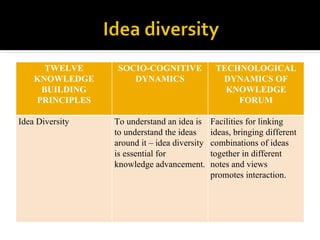
Idea Diversity   To understand an idea is     Facilities for linking
                 to understand the ideas      ideas, bringing different
                 around it – idea diversity   combinations of ideas
                 is essential for             together in different
                 knowledge advancement.       notes and views
                                              promotes interaction.
TWELVE      SOCIO-COGNITIVE              TECHNOLOGICAL
   KNOWLEDGE        DYNAMICS                   DYNAMICS OF
    BUILDING                                    KNOWLEDGE
   PRINCIPLES                                     FORUM

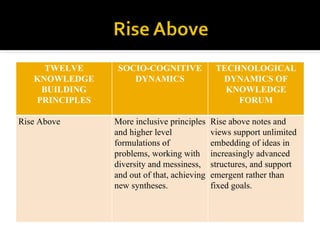
Rise Above      More inclusive principles    Rise above notes and
                and higher level             views support unlimited
                formulations of              embedding of ideas in
                problems, working with       increasingly advanced
                diversity and messiness,     structures, and support
                and out of that, achieving   emergent rather than
                new syntheses.               fixed goals.
TWELVE         SOCIO-COGNITIVE              TECHNOLOGICAL
   KNOWLEDGE           DYNAMICS                   DYNAMICS OF
    BUILDING                                       KNOWLEDGE
   PRINCIPLES                                        FORUM

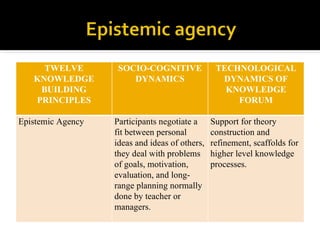
Epistemic Agency   Participants negotiate a     Support for theory
                   fit between personal         construction and
                   ideas and ideas of others,   refinement, scaffolds for
                   they deal with problems      higher level knowledge
                   of goals, motivation,        processes.
                   evaluation, and long-
                   range planning normally
                   done by teacher or
                   managers.
TWELVE               SOCIO-COGNITIVE             TECHNOLOGICAL
    KNOWLEDGE                 DYNAMICS                  DYNAMICS OF
     BUILDING                                            KNOWLEDGE
    PRINCIPLES                                             FORUM

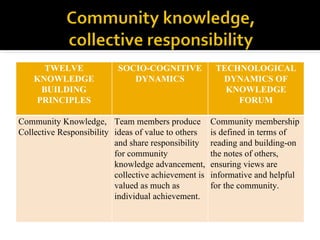
Community Knowledge, Team members produce             Community membership
Collective Responsibility ideas of value to others    is defined in terms of
                          and share responsibility    reading and building-on
                          for community               the notes of others,
                          knowledge advancement,      ensuring views are
                          collective achievement is   informative and helpful
                          valued as much as           for the community.
                          individual achievement.
TWELVE      SOCIO-COGNITIVE              TECHNOLOGICAL
   KNOWLEDGE        DYNAMICS                   DYNAMICS OF
    BUILDING                                    KNOWLEDGE
   PRINCIPLES                                     FORUM

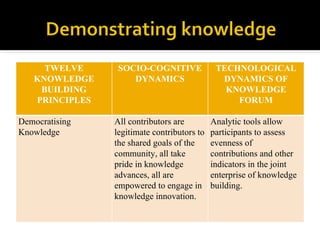
Democratising   All contributors are         Analytic tools allow
Knowledge       legitimate contributors to   participants to assess
                the shared goals of the      evenness of
                community, all take          contributions and other
                pride in knowledge           indicators in the joint
                advances, all are            enterprise of knowledge
                empowered to engage in       building.
                knowledge innovation.
TWELVE            SOCIO-COGNITIVE            TECHNOLOGICAL
   KNOWLEDGE              DYNAMICS                 DYNAMICS OF
    BUILDING                                        KNOWLEDGE
   PRINCIPLES                                         FORUM

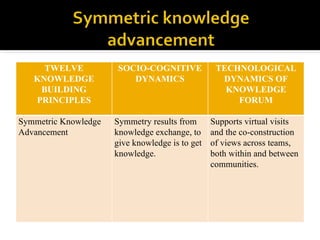
Symmetric Knowledge   Symmetry results from      Supports virtual visits
Advancement           knowledge exchange, to     and the co-construction
                      give knowledge is to get   of views across teams,
                      knowledge.                 both within and between
                                                 communities.
TWELVE            SOCIO-COGNITIVE              TECHNOLOGICAL
   KNOWLEDGE              DYNAMICS                   DYNAMICS OF
    BUILDING                                          KNOWLEDGE
   PRINCIPLES                                           FORUM

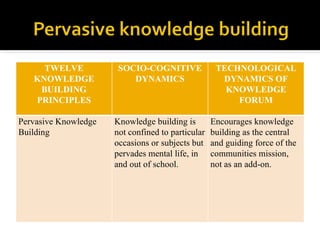
Pervasive Knowledge   Knowledge building is        Encourages knowledge
Building              not confined to particular   building as the central
                      occasions or subjects but    and guiding force of the
                      pervades mental life, in     communities mission,
                      and out of school.           not as an add-on.
TWELVE             SOCIO-COGNITIVE            TECHNOLOGICAL
    KNOWLEDGE               DYNAMICS                 DYNAMICS OF
     BUILDING                                         KNOWLEDGE
    PRINCIPLES                                          FORUM

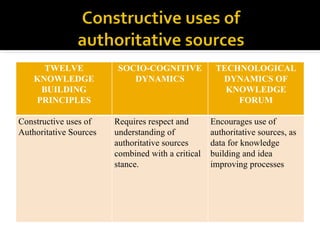
Constructive uses of    Requires respect and       Encourages use of
Authoritative Sources   understanding of           authoritative sources, as
                        authoritative sources      data for knowledge
                        combined with a critical   building and idea
                        stance.                    improving processes
TWELVE           SOCIO-COGNITIVE           TECHNOLOGICAL
   KNOWLEDGE             DYNAMICS                DYNAMICS OF
    BUILDING                                      KNOWLEDGE
   PRINCIPLES                                       FORUM

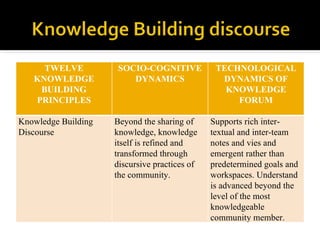
Knowledge Building   Beyond the sharing of     Supports rich inter-
Discourse            knowledge, knowledge      textual and inter-team
                     itself is refined and     notes and vies and
                     transformed through       emergent rather than
                     discursive practices of   predetermined goals and
                     the community.            workspaces. Understand
                                               is advanced beyond the
                                               level of the most
                                               knowledgeable
                                               community member.
TWELVE             SOCIO-COGNITIVE             TECHNOLOGICAL
   KNOWLEDGE               DYNAMICS                  DYNAMICS OF
    BUILDING                                          KNOWLEDGE
   PRINCIPLES                                           FORUM

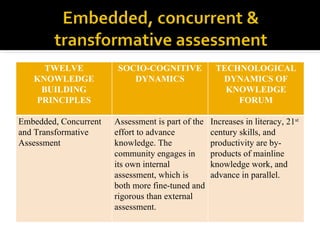
Embedded, Concurrent   Assessment is part of the   Increases in literacy, 21st
and Transformative     effort to advance           century skills, and
Assessment             knowledge. The              productivity are by-
                       community engages in        products of mainline
                       its own internal            knowledge work, and
                       assessment, which is        advance in parallel.
                       both more fine-tuned and
                       rigorous than external
                       assessment.
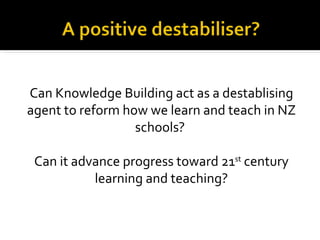
Can Knowledge Building act as a destablising
agent to reform how we learn and teach in NZ
                  schools?

 Can it advance progress toward 21st century
           learning and teaching?
Madeline Campbell
VPLN & DA Hui in Christchurch
       21 June 2012

E hui presentation 2012

  • 1.
    Knowledge Building (thepedagogy) Knowledge Building Communities (the practice) and Knowledge Forum (the ICT tool)
  • 3.
    DSM-IV-TR Criteria: According tothe revised fourth edition of the Diagnostic and Statistical Manual of Mental Disorders (DSM-IV-TR), to be diagnosed with schizo-pedagogo- phrenia, three diagnostic criteria must be met: Characteristic symptoms: Two or more of the following, each present for much of the time during a one-month period (or less, if symptoms remitted with treatment).
  • 4.
    Delusions (ie: I can do a research project as well as doing my normal teaching load and the duties my school requires of me. I'm capable and have something to offer. I enjoy exploring new pedagogical paradigms and am ready to make a 'shift' to a 21st century style of teaching)
  • 5.
    Disorganized speech, which is a manifestation of formal thought disorder (ie: what day is it? which job should I do first - what did I need to do again? What is this sandwich doing in my classroom printmaking press? What meeting was I supposed to be at? Should I apologise again to so and so, what did I do wrong again? Poop on a stick for dinner kids - what, no?)
  • 6.
    Grossly disorganized behavior (e.g. dressing inappropriately whats wrong with undies for a hat?, crying frequently isn't that normal for practitioner researchers?) or catatonic behavior I was sure the TV had been on for the past 2 hours...
  • 7.
    Negative symptoms: Blunted affect(lack or decline in emotional response), alogia (lack or decline in speech), or avolition (lack or decline in motivation ie: What I was going to say about how I feel was...was... oh... um...whatever... cant be bothered anymore...)
  • 8.
    If the delusions are judged to be bizarre (um, yes?), or hallucinations consist of hearing one voice participating in a running commentary of the patient's actions or of hearing two or more voices conversing with each other (isn't that normal? no, its not, yes it is! I don't think it is, what do you think? did you see Australia is on TV, nah, turn it off and concentrate...), only that symptom is required above. The speech disorganization criterion is only met if it is severe enough to substantially impair communication.
  • 9.
    For occupational dysfunction: Fora significant portion of the time since the onset of the disturbance, one or more major areas of functioning such as work, interpersonal relations (what friends), or self- care (my hair has always had dreads), are markedly below the level achieved prior to the onset.
  • 10.
    Significant duration: Continuous signsof the disturbance persist for at least six months (January to mid/late June 2012, thats six months isn't it?). This six-month period must include at least one month of symptoms (or less, if symptoms remitted with treatment).
  • 11.
    “Technological Pedagogical ContentKnowledge – Punya Mishra & A Framework for Teacher Knowledge” Matthew J. Koehler Michigan State University Teachers College Record Volume 108, Number 6, June 2006, pp. 1017–1054 Teachers College, Columbia University
  • 12.
    This research projectis jointly run by Otago University with Kwok Wing Lai and Ann Trewern; and the Virtual Learning Network (VLN) with Ken Pullar from OtagoNet, and funded by the Teaching & Learning Research Initiative (TLRI) fund.
  • 13.
    New Zealand classroomlearners are progressively trained to focus on and value learning outcomes marked by assessment events, and directed towards learning as a competitive means to win employment and contribute to the economy beyond schooling.
  • 14.
    How can theybe turned into a community of learners focused on collaborating to improve ideas and build knowledge together, where the teacher is no longer the repository of specialist knowledge?
  • 15.
    This will haveits challenges, not least of which is the question of the purpose of school based learning within our society in the 21st century. “Catching The Knowledge Wave? – The Knowledge Society and the Future of Education ” Jane Gilbert (NZCER), 2005, NZCER Press “Supporting Future-Oriented Learning & Teaching – A New Zealand Perspective” June 2012 (Report) MOE Rachel Bolstad & Jane Gilbert, with Sue McDowall, Aly Bull, Sally Boyd, & Rosemary Hipkins
  • 16.
    Marlene Scardamalia andCarl Bereiter developed and named their educational pedagogy ‘Knowledge Building’ integrating pedagogy, socio-cognition, and technology to form a coherent 21st century learning paradigm. Knowledge Building theory is practically applied in Knowledge Forum, a digital learning environment.
  • 17.
    Marlene Scardamalia positsthat knowledge building creates idea- centred education, rather than traditional activity-centred education (Scardamalia, 2002)
  • 18.
    While idea-centredness, teachingfor understanding and constructivist structures are familiar to teachers, Knowledge Building integrates and moves well beyond these strategies to form a pedagogical paradigm that draws together elements identified by researchers as distinct to 21st century learning and teaching (Scardamalia, 2002)
  • 20.
    Knowledge Building integrateand activate the ‘front end’ of the NZ Curriculum in an authentic, ‘real life’ way… Vision Principles Values Key competencies
  • 21.
    “Knowledge Building entailscreating a culture in the classroom that is not a miniature of the surrounding culture, but rather is a model of what that surrounding culture might become — a culture in which the creation and improvement of ideas pervades social life.” (Scardamalia, 2002)
  • 22.
    Mechanisms developed tofoster Knowledge Building in Knowledge Forum include: digital space or public forum where a community shares ideas scaffolds & supports that facilitate the inquiry process build-on’s enable idea elaboration quote from ideas presented by others to encourage reflection and synthesis…
  • 23.
    views enable community members to organise & refine notes from other members  rise-above notes facilitate integration and synthesis of ideas & further reflection  publication of notes which make important and creative contributions to the community (Bielaczyc, 2006)
  • 24.
    TWELVE SOCIO-COGNITIVE TECHNOLOGICAL KNOWLEDGE DYNAMICS DYNAMICS OF BUILDING KNOWLEDGE PRINCIPLES FORUM Real Ideas, Authentic Knowledge problems Creates a culture for Problems arise from efforts to creative work with ideas. understand the world, problems are ones learners really care about.
  • 25.
    TWELVE SOCIO-COGNITIVE TECHNOLOGICAL KNOWLEDGE DYNAMICS DYNAMICS OF BUILDING KNOWLEDGE PRINCIPLES FORUM Improvable ideas All ideas are treated as Designed so that there is improvable, always a higher level, psychologically safe always opportunities for learning culture is ideas to be improved, critical for sharing half- revised and refined. baked ideas, revealing ignorance, and giving and receiving criticism.
  • 26.
    TWELVE SOCIO-COGNITIVE TECHNOLOGICAL KNOWLEDGE DYNAMICS DYNAMICS OF BUILDING KNOWLEDGE PRINCIPLES FORUM Idea Diversity To understand an idea is Facilities for linking to understand the ideas ideas, bringing different around it – idea diversity combinations of ideas is essential for together in different knowledge advancement. notes and views promotes interaction.
  • 27.
    TWELVE SOCIO-COGNITIVE TECHNOLOGICAL KNOWLEDGE DYNAMICS DYNAMICS OF BUILDING KNOWLEDGE PRINCIPLES FORUM Rise Above More inclusive principles Rise above notes and and higher level views support unlimited formulations of embedding of ideas in problems, working with increasingly advanced diversity and messiness, structures, and support and out of that, achieving emergent rather than new syntheses. fixed goals.
  • 28.
    TWELVE SOCIO-COGNITIVE TECHNOLOGICAL KNOWLEDGE DYNAMICS DYNAMICS OF BUILDING KNOWLEDGE PRINCIPLES FORUM Epistemic Agency Participants negotiate a Support for theory fit between personal construction and ideas and ideas of others, refinement, scaffolds for they deal with problems higher level knowledge of goals, motivation, processes. evaluation, and long- range planning normally done by teacher or managers.
  • 29.
    TWELVE SOCIO-COGNITIVE TECHNOLOGICAL KNOWLEDGE DYNAMICS DYNAMICS OF BUILDING KNOWLEDGE PRINCIPLES FORUM Community Knowledge, Team members produce Community membership Collective Responsibility ideas of value to others is defined in terms of and share responsibility reading and building-on for community the notes of others, knowledge advancement, ensuring views are collective achievement is informative and helpful valued as much as for the community. individual achievement.
  • 30.
    TWELVE SOCIO-COGNITIVE TECHNOLOGICAL KNOWLEDGE DYNAMICS DYNAMICS OF BUILDING KNOWLEDGE PRINCIPLES FORUM Democratising All contributors are Analytic tools allow Knowledge legitimate contributors to participants to assess the shared goals of the evenness of community, all take contributions and other pride in knowledge indicators in the joint advances, all are enterprise of knowledge empowered to engage in building. knowledge innovation.
  • 31.
    TWELVE SOCIO-COGNITIVE TECHNOLOGICAL KNOWLEDGE DYNAMICS DYNAMICS OF BUILDING KNOWLEDGE PRINCIPLES FORUM Symmetric Knowledge Symmetry results from Supports virtual visits Advancement knowledge exchange, to and the co-construction give knowledge is to get of views across teams, knowledge. both within and between communities.
  • 32.
    TWELVE SOCIO-COGNITIVE TECHNOLOGICAL KNOWLEDGE DYNAMICS DYNAMICS OF BUILDING KNOWLEDGE PRINCIPLES FORUM Pervasive Knowledge Knowledge building is Encourages knowledge Building not confined to particular building as the central occasions or subjects but and guiding force of the pervades mental life, in communities mission, and out of school. not as an add-on.
  • 33.
    TWELVE SOCIO-COGNITIVE TECHNOLOGICAL KNOWLEDGE DYNAMICS DYNAMICS OF BUILDING KNOWLEDGE PRINCIPLES FORUM Constructive uses of Requires respect and Encourages use of Authoritative Sources understanding of authoritative sources, as authoritative sources data for knowledge combined with a critical building and idea stance. improving processes
  • 34.
    TWELVE SOCIO-COGNITIVE TECHNOLOGICAL KNOWLEDGE DYNAMICS DYNAMICS OF BUILDING KNOWLEDGE PRINCIPLES FORUM Knowledge Building Beyond the sharing of Supports rich inter- Discourse knowledge, knowledge textual and inter-team itself is refined and notes and vies and transformed through emergent rather than discursive practices of predetermined goals and the community. workspaces. Understand is advanced beyond the level of the most knowledgeable community member.
  • 35.
    TWELVE SOCIO-COGNITIVE TECHNOLOGICAL KNOWLEDGE DYNAMICS DYNAMICS OF BUILDING KNOWLEDGE PRINCIPLES FORUM Embedded, Concurrent Assessment is part of the Increases in literacy, 21st and Transformative effort to advance century skills, and Assessment knowledge. The productivity are by- community engages in products of mainline its own internal knowledge work, and assessment, which is advance in parallel. both more fine-tuned and rigorous than external assessment.
  • 45.
    Can Knowledge Buildingact as a destablising agent to reform how we learn and teach in NZ schools? Can it advance progress toward 21st century learning and teaching?
  • 46.
    Madeline Campbell VPLN &DA Hui in Christchurch 21 June 2012