NEW PRODUCT DEVELOPMENT
PROCESS
Presented by-
Daksha Karwasara (PhD
Scholar ,MPUAT)
MARKETING
Marketing refers to activities a company undertakes to promote the buying or selling
of a product or service. Marketing includes advertising, selling, and delivering
products to consumers or other businesses.
Marketing is about planning and executing the development, pricing, distribution and
promotion of products and services to satisfy the needs of your customers. The main
role of marketing is to deliver customer value to attracting new customers and
keeping existing ones.
PRODUCT
 In marketing, a product is an object, or system, or service
made available for consumer use as of the consumer
demand; it is anything that can be offered to a market to
satisfy the desire or need of a customer.
 The product development process encompasses all steps
needed to take a product from concept to market
availability. Product development is the process of building
a new product, from ideation all the way through launch.
Product development begins with those initial
brainstorming sessions, when you’re just discussing a
budding idea.
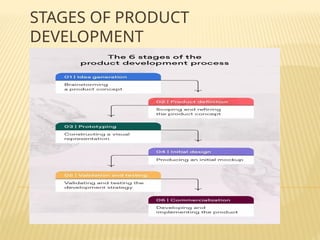
STAGES OF PRODUCT
DEVELOPMENT
IDEA GENERATION (IDEATION)
The initial stage of the product development process begins by generating new product ideas. This is the
product innovation stage, where you brainstorm product concepts based on customer needs, concept
testing, and market research.
Consider the following factors when initiating a new product concept:
Target market: Your target market is the consumer profile you’re building your product for. These are your
potential customers. This is important to identify in the beginning so you can build your product concept
around your target market from the start.
Existing products: When you have a new product concept, it’s a good idea to evaluate your existing product
portfolio. Are there existing products that solve a similar problem? Or does a competitor offer a product that
doesn’t allow for market share? And if yes, is your new concept different enough to be viable? Answering
these questions can ensure the success of your new concept.
Functionality: While you don’t need a detailed report of the product functionality just yet, you should have a
general idea of what functions it will serve. Consider the look and feel of your product and why someone
would be interested in purchasing it.
SWOT analysis: Analyzing your product strengths, weaknesses, opportunities, and threats early in the process
can help you build the best version of your new concept. This will ensure your product is different from
competitors and solves a market gap.
PRODUCT DEFINITION
Once you’ve completed the business case and discussed your target market and product
functionality, it’s time to define the product. This is also referred to as scoping or concept
development, and focuses on refining the product strategy.
During this stage, it’s important to define specifics including:
Business analysis: A business analysis consists of mapping out distribution strategy, ecommerce
strategy, and a more in-depth competitor analysis. The purpose of this step is to begin building a
clearly defined product roadmap.
Value proposition: The value proposition is what problem the product is solving. Consider how it
differs from other products in the market. This value can be useful for market research and for
developing your marketing strategy.
Marketing strategy: Once you’ve identified your value proposition and success metrics, begin
brainstorming a marketing strategy that fits your needs. Consider which channels you want to
promote your product on—such as social media or a blog post. While this strategy may need to be
revised depending on the finished product, it’s a good idea to think about this when defining your
product to begin planning ahead of time.
PROTOTYPING
During the prototyping stage, your team will intensively research and document the
product by creating a more detailed business plan and constructing the product.
These early-stage prototypes might be as simple as a drawing or a more complex computer
render of the initial design. These prototypes help you identify areas of risk before you
create the product.
During the prototyping phase, you will work on specifics like:
Market risk research: It’s important to analyze any potential risks associated with the
production of your product before it’s physically created. This will prevent the product
launch from being derailed later on. It will also ensure you communicate risks to the team
by documenting them in a risk register.
Development strategy: Next, you can begin working through your development plan. In
other words, know how you’ll be assigning tasks and the timeline of these tasks. One way
you can plan tasks and estimate timeline is by using the critical path method.

INITIAL DESIGN
 During the initial design phase, project stakeholders work together to produce a
mockup of the product based on the MVP prototype. The design should be created
with the target audience in mind and complement the key functions of your product.
 To produce the initial design, you will:
 Source materials: Sourcing materials plays an important role in designing the initial
mockup. This may entail working with various vendors and ordering materials or
creating your own. Since materials can come from various places, you should
document material use in a shared space to reference later if needed.

 Connect with stakeholders: It’s important to keep tight communication during the
design phase to verify your initial design is on the right track. Share weekly or daily
progress reports to share updates and get approvals as needed.
 Receive initial feedback: When the design is complete, ask senior management and
project stakeholders for initial feedback. You can then revise the product design as
needed until the final design is ready to be developed and implemented.

VALIDATION AND TESTING
 To go live with a new product, you first need to validate and test it. This ensures that every part
of the product—from development to marketing—is working effectively before it’s released to the
public.
 To ensure the quality of your product, complete the following:
 Concept development and testing: You may have successfully designed your prototype, but you’ll
still need to work through any issues that arise while developing the concept. This could involve
software development or the physical production of the initial prototype. Test functionality by
enlisting the help of team members and beta testers to quality assure the development.
 Front-end testing: During this stage, test the front-end functionality for risks with development
code or consumer-facing errors. This includes checking the ecommerce functionality and
ensuring it’s stable for launch.
 Test marketing: Before you begin producing your final product, test your marketing plan for
functionality and errors. This is also a time to ensure that all campaigns are set up correctly and
ready to launch.

COMMERCIALIZATION
 By now, you’ve finalized the design and quality tested your development and
marketing strategy.
 In this stage you should be working on:
 Product development: This is the physical creation of your product that will be
released to your customers. This may require production or additional
development for software concepts. Give your team the final prototype and
MVP iterations to produce the product to the correct specifications.
 Ecommerce implementation: Once the product has been developed and
you’re ready to launch, your development team will transition your ecommerce
materials to a live state. This may require additional testing to ensure your live
product is functioning as it was intended during the previous front-end testing
phase.
Branding
Packeging
Labelling
BRANDING
 Branding, packaging, and labeling are all important aspects of product marketing.
 Branding is the process of creating a unique image and identity for a product or
company inthe consumers’ minds.
 Benefits of Branding
 1. Customer recognition: A strong brand can help customers recognize and
remember your business, which can lead to increased sales and customer loyalty
 2. Product differentiation: Branding can help differentiate your products from
those of your competitors, making it easier for customers to choose your products
over others
 3. Increased credibility: A well-established brand can increase your business’s
credibility and reputation, which can lead to more sales and customer loyalty
PACKAGING
 Packaging, on the other hand, is designing and producing a product’s
containers, labels, and wrappers . It focuses on the appearance of
the product and is more about the look and feel of the product .
 Packaging is an essential aspect of product marketing that can help
businesses in several ways.
 Here are some benefits of packaging:
 1. Protection:
 2. Product differentiation:
 3. Marketing.
 4. Increased sales:
 5. Brand recognition:
LABELING
Labeling is mainly concerned with product description to be given. It determines
what is to be displayed on the product or its package . Labels are usually used to
communicate important product information such as ingredients, nutritional
information, and warnings . Effective branding and packaging work together to
influence consumer perception and purchase decisions.
 Benefits of labelling
 Labelling is an essential aspect of product marketing that can help businesses in
several ways.
 Here are some benefits of labelling:
 1. Identification:.
 2. Description:.
 3. Comparison
 4. Marketing:
 5. Protection
Marketing  New Product Development Proces

Marketing New Product Development Proces

  • 1.
    NEW PRODUCT DEVELOPMENT PROCESS Presentedby- Daksha Karwasara (PhD Scholar ,MPUAT)
  • 2.
    MARKETING Marketing refers toactivities a company undertakes to promote the buying or selling of a product or service. Marketing includes advertising, selling, and delivering products to consumers or other businesses. Marketing is about planning and executing the development, pricing, distribution and promotion of products and services to satisfy the needs of your customers. The main role of marketing is to deliver customer value to attracting new customers and keeping existing ones.
  • 3.
    PRODUCT  In marketing,a product is an object, or system, or service made available for consumer use as of the consumer demand; it is anything that can be offered to a market to satisfy the desire or need of a customer.  The product development process encompasses all steps needed to take a product from concept to market availability. Product development is the process of building a new product, from ideation all the way through launch. Product development begins with those initial brainstorming sessions, when you’re just discussing a budding idea.
  • 5.
  • 6.
    IDEA GENERATION (IDEATION) Theinitial stage of the product development process begins by generating new product ideas. This is the product innovation stage, where you brainstorm product concepts based on customer needs, concept testing, and market research. Consider the following factors when initiating a new product concept: Target market: Your target market is the consumer profile you’re building your product for. These are your potential customers. This is important to identify in the beginning so you can build your product concept around your target market from the start. Existing products: When you have a new product concept, it’s a good idea to evaluate your existing product portfolio. Are there existing products that solve a similar problem? Or does a competitor offer a product that doesn’t allow for market share? And if yes, is your new concept different enough to be viable? Answering these questions can ensure the success of your new concept. Functionality: While you don’t need a detailed report of the product functionality just yet, you should have a general idea of what functions it will serve. Consider the look and feel of your product and why someone would be interested in purchasing it. SWOT analysis: Analyzing your product strengths, weaknesses, opportunities, and threats early in the process can help you build the best version of your new concept. This will ensure your product is different from competitors and solves a market gap.
  • 7.
    PRODUCT DEFINITION Once you’vecompleted the business case and discussed your target market and product functionality, it’s time to define the product. This is also referred to as scoping or concept development, and focuses on refining the product strategy. During this stage, it’s important to define specifics including: Business analysis: A business analysis consists of mapping out distribution strategy, ecommerce strategy, and a more in-depth competitor analysis. The purpose of this step is to begin building a clearly defined product roadmap. Value proposition: The value proposition is what problem the product is solving. Consider how it differs from other products in the market. This value can be useful for market research and for developing your marketing strategy. Marketing strategy: Once you’ve identified your value proposition and success metrics, begin brainstorming a marketing strategy that fits your needs. Consider which channels you want to promote your product on—such as social media or a blog post. While this strategy may need to be revised depending on the finished product, it’s a good idea to think about this when defining your product to begin planning ahead of time.
  • 8.
    PROTOTYPING During the prototypingstage, your team will intensively research and document the product by creating a more detailed business plan and constructing the product. These early-stage prototypes might be as simple as a drawing or a more complex computer render of the initial design. These prototypes help you identify areas of risk before you create the product. During the prototyping phase, you will work on specifics like: Market risk research: It’s important to analyze any potential risks associated with the production of your product before it’s physically created. This will prevent the product launch from being derailed later on. It will also ensure you communicate risks to the team by documenting them in a risk register. Development strategy: Next, you can begin working through your development plan. In other words, know how you’ll be assigning tasks and the timeline of these tasks. One way you can plan tasks and estimate timeline is by using the critical path method.
  • 9.
     INITIAL DESIGN  Duringthe initial design phase, project stakeholders work together to produce a mockup of the product based on the MVP prototype. The design should be created with the target audience in mind and complement the key functions of your product.  To produce the initial design, you will:  Source materials: Sourcing materials plays an important role in designing the initial mockup. This may entail working with various vendors and ordering materials or creating your own. Since materials can come from various places, you should document material use in a shared space to reference later if needed.   Connect with stakeholders: It’s important to keep tight communication during the design phase to verify your initial design is on the right track. Share weekly or daily progress reports to share updates and get approvals as needed.  Receive initial feedback: When the design is complete, ask senior management and project stakeholders for initial feedback. You can then revise the product design as needed until the final design is ready to be developed and implemented.
  • 10.
     VALIDATION AND TESTING To go live with a new product, you first need to validate and test it. This ensures that every part of the product—from development to marketing—is working effectively before it’s released to the public.  To ensure the quality of your product, complete the following:  Concept development and testing: You may have successfully designed your prototype, but you’ll still need to work through any issues that arise while developing the concept. This could involve software development or the physical production of the initial prototype. Test functionality by enlisting the help of team members and beta testers to quality assure the development.  Front-end testing: During this stage, test the front-end functionality for risks with development code or consumer-facing errors. This includes checking the ecommerce functionality and ensuring it’s stable for launch.  Test marketing: Before you begin producing your final product, test your marketing plan for functionality and errors. This is also a time to ensure that all campaigns are set up correctly and ready to launch.
  • 11.
     COMMERCIALIZATION  By now,you’ve finalized the design and quality tested your development and marketing strategy.  In this stage you should be working on:  Product development: This is the physical creation of your product that will be released to your customers. This may require production or additional development for software concepts. Give your team the final prototype and MVP iterations to produce the product to the correct specifications.  Ecommerce implementation: Once the product has been developed and you’re ready to launch, your development team will transition your ecommerce materials to a live state. This may require additional testing to ensure your live product is functioning as it was intended during the previous front-end testing phase.
  • 12.
  • 13.
    BRANDING  Branding, packaging,and labeling are all important aspects of product marketing.  Branding is the process of creating a unique image and identity for a product or company inthe consumers’ minds.  Benefits of Branding  1. Customer recognition: A strong brand can help customers recognize and remember your business, which can lead to increased sales and customer loyalty  2. Product differentiation: Branding can help differentiate your products from those of your competitors, making it easier for customers to choose your products over others  3. Increased credibility: A well-established brand can increase your business’s credibility and reputation, which can lead to more sales and customer loyalty
  • 14.
    PACKAGING  Packaging, onthe other hand, is designing and producing a product’s containers, labels, and wrappers . It focuses on the appearance of the product and is more about the look and feel of the product .  Packaging is an essential aspect of product marketing that can help businesses in several ways.  Here are some benefits of packaging:  1. Protection:  2. Product differentiation:  3. Marketing.  4. Increased sales:  5. Brand recognition:
  • 15.
    LABELING Labeling is mainlyconcerned with product description to be given. It determines what is to be displayed on the product or its package . Labels are usually used to communicate important product information such as ingredients, nutritional information, and warnings . Effective branding and packaging work together to influence consumer perception and purchase decisions.  Benefits of labelling  Labelling is an essential aspect of product marketing that can help businesses in several ways.  Here are some benefits of labelling:  1. Identification:.  2. Description:.  3. Comparison  4. Marketing:  5. Protection