Gagan Dip,
Ph.D. First Year (L-2021-A-43-D)
Punjab Agricultural University,
Ludhiana
Steps in the
Product Development Process
Submitted to:
Dr. Kamaljit Kaur
INTRODUCTION
 In India, the annual consumption of 'value-added' foods alone is greater
than Rs.2,25,000 crores per year which is larger than the entire
manufacturing sector
 Ironically India looses 25 to 50% of the fruits and vegetables, 10 to 30% of
the grains and oil seeds in the post harvest chain
 These losses translate to a whopping monetary loss worth Rs. 60,000
crores per year. Preserving and value adding these wastages will help to
enhance the income levels of farmers, traders and the country as a whole
 Wide and untapped scopes exist for the farmers, entrepreneurs and
unemployed youths to improve their economic status by investing into food
processing sectors.
 Due to the lack of technical knowledge on processing, preservation and
value addition of the agricultural produce no new ventures in food
processing sector come in.
INTRODUCTION
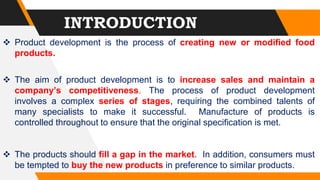
 Product development is the process of creating new or modified food
products.
 The aim of product development is to increase sales and maintain a
company’s competitiveness. The process of product development
involves a complex series of stages, requiring the combined talents of
many specialists to make it successful. Manufacture of products is
controlled throughout to ensure that the original specification is met.
 The products should fill a gap in the market. In addition, consumers must
be tempted to buy the new products in preference to similar products.
INTRODUCTION
CLASSIFICATION
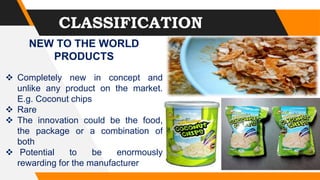
NEW TO THE WORLD
PRODUCTS
 Completely new in concept and
unlike any product on the market.
E.g. Coconut chips
 Rare
 The innovation could be the food,
the package or a combination of
both
 Potential to be enormously
rewarding for the manufacturer
CLASSIFICATION
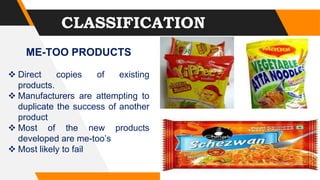
ME-TOO PRODUCTS
 Direct copies of existing
products.
 Manufacturers are attempting to
duplicate the success of another
product
 Most of the new products
developed are me-too’s
 Most likely to fail
CLASSIFICATION
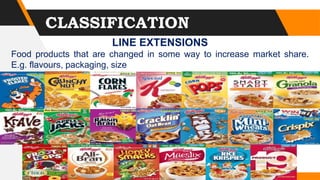
LINE EXTENSIONS
Food products that are changed in some way to increase market share.
E.g. flavours, packaging, size
REASONS FOR NEW PRODUCT
DEVELOPMENT (Market Survey)
1. HEALTH ISSUES
Diet related disorders
Products are developed for target groups
REASONS FOR NEW PRODUCT
DEVELOPMENT
2. ENVIRONMENTAL ISSUES
 Consumers are increasingly concerned about the
environment
 As a result, this has changed farming methods – organic
 Recommendations to reduce, reuse and recycle has lead
to improved packaging materials
REASONS FOR NEW PRODUCT
DEVELOPMENT
3. CONVENIENCE & COST
Changing lifestyle has lead to the need for quick, easy and
economical food solutions
Increased convenience = more money spent, flexible
shopping hours & self serve facilities
 Generic brands are usually more economical options
REASONS FOR NEW PRODUCT
DEVELOPMENT
4. COMPANY PROFITABILITY
In order to be profitable, the company must:
provide products that meet consumer needs
operate efficiently
Utilise promotional strategies
REASONS FOR NEW PRODUCT
DEVELOPMENT
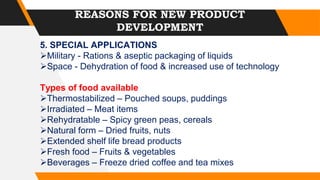
5. SPECIAL APPLICATIONS
Military - Rations & aseptic packaging of liquids
Space - Dehydration of food & increased use of technology
Types of food available
Thermostabilized – Pouched soups, puddings
Irradiated – Meat items
Rehydratable – Spicy green peas, cereals
Natural form – Dried fruits, nuts
Extended shelf life bread products
Fresh food – Fruits & vegetables
Beverages – Freeze dried coffee and tea mixes
REASONS FOR NEW PRODUCT
DEVELOPMENT
6. TECHNOLOGICAL DEVELOPMENTS
 Automated machinery has enabled more efficient
production
 A more scientific approach to food - GM, additives &
functional foods
 Advances in technology have greatly impacted food
packaging
REASONS FOR NEW PRODUCT
DEVELOPMENT
7. SOCIETAL CHANGES
 Women returning to the workforce = men more active role
in shopping & preparation of food
 More meals are eaten away from the home
 Renewed interest in cooking
 Ageing population
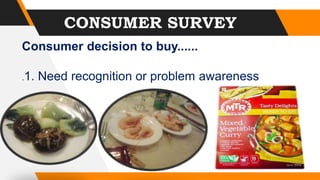
CONSUMER SURVEY
Consumer decision to buy......
.1. Need recognition or problem awareness
CONSUMER SURVEY
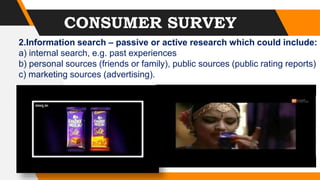
2.Information search – passive or active research which could include:
a) internal search, e.g. past experiences
b) personal sources (friends or family), public sources (public rating reports)
c) marketing sources (advertising).
Advertising mediums
Television
 Social Media
Websites
In-store Marketing
The Effects of Advertising
Compared to non-TV advertised ready-to-eat cereals:
1. TV Advertised child-targeted cereals were purchased thirteen
times more frequently
2. Family-targeted brand purchases were ten times more frequently
3. Adult-targeted cereals were purchased four times more frequently
CONSUMER SURVEY
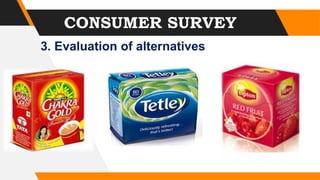
3. Evaluation of alternatives
CONSUMER SURVEY
4. Purchase decision
CONSUMER SURVEY
5. Post purchase evaluation, e.g. a consumer could decide
that an alternative product would have been preferable and
may choose to select an alternative manufacturers product
when the need arises again.
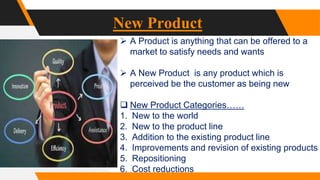
New Product
 A Product is anything that can be offered to a
market to satisfy needs and wants
 A New Product is any product which is
perceived be the customer as being new
 New Product Categories……
1. New to the world
2. New to the product line
3. Addition to the existing product line
4. Improvements and revision of existing products
5. Repositioning
6. Cost reductions
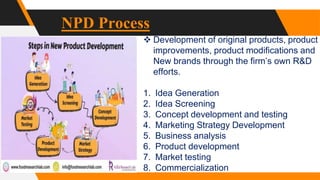
NPD Process
 Development of original products, product
improvements, product modifications and
New brands through the firm’s own R&D
efforts.
1. Idea Generation
2. Idea Screening
3. Concept development and testing
4. Marketing Strategy Development
5. Business analysis
6. Product development
7. Market testing
8. Commercialization
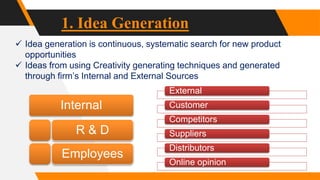
1. Idea Generation
 Idea generation is continuous, systematic search for new product
opportunities
 Ideas from using Creativity generating techniques and generated
through firm’s Internal and External Sources
External
Customer
Competitors
Suppliers
Distributors
Online opinion
Internal
R & D
Employees
2. Idea Screening
 Filtering ideas (Good/Poor)
 Elimination process in which large no. of
ideas screened (Objectivity, policies,
technical feasibility, and financial viability)
 Three groups (Promising, marginal and
rejected)
 Two error should avoided (Drop and Go
error)
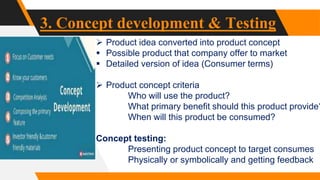
3. Concept development & Testing
 Product idea converted into product concept
 Possible product that company offer to market
 Detailed version of idea (Consumer terms)
 Product concept criteria
Who will use the product?
What primary benefit should this product provide?
When will this product be consumed?
Concept testing:
Presenting product concept to target consumes
Physically or symbolically and getting feedback
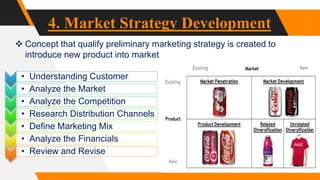
4. Market Strategy Development
 Concept that qualify preliminary marketing strategy is created to
introduce new product into market
• Understanding Customer
• Analyze the Market
• Analyze the Competition
• Research Distribution Channels
• Define Marketing Mix
• Analyze the Financials
• Review and Revise
5. Business analysis
 Financial and marketing point of view (Project benefit or not)
 Estimation of selling price (competition and customer
feedback)
 Estimation of sales volume (Size of market)
 Estimate profitability and break even point
 If above are match with the company’s objectives, then new
product concept moves to product development stage
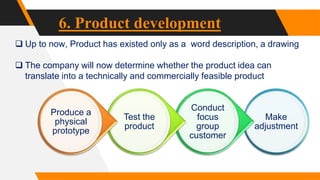
6. Product development
 Up to now, Product has existed only as a word description, a drawing
 The company will now determine whether the product idea can
translate into a technically and commercially feasible product
Make
adjustment
Conduct
focus
group
customer
Test the
product
Produce a
physical
prototype
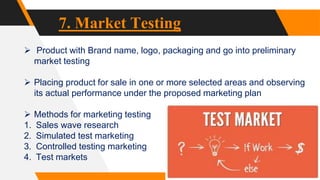
7. Market Testing
 Product with Brand name, logo, packaging and go into preliminary
market testing
 Placing product for sale in one or more selected areas and observing
its actual performance under the proposed marketing plan
 Methods for marketing testing
1. Sales wave research
2. Simulated test marketing
3. Controlled testing marketing
4. Test markets
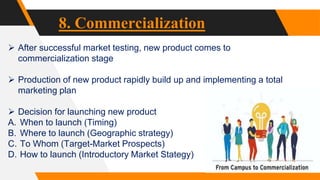
8. Commercialization
 After successful market testing, new product comes to
commercialization stage
 Production of new product rapidly build up and implementing a total
marketing plan
 Decision for launching new product
A. When to launch (Timing)
B. Where to launch (Geographic strategy)
C. To Whom (Target-Market Prospects)
D. How to launch (Introductory Market Stategy)
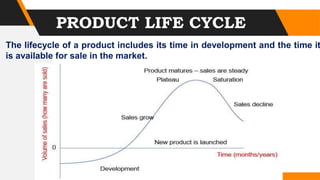
PRODUCT LIFE CYCLE
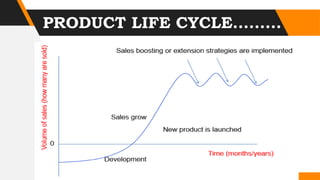
The lifecycle of a product includes its time in development and the time it
is available for sale in the market.
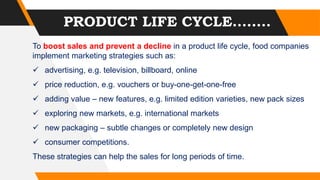
PRODUCT LIFE CYCLE........
To boost sales and prevent a decline in a product life cycle, food companies
implement marketing strategies such as:
 advertising, e.g. television, billboard, online
 price reduction, e.g. vouchers or buy-one-get-one-free
 adding value – new features, e.g. limited edition varieties, new pack sizes
 exploring new markets, e.g. international markets
 new packaging – subtle changes or completely new design
 consumer competitions.
These strategies can help the sales for long periods of time.
PRODUCT LIFE CYCLE.........
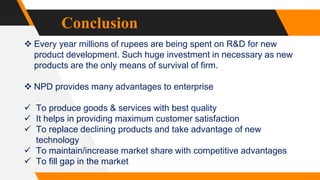
Conclusion
 Every year millions of rupees are being spent on R&D for new
product development. Such huge investment in necessary as new
products are the only means of survival of firm.
 NPD provides many advantages to enterprise
 To produce goods & services with best quality
 It helps in providing maximum customer satisfaction
 To replace declining products and take advantage of new
technology
 To maintain/increase market share with competitive advantages
 To fill gap in the market
THANKS!

New Product Development Food Industry

  • 1.
    Gagan Dip, Ph.D. FirstYear (L-2021-A-43-D) Punjab Agricultural University, Ludhiana Steps in the Product Development Process Submitted to: Dr. Kamaljit Kaur
  • 2.
    INTRODUCTION  In India,the annual consumption of 'value-added' foods alone is greater than Rs.2,25,000 crores per year which is larger than the entire manufacturing sector  Ironically India looses 25 to 50% of the fruits and vegetables, 10 to 30% of the grains and oil seeds in the post harvest chain  These losses translate to a whopping monetary loss worth Rs. 60,000 crores per year. Preserving and value adding these wastages will help to enhance the income levels of farmers, traders and the country as a whole
  • 3.
     Wide anduntapped scopes exist for the farmers, entrepreneurs and unemployed youths to improve their economic status by investing into food processing sectors.  Due to the lack of technical knowledge on processing, preservation and value addition of the agricultural produce no new ventures in food processing sector come in. INTRODUCTION
  • 4.
     Product developmentis the process of creating new or modified food products.  The aim of product development is to increase sales and maintain a company’s competitiveness. The process of product development involves a complex series of stages, requiring the combined talents of many specialists to make it successful. Manufacture of products is controlled throughout to ensure that the original specification is met.  The products should fill a gap in the market. In addition, consumers must be tempted to buy the new products in preference to similar products. INTRODUCTION
  • 5.
    CLASSIFICATION NEW TO THEWORLD PRODUCTS  Completely new in concept and unlike any product on the market. E.g. Coconut chips  Rare  The innovation could be the food, the package or a combination of both  Potential to be enormously rewarding for the manufacturer
  • 6.
    CLASSIFICATION ME-TOO PRODUCTS  Directcopies of existing products.  Manufacturers are attempting to duplicate the success of another product  Most of the new products developed are me-too’s  Most likely to fail
  • 7.
    CLASSIFICATION LINE EXTENSIONS Food productsthat are changed in some way to increase market share. E.g. flavours, packaging, size
  • 8.
    REASONS FOR NEWPRODUCT DEVELOPMENT (Market Survey) 1. HEALTH ISSUES Diet related disorders Products are developed for target groups
  • 9.
    REASONS FOR NEWPRODUCT DEVELOPMENT 2. ENVIRONMENTAL ISSUES  Consumers are increasingly concerned about the environment  As a result, this has changed farming methods – organic  Recommendations to reduce, reuse and recycle has lead to improved packaging materials
  • 10.
    REASONS FOR NEWPRODUCT DEVELOPMENT 3. CONVENIENCE & COST Changing lifestyle has lead to the need for quick, easy and economical food solutions Increased convenience = more money spent, flexible shopping hours & self serve facilities  Generic brands are usually more economical options
  • 11.
    REASONS FOR NEWPRODUCT DEVELOPMENT 4. COMPANY PROFITABILITY In order to be profitable, the company must: provide products that meet consumer needs operate efficiently Utilise promotional strategies
  • 12.
    REASONS FOR NEWPRODUCT DEVELOPMENT 5. SPECIAL APPLICATIONS Military - Rations & aseptic packaging of liquids Space - Dehydration of food & increased use of technology Types of food available Thermostabilized – Pouched soups, puddings Irradiated – Meat items Rehydratable – Spicy green peas, cereals Natural form – Dried fruits, nuts Extended shelf life bread products Fresh food – Fruits & vegetables Beverages – Freeze dried coffee and tea mixes
  • 13.
    REASONS FOR NEWPRODUCT DEVELOPMENT 6. TECHNOLOGICAL DEVELOPMENTS  Automated machinery has enabled more efficient production  A more scientific approach to food - GM, additives & functional foods  Advances in technology have greatly impacted food packaging
  • 14.
    REASONS FOR NEWPRODUCT DEVELOPMENT 7. SOCIETAL CHANGES  Women returning to the workforce = men more active role in shopping & preparation of food  More meals are eaten away from the home  Renewed interest in cooking  Ageing population
  • 15.
    CONSUMER SURVEY Consumer decisionto buy...... .1. Need recognition or problem awareness
  • 16.
    CONSUMER SURVEY 2.Information search– passive or active research which could include: a) internal search, e.g. past experiences b) personal sources (friends or family), public sources (public rating reports) c) marketing sources (advertising).
  • 17.
    Advertising mediums Television  SocialMedia Websites In-store Marketing The Effects of Advertising Compared to non-TV advertised ready-to-eat cereals: 1. TV Advertised child-targeted cereals were purchased thirteen times more frequently 2. Family-targeted brand purchases were ten times more frequently 3. Adult-targeted cereals were purchased four times more frequently
  • 18.
  • 19.
  • 20.
    CONSUMER SURVEY 5. Postpurchase evaluation, e.g. a consumer could decide that an alternative product would have been preferable and may choose to select an alternative manufacturers product when the need arises again.
  • 21.
    New Product  AProduct is anything that can be offered to a market to satisfy needs and wants  A New Product is any product which is perceived be the customer as being new  New Product Categories…… 1. New to the world 2. New to the product line 3. Addition to the existing product line 4. Improvements and revision of existing products 5. Repositioning 6. Cost reductions
  • 22.
    NPD Process  Developmentof original products, product improvements, product modifications and New brands through the firm’s own R&D efforts. 1. Idea Generation 2. Idea Screening 3. Concept development and testing 4. Marketing Strategy Development 5. Business analysis 6. Product development 7. Market testing 8. Commercialization
  • 23.
    1. Idea Generation Idea generation is continuous, systematic search for new product opportunities  Ideas from using Creativity generating techniques and generated through firm’s Internal and External Sources External Customer Competitors Suppliers Distributors Online opinion Internal R & D Employees
  • 24.
    2. Idea Screening Filtering ideas (Good/Poor)  Elimination process in which large no. of ideas screened (Objectivity, policies, technical feasibility, and financial viability)  Three groups (Promising, marginal and rejected)  Two error should avoided (Drop and Go error)
  • 25.
    3. Concept development& Testing  Product idea converted into product concept  Possible product that company offer to market  Detailed version of idea (Consumer terms)  Product concept criteria Who will use the product? What primary benefit should this product provide? When will this product be consumed? Concept testing: Presenting product concept to target consumes Physically or symbolically and getting feedback
  • 26.
    4. Market StrategyDevelopment  Concept that qualify preliminary marketing strategy is created to introduce new product into market • Understanding Customer • Analyze the Market • Analyze the Competition • Research Distribution Channels • Define Marketing Mix • Analyze the Financials • Review and Revise
  • 27.
    5. Business analysis Financial and marketing point of view (Project benefit or not)  Estimation of selling price (competition and customer feedback)  Estimation of sales volume (Size of market)  Estimate profitability and break even point  If above are match with the company’s objectives, then new product concept moves to product development stage
  • 28.
    6. Product development Up to now, Product has existed only as a word description, a drawing  The company will now determine whether the product idea can translate into a technically and commercially feasible product Make adjustment Conduct focus group customer Test the product Produce a physical prototype
  • 29.
    7. Market Testing Product with Brand name, logo, packaging and go into preliminary market testing  Placing product for sale in one or more selected areas and observing its actual performance under the proposed marketing plan  Methods for marketing testing 1. Sales wave research 2. Simulated test marketing 3. Controlled testing marketing 4. Test markets
  • 30.
    8. Commercialization  Aftersuccessful market testing, new product comes to commercialization stage  Production of new product rapidly build up and implementing a total marketing plan  Decision for launching new product A. When to launch (Timing) B. Where to launch (Geographic strategy) C. To Whom (Target-Market Prospects) D. How to launch (Introductory Market Stategy)
  • 31.
    PRODUCT LIFE CYCLE Thelifecycle of a product includes its time in development and the time it is available for sale in the market.
  • 32.
    PRODUCT LIFE CYCLE........ Toboost sales and prevent a decline in a product life cycle, food companies implement marketing strategies such as:  advertising, e.g. television, billboard, online  price reduction, e.g. vouchers or buy-one-get-one-free  adding value – new features, e.g. limited edition varieties, new pack sizes  exploring new markets, e.g. international markets  new packaging – subtle changes or completely new design  consumer competitions. These strategies can help the sales for long periods of time.
  • 33.
  • 35.
    Conclusion  Every yearmillions of rupees are being spent on R&D for new product development. Such huge investment in necessary as new products are the only means of survival of firm.  NPD provides many advantages to enterprise  To produce goods & services with best quality  It helps in providing maximum customer satisfaction  To replace declining products and take advantage of new technology  To maintain/increase market share with competitive advantages  To fill gap in the market
  • 36.