NEUROSTEROIDS
Prepared by: ANUPAM PRAHLAD
First M.Pharm
Pharmacology
Subject :Biochemical and Molecular
Pharmacology
1
 Neuroactive steroids, also known as neurosteroids, are endogenous or
exogenous steroids that rapidly alter neuronal excitability through
interaction with ligand-gated ion channels and other cell surface
receptors.
 The term neuroactive steroids was first coined in 1992 by Steven Paul
and Robert Purdy .
 It refers to steroids that can be synthesized in brain or are synthesized
by an endocrine gland that then reach the brain through the
bloodstream and have effects on brain function.
 Neurosteroids have a wide range of potential clinical applications
from sedation to treatment of epilepsy and traumatic brain injury.
2
CLASSIFICATION
Based on differences in activity and structure:
1. Inhibitory neurosteroids
2.Excitatory neurosteroids
3. Pheromones
3
INHIBITORY NEUROSTEROIDS
 Exert inhibitory actions on neurotransmission.
 They act as positive allosteric modulators of
the GABAa receptor.
 Possess antidepressant, anxiolytic, stress-reducing, memory-
impairing, analgesic,anesthetic, anticonvulsant, neuroprotecti
ve and neurogenic effects.
4
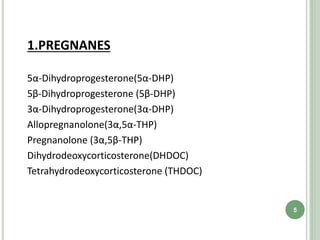
1.PREGNANES
5α-Dihydroprogesterone(5α-DHP)
5β-Dihydroprogesterone (5β-DHP)
3α-Dihydroprogesterone(3α-DHP)
Allopregnanolone(3α,5α-THP)
Pregnanolone (3α,5β-THP)
Dihydrodeoxycorticosterone(DHDOC)
Tetrahydrodeoxycorticosterone (THDOC)
5
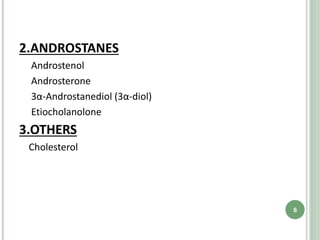
2.ANDROSTANES
Androstenol
Androsterone
3α-Androstanediol (3α-diol)
Etiocholanolone
3.OTHERS
Cholesterol
6
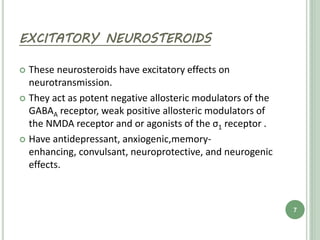
EXCITATORY NEUROSTEROIDS
 These neurosteroids have excitatory effects on
neurotransmission.
 They act as potent negative allosteric modulators of the
GABAA receptor, weak positive allosteric modulators of
the NMDA receptor and or agonists of the σ1 receptor .
 Have antidepressant, anxiogenic,memory-
enhancing, convulsant, neuroprotective, and neurogenic
effects.
7
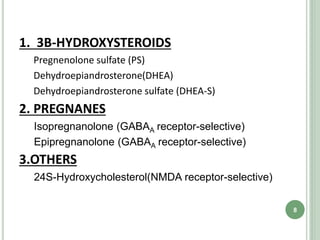
1. 3Β-HYDROXYSTEROIDS
Pregnenolone sulfate (PS)
Dehydroepiandrosterone(DHEA)
Dehydroepiandrosterone sulfate (DHEA-S)
2. PREGNANES
Isopregnanolone (GABAA receptor-selective)
Epipregnanolone (GABAA receptor-selective)
3.OTHERS
24S-Hydroxycholesterol(NMDA receptor-selective)
8
PHEROMONES
These are neurosteroids that influence brain activity via
activation of vomeronasal receptor cells.
1.MALE PHEROMONES
Androstadienol
Androstadienone
Androstenol
Androstenone
2.FEMALE PHEROMONES
Estratetraenol
9
OTHER NEUROSTEROIDS
 Certain other endogenous steroids such
as pregnenolone, progesterone and corticosterone are also
neurosteroids.
 These neurosteroids do not modulate the GABA and NMDA
receptors, and instead affect various other cell surface
receptors and non-genomic targets.
 Many endogenous steroids, including pregnenolone,
progesterone, corticosterone, deoxycorticosterone,
and testosterone, are metabolized into other neurosteroids
called proneurosteroids.
10
BIOSYNTHESIS
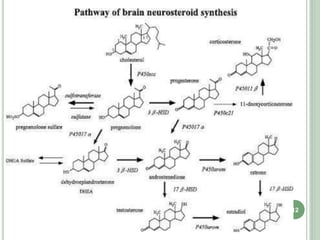
 Neurosteroids are synthesized from cholesterol which is
converted into pregnenolone and then into all other
endogenous steroids.
 Neurosteroids are produced in the brain after local synthesis
or by conversion of peripherally-derived adrenal steroids or
gonadal steroids.
 They accumulate especially in myelinating glial cells, from
cholesterol or steroidal precursors imported from peripheral
sources.
 5α-reductase type i and 3α-hydroxysteroid
dehydrogenase are involved in the biosynthesis of inhibitory
neurosteroids.
 3β-hydroxysteroid dehydrogenase and hydroxysteroid
sulfotransferas are involved in excitatory neurosteroid
production.
11
12
FUNCTIONS
 Known biological functions of neurosteroids include modulation
of neural plasticity,learning and memory processes,behavior
and seizure susceptibility as well as responses to stress, anxiety,
and depression.
 Neurosteroids also appear to play an important role in
various sexually-dimorphic behaviors and emotional responses.
 Acute stress elevates the levels of inhibitory neurosteroids like
allopregnanolone are known to counteract many of the effects of
stress.
 One of the biological functions of these neuromodulators may be
to help maintain emotional homeostasis.
 Changes in neurosteroid levels may be involved in the changes in
mood, anxiety, and sexual desire that occur during puberty in both
sexes and during menopause in women.
13
 Fluctuations in the levels of inhibitory neurosteroids during
the menstrual cycle and pregnancy play an important role in
a variety of women's conditions including premenstrual
syndrome(PMS), postpartum depression(PPD), postpartum
psychosis and catamenial epilepsy.
 Elevated levels of inhibitory neurosteroids, namely
allopregnanolone, can produce paradoxical effects such
as negative mood, anxiety, irritability and aggression.
14
THERAPEUTIC APPLICATION
 Several synthetic neurosteroids have been used as sedatives for
the purpose of general anaesthesia for carrying out surgical
procedures.
 They are alphaxolone,alphadolone and minaxolone. The first of
these to be introduced was hydroxydione, which is the
esterified 21-hydroxy derivative of 5β-pregnanedione.
 Hydroxydione proved to be a useful anaesthetic drug with a
good safety profile, but was painful and irritating when injected
due to poor water solubility.
15
 The next drug from this family to be marketed was a
mixture of alphaxolone and alphadolone, known
as Althesin.
 This was withdrawn from human use due to rare but serious
toxic reactions, but is still used in veterinary medicine.
 The next neurosteroid anaesthetic introduced into human
medicine was minaxolone, which is around three times
more potent than althesin and retains the favourable safety
profile.
16
 The neurosteroid ganaxolone, an analog of the progesterone
metabolite allopregnanolone, has been extensively
investigated in animal models and is currently used in clinical
trials for the treatment of epilepsy.
 Ganaxolone have a broad spectrum of activity in animal
models.]They may have advantages over other
GABAA receptor modulators.
17
 The drug has potential in the treatment of a broad range of
neurological and psychiatric conditions.
 Proof-of-concept studies are currently underway in
posttraumatic stress disorder and fragile x syndrome.
 Researchers have suggested the use of so-called
"neurosteroid replacement therapy" as a way of
treating catamenial epilepsy with neuroactive steroids such
as ganaxolone during the period of the menstrual
cycle when seizure frequency increase.
 Micronized progesterone, which behaves reliably as
a prodrug to allopregnanolone, has been suggested as a
treatment for catamenial epilepsy
 4,16-androstadien-3β-ol is a synthetic pheromone which is
under investigation for the treatment of anxiety disorders in
women. 18
ROLE IN ANTIDEPRESSANT ACTION
 Certain antidepressant drugs such
as fluoxetine and fluvoxamine which are generally thought to
affect depression (SSRIs), have also been found to normalize
the levels of certain neurosteroids (which are frequently
deficient in depressed patients) at doses that are inactive in
affecting the reuptake of serotonin.
 This suggests that other actions involving neurosteroids may
also be at play in the effectiveness of these drugs against
depression.
19
THANK YOU
20

Neurosteroids

  • 1.
    NEUROSTEROIDS Prepared by: ANUPAMPRAHLAD First M.Pharm Pharmacology Subject :Biochemical and Molecular Pharmacology 1
  • 2.
     Neuroactive steroids,also known as neurosteroids, are endogenous or exogenous steroids that rapidly alter neuronal excitability through interaction with ligand-gated ion channels and other cell surface receptors.  The term neuroactive steroids was first coined in 1992 by Steven Paul and Robert Purdy .  It refers to steroids that can be synthesized in brain or are synthesized by an endocrine gland that then reach the brain through the bloodstream and have effects on brain function.  Neurosteroids have a wide range of potential clinical applications from sedation to treatment of epilepsy and traumatic brain injury. 2
  • 3.
    CLASSIFICATION Based on differencesin activity and structure: 1. Inhibitory neurosteroids 2.Excitatory neurosteroids 3. Pheromones 3
  • 4.
    INHIBITORY NEUROSTEROIDS  Exertinhibitory actions on neurotransmission.  They act as positive allosteric modulators of the GABAa receptor.  Possess antidepressant, anxiolytic, stress-reducing, memory- impairing, analgesic,anesthetic, anticonvulsant, neuroprotecti ve and neurogenic effects. 4
  • 5.
  • 6.
  • 7.
    EXCITATORY NEUROSTEROIDS  Theseneurosteroids have excitatory effects on neurotransmission.  They act as potent negative allosteric modulators of the GABAA receptor, weak positive allosteric modulators of the NMDA receptor and or agonists of the σ1 receptor .  Have antidepressant, anxiogenic,memory- enhancing, convulsant, neuroprotective, and neurogenic effects. 7
  • 8.
    1. 3Β-HYDROXYSTEROIDS Pregnenolone sulfate(PS) Dehydroepiandrosterone(DHEA) Dehydroepiandrosterone sulfate (DHEA-S) 2. PREGNANES Isopregnanolone (GABAA receptor-selective) Epipregnanolone (GABAA receptor-selective) 3.OTHERS 24S-Hydroxycholesterol(NMDA receptor-selective) 8
  • 9.
    PHEROMONES These are neurosteroidsthat influence brain activity via activation of vomeronasal receptor cells. 1.MALE PHEROMONES Androstadienol Androstadienone Androstenol Androstenone 2.FEMALE PHEROMONES Estratetraenol 9
  • 10.
    OTHER NEUROSTEROIDS  Certainother endogenous steroids such as pregnenolone, progesterone and corticosterone are also neurosteroids.  These neurosteroids do not modulate the GABA and NMDA receptors, and instead affect various other cell surface receptors and non-genomic targets.  Many endogenous steroids, including pregnenolone, progesterone, corticosterone, deoxycorticosterone, and testosterone, are metabolized into other neurosteroids called proneurosteroids. 10
  • 11.
    BIOSYNTHESIS  Neurosteroids aresynthesized from cholesterol which is converted into pregnenolone and then into all other endogenous steroids.  Neurosteroids are produced in the brain after local synthesis or by conversion of peripherally-derived adrenal steroids or gonadal steroids.  They accumulate especially in myelinating glial cells, from cholesterol or steroidal precursors imported from peripheral sources.  5α-reductase type i and 3α-hydroxysteroid dehydrogenase are involved in the biosynthesis of inhibitory neurosteroids.  3β-hydroxysteroid dehydrogenase and hydroxysteroid sulfotransferas are involved in excitatory neurosteroid production. 11
  • 12.
  • 13.
    FUNCTIONS  Known biologicalfunctions of neurosteroids include modulation of neural plasticity,learning and memory processes,behavior and seizure susceptibility as well as responses to stress, anxiety, and depression.  Neurosteroids also appear to play an important role in various sexually-dimorphic behaviors and emotional responses.  Acute stress elevates the levels of inhibitory neurosteroids like allopregnanolone are known to counteract many of the effects of stress.  One of the biological functions of these neuromodulators may be to help maintain emotional homeostasis.  Changes in neurosteroid levels may be involved in the changes in mood, anxiety, and sexual desire that occur during puberty in both sexes and during menopause in women. 13
  • 14.
     Fluctuations inthe levels of inhibitory neurosteroids during the menstrual cycle and pregnancy play an important role in a variety of women's conditions including premenstrual syndrome(PMS), postpartum depression(PPD), postpartum psychosis and catamenial epilepsy.  Elevated levels of inhibitory neurosteroids, namely allopregnanolone, can produce paradoxical effects such as negative mood, anxiety, irritability and aggression. 14
  • 15.
    THERAPEUTIC APPLICATION  Severalsynthetic neurosteroids have been used as sedatives for the purpose of general anaesthesia for carrying out surgical procedures.  They are alphaxolone,alphadolone and minaxolone. The first of these to be introduced was hydroxydione, which is the esterified 21-hydroxy derivative of 5β-pregnanedione.  Hydroxydione proved to be a useful anaesthetic drug with a good safety profile, but was painful and irritating when injected due to poor water solubility. 15
  • 16.
     The nextdrug from this family to be marketed was a mixture of alphaxolone and alphadolone, known as Althesin.  This was withdrawn from human use due to rare but serious toxic reactions, but is still used in veterinary medicine.  The next neurosteroid anaesthetic introduced into human medicine was minaxolone, which is around three times more potent than althesin and retains the favourable safety profile. 16
  • 17.
     The neurosteroidganaxolone, an analog of the progesterone metabolite allopregnanolone, has been extensively investigated in animal models and is currently used in clinical trials for the treatment of epilepsy.  Ganaxolone have a broad spectrum of activity in animal models.]They may have advantages over other GABAA receptor modulators. 17
  • 18.
     The drughas potential in the treatment of a broad range of neurological and psychiatric conditions.  Proof-of-concept studies are currently underway in posttraumatic stress disorder and fragile x syndrome.  Researchers have suggested the use of so-called "neurosteroid replacement therapy" as a way of treating catamenial epilepsy with neuroactive steroids such as ganaxolone during the period of the menstrual cycle when seizure frequency increase.  Micronized progesterone, which behaves reliably as a prodrug to allopregnanolone, has been suggested as a treatment for catamenial epilepsy  4,16-androstadien-3β-ol is a synthetic pheromone which is under investigation for the treatment of anxiety disorders in women. 18
  • 19.
    ROLE IN ANTIDEPRESSANTACTION  Certain antidepressant drugs such as fluoxetine and fluvoxamine which are generally thought to affect depression (SSRIs), have also been found to normalize the levels of certain neurosteroids (which are frequently deficient in depressed patients) at doses that are inactive in affecting the reuptake of serotonin.  This suggests that other actions involving neurosteroids may also be at play in the effectiveness of these drugs against depression. 19
  • 20.

Editor's Notes

  • #8 These neurosteroids have excitatory effects on neurotransmission. They act as potent negative allosteric modulators of the GABAA receptor, weak positive allosteric modulators of the NMDA receptor and or agonists of the σ1 receptor . have antidepressant, anxiogenic,memory-enhancing, convulsant, neuroprotective, and neurogenic effects.