

HI! I AM BAYMAX. YOUR
PERSONAL HEALTH CARE
PROVIDER
KRISTINE FAITH P. TABLIZO, RN
PRC LICENSE 0576117
Prepare equipment/materials ahead.
Universal precaution.
Establish rapport.
Explain the procedure.
Ensure privacy and comfort.
Comprehensive, ergonomic PE.
Explain result/findings.
Common or Concerning Symptoms
 Headache
 Dizziness or vertigo
 Generalized, proximal, or distal weakness
 Numbness, abnormal or loss of sensations
 Loss of consciousness, syncope, or near-syncope
 Seizures
 Tremors or involuntary movements
Sudden numbness or weakness of the face, arm, or leg
Sudden confusion, trouble speaking or understanding
Sudden trouble seeing in one or both eyes
Sudden trouble walking, dizziness, or loss of balance or
coordination
Sudden severe headache
Facial drooping: A section of the face, usually only on one
side, that is drooping and hard to move
Arm weakness: The inability to raise one's arm fully
Speech difficulties: An inability or difficulty to understand
or produce speech
Time: Time is of the essence when having a stroke, and an
immediate call to emergency services or trip to the
hospital is recommended.[
Ms. CM, Sexing-sexy, Rawr.
Mental Status—level of alertness, appropriateness of
responses, orientation to date and place
Cranial Nerves
Motor System-strength, coordination (cerebellar*)
Sensory System
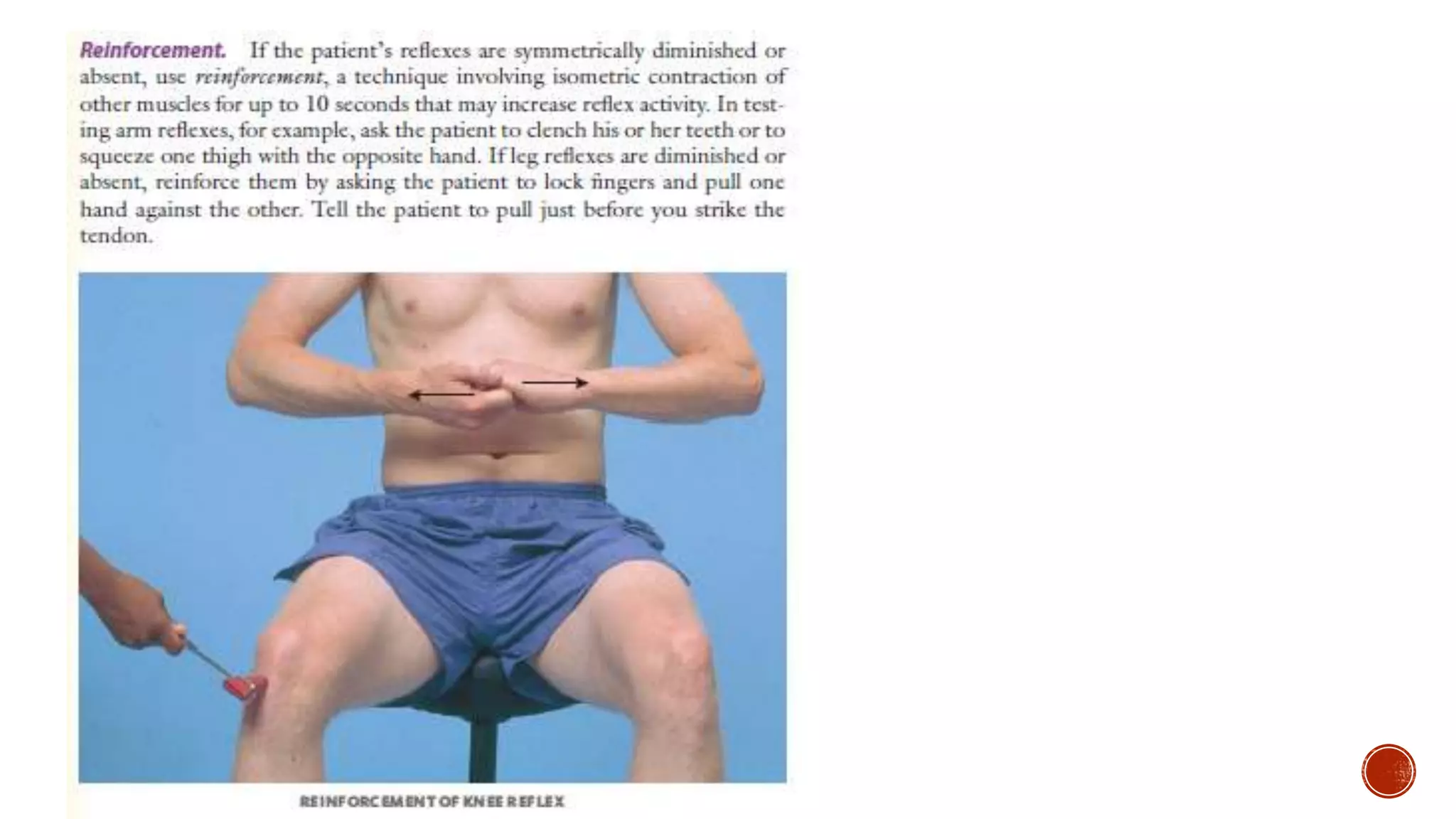
Reflexes-hypo, hyper *with gradings
 Appearance and behavior
 LOC
 Posture and Motor behavior
 Dress, grooming, hygiene
 Facial Expression
 Manner, affect
 Speech and language
 Quantity, Rate, Volume, Articulation, Fluency
 Mood
 Thoughts and perceptions
 Cognition, including memory, attention,
 information and vocabulary, calculations, abstract thinking, and constructional
ability -higher cortical fx
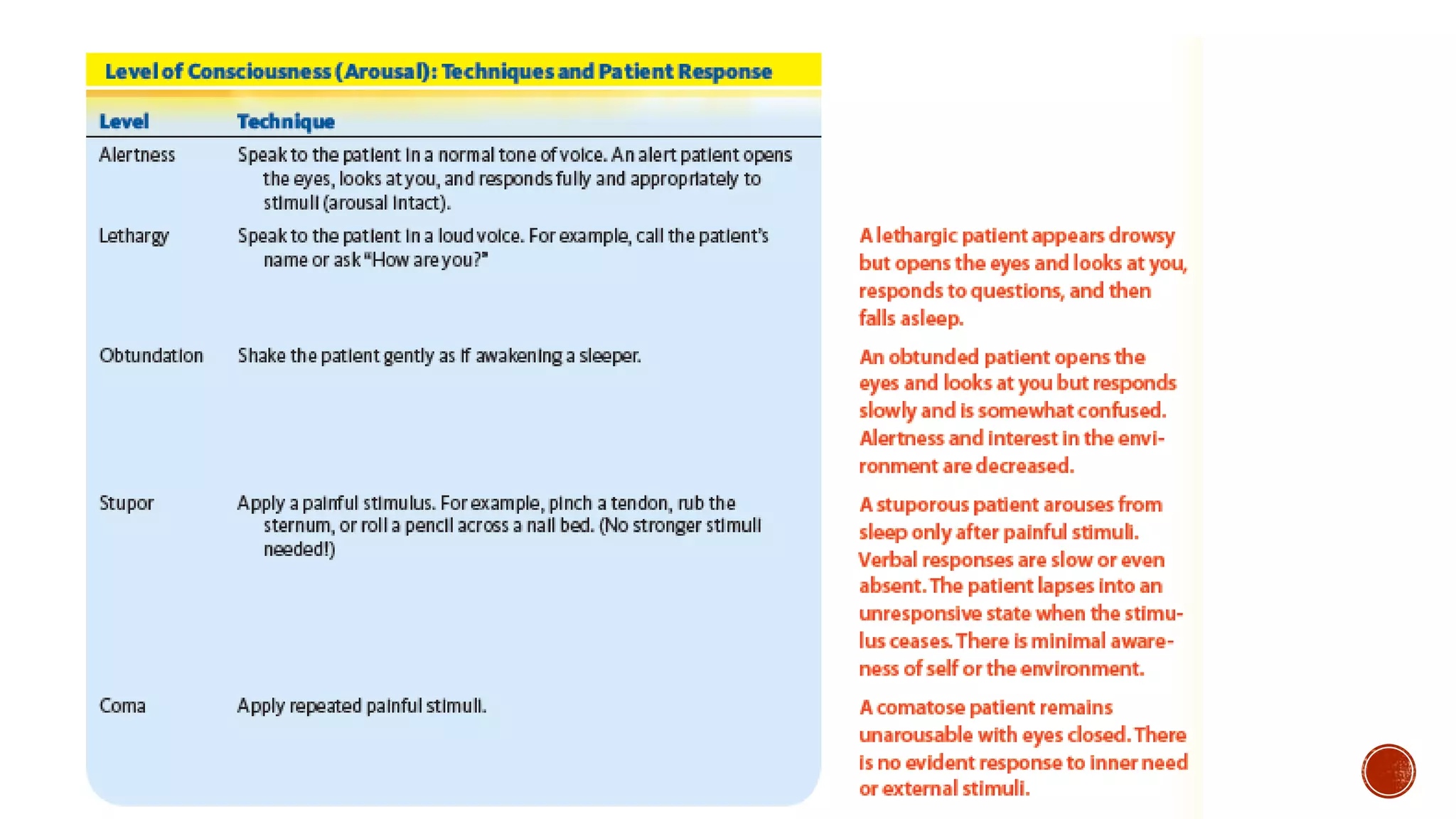
patient’s capacity for arousal, or wakefulness.
determined by the level of activity that the patient can be
aroused to perform in response to escalating stimuli from
the examiner.
Mnemonics CN Sensory/Motor /Both
Oh I Olfactory Some
Oh II Optic Say
Oh III Occular Many
To IV Trochlear (“2”) Money
Touch V Trigeminal (“3”) But
And VI Abducens My
Feel VII Facial Brother
A/ Very VIII Acoustic/Vestibulocochlear Says
Good IX Glossopharyhngeal Big
Velvet X Vagus Brains
So XI Spinal Accessory Matter
Heavenly XII Hypoglossal Most
Sense of smell
 ** Loss of smell occurs in sinus conditions ,head trauma, smoking, aging, and the
use of cocaine and in Parkinson disease.
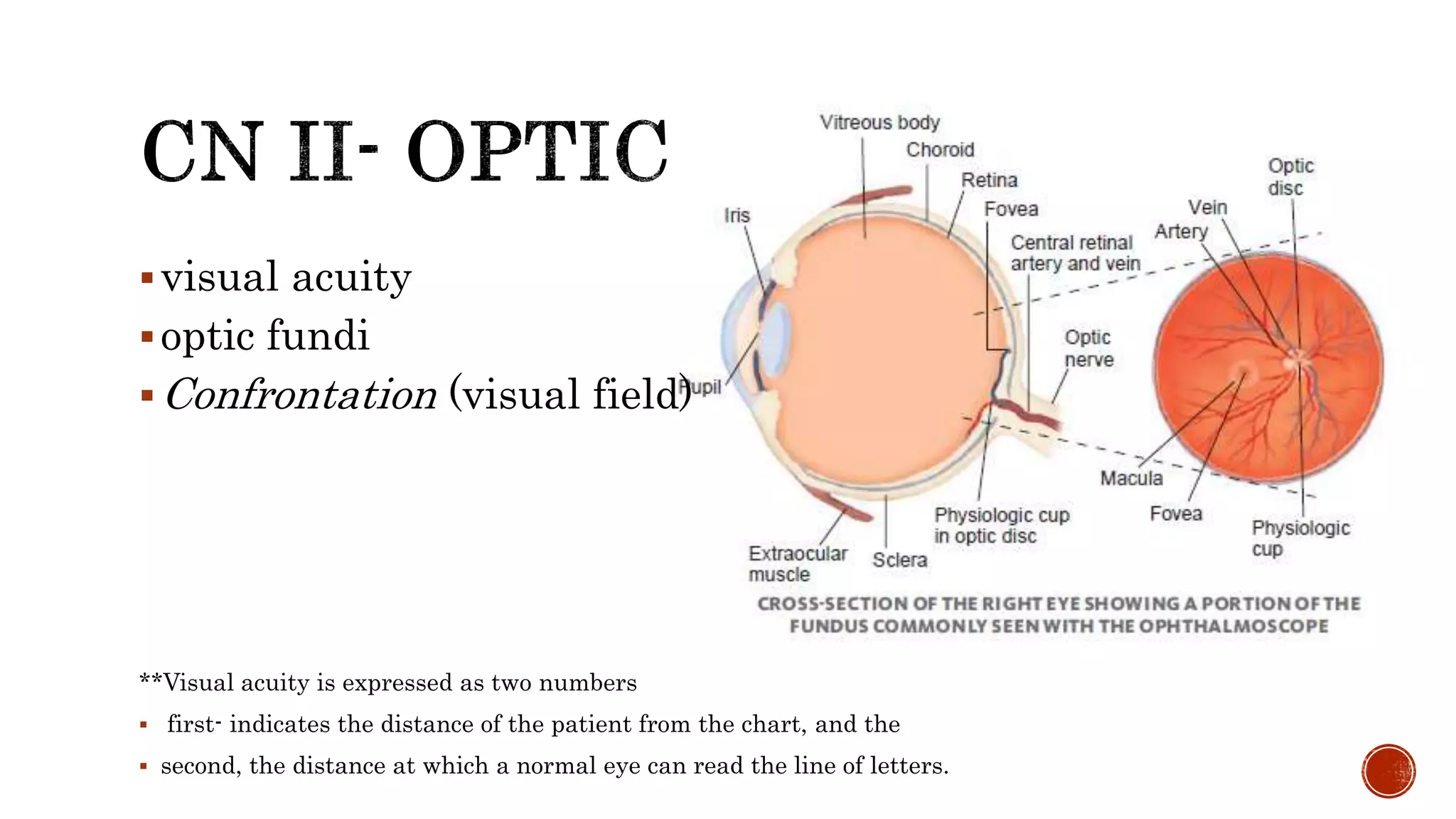
visual acuity
optic fundi
Confrontation (visual field)
**Visual acuity is expressed as two numbers
 first- indicates the distance of the patient from the chart, and the
 second, the distance at which a normal eye can read the line of letters.
PERRLA
Near response
Convergence
Eyelid elevation
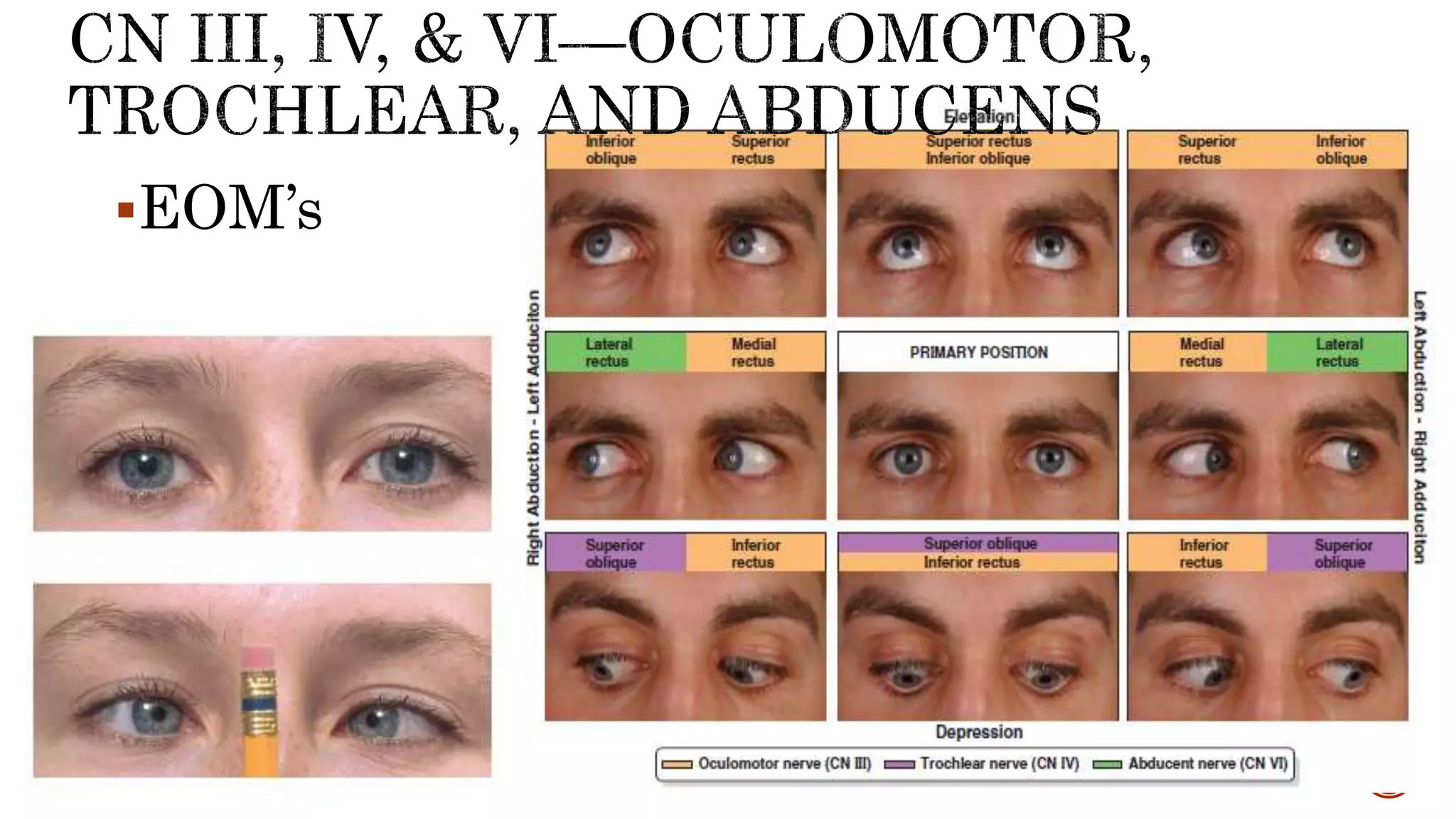
EOM’s
CN III Oculomotor Pupillary constriction, opening the
eye (lid elevation), and most extraocular
movements
CN IV Trochlear Downward, internal rotation of the
eye
CN VI Abducens Lateral deviation of the eye
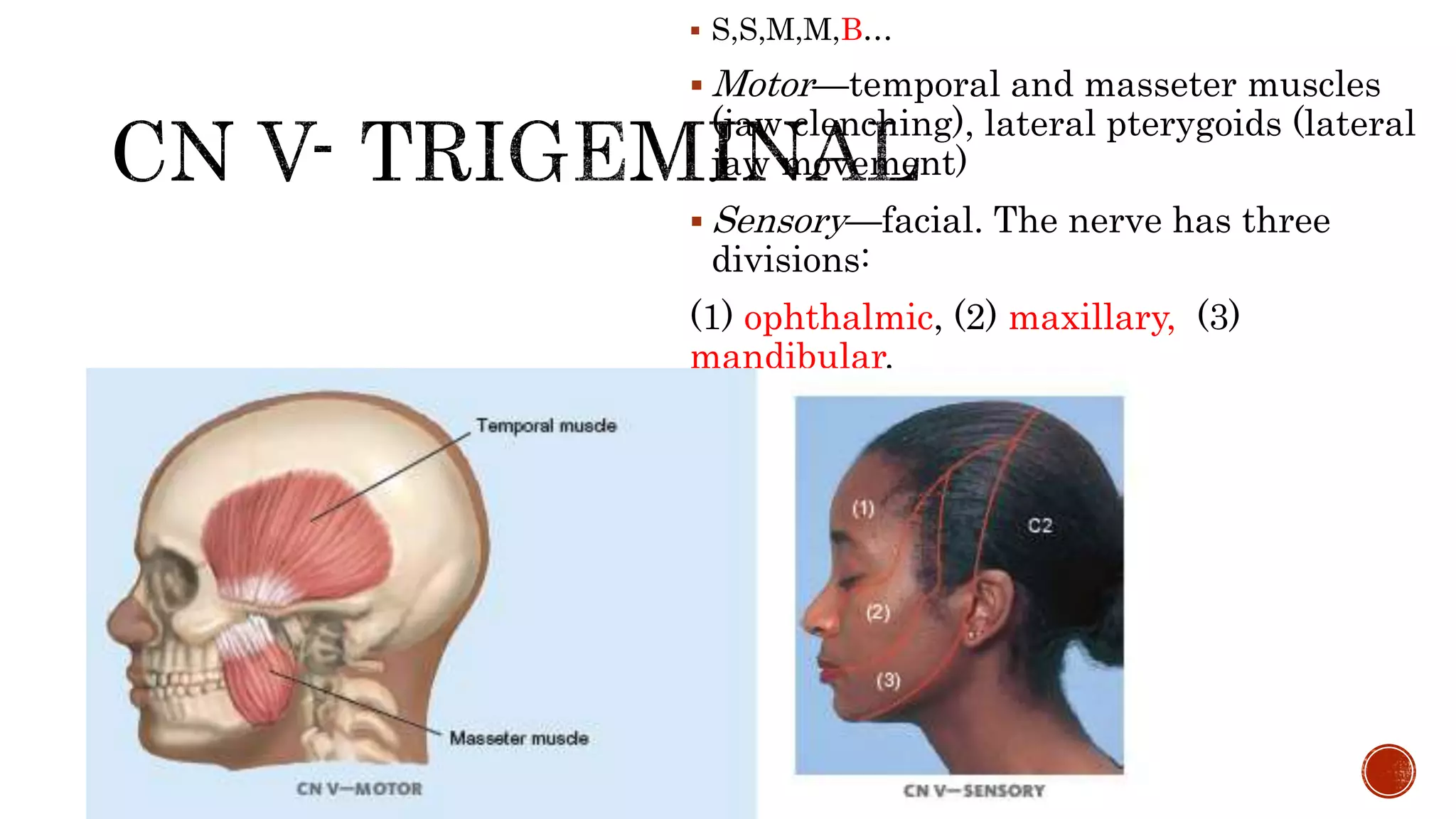
 S,S,M,M,B…
 Motor—temporal and masseter muscles
(jaw clenching), lateral pterygoids (lateral
jaw movement)
 Sensory—facial. The nerve has three
divisions:
(1) ophthalmic, (2) maxillary, (3)
mandibular.
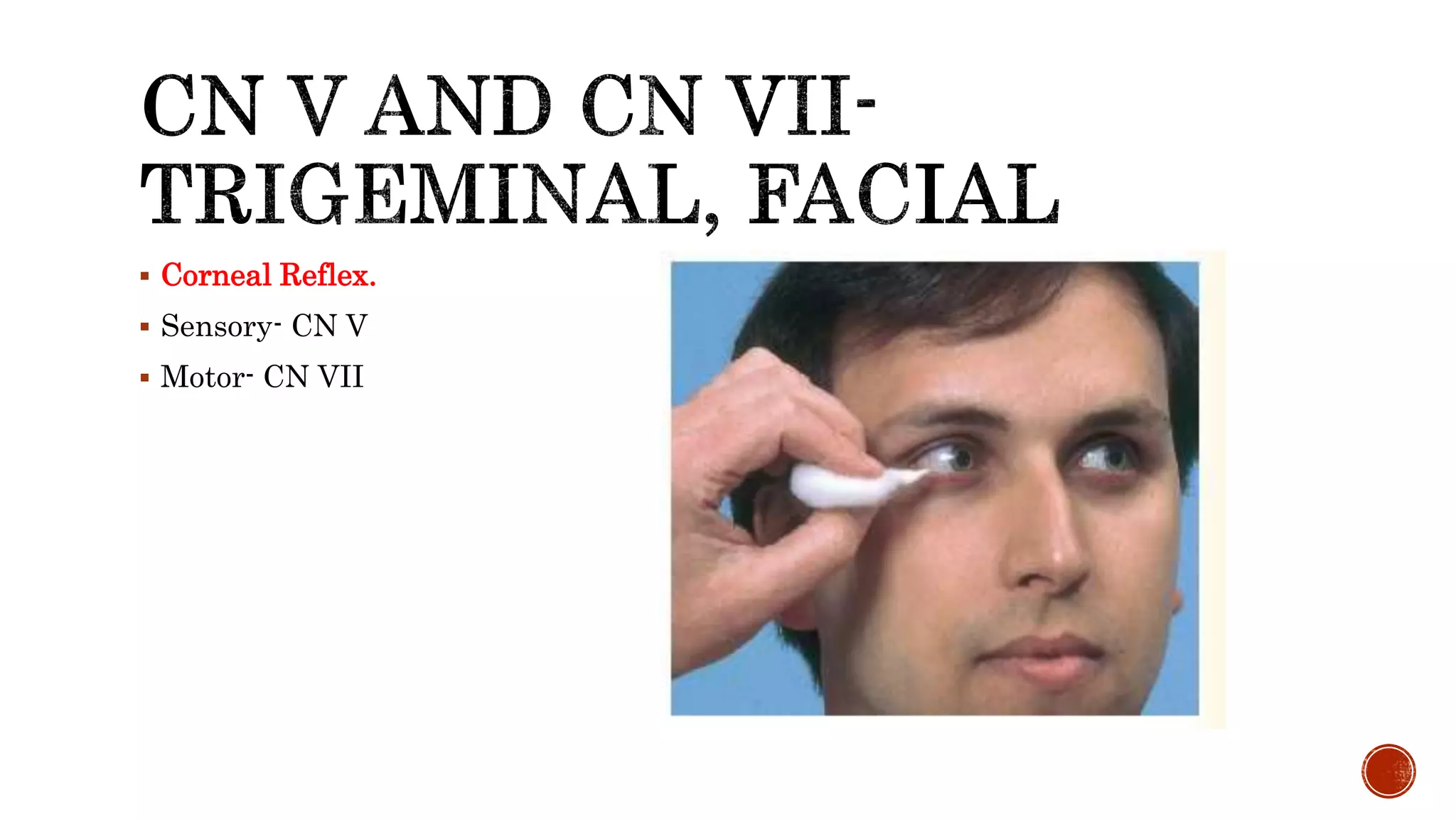
 Corneal Reflex.
 Sensory- CN V
 Motor- CN VII
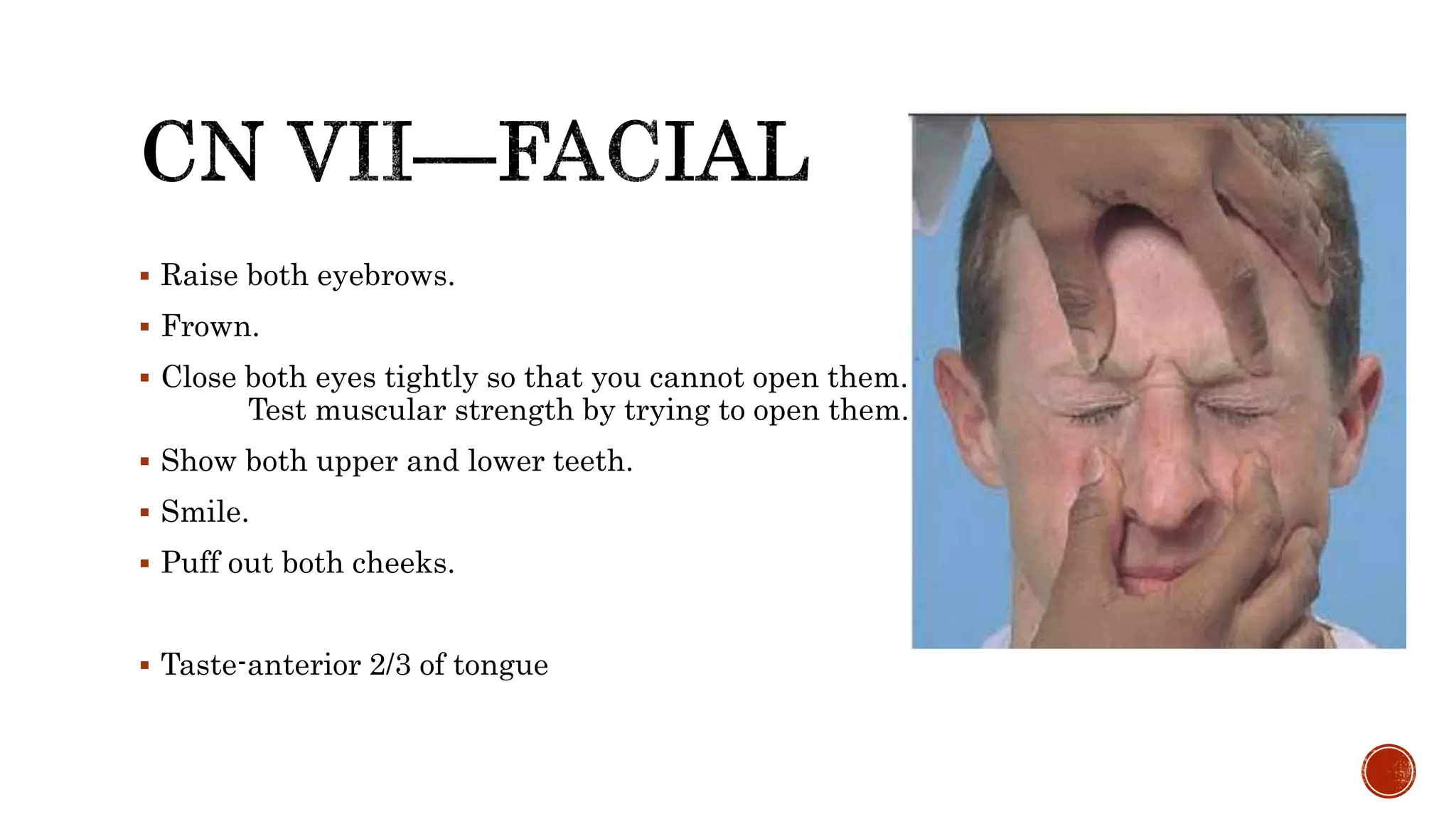
 Raise both eyebrows.
 Frown.
 Close both eyes tightly so that you cannot open them.
Test muscular strength by trying to open them.
 Show both upper and lower teeth.
 Smile.
 Puff out both cheeks.
 Taste-anterior 2/3 of tongue
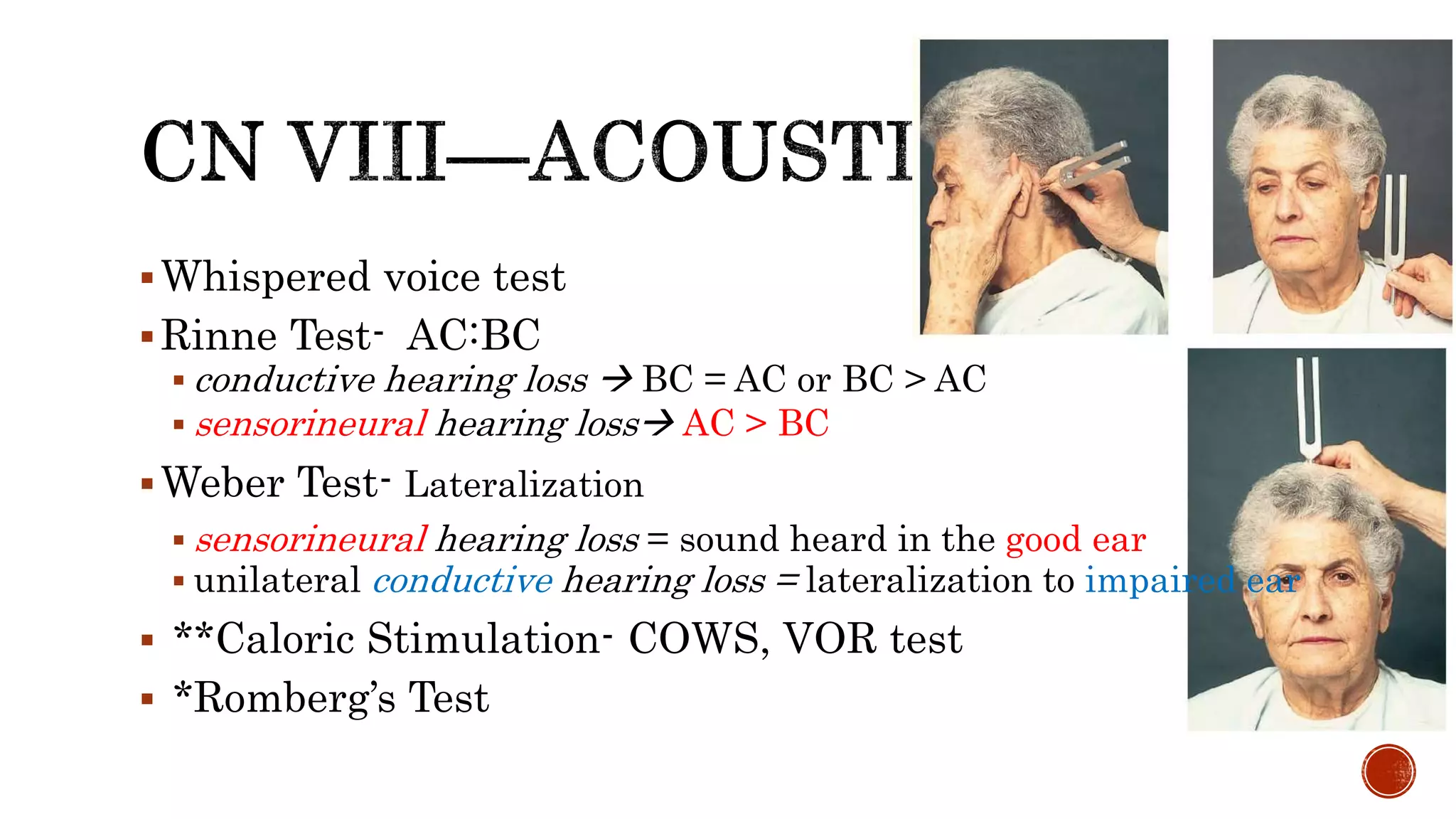
Whispered voice test
Rinne Test- AC:BC
 conductive hearing loss  BC = AC or BC > AC
 sensorineural hearing loss AC > BC
Weber Test- Lateralization
 sensorineural hearing loss = sound heard in the good ear
 unilateral conductive hearing loss = lateralization to impaired ear
 **Caloric Stimulation- COWS, VOR test
 *Romberg’s Test
Gag reflex
Taste- posterior 1/3
 Voice?
 Dysphagia?
 Say “aaaahhh”
 Gag reflex
 *The palate fails to rise with a bilateral lesion of CN X. In unilateral paralysis, one side of
the palate fails to rise and, together with the uvula, is pulled toward the normal side.
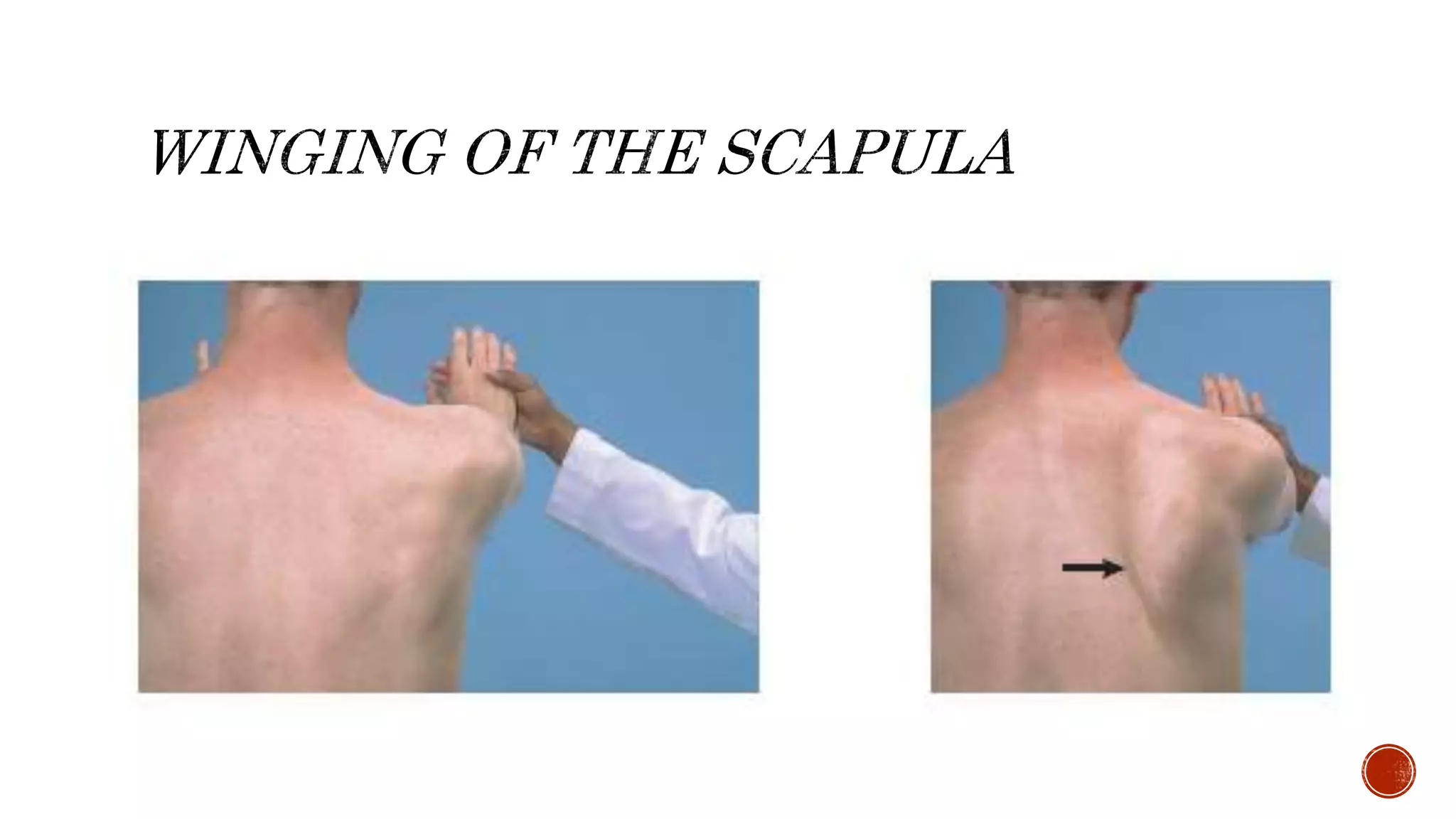
 Observe Trapezius muscle
 * Trapezius muscle paralysis, the shoulder droops, and the scapula is displaced
downward and laterally.
 Sternocleidomastoid
 Trapezius weakness with atrophy and fasciculations- peripheral nerve disorder.
 A supine patient with bilateral weakness of the sternomastoids has difficulty
raising the head off the pillow.
 articulation of words- CN V, VII, and X, as well as XII
 Tongue- atrophy or fasciculations (relaxed)
 asymmetry, atrophy, or deviation from the midline (protruded)
 move from side to side- note the symmetry of the movement
 push against the inside of each cheek in turn as you palpate for strength
 **Tongue atrophy and fasciculations-ALS; polio
 **unilateral cortical lesion-protruded tongue deviates transiently
away from the side of the cortical lesion, toward the side of
weakness.
 body position -during movement and at rest.
 involuntary movements- tremors, tics, or fasciculations.
 Note location, quality, rate, rhythm, and amplitude and relation
to posture, activity, fatigue, emotion, and other factors.
 characteristics of the muscles (bulk, tone, and strength)
 coordination
 If you see an abnormality, identify the muscle(s) involved.
 Determine whether the abnormality is central or peripheral in origin, and begin to learn which nerves
innervate the affected muscles.
ELBOW
 FLEXION and EXTENSION @
by having the patient pull and
push against your hand
 Flexion (C5, C6—biceps)
 extension (C6, C7, C8—triceps)
 extension (C6, C7, C8,
radial nerve—
extensor carpi radialis
longus and brevis)
 make a fist and resist
your pulling it down.
 (C7, C8, T1)
 squeeze two of your fingers as hard
as possible and not let them go
Weak grip
 cervical radiculopathy,
 de Quervain’s tenosynovitis,
 carpal tunnel syndrome,
 arthritis,
 epicondylitis.
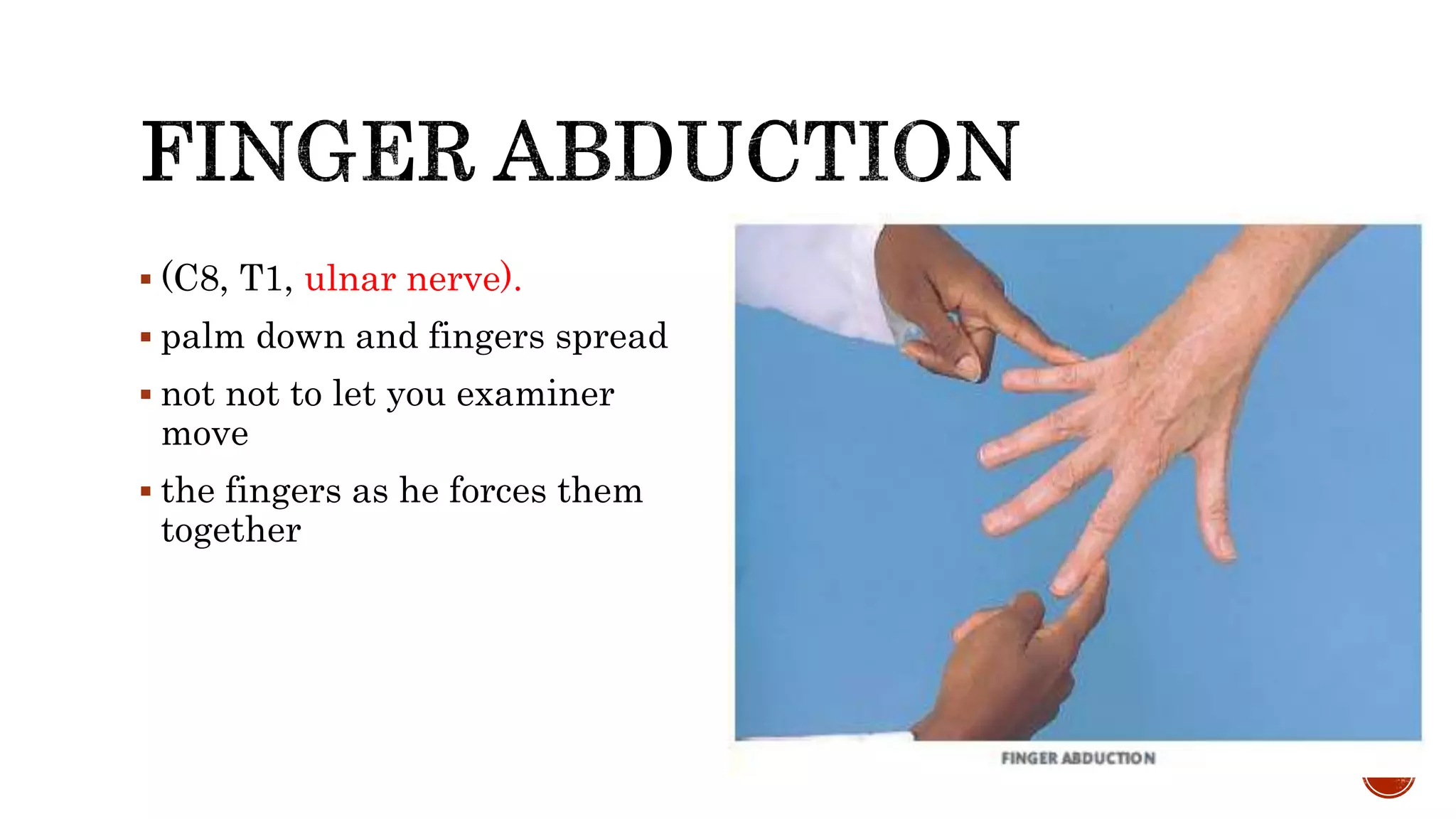
 (C8, T1, ulnar nerve).
 palm down and fingers spread
 not not to let you examiner
move
 the fingers as he forces them
together
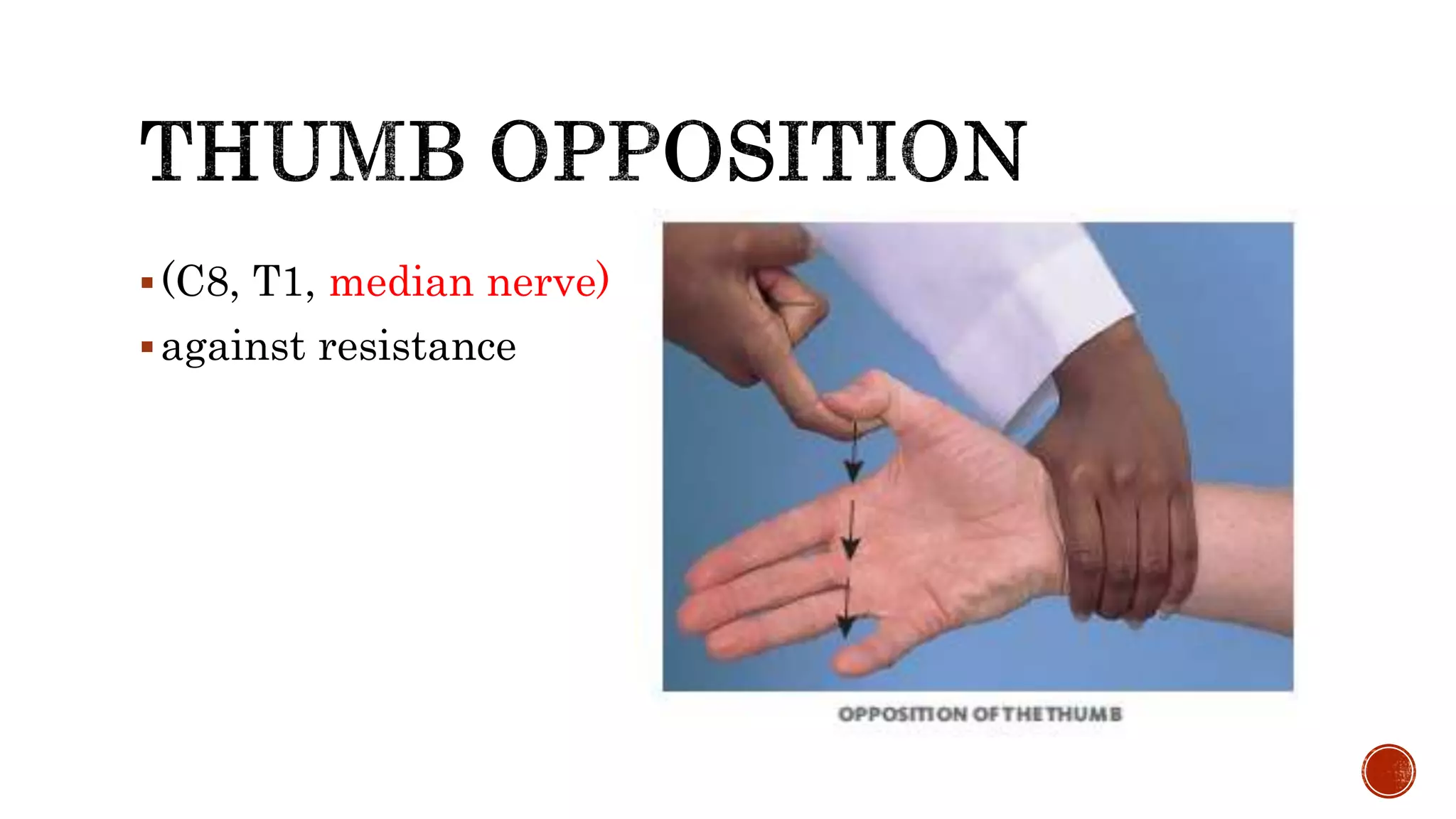
(C8, T1, median nerve)
against resistance
 Strength, tremors, movement
 Flexion, extension, and lateral bending of the spine, and
 Thoracic expansion and diaphragmatic excursion during respiration.
 extension (S1—gluteus maximus) Have the patient
push the posterior thigh down against your hand.
 Flexion-(L2, L3, L4— iliopsoas)
 your hand on the patient’s thigh
 Ask patient to raise the leg against
 adduction (L2, L3, L4—adductors).
 Ask the patient to bring both legs together
 Again, with resistance
 Abduction (L4, L5, S1—gluteus medius and
minimus).
 patient to spread both legs against your hands
*Symmetric weakness of the proximal muscles -myopathy;
*symmetric weakness of distal muscles -a polyneuropathy, or
disorder of peripheral nerves.
 Extension (L2, L3, L4—quadriceps).
 knee in flexion; ask to straighten the leg against
your hand
 quadriceps - strongest muscle in the body
 Flexion (L4, L5, S1, S2—hamstrings)
 knee flexed with the foot resting on the bed.
 Tell patient to keep the foot down as you try to
straighten the leg.
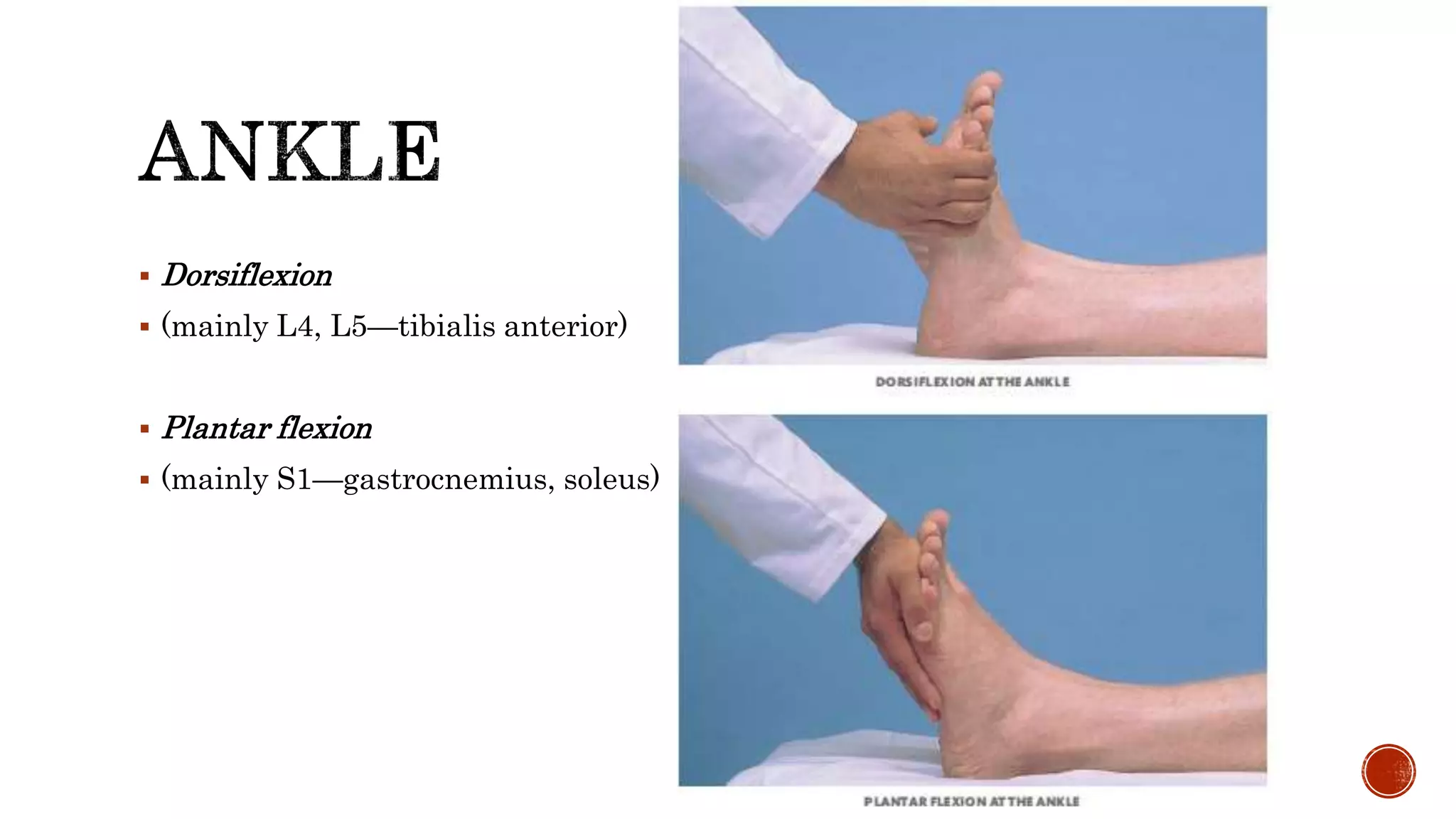
 Dorsiflexion
 (mainly L4, L5—tibialis anterior)
 Plantar flexion
 (mainly S1—gastrocnemius, soleus)
 for rhythmic movement and steady posture
 Rapid alternating movements
 Upper, Lower Ext.
 Point-to-point movements
 Arms—Finger-to-Nose Test
 Legs—Heel-to-Shin Test
 Gait and stance, other related body movements
 Heel-to-toe, heel, toe
 Hopping in place
 Romberg’s
 Pronator Drift
 In cerebellar disease one movement cannot be followed quickly by its
opposite and movements are slow, irregular, and clumsy.
 Gait that lacks coordination, with reeling and instability –ATAXIC
 May be due to cerebellar disease, loss of position sense, or
intoxication.
 **Inability to heel-walk is a sensitive test for corticospinal tract
damage.
Dorsal column disease ataxia, vision compensates for the
sensory loss.
(+) if loses balance when eyes are closed, a positive
Cerebellar ataxia- difficulty standing with feet together –
with yes open or closed.
Pronation of one forearm.
Sensitive and specific for a corticospinal tract lesion
originating in the contralateral hemisphere.
 Pain and temperature (spinothalamic tracts)
 Position and vibration (posterior columns)
 Light touch (both of these pathways)
 Discriminative sensations, which depend on some of the above sensations but also
involve the cortex
 Stereognosis
 Graphestesia
 2-point-discrimination
 Point localization
 Compare symmetric areas on the two sides of the body.
 When testing pain, temperature, and touch sensation, also compare the distal with the proximal areas.
 Scatter the stimuli to sample most of the dermatomes and major peripheral nerves
 both shoulders (C4)
 inner and outer aspects of the forearms (C6 and T1)
 thumbs and little fingers (C6 and C8),
 fronts of both thighs (L2),
 medial and lateral aspects of both calves (L4 and L5)
 little toes (S1)
 medial aspect of each buttock (S3).
 When testing vibration and position sensation, first test the fingers and toes. If these are normal, you may
safely assume that more proximal areas will also be normal.
 ●● Vary the pace of your testing. This is important so that the patient does not merely respond to your
repetitive rhythm.
 ●● When you detect an area of sensory loss or hypersensitivity, map out its boundaries in detail. Stimulate
first at a point of reduced sensation, and move by progressive steps until the patient detects the change.
 pointed end- small areas (i.e finger ), broad-end- larger areas
 Encourage the patient to relax; position the limbs properly and symmetrically.
 Hold reflex hammer loosely between your thumb and index finger so that it
swings freely in an arc within the limits set by your palm and other fingers.
 With wrist relaxed, strike tendon briskly using a rapid wrist movement.
 Strike should be quick and direct, not glancing.
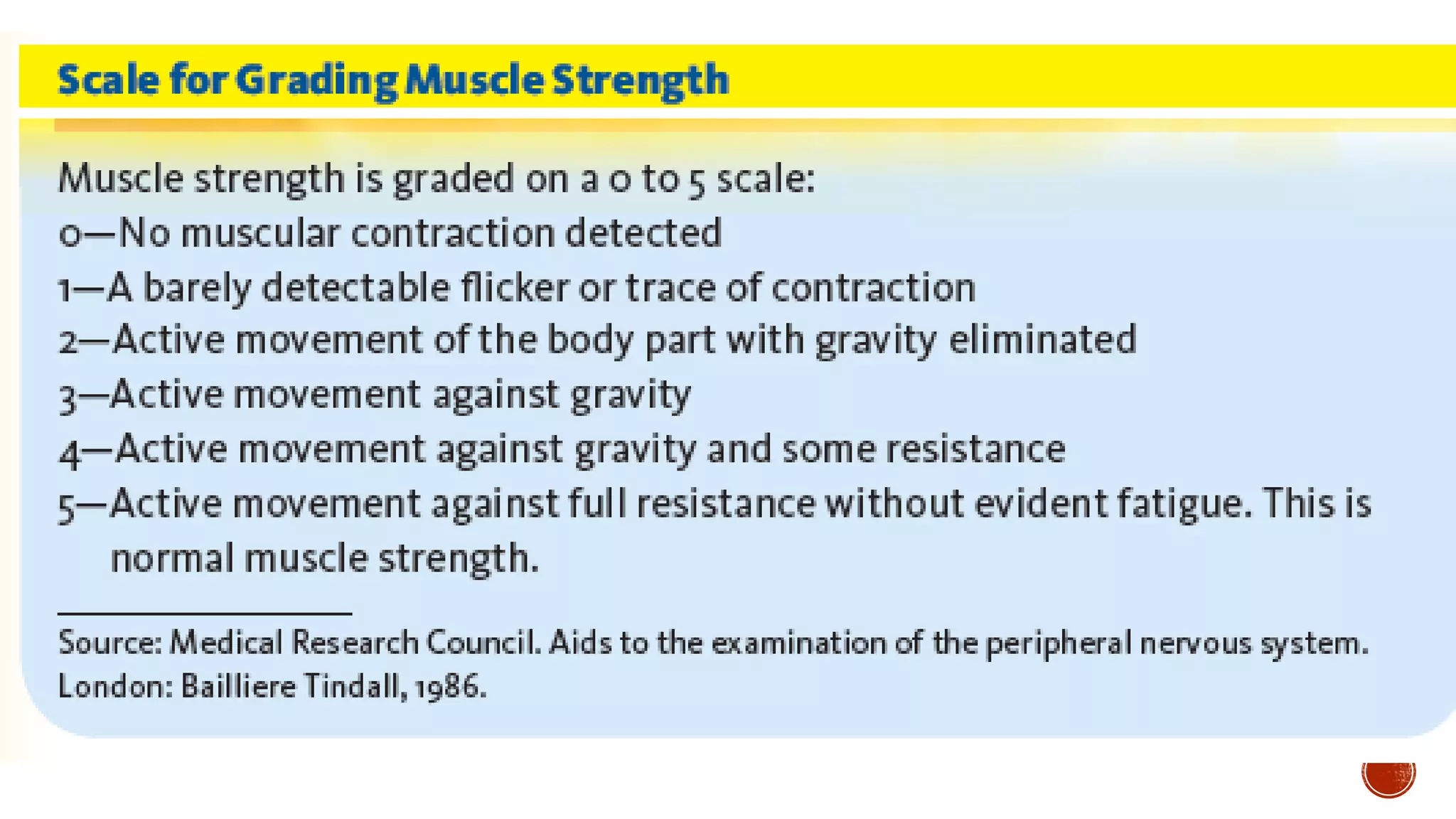
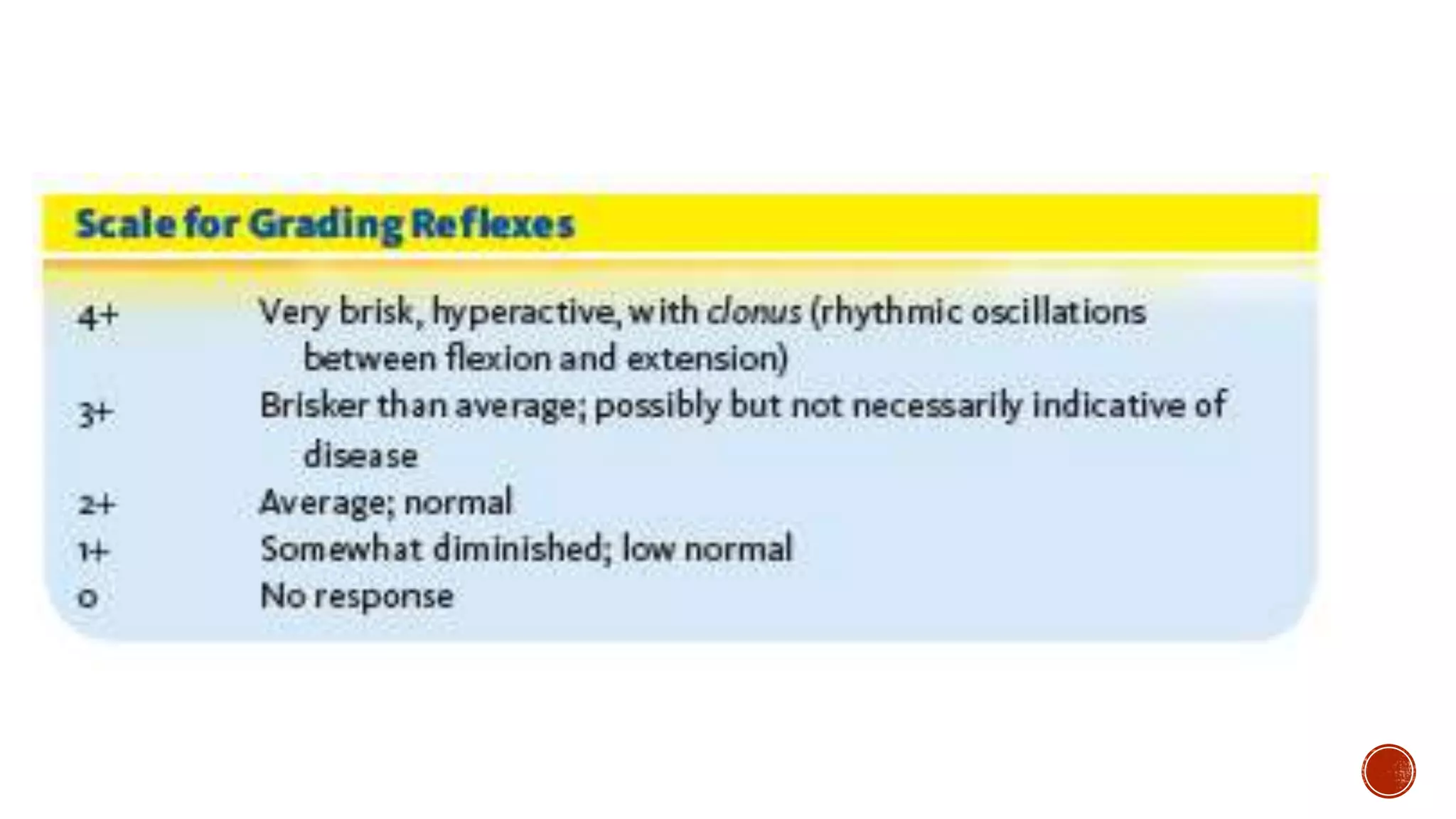
 Note the speed, force, and amplitude of the reflex response and grade the response
using the scale below.
 Always compare the response of one side with the other. Reflexes are usually
graded on a 0 to 4+ scale.
Hyperactive reflexes
(hyperreflexia) - seen in
CNS lesions along the
descending corticospinal
tract.
Look for associated
upper motor neuron
findings of
 weakness, spasticity, or a
positive Babinski sign.
Hypoactive or absent reflexes
(hyporeflexia)
- seen in diseases of spinal nerve
roots, spinal nerves, plexuses, or
peripheral nerves.
-Look for associated findings of
lower motor unit disease, namely
weakness, atrophy, and fasciculations.
**MgSO4- decreases DTR
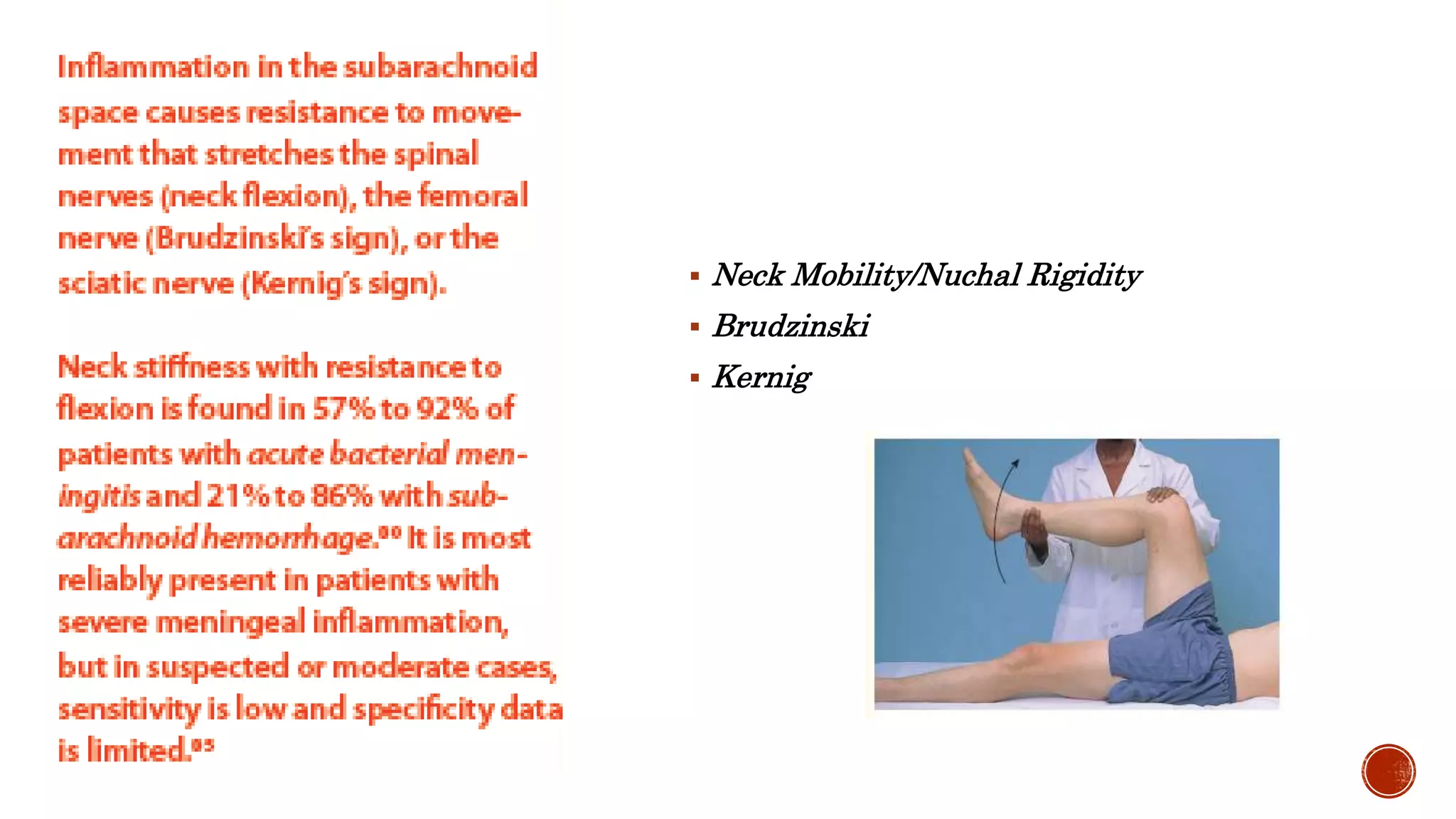
 Neck Mobility/Nuchal Rigidity
 Brudzinski
 Kernig
 Doll’s eye
I CAN NOT DEACTIVATE UNTIL
YOU ARE NOT SATISFIED WITH
MY CARE…
THANK YOU!

Neurologic examination

  • 1.
    HI! I AMBAYMAX. YOUR PERSONAL HEALTH CARE PROVIDER
  • 2.
    KRISTINE FAITH P.TABLIZO, RN PRC LICENSE 0576117
  • 3.
    Prepare equipment/materials ahead. Universalprecaution. Establish rapport. Explain the procedure. Ensure privacy and comfort. Comprehensive, ergonomic PE. Explain result/findings.
  • 4.
    Common or ConcerningSymptoms  Headache  Dizziness or vertigo  Generalized, proximal, or distal weakness  Numbness, abnormal or loss of sensations  Loss of consciousness, syncope, or near-syncope  Seizures  Tremors or involuntary movements
  • 5.
    Sudden numbness orweakness of the face, arm, or leg Sudden confusion, trouble speaking or understanding Sudden trouble seeing in one or both eyes Sudden trouble walking, dizziness, or loss of balance or coordination Sudden severe headache
  • 6.
    Facial drooping: Asection of the face, usually only on one side, that is drooping and hard to move Arm weakness: The inability to raise one's arm fully Speech difficulties: An inability or difficulty to understand or produce speech Time: Time is of the essence when having a stroke, and an immediate call to emergency services or trip to the hospital is recommended.[
  • 7.
    Ms. CM, Sexing-sexy,Rawr. Mental Status—level of alertness, appropriateness of responses, orientation to date and place Cranial Nerves Motor System-strength, coordination (cerebellar*) Sensory System Reflexes-hypo, hyper *with gradings
  • 9.
     Appearance andbehavior  LOC  Posture and Motor behavior  Dress, grooming, hygiene  Facial Expression  Manner, affect  Speech and language  Quantity, Rate, Volume, Articulation, Fluency  Mood  Thoughts and perceptions  Cognition, including memory, attention,  information and vocabulary, calculations, abstract thinking, and constructional ability -higher cortical fx
  • 10.
    patient’s capacity forarousal, or wakefulness. determined by the level of activity that the patient can be aroused to perform in response to escalating stimuli from the examiner.
  • 14.
    Mnemonics CN Sensory/Motor/Both Oh I Olfactory Some Oh II Optic Say Oh III Occular Many To IV Trochlear (“2”) Money Touch V Trigeminal (“3”) But And VI Abducens My Feel VII Facial Brother A/ Very VIII Acoustic/Vestibulocochlear Says Good IX Glossopharyhngeal Big Velvet X Vagus Brains So XI Spinal Accessory Matter Heavenly XII Hypoglossal Most
  • 16.
    Sense of smell ** Loss of smell occurs in sinus conditions ,head trauma, smoking, aging, and the use of cocaine and in Parkinson disease.
  • 17.
    visual acuity optic fundi Confrontation(visual field) **Visual acuity is expressed as two numbers  first- indicates the distance of the patient from the chart, and the  second, the distance at which a normal eye can read the line of letters.
  • 19.
  • 20.
  • 21.
    CN III OculomotorPupillary constriction, opening the eye (lid elevation), and most extraocular movements CN IV Trochlear Downward, internal rotation of the eye CN VI Abducens Lateral deviation of the eye
  • 22.
     S,S,M,M,B…  Motor—temporaland masseter muscles (jaw clenching), lateral pterygoids (lateral jaw movement)  Sensory—facial. The nerve has three divisions: (1) ophthalmic, (2) maxillary, (3) mandibular.
  • 23.
     Corneal Reflex. Sensory- CN V  Motor- CN VII
  • 24.
     Raise botheyebrows.  Frown.  Close both eyes tightly so that you cannot open them. Test muscular strength by trying to open them.  Show both upper and lower teeth.  Smile.  Puff out both cheeks.  Taste-anterior 2/3 of tongue
  • 25.
    Whispered voice test RinneTest- AC:BC  conductive hearing loss  BC = AC or BC > AC  sensorineural hearing loss AC > BC Weber Test- Lateralization  sensorineural hearing loss = sound heard in the good ear  unilateral conductive hearing loss = lateralization to impaired ear  **Caloric Stimulation- COWS, VOR test  *Romberg’s Test
  • 26.
  • 27.
     Voice?  Dysphagia? Say “aaaahhh”  Gag reflex  *The palate fails to rise with a bilateral lesion of CN X. In unilateral paralysis, one side of the palate fails to rise and, together with the uvula, is pulled toward the normal side.
  • 28.
     Observe Trapeziusmuscle  * Trapezius muscle paralysis, the shoulder droops, and the scapula is displaced downward and laterally.  Sternocleidomastoid  Trapezius weakness with atrophy and fasciculations- peripheral nerve disorder.  A supine patient with bilateral weakness of the sternomastoids has difficulty raising the head off the pillow.
  • 29.
     articulation ofwords- CN V, VII, and X, as well as XII  Tongue- atrophy or fasciculations (relaxed)  asymmetry, atrophy, or deviation from the midline (protruded)  move from side to side- note the symmetry of the movement  push against the inside of each cheek in turn as you palpate for strength  **Tongue atrophy and fasciculations-ALS; polio  **unilateral cortical lesion-protruded tongue deviates transiently away from the side of the cortical lesion, toward the side of weakness.
  • 31.
     body position-during movement and at rest.  involuntary movements- tremors, tics, or fasciculations.  Note location, quality, rate, rhythm, and amplitude and relation to posture, activity, fatigue, emotion, and other factors.  characteristics of the muscles (bulk, tone, and strength)  coordination  If you see an abnormality, identify the muscle(s) involved.  Determine whether the abnormality is central or peripheral in origin, and begin to learn which nerves innervate the affected muscles.
  • 33.
    ELBOW  FLEXION andEXTENSION @ by having the patient pull and push against your hand  Flexion (C5, C6—biceps)  extension (C6, C7, C8—triceps)
  • 34.
     extension (C6,C7, C8, radial nerve— extensor carpi radialis longus and brevis)  make a fist and resist your pulling it down.
  • 37.
     (C7, C8,T1)  squeeze two of your fingers as hard as possible and not let them go Weak grip  cervical radiculopathy,  de Quervain’s tenosynovitis,  carpal tunnel syndrome,  arthritis,  epicondylitis.
  • 38.
     (C8, T1,ulnar nerve).  palm down and fingers spread  not not to let you examiner move  the fingers as he forces them together
  • 39.
    (C8, T1, mediannerve) against resistance
  • 40.
     Strength, tremors,movement  Flexion, extension, and lateral bending of the spine, and  Thoracic expansion and diaphragmatic excursion during respiration.
  • 41.
     extension (S1—gluteusmaximus) Have the patient push the posterior thigh down against your hand.  Flexion-(L2, L3, L4— iliopsoas)  your hand on the patient’s thigh  Ask patient to raise the leg against  adduction (L2, L3, L4—adductors).  Ask the patient to bring both legs together  Again, with resistance  Abduction (L4, L5, S1—gluteus medius and minimus).  patient to spread both legs against your hands *Symmetric weakness of the proximal muscles -myopathy; *symmetric weakness of distal muscles -a polyneuropathy, or disorder of peripheral nerves.
  • 43.
     Extension (L2,L3, L4—quadriceps).  knee in flexion; ask to straighten the leg against your hand  quadriceps - strongest muscle in the body  Flexion (L4, L5, S1, S2—hamstrings)  knee flexed with the foot resting on the bed.  Tell patient to keep the foot down as you try to straighten the leg.
  • 44.
     Dorsiflexion  (mainlyL4, L5—tibialis anterior)  Plantar flexion  (mainly S1—gastrocnemius, soleus)
  • 45.
     for rhythmicmovement and steady posture  Rapid alternating movements  Upper, Lower Ext.  Point-to-point movements  Arms—Finger-to-Nose Test  Legs—Heel-to-Shin Test  Gait and stance, other related body movements  Heel-to-toe, heel, toe  Hopping in place  Romberg’s  Pronator Drift
  • 47.
     In cerebellardisease one movement cannot be followed quickly by its opposite and movements are slow, irregular, and clumsy.
  • 48.
     Gait thatlacks coordination, with reeling and instability –ATAXIC  May be due to cerebellar disease, loss of position sense, or intoxication.  **Inability to heel-walk is a sensitive test for corticospinal tract damage.
  • 49.
    Dorsal column diseaseataxia, vision compensates for the sensory loss. (+) if loses balance when eyes are closed, a positive Cerebellar ataxia- difficulty standing with feet together – with yes open or closed.
  • 50.
    Pronation of oneforearm. Sensitive and specific for a corticospinal tract lesion originating in the contralateral hemisphere.
  • 54.
     Pain andtemperature (spinothalamic tracts)  Position and vibration (posterior columns)  Light touch (both of these pathways)  Discriminative sensations, which depend on some of the above sensations but also involve the cortex  Stereognosis  Graphestesia  2-point-discrimination  Point localization
  • 55.
     Compare symmetricareas on the two sides of the body.  When testing pain, temperature, and touch sensation, also compare the distal with the proximal areas.  Scatter the stimuli to sample most of the dermatomes and major peripheral nerves  both shoulders (C4)  inner and outer aspects of the forearms (C6 and T1)  thumbs and little fingers (C6 and C8),  fronts of both thighs (L2),  medial and lateral aspects of both calves (L4 and L5)  little toes (S1)  medial aspect of each buttock (S3).  When testing vibration and position sensation, first test the fingers and toes. If these are normal, you may safely assume that more proximal areas will also be normal.  ●● Vary the pace of your testing. This is important so that the patient does not merely respond to your repetitive rhythm.  ●● When you detect an area of sensory loss or hypersensitivity, map out its boundaries in detail. Stimulate first at a point of reduced sensation, and move by progressive steps until the patient detects the change.
  • 57.
     pointed end-small areas (i.e finger ), broad-end- larger areas  Encourage the patient to relax; position the limbs properly and symmetrically.  Hold reflex hammer loosely between your thumb and index finger so that it swings freely in an arc within the limits set by your palm and other fingers.  With wrist relaxed, strike tendon briskly using a rapid wrist movement.  Strike should be quick and direct, not glancing.  Note the speed, force, and amplitude of the reflex response and grade the response using the scale below.  Always compare the response of one side with the other. Reflexes are usually graded on a 0 to 4+ scale.
  • 58.
    Hyperactive reflexes (hyperreflexia) -seen in CNS lesions along the descending corticospinal tract. Look for associated upper motor neuron findings of  weakness, spasticity, or a positive Babinski sign. Hypoactive or absent reflexes (hyporeflexia) - seen in diseases of spinal nerve roots, spinal nerves, plexuses, or peripheral nerves. -Look for associated findings of lower motor unit disease, namely weakness, atrophy, and fasciculations. **MgSO4- decreases DTR
  • 70.
     Neck Mobility/NuchalRigidity  Brudzinski  Kernig
  • 74.
  • 75.
    I CAN NOTDEACTIVATE UNTIL YOU ARE NOT SATISFIED WITH MY CARE…
  • 76.

Editor's Notes

  • #32 Fasciculation- a brief, spontaneous contraction affecting a small number of muscle fibers, often causing a flicker of movement under the skin. It can be a symptom of disease of the motor neurons. Tic- a habitual spasmodic contraction of the muscles, most often in the face.
  • #55 Stereognosis. Stereognosis refers to the ability to identify an object by feeling it. Place in the patient’s hand a familiar object such as a coin, paper clip, key, pencil, or cotton ball, and ask the patient to tell you what it is. Normally a patient will manipulate it skillfully and identify it correctly within 5 seconds. Asking the patient to distinguish “heads” from “tails” on a coin is a sensitive test of stereognosis. Number identification (graphesthesia). When motor impairment, arthritis, or other conditions prevent the patient from manipulating an object well enough to identify it, test the ability to identify numbers. With the blunt end of a pen or pencil, draw a large number in the patient’s palm. A normal person can identify most such numbers. ●● Two-point discrimination. Using the two ends of an opened paper clip, or the sides of two pins, touch a finger pad in two places simultaneously. Alternate the double stimulus irregularly with a one-point touch. Be careful not to cause pain. Find the minimal distance at which patient can discriminate one from two points (normally <5 mm on the finger pads). This test may be used on other parts of the body, but normal distances vary widely from one body region to another.