



1
Mathematical Understanding in
Traffic Flow Modelling
by
Sarkar Nikhil Chandra, M.S.
PhD Student
2
Context
Objective:
• Develop mathematical understanding in traffic flow modelling
Application:
• Traffic Simulation
3
Outline
 Traffic models
 Solution methods
 Results and Discussion
4
Traffic Flow Models
o Macroscopic models
o Microscopic models
5
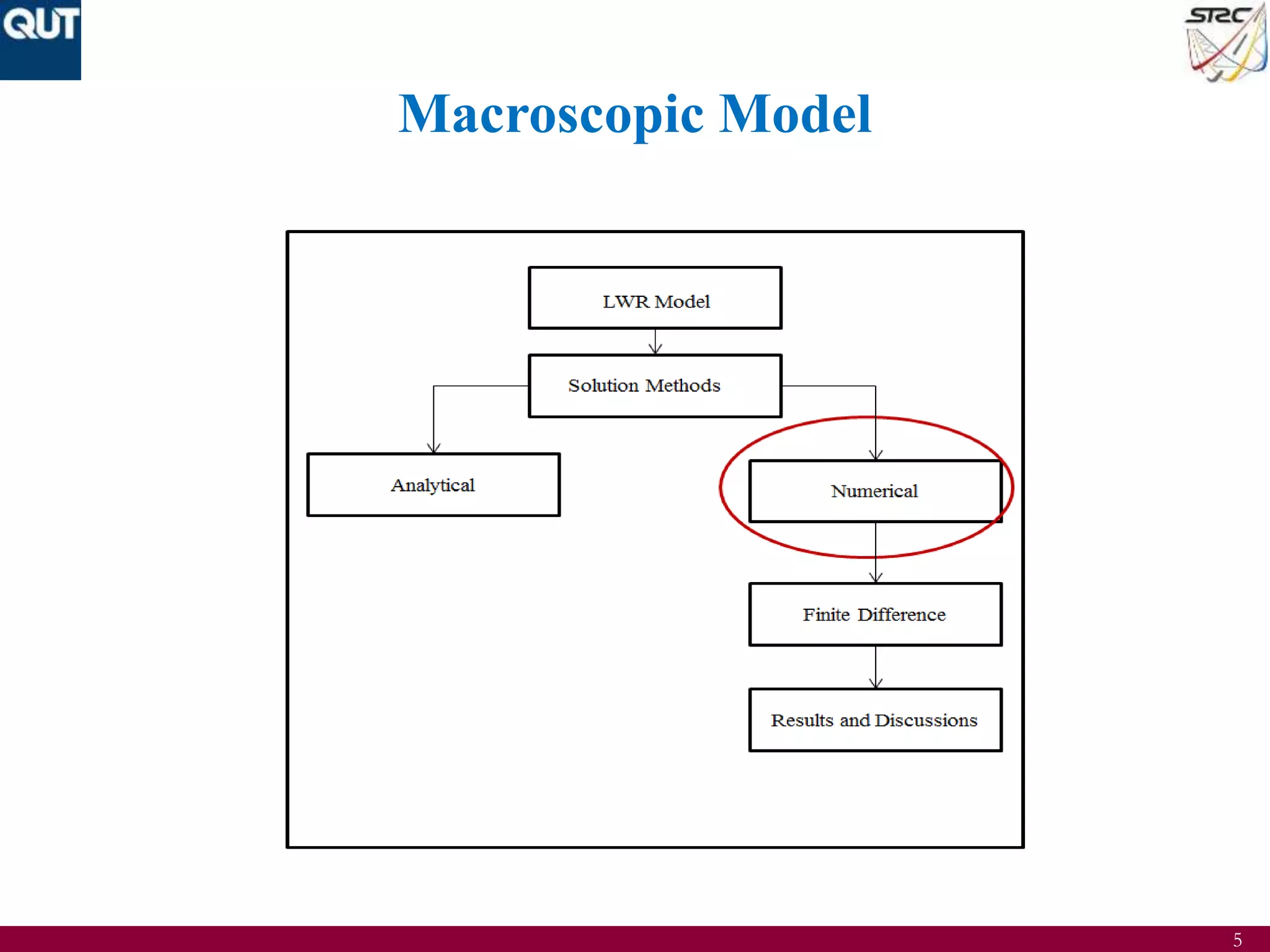
Macroscopic Model
6
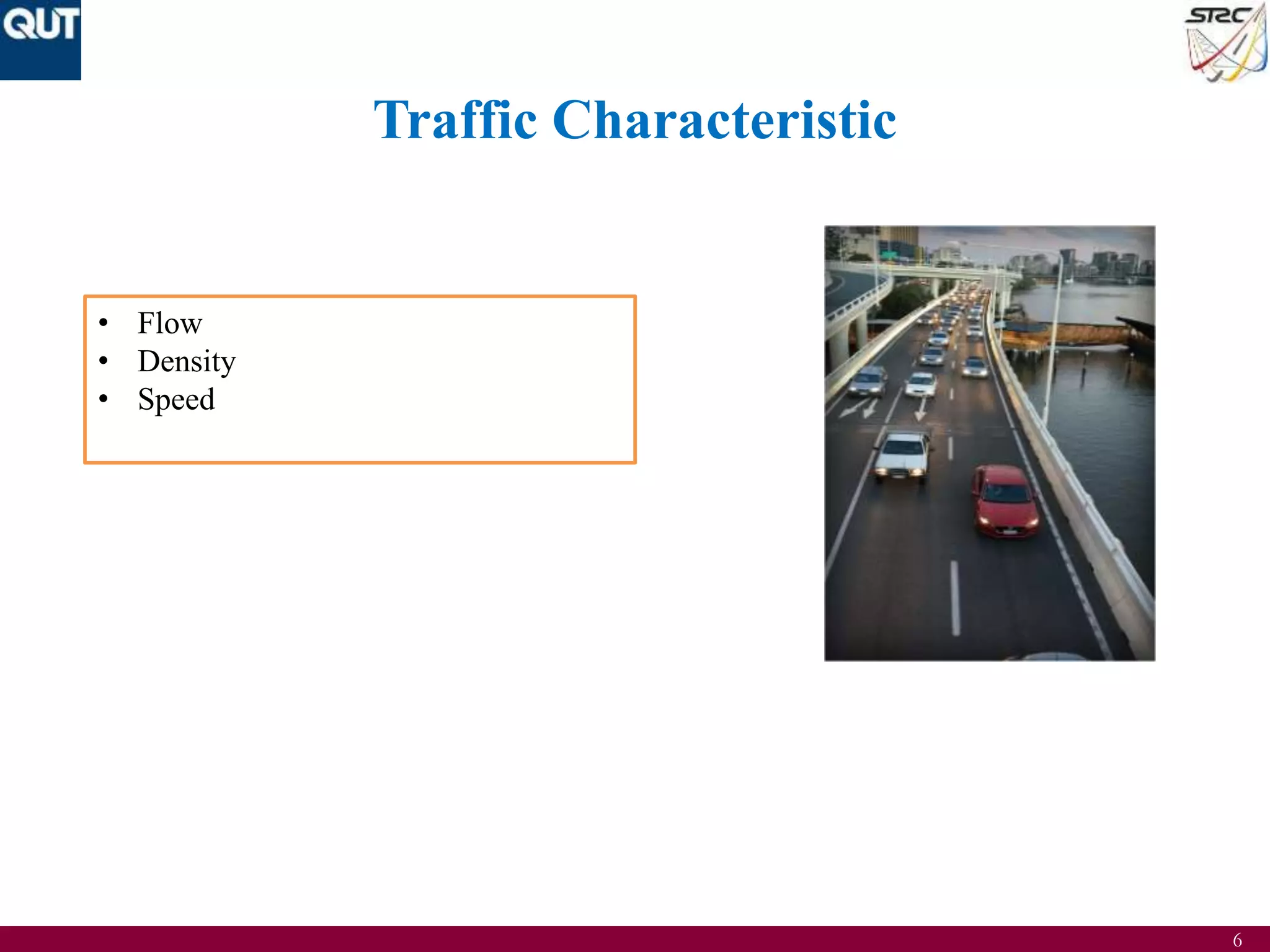
Traffic Characteristic
• Flow
• Density
• Speed
7
Fundamental traffic flow equation
Fundamental traffic flow equation:
𝑁𝑜. 𝑜𝑓 𝑉𝑒ℎ𝑖𝑐𝑙𝑒𝑠
𝑈𝑛𝑖𝑡 𝑡𝑖𝑚𝑒
=
𝐷𝑖𝑠𝑡𝑎𝑛𝑐𝑒 𝑡𝑟𝑎𝑣𝑒𝑙𝑙𝑒𝑑 𝑏𝑦 𝑣𝑒ℎ𝑖𝑐𝑙𝑒
𝑈𝑛𝑖𝑡 𝑡𝑖𝑚𝑒
×
𝑁𝑜. 𝑜𝑓 𝑉𝑒ℎ𝑖𝑐𝑙𝑒𝑠
𝑈𝑛𝑖𝑡 𝑑𝑖𝑠𝑡𝑎𝑛𝑐𝑒
𝑓𝑙𝑜𝑤 = 𝑠𝑝𝑒𝑒𝑑 × 𝑑𝑒𝑛𝑠𝑖𝑡𝑦
𝑞 = 𝑣. 𝜌
where, 𝑞 = traffic flow (veh/hr per lane)
𝑣 = flow speed (km/hr)
𝜌 = flow density (vehicles per lane-km)
8
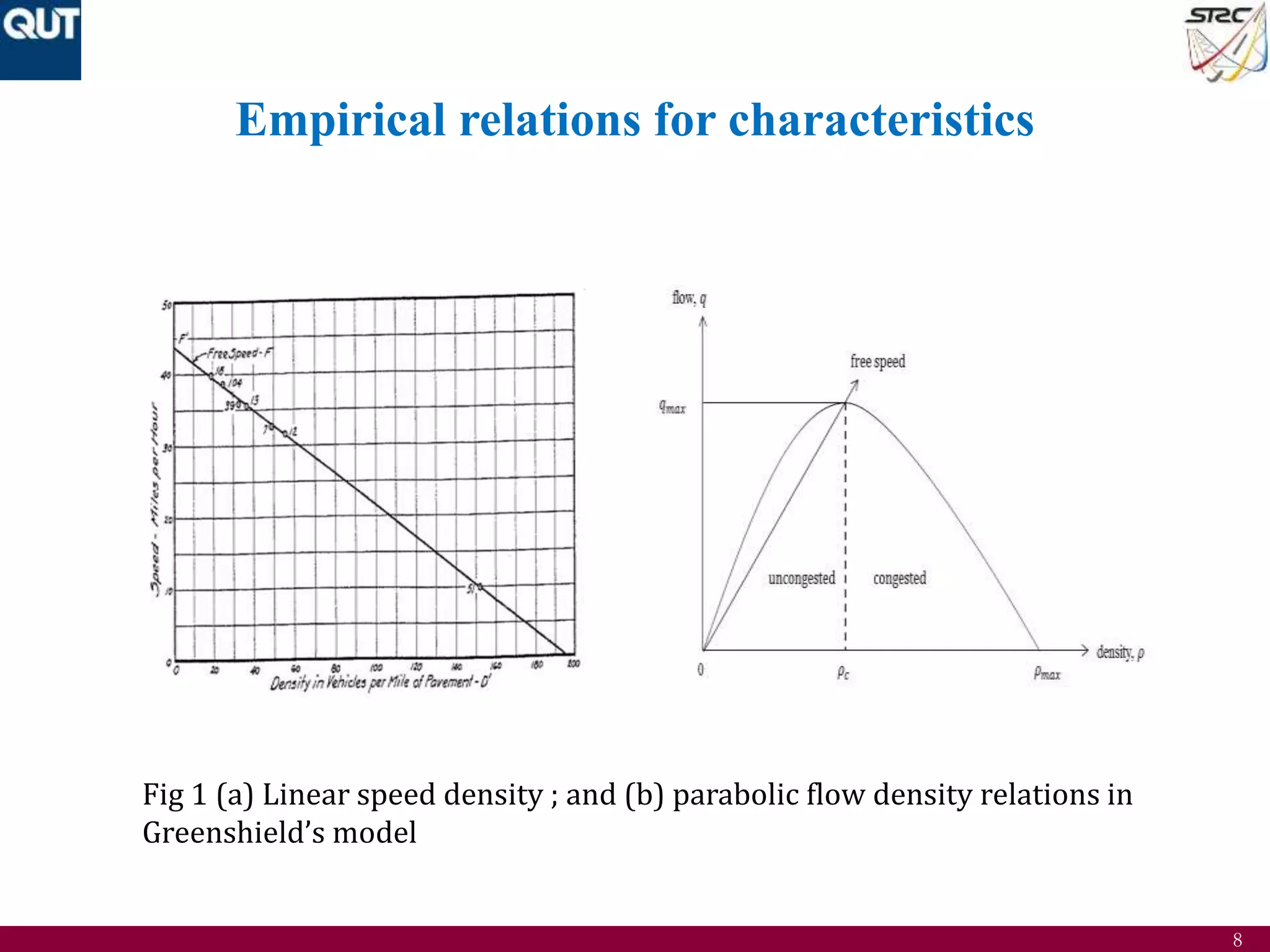
Empirical relations for characteristics
Fig 1 (a) Linear speed density ; and (b) parabolic flow density relations in
Greenshield’s model
9
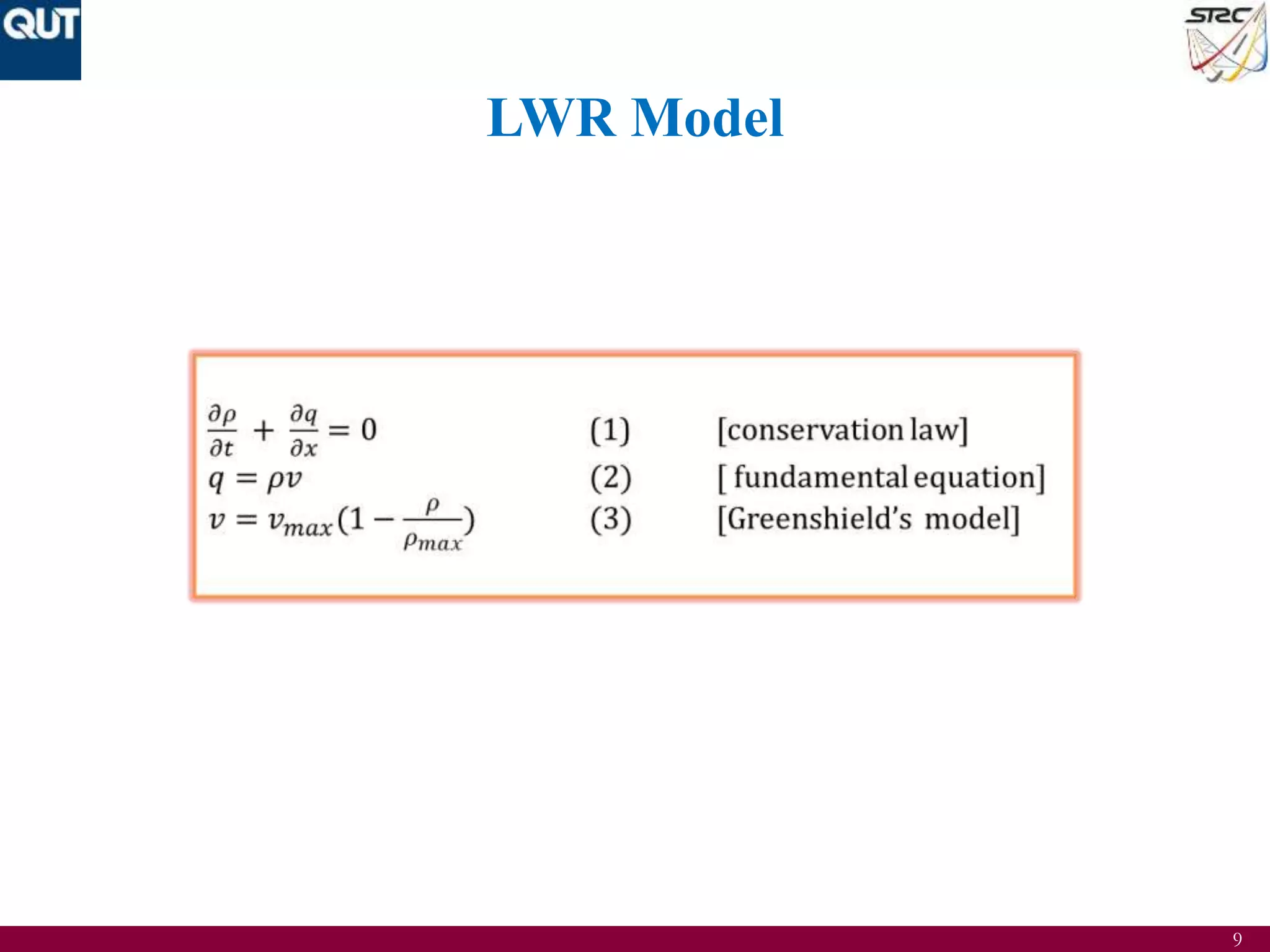
LWR Model
10
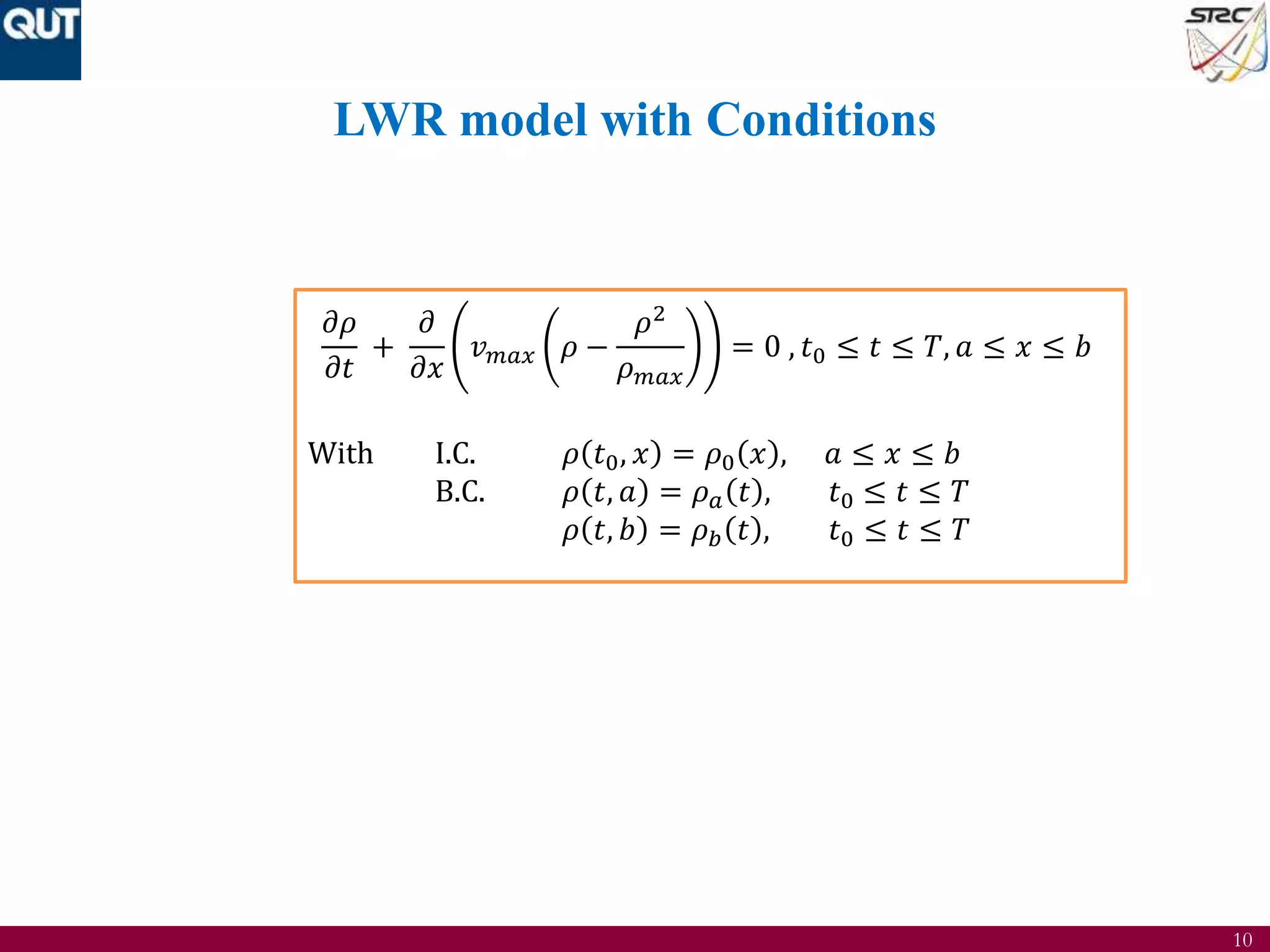
LWR model with Conditions
𝜕𝜌
𝜕𝑡
+
𝜕
𝜕𝑥
𝑣 𝑚𝑎𝑥 𝜌 −
𝜌2
𝜌 𝑚𝑎𝑥
= 0 , 𝑡0 ≤ 𝑡 ≤ 𝑇, 𝑎 ≤ 𝑥 ≤ 𝑏
With I.C. 𝜌 𝑡0, 𝑥 = 𝜌0 𝑥 , 𝑎 ≤ 𝑥 ≤ 𝑏
B.C. 𝜌 𝑡, 𝑎 = 𝜌 𝑎 𝑡 , 𝑡0 ≤ 𝑡 ≤ 𝑇
𝜌 𝑡, 𝑏 = 𝜌 𝑏 𝑡 , 𝑡0 ≤ 𝑡 ≤ 𝑇
11
Finite Difference (FD) Method
Independent variables: space and time
Dependent variable: density
The partial derivatives in LWR model at each grid point are approximated from neighbouring
values by using Taylor’s theorem.
𝜌 𝑥0 + ℎ = 𝜌 𝑥0 + ℎ𝜌 𝑥 𝑥0 +
ℎ2
2!
𝜌 𝑥𝑥 𝑥0 + … +
ℎ 𝑛−1
𝑛 − 1 !
𝜌 𝑛−1 𝑥0 + 𝑂(ℎ 𝑛
)
where 𝜌 𝑥 =
𝜕𝜌
𝜕𝑥
; 𝜌 𝑥𝑥 =
𝜕2 𝜌
𝜕𝑥2; …; 𝜌 𝑛−1 =
𝜕 𝑛−1 𝜌
𝜕𝑥 𝑛−1.
FD approximations:
• Forward difference :
𝜕𝜌
𝜕𝑥
=
𝜌 𝑥0+ℎ −𝜌 𝑥0
ℎ
− 𝑂(ℎ)
• Backward difference:
𝜕𝜌
𝜕𝑥
=
𝜌 𝑥0−ℎ −𝜌 𝑥0
ℎ
+ 𝑂(ℎ)
• Central difference:
𝜕𝜌
𝜕𝑥
=
𝜌 𝑥0+ℎ −𝜌 𝑥0−ℎ
2ℎ
+ 𝑂(ℎ2
)
12
FD Mesh
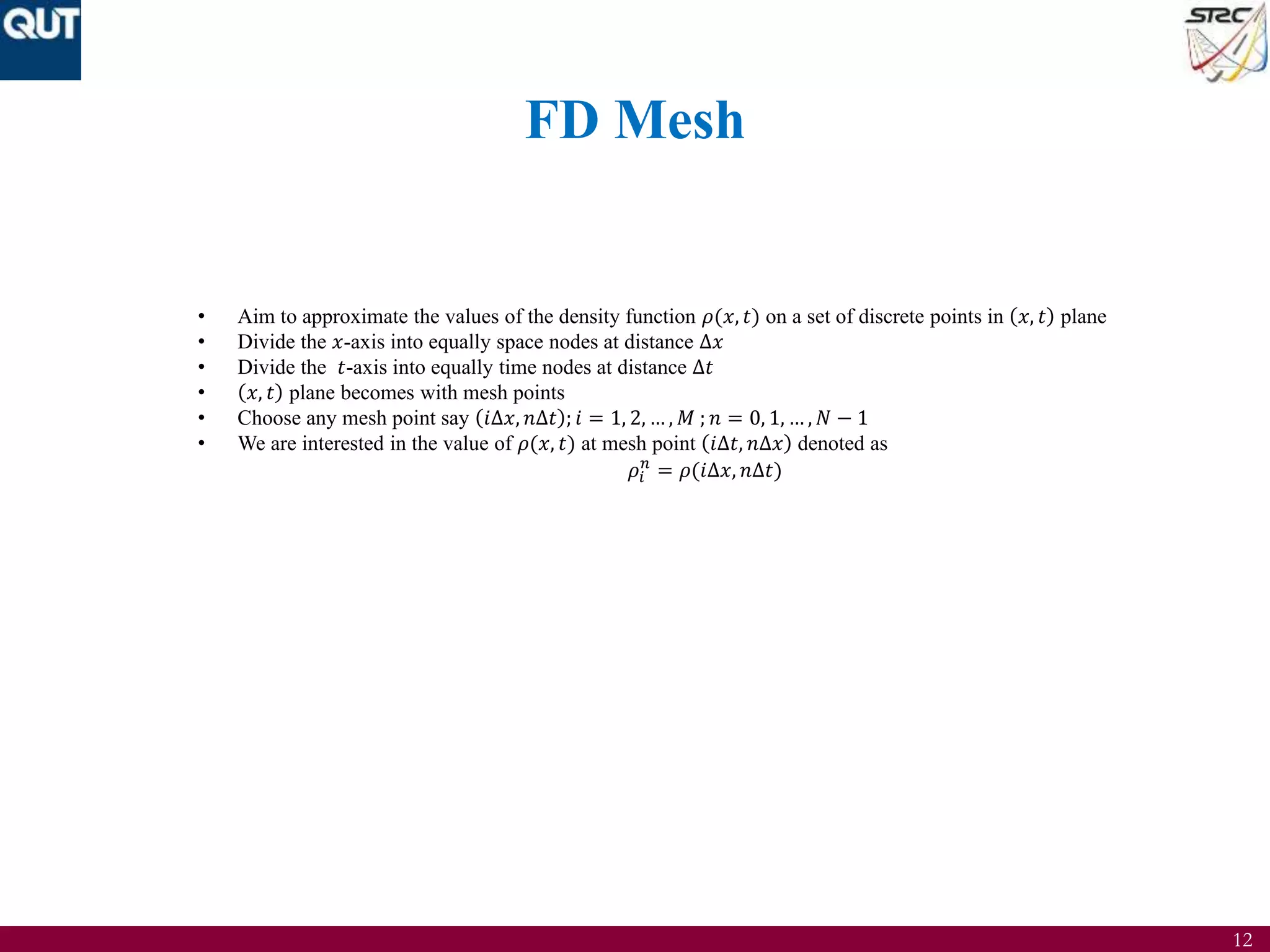
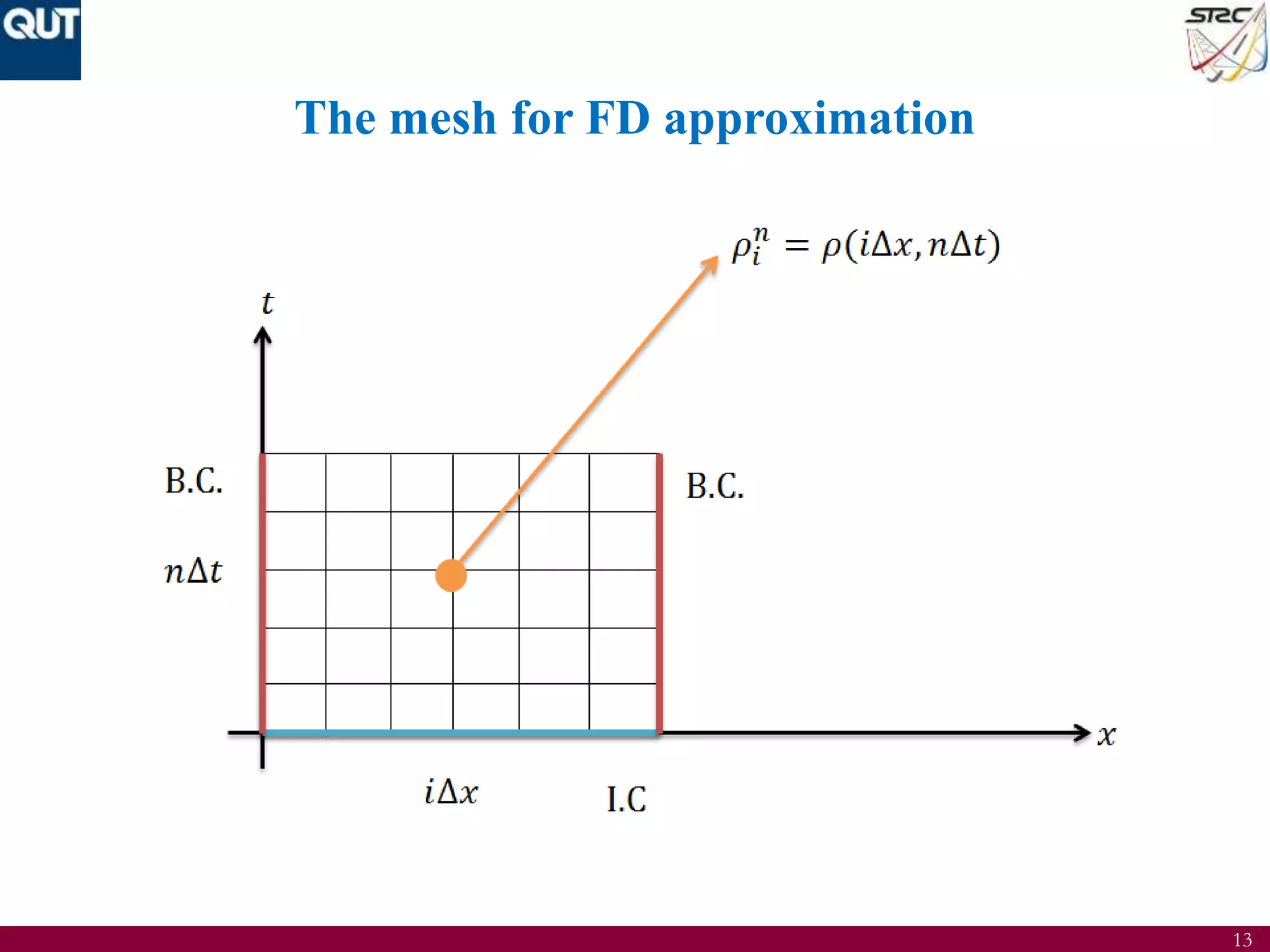
• Aim to approximate the values of the density function 𝜌(𝑥, 𝑡) on a set of discrete points in 𝑥, 𝑡 plane
• Divide the 𝑥-axis into equally space nodes at distance ∆𝑥
• Divide the 𝑡-axis into equally time nodes at distance ∆𝑡
• 𝑥, 𝑡 plane becomes with mesh points
• Choose any mesh point say 𝑖∆𝑥, 𝑛∆𝑡 ; 𝑖 = 1, 2, … , 𝑀 ; 𝑛 = 0, 1, … , 𝑁 − 1
• We are interested in the value of 𝜌(𝑥, 𝑡) at mesh point 𝑖∆𝑡, 𝑛∆𝑥 denoted as
𝜌𝑖
𝑛
= 𝜌(𝑖∆𝑥, 𝑛∆𝑡)
13
The mesh for FD approximation
14
FD Approximations
𝜕𝜌
𝜕𝑡
≈
𝜌𝑖
𝑛+1
−𝜌𝑖
𝑛
∆𝑡
[Forward difference]
𝜕𝜌
𝜕𝑥
≈
𝜌𝑖+1
𝑛
−𝜌𝑖−1
𝑛
2∆𝑥
[Central difference]
15
Numerical Solution of LWR Model
𝜌𝑖
𝑛+1
= 𝜌𝑖
𝑛
−
∆𝑡
2∆𝑥
[𝑣 𝑚𝑎𝑥(𝜌𝑖+1
𝑛
−
(𝜌𝑖+1
𝑛
)2
𝜌 𝑚𝑎𝑥
) − 𝑣 𝑚𝑎𝑥(𝜌𝑖−1
𝑛
−
(𝜌𝑖−1
𝑛
)2
𝜌 𝑚𝑎𝑥
)]
16
Example of Solution
1. Set ∆𝑡 = 0.1, ∆𝑥 = 0.25 ; 𝑎 = 0; 𝑏 = 2.5; 𝑣 𝑚𝑎𝑥 = 1; 𝜌 𝑚𝑎𝑥 = 150
2. 𝑖𝑛𝑖𝑡𝑖𝑙𝑎 𝑐𝑜𝑛𝑑𝑖𝑡𝑖𝑜𝑛: 𝜌 𝑡0, 𝑥 = 𝜌0 𝑥 = 0.5 𝑥 ; 𝑎 ≤ 𝑥 ≤ 𝑏
3. Boundary conditions:
𝜌 𝑡, 𝑎 =
𝑥 𝑎−𝑣 𝑚𝑎𝑥 𝑡/2
1−𝑣 𝑚𝑎𝑥 𝑡/𝜌 𝑚𝑎𝑥
; 𝑡0 ≤ 𝑡 ≤ 𝑇
𝜌 𝑡, 𝑏 =
𝑥 𝑏−𝑣 𝑚𝑎𝑥 𝑡/2
1−𝑣 𝑚𝑎𝑥 𝑡/𝜌 𝑚𝑎𝑥
; 𝑡0 ≤ 𝑡 ≤ 𝑇
4. Stability condition:
𝑣 𝑚𝑎𝑥∆𝑡
∆𝑥
≤ 1
17
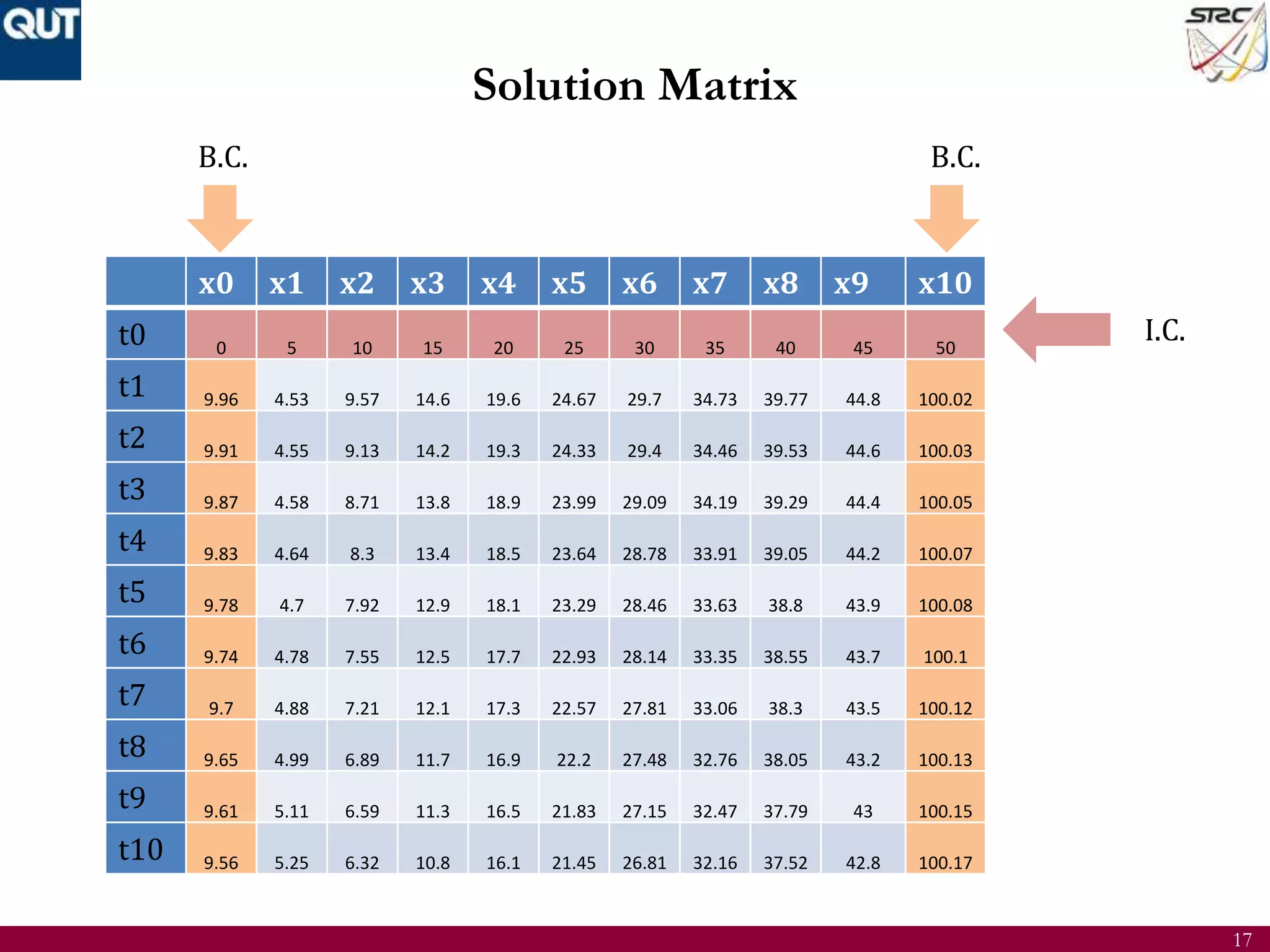
Solution Matrix
x0 x1 x2 x3 x4 x5 x6 x7 x8 x9 x10
t0 0 5 10 15 20 25 30 35 40 45 50
t1 9.96 4.53 9.57 14.6 19.6 24.67 29.7 34.73 39.77 44.8 100.02
t2 9.91 4.55 9.13 14.2 19.3 24.33 29.4 34.46 39.53 44.6 100.03
t3 9.87 4.58 8.71 13.8 18.9 23.99 29.09 34.19 39.29 44.4 100.05
t4 9.83 4.64 8.3 13.4 18.5 23.64 28.78 33.91 39.05 44.2 100.07
t5 9.78 4.7 7.92 12.9 18.1 23.29 28.46 33.63 38.8 43.9 100.08
t6 9.74 4.78 7.55 12.5 17.7 22.93 28.14 33.35 38.55 43.7 100.1
t7 9.7 4.88 7.21 12.1 17.3 22.57 27.81 33.06 38.3 43.5 100.12
t8 9.65 4.99 6.89 11.7 16.9 22.2 27.48 32.76 38.05 43.2 100.13
t9 9.61 5.11 6.59 11.3 16.5 21.83 27.15 32.47 37.79 43 100.15
t10 9.56 5.25 6.32 10.8 16.1 21.45 26.81 32.16 37.52 42.8 100.17
I.C.
B.C.B.C.
18
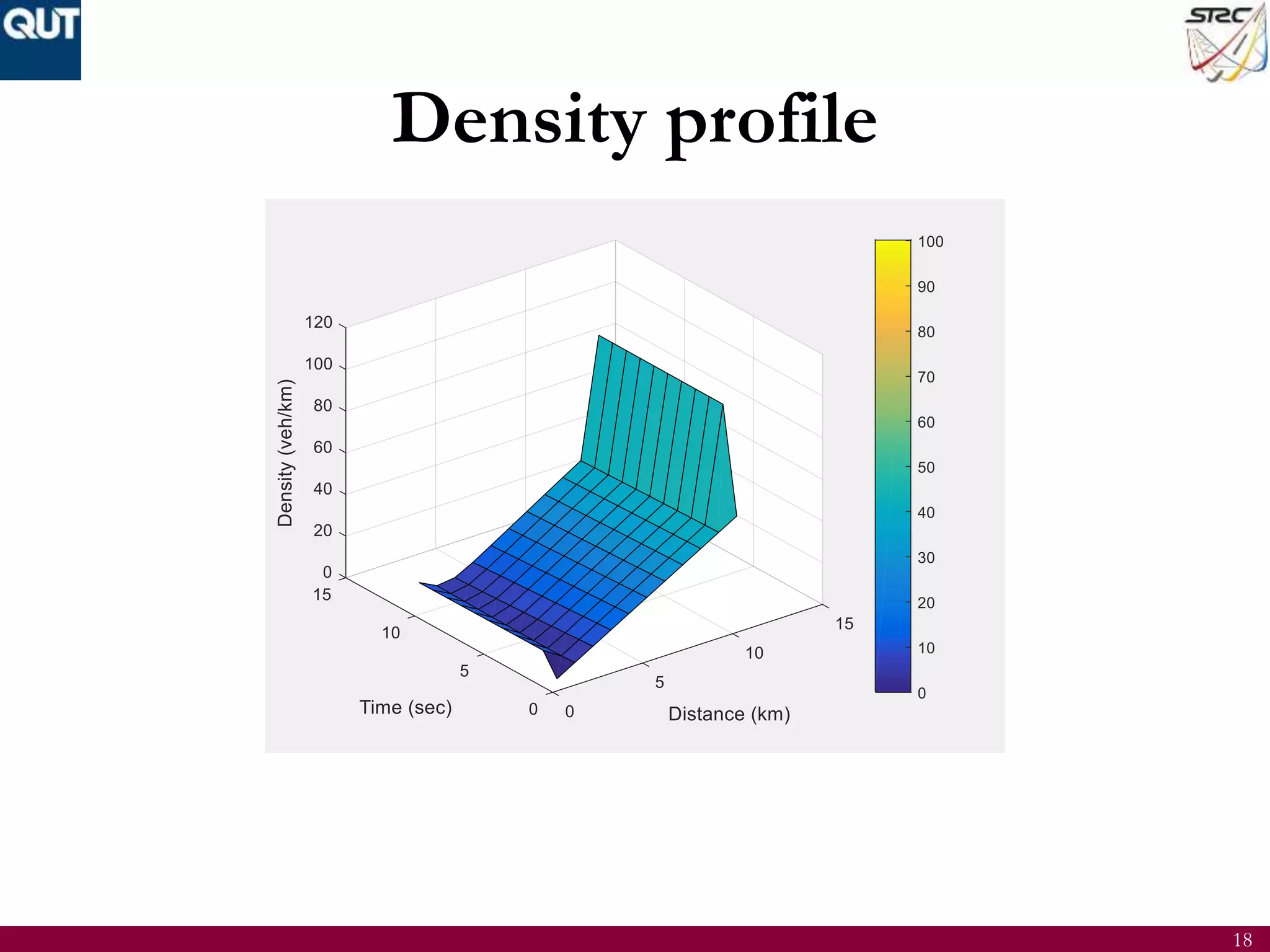
Density profile
19
Thank you !!!

Mathematical Understanding in Traffic Flow Modelling

  • 1.
    1 Mathematical Understanding in TrafficFlow Modelling by Sarkar Nikhil Chandra, M.S. PhD Student
  • 2.
    2 Context Objective: • Develop mathematicalunderstanding in traffic flow modelling Application: • Traffic Simulation
  • 3.
    3 Outline  Traffic models Solution methods  Results and Discussion
  • 4.
    4 Traffic Flow Models oMacroscopic models o Microscopic models
  • 5.
  • 6.
  • 7.
    7 Fundamental traffic flowequation Fundamental traffic flow equation: 𝑁𝑜. 𝑜𝑓 𝑉𝑒ℎ𝑖𝑐𝑙𝑒𝑠 𝑈𝑛𝑖𝑡 𝑡𝑖𝑚𝑒 = 𝐷𝑖𝑠𝑡𝑎𝑛𝑐𝑒 𝑡𝑟𝑎𝑣𝑒𝑙𝑙𝑒𝑑 𝑏𝑦 𝑣𝑒ℎ𝑖𝑐𝑙𝑒 𝑈𝑛𝑖𝑡 𝑡𝑖𝑚𝑒 × 𝑁𝑜. 𝑜𝑓 𝑉𝑒ℎ𝑖𝑐𝑙𝑒𝑠 𝑈𝑛𝑖𝑡 𝑑𝑖𝑠𝑡𝑎𝑛𝑐𝑒 𝑓𝑙𝑜𝑤 = 𝑠𝑝𝑒𝑒𝑑 × 𝑑𝑒𝑛𝑠𝑖𝑡𝑦 𝑞 = 𝑣. 𝜌 where, 𝑞 = traffic flow (veh/hr per lane) 𝑣 = flow speed (km/hr) 𝜌 = flow density (vehicles per lane-km)
  • 8.
    8 Empirical relations forcharacteristics Fig 1 (a) Linear speed density ; and (b) parabolic flow density relations in Greenshield’s model
  • 9.
  • 10.
    10 LWR model withConditions 𝜕𝜌 𝜕𝑡 + 𝜕 𝜕𝑥 𝑣 𝑚𝑎𝑥 𝜌 − 𝜌2 𝜌 𝑚𝑎𝑥 = 0 , 𝑡0 ≤ 𝑡 ≤ 𝑇, 𝑎 ≤ 𝑥 ≤ 𝑏 With I.C. 𝜌 𝑡0, 𝑥 = 𝜌0 𝑥 , 𝑎 ≤ 𝑥 ≤ 𝑏 B.C. 𝜌 𝑡, 𝑎 = 𝜌 𝑎 𝑡 , 𝑡0 ≤ 𝑡 ≤ 𝑇 𝜌 𝑡, 𝑏 = 𝜌 𝑏 𝑡 , 𝑡0 ≤ 𝑡 ≤ 𝑇
  • 11.
    11 Finite Difference (FD)Method Independent variables: space and time Dependent variable: density The partial derivatives in LWR model at each grid point are approximated from neighbouring values by using Taylor’s theorem. 𝜌 𝑥0 + ℎ = 𝜌 𝑥0 + ℎ𝜌 𝑥 𝑥0 + ℎ2 2! 𝜌 𝑥𝑥 𝑥0 + … + ℎ 𝑛−1 𝑛 − 1 ! 𝜌 𝑛−1 𝑥0 + 𝑂(ℎ 𝑛 ) where 𝜌 𝑥 = 𝜕𝜌 𝜕𝑥 ; 𝜌 𝑥𝑥 = 𝜕2 𝜌 𝜕𝑥2; …; 𝜌 𝑛−1 = 𝜕 𝑛−1 𝜌 𝜕𝑥 𝑛−1. FD approximations: • Forward difference : 𝜕𝜌 𝜕𝑥 = 𝜌 𝑥0+ℎ −𝜌 𝑥0 ℎ − 𝑂(ℎ) • Backward difference: 𝜕𝜌 𝜕𝑥 = 𝜌 𝑥0−ℎ −𝜌 𝑥0 ℎ + 𝑂(ℎ) • Central difference: 𝜕𝜌 𝜕𝑥 = 𝜌 𝑥0+ℎ −𝜌 𝑥0−ℎ 2ℎ + 𝑂(ℎ2 )
  • 12.
    12 FD Mesh • Aimto approximate the values of the density function 𝜌(𝑥, 𝑡) on a set of discrete points in 𝑥, 𝑡 plane • Divide the 𝑥-axis into equally space nodes at distance ∆𝑥 • Divide the 𝑡-axis into equally time nodes at distance ∆𝑡 • 𝑥, 𝑡 plane becomes with mesh points • Choose any mesh point say 𝑖∆𝑥, 𝑛∆𝑡 ; 𝑖 = 1, 2, … , 𝑀 ; 𝑛 = 0, 1, … , 𝑁 − 1 • We are interested in the value of 𝜌(𝑥, 𝑡) at mesh point 𝑖∆𝑡, 𝑛∆𝑥 denoted as 𝜌𝑖 𝑛 = 𝜌(𝑖∆𝑥, 𝑛∆𝑡)
  • 13.
    13 The mesh forFD approximation
  • 14.
  • 15.
    15 Numerical Solution ofLWR Model 𝜌𝑖 𝑛+1 = 𝜌𝑖 𝑛 − ∆𝑡 2∆𝑥 [𝑣 𝑚𝑎𝑥(𝜌𝑖+1 𝑛 − (𝜌𝑖+1 𝑛 )2 𝜌 𝑚𝑎𝑥 ) − 𝑣 𝑚𝑎𝑥(𝜌𝑖−1 𝑛 − (𝜌𝑖−1 𝑛 )2 𝜌 𝑚𝑎𝑥 )]
  • 16.
    16 Example of Solution 1.Set ∆𝑡 = 0.1, ∆𝑥 = 0.25 ; 𝑎 = 0; 𝑏 = 2.5; 𝑣 𝑚𝑎𝑥 = 1; 𝜌 𝑚𝑎𝑥 = 150 2. 𝑖𝑛𝑖𝑡𝑖𝑙𝑎 𝑐𝑜𝑛𝑑𝑖𝑡𝑖𝑜𝑛: 𝜌 𝑡0, 𝑥 = 𝜌0 𝑥 = 0.5 𝑥 ; 𝑎 ≤ 𝑥 ≤ 𝑏 3. Boundary conditions: 𝜌 𝑡, 𝑎 = 𝑥 𝑎−𝑣 𝑚𝑎𝑥 𝑡/2 1−𝑣 𝑚𝑎𝑥 𝑡/𝜌 𝑚𝑎𝑥 ; 𝑡0 ≤ 𝑡 ≤ 𝑇 𝜌 𝑡, 𝑏 = 𝑥 𝑏−𝑣 𝑚𝑎𝑥 𝑡/2 1−𝑣 𝑚𝑎𝑥 𝑡/𝜌 𝑚𝑎𝑥 ; 𝑡0 ≤ 𝑡 ≤ 𝑇 4. Stability condition: 𝑣 𝑚𝑎𝑥∆𝑡 ∆𝑥 ≤ 1
  • 17.
    17 Solution Matrix x0 x1x2 x3 x4 x5 x6 x7 x8 x9 x10 t0 0 5 10 15 20 25 30 35 40 45 50 t1 9.96 4.53 9.57 14.6 19.6 24.67 29.7 34.73 39.77 44.8 100.02 t2 9.91 4.55 9.13 14.2 19.3 24.33 29.4 34.46 39.53 44.6 100.03 t3 9.87 4.58 8.71 13.8 18.9 23.99 29.09 34.19 39.29 44.4 100.05 t4 9.83 4.64 8.3 13.4 18.5 23.64 28.78 33.91 39.05 44.2 100.07 t5 9.78 4.7 7.92 12.9 18.1 23.29 28.46 33.63 38.8 43.9 100.08 t6 9.74 4.78 7.55 12.5 17.7 22.93 28.14 33.35 38.55 43.7 100.1 t7 9.7 4.88 7.21 12.1 17.3 22.57 27.81 33.06 38.3 43.5 100.12 t8 9.65 4.99 6.89 11.7 16.9 22.2 27.48 32.76 38.05 43.2 100.13 t9 9.61 5.11 6.59 11.3 16.5 21.83 27.15 32.47 37.79 43 100.15 t10 9.56 5.25 6.32 10.8 16.1 21.45 26.81 32.16 37.52 42.8 100.17 I.C. B.C.B.C.
  • 18.
  • 19.