NAMAZ KA TAREEQA
Communication Media
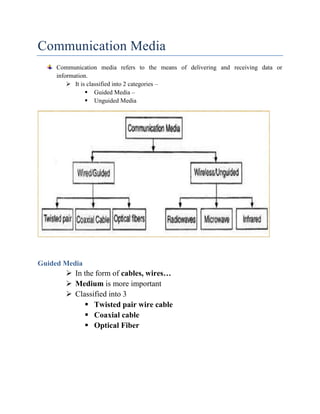
Communication media refers to the means of delivering and receiving data or
information.
 It is classified into 2 categories –
 Guided Media –
 Unguided Media
Guided Media
 In the form of cables, wires…
 Medium is more important
 Classified into 3
 Twisted pair wire cable
 Coaxial cable
 Optical Fiber
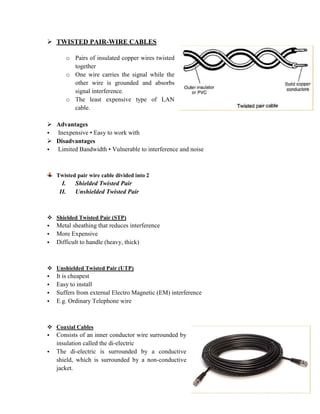
 TWISTED PAIR-WIRE CABLES
o Pairs of insulated copper wires twisted
together
o One wire carries the signal while the
other wire is grounded and absorbs
signal interference.
o The least expensive type of LAN
cable.
 Advantages
• Inexpensive • Easy to work with
 Disadvantages
• Limited Bandwidth • Vulnerable to interference and noise
Twisted pair wire cable divided into 2
I. Shielded Twisted Pair
II. Unshielded Twisted Pair
 Shielded Twisted Pair (STP)
• Metal sheathing that reduces interference
• More Expensive
• Difficult to handle (heavy, thick)
 Unshielded Twisted Pair (UTP)
• It is cheapest
• Easy to install
• Suffers from external Electro Magnetic (EM) interference
• E.g. Ordinary Telephone wire
 Coaxial Cables
• Consists of an inner conductor wire surrounded by
insulation called the di-electric
• The di-electric is surrounded by a conductive
shield, which is surrounded by a non-conductive
jacket.
• The shield minimizes electrical and radio frequency interference
• It is the primary type of cabling used by the cable TV industry and is also widely used for
computer networks.
 Advantages
• Better data transmission rate than twisted pair.
• Easy to install
• High bandwidth
• Excellent noise-immunity
 Disadvantages
• Higher cost compared to twisted pair
• Difficult to work with
• Cable may easily get damaged
 Fiber Optic Cable
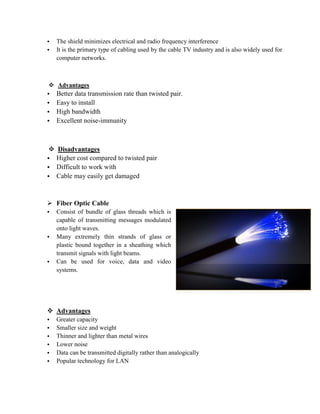
• Consist of bundle of glass threads which is
capable of transmitting messages modulated
onto light waves.
• Many extremely thin strands of glass or
plastic bound together in a sheathing which
transmit signals with light beams.
• Can be used for voice, data and video
systems.
 Advantages
• Greater capacity
• Smaller size and weight
• Thinner and lighter than metal wires
• Lower noise
• Data can be transmitted digitally rather than analogically
• Popular technology for LAN
 Disadvantages
• Cables are expensive to install
• More fragile than wire
Unguided Media
• In the form of radio signals, micro waves, infrared rays…
• Classified into 3
i. Radio wave
ii. Microwave
iii. Infrared
Radio wave
 Signals are digitized and transformed into
radio-frequency electromagnetic fields.
 Advantages
• Cheap form of communication
• Far good for long distance
 Disadvantages
• It has low frequency
• It can't transmit a lot of data at one time.
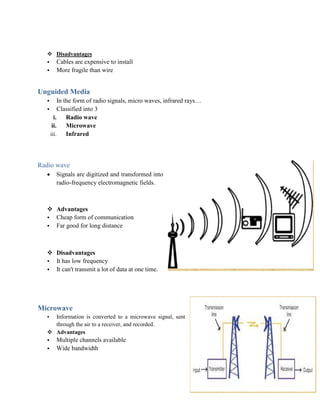
Microwave
• Information is converted to a microwave signal, sent
through the air to a receiver, and recorded.
 Advantages
• Multiple channels available
• Wide bandwidth
 Disadvantages.
• Line-of-sight will be disrupted if any obstacle, are in the way,
• Signal absorption by the atmosphere
• Towers are expensive to build.
Infrared
• This type of transmission uses infrared light to send data
• It transmits data through air and can propagate throughout a room, but will not
penetrate walls.
• It is common in PDAs(Personal Digital Assistants)
• E.g. TV remotes, wireless speakers etc.,.
 Advantages
• Inexpensive compared to other technologies
• Works well over a short distance
 Disadvantages
• Low Bandwidth.

Communication media

  • 1.
  • 2.
    Communication Media Communication mediarefers to the means of delivering and receiving data or information.  It is classified into 2 categories –  Guided Media –  Unguided Media Guided Media  In the form of cables, wires…  Medium is more important  Classified into 3  Twisted pair wire cable  Coaxial cable  Optical Fiber
  • 3.
     TWISTED PAIR-WIRECABLES o Pairs of insulated copper wires twisted together o One wire carries the signal while the other wire is grounded and absorbs signal interference. o The least expensive type of LAN cable.  Advantages • Inexpensive • Easy to work with  Disadvantages • Limited Bandwidth • Vulnerable to interference and noise Twisted pair wire cable divided into 2 I. Shielded Twisted Pair II. Unshielded Twisted Pair  Shielded Twisted Pair (STP) • Metal sheathing that reduces interference • More Expensive • Difficult to handle (heavy, thick)  Unshielded Twisted Pair (UTP) • It is cheapest • Easy to install • Suffers from external Electro Magnetic (EM) interference • E.g. Ordinary Telephone wire  Coaxial Cables • Consists of an inner conductor wire surrounded by insulation called the di-electric • The di-electric is surrounded by a conductive shield, which is surrounded by a non-conductive jacket.
  • 4.
    • The shieldminimizes electrical and radio frequency interference • It is the primary type of cabling used by the cable TV industry and is also widely used for computer networks.  Advantages • Better data transmission rate than twisted pair. • Easy to install • High bandwidth • Excellent noise-immunity  Disadvantages • Higher cost compared to twisted pair • Difficult to work with • Cable may easily get damaged  Fiber Optic Cable • Consist of bundle of glass threads which is capable of transmitting messages modulated onto light waves. • Many extremely thin strands of glass or plastic bound together in a sheathing which transmit signals with light beams. • Can be used for voice, data and video systems.  Advantages • Greater capacity • Smaller size and weight • Thinner and lighter than metal wires • Lower noise • Data can be transmitted digitally rather than analogically • Popular technology for LAN
  • 5.
     Disadvantages • Cablesare expensive to install • More fragile than wire Unguided Media • In the form of radio signals, micro waves, infrared rays… • Classified into 3 i. Radio wave ii. Microwave iii. Infrared Radio wave  Signals are digitized and transformed into radio-frequency electromagnetic fields.  Advantages • Cheap form of communication • Far good for long distance  Disadvantages • It has low frequency • It can't transmit a lot of data at one time. Microwave • Information is converted to a microwave signal, sent through the air to a receiver, and recorded.  Advantages • Multiple channels available • Wide bandwidth
  • 6.
     Disadvantages. • Line-of-sightwill be disrupted if any obstacle, are in the way, • Signal absorption by the atmosphere • Towers are expensive to build. Infrared • This type of transmission uses infrared light to send data • It transmits data through air and can propagate throughout a room, but will not penetrate walls. • It is common in PDAs(Personal Digital Assistants) • E.g. TV remotes, wireless speakers etc.,.  Advantages • Inexpensive compared to other technologies • Works well over a short distance  Disadvantages • Low Bandwidth.