

Business Data Communications,
Fourth Edition
Chapter 11: Network
Management
Learning Objectives
• Describe the five levels of network
management described by the ISO
• List and explain the objectives of network
management
• Define the characteristics of the network
that affect user satisfaction
• Describe cost-effective network
management techniques
Chapter 11: Network Management 2
Learning Objectives
• Describe how network management
objectives are met
• Identify the effect that wireless networks
and e-commerce have on network
management
• List and explain the types of network
monitoring software
• Describe the standards used for network
management
Chapter 11: Network Management 3
Introduction
• Network managers have a complex role in the
organization
• Must manage voice and data networks, as well
as e-commerce
• Many tasks must be performed to manage the
networks
• Manager is more visible to the users/customers
• Well-defined objectives will provide good
customer service
Chapter 11: Network Management 4
Network Management and the ISO
Model
• ISO/IEC 7498-4 defines five areas for
network management
– Performance Management
• Bandwidth
• Processor & memory availability
• Network devices
– Fault Management
• Detects and responds to abnormal conditions
• Software defines normal operations of network
Chapter 11: Network Management 5
Network Management and the ISO
Model
• ISO/IEC 7498-4
– Configuration Management
• Hardware and software make-up of network
– Accounting Management
• Charges by IT to other departments for network
use
– Security Management
• Authorized use of the network
• IDs, passwords, firewalls, antivirus software, data
encryption, formal security procedures
Chapter 11: Network Management 6
Objectives of Network
Management
• User Satisfaction
– Methods used vary by application
– Performance
• Response time
• Should be consistent for each application
• Communications time
– Time on the communication line
– Processing time between client and server
• Response time affected by many events
Chapter 11: Network Management 7
Objectives of Network
Management
• User Satisfaction
– Availability
• All components available for use when needed
• Maintenance schedule should be publicized
• Mean Time Between Failures (MTBF)
• Mean Time to Repair (MTTR)
– Reliability
• Errors expected
• Stability of hardware and software
Chapter 11: Network Management 8
Objectives of Network
Management
• User Satisfaction
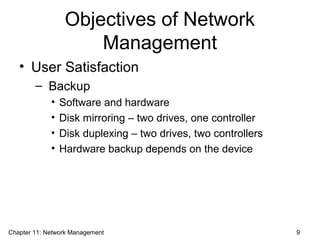
– Backup
• Software and hardware
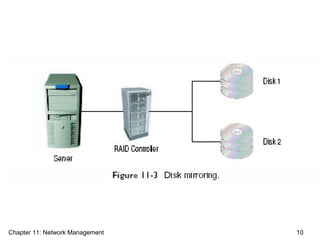
• Disk mirroring – two drives, one controller
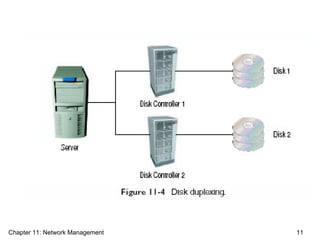
• Disk duplexing – two drives, two controllers
• Hardware backup depends on the device
Chapter 11: Network Management 9
Chapter 11: Network Management 10
Chapter 11: Network Management 11
Objectives of Network
Management
• User Satisfaction
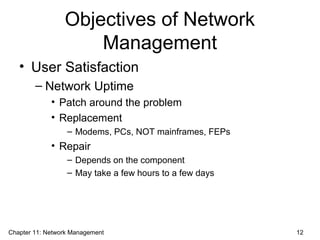
– Network Uptime
• Patch around the problem
• Replacement
– Modems, PCs, NOT mainframes, FEPs
• Repair
– Depends on the component
– May take a few hours to a few days
Chapter 11: Network Management 12
Objectives of Network
Management
• User Satisfaction
– Information Availability
• Critical to keep users updated on events
• Scheduled downtimes
• Alternative work schedules
• Help desk
Chapter 11: Network Management 13
Objectives of Network
Management
• Cost-Effectiveness
– Prior Planning
• Key to the success of a network project
• Volume and type of data must be considered
• Plan for expansion of the network
• Buying equipment
– Buy only for current needs
– Buy for current and future needs
Chapter 11: Network Management 14
Objectives of Network
Management
• Cost-Effectiveness
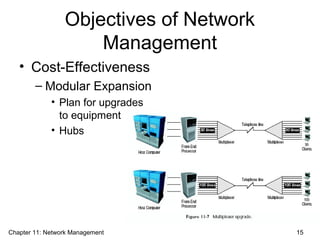
– Modular Expansion
• Plan for upgrades
to equipment
• Hubs
Chapter 11: Network Management 15
Objectives of Network Management
• Cost-Effectiveness
–Equipment Expansion
• Buy new equipment for each expansion
–Relocation of Equipment
• Reuse clients and servers in other locations
Chapter 11: Network Management 16
Meeting the Objectives
• Staffing
– Skills required
• Design and configuration
• Diagnosis (Troubleshooting)
• Documentation
Chapter 11: Network Management 17
Meeting the Objectives
• Network Analysis
–Network Statistics
• Performance monitor can gather statistics
• Simulation models
• Workload generator
• Log files
• Transaction mix should be checked
• Circuit utilization can affect performance
Chapter 11: Network Management 18
Meeting the Objectives
• Network Analysis
–Network Changes
• Tuning
– Changes to the network based on the statistics
gathered
• Can change transmission speeds, buffer
sizes
• Change network configuration
Chapter 11: Network Management 19
Network Management for Wireless
Networks and e-Commerce
• Wireless Networks
– Managers must know the technology
– Videoconferencing, data archiving, data
mirroring
– Connecting PDAs and laptop computers to
the LAN
– Bandwidth, security, design issues
Chapter 11: Network Management 20
Network Management for Wireless
Networks and e-Commerce
• Network Traffic Volume
– High volume caused by e-commerce
– Corporate portal is now important to business
– May slow system response
– Bandwidth may need to be increased
– Must monitor network closely
Chapter 11: Network Management 21
Network Management for Wireless
Networks and e-Commerce
• Internet Network Monitoring Tools
– Transaction Monitoring
• End-to-end response time
• Dummy transaction created
– Network Performance Monitoring
• Service level agreements with ISP
– Live-visitor site monitoring
– Human-response monitoring
Chapter 11: Network Management 22
General Network Monitoring
Tools
• Classes of Network Monitoring Software
– Device management software
• Monitors specific devices
– Enterprise management software
• Monitors entire system
– Application management software
• Monitors specific applications
Chapter 11: Network Management 23
General Network Monitoring
Tools
• Network Management Protocols
– Simple Network Management Protocol
(SNMP)
• Collects and reports data on network performance
• Data stored in management information base
(MIB)
• Security is a problem
• Remote monitoring (RMON) extension
– Stores data at a remote site, rather than a central server
Chapter 11: Network Management 24
General Network Monitoring
Tools
• Network Management Protocols
– Common Management Interface Protocol
(CMIP)
• ISO standard
• Newer than SNMP
• More complete monitoring information
• Better security
• Major changes needed to an SNMP system to
implement CMIP, so it has not been done
Chapter 11: Network Management 25
Summary
• Network managers responsible for both
voice and data networks, as well as e-
commerce
• ISO defines five levels of network
management
• User satisfaction is viewed in terms of
response time, equipment availability,
network reliability, and information
• Cost-effectiveness is accomplished
through prior planning
Chapter 11: Network Management 26
Summary
• Staffing and network analysis can be used to
achieve the network managers goals
• Network tuning is used to improve performance
• Network performance for wireless and e-
commerce applications is now needed
• Network monitoring tools allow the manager to
keep track of how the network is performing
• SNMP was originally used, CMIP is newer
Chapter 11: Network Management 27
Chapter 11 Complete

Network management objective

  • 1.
    Business Data Communications, FourthEdition Chapter 11: Network Management
  • 2.
    Learning Objectives • Describethe five levels of network management described by the ISO • List and explain the objectives of network management • Define the characteristics of the network that affect user satisfaction • Describe cost-effective network management techniques Chapter 11: Network Management 2
  • 3.
    Learning Objectives • Describehow network management objectives are met • Identify the effect that wireless networks and e-commerce have on network management • List and explain the types of network monitoring software • Describe the standards used for network management Chapter 11: Network Management 3
  • 4.
    Introduction • Network managershave a complex role in the organization • Must manage voice and data networks, as well as e-commerce • Many tasks must be performed to manage the networks • Manager is more visible to the users/customers • Well-defined objectives will provide good customer service Chapter 11: Network Management 4
  • 5.
    Network Management andthe ISO Model • ISO/IEC 7498-4 defines five areas for network management – Performance Management • Bandwidth • Processor & memory availability • Network devices – Fault Management • Detects and responds to abnormal conditions • Software defines normal operations of network Chapter 11: Network Management 5
  • 6.
    Network Management andthe ISO Model • ISO/IEC 7498-4 – Configuration Management • Hardware and software make-up of network – Accounting Management • Charges by IT to other departments for network use – Security Management • Authorized use of the network • IDs, passwords, firewalls, antivirus software, data encryption, formal security procedures Chapter 11: Network Management 6
  • 7.
    Objectives of Network Management •User Satisfaction – Methods used vary by application – Performance • Response time • Should be consistent for each application • Communications time – Time on the communication line – Processing time between client and server • Response time affected by many events Chapter 11: Network Management 7
  • 8.
    Objectives of Network Management •User Satisfaction – Availability • All components available for use when needed • Maintenance schedule should be publicized • Mean Time Between Failures (MTBF) • Mean Time to Repair (MTTR) – Reliability • Errors expected • Stability of hardware and software Chapter 11: Network Management 8
  • 9.
    Objectives of Network Management •User Satisfaction – Backup • Software and hardware • Disk mirroring – two drives, one controller • Disk duplexing – two drives, two controllers • Hardware backup depends on the device Chapter 11: Network Management 9
  • 10.
    Chapter 11: NetworkManagement 10
  • 11.
    Chapter 11: NetworkManagement 11
  • 12.
    Objectives of Network Management •User Satisfaction – Network Uptime • Patch around the problem • Replacement – Modems, PCs, NOT mainframes, FEPs • Repair – Depends on the component – May take a few hours to a few days Chapter 11: Network Management 12
  • 13.
    Objectives of Network Management •User Satisfaction – Information Availability • Critical to keep users updated on events • Scheduled downtimes • Alternative work schedules • Help desk Chapter 11: Network Management 13
  • 14.
    Objectives of Network Management •Cost-Effectiveness – Prior Planning • Key to the success of a network project • Volume and type of data must be considered • Plan for expansion of the network • Buying equipment – Buy only for current needs – Buy for current and future needs Chapter 11: Network Management 14
  • 15.
    Objectives of Network Management •Cost-Effectiveness – Modular Expansion • Plan for upgrades to equipment • Hubs Chapter 11: Network Management 15
  • 16.
    Objectives of NetworkManagement • Cost-Effectiveness –Equipment Expansion • Buy new equipment for each expansion –Relocation of Equipment • Reuse clients and servers in other locations Chapter 11: Network Management 16
  • 17.
    Meeting the Objectives •Staffing – Skills required • Design and configuration • Diagnosis (Troubleshooting) • Documentation Chapter 11: Network Management 17
  • 18.
    Meeting the Objectives •Network Analysis –Network Statistics • Performance monitor can gather statistics • Simulation models • Workload generator • Log files • Transaction mix should be checked • Circuit utilization can affect performance Chapter 11: Network Management 18
  • 19.
    Meeting the Objectives •Network Analysis –Network Changes • Tuning – Changes to the network based on the statistics gathered • Can change transmission speeds, buffer sizes • Change network configuration Chapter 11: Network Management 19
  • 20.
    Network Management forWireless Networks and e-Commerce • Wireless Networks – Managers must know the technology – Videoconferencing, data archiving, data mirroring – Connecting PDAs and laptop computers to the LAN – Bandwidth, security, design issues Chapter 11: Network Management 20
  • 21.
    Network Management forWireless Networks and e-Commerce • Network Traffic Volume – High volume caused by e-commerce – Corporate portal is now important to business – May slow system response – Bandwidth may need to be increased – Must monitor network closely Chapter 11: Network Management 21
  • 22.
    Network Management forWireless Networks and e-Commerce • Internet Network Monitoring Tools – Transaction Monitoring • End-to-end response time • Dummy transaction created – Network Performance Monitoring • Service level agreements with ISP – Live-visitor site monitoring – Human-response monitoring Chapter 11: Network Management 22
  • 23.
    General Network Monitoring Tools •Classes of Network Monitoring Software – Device management software • Monitors specific devices – Enterprise management software • Monitors entire system – Application management software • Monitors specific applications Chapter 11: Network Management 23
  • 24.
    General Network Monitoring Tools •Network Management Protocols – Simple Network Management Protocol (SNMP) • Collects and reports data on network performance • Data stored in management information base (MIB) • Security is a problem • Remote monitoring (RMON) extension – Stores data at a remote site, rather than a central server Chapter 11: Network Management 24
  • 25.
    General Network Monitoring Tools •Network Management Protocols – Common Management Interface Protocol (CMIP) • ISO standard • Newer than SNMP • More complete monitoring information • Better security • Major changes needed to an SNMP system to implement CMIP, so it has not been done Chapter 11: Network Management 25
  • 26.
    Summary • Network managersresponsible for both voice and data networks, as well as e- commerce • ISO defines five levels of network management • User satisfaction is viewed in terms of response time, equipment availability, network reliability, and information • Cost-effectiveness is accomplished through prior planning Chapter 11: Network Management 26
  • 27.
    Summary • Staffing andnetwork analysis can be used to achieve the network managers goals • Network tuning is used to improve performance • Network performance for wireless and e- commerce applications is now needed • Network monitoring tools allow the manager to keep track of how the network is performing • SNMP was originally used, CMIP is newer Chapter 11: Network Management 27
  • 28.