Presentation on
Vector Supercomputers
and Scientific Attached
Processors
Submitted by,
Hsuvas borkakoty
Roll no. 02(2years)
Outline
• Vector Supercomputers
• Processing Speed-FLOPS
• Generations of Vector Supercomputers
• Application Areas of Vector Supercomputers
• Scientific Attached Processors
• Working methodology
• Applications of Scientific Attached Processor
• Projected Speed and Performence Evaluation
• Advantages and Limitations of Scientific Attached
Processor
• Conclusion
• Bibliography
Vector Supercomputers
• commonly called as supercomputers
• came to lights in late '60s
• machines built to handle large scientific and engineering
calculations
• handles one dimensional array of data called vectors
• characterised by-
 Computational Speed
 Fast and large Memory(primary/secondary)
 extensive use of parallel structured software
• has a large application domain
• data elements are arranged in vector/matrix form
• current supercomputers has the processing speed in
petaflops.
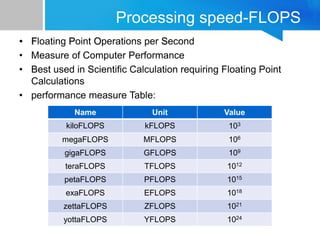
Processing speed-FLOPS
• Floating Point Operations per Second
• Measure of Computer Performance
• Best used in Scientific Calculation requiring Floating Point
Calculations
• performance measure Table:
Name Unit Value
kiloFLOPS kFLOPS 103
megaFLOPS MFLOPS 106
gigaFLOPS GFLOPS 109
teraFLOPS TFLOPS 1012
petaFLOPS PFLOPS 1015
exaFLOPS EFLOPS 1018
zettaFLOPS ZFLOPS 1021
yottaFLOPS YFLOPS 1024
Generations of Vector Supercomputer
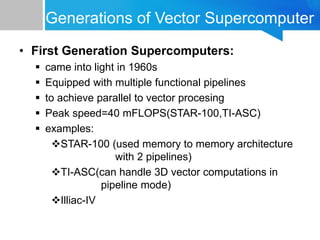
• First Generation Supercomputers:
 came into light in 1960s
 Equipped with multiple functional pipelines
 to achieve parallel to vector procesing
 Peak speed=40 mFLOPS(STAR-100,TI-ASC)
 examples:
STAR-100 (used memory to memory architecture
with 2 pipelines)
TI-ASC(can handle 3D vector computations in
pipeline mode)
Illiac-IV
Generations of Vector Supercomputer
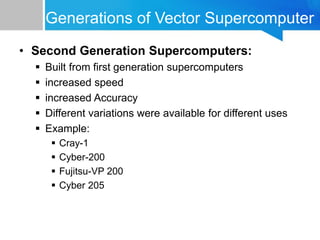
• Second Generation Supercomputers:
 Built from first generation supercomputers
 increased speed
 increased Accuracy
 Different variations were available for different uses
 Example:
 Cray-1
 Cyber-200
 Fujitsu-VP 200
 Cyber 205
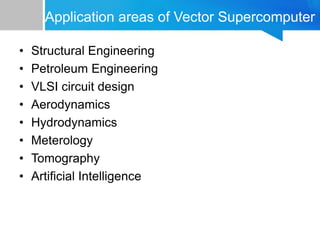
Application areas of Vector Supercomputer
• Structural Engineering
• Petroleum Engineering
• VLSI circuit design
• Aerodynamics
• Hydrodynamics
• Meterology
• Tomography
• Artificial Intelligence
Scientific Attached Processor
• Designed as back-end machines attached to a
host computer
• most of it are pipeline structure
• designed to enhance floating point capabilities of
the host machine
• can be attached to minicomputer/mainframe
• most used systems:
 AP-120B
 FPS-164
 FACOM 230/75
Working Methodology
• Processors are attached to Host
• In a host backend computer organization:
 Host is a program manager that handles:
Input-Output
Code compilation
Operating System Functions
• backend processor concentrates on Arithmetic
computations with data supplied by host machine.
• Also called as Scientific Array Processor
Applications of Scientific Attached Processor
• Stactural Analysis
• Analog circuit simulations
• Computational Chemistry
• Electromegnetic Modeling
• AI applications like Recognition,Classification etc.
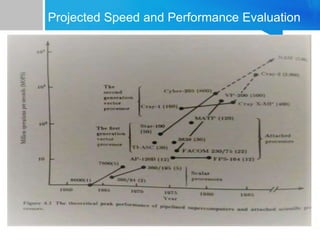
Projected Speed and Performance Evaluation
• Figure describes the projected speed and
performence evaluation of Scientific Attached
Processors.
• Parameters taken:
 Horizontal Axis: Year
 Vertical Axis: Million Operations Per Second(MOPS)
 all theoretical peak performance of the processor
inside the parenthesis.
• Relative speed comparison between the
processors can also be done in the figure
Projected Speed and Performance Evaluation
Advantages and Limitations of Scientific Attached Processors
• Advantages:
 Enhances the speed of Host Machine
 Can be attached to different computers
 Attached processor cost much less than Mainframe and
Super Computers
• Limitations:
 Most attached array processors must be microcoded for
various operations
 The software might be inadequate and costly than the
hardware
 High speed interfacing might be required to maintain the flow
of data
Conclusion
• Vector Supercomputers has become an intregal
part of various application domain
• Its speed and accuracy has shown the wide
range of possibilities in todays world
• In a world where flow of data has crossed every
limit, evaluation and manipulation with
maintaining the efficiency is one major question
• However, with proper help of Vector Computers
and the processing powers of Scientific Attached
Processors, this can be achieved.
Bibliography and Reference
• Bibliography:
 Hwang,Kai,Briggs,Faye A.;Computer
Architecture and Parallel Processing
• Web Reference:
 http://www.johngustafson.net/pubs/pub19/Kai
Hwang.html
 https://en.wikipedia.org/wiki/Supercomputer
Vector Supercomputers and Scientific Array Processors

Vector Supercomputers and Scientific Array Processors

  • 1.
    Presentation on Vector Supercomputers andScientific Attached Processors Submitted by, Hsuvas borkakoty Roll no. 02(2years)
  • 2.
    Outline • Vector Supercomputers •Processing Speed-FLOPS • Generations of Vector Supercomputers • Application Areas of Vector Supercomputers • Scientific Attached Processors • Working methodology • Applications of Scientific Attached Processor • Projected Speed and Performence Evaluation • Advantages and Limitations of Scientific Attached Processor • Conclusion • Bibliography
  • 3.
    Vector Supercomputers • commonlycalled as supercomputers • came to lights in late '60s • machines built to handle large scientific and engineering calculations • handles one dimensional array of data called vectors • characterised by-  Computational Speed  Fast and large Memory(primary/secondary)  extensive use of parallel structured software • has a large application domain • data elements are arranged in vector/matrix form • current supercomputers has the processing speed in petaflops.
  • 4.
    Processing speed-FLOPS • FloatingPoint Operations per Second • Measure of Computer Performance • Best used in Scientific Calculation requiring Floating Point Calculations • performance measure Table: Name Unit Value kiloFLOPS kFLOPS 103 megaFLOPS MFLOPS 106 gigaFLOPS GFLOPS 109 teraFLOPS TFLOPS 1012 petaFLOPS PFLOPS 1015 exaFLOPS EFLOPS 1018 zettaFLOPS ZFLOPS 1021 yottaFLOPS YFLOPS 1024
  • 5.
    Generations of VectorSupercomputer • First Generation Supercomputers:  came into light in 1960s  Equipped with multiple functional pipelines  to achieve parallel to vector procesing  Peak speed=40 mFLOPS(STAR-100,TI-ASC)  examples: STAR-100 (used memory to memory architecture with 2 pipelines) TI-ASC(can handle 3D vector computations in pipeline mode) Illiac-IV
  • 6.
    Generations of VectorSupercomputer • Second Generation Supercomputers:  Built from first generation supercomputers  increased speed  increased Accuracy  Different variations were available for different uses  Example:  Cray-1  Cyber-200  Fujitsu-VP 200  Cyber 205
  • 7.
    Application areas ofVector Supercomputer • Structural Engineering • Petroleum Engineering • VLSI circuit design • Aerodynamics • Hydrodynamics • Meterology • Tomography • Artificial Intelligence
  • 8.
    Scientific Attached Processor •Designed as back-end machines attached to a host computer • most of it are pipeline structure • designed to enhance floating point capabilities of the host machine • can be attached to minicomputer/mainframe • most used systems:  AP-120B  FPS-164  FACOM 230/75
  • 9.
    Working Methodology • Processorsare attached to Host • In a host backend computer organization:  Host is a program manager that handles: Input-Output Code compilation Operating System Functions • backend processor concentrates on Arithmetic computations with data supplied by host machine. • Also called as Scientific Array Processor
  • 10.
    Applications of ScientificAttached Processor • Stactural Analysis • Analog circuit simulations • Computational Chemistry • Electromegnetic Modeling • AI applications like Recognition,Classification etc.
  • 11.
    Projected Speed andPerformance Evaluation • Figure describes the projected speed and performence evaluation of Scientific Attached Processors. • Parameters taken:  Horizontal Axis: Year  Vertical Axis: Million Operations Per Second(MOPS)  all theoretical peak performance of the processor inside the parenthesis. • Relative speed comparison between the processors can also be done in the figure
  • 12.
    Projected Speed andPerformance Evaluation
  • 13.
    Advantages and Limitationsof Scientific Attached Processors • Advantages:  Enhances the speed of Host Machine  Can be attached to different computers  Attached processor cost much less than Mainframe and Super Computers • Limitations:  Most attached array processors must be microcoded for various operations  The software might be inadequate and costly than the hardware  High speed interfacing might be required to maintain the flow of data
  • 14.
    Conclusion • Vector Supercomputershas become an intregal part of various application domain • Its speed and accuracy has shown the wide range of possibilities in todays world • In a world where flow of data has crossed every limit, evaluation and manipulation with maintaining the efficiency is one major question • However, with proper help of Vector Computers and the processing powers of Scientific Attached Processors, this can be achieved.
  • 15.
    Bibliography and Reference •Bibliography:  Hwang,Kai,Briggs,Faye A.;Computer Architecture and Parallel Processing • Web Reference:  http://www.johngustafson.net/pubs/pub19/Kai Hwang.html  https://en.wikipedia.org/wiki/Supercomputer