The Nervous
System
Overview of the Nervous System
Functional Anatomy of the Central Nervous
System
Functional Anatomy of the Peripheral
Nervous System
Nervous Tissue and Transmission of Nerve
Impulses
Injuries and Disorders of the Nervous
System
Overview
of the
Nervous System
Nervous System Overview
• organization of the nervous system
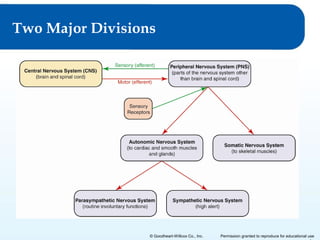
– two major divisions
– the efferent nerves

• nervous tissues
– neuroglia
– neurons

© Goodheart-Willcox Co., Inc.

Permission granted to reproduce for educational use
Organization of the Nervous System
• two major divisions
– central nervous system (CNS)
– peripheral nervous system (PNS)
• sensory receptors
• afferent (sensory) nerves
• efferent (motor) nerves

© Goodheart-Willcox Co., Inc.

Permission granted to reproduce for educational use
Two Major Divisions

© Goodheart-Willcox Co., Inc.

Permission granted to reproduce for educational use
Functional Anatomy
of the
Central Nervous System
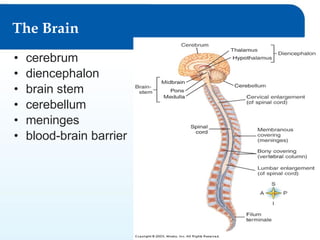
The Brain
•
•
•
•
•
•

cerebrum
diencephalon
brain stem
cerebellum
meninges
blood-brain barrier

© Goodheart-Willcox Co., Inc.

Permission granted to reproduce for educational use
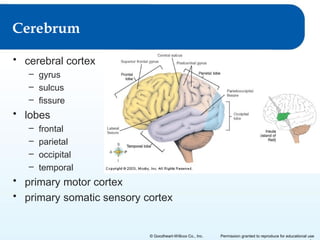
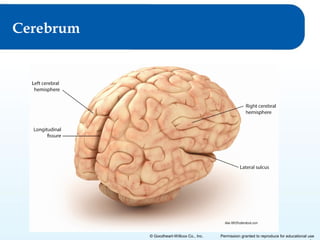
Cerebrum
• cerebral cortex
– gyrus
– sulcus
– fissure

• lobes
–
–
–
–

frontal
parietal
occipital
temporal

• primary motor cortex
• primary somatic sensory cortex

© Goodheart-Willcox Co., Inc.

Permission granted to reproduce for educational use
Cerebrum

© Goodheart-Willcox Co., Inc.

Permission granted to reproduce for educational use
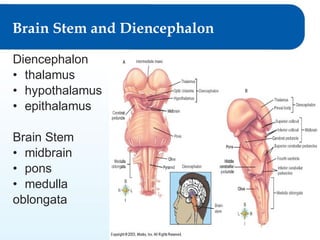
Brain Stem and Diencephalon
Diencephalon
• thalamus
• hypothalamus
• epithalamus
Brain Stem
• midbrain
• pons
• medulla
oblongata
© Goodheart-Willcox Co., Inc.

Permission granted to reproduce for educational use
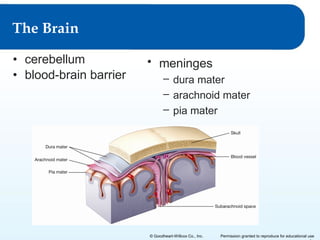
The Brain
• cerebellum
• blood-brain barrier

• meninges
– dura mater
– arachnoid mater
– pia mater

© Goodheart-Willcox Co., Inc.

Permission granted to reproduce for educational use
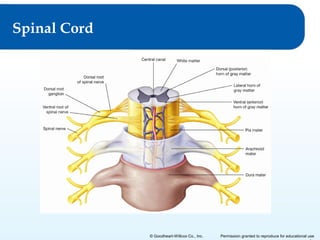
Spinal Cord

© Goodheart-Willcox Co., Inc.

Permission granted to reproduce for educational use
Review and Assessment
True or False?
1. The gyri divide the brain into 4 regions.
2. The hypothalamus regulates blood pressure.
3. The meninges has 3 layers.
4. The cerebellum coordinates balance.
5. The pons is also called the interbrain.

© Goodheart-Willcox Co., Inc.

Permission granted to reproduce for educational use
Functional Anatomy
of the
Peripheral
Nervous System
Functional Anatomy of the Peripheral
Nervous System
•
•
•
•

nerve structure
cranial nerves
spinal nerves and nerve plexuses
autonomic nervous system

© Goodheart-Willcox Co., Inc.

Permission granted to reproduce for educational use
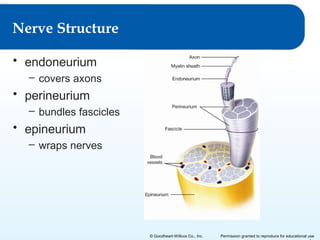
Nerve Structure
• endoneurium
– covers axons

• perineurium
– bundles fascicles

• epineurium
– wraps nerves

© Goodheart-Willcox Co., Inc.

Permission granted to reproduce for educational use
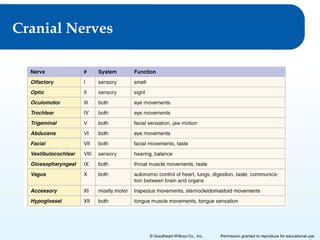
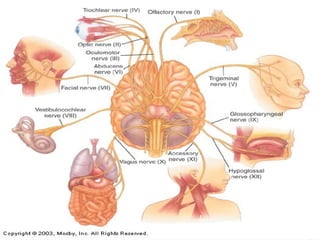
Cranial Nerves

© Goodheart-Willcox Co., Inc.

Permission granted to reproduce for educational use
© Goodheart-Willcox Co., Inc.

Permission granted to reproduce for educational use
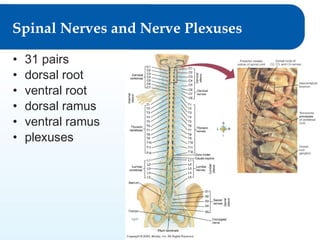
Spinal Nerves and Nerve Plexuses
•
•
•
•
•
•

31 pairs
dorsal root
ventral root
dorsal ramus
ventral ramus
plexuses

© Goodheart-Willcox Co., Inc.

Permission granted to reproduce for educational use
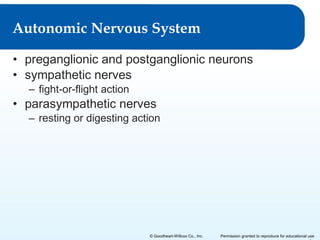
Autonomic Nervous System
• preganglionic and postganglionic neurons
• sympathetic nerves
– fight-or-flight action

• parasympathetic nerves
– resting or digesting action

© Goodheart-Willcox Co., Inc.

Permission granted to reproduce for educational use
Review and Assessment
Match these words with 1–4 below: efferent,
ganglion, optic, perineurium.
1. wraps fascicles
2. motor
3. a cranial nerve
4. enlarged junction

© Goodheart-Willcox Co., Inc.

Permission granted to reproduce for educational use
Nervous Tissue
and Transmission
of Nerve Impulses
The Efferent Nerves
• somatic nervous system
– voluntary

• autonomic nervous system
– involuntary
• Two Divisions
– sympathetic
– parasympathetic

© Goodheart-Willcox Co., Inc.

Permission granted to reproduce for educational use
Nervous Tissues
• neuroglia
–
–
–
–

also known as glial cells
support the neurons
protect the neurons
continue to divide through adulthood- potential
consequence is abnormal cell division (cancer)
– 5 major types of glia cells

• neurons
– transmit nerve impulses
– consist of a cell body and at least two processes.
© Goodheart-Willcox Co., Inc.

Permission granted to reproduce for educational use
Neuroglia
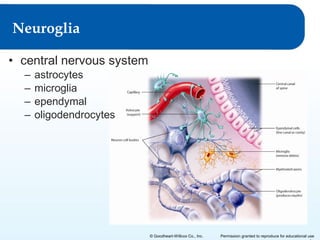
• central nervous system
–
–
–
–

astrocytes
microglia
ependymal
oligodendrocytes

© Goodheart-Willcox Co., Inc.

Permission granted to reproduce for educational use
Neuroglia
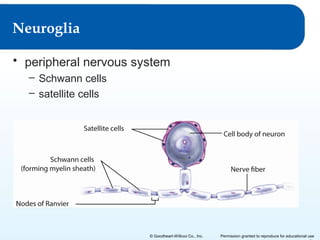
• peripheral nervous system
– Schwann cells
– satellite cells

© Goodheart-Willcox Co., Inc.

Permission granted to reproduce for educational use
Neurons
• dendrites
– send information to cell body

• cell bodies
• axons
– send information away from cell body

© Goodheart-Willcox Co., Inc.

Permission granted to reproduce for educational use
Neuron Types by Function
• sensory neurons
– send impulses toward CNS

• motor neurons
– send impulses away from CNS

• Interneurons
– bridges between neurons

© Goodheart-Willcox Co., Inc.

Permission granted to reproduce for educational use
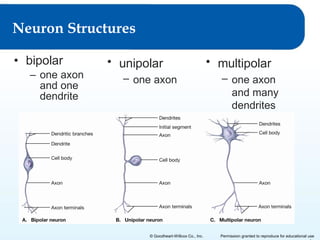
Neuron Structures
• bipolar
– one axon
and one
dendrite

• unipolar
– one axon

© Goodheart-Willcox Co., Inc.

• multipolar
– one axon
and many
dendrites

Permission granted to reproduce for educational use
Review and Assessment
Match these words with 1–4 below: sympathetic
nervous system, myelin, synapse, axon.
1. high alert
2. transmits impulses away from cell body
3. fatty insulating material
4. gap between neurons

© Goodheart-Willcox Co., Inc.

Permission granted to reproduce for educational use
Transmission of Nerve Impulses
• action potentials
– change in cell membrane charge

• impulse transmission
– charge change travels along axon

• reflexes
– involuntary response to stimulus

© Goodheart-Willcox Co., Inc.

Permission granted to reproduce for educational use
© Goodheart-Willcox Co., Inc.

Permission granted to reproduce for educational use
Action Potentials
•
•
•
•

polarized
depolarized
repolarized
refractory period

© Goodheart-Willcox Co., Inc.

Permission granted to reproduce for educational use
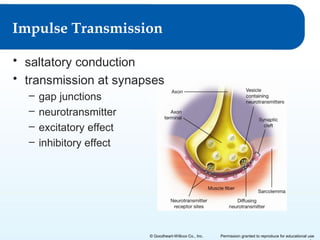
Impulse Transmission
• saltatory conduction
• transmission at synapses
–
–
–
–

gap junctions
neurotransmitter
excitatory effect
inhibitory effect

© Goodheart-Willcox Co., Inc.

Permission granted to reproduce for educational use
Reflexes
• somatic
– stimulate skeletal muscles

• autonomic
– stimulate involuntary muscles

© Goodheart-Willcox Co., Inc.

Permission granted to reproduce for educational use
Review and Assessment
Fill in the blanks with: reflexes, saltatory conduction,
neurotransmitter, or action potential.
1. A(n) _______________ is an all or none
response.
2. _______________ occurs only in myelinated
axons.
3. _______________ are rapid, involuntary
responses.
4. The axon terminal has tiny vesicles filled with
_______________.
© Goodheart-Willcox Co., Inc.

Permission granted to reproduce for educational use
Injuries and
Disorders
of the
Nervous System
Injuries to the Brain and Spinal Cord
• traumatic brain injury
• cerebral palsy
• spinal cord injury

© Goodheart-Willcox Co., Inc.

Permission granted to reproduce for educational use
Traumatic Brain Injury
• violent impact to head
– mild
– moderate
– severe

© Goodheart-Willcox Co., Inc.

Permission granted to reproduce for educational use
Cerebral Palsy
• damage to brain
– before birth
– during birth
– during infancy

• motor function impairment

© Goodheart-Willcox Co., Inc.

Permission granted to reproduce for educational use
Spinal Cord Injuries
•
•
•
•

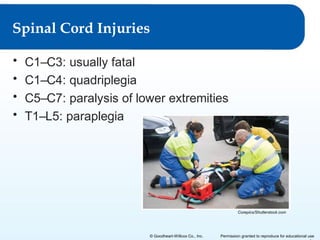
C1–C3: usually fatal
C1–C4: quadriplegia
C5–C7: paralysis of lower extremities
T1–L5: paraplegia

Corepics/Shutterstock.com

© Goodheart-Willcox Co., Inc.

Permission granted to reproduce for educational use
Common Diseases and Disorders of the
CNS
•
•
•
•
•

meningitis
multiple sclerosis
epilepsy
Parkinson’s disease
dementia and Alzheimer’s disease

© Goodheart-Willcox Co., Inc.

Permission granted to reproduce for educational use
Review and Assessment
Match these words with 1–4 below: quadriplegia,
multiple sclerosis, dementia, cerebral palsy.
1. inflammation destroys myelin sheath
2. loss of memory and thinking
3. loss of function below the neck
4. may begin before birth

© Goodheart-Willcox Co., Inc.

Permission granted to reproduce for educational use

Nervous System Overview

  • 1.
    The Nervous System Overview ofthe Nervous System Functional Anatomy of the Central Nervous System Functional Anatomy of the Peripheral Nervous System Nervous Tissue and Transmission of Nerve Impulses Injuries and Disorders of the Nervous System
  • 2.
  • 3.
    Nervous System Overview •organization of the nervous system – two major divisions – the efferent nerves • nervous tissues – neuroglia – neurons © Goodheart-Willcox Co., Inc. Permission granted to reproduce for educational use
  • 4.
    Organization of theNervous System • two major divisions – central nervous system (CNS) – peripheral nervous system (PNS) • sensory receptors • afferent (sensory) nerves • efferent (motor) nerves © Goodheart-Willcox Co., Inc. Permission granted to reproduce for educational use
  • 5.
    Two Major Divisions ©Goodheart-Willcox Co., Inc. Permission granted to reproduce for educational use
  • 6.
  • 7.
    The Brain • • • • • • cerebrum diencephalon brain stem cerebellum meninges blood-brainbarrier © Goodheart-Willcox Co., Inc. Permission granted to reproduce for educational use
  • 8.
    Cerebrum • cerebral cortex –gyrus – sulcus – fissure • lobes – – – – frontal parietal occipital temporal • primary motor cortex • primary somatic sensory cortex © Goodheart-Willcox Co., Inc. Permission granted to reproduce for educational use
  • 9.
    Cerebrum © Goodheart-Willcox Co.,Inc. Permission granted to reproduce for educational use
  • 10.
    Brain Stem andDiencephalon Diencephalon • thalamus • hypothalamus • epithalamus Brain Stem • midbrain • pons • medulla oblongata © Goodheart-Willcox Co., Inc. Permission granted to reproduce for educational use
  • 11.
    The Brain • cerebellum •blood-brain barrier • meninges – dura mater – arachnoid mater – pia mater © Goodheart-Willcox Co., Inc. Permission granted to reproduce for educational use
  • 12.
    Spinal Cord © Goodheart-WillcoxCo., Inc. Permission granted to reproduce for educational use
  • 13.
    Review and Assessment Trueor False? 1. The gyri divide the brain into 4 regions. 2. The hypothalamus regulates blood pressure. 3. The meninges has 3 layers. 4. The cerebellum coordinates balance. 5. The pons is also called the interbrain. © Goodheart-Willcox Co., Inc. Permission granted to reproduce for educational use
  • 14.
  • 15.
    Functional Anatomy ofthe Peripheral Nervous System • • • • nerve structure cranial nerves spinal nerves and nerve plexuses autonomic nervous system © Goodheart-Willcox Co., Inc. Permission granted to reproduce for educational use
  • 16.
    Nerve Structure • endoneurium –covers axons • perineurium – bundles fascicles • epineurium – wraps nerves © Goodheart-Willcox Co., Inc. Permission granted to reproduce for educational use
  • 17.
    Cranial Nerves © Goodheart-WillcoxCo., Inc. Permission granted to reproduce for educational use
  • 18.
    © Goodheart-Willcox Co.,Inc. Permission granted to reproduce for educational use
  • 19.
    Spinal Nerves andNerve Plexuses • • • • • • 31 pairs dorsal root ventral root dorsal ramus ventral ramus plexuses © Goodheart-Willcox Co., Inc. Permission granted to reproduce for educational use
  • 20.
    Autonomic Nervous System •preganglionic and postganglionic neurons • sympathetic nerves – fight-or-flight action • parasympathetic nerves – resting or digesting action © Goodheart-Willcox Co., Inc. Permission granted to reproduce for educational use
  • 21.
    Review and Assessment Matchthese words with 1–4 below: efferent, ganglion, optic, perineurium. 1. wraps fascicles 2. motor 3. a cranial nerve 4. enlarged junction © Goodheart-Willcox Co., Inc. Permission granted to reproduce for educational use
  • 22.
  • 23.
    The Efferent Nerves •somatic nervous system – voluntary • autonomic nervous system – involuntary • Two Divisions – sympathetic – parasympathetic © Goodheart-Willcox Co., Inc. Permission granted to reproduce for educational use
  • 24.
    Nervous Tissues • neuroglia – – – – alsoknown as glial cells support the neurons protect the neurons continue to divide through adulthood- potential consequence is abnormal cell division (cancer) – 5 major types of glia cells • neurons – transmit nerve impulses – consist of a cell body and at least two processes. © Goodheart-Willcox Co., Inc. Permission granted to reproduce for educational use
  • 25.
    Neuroglia • central nervoussystem – – – – astrocytes microglia ependymal oligodendrocytes © Goodheart-Willcox Co., Inc. Permission granted to reproduce for educational use
  • 26.
    Neuroglia • peripheral nervoussystem – Schwann cells – satellite cells © Goodheart-Willcox Co., Inc. Permission granted to reproduce for educational use
  • 27.
    Neurons • dendrites – sendinformation to cell body • cell bodies • axons – send information away from cell body © Goodheart-Willcox Co., Inc. Permission granted to reproduce for educational use
  • 28.
    Neuron Types byFunction • sensory neurons – send impulses toward CNS • motor neurons – send impulses away from CNS • Interneurons – bridges between neurons © Goodheart-Willcox Co., Inc. Permission granted to reproduce for educational use
  • 29.
    Neuron Structures • bipolar –one axon and one dendrite • unipolar – one axon © Goodheart-Willcox Co., Inc. • multipolar – one axon and many dendrites Permission granted to reproduce for educational use
  • 30.
    Review and Assessment Matchthese words with 1–4 below: sympathetic nervous system, myelin, synapse, axon. 1. high alert 2. transmits impulses away from cell body 3. fatty insulating material 4. gap between neurons © Goodheart-Willcox Co., Inc. Permission granted to reproduce for educational use
  • 31.
    Transmission of NerveImpulses • action potentials – change in cell membrane charge • impulse transmission – charge change travels along axon • reflexes – involuntary response to stimulus © Goodheart-Willcox Co., Inc. Permission granted to reproduce for educational use
  • 32.
    © Goodheart-Willcox Co.,Inc. Permission granted to reproduce for educational use
  • 33.
    Action Potentials • • • • polarized depolarized repolarized refractory period ©Goodheart-Willcox Co., Inc. Permission granted to reproduce for educational use
  • 34.
    Impulse Transmission • saltatoryconduction • transmission at synapses – – – – gap junctions neurotransmitter excitatory effect inhibitory effect © Goodheart-Willcox Co., Inc. Permission granted to reproduce for educational use
  • 35.
    Reflexes • somatic – stimulateskeletal muscles • autonomic – stimulate involuntary muscles © Goodheart-Willcox Co., Inc. Permission granted to reproduce for educational use
  • 36.
    Review and Assessment Fillin the blanks with: reflexes, saltatory conduction, neurotransmitter, or action potential. 1. A(n) _______________ is an all or none response. 2. _______________ occurs only in myelinated axons. 3. _______________ are rapid, involuntary responses. 4. The axon terminal has tiny vesicles filled with _______________. © Goodheart-Willcox Co., Inc. Permission granted to reproduce for educational use
  • 37.
  • 38.
    Injuries to theBrain and Spinal Cord • traumatic brain injury • cerebral palsy • spinal cord injury © Goodheart-Willcox Co., Inc. Permission granted to reproduce for educational use
  • 39.
    Traumatic Brain Injury •violent impact to head – mild – moderate – severe © Goodheart-Willcox Co., Inc. Permission granted to reproduce for educational use
  • 40.
    Cerebral Palsy • damageto brain – before birth – during birth – during infancy • motor function impairment © Goodheart-Willcox Co., Inc. Permission granted to reproduce for educational use
  • 41.
    Spinal Cord Injuries • • • • C1–C3:usually fatal C1–C4: quadriplegia C5–C7: paralysis of lower extremities T1–L5: paraplegia Corepics/Shutterstock.com © Goodheart-Willcox Co., Inc. Permission granted to reproduce for educational use
  • 42.
    Common Diseases andDisorders of the CNS • • • • • meningitis multiple sclerosis epilepsy Parkinson’s disease dementia and Alzheimer’s disease © Goodheart-Willcox Co., Inc. Permission granted to reproduce for educational use
  • 43.
    Review and Assessment Matchthese words with 1–4 below: quadriplegia, multiple sclerosis, dementia, cerebral palsy. 1. inflammation destroys myelin sheath 2. loss of memory and thinking 3. loss of function below the neck 4. may begin before birth © Goodheart-Willcox Co., Inc. Permission granted to reproduce for educational use