ANATOMY AND PHYSIOLOGY OF
NERVOUS TISSUE
Dr. MUMENA C.H
Introduction
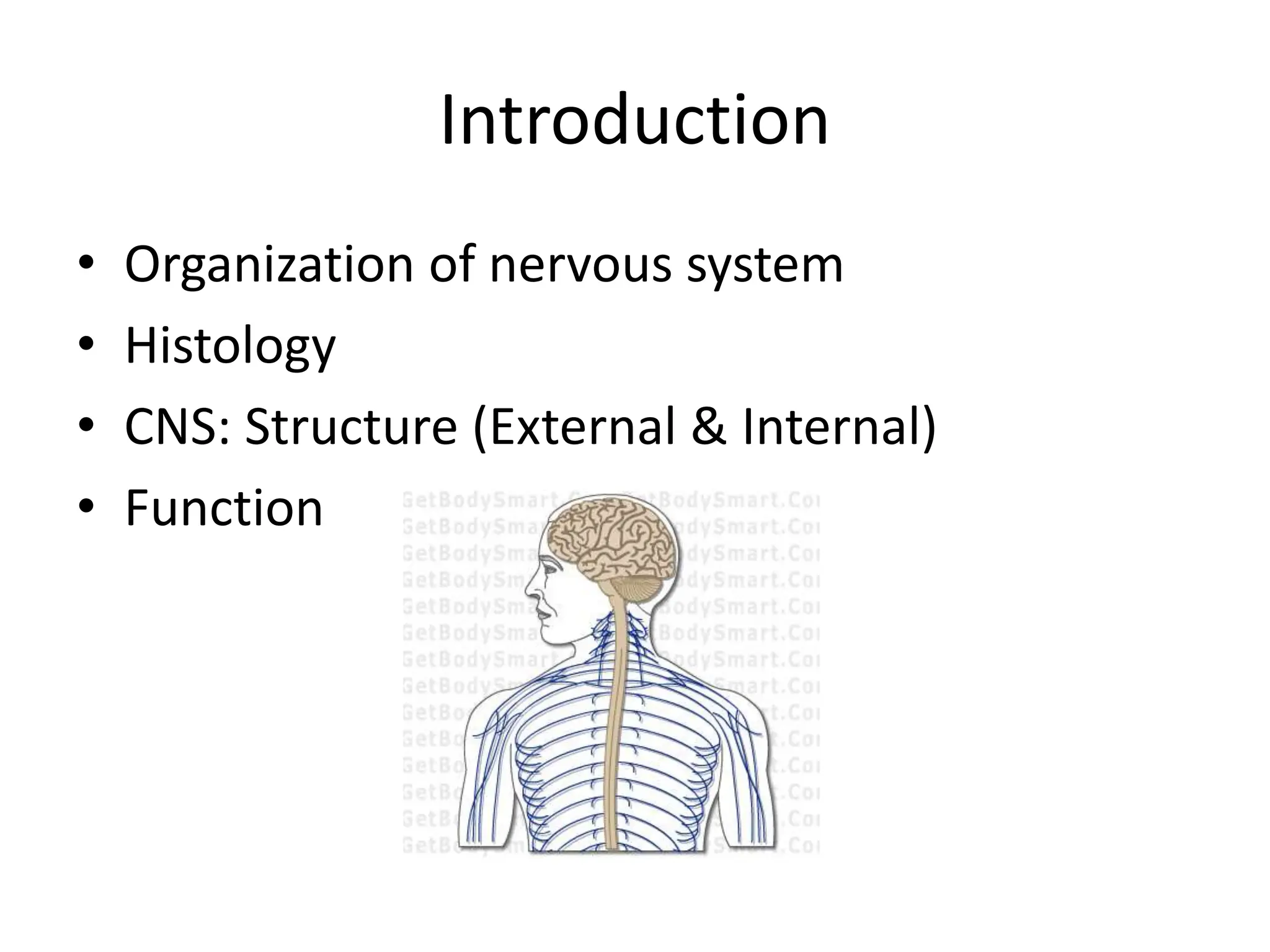
• Organization of nervous system
• Histology
• CNS: Structure (External & Internal)
• Function
Introduction
• Nervous tissue forms the rapid response body
control
• Nervous system is a complex, highly organized
network of billions of neurons
• Structures that makes nervous system
includes: Brain, cranial nerves & their
branches, spinal cord, spinal nerves & their
branches, ganglia, enteric plexuses and
sensory receptors
Nervous system functions
• It has 3 basic function;
– Sensory function
– Senses changes (stimuli) within body (internal) and outside body
(external),
– monitors internal & external environment through presence of
receptors
– Integrative function
– interpretation of sensory information (information processing);
complex (higher order) functions
– Analysis of the information, store and make decisions on appropriate action
– Motor function
– Response to stimuli by initiating action after interpretation in form of
– muscular contraction or
– glandular secretions
Division of nervous system
• Nervous system: two principal divisions:
– Central Nervous System-CNS
– Brain
– Spinal cord
– Peripheral Nervous System-PNS
– Consists of Cranial Nervous (CN 1-12) & Spinal Nervous-SN
– CN arises from the brain
– SC arises from the spinal cord
– All the neural tissue outside CNS
– Afferent division (sensory input)
– Efferent division (motor output)
– Somatic nervous system (Voluntary)
– Autonomic nervous system (Auto-self, Nomos-law): Involuntary
General Organization of the nervous system
Brain & spinal
cord
General organization of the nervous
system
• ANS: the motor portion of the ANS consist of
two branches:
– Sympathetic division: fight-or-flight response
– Parasympathetic division:rest-and-repair
• These two division have opposing action
• Sympathetic speeds the heart, parasympathetic
slows it
• The viscera receive both
Histology of neural tissue
Two types of neural cells in the nervous system:
 Neurons - For processing, transfer, and storage
of information
 Neuroglia – For support, regulation & protection
of neurons
Neuroglia (glial cells): 6 types of cells
CNS neuroglia: (Only 4 types)
• astrocytes
• oligodendrocytes
• microglia
• ependymal cells
PNS neuroglia: (only 2 types)
• Schwann cells (neurolemmocytes)
• satellite cells
Astrocytes
• create supportive
framework for neurons
• create “blood-brain
barrier”
• monitor & regulate
interstitial fluid surrounding
neurons
• secrete chemicals for
embryological neuron
formation
• stimulate the formation of
scar tissue secondary to
CNS injury
Oligodendrocytes
• create myelin sheath
around axons of neurons
in the CNS. Myelinated
axons transmit impulses
faster than unmyelinated
axons
Microglia
• “brain macrophages”
• phagocytize cellular
wastes & pathogens
Ependymal cells
• line ventricles of brain &
central canal of spinal cord
• produce, monitor & help
circulate CSF
(cerebrospinal fluid)
Schwann cells
• surround all axons of neurons in
the PNS creating a neurilemma
around them. Neurilemma allows
for potential regeneration of
damaged axons
• creates myelin sheath around
most axons of PNS
Satellite cells
• support groups of cell bodies
of neurons within ganglia of the
PNS
Neuron structure
•Most axons of the nervous system are
surrounded by a myelin sheath
(myelinated axons)
•The presence of myelin speeds up
the transmission of action potentials
along the axon
•Myelin will get laid down in segments
(internodes) along the axon, leaving
unmyelinated gaps known as “nodes
of Ranvier”
•Regions of the nervous system
containing groupings of myelinated
axons make up the “white matter”
•“gray matter” is mainly comprised of
groups of neuron cell bodies, dendrites
& synapses (connections between
neurons)
of Ranvier
Classification of neurons
Structural classification based on number of
processes coming off of the cell body:
Anaxonic neurons
• no anatomical clues to
determine axons from
dendrites
• functions unknown
Multipolar neuron
• multiple dendrites & single
axon
• most common type
Bipolar neuron
• two processes coming off cell
body – one dendrite & one
axon
• only found in eye, ear & nose
Unipolar (pseudounipolar)
neuron
• single process coming
off cell body, giving rise
to dendrites (at one end)
& axon (making up rest of
process)
Classification of neurons
Functional classification based on type of information &
direction of information transmission:
• Sensory (afferent) neurons –
• transmit sensory information from receptors of PNS towards the CNS
• most sensory neurons are unipolar, a few are bipolar
• Motor (efferent) neurons –
• transmit motor information from the CNS to effectors
(muscles/glands/adipose tissue) in the periphery of the body
• all are multipolar
• Association (interneurons) –
• transmit information between neurons within the CNS; analyze inputs,
coordinate outputs
• are the most common type of neuron (20 billion)
• are all multipolar
Sensory neurons
22
Classification of neurons; Motor or efferent
neurons
24
Classification of neurons:
Interneurons
25
Conduction across synapses
Most synapses within the nervous system are
chemical synapses, & involve the release of a
neurotransmitter
In order for neural control to occur, “information”
must not only be conducted along nerve cells, but
must also be transferred from one nerve cell to
another across a synapse
The Structure of a Typical Synapse
Examples of neurotransmitter &
neurons manufacturing them
3-Neurotransmitter production classification : Neurons
differ in the type of neurotransmitter they manufacture.
Some examples are :
•Cholinergic neurons—acetylcholine.
•ABAergic neurons—gamma amino butyric acid
•Glutamatergic neurons—glutamate
•Dopaminergic neurons—dopamine
•Serotonergic neurons—serotonin
28
Neuronal Pools
Anatomical organization of neurons
Neurons of the nervous system tend to group together into
organized bundles
The axons of neurons are bundled together to form nerves in
the PNS & tracts/pathways in the CNS. Most axons are
myelinated so these structures will be part of “white matter”
The cell bodies of neurons are clustered together into
ganglia in the PNS & nuclei/centers in the CNS. These are
unmyelinated structures and will be part of “gray matter”
Neural Tissue Organization
Anatomical structure of Nerves
Fig. 14.6
NERVE CELL FIBER
- Epineurium : A sheath of
dense connective tissue
surrounds the nerve. Blood
vessels of various sizes can
be seen in the epineurium.
- Perineurium : A sheath
penetrates the nerve to
form the perineurium
which surrounds bundles of
nerve fibers.
- Endoneurium : which
consists of a thin layer of
loose connective tissue,
surrounds the individual
nerve fibers.
33
10 minutes break
The Central Nervous
System
35
CNS
•
The central nervous system (CNS)

It is the part of the nervous system that
integrates the information that it receives and
coordinates the activity of all parts of the body.

It contains the majority of the nervous system
and consists of the brain and the spinal cord .
36
CNS
• Grey matter.
– Areas containing nerve cell bodies, their myelinated and
unmyelinated processes and supporting (glial) cells are
called
– It appears grayish rather than white because the Nissl
bodies impart a gray color and there is little or no myelin in
these areas.
• White matter
– Areas containing predominantly myelinated axons but also
some unmyelinated axons and glial cells are referred to as.
The whitish color of myelin gives white matter its name.
• Blood vessels are present in both white and gray
matter.
37
In the brain, the grey matter is exterior to the
white matter, the reverse is the case in the
spinal cord.
38
The Peripheral Nervous
System
39
PNS
• The peripheral nervous system (PNS)
– consists of the cranial and spinal nerves and
ganglia outside of the brain and spinal cord.
– The main function of the PNS is to connect the
central nervous system (CNS) to the limbs and
organs.
40
PNS
• The sensory Division : ( afferent):
– contains Somatic and visceral sensory nerve fibers
and conducts impulses from receptors to the CNS.
• The Motor Division : ( efferent) :
– contains motor nerves fibers and conducts
impulses from the CNS to effectors ( muscles and
glands ).
41
PNS
• The Somatic nervous system : SNS :
– contains somatic motor nerves .
– Its actions are largely voluntary and conducts
impulses from the CNS to skeletal muscles only.
• The Autonomic nervous system : ANS :
– contains visceral motor nerves .
– Its actions are largely involuntary and conducts
impulses from the CNS to cardiac muscles ,
smooth muscles and glandular epithelium.
42
43
44
PNS
• ANS:
– It also differs from the sensory-somatic system by
using two groups of motor neurons to stimulate
the effectors instead of one.
– The first is the preganglionic neurons that arise
in the CNS and run to a ganglion in the body.
• Here they synapse with postganglionic neurons which
run to the effector organ (cardiac muscle, smooth
muscle, or a gland).
45
PNS:ANS
• Sympathetic Division :
– mobilizes body systems during activity and the stimulation
of the sympathetic branch of the ANS prepares the body
for emergencies: for "fight or flight" (and, perhaps,
enhances the memory of the event that triggered the
response).
• Parasympathetic Division :
– conserves energy and returns the body functions to
normal after they have been altered by sympathetic
stimulation.
N.B: In times of danger, the sympathetic system prepares
the body for violent activity. The parasympathetic
system reverses these changes when the danger is
over.
46
47
The Synapses
48
Synapses
• The synapse
• is a specialized junctional complex by which axons
and dendrites emerging from different neurons
intercommunicate.
• Synapses are essential to neuronal function:
neurons are cells that are specialized to pass
signals to individual target cells, and synapses
are the means by which they do so.
49
Synapses
• At a synapse, the plasma membrane of the signal-
passing neuron (the presynaptic neuron) comes
into close apposition with the membrane of the
target (postsynaptic) cell.
• Both the presynaptic and postsynaptic sites
contain extensive arrays of molecular machinery
that link the two membranes together and carry
out the signaling process.
• In many synapses, the presynaptic part is located
on an axon, but some presynaptic sites are
located on a dendrite or soma.
Synapses are :
1.axodendritic : from axon to dendrite.
2.axosomatic : from axon to cell body.
3.axoaxonic : from axon to axon.
51
Synapses
• The two types of synapses :
–Electrical
– Chemical
• Both differs structurally and
functionally:
Chemical Synapses
• Presynaptic neuron releases a chemical
neurotransmitter that binds to receptors on
the postsynaptic cell, usually embedded in the
plasma membrane.
• The neurotransmitter may initiate an
electrical response or a secondary messenger
pathway that may either excite or inhibit the
postsynaptic neuron.
53
Chemical Synapses
• The connection at chemical synapse contains a
small synaptic cleft between the connect
neurons.
• The AP may not be conveyed across the cleft
as there is no membrane in the cleft.
55
56
Chemical Synapses
• AP at the pre-synaptic neuron.
– Opening of voltage-gated calcium channels
– increase in [ca2+]
– migration and fusion of vesicles containing the
neurotransmitter
– neurotransmitter release
– diffusion of the neurotransmitter in the synaptic cleft
– binding of neurotransmitter to receptors on the post-
synaptic cell
– change in the permeability ( membrane potential ) of
the post-synaptic cell.
57
Electric synapses
• AP conduct directly between adjacent cells
through structures called Gap junctions.
• Each gap junction contains a hundred or so
tubular connexons.
• As ions flow from one cell to the next one
through connexons the AP spreads from cell
to cell.
• We find electrical synapses in the CNS.
58
59
SPINAL CORD
A. External Structure of the spinal cord
• Spinal cord is roughly cylindrical but flattened
slightly in its anterior-posterior dimension
• In adults extends from medulla oblongata (the
most inferior part of the brain) to the superior
border of L2 vertebra
• In new born it extends to the L3 or L4 vertebra
• In adult the length ranges from 42 to 45 cm,
diameter is about 2 cm in mid thoracic, larger in
lower cervical & lumbar regions, smallest at
inferior tips
Structure of the spinal cord
• Viewed externally two conspicuous enlargement
can be seen:
– Superior enlargement: Cervical enlargement; C4 to T1
– Inferior enlargement: lumbar enlargement: T9 to T12
• Spinal cord has two grooves that divide the cord:
– Anterior median fissure: it is deep, wide groove
located on the ventral surface
– Posterior median sulcus: Shallower, narrow groove on
the dorsal surface
Structure of the spinal cord
• Conus medullaris:
– inferior to the lumbar enlargement, spinal cord
tapers to conical portion conus medullaris,
• Filum terminale:
– arises from the conus medullaris, it an extension
of pia matter that extends inferiorly and achors
the spinal cord to the coccyx
Structure of the spinal cord
• Spinal cord
– has bony covering: Vertebrae, and tough meninges
– Has cushioning CSF
– Spinal cord is located in the Vertebra column (Canal),
• Meninges: are connective tissue coverings of the
spinal cord and brain.
– The part of meninges covering spinal cord: Spinal
meninges
– The part of meninges covering the brain: cranial
meninges
Structure of the spinal cord
• Meninges are of three types:
• Most superficial: Dura mater, (Dura-tough, Mater-
mother)
– Composed of dense, irregular connective tissue.
– It forms a sac from the level of foramen magnum of
the occipital bone,
– It continuous with the dura mater of the brain
– It is closed at level of sacral vertebra
– Between dura mater and vertebral column there is
epidural space: contains fats & connective tissues
Structure of the spinal cord
• Second meninge is
• Arachnoid (means spider)
– Avascular
– Spider web arrangement of collagen & elastic
fibers
– It lies inside dura mater and continuous with
arachnoid of the brain
– There is a space between dura and arachnoid:
subdural space-contains interstitial fluid
Structure of the spinal cord
• Third-innermost meninx;
• Pia mater: pia means delicate
– Thin transparent connective tissue layer that
adheres to the surface of the spinal cord and brain
– Contains many blood vessels that supply nutrients
to the spinal cord
– Space between arachnoid and pia mater:
Subarachnoid space: CSF
– NB: Meningitis is inflammation of the meninges
B: Internal Structure of the spinal cord
• N.B: in a freshly dissected brain & spinal cord
note that some regions appear white and
glistering whereas others appear gray
• White matter is aggregations of myelinated
and unmyelinated axons of many neurons-
called white because of myelin
• Gray mater: contains neurons cell bodies,
dendrites, unmyelinated axons, axons
terminals and neuroglia
Structure of the spinal cord
• There are two grooves that penetrates white matter of the
spinal cord and divide into right and left sides.
• AMF: deep, wide groove on anterior aspect (Ventral)
• PMS: Shallower, narrow furrow on the posterior (Dorsal)
• Gray matter of spinal cord is shaped like the letter H,
• Grey commissure forms the cross bar of the H
• In the centre of the gray commissure is the central canal
• Superiorly the central canal is continuous with the 4th
ventricle (contains CSF) in the medulla oblongata
• Anterior to gray commissure is the anterior white
commissure-connects white matter of the right and left
sides
Structure of the spinal cord
• In the grey matter of the spinal cord and
brains: clusters of neuronal cell bodies form
functional groups-Nuclei
• Sensory nuclei: receives inputs from receptors
via sensory neurons
• Motor nuclei: provide output to effector
tissues via motor neurons
Structure of the spinal cord
• Gray matter:
– Is divided into horns
– Anterior gray horn (ventral): contains cell bodies of
somatic motor neurons and motor nuclei
– Posterior gray horn (Dorsal): contains somatic &
autonomic sensory nuclei
– Lateral gray horn: between the anterior and posterior
gray horns; present only in the thoracic, upper lumbar
and sacral segments of SC,
– Lateral horns: contain cell bodies of autonomic motor
neurons that regulate activities of smooth, cardiac
muscles and glands
Structure of the spinal cord
• White matter:
– Like gray matters is also organized into regions
– AGH & PGH divide the white matter on each side
into three broad areas: Columns
– Anterior (ventral) white columns
– Posterior white columns
– Lateral white columns
– Each columns contains distinct bundles of axons
having a common origin or destination and
carrying similar information
Structure of the spinal cord
• White matter cont…
– These bundles are Tracts
– Sensory tracts: ascending tracts: consists of axons
that conduct nerve impulses toward the brain
– Motor tracts: descending tracts: Consists of axons
that carry nerve impulses down the spinal cord
Physiology of spinal cord
• Focus on two major areas:
– Sensory and motor pathways: tracts
– Reflex arc
Physiology of spinal cord
• Physiology of SC:
– SC has two principal functions in maintaining
homeostasis
• Nerve impulses propagation
• Information integration
Physiology of spinal cord
• Sensory and motor tracts:
– Names of tracts indicates where it begins and it ends
– Anterior spinothalamic tract: located in anterior white
column, begins in spinal cord and ends in thalamus
– From sensory receptors there are two tracts for
impulses: Spinothalamic tracts and posterior columns
– Anterior and lateral spinothalamic tracts: pain,
warmth, coolness, itching, tickling, deep pressure &
crude poorly localized sense of touch
Physiology of spinal cord
• Sensory and motor tracts cont…
– Posterior columns (R&L):
• Proprioception-positions and movement of muscles,
tendons & joints.
• Discriminative touch-feel what part of the body is
touched
• Two point discrimination-distinguishing the touching of
two different points in the skin
• Light pressure sensations
• Vibrations
•
Physiology of spinal cord
• Descending pathways:
– Cerebral cortex plays major role in controlling
voluntary muscular movements
– Motor output to skeletal muscles travel down the
spinal cord in two types of descending pathways:
direct and indirect
– Direct: lateral corticopinal, anterior corticospinal,
and corticobulbar tracts
– Indirect: rubrospinal, tectospinal and
vestobulospinal
Physiology of spinal cord
• Reflexes and reflex arcs;
– Spinal cord serves as integration centre for some
reflexes
– A reflex is a fast, involuntary, unplanned sequence of
actions that occurs in response to a particular
stimulus.
– If integration takes place in spinal cord (gray matter):
spinal reflex
– If integration takes place in the brain: Cranial reflex-
using eyes to follow something
– The path followed by nerve impulses that produce
reflex is a reflex arc (reflex circuit)
Physiology of spinal cord
• Reflexes and reflex arcs cont…
– Examples of reflexes: stretch reflex causes muscles to
contracts as a response to stretching of muscles
– Sensory receptor in the muscle: muscle spindle is
stimulated by stretch
– Response to stretch muscle spindle generates
impulses that propagates through the posterior root
of spinal nerve into spinal cord
– In spinal cord integration
– Impulses arise in motor neuron & propagates along
anterior spinal root to stimulated muscles
SPINAL NERVES
• Components & branches of spinal nerves
• Plexus & distribution of nerves of the cervical,
brachial, lumbar & sacral plexuses
• Clinical significance of demartomes

Nervous system anatomy and physiolog.ppt

  • 1.
    ANATOMY AND PHYSIOLOGYOF NERVOUS TISSUE Dr. MUMENA C.H
  • 2.
    Introduction • Organization ofnervous system • Histology • CNS: Structure (External & Internal) • Function
  • 3.
    Introduction • Nervous tissueforms the rapid response body control • Nervous system is a complex, highly organized network of billions of neurons • Structures that makes nervous system includes: Brain, cranial nerves & their branches, spinal cord, spinal nerves & their branches, ganglia, enteric plexuses and sensory receptors
  • 4.
    Nervous system functions •It has 3 basic function; – Sensory function – Senses changes (stimuli) within body (internal) and outside body (external), – monitors internal & external environment through presence of receptors – Integrative function – interpretation of sensory information (information processing); complex (higher order) functions – Analysis of the information, store and make decisions on appropriate action – Motor function – Response to stimuli by initiating action after interpretation in form of – muscular contraction or – glandular secretions
  • 5.
    Division of nervoussystem • Nervous system: two principal divisions: – Central Nervous System-CNS – Brain – Spinal cord – Peripheral Nervous System-PNS – Consists of Cranial Nervous (CN 1-12) & Spinal Nervous-SN – CN arises from the brain – SC arises from the spinal cord – All the neural tissue outside CNS – Afferent division (sensory input) – Efferent division (motor output) – Somatic nervous system (Voluntary) – Autonomic nervous system (Auto-self, Nomos-law): Involuntary
  • 6.
    General Organization ofthe nervous system Brain & spinal cord
  • 7.
    General organization ofthe nervous system • ANS: the motor portion of the ANS consist of two branches: – Sympathetic division: fight-or-flight response – Parasympathetic division:rest-and-repair • These two division have opposing action • Sympathetic speeds the heart, parasympathetic slows it • The viscera receive both
  • 8.
    Histology of neuraltissue Two types of neural cells in the nervous system:  Neurons - For processing, transfer, and storage of information  Neuroglia – For support, regulation & protection of neurons
  • 9.
    Neuroglia (glial cells):6 types of cells CNS neuroglia: (Only 4 types) • astrocytes • oligodendrocytes • microglia • ependymal cells PNS neuroglia: (only 2 types) • Schwann cells (neurolemmocytes) • satellite cells
  • 10.
    Astrocytes • create supportive frameworkfor neurons • create “blood-brain barrier” • monitor & regulate interstitial fluid surrounding neurons • secrete chemicals for embryological neuron formation • stimulate the formation of scar tissue secondary to CNS injury
  • 11.
    Oligodendrocytes • create myelinsheath around axons of neurons in the CNS. Myelinated axons transmit impulses faster than unmyelinated axons Microglia • “brain macrophages” • phagocytize cellular wastes & pathogens
  • 12.
    Ependymal cells • lineventricles of brain & central canal of spinal cord • produce, monitor & help circulate CSF (cerebrospinal fluid)
  • 13.
    Schwann cells • surroundall axons of neurons in the PNS creating a neurilemma around them. Neurilemma allows for potential regeneration of damaged axons • creates myelin sheath around most axons of PNS Satellite cells • support groups of cell bodies of neurons within ganglia of the PNS
  • 14.
  • 15.
    •Most axons ofthe nervous system are surrounded by a myelin sheath (myelinated axons) •The presence of myelin speeds up the transmission of action potentials along the axon •Myelin will get laid down in segments (internodes) along the axon, leaving unmyelinated gaps known as “nodes of Ranvier” •Regions of the nervous system containing groupings of myelinated axons make up the “white matter” •“gray matter” is mainly comprised of groups of neuron cell bodies, dendrites & synapses (connections between neurons) of Ranvier
  • 16.
    Classification of neurons Structuralclassification based on number of processes coming off of the cell body:
  • 17.
    Anaxonic neurons • noanatomical clues to determine axons from dendrites • functions unknown
  • 18.
    Multipolar neuron • multipledendrites & single axon • most common type
  • 19.
    Bipolar neuron • twoprocesses coming off cell body – one dendrite & one axon • only found in eye, ear & nose
  • 20.
    Unipolar (pseudounipolar) neuron • singleprocess coming off cell body, giving rise to dendrites (at one end) & axon (making up rest of process)
  • 21.
    Classification of neurons Functionalclassification based on type of information & direction of information transmission: • Sensory (afferent) neurons – • transmit sensory information from receptors of PNS towards the CNS • most sensory neurons are unipolar, a few are bipolar • Motor (efferent) neurons – • transmit motor information from the CNS to effectors (muscles/glands/adipose tissue) in the periphery of the body • all are multipolar • Association (interneurons) – • transmit information between neurons within the CNS; analyze inputs, coordinate outputs • are the most common type of neuron (20 billion) • are all multipolar
  • 22.
  • 24.
    Classification of neurons;Motor or efferent neurons 24
  • 25.
  • 26.
    Conduction across synapses Mostsynapses within the nervous system are chemical synapses, & involve the release of a neurotransmitter In order for neural control to occur, “information” must not only be conducted along nerve cells, but must also be transferred from one nerve cell to another across a synapse
  • 27.
    The Structure ofa Typical Synapse
  • 28.
    Examples of neurotransmitter& neurons manufacturing them 3-Neurotransmitter production classification : Neurons differ in the type of neurotransmitter they manufacture. Some examples are : •Cholinergic neurons—acetylcholine. •ABAergic neurons—gamma amino butyric acid •Glutamatergic neurons—glutamate •Dopaminergic neurons—dopamine •Serotonergic neurons—serotonin 28
  • 29.
  • 30.
    Anatomical organization ofneurons Neurons of the nervous system tend to group together into organized bundles The axons of neurons are bundled together to form nerves in the PNS & tracts/pathways in the CNS. Most axons are myelinated so these structures will be part of “white matter” The cell bodies of neurons are clustered together into ganglia in the PNS & nuclei/centers in the CNS. These are unmyelinated structures and will be part of “gray matter”
  • 31.
  • 32.
    Anatomical structure ofNerves Fig. 14.6
  • 33.
    NERVE CELL FIBER -Epineurium : A sheath of dense connective tissue surrounds the nerve. Blood vessels of various sizes can be seen in the epineurium. - Perineurium : A sheath penetrates the nerve to form the perineurium which surrounds bundles of nerve fibers. - Endoneurium : which consists of a thin layer of loose connective tissue, surrounds the individual nerve fibers. 33
  • 34.
  • 35.
  • 36.
    CNS • The central nervoussystem (CNS)  It is the part of the nervous system that integrates the information that it receives and coordinates the activity of all parts of the body.  It contains the majority of the nervous system and consists of the brain and the spinal cord . 36
  • 37.
    CNS • Grey matter. –Areas containing nerve cell bodies, their myelinated and unmyelinated processes and supporting (glial) cells are called – It appears grayish rather than white because the Nissl bodies impart a gray color and there is little or no myelin in these areas. • White matter – Areas containing predominantly myelinated axons but also some unmyelinated axons and glial cells are referred to as. The whitish color of myelin gives white matter its name. • Blood vessels are present in both white and gray matter. 37
  • 38.
    In the brain,the grey matter is exterior to the white matter, the reverse is the case in the spinal cord. 38
  • 39.
  • 40.
    PNS • The peripheralnervous system (PNS) – consists of the cranial and spinal nerves and ganglia outside of the brain and spinal cord. – The main function of the PNS is to connect the central nervous system (CNS) to the limbs and organs. 40
  • 41.
    PNS • The sensoryDivision : ( afferent): – contains Somatic and visceral sensory nerve fibers and conducts impulses from receptors to the CNS. • The Motor Division : ( efferent) : – contains motor nerves fibers and conducts impulses from the CNS to effectors ( muscles and glands ). 41
  • 42.
    PNS • The Somaticnervous system : SNS : – contains somatic motor nerves . – Its actions are largely voluntary and conducts impulses from the CNS to skeletal muscles only. • The Autonomic nervous system : ANS : – contains visceral motor nerves . – Its actions are largely involuntary and conducts impulses from the CNS to cardiac muscles , smooth muscles and glandular epithelium. 42
  • 43.
  • 44.
  • 45.
    PNS • ANS: – Italso differs from the sensory-somatic system by using two groups of motor neurons to stimulate the effectors instead of one. – The first is the preganglionic neurons that arise in the CNS and run to a ganglion in the body. • Here they synapse with postganglionic neurons which run to the effector organ (cardiac muscle, smooth muscle, or a gland). 45
  • 46.
    PNS:ANS • Sympathetic Division: – mobilizes body systems during activity and the stimulation of the sympathetic branch of the ANS prepares the body for emergencies: for "fight or flight" (and, perhaps, enhances the memory of the event that triggered the response). • Parasympathetic Division : – conserves energy and returns the body functions to normal after they have been altered by sympathetic stimulation. N.B: In times of danger, the sympathetic system prepares the body for violent activity. The parasympathetic system reverses these changes when the danger is over. 46
  • 47.
  • 48.
  • 49.
    Synapses • The synapse •is a specialized junctional complex by which axons and dendrites emerging from different neurons intercommunicate. • Synapses are essential to neuronal function: neurons are cells that are specialized to pass signals to individual target cells, and synapses are the means by which they do so. 49
  • 50.
    Synapses • At asynapse, the plasma membrane of the signal- passing neuron (the presynaptic neuron) comes into close apposition with the membrane of the target (postsynaptic) cell. • Both the presynaptic and postsynaptic sites contain extensive arrays of molecular machinery that link the two membranes together and carry out the signaling process. • In many synapses, the presynaptic part is located on an axon, but some presynaptic sites are located on a dendrite or soma.
  • 51.
    Synapses are : 1.axodendritic: from axon to dendrite. 2.axosomatic : from axon to cell body. 3.axoaxonic : from axon to axon. 51
  • 52.
    Synapses • The twotypes of synapses : –Electrical – Chemical • Both differs structurally and functionally:
  • 53.
    Chemical Synapses • Presynapticneuron releases a chemical neurotransmitter that binds to receptors on the postsynaptic cell, usually embedded in the plasma membrane. • The neurotransmitter may initiate an electrical response or a secondary messenger pathway that may either excite or inhibit the postsynaptic neuron. 53
  • 54.
    Chemical Synapses • Theconnection at chemical synapse contains a small synaptic cleft between the connect neurons. • The AP may not be conveyed across the cleft as there is no membrane in the cleft.
  • 55.
  • 56.
  • 57.
    Chemical Synapses • APat the pre-synaptic neuron. – Opening of voltage-gated calcium channels – increase in [ca2+] – migration and fusion of vesicles containing the neurotransmitter – neurotransmitter release – diffusion of the neurotransmitter in the synaptic cleft – binding of neurotransmitter to receptors on the post- synaptic cell – change in the permeability ( membrane potential ) of the post-synaptic cell. 57
  • 58.
    Electric synapses • APconduct directly between adjacent cells through structures called Gap junctions. • Each gap junction contains a hundred or so tubular connexons. • As ions flow from one cell to the next one through connexons the AP spreads from cell to cell. • We find electrical synapses in the CNS. 58
  • 59.
  • 60.
  • 62.
    A. External Structureof the spinal cord • Spinal cord is roughly cylindrical but flattened slightly in its anterior-posterior dimension • In adults extends from medulla oblongata (the most inferior part of the brain) to the superior border of L2 vertebra • In new born it extends to the L3 or L4 vertebra • In adult the length ranges from 42 to 45 cm, diameter is about 2 cm in mid thoracic, larger in lower cervical & lumbar regions, smallest at inferior tips
  • 65.
    Structure of thespinal cord • Viewed externally two conspicuous enlargement can be seen: – Superior enlargement: Cervical enlargement; C4 to T1 – Inferior enlargement: lumbar enlargement: T9 to T12 • Spinal cord has two grooves that divide the cord: – Anterior median fissure: it is deep, wide groove located on the ventral surface – Posterior median sulcus: Shallower, narrow groove on the dorsal surface
  • 66.
    Structure of thespinal cord • Conus medullaris: – inferior to the lumbar enlargement, spinal cord tapers to conical portion conus medullaris, • Filum terminale: – arises from the conus medullaris, it an extension of pia matter that extends inferiorly and achors the spinal cord to the coccyx
  • 67.
    Structure of thespinal cord • Spinal cord – has bony covering: Vertebrae, and tough meninges – Has cushioning CSF – Spinal cord is located in the Vertebra column (Canal), • Meninges: are connective tissue coverings of the spinal cord and brain. – The part of meninges covering spinal cord: Spinal meninges – The part of meninges covering the brain: cranial meninges
  • 68.
    Structure of thespinal cord • Meninges are of three types: • Most superficial: Dura mater, (Dura-tough, Mater- mother) – Composed of dense, irregular connective tissue. – It forms a sac from the level of foramen magnum of the occipital bone, – It continuous with the dura mater of the brain – It is closed at level of sacral vertebra – Between dura mater and vertebral column there is epidural space: contains fats & connective tissues
  • 69.
    Structure of thespinal cord • Second meninge is • Arachnoid (means spider) – Avascular – Spider web arrangement of collagen & elastic fibers – It lies inside dura mater and continuous with arachnoid of the brain – There is a space between dura and arachnoid: subdural space-contains interstitial fluid
  • 70.
    Structure of thespinal cord • Third-innermost meninx; • Pia mater: pia means delicate – Thin transparent connective tissue layer that adheres to the surface of the spinal cord and brain – Contains many blood vessels that supply nutrients to the spinal cord – Space between arachnoid and pia mater: Subarachnoid space: CSF – NB: Meningitis is inflammation of the meninges
  • 71.
    B: Internal Structureof the spinal cord • N.B: in a freshly dissected brain & spinal cord note that some regions appear white and glistering whereas others appear gray • White matter is aggregations of myelinated and unmyelinated axons of many neurons- called white because of myelin • Gray mater: contains neurons cell bodies, dendrites, unmyelinated axons, axons terminals and neuroglia
  • 73.
    Structure of thespinal cord • There are two grooves that penetrates white matter of the spinal cord and divide into right and left sides. • AMF: deep, wide groove on anterior aspect (Ventral) • PMS: Shallower, narrow furrow on the posterior (Dorsal) • Gray matter of spinal cord is shaped like the letter H, • Grey commissure forms the cross bar of the H • In the centre of the gray commissure is the central canal • Superiorly the central canal is continuous with the 4th ventricle (contains CSF) in the medulla oblongata • Anterior to gray commissure is the anterior white commissure-connects white matter of the right and left sides
  • 74.
    Structure of thespinal cord • In the grey matter of the spinal cord and brains: clusters of neuronal cell bodies form functional groups-Nuclei • Sensory nuclei: receives inputs from receptors via sensory neurons • Motor nuclei: provide output to effector tissues via motor neurons
  • 75.
    Structure of thespinal cord
  • 76.
    Structure of thespinal cord • Gray matter: – Is divided into horns – Anterior gray horn (ventral): contains cell bodies of somatic motor neurons and motor nuclei – Posterior gray horn (Dorsal): contains somatic & autonomic sensory nuclei – Lateral gray horn: between the anterior and posterior gray horns; present only in the thoracic, upper lumbar and sacral segments of SC, – Lateral horns: contain cell bodies of autonomic motor neurons that regulate activities of smooth, cardiac muscles and glands
  • 77.
    Structure of thespinal cord • White matter: – Like gray matters is also organized into regions – AGH & PGH divide the white matter on each side into three broad areas: Columns – Anterior (ventral) white columns – Posterior white columns – Lateral white columns – Each columns contains distinct bundles of axons having a common origin or destination and carrying similar information
  • 78.
    Structure of thespinal cord • White matter cont… – These bundles are Tracts – Sensory tracts: ascending tracts: consists of axons that conduct nerve impulses toward the brain – Motor tracts: descending tracts: Consists of axons that carry nerve impulses down the spinal cord
  • 81.
    Physiology of spinalcord • Focus on two major areas: – Sensory and motor pathways: tracts – Reflex arc
  • 82.
    Physiology of spinalcord • Physiology of SC: – SC has two principal functions in maintaining homeostasis • Nerve impulses propagation • Information integration
  • 83.
    Physiology of spinalcord • Sensory and motor tracts: – Names of tracts indicates where it begins and it ends – Anterior spinothalamic tract: located in anterior white column, begins in spinal cord and ends in thalamus – From sensory receptors there are two tracts for impulses: Spinothalamic tracts and posterior columns – Anterior and lateral spinothalamic tracts: pain, warmth, coolness, itching, tickling, deep pressure & crude poorly localized sense of touch
  • 84.
    Physiology of spinalcord • Sensory and motor tracts cont… – Posterior columns (R&L): • Proprioception-positions and movement of muscles, tendons & joints. • Discriminative touch-feel what part of the body is touched • Two point discrimination-distinguishing the touching of two different points in the skin • Light pressure sensations • Vibrations •
  • 85.
    Physiology of spinalcord • Descending pathways: – Cerebral cortex plays major role in controlling voluntary muscular movements – Motor output to skeletal muscles travel down the spinal cord in two types of descending pathways: direct and indirect – Direct: lateral corticopinal, anterior corticospinal, and corticobulbar tracts – Indirect: rubrospinal, tectospinal and vestobulospinal
  • 86.
    Physiology of spinalcord • Reflexes and reflex arcs; – Spinal cord serves as integration centre for some reflexes – A reflex is a fast, involuntary, unplanned sequence of actions that occurs in response to a particular stimulus. – If integration takes place in spinal cord (gray matter): spinal reflex – If integration takes place in the brain: Cranial reflex- using eyes to follow something – The path followed by nerve impulses that produce reflex is a reflex arc (reflex circuit)
  • 87.
    Physiology of spinalcord • Reflexes and reflex arcs cont… – Examples of reflexes: stretch reflex causes muscles to contracts as a response to stretching of muscles – Sensory receptor in the muscle: muscle spindle is stimulated by stretch – Response to stretch muscle spindle generates impulses that propagates through the posterior root of spinal nerve into spinal cord – In spinal cord integration – Impulses arise in motor neuron & propagates along anterior spinal root to stimulated muscles
  • 88.
    SPINAL NERVES • Components& branches of spinal nerves • Plexus & distribution of nerves of the cervical, brachial, lumbar & sacral plexuses • Clinical significance of demartomes