PHYSICAL THERAPIST AS EDUCATOR
1
SYED ZAIN UL ABIDIN
DPT, MSPT(IPMR,KMU)
LECTURER-NWIHS
Objectives of this presentation
• Definition of education
• History regarding physical therapy education
• Contemporary role of physical therapist as a
educationist
• Instruction of patient
• Teaching role beyond patient care
• Teaching opportunities
• Role of CCCE
• Responsibilities of the Academic Coordinator of clinical
education (ACCE) or director of clinical education (DCE)
2
DEFINITION OF EDUCATION
• Education is the process of imparting information
or skills and instructing by precept, example, and
experience so that individuals acquire knowledge,
master skills, or develop competence.
• In addition to instructing patients/clients as an
element of intervention, physical therapists may
engage in education activities.
• What are these educational activities?
3
HISTORY OF PHYSICAL THERAPY
EDUCATION
• In 1917 the U.S. Army began to plan for the
physical rehabilitation of injured soldiers
returning home from World War I.
• In 1918 Mary McMillan develop one of seven
emergency training for reconstruction aides.
• In 1919 McMillan became head of the
reconstruction aide training program at Walter
Reed General Hospital.
4
Conti…..
• In 1920 McMillan and Dr. Frank Granger,
developed graduate programs for PTs through
the Harvard Graduate Medical School.
• In 1921 she wrote Massage and Therapeutic
Exercise, the first textbook on physical
therapy.
5
Conti…
• In 1929 the American Physiotherapy
Association (APA) suggested a curriculum to
be used as a minimum standard for schools of
physiotherapy.
• From 1957 to 1976, the American Physical
Therapy Association (APTA) collaborated with
the AMA (American Medical Association) to
approve physical therapy education programs.
6
Conti…
• In 1977 the APTA’S Commission on
Accreditation in Physical Therapy Education
(CAPTE) became the recognized accrediting
body for physical therapy educational
programs.
• By January, 2003, the list of CAPTE-accredited
programs included 204 PT and 459 physical
therapist assistant (PTA) programs.
7
CONTEMPORARY EDUCATIONAL
ROLES OF THE PHYSICAL THERAPIST:
• PTs serve as educators at a variety of levels, from
patient instruction to teaching as professors.
• Teaching opportunities, therefore, can take a
number of forms:
 Informal, short classes
 In-service courses
 Continuing education courses
 Clinical instruction
 Academic programs
8
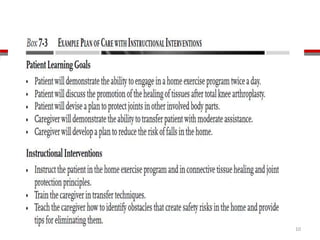
Instruction of Patients
• Patient instruction is a primary component of
every physical therapy intervention. It is the
process of informing, teaching, or training
patients in techniques that promote and
optimize physical therapy services.
9
10
Teaching Roles Beyond Patient Care
• Many PTs are assigned or volunteer to make
presentations as part of their job responsibilities
Examples of such presentations include:
• In-service classes……..update with new
information and skills
• Job training program
• Educational program for patients
• Public service presentation
11
Teaching Opportunities in Clinical
Education
• In physical therapy education, the two kinds of
clinical faculty members are there:
1. Clinical instructor (CI)
2. Center coordinator of clinical education (CCCE)
12
Conti……
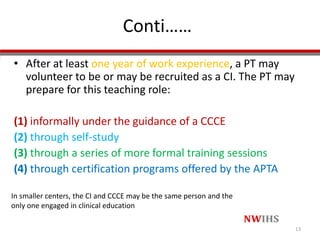
• After at least one year of work experience, a PT may
volunteer to be or may be recruited as a CI. The PT may
prepare for this teaching role:
(1) informally under the guidance of a CCCE
(2) through self-study
(3) through a series of more formal training sessions
(4) through certification programs offered by the APTA
13
In smaller centers, the CI and CCCE may be the same person and the
only one engaged in clinical education
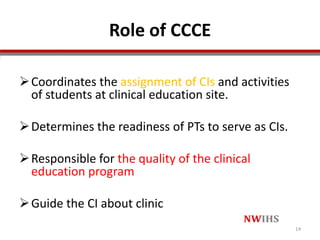
Role of CCCE
Coordinates the assignment of CIs and activities
of students at clinical education site.
Determines the readiness of PTs to serve as CIs.
Responsible for the quality of the clinical
education program
Guide the CI about clinic
14
Effective communication
Instructional skills
Supervisory skills
15
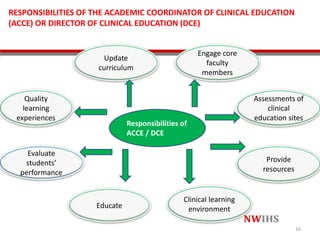
Educate
Quality
learning
experiences
Update
curriculum
Evaluate
students’
performance
Responsibilities of
ACCE / DCE
Clinical learning
environment
Provide
resources
Assessments of
clinical
education sites
Engage core
faculty
members
16
RESPONSIBILITIES OF THE ACADEMIC COORDINATOR OF CLINICAL EDUCATION
(ACCE) OR DIRECTOR OF CLINICAL EDUCATION (DCE)
Clinical performance instrument:
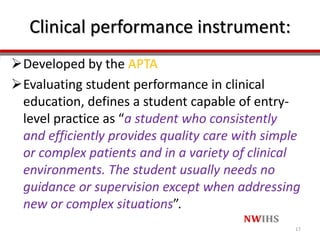
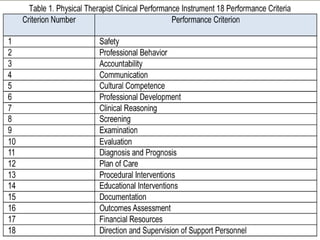
Developed by the APTA
Evaluating student performance in clinical
education, defines a student capable of entry-
level practice as “a student who consistently
and efficiently provides quality care with simple
or complex patients and in a variety of clinical
environments. The student usually needs no
guidance or supervision except when addressing
new or complex situations”.
17
Teaching Opportunities in Continuing
Education
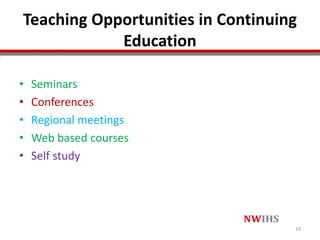
• Seminars
• Conferences
• Regional meetings
• Web based courses
• Self study
19
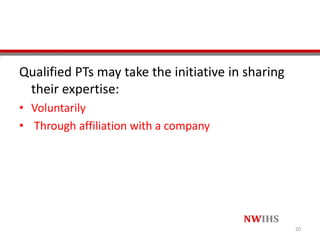
Qualified PTs may take the initiative in sharing
their expertise:
• Voluntarily
• Through affiliation with a company
20
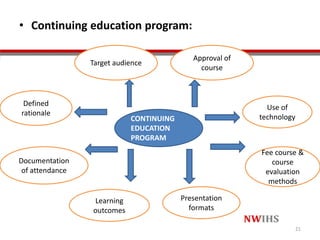
• Continuing education program:
Use of
technology
Presentation
formats
Learning
outcomes
Defined
rationale
Target audience
Approval of
course
Documentation
of attendance
Fee course &
course
evaluation
methods
CONTINUING
EDUCATION
PROGRAM
21
ACADEMIC TEACHING
OPPORTUNITIES
22
Academic teaching opportunities
• PTs may maintain their clinical practice and serve as
guest lecturers in physical therapy and PTA programs.
• Some type of honorarium may be offered, but more
often these are unpaid teaching opportunities
rewarded with letters of appreciation.
23
• Formal teaching opportunity for PTs is a position as
a:
 Full-time faculty member
 Part-time faculty member
• Faculty positions are based on the academic triad of
teaching, research, and service.
24
The distribution of the faculty’s efforts among these
three elements, as well as the performance
expectations for faculty members, vary according to
the type of institution (e.g., private or public,
research or liberal arts) and the availability of tenure.
25
For example:
• In community colleges:
Emphasis is on teaching, with very little
expectation of faculty research
• In large universities:
Expectations for research (production and
dissemination of new knowledge) and for obtaining
external funding to support the research tend to
overshadow efforts in the other areas.
26
• In smaller colleges:
Focus may be more on teaching
responsibilities and publication of new
information.
27
CAPTE(commission on accreditation in physical
therapy education) has clarified the scholarship
expectations for each faculty member in a physical
therapy program, which are based on Boyer’s
categories of scholarship—discovery, integration,
application, and teaching.
28
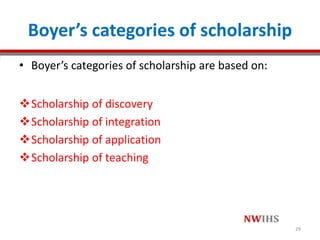
Boyer’s categories of scholarship
• Boyer’s categories of scholarship are based on:
Scholarship of discovery
Scholarship of integration
Scholarship of application
Scholarship of teaching
29
Scholarship of discovery focuses on the
development or creation of new knowledge.
Scholarship of integration involves critical
analysis and review of knowledge within
disciplines
30
Scholarship of application is the use of
knowledge to solve real problems in the
professions, industry, government, and the
community
Scholarship of teaching involves critical
reflection on and dissemination of knowledge
about teaching and learning.
31
Service Responsibilities
• CAPTE differentiates service responsibilities
as:
 Internal Service (e.g., serving on departmental
and college committees)
 External Service (e.g., holding elected office in
professional organizations or serving on
boards of community organizations).
32
ETHICAL AND LEGAL ISSUES IN PHYSICAL
THERAPY EDUCATION
33
Ethical and legal issues
• Teachers are also responsible for understanding
ethical and legal issues.
• Discrimination, privacy, dismissal policies, and
academic freedom are among the issues.
34
APTA Code of Ethics and Guide for Professional Conduct
Principle 6 of the APTA Code of Ethics obligates physical therapists to
“maintain and promote high standards for physical therapy practice,
education, and research.”
The association’s Guide for Profession Conduct (GPC) elaborates on
this principle:
-Linking it to continual self-assessment to determine compliance with
professional standards (GPC 6.1)
-Professional competence and quality improvement (GPC 6.2)
-Support for high-quality professional education (GPC 6.3)
-Continuing education (GPC 6.4).
-Support for research (GPC 6.5).
-The ethical obligations of PTs involved in teaching or continuing
education are specifically addressed.
35
Continuing education
Those attending continuing education courses are
obligated to evaluate the quality of the information
before putting it to use: “A physical therapist shall
evaluate the efficacy and effectiveness of
information and techniques presented in continuing
education programs before integrating them into
his/her practice” (GPC 6.4)
36
Continuing Competence
By granting a license, the licensing board signifies
that it has determined the PT is competent to
practice. As stated by the APTA COE and GPC,
maintaining competence requires commitment to a
lifelong process of education and skill development
to meet the ever-changing needs of health care.
37
Academic Integrity
Technology has created additional challenges to
academic integrity by making materials easier to
copy.
38
Vulnerability of Students
• Just as patients are vulnerable to the PT’s knowledge and
status, students are vulnerable to the status and power of
faculty members.
• Students may be subjected to unfair grading, sexual
harassment, or discrimination.
• A study of covert bias among 83 physical therapists found
that the PTs gave black students lower ratings on a
presentation than they did white and Asian students, even
though the presentations were identical in content
39
Requirements for Full time Teaching
Teaching roles for PTs range from one-
on-one patient/client management to
fulltime teaching with little or no
patient care.
The PT educator may have an informal
preparation or may have completed
graduate studies in education.
The transition from clinician to full-time
educator involves career planning,
because academic positions require
advanced degrees. 40
• PTs who want to pursue professional development
by obtaining an academic position should consider
the following factors:
● Their level of self-confidence as an expert in some
area of physical therapy
● Their level of comfort with public speaking
● Their commitment to research and service as well
as teaching
● The importance of effective teaching and learning
strategies
41
42

07- PT as an educator.pptx

  • 1.
    PHYSICAL THERAPIST ASEDUCATOR 1 SYED ZAIN UL ABIDIN DPT, MSPT(IPMR,KMU) LECTURER-NWIHS
  • 2.
    Objectives of thispresentation • Definition of education • History regarding physical therapy education • Contemporary role of physical therapist as a educationist • Instruction of patient • Teaching role beyond patient care • Teaching opportunities • Role of CCCE • Responsibilities of the Academic Coordinator of clinical education (ACCE) or director of clinical education (DCE) 2
  • 3.
    DEFINITION OF EDUCATION •Education is the process of imparting information or skills and instructing by precept, example, and experience so that individuals acquire knowledge, master skills, or develop competence. • In addition to instructing patients/clients as an element of intervention, physical therapists may engage in education activities. • What are these educational activities? 3
  • 4.
    HISTORY OF PHYSICALTHERAPY EDUCATION • In 1917 the U.S. Army began to plan for the physical rehabilitation of injured soldiers returning home from World War I. • In 1918 Mary McMillan develop one of seven emergency training for reconstruction aides. • In 1919 McMillan became head of the reconstruction aide training program at Walter Reed General Hospital. 4
  • 5.
    Conti….. • In 1920McMillan and Dr. Frank Granger, developed graduate programs for PTs through the Harvard Graduate Medical School. • In 1921 she wrote Massage and Therapeutic Exercise, the first textbook on physical therapy. 5
  • 6.
    Conti… • In 1929the American Physiotherapy Association (APA) suggested a curriculum to be used as a minimum standard for schools of physiotherapy. • From 1957 to 1976, the American Physical Therapy Association (APTA) collaborated with the AMA (American Medical Association) to approve physical therapy education programs. 6
  • 7.
    Conti… • In 1977the APTA’S Commission on Accreditation in Physical Therapy Education (CAPTE) became the recognized accrediting body for physical therapy educational programs. • By January, 2003, the list of CAPTE-accredited programs included 204 PT and 459 physical therapist assistant (PTA) programs. 7
  • 8.
    CONTEMPORARY EDUCATIONAL ROLES OFTHE PHYSICAL THERAPIST: • PTs serve as educators at a variety of levels, from patient instruction to teaching as professors. • Teaching opportunities, therefore, can take a number of forms:  Informal, short classes  In-service courses  Continuing education courses  Clinical instruction  Academic programs 8
  • 9.
    Instruction of Patients •Patient instruction is a primary component of every physical therapy intervention. It is the process of informing, teaching, or training patients in techniques that promote and optimize physical therapy services. 9
  • 10.
  • 11.
    Teaching Roles BeyondPatient Care • Many PTs are assigned or volunteer to make presentations as part of their job responsibilities Examples of such presentations include: • In-service classes……..update with new information and skills • Job training program • Educational program for patients • Public service presentation 11
  • 12.
    Teaching Opportunities inClinical Education • In physical therapy education, the two kinds of clinical faculty members are there: 1. Clinical instructor (CI) 2. Center coordinator of clinical education (CCCE) 12
  • 13.
    Conti…… • After atleast one year of work experience, a PT may volunteer to be or may be recruited as a CI. The PT may prepare for this teaching role: (1) informally under the guidance of a CCCE (2) through self-study (3) through a series of more formal training sessions (4) through certification programs offered by the APTA 13 In smaller centers, the CI and CCCE may be the same person and the only one engaged in clinical education
  • 14.
    Role of CCCE Coordinatesthe assignment of CIs and activities of students at clinical education site. Determines the readiness of PTs to serve as CIs. Responsible for the quality of the clinical education program Guide the CI about clinic 14
  • 15.
  • 16.
    Educate Quality learning experiences Update curriculum Evaluate students’ performance Responsibilities of ACCE /DCE Clinical learning environment Provide resources Assessments of clinical education sites Engage core faculty members 16 RESPONSIBILITIES OF THE ACADEMIC COORDINATOR OF CLINICAL EDUCATION (ACCE) OR DIRECTOR OF CLINICAL EDUCATION (DCE)
  • 17.
    Clinical performance instrument: Developedby the APTA Evaluating student performance in clinical education, defines a student capable of entry- level practice as “a student who consistently and efficiently provides quality care with simple or complex patients and in a variety of clinical environments. The student usually needs no guidance or supervision except when addressing new or complex situations”. 17
  • 19.
    Teaching Opportunities inContinuing Education • Seminars • Conferences • Regional meetings • Web based courses • Self study 19
  • 20.
    Qualified PTs maytake the initiative in sharing their expertise: • Voluntarily • Through affiliation with a company 20
  • 21.
    • Continuing educationprogram: Use of technology Presentation formats Learning outcomes Defined rationale Target audience Approval of course Documentation of attendance Fee course & course evaluation methods CONTINUING EDUCATION PROGRAM 21
  • 22.
  • 23.
    Academic teaching opportunities •PTs may maintain their clinical practice and serve as guest lecturers in physical therapy and PTA programs. • Some type of honorarium may be offered, but more often these are unpaid teaching opportunities rewarded with letters of appreciation. 23
  • 24.
    • Formal teachingopportunity for PTs is a position as a:  Full-time faculty member  Part-time faculty member • Faculty positions are based on the academic triad of teaching, research, and service. 24
  • 25.
    The distribution ofthe faculty’s efforts among these three elements, as well as the performance expectations for faculty members, vary according to the type of institution (e.g., private or public, research or liberal arts) and the availability of tenure. 25
  • 26.
    For example: • Incommunity colleges: Emphasis is on teaching, with very little expectation of faculty research • In large universities: Expectations for research (production and dissemination of new knowledge) and for obtaining external funding to support the research tend to overshadow efforts in the other areas. 26
  • 27.
    • In smallercolleges: Focus may be more on teaching responsibilities and publication of new information. 27
  • 28.
    CAPTE(commission on accreditationin physical therapy education) has clarified the scholarship expectations for each faculty member in a physical therapy program, which are based on Boyer’s categories of scholarship—discovery, integration, application, and teaching. 28
  • 29.
    Boyer’s categories ofscholarship • Boyer’s categories of scholarship are based on: Scholarship of discovery Scholarship of integration Scholarship of application Scholarship of teaching 29
  • 30.
    Scholarship of discoveryfocuses on the development or creation of new knowledge. Scholarship of integration involves critical analysis and review of knowledge within disciplines 30
  • 31.
    Scholarship of applicationis the use of knowledge to solve real problems in the professions, industry, government, and the community Scholarship of teaching involves critical reflection on and dissemination of knowledge about teaching and learning. 31
  • 32.
    Service Responsibilities • CAPTEdifferentiates service responsibilities as:  Internal Service (e.g., serving on departmental and college committees)  External Service (e.g., holding elected office in professional organizations or serving on boards of community organizations). 32
  • 33.
    ETHICAL AND LEGALISSUES IN PHYSICAL THERAPY EDUCATION 33
  • 34.
    Ethical and legalissues • Teachers are also responsible for understanding ethical and legal issues. • Discrimination, privacy, dismissal policies, and academic freedom are among the issues. 34
  • 35.
    APTA Code ofEthics and Guide for Professional Conduct Principle 6 of the APTA Code of Ethics obligates physical therapists to “maintain and promote high standards for physical therapy practice, education, and research.” The association’s Guide for Profession Conduct (GPC) elaborates on this principle: -Linking it to continual self-assessment to determine compliance with professional standards (GPC 6.1) -Professional competence and quality improvement (GPC 6.2) -Support for high-quality professional education (GPC 6.3) -Continuing education (GPC 6.4). -Support for research (GPC 6.5). -The ethical obligations of PTs involved in teaching or continuing education are specifically addressed. 35
  • 36.
    Continuing education Those attendingcontinuing education courses are obligated to evaluate the quality of the information before putting it to use: “A physical therapist shall evaluate the efficacy and effectiveness of information and techniques presented in continuing education programs before integrating them into his/her practice” (GPC 6.4) 36
  • 37.
    Continuing Competence By grantinga license, the licensing board signifies that it has determined the PT is competent to practice. As stated by the APTA COE and GPC, maintaining competence requires commitment to a lifelong process of education and skill development to meet the ever-changing needs of health care. 37
  • 38.
    Academic Integrity Technology hascreated additional challenges to academic integrity by making materials easier to copy. 38
  • 39.
    Vulnerability of Students •Just as patients are vulnerable to the PT’s knowledge and status, students are vulnerable to the status and power of faculty members. • Students may be subjected to unfair grading, sexual harassment, or discrimination. • A study of covert bias among 83 physical therapists found that the PTs gave black students lower ratings on a presentation than they did white and Asian students, even though the presentations were identical in content 39
  • 40.
    Requirements for Fulltime Teaching Teaching roles for PTs range from one- on-one patient/client management to fulltime teaching with little or no patient care. The PT educator may have an informal preparation or may have completed graduate studies in education. The transition from clinician to full-time educator involves career planning, because academic positions require advanced degrees. 40

  • 41.
    • PTs whowant to pursue professional development by obtaining an academic position should consider the following factors: ● Their level of self-confidence as an expert in some area of physical therapy ● Their level of comfort with public speaking ● Their commitment to research and service as well as teaching ● The importance of effective teaching and learning strategies 41
  • 42.

Editor's Notes

  • #4 clinical education, and continuing education programs; planning and conducting educational programs for local, state, and federal agencies; planning and conducting programs for the public to increase awareness of issues in which physical therapists have expertise.
  • #5 The reconstruction aides were civilian women appointed to provide therapy for World War I casualties in military hospitals. The reconstruction aides, civilian women who served in World War I, are credited with an influential role in the development of occupational therapy. Their task was to provide treatment in the form of occupation to enable servicemen suffering from wounds or battle neurosis to return to the battlefront
  • #7 Consequently, the movement away from affiliation with the AMA for program accreditation had been set back, resulting in some loss of autonomy.4
  • #8 Accreditation is the process in which certification of competency, authority, or credibility is presented./officially recognized. To be eligible for licensure as a PT or PTA, a person must be a graduate of a CAPTE-accredited physical therapy program.
  • #13 ci,….Role n duties n responsibilities in clinicl settings Ccce…..Remain current with changes and trends in clinical education
  • #17 RESPONSIBILITIES OF THE ACADEMIC COORDINATOR OF CLINICAL EDUCATION (ACCE) OR DIRECTOR OF CLINICAL EDUCATION (DCE)
  • #21 Such arrangements can be profitable for both parties, but restrictions may be imposed on presenters in terms of the content, frequency, and format of the courses.
  • #22 An entrepreneurial PT can create a continuing education program, although this requires skills beyond professional expertise. For each course offered, the following components must be addressed:
  • #24 honorarium …..a payment given for professional services that are rendered nominally without charge.
  • #35 For further reading proceed to table 7.2 page 144
  • #38 COE.........code of ethics