Action Potential
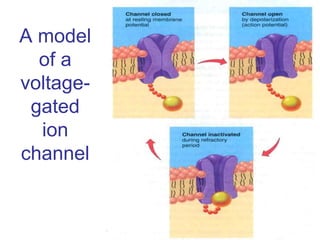
• The channel is closed at the resting
membrane potential but opens in response
to a threshold level of depolarization. This
permits the diffusion of ions required for
action potentials. After a brief period of
time, the channel is inactivated by the "ball
and chain" portion of a polypeptide chain.
A model
of a
voltage-
gated
ion
channel
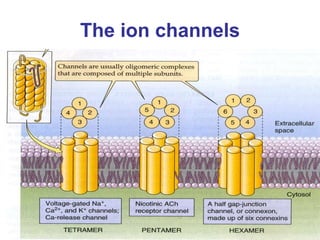
The ion channels
Action potential
• is a property of excitable cells (i.e., nerve,
muscle) that consists of a rapid
depolarization, or upstroke, followed by
repolarization of the membrane potential.
Action potentials have stereotypical size
and shape, are propagating, and are all-
or-none.
Threshold
• is the membrane potential at which the
action potential is inevitable. Inward
current depolarizes the membrane. If the
inward current is not sufficient to
depolarize the membrane to threshold, it
does not produce an action potential. If the
inward current depolarizes the membrane
to threshold, it produces an action
potential.
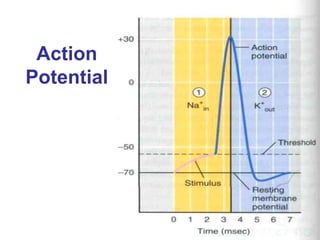
Action
Potential
I. When the axon membrane has been
depolarized to a threshold level the
Na+ gates open and the membrane
becomes permeable to Na+. This
permits Na+ to enter the axon by
diffusion, which further depolarizes
the membrane (makes the inside less
negative, or more positive).
• Since the gates for the Na+ channels
of the axon membrane are voltage
regulated, this additional
depolarization opens more Na+
channels and makes the membrane
even more permeable to Na+. As a
result, more Na+ can enter the cell
and induce a depolarization that
opens even more voltage-regulated
Na+ gates.
• The overshoot is the brief portion at
the peak of the action potential
when the membrane potential is
positive.
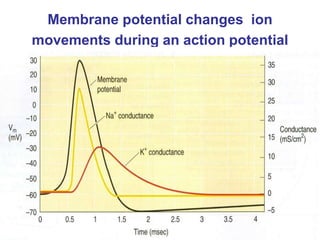
• II. The explosive increase in Na+
permeability results in a rapid
reversal of the membrane potential
in that region from -70 mV to +30
mV.
At that point in time, the channels for
Na+ close (they actually become
inactivated), causing a rapid decrease
in Na+ permeability. Also at this time,
as a result of a time-delayed effect of
the depolarization, voltage-gated K+
channels open and K+ diffuses
rapidly out of the cell.
• Since K+ is positively charged, the
diffusion of K+ out of the cell makes the
inside of the cell less positive, or more
negative, and acts to restore the original
resting membrane potential of -70 mV.
This process is called repolarization.
• These changes in Na+ and K+ diffusion
and the resulting changes in the
membrane potential they produce
constitute an event called the action
potential, or nerve impulse.
Undershoot
(hyperpolarizing afterpotential)
• The K+ conductance remains high for
some time after closure of the
Na+ channels. During this period, the
membrane potential is driven
very close to the K+ equilibrium potential
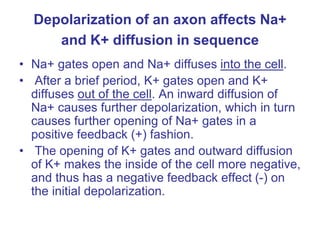
Depolarization of an axon affects Na+
and K+ diffusion in sequence
• Na+ gates open and Na+ diffuses into the cell.
• After a brief period, K+ gates open and K+
diffuses out of the cell. An inward diffusion of
Na+ causes further depolarization, which in turn
causes further opening of Na+ gates in a
positive feedback (+) fashion.
• The opening of K+ gates and outward diffusion
of K+ makes the inside of the cell more negative,
and thus has a negative feedback effect (-) on
the initial depolarization.
Membrane potential changes ion
movements during an action potential
III. Once an action potential has been
completed, the Na+/K+ pumps will extrude
the extra Na+ that has entered the axon
and recover the K+ that has diffused out of
the axon. This active transport of ions
occurs very quickly because this events
occurs across only a very small area of
membrane.
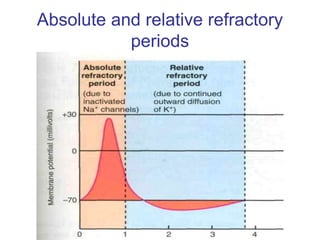
Absolute and relative refractory
periods
Refractory periods
Absolute refractory period
• is the period during which another action
potential cannot be elicited, no matter how large
the stimulus.
• It occurs almost the entire duration of the action
potential.
The inactivation gates of the Na+ channel
are closed when the membrane potential is
depolarized. They remain
closed until repolarization occurs. No action
potential can occur until the inactivation gates
open.
Relative refractory period
• begins at the end of the absolute refractory
period and continues until the membrane
potential returns to the resting level.
• An action potential can be elicited during this
period only if a larger than usual inward current
is provided.
The K+ conductance is higher than at rest,
the membrane potential is closer to the K+
equilibrium potential and, therefore, farther from
threshold; more inward current is required to
bring the membrane to threshold.
Local anesthetics block the conduction
of action potentials in sensory axons
• They do this by reversibly binding to
specific sites within the voltage-gated Na+
channels, reducing the ability of
membrane depolarization to produce
action potentials.
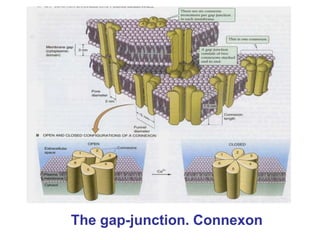
The gap-junction. Connexon

Action Potential.ppt

  • 1.
  • 2.
    • The channelis closed at the resting membrane potential but opens in response to a threshold level of depolarization. This permits the diffusion of ions required for action potentials. After a brief period of time, the channel is inactivated by the "ball and chain" portion of a polypeptide chain.
  • 3.
  • 4.
  • 5.
    Action potential • isa property of excitable cells (i.e., nerve, muscle) that consists of a rapid depolarization, or upstroke, followed by repolarization of the membrane potential. Action potentials have stereotypical size and shape, are propagating, and are all- or-none.
  • 6.
    Threshold • is themembrane potential at which the action potential is inevitable. Inward current depolarizes the membrane. If the inward current is not sufficient to depolarize the membrane to threshold, it does not produce an action potential. If the inward current depolarizes the membrane to threshold, it produces an action potential.
  • 7.
  • 8.
    I. When theaxon membrane has been depolarized to a threshold level the Na+ gates open and the membrane becomes permeable to Na+. This permits Na+ to enter the axon by diffusion, which further depolarizes the membrane (makes the inside less negative, or more positive).
  • 9.
    • Since thegates for the Na+ channels of the axon membrane are voltage regulated, this additional depolarization opens more Na+ channels and makes the membrane even more permeable to Na+. As a result, more Na+ can enter the cell and induce a depolarization that opens even more voltage-regulated Na+ gates.
  • 10.
    • The overshootis the brief portion at the peak of the action potential when the membrane potential is positive. • II. The explosive increase in Na+ permeability results in a rapid reversal of the membrane potential in that region from -70 mV to +30 mV.
  • 11.
    At that pointin time, the channels for Na+ close (they actually become inactivated), causing a rapid decrease in Na+ permeability. Also at this time, as a result of a time-delayed effect of the depolarization, voltage-gated K+ channels open and K+ diffuses rapidly out of the cell.
  • 12.
    • Since K+is positively charged, the diffusion of K+ out of the cell makes the inside of the cell less positive, or more negative, and acts to restore the original resting membrane potential of -70 mV. This process is called repolarization. • These changes in Na+ and K+ diffusion and the resulting changes in the membrane potential they produce constitute an event called the action potential, or nerve impulse.
  • 13.
    Undershoot (hyperpolarizing afterpotential) • TheK+ conductance remains high for some time after closure of the Na+ channels. During this period, the membrane potential is driven very close to the K+ equilibrium potential
  • 14.
    Depolarization of anaxon affects Na+ and K+ diffusion in sequence • Na+ gates open and Na+ diffuses into the cell. • After a brief period, K+ gates open and K+ diffuses out of the cell. An inward diffusion of Na+ causes further depolarization, which in turn causes further opening of Na+ gates in a positive feedback (+) fashion. • The opening of K+ gates and outward diffusion of K+ makes the inside of the cell more negative, and thus has a negative feedback effect (-) on the initial depolarization.
  • 15.
    Membrane potential changesion movements during an action potential
  • 16.
    III. Once anaction potential has been completed, the Na+/K+ pumps will extrude the extra Na+ that has entered the axon and recover the K+ that has diffused out of the axon. This active transport of ions occurs very quickly because this events occurs across only a very small area of membrane.
  • 17.
    Absolute and relativerefractory periods
  • 18.
    Refractory periods Absolute refractoryperiod • is the period during which another action potential cannot be elicited, no matter how large the stimulus. • It occurs almost the entire duration of the action potential. The inactivation gates of the Na+ channel are closed when the membrane potential is depolarized. They remain closed until repolarization occurs. No action potential can occur until the inactivation gates open.
  • 19.
    Relative refractory period •begins at the end of the absolute refractory period and continues until the membrane potential returns to the resting level. • An action potential can be elicited during this period only if a larger than usual inward current is provided. The K+ conductance is higher than at rest, the membrane potential is closer to the K+ equilibrium potential and, therefore, farther from threshold; more inward current is required to bring the membrane to threshold.
  • 20.
    Local anesthetics blockthe conduction of action potentials in sensory axons • They do this by reversibly binding to specific sites within the voltage-gated Na+ channels, reducing the ability of membrane depolarization to produce action potentials.
  • 21.