The Disaster Risk Management Benchmarking Tool
for the Caribbean [BTool]
Organization of Eastern
Caribbean States
The Disaster Risk Management Benchmarking Tool
Disaster risk management
The systematic process of using administrative
decisions, organization, operational skills and
capacities to implement policies, strategies and
coping capacities of the society and
communities to lessen the impacts of natural
hazards and related environmental and
technological disasters.
The Disaster Risk Management Benchmarking Tool
Disaster risk reduction
The systematic development and
application of policies, strategies and
practices to minimize vulnerabilities,
hazards and the unfolding of disaster
impacts throughout a society, in the
broad context of sustainable
development.
The Disaster Risk Management Benchmarking Tool
Background
Our country is particularly vulnerable to natural and technological
hazards. In order to achieve sustained growth, the public and private
sectors in the region there is the need to formulate and implement
meaningful plans to measurably reduce the region’s risk profile for
such potential disasters.
In General,
The approach to disaster risk reduction in the region is varied.
National policies and plans are not in place in some countries
Where national policies and plans do exist, implementation
resources are lacking.
There are no overarching frameworks to address disaster
preparedness and mitigation.
Specific action agenda that is directed to achieving a measurable
reduction in the region’s risk profile for natural disasters has largely
been missing.
The Disaster Risk Management Benchmarking Tool
Goal of the BTool
To improve the ability of communities,
national governments, civil society
organizations, and the private sector to
proactively plan and implement actions to
reduce vulnerability to natural disasters
and create greater economic resilience
when they do occur.
The Disaster Risk Management Benchmarking Tool
Objective of the BTool
To develop and implement:
A practical tool that could be used to assess a
country’s natural disaster risk reduction profile.
A tool to validate that disaster risk management
tasks have been completed and resources are
available, to report on the status of their
readiness.
A list of items or tasks to be checked or consulted
when investing on disaster risk management.
The Disaster Risk Management Benchmarking Tool
What is a DR Benchmarking Tool?
1. A tool for evaluating the adequacy of current
disaster risk management initiatives.
2. A tool for evaluating the readiness and capability
of local and national institutions to deal with the
risk of disaster.
3. A list of best practice recommendations for
disaster risk management.
4. A tool for regional benchmarking of nations and
programmes.
The Disaster Risk Management Benchmarking Tool
What is a DR Benchmarking Tool?
It comprises of indicators which are verifiable.
Examples of Indicators:
Level of community involvement
Preparedness of utilities
Level of insurance coverage for public, business,
and private facilities.
Public awareness for disaster risk reduction.
The Disaster Risk Management Benchmarking Tool
Uses of the Tool
 Identification of gaps in the development
planning/disaster management continuum.
 Highlights of multi-disciplinary approach required
for the development and implementation of a
holistic disaster management program
 A tool for preparing programme of work
 A tool for writing Terms of Reference for Disaster
Management projects
 Highlights deficiencies in public/private sector
interface in disaster management.
The Disaster Risk Management Benchmarking Tool
Catastrophe Risk Insurance Fund:
•Parametric trigger mechanism to access
liquidities in the immediate aftermath of a
disaster
•Premiums based on local vulnerability
assessment and improvements.
Other Usefulness of the BTool
Benefits of the BTool
 It provides a snapshot of a country’s exposure to natural
disaster.
 It can be used to build support for the allocation of
resources to reduce risk in areas defined by the BTool.
 It can be used to prioritize national and regional
programmes of activities.
 It can be used as an incentive at the political level to
stimulate action due to the comparative nature of its
scores against another country.
 It provides information, in a consistent manner, on the
state of readiness of each country. This information can
be used by regional and international funding agencies to
define or redefine programmes of assistance to the
region.
The Disaster Risk Management Benchmarking Tool
Design Considerations
Comprehensive in scope
A non-technical instrument
Simple to implement
Verifiable and replicable
Transparent and representative
Objective and positive in tone
Definite and absolute
Methodological Steps
The BTool should be developed in six steps:
 Selection of a comprehensive disaster
management framework
 Identification of disaster risk management tools
and resources
 Design of assessment questions
 Stakeholder review and modification of the tool
 Pilot testing and modification of the tool
 Adoption of the tool by local and regional
stakeholders.
The Disaster Risk Management Benchmarking Tool
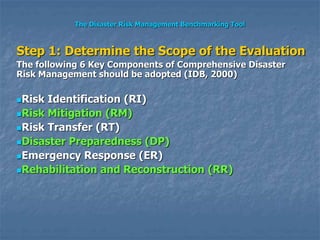
Step 1: Determine the Scope of the Evaluation
The following 6 Key Components of Comprehensive Disaster
Risk Management should be adopted (IDB, 2000)
Risk Identification (RI)
Risk Mitigation (RM)
Risk Transfer (RT)
Disaster Preparedness (DP)
Emergency Response (ER)
Rehabilitation and Reconstruction (RR)
The Disaster Risk Management Benchmarking Tool
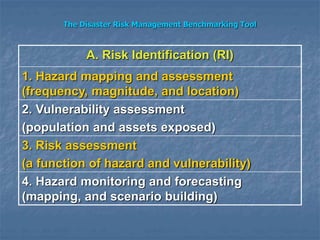
A. Risk Identification (RI)
1. Hazard mapping and assessment
(frequency, magnitude, and location)
2. Vulnerability assessment
(population and assets exposed)
3. Risk assessment
(a function of hazard and vulnerability)
4. Hazard monitoring and forecasting
(mapping, and scenario building)
The Disaster Risk Management Benchmarking Tool
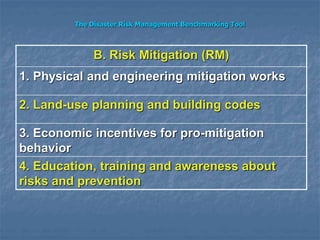
B. Risk Mitigation (RM)
1. Physical and engineering mitigation works
2. Land-use planning and building codes
3. Economic incentives for pro-mitigation
behavior
4. Education, training and awareness about
risks and prevention
The Disaster Risk Management Benchmarking Tool
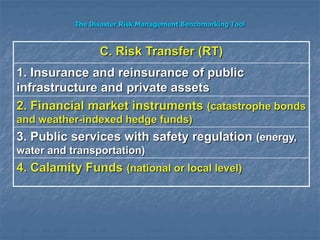
C. Risk Transfer (RT)
1. Insurance and reinsurance of public
infrastructure and private assets
2. Financial market instruments (catastrophe bonds
and weather-indexed hedge funds)
3. Public services with safety regulation (energy,
water and transportation)
4. Calamity Funds (national or local level)
The Disaster Risk Management Benchmarking Tool
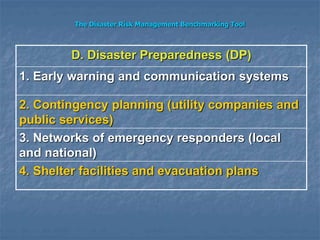
D. Disaster Preparedness (DP)
1. Early warning and communication systems
2. Contingency planning (utility companies and
public services)
3. Networks of emergency responders (local
and national)
4. Shelter facilities and evacuation plans
The Disaster Risk Management Benchmarking Tool
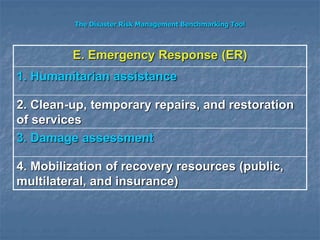
E. Emergency Response (ER)
1. Humanitarian assistance
2. Clean-up, temporary repairs, and restoration
of services
3. Damage assessment
4. Mobilization of recovery resources (public,
multilateral, and insurance)
The Disaster Risk Management Benchmarking Tool
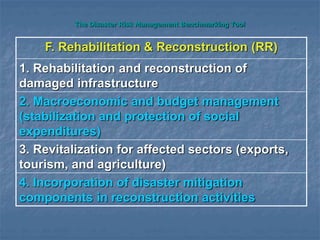
F. Rehabilitation & Reconstruction (RR)
1. Rehabilitation and reconstruction of
damaged infrastructure
2. Macroeconomic and budget management
(stabilization and protection of social
expenditures)
3. Revitalization for affected sectors (exports,
tourism, and agriculture)
4. Incorporation of disaster mitigation
components in reconstruction activities
The Disaster Risk Management Benchmarking Tool
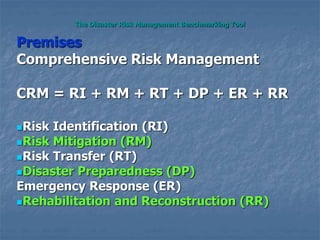
Premises
Comprehensive Risk Management
CRM = RI + RM + RT + DP + ER + RR
Risk Identification (RI)
Risk Mitigation (RM)
Risk Transfer (RT)
Disaster Preparedness (DP)
Emergency Response (ER)
Rehabilitation and Reconstruction (RR)
The Disaster Risk Management Benchmarking Tool
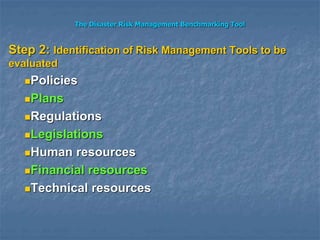
Step 2: Identification of Risk Management Tools to be
evaluated
Policies
Plans
Regulations
Legislations
Human resources
Financial resources
Technical resources
The Disaster Risk Management Benchmarking Tool
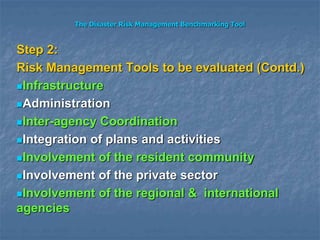
Step 2:
Risk Management Tools to be evaluated (Contd.)
Infrastructure
Administration
Inter-agency Coordination
Integration of plans and activities
Involvement of the resident community
Involvement of the private sector
Involvement of the regional & international
agencies
The Disaster Risk Management Benchmarking Tool
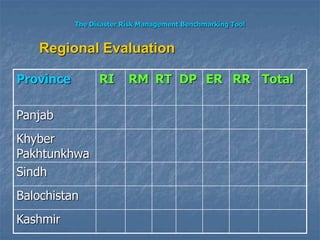
Regional Evaluation
Province RI RM RT DP ER RR Total
Panjab
Khyber
Pakhtunkhwa
Sindh
Balochistan
Kashmir
The Disaster Risk Management Benchmarking Tool
Benchmarking Indicators
Risk identification: hazard mapping
1-7 Have any of the following prevalent hazards in
your communities been assessed and areas
subject to their effects mapped?
1. Earthquakes hazards
2. Volcanic hazards
3. Landslide hazards
4. Flood hazards
5. Drought hazards
6. Hurricane hazards
7. Chemical hazards
8. Do the hazard maps depict the location and
magnitude of hazards?
A1. Hazard Mapping and Assessment
9. Does every household in the communities know the impact
zones of these hazards?
10. Are records of the magnitude of their occurrence measured
and recorded?
11. Has the potential magnitude and frequency of future
occurrence of these hazards been forecasted?
12. Does the hazard map show the vulnerable human
settlements in the communities?
13. Does the hazard map show the vulnerable social
infrastructure in the communities?
14. Does the hazard map show the vulnerable economic
infrastructure in the communities?
15. Have integrated hazard maps that assess the interaction of
multiple natural hazards been produced?
16. Are these maps available in public places such as
community centers, place of worship, police stations,
supermarkets within the hazard impact zones?
17. Have the causes of hazard-related disaster been studied and
their remedies made public?
A1. Hazard Mapping and Assessment
18. Are these maps produced at scales that permit their use
for development planning and control?
19. Do you have a policy that mandates the preparation,
publication, and revision of hazard maps for all
communities?
20. Do you have legislation that mandates the preparation,
publication, and revision of hazard maps for all
communities?
21. In the comments column, please indicate the total
number of communities in the country
22. In the comments column, please indicate the percentage
of communities assessed on the basis of questions 1-20
23. Do you have standards and regulations for the
preparation, publication, and revision of hazard maps?
24. Is the cost of producing, publishing, and revision of
hazard maps budgeted for on a regular basis?
25. Has the responsibility for the preparation, publication,
and revision of hazard maps been assigned to a national
entity?
A1. Hazard Mapping and Assessment
26. Do you have trained local capacity for the preparation,
publication, and revision of hazard maps?
27. Are local communities actively involved in the
preparation, publication, and revision of hazard maps?
28. Where local capacity is limited, do you get support from
regional agencies?
29. Where regional capacity is limited, do you get support
from international bodies?
30. Are the outputs of hazard mapping exercises centrally
stored and accessible to all stakeholders?
31. Is the country signatory to conventions on the storage
and disposal of hazardous chemicals?
32. Are there procedures in place to implement the
requirements for the storage and disposal of chemicals?
33. Have locations of significant oil spill potential been
identified?
34. Are there ‘quick response’ measures in place in areas of
high oil-spill potential?
35. Are there arrangements for monitoring and evaluating the
effectiveness of hazard maps?
Adoption of the tool by local and regional
stakeholders
Suggested Actions:
 Provide sufficient financial and technical resources by
national governments to fulfill the objectives of the BTool;
that is, reducing the region’s risk exposure to natural hazard
events.
 Establish a National Risk Reduction Committee in each
country that has the responsibility to implement the BTool,
and present the results of each country’s readiness to
withstand natural hazards.
 Building the knowledge-base of political directorates,
Permanent Secretaries, and Chief Executive Officers of
major public and private agencies on the utility of the BTool
as a self-assessment disaster risk management evaluation
tool.
Adoption of the tool by local and regional
stakeholders
 Formulation of policy directives and legislative support
towards the mainstreaming of the BTool as an annual
audit tool to be complied by all key agencies of a
country.
 Building effective public awareness programme that
promote stakeholder participation and involvement in
the use and adaptation of the BTool
 Establishment and funding of an award programme that
recognize and rewards progress made by stakeholders
towards meeting the disaster risk reduction agendas of
enterprises, communities, and the nation.
 Identification and nomination of a national champion
that would promote the use of the BTool.
Thank you

Lecture 4 bm tool

  • 1.
    The Disaster RiskManagement Benchmarking Tool for the Caribbean [BTool] Organization of Eastern Caribbean States
  • 2.
    The Disaster RiskManagement Benchmarking Tool Disaster risk management The systematic process of using administrative decisions, organization, operational skills and capacities to implement policies, strategies and coping capacities of the society and communities to lessen the impacts of natural hazards and related environmental and technological disasters.
  • 3.
    The Disaster RiskManagement Benchmarking Tool Disaster risk reduction The systematic development and application of policies, strategies and practices to minimize vulnerabilities, hazards and the unfolding of disaster impacts throughout a society, in the broad context of sustainable development.
  • 4.
    The Disaster RiskManagement Benchmarking Tool Background Our country is particularly vulnerable to natural and technological hazards. In order to achieve sustained growth, the public and private sectors in the region there is the need to formulate and implement meaningful plans to measurably reduce the region’s risk profile for such potential disasters. In General, The approach to disaster risk reduction in the region is varied. National policies and plans are not in place in some countries Where national policies and plans do exist, implementation resources are lacking. There are no overarching frameworks to address disaster preparedness and mitigation. Specific action agenda that is directed to achieving a measurable reduction in the region’s risk profile for natural disasters has largely been missing.
  • 5.
    The Disaster RiskManagement Benchmarking Tool Goal of the BTool To improve the ability of communities, national governments, civil society organizations, and the private sector to proactively plan and implement actions to reduce vulnerability to natural disasters and create greater economic resilience when they do occur.
  • 6.
    The Disaster RiskManagement Benchmarking Tool Objective of the BTool To develop and implement: A practical tool that could be used to assess a country’s natural disaster risk reduction profile. A tool to validate that disaster risk management tasks have been completed and resources are available, to report on the status of their readiness. A list of items or tasks to be checked or consulted when investing on disaster risk management.
  • 7.
    The Disaster RiskManagement Benchmarking Tool What is a DR Benchmarking Tool? 1. A tool for evaluating the adequacy of current disaster risk management initiatives. 2. A tool for evaluating the readiness and capability of local and national institutions to deal with the risk of disaster. 3. A list of best practice recommendations for disaster risk management. 4. A tool for regional benchmarking of nations and programmes.
  • 8.
    The Disaster RiskManagement Benchmarking Tool What is a DR Benchmarking Tool? It comprises of indicators which are verifiable. Examples of Indicators: Level of community involvement Preparedness of utilities Level of insurance coverage for public, business, and private facilities. Public awareness for disaster risk reduction.
  • 9.
    The Disaster RiskManagement Benchmarking Tool Uses of the Tool  Identification of gaps in the development planning/disaster management continuum.  Highlights of multi-disciplinary approach required for the development and implementation of a holistic disaster management program  A tool for preparing programme of work  A tool for writing Terms of Reference for Disaster Management projects  Highlights deficiencies in public/private sector interface in disaster management.
  • 10.
    The Disaster RiskManagement Benchmarking Tool Catastrophe Risk Insurance Fund: •Parametric trigger mechanism to access liquidities in the immediate aftermath of a disaster •Premiums based on local vulnerability assessment and improvements. Other Usefulness of the BTool
  • 11.
    Benefits of theBTool  It provides a snapshot of a country’s exposure to natural disaster.  It can be used to build support for the allocation of resources to reduce risk in areas defined by the BTool.  It can be used to prioritize national and regional programmes of activities.  It can be used as an incentive at the political level to stimulate action due to the comparative nature of its scores against another country.  It provides information, in a consistent manner, on the state of readiness of each country. This information can be used by regional and international funding agencies to define or redefine programmes of assistance to the region.
  • 12.
    The Disaster RiskManagement Benchmarking Tool Design Considerations Comprehensive in scope A non-technical instrument Simple to implement Verifiable and replicable Transparent and representative Objective and positive in tone Definite and absolute
  • 13.
    Methodological Steps The BToolshould be developed in six steps:  Selection of a comprehensive disaster management framework  Identification of disaster risk management tools and resources  Design of assessment questions  Stakeholder review and modification of the tool  Pilot testing and modification of the tool  Adoption of the tool by local and regional stakeholders.
  • 14.
    The Disaster RiskManagement Benchmarking Tool Step 1: Determine the Scope of the Evaluation The following 6 Key Components of Comprehensive Disaster Risk Management should be adopted (IDB, 2000) Risk Identification (RI) Risk Mitigation (RM) Risk Transfer (RT) Disaster Preparedness (DP) Emergency Response (ER) Rehabilitation and Reconstruction (RR)
  • 15.
    The Disaster RiskManagement Benchmarking Tool A. Risk Identification (RI) 1. Hazard mapping and assessment (frequency, magnitude, and location) 2. Vulnerability assessment (population and assets exposed) 3. Risk assessment (a function of hazard and vulnerability) 4. Hazard monitoring and forecasting (mapping, and scenario building)
  • 16.
    The Disaster RiskManagement Benchmarking Tool B. Risk Mitigation (RM) 1. Physical and engineering mitigation works 2. Land-use planning and building codes 3. Economic incentives for pro-mitigation behavior 4. Education, training and awareness about risks and prevention
  • 17.
    The Disaster RiskManagement Benchmarking Tool C. Risk Transfer (RT) 1. Insurance and reinsurance of public infrastructure and private assets 2. Financial market instruments (catastrophe bonds and weather-indexed hedge funds) 3. Public services with safety regulation (energy, water and transportation) 4. Calamity Funds (national or local level)
  • 18.
    The Disaster RiskManagement Benchmarking Tool D. Disaster Preparedness (DP) 1. Early warning and communication systems 2. Contingency planning (utility companies and public services) 3. Networks of emergency responders (local and national) 4. Shelter facilities and evacuation plans
  • 19.
    The Disaster RiskManagement Benchmarking Tool E. Emergency Response (ER) 1. Humanitarian assistance 2. Clean-up, temporary repairs, and restoration of services 3. Damage assessment 4. Mobilization of recovery resources (public, multilateral, and insurance)
  • 20.
    The Disaster RiskManagement Benchmarking Tool F. Rehabilitation & Reconstruction (RR) 1. Rehabilitation and reconstruction of damaged infrastructure 2. Macroeconomic and budget management (stabilization and protection of social expenditures) 3. Revitalization for affected sectors (exports, tourism, and agriculture) 4. Incorporation of disaster mitigation components in reconstruction activities
  • 21.
    The Disaster RiskManagement Benchmarking Tool Premises Comprehensive Risk Management CRM = RI + RM + RT + DP + ER + RR Risk Identification (RI) Risk Mitigation (RM) Risk Transfer (RT) Disaster Preparedness (DP) Emergency Response (ER) Rehabilitation and Reconstruction (RR)
  • 22.
    The Disaster RiskManagement Benchmarking Tool Step 2: Identification of Risk Management Tools to be evaluated Policies Plans Regulations Legislations Human resources Financial resources Technical resources
  • 23.
    The Disaster RiskManagement Benchmarking Tool Step 2: Risk Management Tools to be evaluated (Contd.) Infrastructure Administration Inter-agency Coordination Integration of plans and activities Involvement of the resident community Involvement of the private sector Involvement of the regional & international agencies
  • 24.
    The Disaster RiskManagement Benchmarking Tool Regional Evaluation Province RI RM RT DP ER RR Total Panjab Khyber Pakhtunkhwa Sindh Balochistan Kashmir
  • 25.
    The Disaster RiskManagement Benchmarking Tool Benchmarking Indicators Risk identification: hazard mapping
  • 26.
    1-7 Have anyof the following prevalent hazards in your communities been assessed and areas subject to their effects mapped? 1. Earthquakes hazards 2. Volcanic hazards 3. Landslide hazards 4. Flood hazards 5. Drought hazards 6. Hurricane hazards 7. Chemical hazards 8. Do the hazard maps depict the location and magnitude of hazards? A1. Hazard Mapping and Assessment
  • 27.
    9. Does everyhousehold in the communities know the impact zones of these hazards? 10. Are records of the magnitude of their occurrence measured and recorded? 11. Has the potential magnitude and frequency of future occurrence of these hazards been forecasted? 12. Does the hazard map show the vulnerable human settlements in the communities? 13. Does the hazard map show the vulnerable social infrastructure in the communities? 14. Does the hazard map show the vulnerable economic infrastructure in the communities? 15. Have integrated hazard maps that assess the interaction of multiple natural hazards been produced? 16. Are these maps available in public places such as community centers, place of worship, police stations, supermarkets within the hazard impact zones? 17. Have the causes of hazard-related disaster been studied and their remedies made public? A1. Hazard Mapping and Assessment
  • 28.
    A1. Hazard Mappingand Assessment 18. Are these maps produced at scales that permit their use for development planning and control? 19. Do you have a policy that mandates the preparation, publication, and revision of hazard maps for all communities? 20. Do you have legislation that mandates the preparation, publication, and revision of hazard maps for all communities? 21. In the comments column, please indicate the total number of communities in the country 22. In the comments column, please indicate the percentage of communities assessed on the basis of questions 1-20 23. Do you have standards and regulations for the preparation, publication, and revision of hazard maps? 24. Is the cost of producing, publishing, and revision of hazard maps budgeted for on a regular basis? 25. Has the responsibility for the preparation, publication, and revision of hazard maps been assigned to a national entity?
  • 29.
    A1. Hazard Mappingand Assessment 26. Do you have trained local capacity for the preparation, publication, and revision of hazard maps? 27. Are local communities actively involved in the preparation, publication, and revision of hazard maps? 28. Where local capacity is limited, do you get support from regional agencies? 29. Where regional capacity is limited, do you get support from international bodies? 30. Are the outputs of hazard mapping exercises centrally stored and accessible to all stakeholders? 31. Is the country signatory to conventions on the storage and disposal of hazardous chemicals? 32. Are there procedures in place to implement the requirements for the storage and disposal of chemicals? 33. Have locations of significant oil spill potential been identified? 34. Are there ‘quick response’ measures in place in areas of high oil-spill potential? 35. Are there arrangements for monitoring and evaluating the effectiveness of hazard maps?
  • 30.
    Adoption of thetool by local and regional stakeholders Suggested Actions:  Provide sufficient financial and technical resources by national governments to fulfill the objectives of the BTool; that is, reducing the region’s risk exposure to natural hazard events.  Establish a National Risk Reduction Committee in each country that has the responsibility to implement the BTool, and present the results of each country’s readiness to withstand natural hazards.  Building the knowledge-base of political directorates, Permanent Secretaries, and Chief Executive Officers of major public and private agencies on the utility of the BTool as a self-assessment disaster risk management evaluation tool.
  • 31.
    Adoption of thetool by local and regional stakeholders  Formulation of policy directives and legislative support towards the mainstreaming of the BTool as an annual audit tool to be complied by all key agencies of a country.  Building effective public awareness programme that promote stakeholder participation and involvement in the use and adaptation of the BTool  Establishment and funding of an award programme that recognize and rewards progress made by stakeholders towards meeting the disaster risk reduction agendas of enterprises, communities, and the nation.  Identification and nomination of a national champion that would promote the use of the BTool.
  • 32.