Information Management 2.0Gísli ÓlafssonDisaster Management Advisorgislio@live.comhttp://blog.disasterexpert.orgTwitter: @gislio
“Information itself is very directly about saving lives. If we take the wrong decisions, make the wrong choices about where we put our money and our effort because our knowledge is poor, we are condemning some of the most deserving to death or destitution.”John Holmes, UN Emergency Relief Coordinator Importance of Information
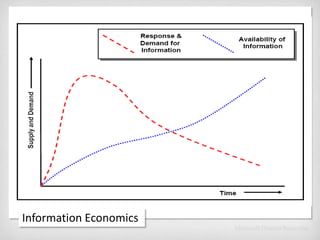
Information Economics
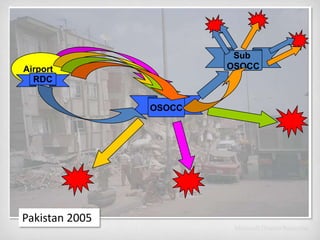
Sub OSOCCAirportRDCOSOCCPakistan 2005
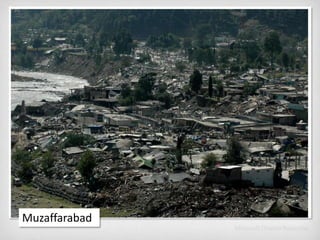
Muzaffarabad
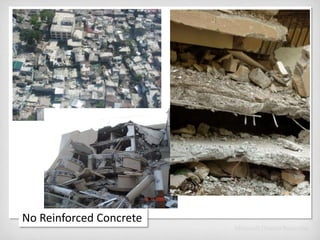
No Reinforced Concrete
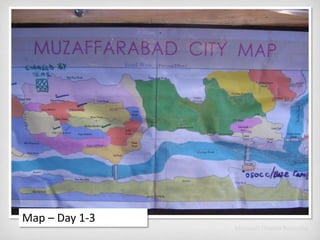
Map – Day 1-3
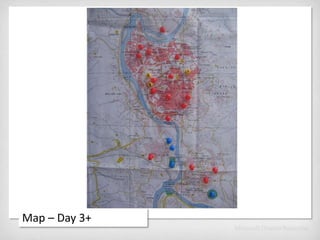
Map – Day 3+
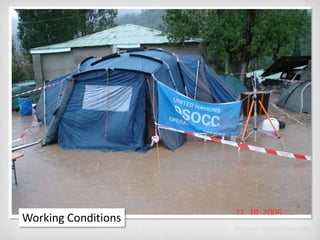
Working Conditions
In most of the twelve clusters established, cluster coordinators continue to struggle without the capacity required to coordinate efficiently the large number of partners involved in the operation. One month into the response, only a few clusters have fully dedicated cluster coordinators, information management focal points and technical support capacity, all of which are basic requirements for the efficient management of a large scale emergency operation. This lack of capacity has meant that several clusters have yet to establish a concise overview of needs and develop coherent response plans, strategies and gap analyses. This is beginning to show and is leading others to doubt our ability to deliver. John Holmes‘ email to Global Cluster Leads
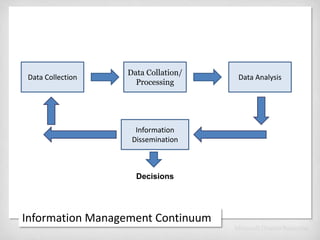
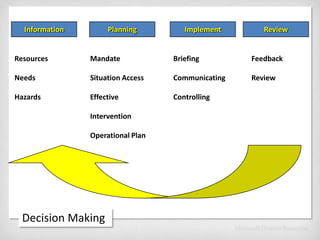
Data CollectionData Collation/ProcessingData AnalysisInformation DisseminationDecisionsInformation Management Continuum
The Role of ICT
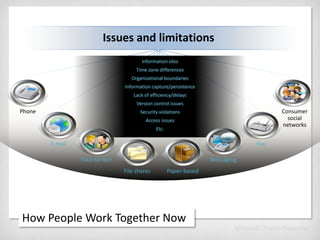
Issues and limitationsInformation silosTime zone differencesOrganizational boundariesInformation capture/persistenceLack of efficiency/delaysVersion control issuesSecurity violationsAccess issuesEtc.ConsumersocialnetworksPhoneE-mailFaxFace-to-faceMessagingHow People Work Together NowFile sharesPaper-based
Connectivity
Big World – Small World
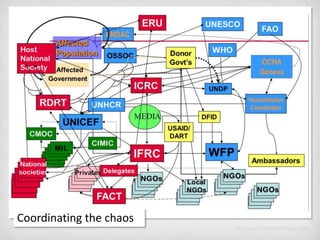
Coordinating the chaos
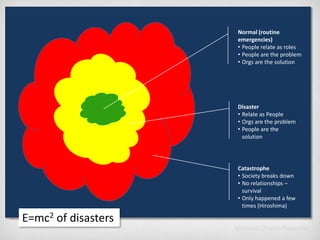
Normal (routine emergencies)People relate as roles
People are the problem
Orgs are the solutionDisasterRelate as People
Orgs are the problem
People are the solutionCatastropheSociety breaks down
No relationships – survival
Only happened a few times (Hiroshima)E=mc2 of disasters
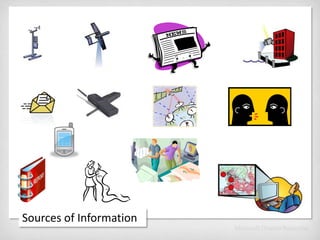
Sources of Information
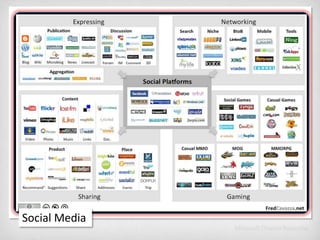
Social Media
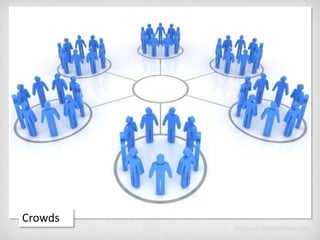
Crowds
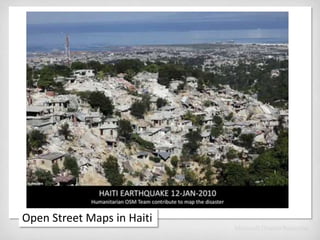
Open Street Maps in Haiti
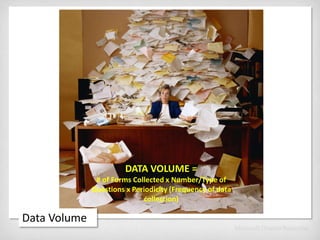
DATA VOLUME = # of Forms Collected x Number/Type of Questions x Periodicity (Frequency of data collection)Data Volume
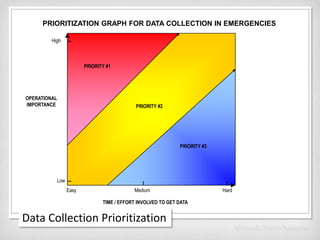
PRIORITIZATION GRAPH FOR DATA COLLECTION IN EMERGENCIESHigh PRIORITY #1OPERATIONALIMPORTANCEPRIORITY #2PRIORITY #3Low Easy Medium HardTIME / EFFORT INVOLVED TO GET DATAData Collection Prioritization
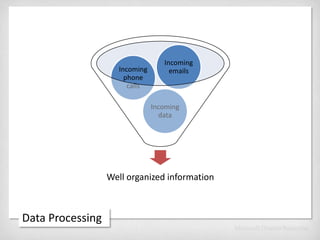
Data Processing
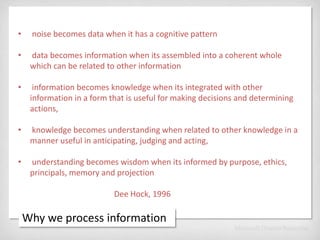
 noise becomes data when it has a cognitive pattern
 data becomes information when its assembled into a coherent whole which can be related to other information
 information becomes knowledge when its integrated with other information in a form that is useful for making decisions and determining actions,
 knowledge becomes understanding when related to other knowledge in a manner useful in anticipating, judging and acting,
 understanding becomes wisdom when its informed by purpose, ethics, principals, memory and projection			Dee Hock, 1996Why we process information
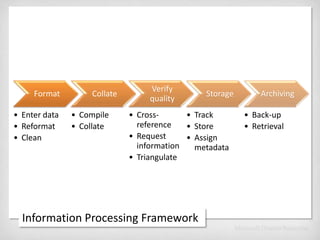
Information Processing Framework
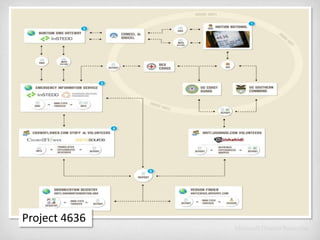
Project 4636
Dealing With Ambiquity
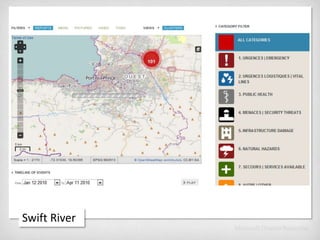
Swift River
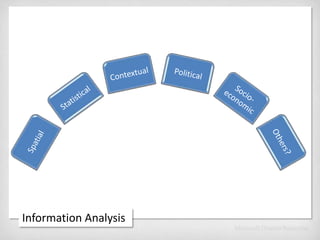
Information Analysis
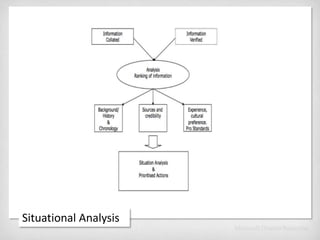
Situational Analysis
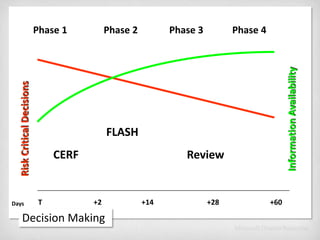
Phase 1Phase 2Phase 3Phase 4Information AvailabilityRisk Critical DecisionsFLASHCERFReviewT+2+14+28+60DaysDecision Making

Information Management 2.0

Editor's Notes

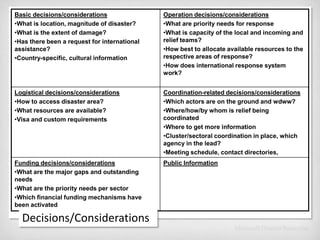
  • #4 Lots/Lack of dataLack of (processed) informationAt times no access to baseline dataNo data collection/information processes yet in placeNeed for rapid decision-making, prioritisation – also IM prioritisationOverwhelming demand for information from all sidesClients of IM products are both on-site/in country and “not yet on site”/about to deploy
  • #17 Establishing an OSOCCRole of the OSOCCRoles within the OSOCCManning the OSOCCRole of GISLogistics issuesCommunication issuesSecurity issues
  • #18 When asked what was his most important discovery within the area of disaster mangement, Mileti said that 40 years of his work could be sumarized into this one finding.Mileti said we could define three phases of crisis. The first one is the Routine Emergency phase, something our fire figthers and police officers have to deal with every day. Then there are the disasters which overwhelm the daily responders and cause us to change our behaviour. Finally there are the catastrophees which luckliy only happen very seldom throughout our history.But lets look at these different phases and the behaviour of people during these phases. During the normal routine emergency phase, we look towards organizations such as the police to assist us in the problems we have. And when we interact with these organizations we related to the people we deal with through the roles they represent. In other words, when my house gets on fire, I call the fire department and the firemen will come and help me. I do not refer to them by their names or who they are as persons, in my mind they are representatives of the organization they work for.However during a disaster there is a radical change in our behaviour. The number of organizations involved increases and all of a sudden a coordinated approach is needed. But at this time the organizations become the problem. Political and sometimes financial motives of those organizations hinder them from working efficiently with each other. In the international humanitarian world we often see different UN organizations competing for the attention of the media and the donors instead of collaborating with other organizations involved in the same response. Very often the leadership of those organizations are playing a political game during these periods, something that can realy affect the efficiency of the response. But luckily there is a solution to this problem and in this case it is people. It is people at different levels of the organization which feel human emotions about those affected by the disaster and because of these human emotions are willing to break down and reach out of the organizational silos that they represent. It is through these kind of connection between people within the different organizations that work actually gets done. We must therefore learn to leverage and build up in advance those personal relationships between the people in these organizations.In the third phase, catastrophie, Mileti points out that society breaks down and the basic human instinct of survial kicks in. During this phase relationships no longer matter, only yourself matter. However he points out that lucklily this phase does not last for very long and only happens extreemly seldom.A key point to understand about his findings is that it is not a formal organizational declaration that transititions us between these different phases, but rather it is determined by the behaviour of the people involved.So keep this in mind as I go through the next few slides and discuss methods for effective coordination.
  • #34 Lots/Lack of dataLack of (processed) informationAt times no access to baseline dataNo data collection/information processes yet in placeNeed for rapid decision-making, prioritisation – also IM prioritisationOverwhelming demand for information from all sidesClients of IM products are both on-site/in country and “not yet on site”/about to deploy