Codes and
Conventions
–
Music Videos
Styles and Target Audience:
There are 5 types of music videos in general: Performance, Narrative, Abstract,
Animation and Cinematic. My target audience’s genres of indie and alternative
rock are typically performance and narrative based so I will focus on those 2
accordingly.
My target audience are teenage to young adult alternative and indie rock fans.
Thusly, the artists and videos analysed here will be from these genres, with
general rock-wide conventions also being explored.
Alternative and Indie Rock
Research:
- The Alternative Rock genre is a branch of typical
rock that came from the independent music
underground of the 1970s.
- “Alternative” refers to straying from mainstream
rock’s conventions ranging from sonic, social and
regional typicality.
- Especially in Britain, Alternative Rock evolved into
punk, followed by post-punk and then new-wave
and gothic rock with staples of these genres being
The Cure, Joy Division, and Siouxsie and the
Banshees.
- Alt Rock is largely an umbrella term, which indie
rock itself falls under, involving movements and
genres such as grunge with bands like Alice in
Chains, Pearl Jam and Soundgarden.
- Other Alt Rock bands include the funk-rooted Red
Hot Chili Peppers, Nirvana, Velvet Underground and
and Dead Kennedys.
- Indie Rock is a product of the 1980s, originally
used as a term to describe rock music released
independent to a large record label.
- Characteristically low-budget and DIY, the
genre is one of the freest and liberated out of
rock, its entire premise revolving around an
artist’s total self-influence with no large
corporation making creative decisions.
- Defined by early bands like the Pixies,
Radiohead, and the Smiths, the independent
label aspect of the genre fell away as the years
went on, with indie now referring to the feeling
of the music more than self-publishing.
- In the modern day, Indie Rock bands include
The Strokes, Kasabian, Arctic Monkeys,
Florence + the Machine, and The Vaccines.
Analysed Video
Codes and
Conventions:
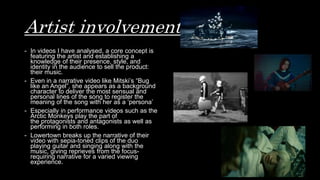
Artist involvement
- In videos I have analysed, a core concept is
featuring the artist and establishing a
knowledge of their presence, style, and
identity in the audience to sell the product:
their music.
- Even in a narrative video like Mitski’s “Bug
like an Angel”, she appears as a background
character to deliver the most sensual and
personal lines of the song to register the
meaning of the song with her as a ‘persona’
- Especially in performance videos such as the
Arctic Monkeys play the part of
the protagonists and antagonists as well as
performing in both roles.
- Lowertown breaks up the narrative of their
video with sepia-toned clips of the duo
playing guitar and singing along with the
music, giving reprieves from the focus-
requiring narrative for a varied viewing
experience.
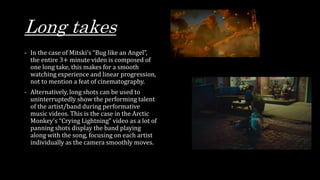
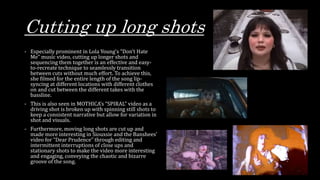
Long takes
- In the case of Mitski’s “Bug like an Angel”,
the entire 3+ minute video is composed of
one long take, this makes for a smooth
watching experience and linear progression,
not to mention a feat of cinematography.
- Alternatively, long shots can be used to
uninterruptedly show the performing talent
of the artist/band during performative
music videos. This is the case in the Arctic
Monkey’s “Crying Lightning” video as a lot of
panning shots display the band playing
along with the song, focusing on each artist
individually as the camera smoothly moves.
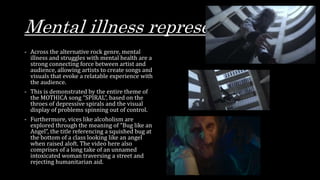
Cutting up long shots
- Especially prominent in Lola Young’s “Don’t Hate
Me” music video, cutting up longer shots and
sequencing them together is an effective and easy-
to-recreate technique to seamlessly transition
between cuts without much effort. To achieve this,
she filmed for the entire length of the song lip-
syncing at different locations with different clothes
on and cut between the different takes with the
bassline.
- This is also seen in MOTHICA’s “SPIRAL” video as a
driving shot is broken up with spinning still shots to
keep a consistent narrative but allow for variation in
shot and visuals.
- Furthermore, moving long shots are cut up and
made more interesting in Siouxsie and the Banshees’
video for “Dear Prudence” through editing and
intermittent interruptions of close ups and
stationary shots to make the video more interesting
and engaging, conveying the chaotic and bizarre
groove of the song.
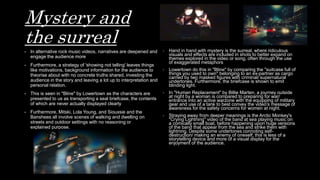
Mental illness representation
- Across the alternative rock genre, mental
illness and struggles with mental health are a
strong connecting force between artist and
audience, allowing artists to create songs and
visuals that evoke a relatable experience with
the audience.
- This is demonstrated by the entire theme of
the MOTHICA song “SPIRAL”, based on the
throes of depressive spirals and the visual
display of problems spinning out of control.
- Furthermore, vices like alcoholism are
explored through the meaning of “Bug like an
Angel”, the title referencing a squished bug at
the bottom of a class looking like an angel
when raised aloft. The video here also
comprises of a long take of an unnamed
intoxicated woman traversing a street and
rejecting humanitarian aid.
Mystery and
the surreal
- In alternative rock music videos, narratives are deepened and
engage the audience more
- Furthermore, a strategy of 'showing not telling' leaves things
like motivations, background information for the audience to
theorise about with no concrete truths shared, investing the
audience in the story and leaving a lot up to interpretation and
personal relation.
- This is seen in "Bline" by Lowertown as the characters are
presented to us as transporting a seal briefcase, the contents
of which are never actually displayed clearly
- Furthermore, Mitski, Lola Young, and Siouxsie and the
Banshees all involve scenes of walking and dwelling on
streets and outdoor settings with no reasoning or
explained purpose.
- Hand in hand with mystery is the surreal, where ridiculous
visuals and effects are included in shots to better expand on
themes explored in the video or song, often through the use
of exaggerated metaphors
- Lowertown do this in "Bline" by comparing the "suitcase full of
things you used to own" belonging to an ex-partner as cargo
carried by two masked figures with criminal/ supernatural
undertones. Furthermore, the briefcase is shown to emit
blinding light.
- In "Human Replacement" by Billie Marten, a journey outside
at night by a woman is compared to preparing for war/
entrance into an active warzone with the equipping of military
gear and use of a tank to best convey the video's message of
awareness for the safety concerns for women at night.
- Straying away from deeper meanings is the Arctic Monkey's
"Crying Lightning" video of the band at sea playing music on
a comically small boat, before happening upon huge versions
of the band that appear from the sea and strike them with
lightning. Despite some undertones connoting self-
destruction/ making an enemy of oneself, this is less of a
storytelling device and more of a visual display for the
enjoyment of the audience.
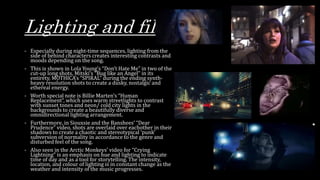
Lighting and filters
- Especially during night-time sequences, lighting from the
side of behind characters creates interesting contrasts and
moods depending on the song.
- This is shown in Lola Young’s “Don’t Hate Me” in two of the
cut-up long shots, Mitski’s “Bug like an Angel” in its
entirety, MOTHICA’s “SPIRAL” during the ending synth-
heavy resolution shots to create a dusky, nostalgic and
ethereal energy.
- Worth special note is Billie Marten’s “Human
Replacement”, which uses warm streetlights to contrast
with sunset tones and neon/ cold city lights in the
backgrounds to create a beautifully diverse and
omnidirectional lighting arrangement.
- Furthermore, in Siouxsie and the Banshees’ “Dear
Prudence” video, shots are overlaid over eachother in their
shadows to create a chaotic and stereotypical ‘punk’
subversion of normality in accordance to the genre and
disturbed feel of the song.
- Also seen in the Arctic Monkeys’ video for “Crying
Lightning” is an emphasis on hue and lighting to indicate
time of day and as a tool for storytelling. The intensity,
location, and colour of lighting is in constant change as the
weather and intensity of the music progresses.
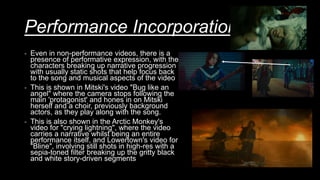
Performance Incorporation
- Even in non-performance videos, there is a
presence of performative expression, with the
characters breaking up narrative progression
with usually static shots that help focus back
to the song and musical aspects of the video
- This is shown in Mitski's video "Bug like an
angel" where the camera stops following the
main 'protagonist' and hones in on Mitski
herself and a choir, previously background
actors, as they play along with the song.
- This is also shown in the Arctic Monkey's
video for "crying lightning", where the video
carries a narrative whilst being an entire
performance itself, and Lowertown's video for
"Bline", involving still shots in high-res with a
sepia-toned filter breaking up the gritty black
and white story-driven segments
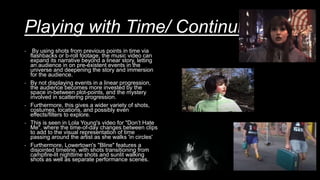
Playing with Time/ Continuity
- By using shots from previous points in time via
flashbacks or b-roll footage, the music video can
expand its narrative beyond a linear story, letting
an audience in on pre-existent events in the
universe and deepening the story and immersion
for the audience.
- By not displaying events in a linear progression,
the audience becomes more invested by the
space in-between plot-points, and the mystery
involved in scattering progression.
- Furthermore, this gives a wider variety of shots,
costumes, locations, and possibly even
effects/filters to explore.
- This is seen in Lola Young's video for "Don’t Hate
Me", where the time-of-day changes between clips
to add to the visual representation of time
passing around the artist as she walks 'in circles'
- Furthermore, Lowertown's "Bline" features a
disjointed timeline, with shots transitioning from
campfire-lit nighttime shots and sunlit walking
shots as well as separate performance scenes.
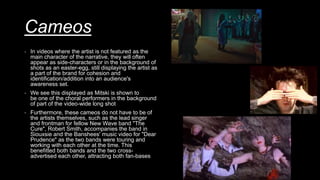
Cameos
- In videos where the artist is not featured as the
main character of the narrative, they will often
appear as side-characters or in the background of
shots as an easter-egg, still displaying the artist as
a part of the brand for cohesion and
identification/addition into an audience's
awareness set.
- We see this displayed as Mitski is shown to
be one of the choral performers in the background
of part of the video-wide long shot
- Furthermore, these cameos do not have to be of
the artists themselves, such as the lead singer
and frontman for fellow New Wave band "The
Cure", Robert Smith, accompanies the band in
Siouxsie and the Banshees' music video for "Dear
Prudence" as the two bands were touring and
working with each other at the time. This
benefitted both bands and the two cross-
advertised each other, attracting both fan-bases
Subversion of expectations
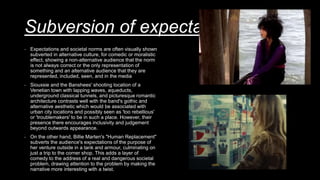
- Expectations and societal norms are often visually shown
subverted in alternative culture, for comedic or moralistic
effect, showing a non-alternative audience that the norm
is not always correct or the only representation of
something and an alternative audience that they are
represented, included, seen, and in the media
- Siouxsie and the Banshees' shooting location of a
Venetian town with lapping waves, aqueducts,
underground classical tunnels, and picturesque romantic
architecture contrasts well with the band's gothic and
alternative aesthetic which would be associated with
urban city locations and possibly seen as 'too rebellious'
or 'troublemakers' to be in such a place. However, their
presence there encourages inclusivity and judgement
beyond outwards appearance.
- On the other hand, Billie Marten's "Human Replacement"
subverts the audience's expectations of the purpose of
her venture outside in a tank and armour, culminating on
just a trip to the corner shop. This adds a layer of
comedy to the address of a real and dangerous societal
problem, drawing attention to the problem by making the
narrative more interesting with a twist.
Alternative Fashion
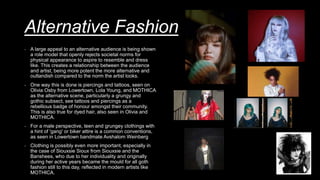
- A large appeal to an alternative audience is being shown
a role model that openly rejects societal norms for
physical appearance to aspire to resemble and dress
like. This creates a relationship between the audience
and artist, being more potent the more alternative and
outlandish compared to the norm the artist looks.
- One way this is done is piercings and tattoos, seen on
Olivia Osby from Lowertown, Lola Young, and MOTHICA
as the alternative scene, particularly a grungy and
gothic subsect, see tattoos and piercings as a
rebellious badge of honour amongst their community.
This is also true for dyed hair, also seen in Olivia and
MOTHICA.
- For a male perspective, teen and grungey clothings with
a hint of 'gang' or biker attire is a common conventions,
as seen in Lowertown bandmate Avshalom Weinberg
- Clothing is possibly even more important, especially in
the case of Siouxsie Sioux from Siouxsie and the
Banshees, who due to her individuality and originally
during her active years became the mould for all goth
fashion still to this day, reflected in modern artists like
MOTHICA.
Multi-role
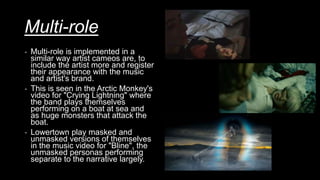
- Multi-role is implemented in a
similar way artist cameos are, to
include the artist more and register
their appearance with the music
and artist's brand.
- This is seen in the Arctic Monkey's
video for "Crying Lightning" where
the band plays themselves
performing on a boat at sea and
as huge monsters that attack the
boat.
- Lowertown play masked and
unmasked versions of themselves
in the music video for "Bline", the
unmasked personas performing
separate to the narrative largely.
Day vs Night
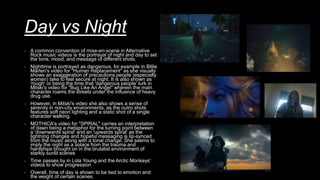
- A common convention of mise-en-scene in Alternative
Rock music videos is the portrayal of night and day to set
the tone, mood, and message of different shots.
- Nighttime is portrayed as dangerous, for example in Billie
Marten's video for "Human Replacement" as she visually
shows an exaggeration of precautions people (especially
women) take to feel secure at night. It is also shown as
'rough' or being the time that 'dangerous people' lurk in
Mitski's video for "Bug Like An Angel" wherein the main
character roams the streets under the influence of heavy
drug use.
- However, in Mitski's video she also shows a sense of
serenity in non-city environments, as the outro shots
features soft neon lighting and a static shot of a single
character walking.
- MOTHICA's video for "SPIRAL" carries an interpretation
of dawn being a metaphor for the turning point between
a 'downwards spiral' and an 'upwards spiral' as the
lightning changes and hopeful messaging is lip-synced
from the music along with a tonal change. She seems to
imply the night as a solace from the trauma and
hardships brought on in the brutalist environment of
starkly sunlit scenes
- Time passes by in Lola Young and the Arctic Monkeys'
videos to show progression
- Overall, time of day is shown to be tied to emotion and
the weight of certain scenes.
Moral Messaging, Portrayal of
Hope
- A core aspect of Alternative Rock music videos is their
moral messaging and portrayal of shared experiences
where hope is vital. In these videos, vices and problems
common in people's lives are transformed into surreal
representations of these themes along a narrative to
carry a message and impart some sense of hope and
advice for those in need.
- Mitski, for example, visually shows to the audience
through her narrative that people don't always want to
help themselves, and thus cannot be helped by other
people. This coincides with her main
character's representation of alcoholism/ drug misuse in
"Bug Like An Angel", also shown in MOTHICA's music
video for "SPIRAL", recounting her own experience with
alcoholism and depression, with a hopeful message at
the end of the song.
- "Bline" by Lowertown explores the importance of letting
go of the past and one's history with people for the
better, the narrative being a physical representation of a
"suitcase full of things you used to own" that "used to feel
so heavy" belonging to an ex-significant other.
- Lola, through recording the same style of shot in a dozen
locations with differing clothes and scenery, portrays a
moral message of focusing too much on other
people's feelings about someone and the physical
representation of one's mind 'running in circles'
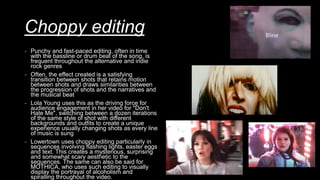
Choppy editing
- Punchy and fast-paced editing, often in time
with the bassline or drum beat of the song, is
frequent throughout the alternative and indie
rock genres
- Often, the effect created is a satisfying
transition between shots that retains motion
between shots and draws similarities between
the progression of shots and the narratives and
the musical beat
- Lola Young uses this as the driving force for
audience engagement in her video for "Don't
Hate Me", switching between a dozen iterations
of the same style of shot with different
backgrounds and outfits to create a unique
experience usually changing shots as every line
of music is sung
- Lowertown uses choppy editing particularly in
sequences involving flashing lights, easter eggs
and text. This creates a mysterious, surprising
and somewhat scary aesthetic to the
sequences. The same can also be said for
MOTHICA, who uses such editing to visually
display the portrayal of alcoholism and
spiralling throughout the video.
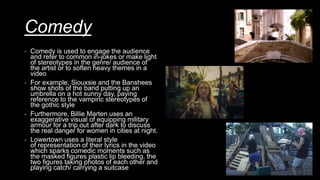
Comedy
- Comedy is used to engage the audience
and refer to common in-jokes or make light
of stereotypes in the genre/ audience of
the artist or to soften heavy themes in a
video
- For example, Siouxsie and the Banshees
show shots of the band putting up an
umbrella on a hot sunny day, paying
reference to the vampiric stereotypes of
the gothic style
- Furthermore, Billie Marten uses an
exaggerative visual of equipping military
armour for a trip out after dark to discuss
the real danger for women in cities at night.
- Lowertown uses a literal style
of representation of their lyrics in the video
which sparks comedic moments such as
the masked figures plastic lip bleeding, the
two figures taking photos of each other and
playing catch/ carrying a suitcase
Genre-Wide
Codes and
Conventions:
Mise en Scene and Appearances
- Piercings, extreme makeup
- Dark clothing and usually hair
- DARK ATMOSPHERE, darkened lighting, low-key
- High-key lighting used for emphasis to mark moments as pivotal, draw
attention. CONTRAST
- Locations usually outside or in urban areas. Brutalist archietcture
compliments aesthetic and simple surroundings keep attention on band,
helps them stick out.
- Presence and acting tends to be exaggerated, with facial expressions and
motions reinforcing lyrics and being expressive, usually conveying
frustration or anger. PASSIONATE
- Includes typical iconography of the genre to unify and identify with fans
and other rock bands: rock devil horn sign, pentagram, skull, tongue-out,
etc.
Music Interruptions
- The music may be interrupted or begin with a brief portion of
dialogue/ a scene additional to the original music to start a
narrative/ better tell the story of the video
- An example of interludes with dialogue conveying a narrative
would be "why do you only call me when your high" by the
Arctic Monkeys
Editing
- Usually edited in line with tempo, tending to be fast paced.
- Tends to contain a lot of jump-cuts and abrupt shifts in scenes
and shots, often in instrumental sections or the chorus to better
intensify crescendos
- Montages are common, showing a lot of different sequences in
a short space of time, usually in some kind of chronological
progression
- Little to no special effects/ editing as the focus is on the artists
Cinematography
- Close-ups are commonly used to show emotions on (usually the
lead singers') faces or the instruments being played in a
performative video
- Arial and distanced shots are also used to establish the scope
of locations and action occurring, specifically in shots with
crowds or a lot of events happening together. Usually at the
beginnings/ends to set and conclude scenes.
- Angles and rotating cameras evoke action and movement,
usually in line with the artists, keeping the experience
interesting
Narratives
- Usually, a story will be told, relevant to the lyrics of the song,
explaining and exploring topics discussed using analogies and
example instances of broader topics (such as addiction or domestic
violence)
- The artist usually features in the video, if not as protagonists, then as
cameos or background characters
- Effectively delivers the message in a visual form of media
- Often includes a portion of live performance/ musical showcasing,
especially during instrumental scenes
- Usually both performance and narrative
- Usually revolve around characters being wronged/ straying away
from societal mainstream corruption/ conformity

Codes n Conventionss copy (1).paaaaaaptx

  • 1.
  • 2.
    Styles and TargetAudience: There are 5 types of music videos in general: Performance, Narrative, Abstract, Animation and Cinematic. My target audience’s genres of indie and alternative rock are typically performance and narrative based so I will focus on those 2 accordingly. My target audience are teenage to young adult alternative and indie rock fans. Thusly, the artists and videos analysed here will be from these genres, with general rock-wide conventions also being explored.
  • 3.
    Alternative and IndieRock Research: - The Alternative Rock genre is a branch of typical rock that came from the independent music underground of the 1970s. - “Alternative” refers to straying from mainstream rock’s conventions ranging from sonic, social and regional typicality. - Especially in Britain, Alternative Rock evolved into punk, followed by post-punk and then new-wave and gothic rock with staples of these genres being The Cure, Joy Division, and Siouxsie and the Banshees. - Alt Rock is largely an umbrella term, which indie rock itself falls under, involving movements and genres such as grunge with bands like Alice in Chains, Pearl Jam and Soundgarden. - Other Alt Rock bands include the funk-rooted Red Hot Chili Peppers, Nirvana, Velvet Underground and and Dead Kennedys. - Indie Rock is a product of the 1980s, originally used as a term to describe rock music released independent to a large record label. - Characteristically low-budget and DIY, the genre is one of the freest and liberated out of rock, its entire premise revolving around an artist’s total self-influence with no large corporation making creative decisions. - Defined by early bands like the Pixies, Radiohead, and the Smiths, the independent label aspect of the genre fell away as the years went on, with indie now referring to the feeling of the music more than self-publishing. - In the modern day, Indie Rock bands include The Strokes, Kasabian, Arctic Monkeys, Florence + the Machine, and The Vaccines.
  • 4.
  • 5.
    Artist involvement - Invideos I have analysed, a core concept is featuring the artist and establishing a knowledge of their presence, style, and identity in the audience to sell the product: their music. - Even in a narrative video like Mitski’s “Bug like an Angel”, she appears as a background character to deliver the most sensual and personal lines of the song to register the meaning of the song with her as a ‘persona’ - Especially in performance videos such as the Arctic Monkeys play the part of the protagonists and antagonists as well as performing in both roles. - Lowertown breaks up the narrative of their video with sepia-toned clips of the duo playing guitar and singing along with the music, giving reprieves from the focus- requiring narrative for a varied viewing experience.
  • 6.
    Long takes - Inthe case of Mitski’s “Bug like an Angel”, the entire 3+ minute video is composed of one long take, this makes for a smooth watching experience and linear progression, not to mention a feat of cinematography. - Alternatively, long shots can be used to uninterruptedly show the performing talent of the artist/band during performative music videos. This is the case in the Arctic Monkey’s “Crying Lightning” video as a lot of panning shots display the band playing along with the song, focusing on each artist individually as the camera smoothly moves.
  • 7.
    Cutting up longshots - Especially prominent in Lola Young’s “Don’t Hate Me” music video, cutting up longer shots and sequencing them together is an effective and easy- to-recreate technique to seamlessly transition between cuts without much effort. To achieve this, she filmed for the entire length of the song lip- syncing at different locations with different clothes on and cut between the different takes with the bassline. - This is also seen in MOTHICA’s “SPIRAL” video as a driving shot is broken up with spinning still shots to keep a consistent narrative but allow for variation in shot and visuals. - Furthermore, moving long shots are cut up and made more interesting in Siouxsie and the Banshees’ video for “Dear Prudence” through editing and intermittent interruptions of close ups and stationary shots to make the video more interesting and engaging, conveying the chaotic and bizarre groove of the song.
  • 8.
    Mental illness representation -Across the alternative rock genre, mental illness and struggles with mental health are a strong connecting force between artist and audience, allowing artists to create songs and visuals that evoke a relatable experience with the audience. - This is demonstrated by the entire theme of the MOTHICA song “SPIRAL”, based on the throes of depressive spirals and the visual display of problems spinning out of control. - Furthermore, vices like alcoholism are explored through the meaning of “Bug like an Angel”, the title referencing a squished bug at the bottom of a class looking like an angel when raised aloft. The video here also comprises of a long take of an unnamed intoxicated woman traversing a street and rejecting humanitarian aid.
  • 9.
    Mystery and the surreal -In alternative rock music videos, narratives are deepened and engage the audience more - Furthermore, a strategy of 'showing not telling' leaves things like motivations, background information for the audience to theorise about with no concrete truths shared, investing the audience in the story and leaving a lot up to interpretation and personal relation. - This is seen in "Bline" by Lowertown as the characters are presented to us as transporting a seal briefcase, the contents of which are never actually displayed clearly - Furthermore, Mitski, Lola Young, and Siouxsie and the Banshees all involve scenes of walking and dwelling on streets and outdoor settings with no reasoning or explained purpose. - Hand in hand with mystery is the surreal, where ridiculous visuals and effects are included in shots to better expand on themes explored in the video or song, often through the use of exaggerated metaphors - Lowertown do this in "Bline" by comparing the "suitcase full of things you used to own" belonging to an ex-partner as cargo carried by two masked figures with criminal/ supernatural undertones. Furthermore, the briefcase is shown to emit blinding light. - In "Human Replacement" by Billie Marten, a journey outside at night by a woman is compared to preparing for war/ entrance into an active warzone with the equipping of military gear and use of a tank to best convey the video's message of awareness for the safety concerns for women at night. - Straying away from deeper meanings is the Arctic Monkey's "Crying Lightning" video of the band at sea playing music on a comically small boat, before happening upon huge versions of the band that appear from the sea and strike them with lightning. Despite some undertones connoting self- destruction/ making an enemy of oneself, this is less of a storytelling device and more of a visual display for the enjoyment of the audience.
  • 10.
    Lighting and filters -Especially during night-time sequences, lighting from the side of behind characters creates interesting contrasts and moods depending on the song. - This is shown in Lola Young’s “Don’t Hate Me” in two of the cut-up long shots, Mitski’s “Bug like an Angel” in its entirety, MOTHICA’s “SPIRAL” during the ending synth- heavy resolution shots to create a dusky, nostalgic and ethereal energy. - Worth special note is Billie Marten’s “Human Replacement”, which uses warm streetlights to contrast with sunset tones and neon/ cold city lights in the backgrounds to create a beautifully diverse and omnidirectional lighting arrangement. - Furthermore, in Siouxsie and the Banshees’ “Dear Prudence” video, shots are overlaid over eachother in their shadows to create a chaotic and stereotypical ‘punk’ subversion of normality in accordance to the genre and disturbed feel of the song. - Also seen in the Arctic Monkeys’ video for “Crying Lightning” is an emphasis on hue and lighting to indicate time of day and as a tool for storytelling. The intensity, location, and colour of lighting is in constant change as the weather and intensity of the music progresses.
  • 11.
    Performance Incorporation - Evenin non-performance videos, there is a presence of performative expression, with the characters breaking up narrative progression with usually static shots that help focus back to the song and musical aspects of the video - This is shown in Mitski's video "Bug like an angel" where the camera stops following the main 'protagonist' and hones in on Mitski herself and a choir, previously background actors, as they play along with the song. - This is also shown in the Arctic Monkey's video for "crying lightning", where the video carries a narrative whilst being an entire performance itself, and Lowertown's video for "Bline", involving still shots in high-res with a sepia-toned filter breaking up the gritty black and white story-driven segments
  • 12.
    Playing with Time/Continuity - By using shots from previous points in time via flashbacks or b-roll footage, the music video can expand its narrative beyond a linear story, letting an audience in on pre-existent events in the universe and deepening the story and immersion for the audience. - By not displaying events in a linear progression, the audience becomes more invested by the space in-between plot-points, and the mystery involved in scattering progression. - Furthermore, this gives a wider variety of shots, costumes, locations, and possibly even effects/filters to explore. - This is seen in Lola Young's video for "Don’t Hate Me", where the time-of-day changes between clips to add to the visual representation of time passing around the artist as she walks 'in circles' - Furthermore, Lowertown's "Bline" features a disjointed timeline, with shots transitioning from campfire-lit nighttime shots and sunlit walking shots as well as separate performance scenes.
  • 13.
    Cameos - In videoswhere the artist is not featured as the main character of the narrative, they will often appear as side-characters or in the background of shots as an easter-egg, still displaying the artist as a part of the brand for cohesion and identification/addition into an audience's awareness set. - We see this displayed as Mitski is shown to be one of the choral performers in the background of part of the video-wide long shot - Furthermore, these cameos do not have to be of the artists themselves, such as the lead singer and frontman for fellow New Wave band "The Cure", Robert Smith, accompanies the band in Siouxsie and the Banshees' music video for "Dear Prudence" as the two bands were touring and working with each other at the time. This benefitted both bands and the two cross- advertised each other, attracting both fan-bases
  • 14.
    Subversion of expectations -Expectations and societal norms are often visually shown subverted in alternative culture, for comedic or moralistic effect, showing a non-alternative audience that the norm is not always correct or the only representation of something and an alternative audience that they are represented, included, seen, and in the media - Siouxsie and the Banshees' shooting location of a Venetian town with lapping waves, aqueducts, underground classical tunnels, and picturesque romantic architecture contrasts well with the band's gothic and alternative aesthetic which would be associated with urban city locations and possibly seen as 'too rebellious' or 'troublemakers' to be in such a place. However, their presence there encourages inclusivity and judgement beyond outwards appearance. - On the other hand, Billie Marten's "Human Replacement" subverts the audience's expectations of the purpose of her venture outside in a tank and armour, culminating on just a trip to the corner shop. This adds a layer of comedy to the address of a real and dangerous societal problem, drawing attention to the problem by making the narrative more interesting with a twist.
  • 15.
    Alternative Fashion - Alarge appeal to an alternative audience is being shown a role model that openly rejects societal norms for physical appearance to aspire to resemble and dress like. This creates a relationship between the audience and artist, being more potent the more alternative and outlandish compared to the norm the artist looks. - One way this is done is piercings and tattoos, seen on Olivia Osby from Lowertown, Lola Young, and MOTHICA as the alternative scene, particularly a grungy and gothic subsect, see tattoos and piercings as a rebellious badge of honour amongst their community. This is also true for dyed hair, also seen in Olivia and MOTHICA. - For a male perspective, teen and grungey clothings with a hint of 'gang' or biker attire is a common conventions, as seen in Lowertown bandmate Avshalom Weinberg - Clothing is possibly even more important, especially in the case of Siouxsie Sioux from Siouxsie and the Banshees, who due to her individuality and originally during her active years became the mould for all goth fashion still to this day, reflected in modern artists like MOTHICA.
  • 16.
    Multi-role - Multi-role isimplemented in a similar way artist cameos are, to include the artist more and register their appearance with the music and artist's brand. - This is seen in the Arctic Monkey's video for "Crying Lightning" where the band plays themselves performing on a boat at sea and as huge monsters that attack the boat. - Lowertown play masked and unmasked versions of themselves in the music video for "Bline", the unmasked personas performing separate to the narrative largely.
  • 17.
    Day vs Night -A common convention of mise-en-scene in Alternative Rock music videos is the portrayal of night and day to set the tone, mood, and message of different shots. - Nighttime is portrayed as dangerous, for example in Billie Marten's video for "Human Replacement" as she visually shows an exaggeration of precautions people (especially women) take to feel secure at night. It is also shown as 'rough' or being the time that 'dangerous people' lurk in Mitski's video for "Bug Like An Angel" wherein the main character roams the streets under the influence of heavy drug use. - However, in Mitski's video she also shows a sense of serenity in non-city environments, as the outro shots features soft neon lighting and a static shot of a single character walking. - MOTHICA's video for "SPIRAL" carries an interpretation of dawn being a metaphor for the turning point between a 'downwards spiral' and an 'upwards spiral' as the lightning changes and hopeful messaging is lip-synced from the music along with a tonal change. She seems to imply the night as a solace from the trauma and hardships brought on in the brutalist environment of starkly sunlit scenes - Time passes by in Lola Young and the Arctic Monkeys' videos to show progression - Overall, time of day is shown to be tied to emotion and the weight of certain scenes.
  • 18.
    Moral Messaging, Portrayalof Hope - A core aspect of Alternative Rock music videos is their moral messaging and portrayal of shared experiences where hope is vital. In these videos, vices and problems common in people's lives are transformed into surreal representations of these themes along a narrative to carry a message and impart some sense of hope and advice for those in need. - Mitski, for example, visually shows to the audience through her narrative that people don't always want to help themselves, and thus cannot be helped by other people. This coincides with her main character's representation of alcoholism/ drug misuse in "Bug Like An Angel", also shown in MOTHICA's music video for "SPIRAL", recounting her own experience with alcoholism and depression, with a hopeful message at the end of the song. - "Bline" by Lowertown explores the importance of letting go of the past and one's history with people for the better, the narrative being a physical representation of a "suitcase full of things you used to own" that "used to feel so heavy" belonging to an ex-significant other. - Lola, through recording the same style of shot in a dozen locations with differing clothes and scenery, portrays a moral message of focusing too much on other people's feelings about someone and the physical representation of one's mind 'running in circles'
  • 19.
    Choppy editing - Punchyand fast-paced editing, often in time with the bassline or drum beat of the song, is frequent throughout the alternative and indie rock genres - Often, the effect created is a satisfying transition between shots that retains motion between shots and draws similarities between the progression of shots and the narratives and the musical beat - Lola Young uses this as the driving force for audience engagement in her video for "Don't Hate Me", switching between a dozen iterations of the same style of shot with different backgrounds and outfits to create a unique experience usually changing shots as every line of music is sung - Lowertown uses choppy editing particularly in sequences involving flashing lights, easter eggs and text. This creates a mysterious, surprising and somewhat scary aesthetic to the sequences. The same can also be said for MOTHICA, who uses such editing to visually display the portrayal of alcoholism and spiralling throughout the video.
  • 20.
    Comedy - Comedy isused to engage the audience and refer to common in-jokes or make light of stereotypes in the genre/ audience of the artist or to soften heavy themes in a video - For example, Siouxsie and the Banshees show shots of the band putting up an umbrella on a hot sunny day, paying reference to the vampiric stereotypes of the gothic style - Furthermore, Billie Marten uses an exaggerative visual of equipping military armour for a trip out after dark to discuss the real danger for women in cities at night. - Lowertown uses a literal style of representation of their lyrics in the video which sparks comedic moments such as the masked figures plastic lip bleeding, the two figures taking photos of each other and playing catch/ carrying a suitcase
  • 21.
  • 22.
    Mise en Sceneand Appearances - Piercings, extreme makeup - Dark clothing and usually hair - DARK ATMOSPHERE, darkened lighting, low-key - High-key lighting used for emphasis to mark moments as pivotal, draw attention. CONTRAST - Locations usually outside or in urban areas. Brutalist archietcture compliments aesthetic and simple surroundings keep attention on band, helps them stick out. - Presence and acting tends to be exaggerated, with facial expressions and motions reinforcing lyrics and being expressive, usually conveying frustration or anger. PASSIONATE - Includes typical iconography of the genre to unify and identify with fans and other rock bands: rock devil horn sign, pentagram, skull, tongue-out, etc.
  • 23.
    Music Interruptions - Themusic may be interrupted or begin with a brief portion of dialogue/ a scene additional to the original music to start a narrative/ better tell the story of the video - An example of interludes with dialogue conveying a narrative would be "why do you only call me when your high" by the Arctic Monkeys
  • 24.
    Editing - Usually editedin line with tempo, tending to be fast paced. - Tends to contain a lot of jump-cuts and abrupt shifts in scenes and shots, often in instrumental sections or the chorus to better intensify crescendos - Montages are common, showing a lot of different sequences in a short space of time, usually in some kind of chronological progression - Little to no special effects/ editing as the focus is on the artists
  • 25.
    Cinematography - Close-ups arecommonly used to show emotions on (usually the lead singers') faces or the instruments being played in a performative video - Arial and distanced shots are also used to establish the scope of locations and action occurring, specifically in shots with crowds or a lot of events happening together. Usually at the beginnings/ends to set and conclude scenes. - Angles and rotating cameras evoke action and movement, usually in line with the artists, keeping the experience interesting
  • 26.
    Narratives - Usually, astory will be told, relevant to the lyrics of the song, explaining and exploring topics discussed using analogies and example instances of broader topics (such as addiction or domestic violence) - The artist usually features in the video, if not as protagonists, then as cameos or background characters - Effectively delivers the message in a visual form of media - Often includes a portion of live performance/ musical showcasing, especially during instrumental scenes - Usually both performance and narrative - Usually revolve around characters being wronged/ straying away from societal mainstream corruption/ conformity