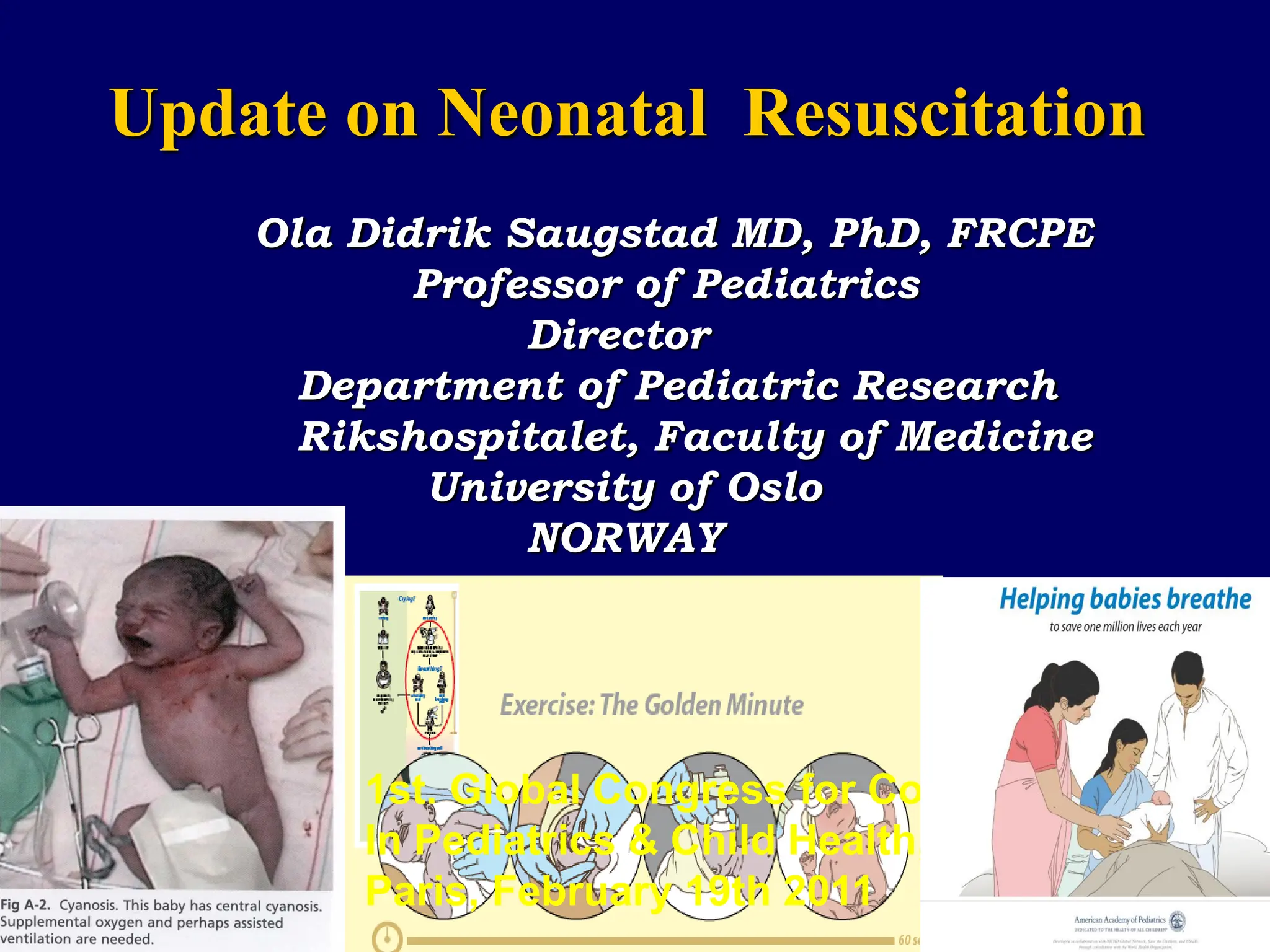
Ola Didrik Saugstad MD, PhD, FRCPE
Professor of Pediatrics
Director
Department of Pediatric Research
Rikshospitalet, Faculty of Medicine
University of Oslo
NORWAY
Update on Neonatal Resuscitation
1st. Global Congress for Consenus
In Pediatrics & Child Health,
Paris, February 19th 2011
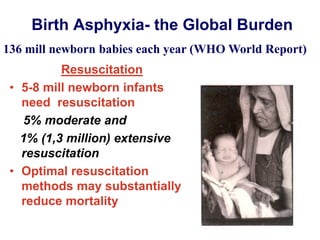
Birth Asphyxia- the Global Burden
Resuscitation
• 5-8 mill newborn infants
need resuscitation
5% moderate and
1% (1,3 million) extensive
resuscitation
• Optimal resuscitation
methods may substantially
reduce mortality
136 mill newborn babies each year (WHO World Report)
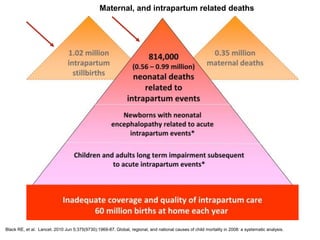
Black RE, et al. Lancet. 2010 Jun 5;375(9730):1969-87. Global, regional, and national causes of child mortality in 2008: a systematic analysis.
Maternal, and intrapartum related deaths
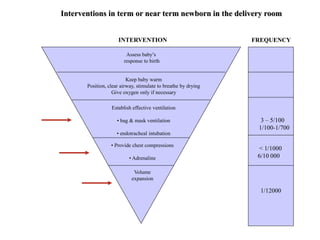
Assess baby’s
response to birth
Keep baby warm
Position, clear airway, stimulate to breathe by drying
Give oxygen only if necessary
Establish effective ventilation
• bag & mask ventilation
• endotracheal intubation
• Provide chest compressions
• Adrenaline
Volume
expansion
3 – 5/100
1/100-1/700
< 1/1000
6/10 000
1/12000
Interventions in term or near term newborn in the delivery room
INTERVENTION FREQUENCY
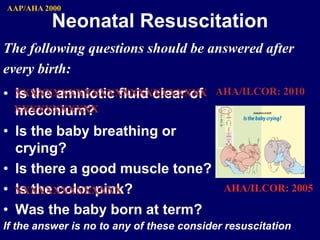
Neonatal Resuscitation
• Is the amniotic fluid clear of
meconium?
• Is the baby breathing or
crying?
• Is there a good muscle tone?
• Is the color pink?
• Was the baby born at term?
If the answer is no to any of these consider resuscitation
The following questions should be answered after
every birth:
AAP/AHA 2000
XXXXXXXXXXXXXX AHA/ILCOR: 2005
XXXXXXXXXXXXXXXXXXXXXXXXX
XXXXXXXXXXX
AHA/ILCOR: 2010
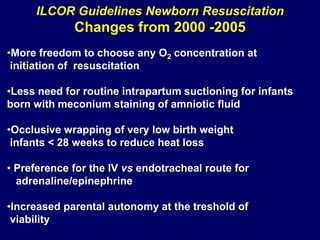
ILCOR Guidelines Newborn Resuscitation
Changes from 2000 -2005
•More freedom to choose any O2 concentration at
initiation of resuscitation
•Less need for routine intrapartum suctioning for infants
born with meconium staining of amniotic fluid
•Occlusive wrapping of very low birth weight
infants < 28 weeks to reduce heat loss
• Preference for the IV vs endotracheal route for
adrenaline/epinephrine
•Increased parental autonomy at the treshold of
viability
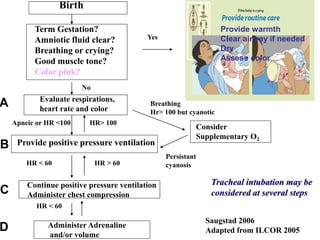
Birth
Term Gestation?
Amniotic fluid clear?
Breathing or crying?
Good muscle tone?
Color pink?
Evaluate respirations,
heart rate and color
Provide positive pressure ventilation
Continue positive pressure ventilation
Administer chest compression
Administer Adrenaline
and/or volume
Consider
Supplementary O2
Tracheal intubation may be
considered at several steps
Breathing
Hr> 100 but cyanotic
Apneic or HR <100
Persistant
cyanosis
HR < 60 HR > 60
HR < 60
Saugstad 2006
Adapted from ILCOR 2005
Yes
No
HR> 100
A
B
C
D
Provide warmth
Clear airway if needed
Dry
Assess color
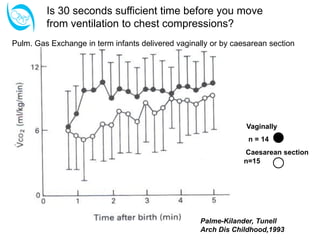
Vaginally
n = 14
Caesarean section
n=15
Palme-Kilander, Tunell
Arch Dis Childhood,1993
Pulm. Gas Exchange in term infants delivered vaginally or by caesarean section
Is 30 seconds sufficient time before you move
from ventilation to chest compressions?
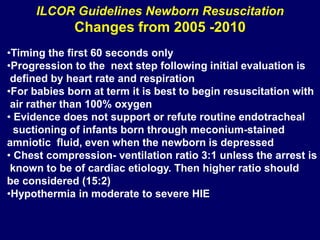
ILCOR Guidelines Newborn Resuscitation
Changes from 2005 -2010
•Timing the first 60 seconds only
•Progression to the next step following initial evaluation is
defined by heart rate and respiration
•For babies born at term it is best to begin resuscitation with
air rather than 100% oxygen
• Evidence does not support or refute routine endotracheal
suctioning of infants born through meconium-stained
amniotic fluid, even when the newborn is depressed
• Chest compression- ventilation ratio 3:1 unless the arrest is
known to be of cardiac etiology. Then higher ratio should
be considered (15:2)
•Hypothermia in moderate to severe HIE
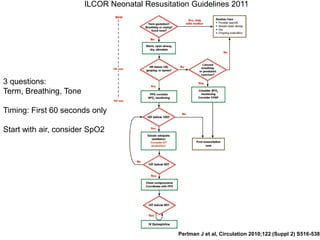
ILCOR Neonatal Resusitation Guidelines 2011
Perlman J et al, Circulation 2010;122 (Suppl 2) S516-538
3 questions:
Term, Breathing, Tone
Timing: First 60 seconds only
Start with air, consider SpO2
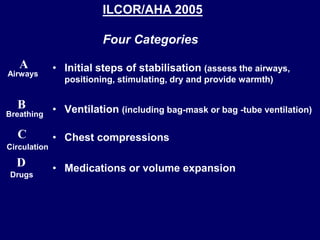
• Initial steps of stabilisation (assess the airways,
positioning, stimulating, dry and provide warmth)
• Ventilation (including bag-mask or bag -tube ventilation)
• Chest compressions
• Medications or volume expansion
A
B
D
C
Airways
Breathing
Circulation
Drugs
ILCOR/AHA 2005
Four Categories
A: Airways
Stabilisation and suctioning
•A vigorous newborn who starts to breath within 10-15
seconds does not need suctioning routinely
•Deep suctioning should be avoided especially the first 5
min of life. It may induce apnea, bradycardia and
bronchospasm
•If suctioning, always suction the mouth before through
the nose to minimize risk of aspiration
Suctioning of upper airways
• Routine intrapartum oropharyngeal and
nasopharyngeal suctioning for infants
born with clear or meconium stained
amniotic fluid is no longer
recommended
ILCOR 2010
The most important is to ventilate the lungs. Training is needed
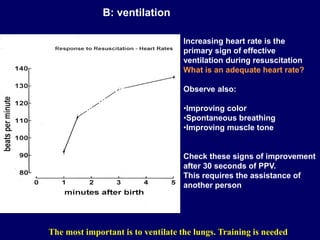
B: ventilation
Increasing heart rate is the
primary sign of effective
ventilation during resuscitation
What is an adequate heart rate?
Observe also:
•Improving color
•Spontaneous breathing
•Improving muscle tone
Check these signs of improvement
after 30 seconds of PPV.
This requires the assistance of
another person
50 percentile for heart rate
is 99 bpm at one min
Dawson et al, 2010
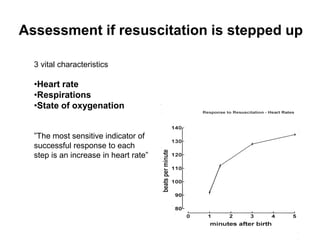
Assessment if resuscitation is stepped up
3 vital characteristics
•Heart rate
•Respirations
•State of oxygenation
”The most sensitive indicator of
successful response to each
step is an increase in heart rate”
Sustained inflation (SI) ?
● In babies with GA < 29 weeks SI is tested
out
● Different models for instance 5 seconds x 3
or 15 seconds with increasing PIP
● Still experimental
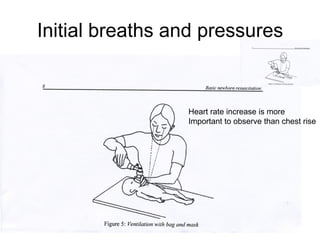
Initial breaths and pressures
• Initiation of intermittent positive-
pressure ventilation at birth can
be accomplished with either shorter or
longer inspiratory times.
• Initial peak inflating pressures needed are
variable- start with 20 cm H2O may be
effective but 30-40 Cm H2O may be
needed.
• PEEP is likely to be beneficial
Heart rate increase is more
Important to observe than chest rise
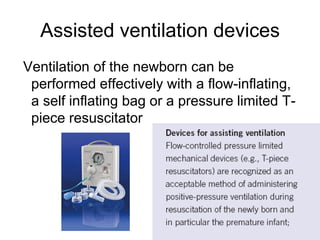
Assisted ventilation devices
Ventilation of the newborn can be
performed effectively with a flow-inflating,
a self inflating bag or a pressure limited T-
piece resuscitator
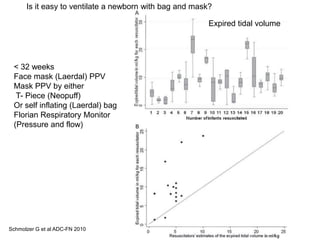
Schmolzer G et al ADC-FN 2010
< 32 weeks
Face mask (Laerdal) PPV
Mask PPV by either
T- Piece (Neopuff)
Or self inflating (Laerdal) bag
Florian Respiratory Monitor
(Pressure and flow)
Expired tidal volume
Is it easy to ventilate a newborn with bag and mask?
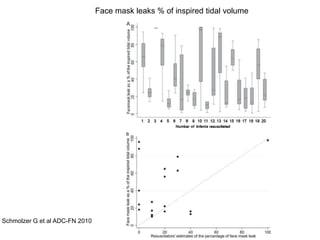
Schmolzer G et al ADC-FN 2010
Face mask leaks % of inspired tidal volume
C: Circulation
Neonatal Resuscitation
Chest compressions - indication
Chest compressions should be performed if the heart
rate is < 60 beats/minute, despite adequate ventilation
for 30 seconds. 3:1 ratio - that is 90:30
ILCOR 2005
0.8 per 1000 term or near term infants
2-10% in preterm infants
No Human data have identified an optimal compression to ventilation
ratio for cardiopulmonary resuscitation in any age
2 thumb technique is more efficient than the 2 finger technique
Lower 1/3 of sternum, pressure to one third of posterior anterior
diameter to generate pulses
Goals: Reperfuse the heart (obtain diastolic pressure)
Reperfuse the Brain Wyckoff et al, Pediatrics 2005:115:950-955
Finer et al Pediatrics 1999;104:428-34
Wyckoff and Berg Seminars Fetal and Neonatal
Med 2008;13:410-415
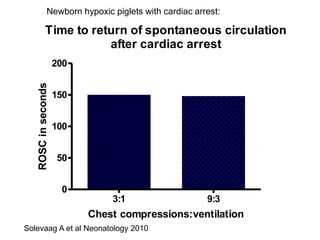
Time to return of spontaneous circulation
after cardiac arrest
3:1 9:3
0
50
100
150
200
Chest compressions:ventilation
ROSC
in
seconds
Solevaag A et al Neonatology 2010
Newborn hypoxic piglets with cardiac arrest:
D: Drugs
Neonatal Resuscitation
Adenaline/Epinephrine dose
If adequate ventilation and chest compressions have failed to
increase heart rate to > 60 bpm, then it is reasonable to use
adrenaline despite the lack of human neonatal data.
The recommended dose of adrenaline is 0.1 to 0.3 mL/kg IV of a
1:10,000 solution (0.01 to 0.03 mg/kg) repeated every 3 to 5
minutes as indicated. – Not evidence based
Higher doses cannot be recommended and may be harmful.
If the Endotracehal route is chosen use higher doses (0.05-0.1 mg/kg)
No different dose for premature infants
Adrenaline for newborn resuscitation
• 6:10 000 newborns
• 0.1-0.3 mL/kg 1:10 000 adrenaline solution
• 1st dose at earliest at 6 min of life
Barber et al Pediatrics 2006;118:1028-1034
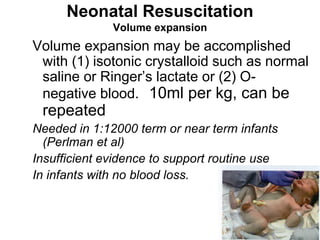
Neonatal Resuscitation
Volume expansion
Volume expansion may be accomplished
with (1) isotonic crystalloid such as normal
saline or Ringer’s lactate or (2) O-
negative blood. 10ml per kg, can be
repeated
Needed in 1:12000 term or near term infants
(Perlman et al)
Insufficient evidence to support routine use
In infants with no blood loss.
Air versus Oxygen
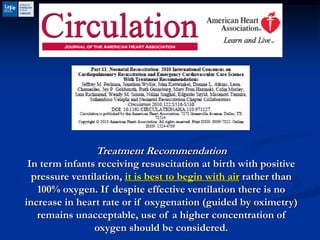
Treatment Recommendation
In term infants receiving resuscitation at birth with positive
pressure ventilation, it is best to begin with air rather than
100% oxygen. If despite effective ventilation there is no
increase in heart rate or if oxygenation (guided by oximetry)
remains unacceptable, use of a higher concentration of
oxygen should be considered.
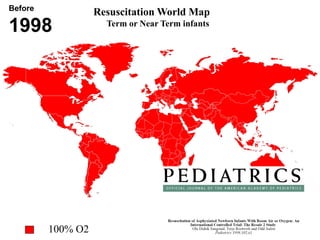
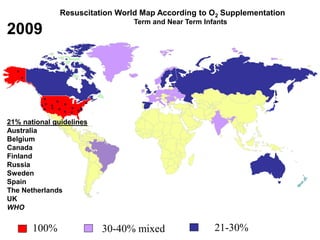
Resuscitation World Map
Term or Near Term infants
100% O2
Before
1998
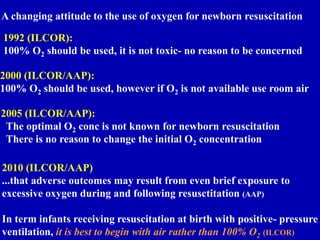
A changing attitude to the use of oxygen for newborn resuscitation
1992 (ILCOR):
100% O2 should be used, it is not toxic- no reason to be concerned
2000 (ILCOR/AAP):
100% O2 should be used, however if O2 is not available use room air
2005 (ILCOR/AAP):
The optimal O2 conc is not known for newborn resuscitation
There is no reason to change the initial O2 concentration
2010 (ILCOR/AAP)
...that adverse outcomes may result from even brief exposure to
excessive oxygen during and following resusctitation (AAP)
In term infants receiving resuscitation at birth with positive- pressure
ventilation, it is best to begin with air rather than 100% O2 (ILCOR)
Resuscitation World Map According to O2 Supplementation
Term and Near Term Infants
100% 30-40% mixed 21-30%
2009
21% national guidelines
Australia
Belgium
Canada
Finland
Russia
Sweden
Spain
The Netherlands
UK
WHO
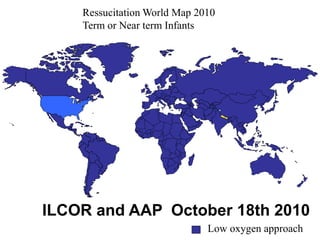
Ressucitation World Map 2010
Term or Near term Infants
Low oxygen approach
ILCOR and AAP October 18th 2010
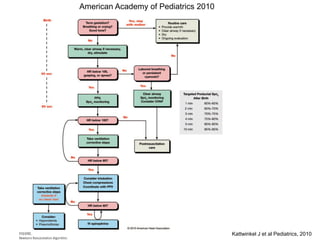
American Academy of Pediatrics 2010
Kattwinkel J et al Pediatrics, 2010
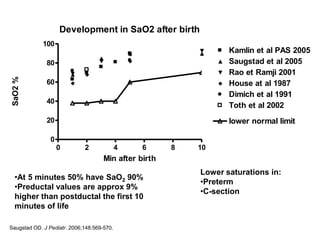
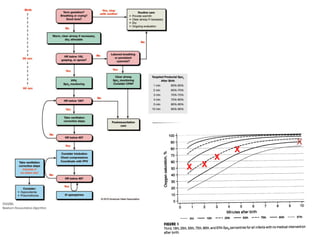
Development in SaO2 after birth
0 2 4 6 8 10
0
20
40
60
80
100
Kamlin et al PAS 2005
Saugstad et al 2005
Rao et Ramji 2001
House at al 1987
Dimich et al 1991
Toth et al 2002
lower normal limit
Min after birth
SaO2
%
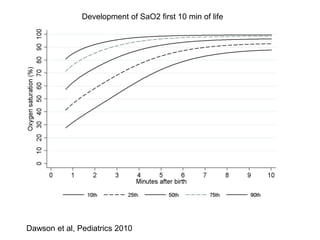
•At 5 minutes 50% have SaO2 90%
•Preductal values are approx 9%
higher than postductal the first 10
minutes of life
Lower saturations in:
•Preterm
•C-section
Saugstad OD. J Pediatr. 2006;148:569-570.
Dawson et al, Pediatrics 2010
Development of SaO2 first 10 min of life
X
X
X
X
X
X
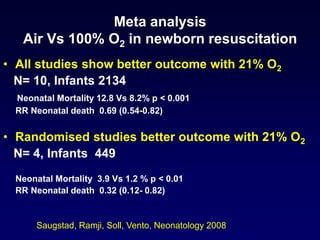
Meta analysis
Air Vs 100% O2 in newborn resuscitation
• All studies show better outcome with 21% O2
N= 10, Infants 2134
Neonatal Mortality 12.8 Vs 8.2% p < 0.001
RR Neonatal death 0.69 (0.54-0.82)
• Randomised studies better outcome with 21% O2
N= 4, Infants 449
Neonatal Mortality 3.9 Vs 1.2 % p < 0.01
RR Neonatal death 0.32 (0.12- 0.82)
Saugstad, Ramji, Soll, Vento, Neonatology 2008
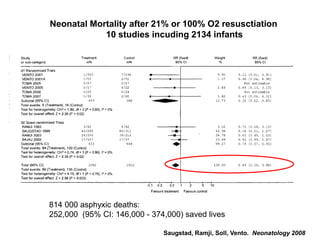
Neonatal Mortality after 21% or 100% O2 resusctiation
10 studies incuding 2134 infants
Saugstad, Ramji, Soll, Vento. Neonatology 2008
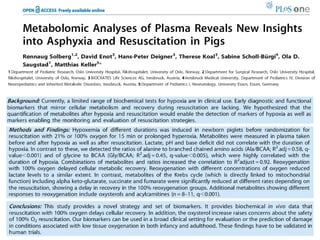
814 000 asphyxic deaths:
252,000 (95% CI: 146,000 - 374,000) saved lives
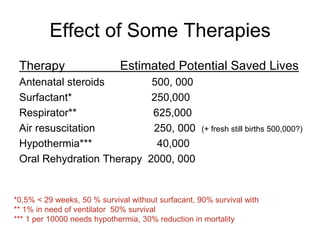
Effect of Some Therapies
Therapy Estimated Potential Saved Lives
Antenatal steroids 500, 000
Surfactant* 250,000
Respirator** 625,000
Air resuscitation 250, 000 (+ fresh still births 500,000?)
Hypothermia*** 40,000
Oral Rehydration Therapy 2000, 000
*0,5% < 29 weeks, 50 % survival without surfacant, 90% survival with
** 1% in need of ventilator 50% survival
*** 1 per 10000 needs hypothermia, 30% reduction in mortality
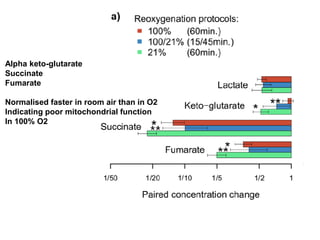
Alpha keto-glutarate
Succinate
Fumarate
Normalised faster in room air than in O2
Indicating poor mitochondrial function
In 100% O2
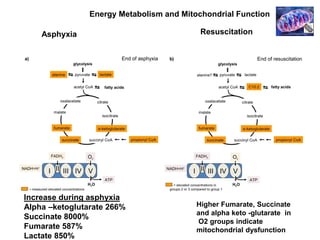
Asphyxia Resuscitation
Higher Fumarate, Succinate
and alpha keto -glutarate in
O2 groups indicate
mitochondrial dysfunction
Increase during asphyxia
Alpha –ketoglutarate 266%
Succinate 8000%
Fumarate 587%
Lactate 850%
Energy Metabolism and Mitochondrial Function
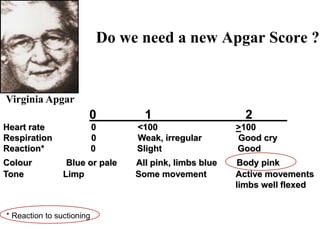
Do we need a new Apgar Score ?
0_______1__________ 2_____
Heart rate 0 <100 >100
Respiration 0 Weak, irregular Good cry
Reaction* 0 Slight Good
Colour Blue or pale All pink, limbs blue Body pink
Tone Limp Some movement Active movements
limbs well flexed
Virginia Apgar
* Reaction to suctioning
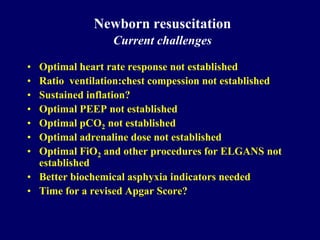
Newborn resuscitation
Current challenges
• Optimal heart rate response not established
• Ratio ventilation:chest compession not established
• Sustained inflation?
• Optimal PEEP not established
• Optimal pCO2 not established
• Optimal adrenaline dose not established
• Optimal FiO2 and other procedures for ELGANS not
established
• Better biochemical asphyxia indicators needed
• Time for a revised Apgar Score?
Thank you for your attention!
Comments – Questions?

Neonatal resusictation Guidelines new Paris

  • 1.
    Ola Didrik SaugstadMD, PhD, FRCPE Professor of Pediatrics Director Department of Pediatric Research Rikshospitalet, Faculty of Medicine University of Oslo NORWAY Update on Neonatal Resuscitation 1st. Global Congress for Consenus In Pediatrics & Child Health, Paris, February 19th 2011
  • 2.
    Birth Asphyxia- theGlobal Burden Resuscitation • 5-8 mill newborn infants need resuscitation 5% moderate and 1% (1,3 million) extensive resuscitation • Optimal resuscitation methods may substantially reduce mortality 136 mill newborn babies each year (WHO World Report)
  • 3.
    Black RE, etal. Lancet. 2010 Jun 5;375(9730):1969-87. Global, regional, and national causes of child mortality in 2008: a systematic analysis. Maternal, and intrapartum related deaths
  • 4.
    Assess baby’s response tobirth Keep baby warm Position, clear airway, stimulate to breathe by drying Give oxygen only if necessary Establish effective ventilation • bag & mask ventilation • endotracheal intubation • Provide chest compressions • Adrenaline Volume expansion 3 – 5/100 1/100-1/700 < 1/1000 6/10 000 1/12000 Interventions in term or near term newborn in the delivery room INTERVENTION FREQUENCY
  • 5.
    Neonatal Resuscitation • Isthe amniotic fluid clear of meconium? • Is the baby breathing or crying? • Is there a good muscle tone? • Is the color pink? • Was the baby born at term? If the answer is no to any of these consider resuscitation The following questions should be answered after every birth: AAP/AHA 2000 XXXXXXXXXXXXXX AHA/ILCOR: 2005 XXXXXXXXXXXXXXXXXXXXXXXXX XXXXXXXXXXX AHA/ILCOR: 2010
  • 6.
    ILCOR Guidelines NewbornResuscitation Changes from 2000 -2005 •More freedom to choose any O2 concentration at initiation of resuscitation •Less need for routine intrapartum suctioning for infants born with meconium staining of amniotic fluid •Occlusive wrapping of very low birth weight infants < 28 weeks to reduce heat loss • Preference for the IV vs endotracheal route for adrenaline/epinephrine •Increased parental autonomy at the treshold of viability
  • 7.
    Birth Term Gestation? Amniotic fluidclear? Breathing or crying? Good muscle tone? Color pink? Evaluate respirations, heart rate and color Provide positive pressure ventilation Continue positive pressure ventilation Administer chest compression Administer Adrenaline and/or volume Consider Supplementary O2 Tracheal intubation may be considered at several steps Breathing Hr> 100 but cyanotic Apneic or HR <100 Persistant cyanosis HR < 60 HR > 60 HR < 60 Saugstad 2006 Adapted from ILCOR 2005 Yes No HR> 100 A B C D Provide warmth Clear airway if needed Dry Assess color
  • 8.
    Vaginally n = 14 Caesareansection n=15 Palme-Kilander, Tunell Arch Dis Childhood,1993 Pulm. Gas Exchange in term infants delivered vaginally or by caesarean section Is 30 seconds sufficient time before you move from ventilation to chest compressions?
  • 9.
    ILCOR Guidelines NewbornResuscitation Changes from 2005 -2010 •Timing the first 60 seconds only •Progression to the next step following initial evaluation is defined by heart rate and respiration •For babies born at term it is best to begin resuscitation with air rather than 100% oxygen • Evidence does not support or refute routine endotracheal suctioning of infants born through meconium-stained amniotic fluid, even when the newborn is depressed • Chest compression- ventilation ratio 3:1 unless the arrest is known to be of cardiac etiology. Then higher ratio should be considered (15:2) •Hypothermia in moderate to severe HIE
  • 10.
    ILCOR Neonatal ResusitationGuidelines 2011 Perlman J et al, Circulation 2010;122 (Suppl 2) S516-538 3 questions: Term, Breathing, Tone Timing: First 60 seconds only Start with air, consider SpO2
  • 11.
    • Initial stepsof stabilisation (assess the airways, positioning, stimulating, dry and provide warmth) • Ventilation (including bag-mask or bag -tube ventilation) • Chest compressions • Medications or volume expansion A B D C Airways Breathing Circulation Drugs ILCOR/AHA 2005 Four Categories
  • 12.
    A: Airways Stabilisation andsuctioning •A vigorous newborn who starts to breath within 10-15 seconds does not need suctioning routinely •Deep suctioning should be avoided especially the first 5 min of life. It may induce apnea, bradycardia and bronchospasm •If suctioning, always suction the mouth before through the nose to minimize risk of aspiration
  • 13.
    Suctioning of upperairways • Routine intrapartum oropharyngeal and nasopharyngeal suctioning for infants born with clear or meconium stained amniotic fluid is no longer recommended ILCOR 2010
  • 14.
    The most importantis to ventilate the lungs. Training is needed B: ventilation Increasing heart rate is the primary sign of effective ventilation during resuscitation What is an adequate heart rate? Observe also: •Improving color •Spontaneous breathing •Improving muscle tone Check these signs of improvement after 30 seconds of PPV. This requires the assistance of another person 50 percentile for heart rate is 99 bpm at one min Dawson et al, 2010
  • 15.
    Assessment if resuscitationis stepped up 3 vital characteristics •Heart rate •Respirations •State of oxygenation ”The most sensitive indicator of successful response to each step is an increase in heart rate”
  • 16.
    Sustained inflation (SI)? ● In babies with GA < 29 weeks SI is tested out ● Different models for instance 5 seconds x 3 or 15 seconds with increasing PIP ● Still experimental
  • 17.
    Initial breaths andpressures • Initiation of intermittent positive- pressure ventilation at birth can be accomplished with either shorter or longer inspiratory times. • Initial peak inflating pressures needed are variable- start with 20 cm H2O may be effective but 30-40 Cm H2O may be needed. • PEEP is likely to be beneficial Heart rate increase is more Important to observe than chest rise
  • 18.
    Assisted ventilation devices Ventilationof the newborn can be performed effectively with a flow-inflating, a self inflating bag or a pressure limited T- piece resuscitator
  • 19.
    Schmolzer G etal ADC-FN 2010 < 32 weeks Face mask (Laerdal) PPV Mask PPV by either T- Piece (Neopuff) Or self inflating (Laerdal) bag Florian Respiratory Monitor (Pressure and flow) Expired tidal volume Is it easy to ventilate a newborn with bag and mask?
  • 20.
    Schmolzer G etal ADC-FN 2010 Face mask leaks % of inspired tidal volume
  • 21.
    C: Circulation Neonatal Resuscitation Chestcompressions - indication Chest compressions should be performed if the heart rate is < 60 beats/minute, despite adequate ventilation for 30 seconds. 3:1 ratio - that is 90:30 ILCOR 2005 0.8 per 1000 term or near term infants 2-10% in preterm infants No Human data have identified an optimal compression to ventilation ratio for cardiopulmonary resuscitation in any age 2 thumb technique is more efficient than the 2 finger technique Lower 1/3 of sternum, pressure to one third of posterior anterior diameter to generate pulses Goals: Reperfuse the heart (obtain diastolic pressure) Reperfuse the Brain Wyckoff et al, Pediatrics 2005:115:950-955 Finer et al Pediatrics 1999;104:428-34 Wyckoff and Berg Seminars Fetal and Neonatal Med 2008;13:410-415
  • 22.
    Time to returnof spontaneous circulation after cardiac arrest 3:1 9:3 0 50 100 150 200 Chest compressions:ventilation ROSC in seconds Solevaag A et al Neonatology 2010 Newborn hypoxic piglets with cardiac arrest:
  • 23.
    D: Drugs Neonatal Resuscitation Adenaline/Epinephrinedose If adequate ventilation and chest compressions have failed to increase heart rate to > 60 bpm, then it is reasonable to use adrenaline despite the lack of human neonatal data. The recommended dose of adrenaline is 0.1 to 0.3 mL/kg IV of a 1:10,000 solution (0.01 to 0.03 mg/kg) repeated every 3 to 5 minutes as indicated. – Not evidence based Higher doses cannot be recommended and may be harmful. If the Endotracehal route is chosen use higher doses (0.05-0.1 mg/kg) No different dose for premature infants
  • 24.
    Adrenaline for newbornresuscitation • 6:10 000 newborns • 0.1-0.3 mL/kg 1:10 000 adrenaline solution • 1st dose at earliest at 6 min of life Barber et al Pediatrics 2006;118:1028-1034
  • 25.
    Neonatal Resuscitation Volume expansion Volumeexpansion may be accomplished with (1) isotonic crystalloid such as normal saline or Ringer’s lactate or (2) O- negative blood. 10ml per kg, can be repeated Needed in 1:12000 term or near term infants (Perlman et al) Insufficient evidence to support routine use In infants with no blood loss.
  • 26.
  • 27.
    Treatment Recommendation In terminfants receiving resuscitation at birth with positive pressure ventilation, it is best to begin with air rather than 100% oxygen. If despite effective ventilation there is no increase in heart rate or if oxygenation (guided by oximetry) remains unacceptable, use of a higher concentration of oxygen should be considered.
  • 28.
    Resuscitation World Map Termor Near Term infants 100% O2 Before 1998
  • 29.
    A changing attitudeto the use of oxygen for newborn resuscitation 1992 (ILCOR): 100% O2 should be used, it is not toxic- no reason to be concerned 2000 (ILCOR/AAP): 100% O2 should be used, however if O2 is not available use room air 2005 (ILCOR/AAP): The optimal O2 conc is not known for newborn resuscitation There is no reason to change the initial O2 concentration 2010 (ILCOR/AAP) ...that adverse outcomes may result from even brief exposure to excessive oxygen during and following resusctitation (AAP) In term infants receiving resuscitation at birth with positive- pressure ventilation, it is best to begin with air rather than 100% O2 (ILCOR)
  • 30.
    Resuscitation World MapAccording to O2 Supplementation Term and Near Term Infants 100% 30-40% mixed 21-30% 2009 21% national guidelines Australia Belgium Canada Finland Russia Sweden Spain The Netherlands UK WHO
  • 31.
    Ressucitation World Map2010 Term or Near term Infants Low oxygen approach ILCOR and AAP October 18th 2010
  • 32.
    American Academy ofPediatrics 2010 Kattwinkel J et al Pediatrics, 2010
  • 33.
    Development in SaO2after birth 0 2 4 6 8 10 0 20 40 60 80 100 Kamlin et al PAS 2005 Saugstad et al 2005 Rao et Ramji 2001 House at al 1987 Dimich et al 1991 Toth et al 2002 lower normal limit Min after birth SaO2 % •At 5 minutes 50% have SaO2 90% •Preductal values are approx 9% higher than postductal the first 10 minutes of life Lower saturations in: •Preterm •C-section Saugstad OD. J Pediatr. 2006;148:569-570.
  • 34.
    Dawson et al,Pediatrics 2010 Development of SaO2 first 10 min of life
  • 35.
  • 36.
    Meta analysis Air Vs100% O2 in newborn resuscitation • All studies show better outcome with 21% O2 N= 10, Infants 2134 Neonatal Mortality 12.8 Vs 8.2% p < 0.001 RR Neonatal death 0.69 (0.54-0.82) • Randomised studies better outcome with 21% O2 N= 4, Infants 449 Neonatal Mortality 3.9 Vs 1.2 % p < 0.01 RR Neonatal death 0.32 (0.12- 0.82) Saugstad, Ramji, Soll, Vento, Neonatology 2008
  • 37.
    Neonatal Mortality after21% or 100% O2 resusctiation 10 studies incuding 2134 infants Saugstad, Ramji, Soll, Vento. Neonatology 2008 814 000 asphyxic deaths: 252,000 (95% CI: 146,000 - 374,000) saved lives
  • 38.
    Effect of SomeTherapies Therapy Estimated Potential Saved Lives Antenatal steroids 500, 000 Surfactant* 250,000 Respirator** 625,000 Air resuscitation 250, 000 (+ fresh still births 500,000?) Hypothermia*** 40,000 Oral Rehydration Therapy 2000, 000 *0,5% < 29 weeks, 50 % survival without surfacant, 90% survival with ** 1% in need of ventilator 50% survival *** 1 per 10000 needs hypothermia, 30% reduction in mortality
  • 40.
    Alpha keto-glutarate Succinate Fumarate Normalised fasterin room air than in O2 Indicating poor mitochondrial function In 100% O2
  • 41.
    Asphyxia Resuscitation Higher Fumarate,Succinate and alpha keto -glutarate in O2 groups indicate mitochondrial dysfunction Increase during asphyxia Alpha –ketoglutarate 266% Succinate 8000% Fumarate 587% Lactate 850% Energy Metabolism and Mitochondrial Function
  • 42.
    Do we needa new Apgar Score ? 0_______1__________ 2_____ Heart rate 0 <100 >100 Respiration 0 Weak, irregular Good cry Reaction* 0 Slight Good Colour Blue or pale All pink, limbs blue Body pink Tone Limp Some movement Active movements limbs well flexed Virginia Apgar * Reaction to suctioning
  • 43.
    Newborn resuscitation Current challenges •Optimal heart rate response not established • Ratio ventilation:chest compession not established • Sustained inflation? • Optimal PEEP not established • Optimal pCO2 not established • Optimal adrenaline dose not established • Optimal FiO2 and other procedures for ELGANS not established • Better biochemical asphyxia indicators needed • Time for a revised Apgar Score?
  • 44.
    Thank you foryour attention! Comments – Questions?