Neonatal Jaundice
Neonatal Jaundice
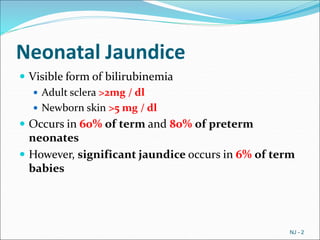
 Visible form of bilirubinemia
 Adult sclera >2mg / dl
 Newborn skin >5 mg / dl
 Occurs in 60% of term and 80% of preterm
neonates
 However, significant jaundice occurs in 6% of term
babies
NJ - 2
NJ - 3
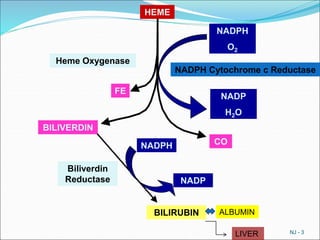
HEME
NADPH
O2
NADPH Cytochrome c Reductase
Heme Oxygenase
NADP
H2O
FE
BILIVERDIN
Biliverdin
Reductase
BILIRUBIN
CO
NADPH
NADP
ALBUMIN
LIVER
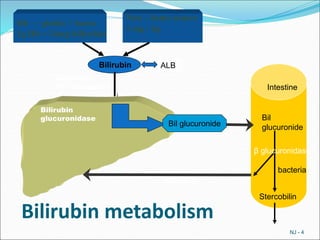
Bilirubin metabolism
NJ - 4
Hb → globin + haem
1g Hb = 34mg bilirubin
Non – heme source
1 mg / kg
Bilirubin
glucuronidase
Bilirubin
Bilirubin
Ligandin
(Y - acceptor)
Bil glucuronide
Intestine
Bil
glucuronide
Stercobilin
bacteria
β glucuronidase
ALB
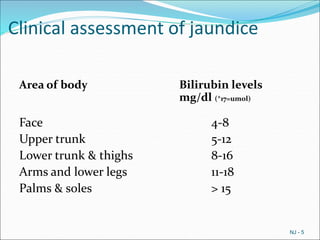
Clinical assessment of jaundice
Area of body Bilirubin levels
mg/dl (*17=umol)
Face 4-8
Upper trunk 5-12
Lower trunk & thighs 8-16
Arms and lower legs 11-18
Palms & soles > 15
NJ - 5
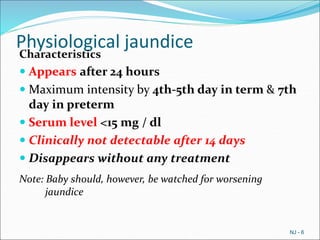
Physiological jaundice
Characteristics
 Appears after 24 hours
 Maximum intensity by 4th-5th day in term & 7th
day in preterm
 Serum level <15 mg / dl
 Clinically not detectable after 14 days
 Disappears without any treatment
Note: Baby should, however, be watched for worsening
jaundice
NJ - 6
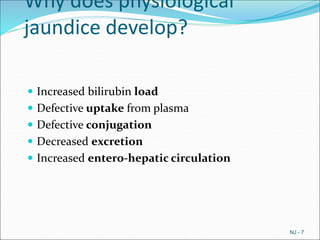
Why does physiological
jaundice develop?
 Increased bilirubin load
 Defective uptake from plasma
 Defective conjugation
 Decreased excretion
 Increased entero-hepatic circulation
NJ - 7
NJ - 8
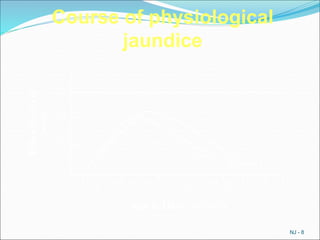
Age in Days
Term
Preterm
1 2 3 4 5 6 10 11 12 13 14
15
10
5
Bilirubin
level
mg/dl
Course of physiological
jaundice
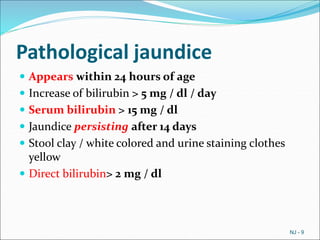
Pathological jaundice
 Appears within 24 hours of age
 Increase of bilirubin > 5 mg / dl / day
 Serum bilirubin > 15 mg / dl
 Jaundice persisting after 14 days
 Stool clay / white colored and urine staining clothes
yellow
 Direct bilirubin> 2 mg / dl
NJ - 9
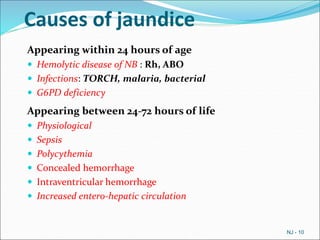
Causes of jaundice
Appearing within 24 hours of age
 Hemolytic disease of NB : Rh, ABO
 Infections: TORCH, malaria, bacterial
 G6PD deficiency
Appearing between 24-72 hours of life
 Physiological
 Sepsis
 Polycythemia
 Concealed hemorrhage
 Intraventricular hemorrhage
 Increased entero-hepatic circulation
NJ - 10
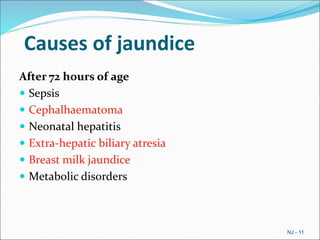
Causes of jaundice
After 72 hours of age
 Sepsis
 Cephalhaematoma
 Neonatal hepatitis
 Extra-hepatic biliary atresia
 Breast milk jaundice
 Metabolic disorders
NJ - 11
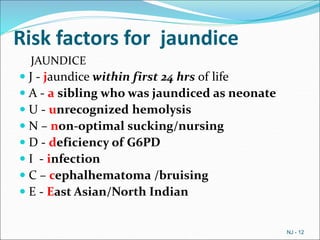
Risk factors for jaundice
JAUNDICE
 J - jaundice within first 24 hrs of life
 A - a sibling who was jaundiced as neonate
 U - unrecognized hemolysis
 N – non-optimal sucking/nursing
 D - deficiency of G6PD
 I - infection
 C – cephalhematoma /bruising
 E - East Asian/North Indian
NJ - 12
Common causes
 Exaggerated physiological
 Blood group incompatibility – ABO,Rh
 G6PD deficiency
 Bruising and cephalhaematoma
 Intrauterine and postnatal infections
 Breast milk jaundice
NJ - 13
Approach to jaundiced baby
 Ascertain birth weight, gestation and postnatal age
 Ask when jaundice was first noticed
 Assess clinical condition (well or ill)
 Decide whether jaundice is physiological or pathological
 Look for evidence of kernicterus* in deeply jaundiced NB
*Lethargy and poor feeding, poor or absent Moro's, opisthotonus
or convulsions
NJ - 14
Workup
 Maternal & perinatal history
 Physical examination
 Laboratory tests (must in all)*
 Total & direct bilirubin*
 Blood group and Rh for mother and baby*
 Hematocrit, retic count and peripheral smear*
 Sepsis screen
 Liver and thyroid function
 TORCH titers, liver scan when conjugated
hyperbilirubinemia
NJ - 15
Management
 Rationale: reduce level of serum bilirubin and prevent
bilirubin toxicity
 Prevention of hyperbilirubinemia: early feeds,
adequate hydration
 Reduction of bilirubin levels: phototherapy, exchange
transfusion, drugs
NJ - 16
Principle of phototherapy
Native bilirubin Photo isomers of bilirubin
Insoluble Soluble
NJ - 17
450-460nm
of light
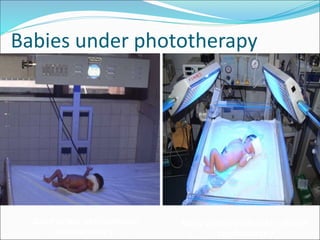
Babies under phototherapy
Baby under conventional
phototherapy
Baby under triple unit intense
phototherapy
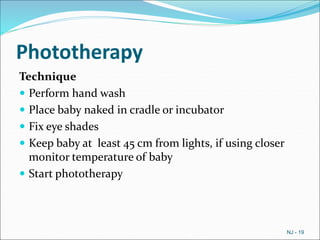
Phototherapy
Technique
 Perform hand wash
 Place baby naked in cradle or incubator
 Fix eye shades
 Keep baby at least 45 cm from lights, if using closer
monitor temperature of baby
 Start phototherapy
NJ - 19
Phototherapy
 Frequent extra breast feeding every 2 hourly
 Turn baby after each feed
 Temperature record 2 to 4 hourly
 Weight record- daily
 Monitor urine frequency
 Monitor bilirubin level
NJ - 20
Side effects of phototherapy
 Increased insensible water loss
 Loose stools
 Skin rash
 Bronze baby syndrome
 Hyperthermia
 Upsets maternal baby interaction
 May result in hypocalcemia
NJ - 21
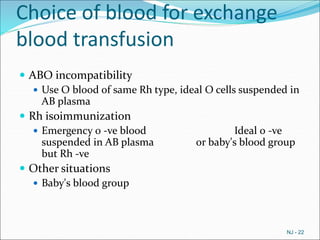
Choice of blood for exchange
blood transfusion
 ABO incompatibility
 Use O blood of same Rh type, ideal O cells suspended in
AB plasma
 Rh isoimmunization
 Emergency 0 -ve blood Ideal 0 -ve
suspended in AB plasma or baby's blood group
but Rh -ve
 Other situations
 Baby's blood group
NJ - 22
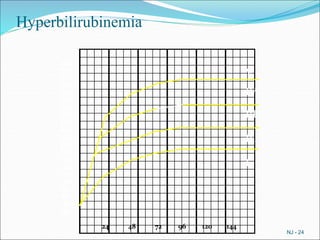
Hyperbilirubinemia
24 48 72 96 120 144
NJ - 24
420
400
380
360
340
320
300
280
260
240
220
200
180
160
140
120
100
80
60
40
20
V.
IV.
III.
II.
I.
NJ - 25
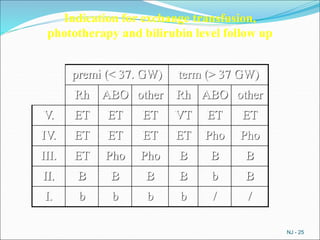
premi (< 37. GW) term (> 37 GW)
Rh ABO other Rh ABO other
V. ET ET ET VT ET ET
IV. ET ET ET ET Pho Pho
III. ET Pho Pho B B B
II. B B B B b B
I. b b b b / /
Indication for exchange transfusion,
phototherapy and bilirubin level follow up
Prolonged indirect jaundice
Causes
 Crigler Najjar syndrome
 Breast milk jaundice
 Hypothyroidism
 Pyloric stenosis
 Ongoing hemolysis, malaria
NJ - 26
Conjugated hyperbilirubinemia
Suspect
 High colored urine
 White or clay colored stool
Caution
Always refer to hospital for investigations so that
biliary atresia or metabolic disorders can be
diagnosed and managed early
NJ - 27
Conjugated hyperbilirubinemia
Causes
 Idiopathic neonatal hepatitis
 Infections -Hepatitis B, TORCH, sepsis
 Biliary atresia, choledochal cyst
 Metabolic -Galactosemia, tyrosinemia,
hypothyroidism
 Total parenteral nutrition
NJ - 28

jaundice-new.ppt

  • 1.
  • 2.
    Neonatal Jaundice  Visibleform of bilirubinemia  Adult sclera >2mg / dl  Newborn skin >5 mg / dl  Occurs in 60% of term and 80% of preterm neonates  However, significant jaundice occurs in 6% of term babies NJ - 2
  • 3.
    NJ - 3 HEME NADPH O2 NADPHCytochrome c Reductase Heme Oxygenase NADP H2O FE BILIVERDIN Biliverdin Reductase BILIRUBIN CO NADPH NADP ALBUMIN LIVER
  • 4.
    Bilirubin metabolism NJ -4 Hb → globin + haem 1g Hb = 34mg bilirubin Non – heme source 1 mg / kg Bilirubin glucuronidase Bilirubin Bilirubin Ligandin (Y - acceptor) Bil glucuronide Intestine Bil glucuronide Stercobilin bacteria β glucuronidase ALB
  • 5.
    Clinical assessment ofjaundice Area of body Bilirubin levels mg/dl (*17=umol) Face 4-8 Upper trunk 5-12 Lower trunk & thighs 8-16 Arms and lower legs 11-18 Palms & soles > 15 NJ - 5
  • 6.
    Physiological jaundice Characteristics  Appearsafter 24 hours  Maximum intensity by 4th-5th day in term & 7th day in preterm  Serum level <15 mg / dl  Clinically not detectable after 14 days  Disappears without any treatment Note: Baby should, however, be watched for worsening jaundice NJ - 6
  • 7.
    Why does physiological jaundicedevelop?  Increased bilirubin load  Defective uptake from plasma  Defective conjugation  Decreased excretion  Increased entero-hepatic circulation NJ - 7
  • 8.
    NJ - 8 Agein Days Term Preterm 1 2 3 4 5 6 10 11 12 13 14 15 10 5 Bilirubin level mg/dl Course of physiological jaundice
  • 9.
    Pathological jaundice  Appearswithin 24 hours of age  Increase of bilirubin > 5 mg / dl / day  Serum bilirubin > 15 mg / dl  Jaundice persisting after 14 days  Stool clay / white colored and urine staining clothes yellow  Direct bilirubin> 2 mg / dl NJ - 9
  • 10.
    Causes of jaundice Appearingwithin 24 hours of age  Hemolytic disease of NB : Rh, ABO  Infections: TORCH, malaria, bacterial  G6PD deficiency Appearing between 24-72 hours of life  Physiological  Sepsis  Polycythemia  Concealed hemorrhage  Intraventricular hemorrhage  Increased entero-hepatic circulation NJ - 10
  • 11.
    Causes of jaundice After72 hours of age  Sepsis  Cephalhaematoma  Neonatal hepatitis  Extra-hepatic biliary atresia  Breast milk jaundice  Metabolic disorders NJ - 11
  • 12.
    Risk factors forjaundice JAUNDICE  J - jaundice within first 24 hrs of life  A - a sibling who was jaundiced as neonate  U - unrecognized hemolysis  N – non-optimal sucking/nursing  D - deficiency of G6PD  I - infection  C – cephalhematoma /bruising  E - East Asian/North Indian NJ - 12
  • 13.
    Common causes  Exaggeratedphysiological  Blood group incompatibility – ABO,Rh  G6PD deficiency  Bruising and cephalhaematoma  Intrauterine and postnatal infections  Breast milk jaundice NJ - 13
  • 14.
    Approach to jaundicedbaby  Ascertain birth weight, gestation and postnatal age  Ask when jaundice was first noticed  Assess clinical condition (well or ill)  Decide whether jaundice is physiological or pathological  Look for evidence of kernicterus* in deeply jaundiced NB *Lethargy and poor feeding, poor or absent Moro's, opisthotonus or convulsions NJ - 14
  • 15.
    Workup  Maternal &perinatal history  Physical examination  Laboratory tests (must in all)*  Total & direct bilirubin*  Blood group and Rh for mother and baby*  Hematocrit, retic count and peripheral smear*  Sepsis screen  Liver and thyroid function  TORCH titers, liver scan when conjugated hyperbilirubinemia NJ - 15
  • 16.
    Management  Rationale: reducelevel of serum bilirubin and prevent bilirubin toxicity  Prevention of hyperbilirubinemia: early feeds, adequate hydration  Reduction of bilirubin levels: phototherapy, exchange transfusion, drugs NJ - 16
  • 17.
    Principle of phototherapy Nativebilirubin Photo isomers of bilirubin Insoluble Soluble NJ - 17 450-460nm of light
  • 18.
    Babies under phototherapy Babyunder conventional phototherapy Baby under triple unit intense phototherapy
  • 19.
    Phototherapy Technique  Perform handwash  Place baby naked in cradle or incubator  Fix eye shades  Keep baby at least 45 cm from lights, if using closer monitor temperature of baby  Start phototherapy NJ - 19
  • 20.
    Phototherapy  Frequent extrabreast feeding every 2 hourly  Turn baby after each feed  Temperature record 2 to 4 hourly  Weight record- daily  Monitor urine frequency  Monitor bilirubin level NJ - 20
  • 21.
    Side effects ofphototherapy  Increased insensible water loss  Loose stools  Skin rash  Bronze baby syndrome  Hyperthermia  Upsets maternal baby interaction  May result in hypocalcemia NJ - 21
  • 22.
    Choice of bloodfor exchange blood transfusion  ABO incompatibility  Use O blood of same Rh type, ideal O cells suspended in AB plasma  Rh isoimmunization  Emergency 0 -ve blood Ideal 0 -ve suspended in AB plasma or baby's blood group but Rh -ve  Other situations  Baby's blood group NJ - 22
  • 23.
    Hyperbilirubinemia 24 48 7296 120 144 NJ - 24 420 400 380 360 340 320 300 280 260 240 220 200 180 160 140 120 100 80 60 40 20 V. IV. III. II. I.
  • 24.
    NJ - 25 premi(< 37. GW) term (> 37 GW) Rh ABO other Rh ABO other V. ET ET ET VT ET ET IV. ET ET ET ET Pho Pho III. ET Pho Pho B B B II. B B B B b B I. b b b b / / Indication for exchange transfusion, phototherapy and bilirubin level follow up
  • 25.
    Prolonged indirect jaundice Causes Crigler Najjar syndrome  Breast milk jaundice  Hypothyroidism  Pyloric stenosis  Ongoing hemolysis, malaria NJ - 26
  • 26.
    Conjugated hyperbilirubinemia Suspect  Highcolored urine  White or clay colored stool Caution Always refer to hospital for investigations so that biliary atresia or metabolic disorders can be diagnosed and managed early NJ - 27
  • 27.
    Conjugated hyperbilirubinemia Causes  Idiopathicneonatal hepatitis  Infections -Hepatitis B, TORCH, sepsis  Biliary atresia, choledochal cyst  Metabolic -Galactosemia, tyrosinemia, hypothyroidism  Total parenteral nutrition NJ - 28