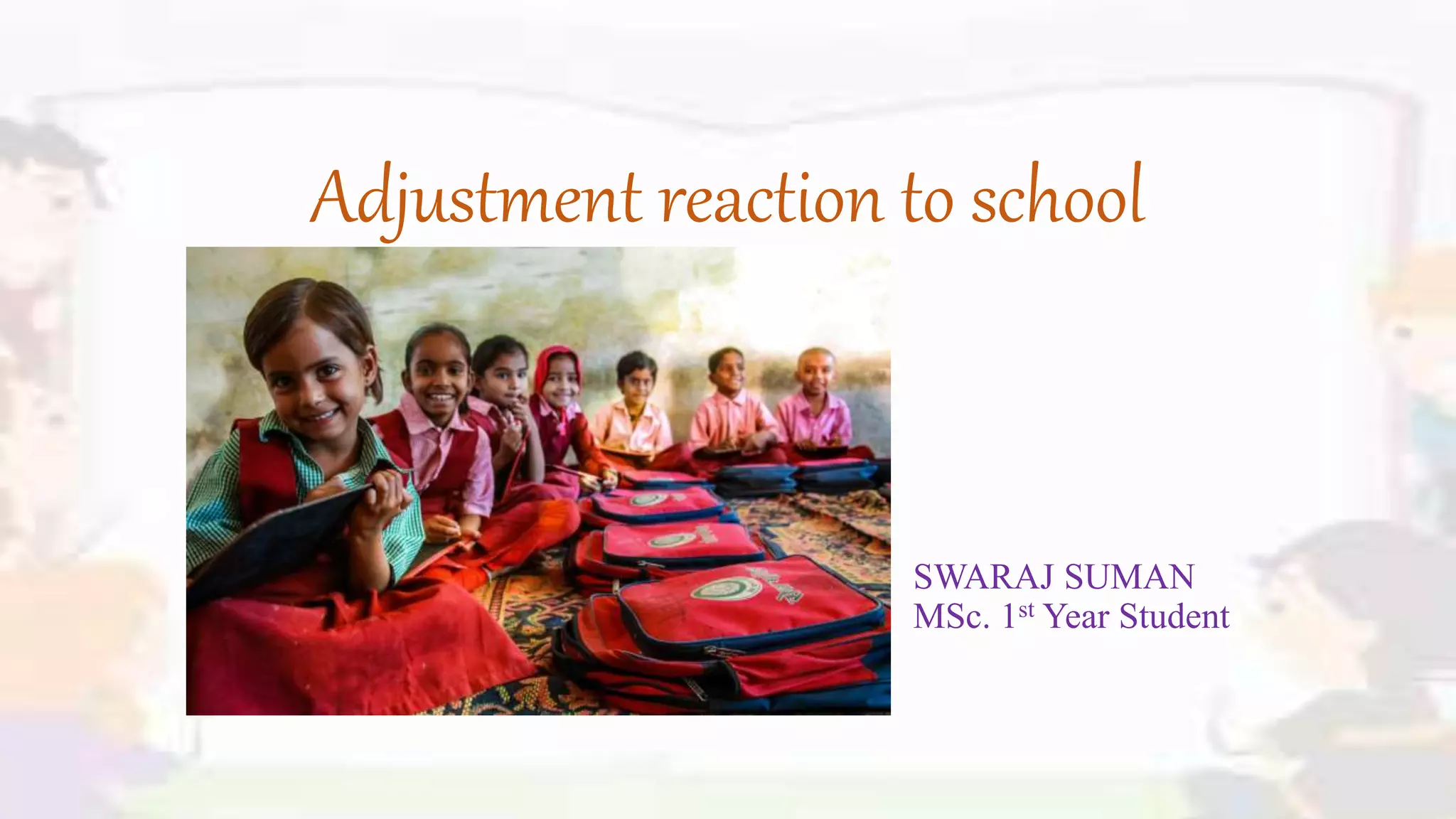
Adjustment reaction to school
SWARAJ SUMAN
MSc. 1st Year Student
INTRODUCTION
• School adjustment refers to children’s interest and comfort in the
school setting, school engagement, and school achievement (Ladd,
1996).
• The concept of school adjustment is associated with other aspects
of children’s education processes including children’s perceptions
of the school environment, school experiences, school
engagement, school readiness, and school performance.
Definition
An adjustment disorder is an abnormal, debilitating and
excessive reaction usually lasting less than six months
to a life stress such as starting school, experiencing
grief.
•
Definition
•A school adjustment disorder is defined as
problems in adapting to the school
environment or to the role of being a student.
•According to Mathur (1999), children’s
abilities, skills, adjustment characteristics,
and interpersonal environment underlie
their school adjustment process.
TYPES
• The types of school adjustment problems that include:
• School Refusal- Unwillingness to attend school, or dropping out of
school
• Academic Difficulties- Problems completing assignments, poor
study habits, poor performance on tests, grades dropping
• Unusual Emotional Reactions- Anxiety, depression, lack of
motivation, disinterest, anger
• Interpersonal Problems- Negative attitude towards others, acting-
out behavior, fighting, oppositional or defiant with teachers
• Loneliness & Social Isolation- Shyness, introversion, disinterest
socially
Defence Mechanisms
These are unconscious psychological strategies brought into play by
various entities to cope with reality and maintain self image.
 Rationalisation
Projection
Introjection
Identification
Isolation
Sublimation
Causes:
a) Strange feeling
b) Unfamiliarity
c) Change in environment
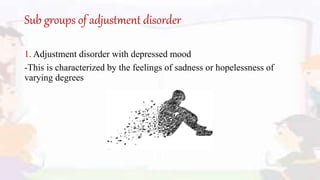
Sub groups of adjustment disorder
1. Adjustment disorder with depressed mood
-This is characterized by the feelings of sadness or hopelessness of
varying degrees
2. Adjustment disorder with Anxiety
-It typically includes agitation or nervous behavior or obsessive
worrying.
3. Adjustment disorder with mixed anxiety and depressed mood.
4. Adjustment disorder with disturbance of conduct.
5. Adjustment disorder with mixed disturbance of emotions and
conduct
6. Unspecified adjustment disorder.
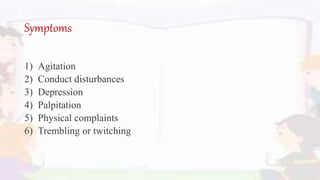
Symptoms
1) Agitation
2) Conduct disturbances
3) Depression
4) Palpitation
5) Physical complaints
6) Trembling or twitching
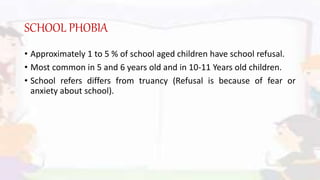
SCHOOL PHOBIA
• Approximately 1 to 5 % of school aged children have school refusal.
• Most common in 5 and 6 years old and in 10-11 Years old children.
• School refers differs from truancy (Refusal is because of fear or
anxiety about school).
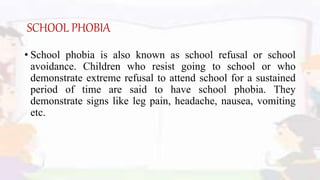
SCHOOL PHOBIA
• School phobia is also known as school refusal or school
avoidance. Children who resist going to school or who
demonstrate extreme refusal to attend school for a sustained
period of time are said to have school phobia. They
demonstrate signs like leg pain, headache, nausea, vomiting
etc.
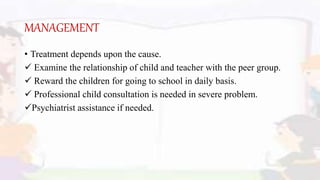
MANAGEMENT
• Treatment depends upon the cause.
 Examine the relationship of child and teacher with the peer group.
 Reward the children for going to school in daily basis.
 Professional child consultation is needed in severe problem.
Psychiatrist assistance if needed.
Diagnosis
• Diagnosis by a specialist service, which may include a pediatrician, psychologist
or child psychiatrist
• In-depth interviews with the parents, child and teachers
• Behavior check lists or standardized questionnaires.
• The child being evaluated for an adjustment disorder needs to meet the following
criteria in order to confirm the diagnosis.
1) Has had a psychological evaluation .
2) The symptoms clearly follow a stressor .
3) Shows the symptoms that appear disproportionate to the stress-full event
4) Does not appear to be suffering from any other underlying mental or physical
illness.
Treatment
Treatment depends upon the age and overall health of the child as well
as the severity of the symptoms. It includes -
a) Behavior therapy
b) Individual psycho therapy
c) Family therapy
d) Self-help group
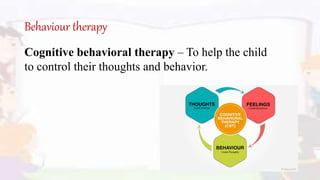
Behaviour therapy
Cognitive behavioral therapy – To help the child
to control their thoughts and behavior.
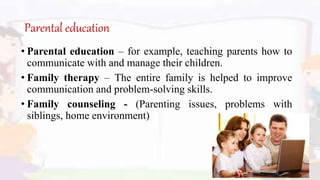
Parental education
• Parental education – for example, teaching parents how to
communicate with and manage their children.
• Family therapy – The entire family is helped to improve
communication and problem-solving skills.
• Family counseling - (Parenting issues, problems with
siblings, home environment)
• Social training – the child is taught important social skills,
such as how to have a conversation or play cooperatively with
others.
• Anger management – the child is taught how to recognize the
signs of their growing frustration and given a range of coping
skills designed to defuse their anger and aggressive behavior.
• Relaxation techniques and stress management skills are also
taught.
• Individual counseling- To help children and adolescents with
the developmental challenges faced by many students
• School adjustment counseling is very effective in helping
children and adolescents become confident, motivated and
successful academically and interpersonally.
• The school adjustment specialists- work closely with children,
their parents and teachers to develop the most effective,
personalized plan to improve any aspect of academic and social
functioning.
Our approach to school adjustment counseling includes: -
• Consultation with School teachers and administration to
provide appropriate support services
• Contribute to an IEP (Individualized Education Plan) when
necessary.
• Treat emotional and psychological problems associated with
school performance problems.
Prognosis
Adjustment disorders usually get better quickly without any
remaining symptoms.
Prevention: There is no known way to prevent this disorder.
Strong support from friends and family can help.
School adjustment of first-grade primary school students: Effects of
family involvement, externalizing behavior, teacher and peer
relations
• Selen Demirtaş Zorbaz and Tuncay Ergene 2019
Adjusting to school contributes to the healthy introduction of all educational activities. For this reason, it is important to
determine all facilitating and debilitating factors to the school adjustment process and to develop preventive studies for
overcoming school adjustment. The purpose of this study is to determine the factors affecting the school adjustment of first-
grade primary school students based on an ecological approach. The study group consisted of 81 teachers and 517 parents.
Methodology-The data were gathered for 517 children aged between 64 months and 98 months from public schools located
in the central districts of Ankara in the 2015–2016 academic year. Structural equation modeling was used in the present
study.
Results- Thus, according to the School Adjustment Model, externalizing behaviors, teacher–student relationship, and peer
relations have a significant direct impact on first-grade students’ school adjustment, whereas family involvement has no
statistically significant direct influence on first-grade students’ school adjustment. In addition, externalizing behaviors affect
school adjustment through the mediating role of teacher–student relationship and peer relations. Also, the total effect of the
externalizing behavior variable on school adjustment is −0.55. The student-teacher relationship (B = 0.53) and peer
relationship (B = 0.48) variables have also had an effect on school adjustment.
Adjustment reaction to school.pptx

Adjustment reaction to school.pptx

  • 1.
    Adjustment reaction toschool SWARAJ SUMAN MSc. 1st Year Student
  • 2.
    INTRODUCTION • School adjustmentrefers to children’s interest and comfort in the school setting, school engagement, and school achievement (Ladd, 1996). • The concept of school adjustment is associated with other aspects of children’s education processes including children’s perceptions of the school environment, school experiences, school engagement, school readiness, and school performance.
  • 3.
    Definition An adjustment disorderis an abnormal, debilitating and excessive reaction usually lasting less than six months to a life stress such as starting school, experiencing grief. •
  • 4.
    Definition •A school adjustmentdisorder is defined as problems in adapting to the school environment or to the role of being a student. •According to Mathur (1999), children’s abilities, skills, adjustment characteristics, and interpersonal environment underlie their school adjustment process.
  • 5.
    TYPES • The typesof school adjustment problems that include: • School Refusal- Unwillingness to attend school, or dropping out of school • Academic Difficulties- Problems completing assignments, poor study habits, poor performance on tests, grades dropping • Unusual Emotional Reactions- Anxiety, depression, lack of motivation, disinterest, anger • Interpersonal Problems- Negative attitude towards others, acting- out behavior, fighting, oppositional or defiant with teachers • Loneliness & Social Isolation- Shyness, introversion, disinterest socially
  • 6.
    Defence Mechanisms These areunconscious psychological strategies brought into play by various entities to cope with reality and maintain self image.  Rationalisation Projection Introjection Identification Isolation Sublimation
  • 7.
    Causes: a) Strange feeling b)Unfamiliarity c) Change in environment
  • 8.
    Sub groups ofadjustment disorder 1. Adjustment disorder with depressed mood -This is characterized by the feelings of sadness or hopelessness of varying degrees
  • 9.
    2. Adjustment disorderwith Anxiety -It typically includes agitation or nervous behavior or obsessive worrying. 3. Adjustment disorder with mixed anxiety and depressed mood. 4. Adjustment disorder with disturbance of conduct. 5. Adjustment disorder with mixed disturbance of emotions and conduct 6. Unspecified adjustment disorder.
  • 10.
    Symptoms 1) Agitation 2) Conductdisturbances 3) Depression 4) Palpitation 5) Physical complaints 6) Trembling or twitching
  • 11.
    SCHOOL PHOBIA • Approximately1 to 5 % of school aged children have school refusal. • Most common in 5 and 6 years old and in 10-11 Years old children. • School refers differs from truancy (Refusal is because of fear or anxiety about school).
  • 12.
    SCHOOL PHOBIA • Schoolphobia is also known as school refusal or school avoidance. Children who resist going to school or who demonstrate extreme refusal to attend school for a sustained period of time are said to have school phobia. They demonstrate signs like leg pain, headache, nausea, vomiting etc.
  • 13.
    MANAGEMENT • Treatment dependsupon the cause.  Examine the relationship of child and teacher with the peer group.  Reward the children for going to school in daily basis.  Professional child consultation is needed in severe problem. Psychiatrist assistance if needed.
  • 14.
    Diagnosis • Diagnosis bya specialist service, which may include a pediatrician, psychologist or child psychiatrist • In-depth interviews with the parents, child and teachers • Behavior check lists or standardized questionnaires. • The child being evaluated for an adjustment disorder needs to meet the following criteria in order to confirm the diagnosis. 1) Has had a psychological evaluation . 2) The symptoms clearly follow a stressor . 3) Shows the symptoms that appear disproportionate to the stress-full event 4) Does not appear to be suffering from any other underlying mental or physical illness.
  • 15.
    Treatment Treatment depends uponthe age and overall health of the child as well as the severity of the symptoms. It includes - a) Behavior therapy b) Individual psycho therapy c) Family therapy d) Self-help group
  • 16.
    Behaviour therapy Cognitive behavioraltherapy – To help the child to control their thoughts and behavior.
  • 17.
    Parental education • Parentaleducation – for example, teaching parents how to communicate with and manage their children. • Family therapy – The entire family is helped to improve communication and problem-solving skills. • Family counseling - (Parenting issues, problems with siblings, home environment)
  • 18.
    • Social training– the child is taught important social skills, such as how to have a conversation or play cooperatively with others. • Anger management – the child is taught how to recognize the signs of their growing frustration and given a range of coping skills designed to defuse their anger and aggressive behavior. • Relaxation techniques and stress management skills are also taught. • Individual counseling- To help children and adolescents with the developmental challenges faced by many students
  • 19.
    • School adjustmentcounseling is very effective in helping children and adolescents become confident, motivated and successful academically and interpersonally. • The school adjustment specialists- work closely with children, their parents and teachers to develop the most effective, personalized plan to improve any aspect of academic and social functioning.
  • 20.
    Our approach toschool adjustment counseling includes: - • Consultation with School teachers and administration to provide appropriate support services • Contribute to an IEP (Individualized Education Plan) when necessary. • Treat emotional and psychological problems associated with school performance problems.
  • 21.
    Prognosis Adjustment disorders usuallyget better quickly without any remaining symptoms. Prevention: There is no known way to prevent this disorder. Strong support from friends and family can help.
  • 22.
    School adjustment offirst-grade primary school students: Effects of family involvement, externalizing behavior, teacher and peer relations • Selen Demirtaş Zorbaz and Tuncay Ergene 2019 Adjusting to school contributes to the healthy introduction of all educational activities. For this reason, it is important to determine all facilitating and debilitating factors to the school adjustment process and to develop preventive studies for overcoming school adjustment. The purpose of this study is to determine the factors affecting the school adjustment of first- grade primary school students based on an ecological approach. The study group consisted of 81 teachers and 517 parents. Methodology-The data were gathered for 517 children aged between 64 months and 98 months from public schools located in the central districts of Ankara in the 2015–2016 academic year. Structural equation modeling was used in the present study. Results- Thus, according to the School Adjustment Model, externalizing behaviors, teacher–student relationship, and peer relations have a significant direct impact on first-grade students’ school adjustment, whereas family involvement has no statistically significant direct influence on first-grade students’ school adjustment. In addition, externalizing behaviors affect school adjustment through the mediating role of teacher–student relationship and peer relations. Also, the total effect of the externalizing behavior variable on school adjustment is −0.55. The student-teacher relationship (B = 0.53) and peer relationship (B = 0.48) variables have also had an effect on school adjustment.