NEOLIBERALIS
M
NEOLIBERALISM
DEFINITION
WHAT IS NEOLIBERALISM?
NEOLIBERAL THEORY
A largely unregulated capitalist system not only embodies the
ideal of free individual choice but also achieves optimum
economic
performance with respect to efficiency, economic growth,
technical
progress, and distributional justice.

“The state is assigned a very limited economic role:
WHAT IS NEOLIBERALISM?
It is essentially about making trade
between nations easier.
It is about freer movement of goods, resources
and
enterprises to maximize profits and efficiency.
CRITICAL ANALYSIS
DISPARITY BETWEEN THE THEORY OF
NEOLIBERALISM AND THE PRAGMATICS OF
NEOLIBERALISM




Principles of neoclassical economics vs political
commitment to individual freedom
Distrust of state power vs the need for an authority to
defend rights of private property, individual liberties and
entrepreneurial freedom.
CRITICAL ANALYSIS
RESTORATION OF POWER


Gerard Dumenil and Dominique Levy have concluded
that neoliberalization was, from the very beginning, a
project to achieve the restoration of class power.




1970‟s capital accumulation crisis: There were clear political
and economic threats to elites and ruling classes everywhere.
They had to move decisively to protect themselves from
political and economic annihilation.
After the implementation of neoliberal policies in the late
1970‟s, extraordinary surges in income inequalities and wealth
occurred in the US, Britain, Russia, China and Mexico.
CRITICAL ANALYSIS
RESTORATION OF POWER


The rich and powerful of the world have formed somewhat of an
informal alliance with one another in order to protect their mutual
interests and maintain their dominance. They “posses a certain
accordance of interests that generally recognizes the advantages to
be derived from neoliberalization.”



We can even go as far as to say that a political consensus has been
reached; that governments throughout the world have fully
embraced the neoliberal policy agenda.
CRITICAL ANALYSIS
POVERTY, OVERPRODUCTION AND LOCAL
DISINTEGRATION




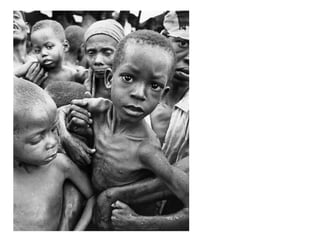
Harsh economic measures have resulted in the
gradual disintegration of the Welfare State.
Because of the large accumulation of public debts
in western countries, the financial elites have been
given the power to dictate government economic
and social policy.
CRITICAL ANALYSIS
POVERTY, OVERPRODUCTION AND LOCAL
DISINTEGRATION


This economic restructuring has made the divide between
different social and ethnic groups even deeper. Moreover, it
has increased the potential capacity of the economic system
and expanded levels of production without reducing poverty
significantly.





Micro-Efficiency = Macro-Insufficiency:
Global oversupply of commodities: a result of the unlimited capacity to
produce and the limited capacity to consume.

In developing countries, entire branches of industry producing
for the internal market are driven into bankruptcy on the
orders of the WB and IMF
CRITICAL ANALYSIS
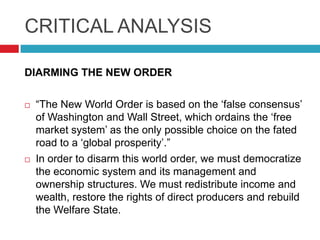
DIARMING THE NEW ORDER




“The New World Order is based on the „false consensus‟
of Washington and Wall Street, which ordains the „free
market system‟ as the only possible choice on the fated
road to a „global prosperity‟.”
In order to disarm this world order, we must democratize
the economic system and its management and
ownership structures. We must redistribute income and
wealth, restore the rights of direct producers and rebuild
the Welfare State.
NEOLIBERALISM
IN THE PHILIPPINE CONTEXT
PHILIPPINE CONTEXT
Payne-Aldrich Act of 1909






Allowed unlimited quantities of all kinds of U.S.
Goods to enter the Philippines freely
Importing U.S. goods became an obligation for the
Philippines
Philippine exports to the U.S. were given particular
quota restrictions
PHILIPPINE CONTEXT
1946 Bell Trade Act
1954 Laurel-Langley Agreement




Provisions of this act tied the Philippine
economy to the economy of the United States.
Despite the nominal independence of the
Philippines at that time, these established free
trade with the U.S., so neocolonial patterns
were sustained.
PHILIPPINE CONTEXT
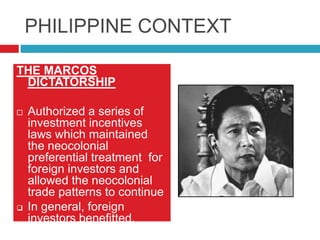
THE MARCOS
DICTATORSHIP




Authorized a series of
investment incentives
laws which maintained
the neocolonial
preferential treatment for
foreign investors and
allowed the neocolonial
trade patterns to continue
In general, foreign
investors benefitted.
PHILIPPINE CONEXT
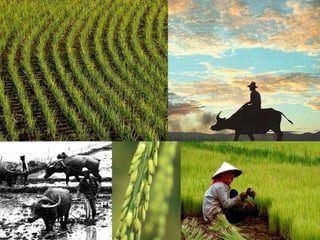
AGRICULTURE
Background Information






1/3 of the land area of
the Philippines is fertile
and can be used for
agriculture
The Philippine economy
is predominantly agrarian
Agriculture, fishery, and
forestry contributed to
almost 20% to the
GDP[Gross Domestic
Product]
PHILIPPINE CONTEXT
HOW TRADE LIBERALIZATION UNDER THE WTO HAS AFFECTED IT






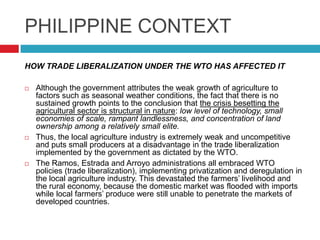
Although the government attributes the weak growth of agriculture to
factors such as seasonal weather conditions, the fact that there is no
sustained growth points to the conclusion that the crisis besetting the
agricultural sector is structural in nature: low level of technology, small
economies of scale, rampant landlessness, and concentration of land
ownership among a relatively small elite.
Thus, the local agriculture industry is extremely weak and uncompetitive
and puts small producers at a disadvantage in the trade liberalization
implemented by the government as dictated by the WTO.
The Ramos, Estrada and Arroyo administrations all embraced WTO
policies (trade liberalization), implementing privatization and deregulation in
the local agriculture industry. This devastated the farmers‟ livelihood and
the rural economy, because the domestic market was flooded with imports
while local farmers‟ produce were still unable to penetrate the markets of
developed countries.
PHILIPPINE CONTEXT
INDUSTRY
Background Information:
In 2004, 33% of the Philippines‟ GDP came from the industry sector
How Trade Liberalization under the WTO has affected it

The government‟s policy of attracting foreign investments increased foreign
dominance in Philippine industries.

Footwear, apparel, rubber, textile, glass, tires, paper, wood, cement, and steel
manufacturers in the country all suffered from imports and low tariffs.

Many local companies were forced to downsize/close because of the foreign
competition.

Many workers were laid off or force to go on rotation

45.1% of workers in January to March 2004 were displaced because of
reorganization, downsizing, and change in management (merger). 8 establishments
reduced their number of workers or closed down every day, and 196 workers were
displaced daily.

In July 2004, approximately 2,688 Filipinos left the country everyday.
PHILIPPINE CONTEXT
SERVICES
Background Information:
Roughly 44% of the Philippines‟ GDP is from the Service Sector
How Trade Liberalization under the WTO has affected it

The Philippines has committed under the GATS to bind all restrictions on market
access and has applied national treatment on foreign investors and suppliers in
financial services

The Privatization and Commercialization of social services is a burden to average
Filipinos.

Rates for vital utilities increase, making them less accessible.

Many families could not pay for healthcare in Public Hospitals.

Education became so costly because of the privatization of state colleges and
universities.

Local service providers are marginalized because of the liberalization under GATS.

Capital has become concentrated on foreigners, through TNC‟s.

Neoliberalism

  • 1.
  • 2.
  • 3.
    WHAT IS NEOLIBERALISM? NEOLIBERALTHEORY A largely unregulated capitalist system not only embodies the ideal of free individual choice but also achieves optimum economic performance with respect to efficiency, economic growth, technical progress, and distributional justice. “The state is assigned a very limited economic role:
  • 4.
    WHAT IS NEOLIBERALISM? Itis essentially about making trade between nations easier. It is about freer movement of goods, resources and enterprises to maximize profits and efficiency.
  • 6.
    CRITICAL ANALYSIS DISPARITY BETWEENTHE THEORY OF NEOLIBERALISM AND THE PRAGMATICS OF NEOLIBERALISM   Principles of neoclassical economics vs political commitment to individual freedom Distrust of state power vs the need for an authority to defend rights of private property, individual liberties and entrepreneurial freedom.
  • 7.
    CRITICAL ANALYSIS RESTORATION OFPOWER  Gerard Dumenil and Dominique Levy have concluded that neoliberalization was, from the very beginning, a project to achieve the restoration of class power.   1970‟s capital accumulation crisis: There were clear political and economic threats to elites and ruling classes everywhere. They had to move decisively to protect themselves from political and economic annihilation. After the implementation of neoliberal policies in the late 1970‟s, extraordinary surges in income inequalities and wealth occurred in the US, Britain, Russia, China and Mexico.
  • 9.
    CRITICAL ANALYSIS RESTORATION OFPOWER  The rich and powerful of the world have formed somewhat of an informal alliance with one another in order to protect their mutual interests and maintain their dominance. They “posses a certain accordance of interests that generally recognizes the advantages to be derived from neoliberalization.”  We can even go as far as to say that a political consensus has been reached; that governments throughout the world have fully embraced the neoliberal policy agenda.
  • 10.
    CRITICAL ANALYSIS POVERTY, OVERPRODUCTIONAND LOCAL DISINTEGRATION   Harsh economic measures have resulted in the gradual disintegration of the Welfare State. Because of the large accumulation of public debts in western countries, the financial elites have been given the power to dictate government economic and social policy.
  • 12.
    CRITICAL ANALYSIS POVERTY, OVERPRODUCTIONAND LOCAL DISINTEGRATION  This economic restructuring has made the divide between different social and ethnic groups even deeper. Moreover, it has increased the potential capacity of the economic system and expanded levels of production without reducing poverty significantly.    Micro-Efficiency = Macro-Insufficiency: Global oversupply of commodities: a result of the unlimited capacity to produce and the limited capacity to consume. In developing countries, entire branches of industry producing for the internal market are driven into bankruptcy on the orders of the WB and IMF
  • 13.
    CRITICAL ANALYSIS DIARMING THENEW ORDER   “The New World Order is based on the „false consensus‟ of Washington and Wall Street, which ordains the „free market system‟ as the only possible choice on the fated road to a „global prosperity‟.” In order to disarm this world order, we must democratize the economic system and its management and ownership structures. We must redistribute income and wealth, restore the rights of direct producers and rebuild the Welfare State.
  • 14.
  • 15.
    PHILIPPINE CONTEXT Payne-Aldrich Actof 1909    Allowed unlimited quantities of all kinds of U.S. Goods to enter the Philippines freely Importing U.S. goods became an obligation for the Philippines Philippine exports to the U.S. were given particular quota restrictions
  • 16.
    PHILIPPINE CONTEXT 1946 BellTrade Act 1954 Laurel-Langley Agreement   Provisions of this act tied the Philippine economy to the economy of the United States. Despite the nominal independence of the Philippines at that time, these established free trade with the U.S., so neocolonial patterns were sustained.
  • 17.
    PHILIPPINE CONTEXT THE MARCOS DICTATORSHIP   Authorizeda series of investment incentives laws which maintained the neocolonial preferential treatment for foreign investors and allowed the neocolonial trade patterns to continue In general, foreign investors benefitted.
  • 18.
    PHILIPPINE CONEXT AGRICULTURE Background Information    1/3of the land area of the Philippines is fertile and can be used for agriculture The Philippine economy is predominantly agrarian Agriculture, fishery, and forestry contributed to almost 20% to the GDP[Gross Domestic Product]
  • 20.
    PHILIPPINE CONTEXT HOW TRADELIBERALIZATION UNDER THE WTO HAS AFFECTED IT    Although the government attributes the weak growth of agriculture to factors such as seasonal weather conditions, the fact that there is no sustained growth points to the conclusion that the crisis besetting the agricultural sector is structural in nature: low level of technology, small economies of scale, rampant landlessness, and concentration of land ownership among a relatively small elite. Thus, the local agriculture industry is extremely weak and uncompetitive and puts small producers at a disadvantage in the trade liberalization implemented by the government as dictated by the WTO. The Ramos, Estrada and Arroyo administrations all embraced WTO policies (trade liberalization), implementing privatization and deregulation in the local agriculture industry. This devastated the farmers‟ livelihood and the rural economy, because the domestic market was flooded with imports while local farmers‟ produce were still unable to penetrate the markets of developed countries.
  • 21.
    PHILIPPINE CONTEXT INDUSTRY Background Information: In2004, 33% of the Philippines‟ GDP came from the industry sector How Trade Liberalization under the WTO has affected it  The government‟s policy of attracting foreign investments increased foreign dominance in Philippine industries.  Footwear, apparel, rubber, textile, glass, tires, paper, wood, cement, and steel manufacturers in the country all suffered from imports and low tariffs.  Many local companies were forced to downsize/close because of the foreign competition.  Many workers were laid off or force to go on rotation  45.1% of workers in January to March 2004 were displaced because of reorganization, downsizing, and change in management (merger). 8 establishments reduced their number of workers or closed down every day, and 196 workers were displaced daily.  In July 2004, approximately 2,688 Filipinos left the country everyday.
  • 22.
    PHILIPPINE CONTEXT SERVICES Background Information: Roughly44% of the Philippines‟ GDP is from the Service Sector How Trade Liberalization under the WTO has affected it  The Philippines has committed under the GATS to bind all restrictions on market access and has applied national treatment on foreign investors and suppliers in financial services  The Privatization and Commercialization of social services is a burden to average Filipinos.  Rates for vital utilities increase, making them less accessible.  Many families could not pay for healthcare in Public Hospitals.  Education became so costly because of the privatization of state colleges and universities.  Local service providers are marginalized because of the liberalization under GATS.  Capital has become concentrated on foreigners, through TNC‟s.