
THE GLOBAL CITIES
Sir Malit
THE RISE OF THE CITIES
The term civilization
come from the Latin
word civis, meaning “a
person living in a city.”
THE RISE OF CITIES IS LINKED TO THE
FOLLOWING FACTORS:
Agricultural improvement
that reduce the number of
workers needed for food
production.
Stabilization of political and
economic institutions, which
enhance safety and
distribution of goods and
services.
Improvements in the
transportation and
communication, which enhance
trade and social interactions
among large number of people.
The rise of industrial and
postindustrial economies, which
demand concentrated
populations to provide labor
and services.
URBANIZATION AND HUMAN ECOLOGY
Urbanization refers to the
movement of masses of people
from rural to urban areas and an
increase in urban influence over all
spheres of culture and society.
PATTERNS OF URBAN DEVELOPMENT
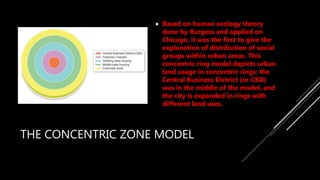
THE CONCENTRIC ZONE MODEL
 Based on human ecology theory
done by Burgess and applied on
Chicago, it was the first to give the
explanation of distribution of social
groups within urban areas. This
concentric ring model depicts urban
land usage in concentric rings: the
Central Business District (or CBD)
was in the middle of the model, and
the city is expanded in rings with
different land uses.
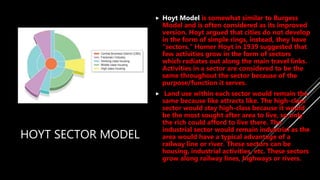
HOYT SECTOR MODEL
 Hoyt Model is somewhat similar to Burgess
Model and is often considered as its improved
version. Hoyt argued that cities do not develop
in the form of simple rings, instead, they have
“sectors.” Homer Hoyt in 1939 suggested that
few activities grow in the form of sectors
which radiates out along the main travel links.
Activities in a sector are considered to be the
same throughout the sector because of the
purpose/function it serves.
 Land use within each sector would remain the
same because like attracts like. The high-class
sector would stay high-class because it would
be the most sought after area to live, so only
the rich could afford to live there. The
industrial sector would remain industrial as the
area would have a typical advantage of a
railway line or river. These sectors can be
housing, industrial activities, etc. These sectors
grow along railway lines, highways or rivers.
MULTIPLE-NUCLEI
MODEL
 This model is based on the structure
of Chicago just like the Burgess
model or Concentric zone model of
1925. It can be considered as an
attempt to explain the structure of
the city taking into account the
complexity and growth over time.
Harris and Ullman argued that a city
might start with a single central
business district (CBD), but over the
time the activities scatter and gets
modified. The scattered activities
attract people from surrounding
areas and act as smaller nuclei in
itself. These small nuclei gain
importance and grow in size and
start influencing the growth of
activities around them.
METROPOLIS, MEGALOPOLIS, AND
SUBURBS
 Metropolis is a large city or conurbation which is a significant
economic, political, and cultural center for a country or region, and
an important hub for regional or international connections,
commerce, and communications.
 Megalopolis a group of two or more roughly adjacent
metropolitan areas, which may be somewhat separated or may
merge into a continuous urban region.
 A suburb is a mixed-use or residential area, existing either as part
of a city or urban area or as a separate residential community
within commuting distance of a city.
PROBLEMS IN CITIES
The greatest problem facing major cities is
generating enough revenue to provide
adequate services and protection for their
residents. Most major cities raise taxes to
compensate for shrinking revenues but this in
turn encourages more residents and businesses
to flee the city and locate in surrounding
suburb.
Urban decay hits the central city as major
businesses move from the downtown area to
more profitable suburban locations. Old
buildings subsequently either remain vacant and
deteriorate or become multiple-unit slum
housing, low-rent hotels, “adult” bookstores, and
theaters, center for drug distribution and other
criminal activities, and repositories for the urban
homeless.
 The central cities have increasingly become the
domicile of the poor. Although many of the poor
reside in rural areas, the proposition of urban poor
increased between 1980 and 1990. Much urban
poverty is a result of growing urban underclass of
poorly educated and unskilled minorities who lack
the skills and education to make the transition from
an industrial to service economy (Wilson, 1998).
Urban problems continue to exist
such as chronic unemployment,
homelessness, violent crimes,
alcohol and drug abuse, suicide,
and other forms of deviance.
 Inner-city decay. Even if some city governments in global cities attempt
to revitalize central cities by razing dilapidated buildings and replacing
them with modern high-rise office buildings, apartment complexes, and
condominiums, they could not contain the proliferation of street
people, drug dealers, and prostitutes who do their illegal trades,
especially night time.
HUMAN ECOLOGY AND ENVIRONMENTAL
CONCERNS IN GLOBAL CITIES
The ecological perspective provides a
theoretical model for analyzing the
interdependence between human beings and
the physical environment. In the case of human
society, two of the most important ecological
factors are growth in population and our ability
to alter the environment through technology.
OVERPOPULATION
 Overpopulation threatens to bring about widespread
starvation and avalanche of death. As population
increases and urban areas expand, farmers are forced
onto marginal lands. They may burn forest to grow
crops or raise cattle on that land. Deforestation can
result in over cultivation and soil erosion. Moreover,
larger populations demand not only more food but
also wood, petroleum, and other fossil fuels, electricity,
water and other scarce commodities.
DEPLETION OF NATURAL RESOURCES
Forest land around the globe is being
destroyed at a rate of an acre every second and
tropical forests are shrinking by 11 million
hectares (over 27 million hectares) each year
(Brown, L.R 1998; Gore 1992). Particularly
disturbing is the fact that tropical forests, which
cover only 7% of the earth’s surface, may house
as much as 80% of the planet’s species (Linden,
1989).
POLLUTION: WATER, AIR AND LAND
 Pollution is now affecting almost every global city worldwide. Its
most serious manifestations affect the three major givers of life:
Water, Air, and Land. The three major sources of water pollution
are domestic waste-water, industrial charges, and agricultural
runoff (World Resources Institute, 1990). Urbanization creates a
heavy concentration of human waste, which is usually discharged
into sewage system that empty into nearby bodies of water.
Unfortunately, other municipalities downstream often rely on
those same bodies of water as their major supply of drinking
water.
THE WORLD GLOBAL CITIES
ANSWER: MANILA,
PHILIPPINES
ANSWER: NEW YORK
CITY, USA
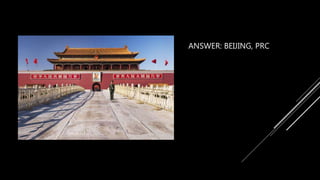
ANSWER: BEIJING, PRC
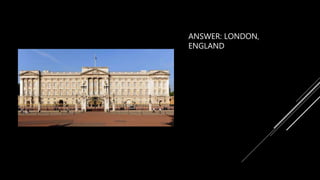
ANSWER: LONDON,
ENGLAND
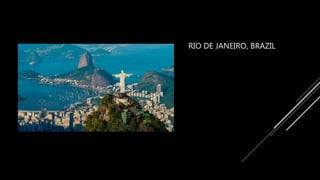
RIO DE JANEIRO, BRAZIL
SHIBUYA DISTRICT,
TOKYO, JAPAN
SEOUL, SOUTH KOREA
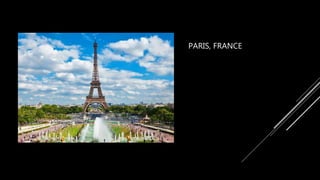
PARIS, FRANCE
DUBAI, UAE
ROME, ITALY
MOSCOW, RUSSIA
PYONGYANG, NORTH
KOREA
THE GLOBAL ELITE
GLOBAL CITIES: INDEX LEADERS

The global cities

  • 1.
  • 2.
    THE RISE OFTHE CITIES The term civilization come from the Latin word civis, meaning “a person living in a city.”
  • 3.
    THE RISE OFCITIES IS LINKED TO THE FOLLOWING FACTORS:
  • 4.
    Agricultural improvement that reducethe number of workers needed for food production.
  • 5.
    Stabilization of politicaland economic institutions, which enhance safety and distribution of goods and services.
  • 6.
    Improvements in the transportationand communication, which enhance trade and social interactions among large number of people.
  • 7.
    The rise ofindustrial and postindustrial economies, which demand concentrated populations to provide labor and services.
  • 8.
    URBANIZATION AND HUMANECOLOGY Urbanization refers to the movement of masses of people from rural to urban areas and an increase in urban influence over all spheres of culture and society.
  • 9.
    PATTERNS OF URBANDEVELOPMENT
  • 10.
    THE CONCENTRIC ZONEMODEL  Based on human ecology theory done by Burgess and applied on Chicago, it was the first to give the explanation of distribution of social groups within urban areas. This concentric ring model depicts urban land usage in concentric rings: the Central Business District (or CBD) was in the middle of the model, and the city is expanded in rings with different land uses.
  • 11.
    HOYT SECTOR MODEL Hoyt Model is somewhat similar to Burgess Model and is often considered as its improved version. Hoyt argued that cities do not develop in the form of simple rings, instead, they have “sectors.” Homer Hoyt in 1939 suggested that few activities grow in the form of sectors which radiates out along the main travel links. Activities in a sector are considered to be the same throughout the sector because of the purpose/function it serves.  Land use within each sector would remain the same because like attracts like. The high-class sector would stay high-class because it would be the most sought after area to live, so only the rich could afford to live there. The industrial sector would remain industrial as the area would have a typical advantage of a railway line or river. These sectors can be housing, industrial activities, etc. These sectors grow along railway lines, highways or rivers.
  • 12.
    MULTIPLE-NUCLEI MODEL  This modelis based on the structure of Chicago just like the Burgess model or Concentric zone model of 1925. It can be considered as an attempt to explain the structure of the city taking into account the complexity and growth over time. Harris and Ullman argued that a city might start with a single central business district (CBD), but over the time the activities scatter and gets modified. The scattered activities attract people from surrounding areas and act as smaller nuclei in itself. These small nuclei gain importance and grow in size and start influencing the growth of activities around them.
  • 13.
    METROPOLIS, MEGALOPOLIS, AND SUBURBS Metropolis is a large city or conurbation which is a significant economic, political, and cultural center for a country or region, and an important hub for regional or international connections, commerce, and communications.  Megalopolis a group of two or more roughly adjacent metropolitan areas, which may be somewhat separated or may merge into a continuous urban region.  A suburb is a mixed-use or residential area, existing either as part of a city or urban area or as a separate residential community within commuting distance of a city.
  • 14.
  • 15.
    The greatest problemfacing major cities is generating enough revenue to provide adequate services and protection for their residents. Most major cities raise taxes to compensate for shrinking revenues but this in turn encourages more residents and businesses to flee the city and locate in surrounding suburb.
  • 16.
    Urban decay hitsthe central city as major businesses move from the downtown area to more profitable suburban locations. Old buildings subsequently either remain vacant and deteriorate or become multiple-unit slum housing, low-rent hotels, “adult” bookstores, and theaters, center for drug distribution and other criminal activities, and repositories for the urban homeless.
  • 17.
     The centralcities have increasingly become the domicile of the poor. Although many of the poor reside in rural areas, the proposition of urban poor increased between 1980 and 1990. Much urban poverty is a result of growing urban underclass of poorly educated and unskilled minorities who lack the skills and education to make the transition from an industrial to service economy (Wilson, 1998).
  • 18.
    Urban problems continueto exist such as chronic unemployment, homelessness, violent crimes, alcohol and drug abuse, suicide, and other forms of deviance.
  • 19.
     Inner-city decay.Even if some city governments in global cities attempt to revitalize central cities by razing dilapidated buildings and replacing them with modern high-rise office buildings, apartment complexes, and condominiums, they could not contain the proliferation of street people, drug dealers, and prostitutes who do their illegal trades, especially night time.
  • 20.
    HUMAN ECOLOGY ANDENVIRONMENTAL CONCERNS IN GLOBAL CITIES The ecological perspective provides a theoretical model for analyzing the interdependence between human beings and the physical environment. In the case of human society, two of the most important ecological factors are growth in population and our ability to alter the environment through technology.
  • 21.
    OVERPOPULATION  Overpopulation threatensto bring about widespread starvation and avalanche of death. As population increases and urban areas expand, farmers are forced onto marginal lands. They may burn forest to grow crops or raise cattle on that land. Deforestation can result in over cultivation and soil erosion. Moreover, larger populations demand not only more food but also wood, petroleum, and other fossil fuels, electricity, water and other scarce commodities.
  • 22.
    DEPLETION OF NATURALRESOURCES Forest land around the globe is being destroyed at a rate of an acre every second and tropical forests are shrinking by 11 million hectares (over 27 million hectares) each year (Brown, L.R 1998; Gore 1992). Particularly disturbing is the fact that tropical forests, which cover only 7% of the earth’s surface, may house as much as 80% of the planet’s species (Linden, 1989).
  • 23.
    POLLUTION: WATER, AIRAND LAND  Pollution is now affecting almost every global city worldwide. Its most serious manifestations affect the three major givers of life: Water, Air, and Land. The three major sources of water pollution are domestic waste-water, industrial charges, and agricultural runoff (World Resources Institute, 1990). Urbanization creates a heavy concentration of human waste, which is usually discharged into sewage system that empty into nearby bodies of water. Unfortunately, other municipalities downstream often rely on those same bodies of water as their major supply of drinking water.
  • 24.
  • 26.
  • 27.
  • 28.
  • 29.
  • 30.
  • 31.
  • 32.
  • 33.
  • 34.
  • 35.
  • 36.
  • 37.
  • 38.
  • 39.