Chapter 9


Comparative Politics II
 Interest Groups, Political Parties,
           and Elections
Interest Groups


• Any collection of people trying to
  influence government
• Nonpublicly accountable
  organizations that attempt to promote
  shared private interests by
  influencing public-policy outcomes
Interest Groups Differ
from Political Parties
• Goals
  • Parties acquire power through elections
  • Interest groups focus on specific issues rarely
    represented in government
• Nature of memberships
  • Parties seek broad support
  • Interest groups have a narrower membership
• Numbers
  • Rarely more than 10-12 parties
  • No limit on number of interest groups
Who Belongs?

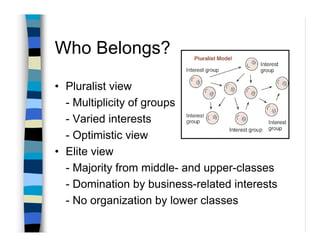
• Pluralist view
  - Multiplicity of groups
  - Varied interests
  - Optimistic view
• Elite view
  - Majority from middle- and upper-classes
  - Domination by business-related interests
  - No organization by lower classes
Interest Groups
and Government

• Interest groups presuppose an existing
  government worth trying to influence.
• As government grows, so do interest groups.
• Some interest groups take on government
  functions (corporatism).
• The bureaucracy has become one of the
  biggest and most powerful interest groups of
  all.
Big Money

• The single most important factor in interest
  group success
  • Danger: “the best Congress money can buy.”
  • Corruption (public office for private gain)
• Soft Money
  • Contributing to parties and interest groups not
    directly working for a candidate’s election
    campaign.
  • “If you don’t give, you get no access.”
• U.S. campaigns lengthy and costly
Political Action
 Committees
 (PACs)

• Set up specifically to contribute money
  to election campaigns
• Originally an idea of labor unions
• Biggest spending from business
• Bulk of contributions to incumbents
Interest Group Strategies
•   Approaching lawmakers
•   Approaching the administration
•   Approaching the judiciary
•   Appeals to the public
•   Demonstrations
•   Violent protest

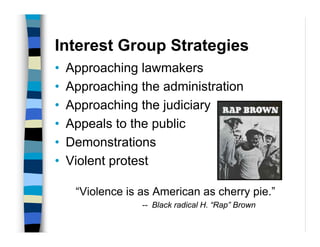
     “Violence is as American as cherry pie.”
                  -- Black radical H. “Rap” Brown
Finding a Balance

     Good of all
         vs.
  Good of particular
        groups

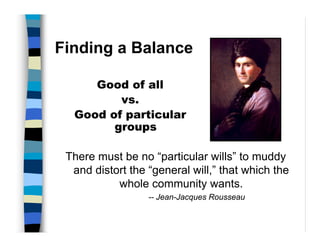
 There must be no “particular wills” to muddy
  and distort the “general will,” that which the
           whole community wants.
                  -- Jean-Jacques Rousseau
Political Parties
and Party Systems
Political Party
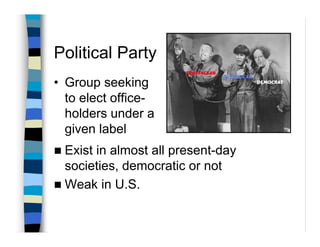
• Group seeking
  to elect office-
  holders under a
  given label
 Exist in almost all present-day
 societies, democratic or not
 Weak in U.S.
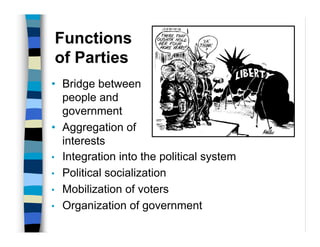
Functions
of Parties
• Bridge between
  people and
  government
• Aggregation of
  interests
• Integration into the political system
• Political socialization
• Mobilization of voters
• Organization of government
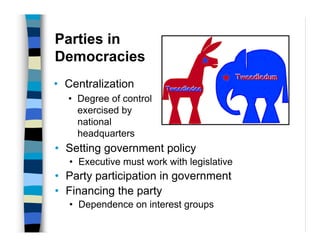
Parties in
Democracies
• Centralization
  • Degree of control
    exercised by
    national
    headquarters
• Setting government policy
   • Executive must work with legislative
• Party participation in government
• Financing the party
   • Dependence on interest groups
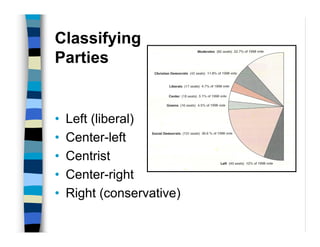
Classifying
Parties


•   Left (liberal)
•   Center-left
•   Centrist
•   Center-right
•   Right (conservative)
Party Systems
• One-party
    • Totalitarian
• Dominant-party
    • Opposition parties free to run, but rarely win
•   Two-party
•   Multiparty
•   Two-plus party
•   Fluid (or inchoate) party
    • New and unstable democracies
Parties and
Electoral Systems
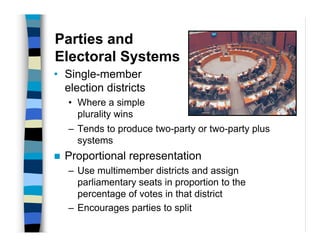
• Single-member
  election districts
   • Where a simple
     plurality wins
   – Tends to produce two-party or two-party plus
     systems
  Proportional representation
   – Use multimember districts and assign
     parliamentary seats in proportion to the
     percentage of votes in that district
   – Encourages parties to split
Types of Party
Competition
• Moderate pluralism
  • Center-seeking
  • Parties become
    moderate, aiming for
    large block of votes in
    center of political
    spectrum
  Polarized pluralism
  – Center-fleeing
  – Parties become extremist, ignoring voters in center
  – Can cause political unrest and civil war
Just because you don't take an interest in politics,
doesn't mean politics won't take an interest in you!
             Pericles - 430 BC (BCE)

"Regarding Government:
We call for the abolition
      of damn near
       everything;
  We call for drastic
   reductions in what's
           left;
And we refuse to pay for
        any of it!"
 Platform synopsis by David Nolan, LP
              Co-founder
Elections
Electoral
Systems
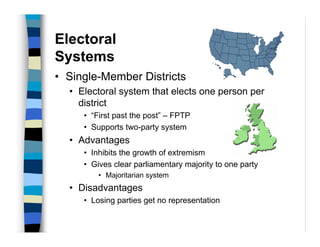
• Single-Member Districts
  • Electoral system that elects one person per
    district
     • “First past the post” – FPTP
     • Supports two-party system
  • Advantages
     • Inhibits the growth of extremism
     • Gives clear parliamentary majority to one party
         • Majoritarian system
  • Disadvantages
     • Losing parties get no representation
Electoral
Systems
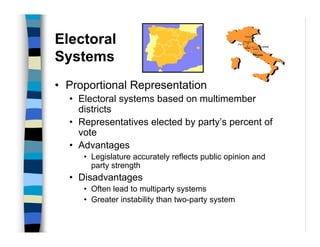
• Proportional Representation
  • Electoral systems based on multimember
    districts
  • Representatives elected by party’s percent of
    vote
  • Advantages
     • Legislature accurately reflects public opinion and
       party strength
  • Disadvantages
     • Often lead to multiparty systems
     • Greater instability than two-party system
Voter Turnout

• Percent of those eligible
  who vote
  • U.S. peak in 1960 – 63%
  • Sweden, Germany, Italy –
    90%
  U.S. turnout low historically
  Lower in U.S. than in other democracies
U.S. Nonvoting:
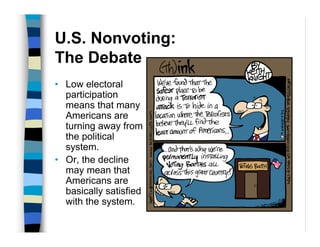
The Debate
• Low electoral
  participation
  means that many
  Americans are
  turning away from
  the political
  system.
• Or, the decline
  may mean that
  Americans are
  basically satisfied
  with the system.
How Do
People Vote?
• Long-term variables
  • Party identification
     • Tendency to associate mentally with one party over
       may years
     • Easier to vote along party lines
     • Important element in electoral stability
• Short-term variables
  • Cause a person to vote one way for one
    election, but not four years later.
     • “Morality factor” awakened by Watergate scandal
     • Economic conditions
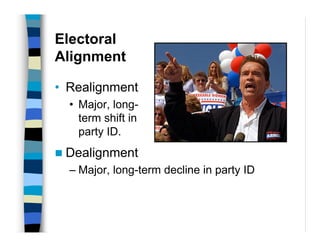
Electoral
Alignment

• Realignment
  • Major, long-
    term shift in
    party ID.
 Dealignment
  – Major, long-term decline in party ID
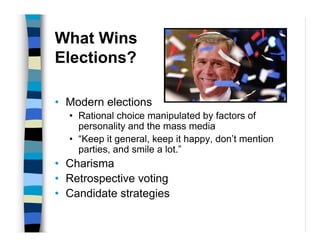
What Wins
Elections?

• Modern elections
  • Rational choice manipulated by factors of
    personality and the mass media
  • “Keep it general, keep it happy, don’t mention
    parties, and smile a lot.”
• Charisma
• Retrospective voting
• Candidate strategies
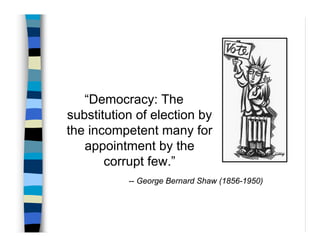
“Democracy: The
substitution of election by
the incompetent many for
   appointment by the
       corrupt few.”
           -- George Bernard Shaw (1856-1950)

Grigsby slides 9

  • 1.
    Chapter 9 Comparative PoliticsII Interest Groups, Political Parties, and Elections
  • 2.
    Interest Groups • Anycollection of people trying to influence government • Nonpublicly accountable organizations that attempt to promote shared private interests by influencing public-policy outcomes
  • 3.
    Interest Groups Differ fromPolitical Parties • Goals • Parties acquire power through elections • Interest groups focus on specific issues rarely represented in government • Nature of memberships • Parties seek broad support • Interest groups have a narrower membership • Numbers • Rarely more than 10-12 parties • No limit on number of interest groups
  • 4.
    Who Belongs? • Pluralistview - Multiplicity of groups - Varied interests - Optimistic view • Elite view - Majority from middle- and upper-classes - Domination by business-related interests - No organization by lower classes
  • 5.
    Interest Groups and Government •Interest groups presuppose an existing government worth trying to influence. • As government grows, so do interest groups. • Some interest groups take on government functions (corporatism). • The bureaucracy has become one of the biggest and most powerful interest groups of all.
  • 6.
    Big Money • Thesingle most important factor in interest group success • Danger: “the best Congress money can buy.” • Corruption (public office for private gain) • Soft Money • Contributing to parties and interest groups not directly working for a candidate’s election campaign. • “If you don’t give, you get no access.” • U.S. campaigns lengthy and costly
  • 7.
    Political Action Committees (PACs) • Set up specifically to contribute money to election campaigns • Originally an idea of labor unions • Biggest spending from business • Bulk of contributions to incumbents
  • 8.
    Interest Group Strategies • Approaching lawmakers • Approaching the administration • Approaching the judiciary • Appeals to the public • Demonstrations • Violent protest “Violence is as American as cherry pie.” -- Black radical H. “Rap” Brown
  • 9.
    Finding a Balance Good of all vs. Good of particular groups There must be no “particular wills” to muddy and distort the “general will,” that which the whole community wants. -- Jean-Jacques Rousseau
  • 10.
  • 11.
    Political Party • Groupseeking to elect office- holders under a given label Exist in almost all present-day societies, democratic or not Weak in U.S.
  • 12.
    Functions of Parties • Bridgebetween people and government • Aggregation of interests • Integration into the political system • Political socialization • Mobilization of voters • Organization of government
  • 13.
    Parties in Democracies • Centralization • Degree of control exercised by national headquarters • Setting government policy • Executive must work with legislative • Party participation in government • Financing the party • Dependence on interest groups
  • 14.
    Classifying Parties • Left (liberal) • Center-left • Centrist • Center-right • Right (conservative)
  • 15.
    Party Systems • One-party • Totalitarian • Dominant-party • Opposition parties free to run, but rarely win • Two-party • Multiparty • Two-plus party • Fluid (or inchoate) party • New and unstable democracies
  • 16.
    Parties and Electoral Systems •Single-member election districts • Where a simple plurality wins – Tends to produce two-party or two-party plus systems Proportional representation – Use multimember districts and assign parliamentary seats in proportion to the percentage of votes in that district – Encourages parties to split
  • 17.
    Types of Party Competition •Moderate pluralism • Center-seeking • Parties become moderate, aiming for large block of votes in center of political spectrum Polarized pluralism – Center-fleeing – Parties become extremist, ignoring voters in center – Can cause political unrest and civil war
  • 18.
    Just because youdon't take an interest in politics, doesn't mean politics won't take an interest in you! Pericles - 430 BC (BCE) "Regarding Government: We call for the abolition of damn near everything; We call for drastic reductions in what's left; And we refuse to pay for any of it!" Platform synopsis by David Nolan, LP Co-founder
  • 19.
  • 20.
    Electoral Systems • Single-Member Districts • Electoral system that elects one person per district • “First past the post” – FPTP • Supports two-party system • Advantages • Inhibits the growth of extremism • Gives clear parliamentary majority to one party • Majoritarian system • Disadvantages • Losing parties get no representation
  • 21.
    Electoral Systems • Proportional Representation • Electoral systems based on multimember districts • Representatives elected by party’s percent of vote • Advantages • Legislature accurately reflects public opinion and party strength • Disadvantages • Often lead to multiparty systems • Greater instability than two-party system
  • 22.
    Voter Turnout • Percentof those eligible who vote • U.S. peak in 1960 – 63% • Sweden, Germany, Italy – 90% U.S. turnout low historically Lower in U.S. than in other democracies
  • 23.
    U.S. Nonvoting: The Debate •Low electoral participation means that many Americans are turning away from the political system. • Or, the decline may mean that Americans are basically satisfied with the system.
  • 24.
    How Do People Vote? •Long-term variables • Party identification • Tendency to associate mentally with one party over may years • Easier to vote along party lines • Important element in electoral stability • Short-term variables • Cause a person to vote one way for one election, but not four years later. • “Morality factor” awakened by Watergate scandal • Economic conditions
  • 25.
    Electoral Alignment • Realignment • Major, long- term shift in party ID. Dealignment – Major, long-term decline in party ID
  • 26.
    What Wins Elections? • Modernelections • Rational choice manipulated by factors of personality and the mass media • “Keep it general, keep it happy, don’t mention parties, and smile a lot.” • Charisma • Retrospective voting • Candidate strategies
  • 27.
    “Democracy: The substitution ofelection by the incompetent many for appointment by the corrupt few.” -- George Bernard Shaw (1856-1950)