Relationship Marketing


  ANKIT ALREJA
ROLL NO. 808906320010
   SVIMT (SVIET)
INTRODUCTION
Relationship Marketing (or relationship
management) is a philosophy of doing
business, a strategic orientation that focuses
on keeping and improving current
customers rather than on acquiring new
customer.
What is relationship marketing?

  Marketing designed to create,
maintain, and enhance strong
relationships with customers
and other stakeholders.
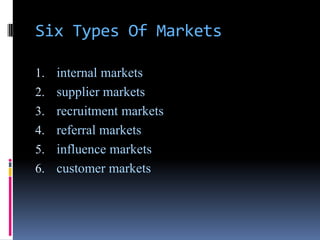
Six Types Of Markets

1. internal markets
2. supplier markets
3. recruitment markets
4. referral markets
5. influence markets
6. customer markets
Customer Lifetime Value

Losing an existing customer means
losing the entire revenue stream
that customer represents – not just
that single encounter or sale.
Attracting, retaining and
         growing customers

Customer delivered value – the difference
 between total customer value and total
 customer cost.
  Value includes product, services,
   personnel and image value.
  Cost includes monetary, time, energy and
   psychic costs.
Growing “share of customer”

 Increasing the share of the customer’s
  purchasing in your product category.
 Best way is through cross-selling
   Getting more business from current
    customers by selling them additional
    or complementary services
Managing your customers

 Relationship marketing is designed to
  create, maintain, and enhance strong
  relationships with profitable
  customers and other stakeholders.
 First need to define what your profit is
  on specific services…
How to calculate profit
 In most business:
  Gross income – (cost of goods + expenses)
    = net profit
 In healthcare:
  Reimbursement income – (cost of goods +
    expenses) = net profit
STRENGTHS OF RELATIONSHIP
       MARKETING
 Focus on providing value to customers.
 Emphasis on customer retention.
 it provides a better basis for achieving
  Competitive advantage.
 Long-term customers may initiate free word of
  mouth promotions.
 Long-term customers are less likely to switch to
  competitors.
 Happier customers may lead to happier
  employees
PROCESS

 Chart the service delivery system.
 Identify critical service issues.
 Set service standards for all aspects of service
  delivery.
 Develop customer communication systems.
 Train employees on building and maintaining a good
  relationship with clients.
 Monitor service standards, reward staff for
  exceeding service levels.
 Each employee fully understands the importance of
  quality and relationships in the marketing
  philosophy.
RESEARCH METHODLOGY
Meaning of Research:
Research Methodology is a way to systematically solve the research problem .


RESEARCH DESIGN:
It is a major plan specifying the method and procedure for collecting and
     analyzing the needed information. It is framework within which research will
     be conducted.
   It mainly includes following factors :
Means of obtaining the information.
Availability of time.
Availability of cost factor.
Skills of the researcher.
Sample size:
I interviewed 25 wholesalers & 25 retailers
RESEARCH OBJECTIVES


 To find out how organizations devise their
  relationship strategies.
 To find out the foundations for successful
  relationship marketing.
 To find out the correlation between
  customer & relationship strategies.
 To find determine the benefits of long term
  relationship for firms &customers.
SOURCES OF DATA COLLECTION

PRIMARY SOURCES:

 The primary sources will be
       Questionnaire through survey will be administered to
    the company managers .

SECONDARY SOURCES:

 Website and books will be used for obtaining data.
DATA ANALYSIS
      OR
INTERPERATION
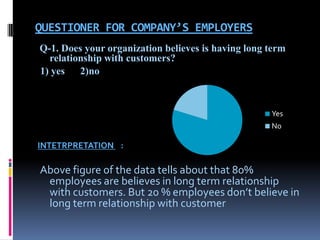
QUESTIONER FOR COMPANY’S EMPLOYERS
Q-1. Does your organization believes is having long term
  relationship with customers?
1) yes 2)no


                                                    Yes
                                                    No

INTETRPRETATION :

Above figure of the data tells about that 80%
 employees are believes in long term relationship
 with customers. But 20 % employees don’t believe in
 long term relationship with customer
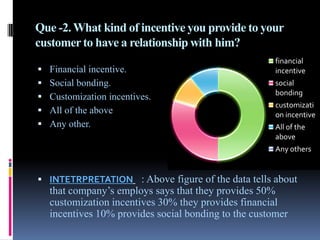
Que -2. What kind of incentive you provide to your
customer to have a relationship with him?
                                                       financial
   Financial incentive.                               incentive
   Social bonding.                                    social
                                                       bonding
   Customization incentives.
                                                       customizati
   All of the above                                   on incentive
   Any other.                                         All of the
                                                       above
                                                       Any others


 INTETRPRETATION : Above figure of the data tells about
    that company’s employs says that they provides 50%
    customization incentives 30% they provides financial
    incentives 10% provides social bonding to the customer
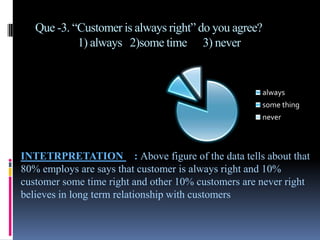
Que -3. “Customer is always right” do you agree?
            1) always 2)some time 3) never


                                                     always
                                                     some thing
                                                     never


INTETRPRETATION : Above figure of the data tells about that
80% employs are says that customer is always right and 10%
customer some time right and other 10% customers are never right
believes in long term relationship with customers
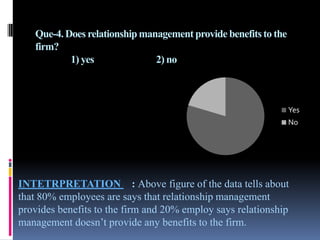
Que-4. Does relationship management provide benefits to the
   firm?
           1) yes              2) no


                                                                 Yes
                                                                 No


INTETRPRETATION : Above figure of the data tells about
that 80% employees are says that relationship management
provides benefits to the firm and 20% employ says relationship
management doesn’t provide any benefits to the firm.
LIMITATIONS:
 Study has been restricted to Punjab & Haryana
 Only and findings may not be reflect the true picture of
  users spread over entire nation.
 Sample size of 20 customer& 10 company’s employers
  has been taken due to time constraints which may be
  considered too small a sample to predict 100% results.
 Shortage of time is also reason for incomprehensiveness.
 The views of the customers & company’s employers are
  biased therefore it doesn’t reflect true picture
CONCLUSION
    The research was of customers & company’s
    employers attitudes towards the relationship
    marketing. Over all it was resulted in very interesting
    a positive attitude. This research has shown that the
    customers & company’s employers who are using the
    service have a higher level of satisfaction after
    consuming their needs. This research had shown that
    the keen interest of customers & company’s
    employers on this service of its good level, service.
    More over they want to take another new service like
    this in the future.

Relationship  Marketing  ppt 31

Relationship Marketing ppt 31

  • 1.
    Relationship Marketing ANKIT ALREJA ROLL NO. 808906320010 SVIMT (SVIET)
  • 2.
  • 3.
    Relationship Marketing (orrelationship management) is a philosophy of doing business, a strategic orientation that focuses on keeping and improving current customers rather than on acquiring new customer.
  • 4.
    What is relationshipmarketing? Marketing designed to create, maintain, and enhance strong relationships with customers and other stakeholders.
  • 5.
    Six Types OfMarkets 1. internal markets 2. supplier markets 3. recruitment markets 4. referral markets 5. influence markets 6. customer markets
  • 6.
    Customer Lifetime Value Losingan existing customer means losing the entire revenue stream that customer represents – not just that single encounter or sale.
  • 7.
    Attracting, retaining and growing customers Customer delivered value – the difference between total customer value and total customer cost. Value includes product, services, personnel and image value. Cost includes monetary, time, energy and psychic costs.
  • 8.
    Growing “share ofcustomer”  Increasing the share of the customer’s purchasing in your product category.  Best way is through cross-selling  Getting more business from current customers by selling them additional or complementary services
  • 9.
    Managing your customers Relationship marketing is designed to create, maintain, and enhance strong relationships with profitable customers and other stakeholders.  First need to define what your profit is on specific services…
  • 10.
    How to calculateprofit  In most business: Gross income – (cost of goods + expenses) = net profit  In healthcare: Reimbursement income – (cost of goods + expenses) = net profit
  • 11.
    STRENGTHS OF RELATIONSHIP MARKETING  Focus on providing value to customers.  Emphasis on customer retention.  it provides a better basis for achieving Competitive advantage.  Long-term customers may initiate free word of mouth promotions.  Long-term customers are less likely to switch to competitors.  Happier customers may lead to happier employees
  • 12.
    PROCESS  Chart theservice delivery system.  Identify critical service issues.  Set service standards for all aspects of service delivery.  Develop customer communication systems.  Train employees on building and maintaining a good relationship with clients.  Monitor service standards, reward staff for exceeding service levels.  Each employee fully understands the importance of quality and relationships in the marketing philosophy.
  • 13.
    RESEARCH METHODLOGY Meaning ofResearch: Research Methodology is a way to systematically solve the research problem . RESEARCH DESIGN: It is a major plan specifying the method and procedure for collecting and analyzing the needed information. It is framework within which research will be conducted. It mainly includes following factors : Means of obtaining the information. Availability of time. Availability of cost factor. Skills of the researcher. Sample size: I interviewed 25 wholesalers & 25 retailers
  • 14.
    RESEARCH OBJECTIVES  Tofind out how organizations devise their relationship strategies.  To find out the foundations for successful relationship marketing.  To find out the correlation between customer & relationship strategies.  To find determine the benefits of long term relationship for firms &customers.
  • 15.
    SOURCES OF DATACOLLECTION PRIMARY SOURCES:  The primary sources will be  Questionnaire through survey will be administered to the company managers . SECONDARY SOURCES:  Website and books will be used for obtaining data.
  • 16.
    DATA ANALYSIS OR INTERPERATION
  • 17.
    QUESTIONER FOR COMPANY’SEMPLOYERS Q-1. Does your organization believes is having long term relationship with customers? 1) yes 2)no Yes No INTETRPRETATION : Above figure of the data tells about that 80% employees are believes in long term relationship with customers. But 20 % employees don’t believe in long term relationship with customer
  • 18.
    Que -2. Whatkind of incentive you provide to your customer to have a relationship with him? financial  Financial incentive. incentive  Social bonding. social bonding  Customization incentives. customizati  All of the above on incentive  Any other. All of the above Any others  INTETRPRETATION : Above figure of the data tells about that company’s employs says that they provides 50% customization incentives 30% they provides financial incentives 10% provides social bonding to the customer
  • 19.
    Que -3. “Customeris always right” do you agree? 1) always 2)some time 3) never always some thing never INTETRPRETATION : Above figure of the data tells about that 80% employs are says that customer is always right and 10% customer some time right and other 10% customers are never right believes in long term relationship with customers
  • 20.
    Que-4. Does relationshipmanagement provide benefits to the firm? 1) yes 2) no Yes No INTETRPRETATION : Above figure of the data tells about that 80% employees are says that relationship management provides benefits to the firm and 20% employ says relationship management doesn’t provide any benefits to the firm.
  • 21.
    LIMITATIONS:  Study hasbeen restricted to Punjab & Haryana  Only and findings may not be reflect the true picture of users spread over entire nation.  Sample size of 20 customer& 10 company’s employers has been taken due to time constraints which may be considered too small a sample to predict 100% results.  Shortage of time is also reason for incomprehensiveness.  The views of the customers & company’s employers are biased therefore it doesn’t reflect true picture
  • 22.
    CONCLUSION The research was of customers & company’s employers attitudes towards the relationship marketing. Over all it was resulted in very interesting a positive attitude. This research has shown that the customers & company’s employers who are using the service have a higher level of satisfaction after consuming their needs. This research had shown that the keen interest of customers & company’s employers on this service of its good level, service. More over they want to take another new service like this in the future. 